Posts Tagged ‘The Big Bundle’

About Losing the Edgar

Tuesday, May 2nd, 2023

Before I discuss losing the Edgar, I want to mention a winning promotion from Thomas and Mercer on certain of my titles on e-book.
True Detective () and True Crime () (the first two Nathan Heller novels) will be offered at $1.99 via Mystery, Thriller & Suspense Kindle book deals in the US marketplace, starting 5/1/2023 and running through 5/31/2023. Also on sale at Amazon during that period are three titles by me and my buddy Matt Clemens – What Doesn’t Kill Her () ($1.99), Fate of the Union () ($.99) and Executive Order () ($3).

* * *
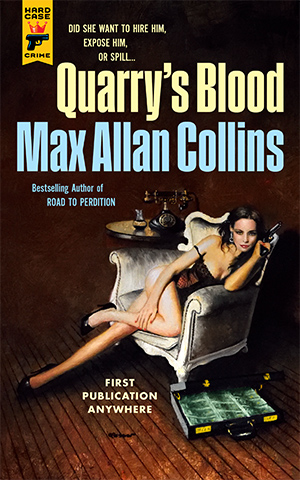
Quarry's Blood Cover
Trade Paperback: Bookshop Purchase Link Amazon Purchase Link Books-A-Million Purchase Link Barnes & Noble Purchase Link Target Purchase Link
E-Book: Google Play Kobo
Digital Audiobook: Audible Purchase Link

I, of course, did not win the Edgar for Best Paperback, but I assure you I was convinced I wouldn’t. I didn’t go to New York for the ceremony, which – if I thought I had a hootin’ chance in hell – I would have.

Quarry’s Blood is the 16th entry in a series that began in 1976 (actually 1971), and novels in long-running series almost never get nominated by the Edgars. Furthermore, the Quarry novels are perceived by more delicate readers as nasty, and they aren’t necessarily wrong. In any event, I am grateful to those of you who have made Quarry and me a cult success.

This experience – sitting at home, not even remembering that the Edgars were going on in New York while Barb and I watched a Star Trek: The Next Generation episode – was a very good one. Why? Because I have always taken awards too seriously. I have always wanted to win them, being naturally competitive, which has largely been a positive thing in my career, a driving force if you will.

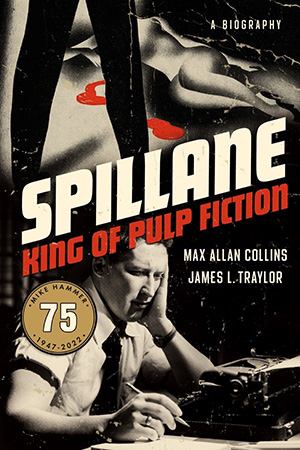
But at this ripe old age I now realize how meaningless awards are. Well, relatively meaningless. If Jim Traylor and I do not get an Edgar nomination for Spillane – King of Pulp Fiction, I guarantee you it will disappoint me. But if we don’t get an Edgar nomination, what is the difference, ultimately? Our Spillane bio is no less definitive and ground-breaking if it does not receive a nomination.

On the most basic level, I have looked at awards as the kind of validation that can keep me in business – much the same way good reviews can benefit a writer’s reputation. A wise soul once said, “If you believe the good reviews, you have to believe the bad reviews, too.” So I have never allowed myself to believe that an award, or a good review, is anything but an opinion, and a potentially useful sales tool. Awards don’t make me a good writer, nor do good reviews. Readers liking my work make me a good writer; editors liking my work make me a good writer; sufficient sales make me a good writer. Or anyway keep me in business.

My father was a respected, even beloved member of our small community (Muscatine, Iowa, has a population of around 25,000 residents). In the early ‘50s, he was the first high school music teacher to mount productions of Oklahoma and Carousel, attracting national attention (they were excellent productions, too). When he left teaching to go into industry as a personnel man, he hired hundreds of people in this community who loved him for it. At the same time he directed a male chorus (the Muscatine Elks Chanters) – for fifty years! – that won so many national championships that the competition was shut down and the Chanters were made the permanent champs. That chorus is gone now because my father is gone – he was their engine and a genius who could make any group of random men sound like a professional chorus.

When he passed, Barb and I stood looking at a wall of award plaques and a tabletop of awards representing all his triumphs and achievements. All but a handful went into the trash. We did not do this cavalierly, but realistically – where would we display them? Where would we store them? We selected the most important ones and the rest of these once precious items, we tossed.

I have – what is the polite term? – a shitload of awards on display in my office and the really important ones are in the living room. Of these, I think my family is likely to hold onto the ones I prize most highly – my Grand Master Edgar from the Mystery Writers of American and my three Shamus awards. Maybe my lifetime achievement from the PWA. Otherwise, it’s probably into the landfill with awards that at the time (and for some time thereafter) meant a lot to me.

Artists – and I am one – are always looking for validation, because the two inescapable facts about all artists (every damn one of them) is their insane confidence in the value of their work and their inner fear that they are frauds. Too much confidence, and no confidence at all. That is the cocktail from which every artist drinks.

If they say otherwise, they are lying, or about as reflective as a broken mirror.

You bet I would like to have won an Edgar for Quarry’s Blood. But I was lucky, incredibly lucky, for that kind of recognition for my fifty year-old series, which happens to be littered with sex scenes and carnage and sometimes black humor (in questionable taste). There were over 250 submissions for Best Paperback, and I made the cut.

Charles Ardai, my great editor at the great Hard Case Crime, insisted I write an acceptance speech, “just in case” (he, too, accurately felt the odds were very much against me).

Anyway, this would have been my acceptance speech (delivered by Charles):

“Quarry was created at the University of Iowa’s Writers Workshop in 1971. Looks like we both have finally graduated. My thanks to editor Charles Ardai (who did not insist I say this) for giving me the opportunity to revive this cult character. And also, for inspiration, to my late mentor Donald E. Westlake, who reminded me that a cult author is seven readers short of making a living.”

* * *

Paul Davis, who writes about crime fiction at the Washington Times, wrote an astonishing three pieces about Spillane – King of Pulp Fiction. This incredible attention was followed by a favorable reaction to the new Nate Heller novel (from Hard Case Crime), The Big Bundle. He interviewed me about it, and here it is:

A Private Eye Witness To History: My Washington Times On Crime Column On Max Allan Collins ‘The Big Bundle’

This interesting and insightful crime novel is about a fictional private eye traversing through a begone era and a true and once famous child kidnapping.

In “The Big Bundle,” Max Allan Collins’ 18th novel featuring Nathan Heller, the private detective appears alongside Robert F. Kennedy and Jimmy Hoffa, as well as historical crime and law enforcement figures involved in the real-life kidnapping of a millionaire’s son in 1953.

I contacted Mr. Collins and asked him to describe “The Big Bundle.”

“In many respects, it’s a private eye thriller in the tradition of Dashiell Hammett, Raymond Chandler and Mickey Spillane,” Mr. Collins replied. “I was moving to a new publisher, Hard Case Crime, and knew their audience was steeped in hardboiled fiction and might be put off by the famous crimes I usually look at in a Nathan Heller novel. The real-life case in ‘The Big Bundle,’ quite well known in the 1950s but forgotten now, allowed me to put the emphasis on the noir aspect of the Heller novels and not be accused of teaching a “history lesson.”

How would you describe Nathan Heller?

“Heller is a businessman who starts out in a small office where he sleeps on a Murphy bed and winds up with a coast-to-coast detective agency. He is not the typical Phillip Marlowe-style modern-day knight who would never take a bribe or seduce a virgin — Heller has done both and often indulges in situational ethics. Unlike most fictional private eyes, he marries (more than once) and is a father and had a father and mother and even grandparents. He ages with the years. At any age, Heller recoils at injustice in society and serves up rough justice when he feels it necessary. He not only knows where the bodies are buried, he has buried more than his share.”

Why have you written a series of crime novels based on historical events with a fictional character interacting with historical figures?

“Rereading ‘The Maltese Falcon’ for a college class I was teaching in the early 1970s, I noticed the 1929 copyright. I had a light-bulb moment: The St. Valentine’s Day Massacre was 1929 — Sam Spade and Al Capone were contemporaries! Instead of Mike Hammer meeting a Capone type, I could have Capone meeting a Mike Hammer type. It was a fresh way into a form that had gone stale,” Mr. Collins (seen in the bottom photo) explained. “What evolved, from the initial novel about Frank Nitti’s Chicago (“True Detective,” 1983), was Heller solving famous unsolved or controversially solved crimes, like the Lindbergh kidnapping, the Black Dahila murder, the assassinations of Huey Long and JFK. Often, I substitute him for a real detective involved in a case. Heller becomes a sort of ‘private eye witness’ to history.”

How did you research the history that you use in “The Big Bundle”?

“Less was available about the Greenlease case than with most mysteries Heller has tackled — both Amelia Earhart’s disappearance, the Roswell incident, required dealing with a staggering number of books and voluminous newspaper and magazine material. Only a handful of books about the Greenlease kidnapping existed to draw upon in “The Big Bundle.” But the political aspect — Bobby Kennedy and Jimmy Hoffa’s involvement in the aftermath of the ransom’s disappearance — meant referring to several dozen nonfiction works, as well as the usual newspaper and magazine articles, which the kidnapping itself also generated. The idea is that I prepare to write the definitive nonfiction book on a real crime or mystery. Then I write a private eye novel instead.”

Did you discover anything in your research that surprised you about the kidnapping and other elements you use in your novel?

“Automobiles were everywhere in the narrative, befitting the postwar boom in car buying and interstate travel. Key events took place at a famous no-tell motel, the Coral Court, outside St. Louis. A crooked taxicab company was caught up in the probable theft of half the ransom, and every criminal in the case seemed either to drive a Caddy or want to — purchased inevitably at one of the many Midwestern Cadillac dealerships owned by the kidnap victim’s father.”

Do you plan to continue the Nathan Heller series?

“Too Many Bullets” has been completed, with Heller present in the pantry at the Ambassador Hotel when Robert Kennedy was shot. It’s an open-and-shut case, supposedly, yet the research indicates otherwise. In many respects, the real story is like something out of Raymond Chandler: hit men, crooked cops, a crazy hypnotist, a duplicitous showgirl. That comes out in October, again from Hard Case Crime. There may be one more after that. The degree of difficulty here is high, however, and I just turned 75, so it depends on how well Heller and I hold up.”

* * *

CBR.com has this good article about the comic book roots of Mike Hammer.

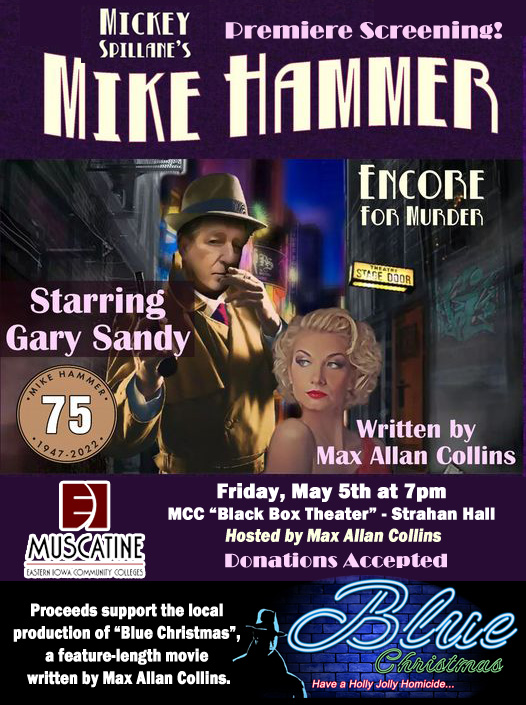
Encore for Murder Screening Info. Friday, May 5 at 7pm, in the MCC Big Box Theater, Strahan Hall. Donations accepted.

For those of you close enough to Muscatine, Iowa, to consider attending, here’s the info about the screening of Mickey Spillane’s Encore for Murder starring Gary Sandy this coming Friday, May 5.

And finally thanks to those of you who have contributed to the Indiegogo campaign for Blue Christmas, and I hope more of you will consider pitching. We’re just under $1700 (of the $5000 goal) with about a month left to go.

M.A.C.

Chain Book Stores, Indie Movies and Avoiding Real Work

Tuesday, February 14th, 2023
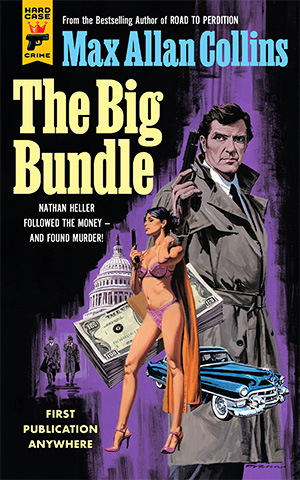
Big Bundle Cover
Hardcover:
E-Book: Kobo Google Play
Digital Audiobook:
Spillane: King of Pulp Fiction Cover
Hardcover:
E-Book: Kobo
Digital Audiobook: Kobo Libro.fm

Both The Big Bundle and Spillane – King of Pulp Fiction are now out and available, but I don’t seem to be getting much shelf space for either from the likes of Barnes & Noble and BAM! This despite starred reviews from Publisher’s Weekly and Booklist, and a very, very widely distributed positive review circulated by the AP. You don’t get much better press than this.

But our surviving book chains determine what they’re going to order by past sales of the author. Which does me no favors. I remain a cult author (yes, I’ll remind you that Don Westlake told me, “A cult author is seven readers short of making a living”) and these stellar reviews have arrived long after B & N and others have put in their orders.

So what is my point? If you see Bundle and/or Spillane at one of the chains, and buy it, tell the register jockey (and perhaps the help desk) that you are purchasing the last copy in the store of this very well-reviewed book. It may inspire them to order more.

What else can I do for Max Allan Collins today (a question I’m sure you ask yourself upon early rising, right after your exercise regimen)? If you won a book giveaway for either title, be sure to read the book soon and get a review in. If you are an unlucky soul who merely ponied up the dough for one of these titles at Amazon (or anywhere, really), post a review at Amazon and elsewhere if you’re truly dedicated to the cause of keeping me in business.

It is extremely undignified for me to beg, but I have never been particularly dignified. I wrote the song “Psychedlic Siren,” for Pete’s sake. But don’t think I’m complaining (though of course I am) because I am well aware of how blessed I am to have been able to avoid real work for over fifty years by telling elaborate lies known as novels and comics and film scripts. To play working man I have to reach back into bussing tables in high school and sacking groceries in college.

I don’t consider teaching “real work.” There’s not much heavy lifting in teaching, beyond lifting the aspirations of, in my case, high school graduates who hadn’t quite learned to read yet and were now in community college wondering why it’s a struggle.

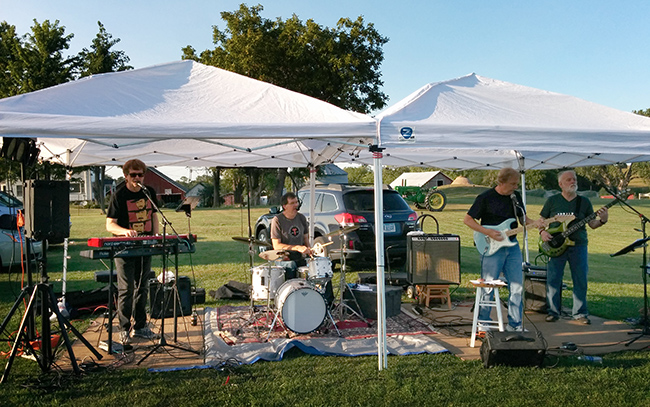
I don’t mean to dis community colleges, because I believe in them wholeheartedly and think going to the first two years of a four-year college is akin to setting your future earnings on fire, till that pesky student loan is paid off, anyway (which should only take a few decades). I am back at Muscatine Community College right now, working on a project (the Blue Christmas one) and am about to be feted as an MCC Legend (“feted” not “fetid”). I may have already mentioned this here, but I’m going to get a dinner and everything. My band was asked to play for it, but I stop short of honoring myself. That much dignity, shabby as it may be, I do have.

I want to thank all of you out there in Mystery-Fiction-Land who have responded so beautifully to these two new books – The Big Bundle and Spillane – King of Pulp Fiction, that is. Also to Kill Me If You Can, the 75th anniversary Mike Hammer novel (post reviews please!).

My partner in cinematic crime, Phil Dingeldein, and I are putting the finishing touches on the 75th anniversary expanded edition of Mike Hammer’s Mickey Spillane, my 1999 documentary. It’s jumping from 47 minutes to 61 minutes. We are in serious talks with Robert Blair at VCI Home Entertainment to bring it out on Blu-ray and DVD, and to include the film Chad Bishop and I put together of the Encore for Murder play we mounted last September. Gary Sandy has okayed its release, and it’s possible it will go out to the streaming services for their consideration. We’ve also entered the Iowa Motion Pictures Awards and the Cedar Rapids Film Festival, though we don’t know if we’re nominated for anything yet.

There’s a strong possibility we’ll be presenting Encore for Murder (the “movie”) on Friday, March 31, at Muscatine Community College. That would be the day after the Legends dinner. More later on that subject, but for those of you close enough to get to Muscatine, pencil in that date. It’ll be shown on a big screen in MCC’s “black box” theater.

Putting together Encore for Murder as a video presentation got my filmic juices flowing again (which I admit sounds kind of disgusting). Several of my fiction markets have fallen by the wayside – neither Thomas & Mercer nor Kensington seem even vaguely interested in me at this point, for example – so I find myself drawn back into indie film. I like the idea of low-budget (even micro-budget) filmmaking. Real Time: Siege at Lucas Street Market and Eliot Ness: An Untouchable Life had cash budgets under $15,000 each (though if I’d paid myself and Phil had taken any pay, and any number of other volunteers hadn’t gone along on the rides, we’d have skyrocketed to maybe $30,000 each).

Even the Mommy movies were under half a million – Mommy’s Day was under $200,000. Again, several of the key participants did not draw upon that budget.

What happened was the ten years I worked on indie films had me alternately learning the craft (on the job training) and then – after my producer stole all our Mommy 1 & 2 money – figuring how to operate on a micro-budget. This was followed by a lengthy attempt to get the sequel to Road to Perdition made. I wanted to direct my script of Road to Purgatory and we came very close a number of times. But it always fell through.

Now, at my advancing age, I know doing a big project is probably too challenging – too hard on me physically, post-heart surgery and stroke, and Barb had forbidden me going down that road, preferring me alive to dead (no accounting for taste). But working on a low-budget feature – despite the stresses even that level of filmmaking can bring – is more a doable proposition. The support I’m getting from Muscatine Community College had made all of that more manageable. Or it looks that way at this stage.

If indeed we get to make Blue Christmas – which we intend to – I will report the journey here.

And don’t you hate when people talk about their “journeys”?

* * *

We’re starting to put material together for seeking grant money and investors for Blue Christmas. Here’s the Demo Real put together by Chad Bishop.

* * *

I did a fun interview with the very smart Terrance Gelenter, who is based in Paris. And this is about as close to visiting the City of Lights as I’m likely to get in the near future….

* * *

Here is a Ted Hertel (wonderful guy) on The Big Bundle in the February 2023 print issue of Deadly Pleasures:

“One of the finest historical crime novel series being published today” Deadly Pleasures (Rating: A)
The Big Bundle by Max Allan Collins (Hard Case Crime, $22.99, December 2022) Rating: A

In 1953 six-year-old Bobby Greenlease is kidnapped. His wealthy parents call on the services of private investigator Nathan Heller, who had represented them in another matter some years earlier. Robert Greenlease insists on having the kidnapping of his son handled on his terms with as little interference from the FBI and police as possible. The kidnappers pick up the ransom, as scheduled, but Bobby is not returned. The kidnappers, however, assure the family that he’ll be back, safe and sound, within twenty-four additional hours. But then half of the $600,000 ransom disappears and things take a turn for the worse. Five years later Heller is called back to try to find the missing money. But Washington politics, Bobby Kennedy, and Jimmy Hoffa all manage to get tangled up with Heller’s efforts to help Greenlease once again.

All of the Heller novels are based in solid fact, thoroughly researched, with details of the characters and their eventual fates detailed at the conclusion of the story. Of course the real-life kidnapping of Bobby Greenlease is nowhere near as well-known as the 1932 abduction and murder of the Lindbergh baby. Heller had investigated that crime, as well, in Max Allan Collins’ Stolen Away (1992). In spite of the outcome of that case, he is once again entrusted with finding and returning a missing child to his parents.

Collins is a master (actually an MWA Grand Master!) at finding a plausible method of inserting his long-running fictional detective into the events of the day. He does this by using actual places, events and real people such as Kennedy, Hoffa, Chuck Berry, and Drew Pearson to add authenticity to the narrative. In doing so Collins immerses the reader in the 1950s’ era lifestyle. What’s even more remarkable is that he’s been doing this for forty years, since his 1983 debut Heller novel, True Detective.

If you’ve never read a Heller novel, don’t be discouraged by the fact that this is the eighteenth book (plus a number of short stories) in the series. The chronicles are not published in any specific order, moving around in time from the days of Capone and Nitti to Monroe and the Kennedys. But this one, the first from Hard Case Crime, is as good a place to jump in as any other. Then you’ll want to go back to the 1920s and start with that first one in what is one of the finest historical crime novel series being published today.

Ted makes an excellent point. I find that many mystery fans, who – like me – have a certain amount of OCD in their souls, are prone to wanting to read a series in chronological order.

I’ve touched on this here in the past, and I’m about to touch on it again. First of all, only the first four Hellers are in chronological order (and have done Hellers set within the parameters of certain books…Damned in Paradise, for example, takes place within the structure of Stolen Away). Second, if you only read my back list, then you risk putting me out of business.

If you have never read a Nathan Heller, start right now with The Big Bundle. You are big boys and big girls – you can handle coming in late. I keep things very clear for newcomers. No whipsaw effect in your brain is imminent. Imagine you are getting this advice from the guy in those Progressive commercials who is counseling new home owners who are in danger of becoming their parents….

* * *

Here is a dual interview with my co-author Jim Traylor and me about Spillane – King of Pulp Fiction. A shorter, somewhat different version appeared in Publisher’s Weekly.

The same web site, Bookreporter.com, also gives Spillane – King of Pulp Fiction a lovely review, right here.

M.A.C.

Bundle and Spillane Reviews – And Audio!

Tuesday, February 7th, 2023

For those of you who have never tried one of the three Reeder and Rogers political thrillers, written by Matt Clemens and me, the first of the trilogy – Supreme Justice – will be promoted via Mystery, Thriller & Suspense Kindle book deals in the US marketplace, starting 2/1/2023 and running through 2/28/2023. It will be available at $2.99 during the promotion period.

This is one of my bestselling books (the trilogy has sold in the hundreds of thousands) and a novel readers mention to me all the time. But readers of Nate Heller, Quarry and Mike Hammer sometimes skip these books. I think those readers would enjoy them.

Here’s another good review of Spillane – King of Pulp Fiction, although the reviewer questions whether I should be writing about Mickey since the Mick and I were friends. Apparently having an inside track is a bad thing….

The very smart and articulate Ed Catto has written a honey of a Big Bundle review at the Pop Culture Squad site. I will immodestly share it with you now:

The Big Bundle
By Max Allan Collins

It’s so good to start the year off with another Nate Heller thriller. Like so many in this series, this mystery is brilliant. It’s hard to believe, but about 35 years ago I stumbled across Max Allan Collins’ first story featuring Heller. I had enjoyed the Ms. Tree strip, written by Collins and illustrated by Terry Beatty and Collins’ Batman adventures (although not everyone did.)

Nate Heller is a fictional detective, a hero yet a flawed person full of many regrets, who typically gets involved with the biggest cases and personalities in the last 50 years. Collins has written stories where Heller gets involved with the gangsters who ‘created’ Las Vegas, the Lindbergh kidnapping, Marilyn Monroe’s death, Huey Long’s assassination and more. And just when you think Collins has exhausted all the good stuff, the next novel comes roaring back.

The latest historical adventure, The Big Bundle, has a lot of roar in it. This one focuses on the Greenlease kidnapping in the 50s. I didn’t know anything about this one, and I don’t know much about St. Louis’s history, despite visiting the city a couple of times. My trips there were nothing like Heller’s, though. He gets into it all in a way that turns what you thought was going to be a casual read into a “I can’t put this down” book.

These Heller books are meticulously researched with juicy details. I found myself pausing to run down little rabbit holes along the way. For example, Heller rides the historical landmark Angel’s Flight. It was described in such a way that I had to learn more about this narrow gauge funicular railway. When I’m reading, I usually like to leave my cellphone in the other room, but with this Heller mystery, I had to keep it handy for additional research. Collins tends to introduce me to so many fascinating places, events and people.

As a writer, Collins always finds innovative ways to describe people and settings. This is a crime thriller to be sure, but I often pause at the clever descriptions. For example.

The hero walks into a diner and Collins gives the reader something to think about and to remember: ”The bedraggled adults in booths and at tables were like predictions of how the town’s teens would turn out.”

Or earlier in the novel, as Heller meets a key character: “In his mid-thirties, my host was of average height and weight with a squared-off head and a rounded jaw, his forehead so high it was like his features had slipped down too far on his oval face.”

After reading a novel like this, my pal Mike Gold used to always make the joke “If you only read one Max Allan Collins novel this month, make it this one.” The gag still holds up and it’s truer than ever.

The only way I could get a better review is to write it myself…although actually I’m pretty hard on myself. If you want to read Ed’s review in context, go here.

While I’m wallowing in a self-congratulatory stew, here’s the fine Mystery Scene review (in its final newsstand issue – damnit!) of The Big Bundle:

The Big Bundle
Hard Case Crime, January 2023, $25.95
by Max Allan Collins

Opening in October 1953, Max Allan Collins’ 18th Nathan Heller adventure finds the middle-aged detective in Kansas City, consulting on a kidnapping, this time involving Bobby Greenlease, the 6-year-old son of multimillionaire auto dealer Robert Cosgrove Greenlease, Sr. Although Heller works with both the local police and the FBI, the case ends tragically, with the death of the child and half of the ransom money seemingly vanished.

Collins then fast forwards to August 1958, as Heller covertly investigates what happened to the missing ransom, at the behest of both Jimmy Hoffa and Robert F. Kennedy, who want to uncover the sordid truth about the tainted money.

Simply put, if you’ve enjoyed this series thus far, you’ll find plenty to like about Collins’ latest fictional foray, as, like previous installments, the story expertly interweaves fact and fiction in an entertaining and winning manner. If you’re new to the series, this is a great place to start, as it finds Collins at the top of his considerable game.

The author’s crisp writing and canny plotting, supplemented by his thorough and revealing research, are on ample display from start to finish. It’s an impressive piece of work, especially when you consider that this MWA Grandmaster, who has been at it for close to half a century now, doesn’t falter once.

Now let me give The Big Bundle my own good review – no, not my writing, but the reading Dan John Miller brings to narrating the book on the Recorded Books audio of the novel. On various car rides, Barb and I have been listening to it (we’re deep into the second of two sections) and are blown away by how much Dan “gets it.” He has read every Heller on audio to date, and he’s really become the voice of Nathan Heller. As I’ve said before, I don’t really feel like a Heller exists until I hear Dan John Miller read it.

Dan John Miller
Dan John Miller

Another great narrator who deserves kudos is Stefan Rudnicki of Skyboat, who has taken over the unenviable task of stepping into Stacy Keach’s shoes in reading the Mike Hammer novels. He is also Quarry these days, and Skyboat’s Gabrielle de Cuir has just completed reading Fancy Anders for the Boys. Stefan and Gabrielle’s production of Fancy Anders Goes Hollywood is wonderful – with sound effects and music – so I expect great things.

Stefan Rudnicki
Stefan Rudnicki
Gabrielle de Cuir
Gabrielle de Cuir

And speaking of Fancy Anders, you can now pre-order the second book (as a trade paperback, e-book and audio), right here. Fancy Anders For the Boys finds her working undercover on a murder case at the movie star-flung Hollywood Canteen.

* * *

Two documentaries, streaming right now, are worth your time, particularly if you’re interested in the history of pop and rock music.

Joan Jett
Joan Jett

The Joan Jett documentary, Bad Reputation (2018), looks at the phenomenal rocker whose story is a fascinating bumpy ride, starting with the Runaways and continuing up to her Rock ‘n’ Roll Hall of Fame induction. The tough road any rock artist trods is even tougher for women, and the sacrifices a road warrior takes on personally are a constant undercurrent. Excellent doc. It’s on Hulu and Prime Video, among others (and in some theaters).

Dionne Warwick
Dionne Warwick

HBO Max is perhaps best known right now for what it’s dropping (and not as in new programming “dropping,” but in the where-the-hell’s-the-content sense). But right now they have an excellent Dionne Warwick documentary – Don’t Make Me Over – which is a loving but unflinching look at this amazing artist. What became readily apparent to me was how Warwick coming together with the team of Burt Bacharach and Hal David was one of the most fortunate collaborations in the history of popular music – that neither the singer nor the songwriters would not likely have had the enormous pop cultural impact without each other. Like Joan Jett, Warwick is a strong, opinionated woman who used her position in the music industry to do good things for humanity…and never in a self-serving manner. I found this documentary extremely moving and highly recommend it.

M.A.C.

Spillane Giveaway, Bundle Sex & Errors, and Good Reviews!

Tuesday, January 31st, 2023

Yes, it’s another book giveaway!

This time it’s Spillane – King of Pulp Fiction by James Traylor and me (published by Mysterious Press). I have ten copies available – eight hardcovers and two trade paperback-style Advance Reading Copies. [All copies have been claimed. Thank you!–Nate]

Is it worth reading?

Here’s what the Wall Street Journal thinks:

Mickey Spillane, in the role of his creation Mike Hammer, on the set of “The Girl Hunters” (1963) with co-star Shirley Eaton.
PHOTO: POPPERFOTO VIA GETTY IMAGES
‘Spillane’ Review: He Nailed Mike Hammer
By Michael Saler

Mickey Spillane knew how to make crime pay, and he transformed the American publishing industry in the process. Between 1947 and 1952, his first six novels featuring private investigator Mike Hammer, a sadist with a heart of gold, sold millions of copies in paperback—bringing legitimacy to the fledgling format. Spillane’s global sales now exceed 200 million.

His recipe for success appeared simple. Mix racy innuendo (“She was oozing out of a bikini suit like toothpaste out of a tube”) with graphic violence (“I snapped the side of the rod across his jaw and laid the flesh open to the bone”); season with stereotypes and vivid prose; knead these raw materials into a propulsive plot pitting good versus evil. Et voilà: “The chewing gum of American literature,” as Spillane cheerfully admitted. Many critics of the time, repelled by his vigilantism and sensationalism, condemned his books as nasty, poor, brutish and not short enough. Others found that Hammer’s sincere conviction exerted a powerful spell.

Noir fans know a lot about Mike Hammer, but who was Mickey Spillane? Max Allan Collins and James L. Traylor are Spillane experts who have championed the author’s works since the early 1980s. Mr. Collins, a noted crime writer, also collaborated with Spillane and has been completing drafts left by Spillane upon his death in 2006. The biographers concede their partisanship but avow they have been “hard-nosed” about their hard-boiled subject. “Spillane” is an engaging, capacious and largely celebratory account, presenting the writer, his works and their multimedia adaptations as worthy of serious consideration.

Spillane was born in 1918, the only child of a Catholic father and Protestant mother. Religion would play a significant role in his life: He became a Baptist, like his first wife Mary Ann, whom he married in 1945; in 1951 he converted to the Jehovah’s Witnesses. His biographers suggest that Hammer’s Old Testament, “eye-for-an-eye” justice is partly beholden to Spillane’s religious outlook. As a youth, however, Spillane may not have been devout; he loved adventure and crime fiction and claimed to have published short stories under pseudonyms soon after graduating high school. He left college after two years to join the nascent comic-book industry in New York City, honing his skills by scripting early adventures of Captain America and other crime fighters.

Spillane spent World War II stateside as a flight instructor. His biographers believe he suffered “survivor’s guilt,” which may have contributed to the macho postures he shared with Hammer. After the war he also came to loathe cities and their immoral, high-rise-residing “cliff-dwellers.” Needing money to build a house in the country, Spillane transformed an unsold comic story about “Mike Danger” into “I, the Jury” (1947), which introduced Mike Hammer as a traumatized combat veteran who relishes dispatching killers by employing their own methods. The book sold modestly in hardcover but proved a sensation in paperback, appealing especially to veterans accustomed to reading comics and “Armed Services” softcover editions during the war. Paperbacks had hitherto consisted of reprints; Spillane’s sales convinced publishers to issue original works—a sea change in the industry.

The authors find that the early Hammer novels portray a conflicted protagonist remaking his moral compass. In “One Lonely Night” (1951), Hammer searches for his own identity alongside that of the murderer. He concludes that God has fashioned him as a monster for the greater good: “I was the evil that opposed other evil, leaving the good and the meek . . . to live and inherit the earth!”

After reaching unprecedented popularity by 1952, Spillane ceased writing novels for a decade. Previous commentators assumed he was occupied with, and perhaps inhibited by, his new religion. But the authors suggest that his silence owed as much to his wealth and the distracting hobbies it permitted; he had also sold the film rights to his hero and was biding his time, waiting to reclaim them.

When Spillane returned to writing novels in 1962, with “The Girl Hunters,” his narratives were more polished but lacked the manic energy of earlier works. By this time, both Spillane and Hammer had become pop-culture touchstones. The author would portray Hammer in the 1963 film version of “The Girl Hunters,” and subsequently blurred the line between himself and his hero. Spillane divorced in 1962, marrying again in 1964. His second wife, Sherri, was half his age, a model who played the “doll” alongside Spillane’s public appearances as “the living embodiment” of Hammer. Spillane even assumed the Hammer persona for Miller Lite Beer commercials, a campaign that continued from the 1970s through the 1990s. The genial Spillane and the grim Hammer became coterminous in the public mind, leaching certain dark undercurrents from the fictional character.

“Spillane” emphasizes the gentler side of its subject, only fleetingly considering the charming writer’s crueller opinions and actions. Yet Mr. Collins does recall a frightening instance he witnessed in 1992. Spillane’s home had been burgled and the author, gesticulating with his fists, “told me vividly what he’d like to do to the thieves.” Then the squall subsided. “But I’m not like that anymore. I don’t do that now.”

The biography concludes on such grace notes. After an acrimonious divorce from Sherri, Spillane married for a final time, doting on his wife Jane and her two daughters. He continued to write bestsellers in multiple genres and attained literary honors, including a belated “Grand Master” award from the Mystery Writers of America in 1995. In language consonant with Spillane’s themes, author Donald E. Westlake saw this as “redemption” for a writer long considered a “pariah” among his peers.

Mr. Saler is a professor at the University of California, Davis.

Spillane: King of Pulp Fiction cover
Hardcover:
E-Book: Kobo
* * *

Here is a lovely and insightful Big Bundle review from borg’s C.J. Bunce (that doesn’t mean I don’t have a few quibbles).

Author Max Allan Collins doesn’t let up and neither does his A-1 Private Detective Agency hero Nathan Heller. His client list is one-of-a-kind, including the likes of Clarence Darrow, Amelia Earhart, and Dashiell Hammett. After 17 novels and three collections of short stories, Heller, the “P.I. to the stars” is back in The Big Bundle, an all-new 1950s crime story from Hard Case Crime, available for pre-order now here at Amazon. The first of two historical crime novels from Collins tying in a fictionalized version of Robert F. Kennedy, the story brings together again that classic 1950s triangle: RFK’s Congressional racketeering committee efforts, Jimmy Hoffa’s role in the labor movement and his questionable cohorts, and the antics of low-and mid-level members of the Mafia. But that’s really only the background for a real-life kidnapping that took place in Kansas City in 1953, and Heller, once handpicked by Lindbergh to find the villains in the case of his own missing son, is brought into another similar, gut-wrenching case. His first client was Al Capone. Frank Nitti was his father figure. His best friend was Eliot Ness. But that’s in the past when Nate Heller’s next story begins.
Collins and his well-dressed hero are in prime form–this is one of those Collins novels that one-ups his own famous Road to Perdition, blending in some nasty villains straight out of Quentin Tarantino’s From Dusk Till Dawn. His expert storytelling investigates whether or not bad guys have a code, and how much they’ll stick to that code when big money is at stake. Heller comes across bad cops, cops that are just bad at being cops, street thugs, minor and major mobsters, organized labor leaders, politicians, and just plain evil people with no soul. They all say the same thing: “I’d never touch that kind of blood money.” So who is lying and who is telling the truth?

The real-life facts are on the record, but if you believe an event 70 years ago can remotely be a spoiler to talk about, move along and come back after you’ve read the novel, but just note that the story isn’t the reason to read the novel–it’s Collins’ storytelling.

Keeping with his four-decade-long series, Heller sounds like a real person, but he’s not. Heller is Collins’ fictional private detective who has clients of every ilk, but notably each novel features Heller’s exploits with a famous celebrity or historical event–Heller this time has many clients, often with conflicting agendas. In The Big Bundle that includes RFK, Hoffa, and Kansas City multi-millionaire Robert Greenlease, Sr. It’s Greenlease whose six-year-old son Bobby was walked out of a Catholic school by a woman pretending to be his aunt, never to be seen again, as part of an infamous, nationally-reported kidnapping in 1953. A drug-addicted and alcoholic couple from St. Joseph, Missouri–a “Bonnie and Carl,” Bonnie Heady and Carl Hall–were sent to the gas chamber for their crimes, Heady notably as only the third woman ever killed by the federal government, following Lincoln assassination conspirator Mary Surratt and the convicted spy Ethel Rosenberg.

Greenlease, a wealthy Cadillac dealer, paid $600,000 to the kidnappers, the largest ransom ever paid at the time. Only $288,000 of the ransom was recovered by authorities. Collins breaks the story into what reads like two separate books. The first covers Heller as one of the shadowy figures that was brought in (as happened in real life) to help sleuth out the kidnappers and hopefully save the boy in time. The second follows Heller as he’s tapped by multiple factions to leverage his underworld relationships–many via characters introduced by Collins in his previous twenty-plus stories.

Collins makes a good effort upfront and in an afterword to make it clear how the events have been altered for storytelling purposes. Heller is an interesting storytelling device, a bit of a time traveler that didn’t exist that is thrust into these historical events as our tour guide. It works, but Heller’s voice may strike fans of Collins’ other voices, like Mike Hammer (who he shares with Mickey Spillane), Quarry, and Nolan, as the furthest away in style and manner. Without reading his past exploits it’s not clear why Heller can afford to be so confident. He strides into situations where others are getting killed for doing much less, and yet he walks out clean–like a protagonist in a slasher film.

The Big Bundle is a noir crime novel, so Collins splices in his dark hero getting a piece of the physical action, like getting beat-up by thugs, and also with the femme fatale/good-bad girl types, including a few sex scenes that seem a little too steamy for a plot about a real-life child kidnapping. But that may just be a matter of personal taste.

Collins’ use of real people gives this novel a cinematic feel in the vein of Oliver Stone, especially his JFK, and David Mamet’s Hoffa. The story shuffles back and forth from the real and fictional somewhat better than in the recent movie based on real facts, Amsterdam. Readers who are fans of The Untouchables will find the setting familiar, and St. Louis and Kansas City is a great undertapped (and the real-life) 1950s venue for a major work like this. Collins’ exhaustive research into the nooks and crannies of every bar, diner, and seedy hotel is evident. The approach reminded me at times of former Kansas City Star reporter Giles Fowler’s non-fiction work Deaths on Pleasant Street. It also plays out like another D.B. Cooper rabbit hole for federal investigators.

Paul Mann creates a very good spin on Heller as he might have been portrayed by Robert Lansing for his painted cover art.

The Big Bundle should land as a major work for Collins, and that’s saying a lot for someone who is so prolific. It’s prime for a movie, complete with a dozen odd characters to be filled by your favorite character actors. This is a must for all noir crime readers, fans of Collins and his detective Heller (especially his 1991 novel Stolen Away), 20th century crime stories found in the movie The Changeling and in the books In Cold Blood, Union Station, and A Bloody Business. Pre-order The Big Bundle in hardcover now in its first-ever publication here at Amazon, scheduled for arrival next Tuesday, January 24, 2023.

Big Bundle cover
Hardcover:
E-Book: Kobo Google Play
Digital Audiobook:

You could hardly dream of a better review than this, and seldom have I seen Heller analyzed better. Here’s where I take slight issue. (In addition to disliking David Mamet’s work and walking out of Amsterdam.)

This very generous reviewer expresses that now standard modern-day complaint about “steamy sex scenes.” The current attitude toward sexual content in tough mysteries is something I understand but don’t tolerate. I grew up reading books that were supposed to be racy and then the sex scenes always petered out (excuse the expression). During my college years, when I developed as a writer, the creative atmosphere was impacted by the sexual revolution – pubic hair in Playboy, Deep Throat playing at respectable theaters, soft-core sex scenes in mainstream movies. The idea of heterosexual men objecting to sexual content still bewilders me. When Heller and Hammer and Quarry (who are men of their time) notice the physicality of a woman, they are admiring them, not objectifying them, though admittedly sizing them up; and if men today tell you they do not notice a woman’s pretty face or shapely form, they are either lying or nuts.

In The Big Bundle, a real-life prostitute figures. In part one she tries to seduce Heller, who sends her packing, as he is depressed as hell about this kidnapping (he has a six-year-old son himself). Five years later, he does succumb in a very character-driven sex scene that to me isn’t terribly sexy.

There was very little sexual fun-and-games-type content in the previous Heller, Do No Harm, because neither Heller nor I were comfortable, due to the sex-crime aspect of the murder.

This reviewer rightly says, “It’s a matter of taste,” and I agree. But what in art isn’t?

Heller is indeed a device, a window through which to look at these crimes and mysteries. I try to make Heller as real as I can, and frankly think he’s far more real than most fictional private eyes, despite the historical baggage I make him lug around. When he gets the shit beat out of him, he bleeds and has to recover. He’s been known to fart. One well-known private eye writer criticized me for having Heller take a bribe; another for Heller using a condom. Part of what I was up to with Nate Heller was to make him, on some level, a real guy – which is why he starts out sleeping in his office and works his way up to a coast-to-coast operation. Which is why he marries (more than once) and has a son he loves very much.

In the first Heller, True Detective (1983), I set out to have my detective break every one of Raymond Chandler’s “Down These Mean Streets” rules. And Heller did that very thing, including deflowering a virgin.

I in no way mean to beat up on this reviewer, who did a splendid job; he actually understands what I’m up against, and I am very grateful for a writer this perceptive taking a look at my work. And a good critic, like this one, can see things, perceive things, in fiction writers’ work that the they might well miss, being too close to the material to detect the not necessarily obvious.

I have been accused, properly I think, accurately I’m afraid, of being thin-skinned. Just this week a longtime Heller reader, and a former bookshop proprietor, wrote a lengthy e-mail and sent it to me and to my editor/publisher about some errors in The Big Bundle.

Now, if you’re a regular reader of mine you may recall that in my bibliographic afterword I always state: “Despite its extensive basis in history, this is a work of fiction, some liberties have been taken with the facts, and any blame for historical inaccuracies is my own, mitigated by the limitations of conflicting source material.”

I responded to this reader in a manner that I think was polite and even friendly, answering each of the reader’s points individually. About half of them had to do with a small town that is mentioned but does not figure in the narrative in a major way. Another cited error was a possible numerical typo, but the rest I just didn’t agree with – for example, the FBI couldn’t know a state line had been crossed until they captured the perps and knew that those perps had in fact crossed a state line.

This reader grew up in the area where the book is set, and of course I did not grow up in the twenty-plus areas where Heller’s novels and short stories take place. From my point of view, this individual was lording it over me for not knowing things he did, as a local resident (as opposed to my book and Internet research).

I don’t think my irritation was obvious in my response, although I would have preferred he would have written me and not ratted me out to my editor/publisher. His response was lengthy and indignant, letting me know he was no longer a fan and would get rid of all my books in his collection, now that he had discovered that he couldn’t trust the details in my books.

As it happens, I dug deeper into the “errors” – about half of them I still do not consider errors. But I learned, after some effort, that there were two small towns, in Missouri and Kansas respectively, that shared the same name. That’s where the confusion came from, and my letter-writer didn’t seem to know that, either…or at least didn’t make that clear. The numerical address that he pointed out to me turned up in two ways in my research, and I have corrected that – and the small-town confusion – for the paperback edition. It shouldn’t cause you any problems reading the hardcover edition. This is minor stuff, but I still like to have it correct.

Look. I know readers just want to be helpful, in pointing our errors, and they are in fact being helpful when they do. I have made corrections in subsequent editions any number of times. But acting like you found a prize in the Cracker Jacks or being gleefully superior about it does not make you popular with the writer. In this case, the writer of the e-mail probably spent at most an hour on his missive, and likely much less. I spent six months writing The Big Bundle. It’s only natural I am irritated when someone seems to play “Gotcha” with me.

One of the reviewers I respected most, and who was a big supporter of mine – Jon Breen, for years the regular reviewer at EQMM – always gave Heller great reviews, if necessarily brief because he was writing a column, not a single review. Yet he always found time and space to list one or two things I got wrong.

Like I said, I am probably overly guilty of being thin-skinned. In reality, I try not to believe reviews – whether good, bad or in between – and only look at them from the aspect of whether they will help sell books or not (obviously, the bad reviews are not helpful sales tools!). I wish I had a better attitude about this, but it’s doubtful I will change.

The critic who is toughest on me is me. That’s why if you point out an error in a book of mine, I react negatively, even emotionally. Because I am mad at myself for making a mistake. I hate getting the history wrong (unknowingly – sometimes, of course, I “adjust” it for the sake of a story).

Two things I would ask the likes of my ex-reader/former bookseller error spotter: try to remember that my books are fiction; and that I am human.

* * *

Here’s a You Tube video about one reader’s Top Ten books written by me.

The Big Bundle is one of ten new books Crime Reads recommends.

CBR says Road to Perdition is one of the most faithful comic book movies.

Here’s a terrific review of Spillane – King of Pulp Fiction from the great Ron Fortier.

Finally, this excellent video review of the graphic novel, Road to Perdition.

M.A.C.