Posts Tagged ‘Reviews’

A Unique Take on Return of the Maltese Falcon

Tuesday, May 5th, 2026

I had a lovely and really interesting e-mail about Return of the Maltese Falcon I’d like to share with you…and the e-mail writer has given me permission to do so, including her review of the novel.

Dear Max Allan Collins,

You have earned yourself a new fan. I loved Return of the Maltese Falcon.

Several years ago, I convinced my local Big Read committee to adopt The Maltese Falcon for their community wide project. I was a teacher, and I wanted my students to love all genres of classic lit as much as I do. The closest thing we had to The Maltese Falcon in our curriculum was Edgar Allan Poe short stories. Those are great, but I wanted them to read something more modern, too.

My students studied the novel and then hosted a successful community event where they shared their Maltese Falcon-related research to the public in interactive presentations. That project continues to be one of my most favorite teaching moments.

Thank you for revisiting this fun story. I recently reviewed it on my Substack page. I hope you have time to check it out. It’s linked here.

Thanks again for all your stories.

Oh, one more thing. I watched your YouTube video and picked up several writing tips. You are an inspiration.

Deborah Linn McNemee
KeepingClassics.com

Now here is Deborah’s really unique take on my novel.

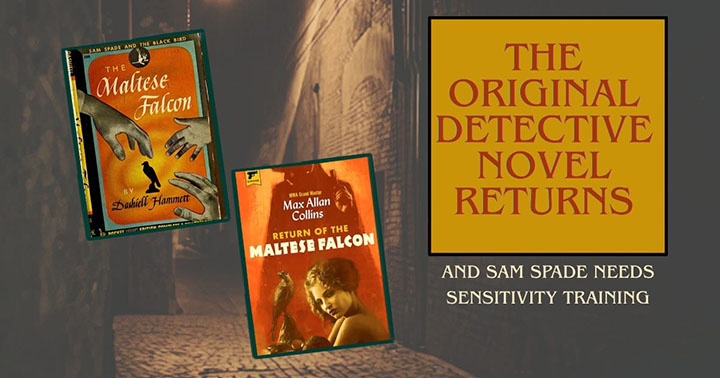
It’s 2026 and Sam Spade Needs Sensitivity Training
How Max Allan Collins Nails a Sexist Detective
in Return of the Maltese Falcon

Deborah Linn McNemee
Apr 27, 2026

Sam Spade is a sexist pig.

We know this, right? He’s been a sexist pig since 1939. A good mystery is timeless, but we all can agree a man like Spade should leave his sexist behavior in the past.

Or maybe not because earlier this year, MWA Grand Master Max Allan Collins brought him back, problematic attitude and all, in the much anticipated Return of the Maltese Falcon. Collins has earned the title of MWA Grandmaster from a lifetime of great writing, such as Road to Perdition, and his work on well-known series like Dick Tracy, Mickey Spillane’s Mike Hammer, and even the Batman comic book.

Sam Spade was originally brought to literary life by Dashell Hammett in the 1930 classic detective novel, The Maltese Falcon. Sam Spade became the template for all the cynical, hard-nosed detectives that came after him. As problematic as these womanizing anti-heroes are, the biggest problem of all is that we like them, especially Sam Spade.

I’ll give you a moment to gasp and fan your face. You know it’s true. Readers, and probably the general public, love a bad good guy, especially when paired with a femme fatale and a wisecracking secretary who calls him out.

But–and it’s a big but–today’s culture will cancel writers for creating these characters just to make ourselves feel righteous.

If I weren’t already salivating at the thought of a sequel to Dashiell Hammett’s The Maltese Falcon, I would have picked up Collins’ book simply out of cancel culture curiosity. How would Collins handle writing a womanizing, sexist character like Sam Spade and a setting like 1928 San Francisco for someone reading him in 2026?

I am an author of retellings, so I know the dilemma. In my current work in progress, I’m navigating one of Mark Twain’s characters, Joe. You know him with the proper adjective Injun placed in front. The retelling needs the character and his storyline. It definitely does not need the moniker. It’s not a name I would ever consider using. It would never pop into my author brain, but it’s in the original. It must be dealt with. It’s delicate work to honor the character and the writing and not insult my readers or myself.

So how does Collins deal with one hundred year old norms? Brilliantly. He nails the sexist detective. And he does it with the help of a woman.

Return of the Maltese Falcon starts two weeks after The Maltese Falcon ends. Brigid O’Shaughnessy and Joe Cairo are languishing in jail for murder, double-crossing, fraud, and a myriad of other shady behaviors. Sam Spade, with his blonde Satan-esque face, is seated at his desk, considering a Christmas tree standing where his former partner’s chair used to be. It was erected by Effie Perrine, his secretary, who enters on cue with her “thin tan woolen dress” clinging to her as her heels clack on the linoleum floor.

We’re barely off page one and the only femme who’s not fatale is already having her way with Sam Spade. He’s not crazy about the holiday decor, but, in some ways, he’s crazy about Effie Perrine, so the tree stays. He knows this and doesn’t fight it as lights and tinsel and ornaments show up throughout the book.

Collins doubles down on Perrine’s power by giving her the last dig in this opening repartee. Perrine introduces Spade to a new client, Miss Smith, saying, “‘You’ll like her…She’s female and young.’”

Okay, so we like Effie Perrine. She is spunky and smart and takes Spade’s machismo in stride. But what about Spade? How does Collins nail him? And why do we like it that he does?

Writers of retellings have the benefit of ready made descriptions. In a Cereal at Midnight YouTube interview, Collins explains that even though Sam Spade has made appearances in short stories and movie adaptations, none of those likenesses could be represented in The Return of the Maltese Falcon because those works aren’t in the public domain. So the blonde hair, the V-shaped facial features, and yellow-grey eyes all come from the original novel. Hammett describes Spade as looking “rather pleasantly like a blond satan”.

This blond Satan idea is the seed that grows into our bad good guy for whom we can’t help cheering. Traditionally, Satan is a red dude with black skin or red horns where hair should be. We don’t think of him as blonde. We certainly don’t think of him as pleasant. But these are Hammett’s words that Collins runs with. It’s as if Spade is the middle ground embodiment of the little angel on one shoulder and the little devil on the other.

That combination continues as Spade smirks and smiles and calls his secretary and every other babe in the story honey or sweetheart or rattle-brained angel. In the original, a frustrated Spade rubs his face into Effie Perrine’s hip for comfort and in the same conversation discusses how he won’t marry his dead partner’s wife just because he was hooking up with her before the poor son-of-a-gun died. Somehow, we don’t hate him for it. We scowl with Effie Perrine as Spade then walks out the door to visit Miss Wonderly for what will become more than strictly a business call, but we don’t hate him.

Throughout both novels, we watch with voyeuristic delight as Spade plays every girl he calls on. Most of them are much younger, but it still doesn’t seem to upset us. Even Collins’ 2026 audience won’t protest too much. Maybe that’s because those honey-sweetheart-angels answer their hotel room doors still damp from a shower, barely covered with thin, see-through negligees and look up at him with doughy eyes and pouting lips. They flaunt their feigned vulnerability because they are playing him right back.

The truth is that Hammett’s Brigid O’Shaughnessy and Collins’ Rhea Gutman and Corrine Wonderly don’t only bring the game to the party, they write the rules, too.

Before you come at me with a lecture on it’s always wrong for older, wiser men to take advantage of younger women, let me concur. It’s wrong. Always. In real life.

Fiction is another world. What we abhor in real life, we often excuse in fiction. It’s a tough pill to swallow, but swallow it we must because Sam Spade is not the only devil getting away with it. Think of James Bond. Think of Indiana Jones when he walks into Marion Ravenwood’s pub to be welcomed with a punch to the face. She adds a certain desperation to her voice. “I was a child,” she says, “I was in love.” He responds with a barely considered, “You knew what you were doing,” and she drops the subject. By the end of the scene, she’s partnering up with him, and by the end of the movie, they’re in love again.

And the crowd goes wild.

Collins is a bit smarter. In that same Cereal at Midnight interview, Collins makes the statement to never write down to your reader. Always assume they are smarter than you. He does not assume the reader will so easily forget and forgive Spade’s escapades, so he brings on women who deserve comeuppance way more than Marion Ravenwood ever does.

Collins also says that the mystery of his novel is not the Maltese Falcon. The mystery is Sam Spade, himself. Who is Sam Spade, really, and what’s he gonna do?

Even if the statue was Hammett’s MacGuffin first, and Spade was his mystery, Collins enacts the concept perfectly. In The Return of the Maltese Falcon, we also have the return of Sam Spade’s libido. He seduces not one, but two young women. Just like in The Maltese Falcon, the women and the reader think maybe he’s gone soft-hearted. Maybe he’s finally met the dame to crack his gumshoe code.

And who knows, maybe Sam Spade isn’t even sure he hasn’t it. In The Maltese Falcon Returns, there’s a point when Effie Perrine watches one of those young ladies walk away and shudders. “‘I was afraid I wouldn’t be able to help you after all, as close as she was to you.’”

“‘She was,’ Spade admit[s]. ‘Too close’”

The point is that Sam Spade does have a code. It might not work for everyone, but it works for him. He doesn’t carry a gun in case he’s tempted to use it. He basically tells it straight. He keeps his word. And he likes women. He especially likes women who think they can pull one over on him, but he never likes them well enough to let them. Smart ones like Effie Perrine who tell it straight, too…well, he more than likes them. He respects them.

And maybe that’s why we like him.

Ultimately, Sam Spade doesn’t get a pass without the women in his world. We don’t mind him blowing off Iva Archer because she’s awful. The femme fatales with all their aliases and alliances are even worse. Their codes make his code seem darn near gallant.

There is one woman, though, who is everyone’s saving grace, Effie Perrine. She’s so sharp, so witty, and so good that if she can see something redeemable in Sam Spade, the sexist pig, we can forgive ourselves for seeing it, too.

* * *

Barb and I have been slowed down these past three weeks by bronchitis. We initially thought we had a reaction to working in the dust and detritus encountered while getting our basement back in shape – the book area, what has been the band room since we moved in and now is more a rec room. We worked hard for days and did not wear masks, so we figured that was the problem.

But we gave what we had to Nate and his family up the street, so if we were contagious, it wasn’t the basement. Barb is about two days behind me, but she’s had it even worse. We both made Emergency Room and Urgent Care visits, and I had an unrelated episode repeating some of the crazy verbal difficulties I experienced back when I had my zany hospital stay (in which I hallucinated I was solving a murder).

We are both doing much better, but we tire easily. It seems bronchitis has a bad habit of holding on.

In the meantime, I’ve started writing the new Sam Spade novel and that seems to be the best medicine.

Speaking of which, here’s some nice Spade coverage from Jeff Pierce at Rap Sheet.

M.A.C.

Sam Spade News & A Fruitcake Near-Rave

Tuesday, April 28th, 2026

I’m pleased to announce I’ve signed with Hard Case Crime to do two more Sam Spade novels.

Launching a new Spade series wasn’t my intention in writing Return of the Maltese Falcon. I merely wanted to be out there first with a sequel to the classic original, now that it was in the public domain, and was presumptuous enough to think I could get it right.

As I’ve mentioned here, when I finished writing the book, and was pleased with it, my wife Barb warned me to brace myself – she said, Not everyone would like me appointing myself to a task that some might think ought never have been attempted. My thinking was, Somebody’s going to do this, and it might as well be me.

And I was surprised and pleased that the reactions were overwhelmingly favorable, generating some of my best reviews ever. A few naysayers weighed in, though were very much in the minority. Don’t get me wrong: I didn’t feel vindicated, I felt relieved.

Only when I saw how well Return of the Maltese Falcon was doing did I begin thinking about writing more Sam Spade. Spade is a character about whom Hammett might well have written another dozen or two novels, like Gardner with Perry Mason, Christie with Hercule Poirot or Rex Stout with Nero Wolfe. And of course Hammett, before turning his back on mystery writing, had written three Spade short stories, plus there’d been the popular Spade radio show with Howard Duff.

But what came to my mind was offering my publisher a trilogy, the first of which would be the already existing Return. I found it interesting to suggest two more Spade novels, each separated by ten years or so – to see what Spade was up to in the war years and then the McCarthy-era ‘50s (which obviously have resonance with Hammett’s life).

I wrote a fairly lengthy proposal and Hard Case Crime’s Charles Ardai, with support from parent company Titan’s Nick and Vivian Landau and my editor Andrew Sumner, responded favorably. I am now about to begin work on Prey for the Maltese Falcon, set in 1939.

In some ways it’s more challenging than Return, which gave me the luxury of working within the parameters of the original novel – its characters, its locations, its themes. Now Spade is ten years older, and the case I’ve constructed takes him all sorts of places that the original novel and my sequel didn’t.

Wish me luck.

* * *

The UK’s Guardian has an excellent essay on the resurgence of interest in the private eye. It includes a nice reference to Return and me.

* * *

I was surprised and pleased to discover that the Overly Honest Reviews site has posted a terrific Death by Fruitcake review that I’ve been granted permission to share with you.

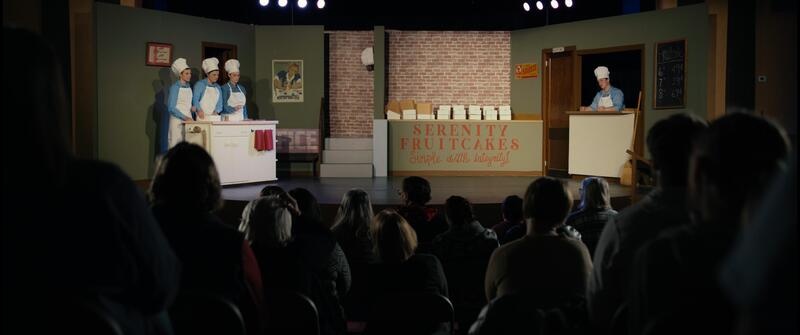
RAVING REVIEW: One of the best types of mysteries doesn’t pretend to be bigger than it is. DEATH BY FRUITCAKE leans into its small-town setting, its contained stage environment, and its personality-driven storytelling without trying to inflate the stakes beyond what the story can support. That restraint ends up being one of its biggest advantages. It knows the scale it’s operating within and, instead of stretching, digs inward into character, tone, and timing.

The setup is simple in the best way. A dress rehearsal collapses into chaos when a notoriously difficult actress drops dead mid-performance, and suddenly everyone in the room becomes a suspect. That kind of confined, single-location mystery has been done countless times, but what makes this one click is the attention it pays to the personalities circling the event. This isn’t about elaborate plotting or intricate twists stacked on top of each other. It’s about letting the audience sit in a room full of people who all have a reason to hate the victim and watching the tension build from there.

Paula Sands carries much of the story as Vivian, and what stands out isn’t just her presence but the way the performance embraces a slightly heightened delivery without tipping into parody. There’s a stiffness to her line reading at times, but instead of breaking the illusion, it almost feeds into the character. Vivian feels like someone who sees herself as more composed and authoritative than she actually is, and that disconnect becomes part of the charm. It’s not polished conventionally, but it fits the world the film builds.

Alisabeth Von Presley brings a different kind of portrayal as Brandy, and the contrast between the two performances becomes one of the film’s strengths. Where Vivian leans toward control and presentation, Brandy feels more fluid, more aware of the absurdity around her. The moments where she interacts directly with the camera could have come off as distracting. They’re used sparingly enough that they add personality instead of pulling you out of the story. It gives the film an edge, a reminder that it’s in on its own tone without constantly pointing it out.

The supporting cast fills out the ensemble, keeping the suspect pool engaging. No one is pushed into satire, but everyone is just exaggerated enough to feel distinct. That balance is important in a story like this. If the characters blend into one another, the mystery loses its shape. Here, each interaction carries just enough tension or humor to keep things moving, even when the narrative slows.

The investigation expands in a way that feels intentionally relaxed, but there are stretches where it could have used a sharper sense of escalation. Conversations feel a bit repetitive at times, suspicions shift without always adding new information, and the momentum dips as a result. It never stalls completely, but there’s a version of this that trims some of that repetition and lands with a bit more impact.

There’s a lightness to the humor that doesn’t undercut the mystery, and a sense of familiarity that works in its favor rather than against it. It feels like a story that understands its audience, especially those drawn to mysteries where the intrigue matters but the experience is just as much about spending time with the characters. The jokes land more often than not, and when they don’t, they still feel in line with the world the film has created.

The single-location setting becomes a strength rather than a constraint, forcing the film to rely on blocking, performance, and dialogue rather than on visuals. There’s a stage-like quality to everything, which makes sense given the setting, and instead of fighting that, the film leans into it.

What ultimately holds everything together is the film’s understanding of what kind of mystery it wants to be. It’s not chasing complexity for its own sake, and it’s not trying to reinvent the genre. Instead, it focuses on delivering a contained, character-driven story with enough intrigue to keep you guessing and enough personality to keep you invested.

There’s also an underlying appreciation for the setting itself. The small-town dynamics, the overlapping relationships, the way grudges and histories linger just beneath the surface, all of that feeds into the mystery without needing to be spelled out. It gives the film a sense of place that adds texture without complicating the narrative.

DEATH BY FRUITCAKE doesn’t aim for perfection. Its appeal comes from how comfortably it settles into its identity. The imperfections are part of the experience, but they don’t define it. What sticks is the chemistry between its leads, the playful tone, and the steady commitment to telling a story that fits its scale. It’s the kind of film that understands exactly what it’s offering, and more importantly, what it isn’t. And in a genre that often overreaches or overcomplicates itself, that clarity goes a long way.

Please visit https://linktr.ee/overlyhonestr for more reviews.

* * *

If you haven’t read Return of the Maltese Falcon yet, please do. And if you watch Death by Fruitcake on Prime or Roku or Apple TV, please leave a thumbs up if you’ve enjoyed it. And if you order the DVD from Amazon, a favorable review there would also be helpful.

Finally, just a reminder that True Noir: The Assassination of Anton Cermak is out as a 4-CD set now, and can be ordered here for only $23.37 (on sale from its usual $35.95) [Also in a single-disc MP3-CD for $19.47 or digital download for a mere $12.97! – Nate] It’s a full-cast star-studded nearly five-hour audio drama written by me from the first Nate Heller novel, True Detective, and directed by my pal Robert Meyer Burnett.

M.A.C.

Alisabeth Von Presley, Eliot Ness and the Basement from Hell

Tuesday, April 7th, 2026

This from Alisabeth Von Presley on instragram:

You guys!!! The movie I filmed last year is officially OUT and I’m screaming.

Death By Fruitcake is finally here!! I play the daughter of a local theatre diva, and together we accidentally (and very fabulously) get wrapped up in solving a murder… don’t worry, it’s chaos in the cutest, funniest way possible

You can stream it on Amazon or grab your own copy (which, obviously, you should).

Directed by the incredible Max Allan Collins. Truly one of the most joyful humans to work with. I loved every second of this experience with him and the entire cast & crew!!

* * *

Here’s Tim DeForest on Bullet Proof:

Eliot Ness #3: Bullet Proof, by Max Allan is the third of Max Allan Collins’ excellent hard-boiled series set in the 1930s and featuring Eliot Ness. It’s set after Ness’s Untouchable days, when he worked as Safety Director in Cleveland, running both police and fire departments.

Collins’ novels are fictionalized versions of cases Ness actually worked. In this case, he’s looking into labor trouble. A couple of smart racketeers are entrenched in important union positions, using this to extort money out of local business owners.

Ness’ problem is getting enough of the victims to testify, since doing so could be dangerous to their health. In the meantime, Ness recruits an old friend who is involved in the unions to help gather evidence. The friend is an old union hand, but recognizes that the racketeers aren’t doing the working class any favors.

Eventually, the situation escalates from vandalism and extortion to murder. There’s an attempt to hit Ness as well, but the top cop comes up with a clever plan to gather supposedly lost ballistics evidence and soon finds himself stalking a killer through a warehouse filled with plate glass.

It is yet another great entry in this great series. The story progresses logically and Collins presents Ness as a strong, smart protagonist. Characterizations of both good guys and bad guys are excellent.

It’s available here in a $10.99 trade paperback.

There is also a four-book collection of all my Ness novels in Kindle e-book format.

And Wolfpack has 16 of my novels (some with Mickey Spillane) as well as other e-book collections. If you haven’t read the three John Sand novels (Matt Clemens and I paying tribute to James Bond), the two Mommy novels, the Blue Christmas collection (with the novella that is the source of the film), or my pre-Antiques series collaborations with my wife Barb, this is where you’ll find them: https://wolfpackpublishing.com/collections/max-allan-collins

* * *

As I await hearing from one of my regular publishers on a book proposal, Barb and I have gone into Extreme Spring Cleaning mode.

To say our basement – home to many books, magazines, comic books, DVDs and laserdiscs – was overdue for attention would be a ridiculous understatement.

The shelves in what should be a library have become overstuffed and random, where for years they had been reasonably well-organized. Much of my Nathan Heller and other historical research lives there, until recent years decently curated. Now what should be an array of wonderful reading material looks like the Yard Sale from Hell.

Barb and I have spent most of two weeks on the project of sorting and culling, boxing up books and DVDs and magazines and comics to go to Half-Price Books and Davenport’s Source Bookstore. I admit to prefering the latter, because Half-Price Books is Complete Highway Robbery; but when stuff has gotta go, it’s gotta go.

This has involved going into nooks and crannies where previous books, comics and mags have been subject to water damage. These go unceremoniously into the trash. Here’s the thing about going through sixty years of collecting: you face not just your own mortality, but that of physical objects.

Sorting correspondence has been rewarding, however, with letters turning up from Chester Gould, Mickey Spillane, Ross MacDonald, Brian Garfield and (a huge stash from) Donald E. Westlake. Less rewarding have been decisions about which runs of magazines to keep and which to get rid of.

The difference between hoarding and collecting, particularly if you don’t collect carefully, is a surprisingly small one. Rob Burnett keeps his DVDs and Blu-rays and 4K discs alphabetized, and I bet Terry Beatty knows where every collectible he owns can be found.

I have always been good about not going overboard with multiple editions. I do have various editions of the Father, Son and Holy Ghost (Hammett, Chandler, Spillane), but mostly I keep only one copy of any book I love. And deciding what to keep that doesn’t fall into the “love” category, say a book you liked, or a not particularly good book by a favorite author, well…that’s where Barb comes in. She snatches me from the jaws of insanity and pitches what questionable item I’m contemplating into oblivion.

And I have to say she’s incredible. For example. Barb has, from the start, never minded me buying men’s magazines. She’s been beautiful as long as I can remember (going back to my crush on her in the fifth grade), and her self-confidence has never been shaken by paper images. We have pin-up paintings all over the house and she likes most and tolerates the rest. When our son Nate was a little kid, his friends would look around wide-eyed and say, “Does your dad like girls?”

But how many women would patiently pile copies of Hustler and Penthouse into box after box to take to be sold to a book dealer for pennies, nickels and dimes? Few, if any other wives, would. She even insists on loading up our vehicle with boxes of books, mags and comics, not wanting me to risk my heart condition.

And it’s true that I can only work for a couple of hours before either taking a long break or hanging it up for the day. This kind of sorting requires a lot of up and down and reaching for this or bending for that, which is hard for a guy whose meds all come with dizziness and balance side issues. If just you’re starting to feel sorry for me, which I sincerely doubt, my most recent check-up showed that I am in incredibly good health for somebody with so much shit wrong with him.

I have known for a long time that my possessions come seriously close to owning me. Now I am finally getting even with them.

And even at this stage – past the half-way point – our basement lair is looking more like a library and less like a embarrassment.

M.A.C.

Many Happy Returns

Tuesday, February 3rd, 2026

The Return of the Maltese Falcon continues to dominate around here. We continue to get lovely notices, and this one from The Strand is a doozy:

We encourage sending pics of Return from your phones spotted out in the wild of Return on display. Barnes & Noble has improved on the title, but reports still come in that the book is not anywhere in certain individual stores. If you are a brave, hearty soul, go to the Help Counter and ask if it’s in stock, and if it isn’t, whether more are on the way. (You don’t have to buy the book at B & N to do this.)

Also, reviews posted at Amazon are highly helpful, however short, though we’ve had some really smart, well-written long ones, as well. Worth doing at Barnes & Noble dot com, too – considerably fewer reviews have been posted there, but still a fair number.

John-Jr-Jackson, an Imagination Connoisseur, wrote Patton Oswalt an Instagram recommendation:

Hey man , I know you like classic films and reading books , so I wanted to recommend a book to you if that is ok. Return of The Maltese Falcon by Max Allan Collins. It’s a great book and pure noir goodness. Thought I would throw that on to your radar.

That’s very cool, as Patton is not only a friend (well, friendly acquaintance), but did me the favor of joining the all-star cast of True Noir: The Assassination of Anton Cermak.

By the way, a big, big, big date for me is coming up:

FEBRUARY 17, 2026

Why is that date important? It’s the official release date of two major projects of mine.

First – and more exciting news about this will follow in the next few Updates – True Noir: The Assassination of Anton Cermak, the 4 ½ full, full-cast adaptation written by me (from the first Nathan Heller novel, True Detective), will be officially released worldwide. You’ll find it downloadable at Audible and elsewhere, and will be able to order the Skyboat Media 4-CD set (yay physical media!).

February 17 is also the release date of the Antiques/Trash ‘n’ Treasures movie, Death by Fruitcake, based on the novels by Barbara Allan (wife Barb and me), adapted from a novella of ours and co-produced by Barb. The great cast is topped by Emmy winner Paula Sands, Midwest superstar Alisabeth Von Presley, and my Blue Christmas lead, Rob Merritt. Chad T. Bishop shot and edited our modestly budgeted film and I directed it.

Pre-order the DVD here (no blu-ray).

One of the best reviews and interviews, relating to Return of the Maltese Falcon, appears at J. Kingston Pierce’s indispensable Rap Sheet. I’m taking the liberty of reprinting the review portion this week.

SPADE GOES BACK TO BIRD-HUNTING

Pinkerton detective-turned-author Dashiell Hammett realized he had something special on his hands when he submitted his revised, typewritten version of The Maltese Falcon to publisher Alfred A. Knopf in July 1929, asking that Knopf (who had previously handled his books Red Harvest and The Dain Curse) practice restraint in editing this latest manuscript. As Hammett scholar Richard Layman has explained: “He knew what he was doing, he said. Hammett wanted to get his third book right. It was a departure work for him, his attempt to break away from the formulas of pulp fiction to create a work with serious literary value.” Although the writer resisted changes by copy editors, he continued to tweak his own story—which had originally appeared (in slightly different form) in five monthly segments in Black Mask magazine—right up to when Knopf finally sent it away for printing. The completed novel was released on February 14, 1930.

Ninety-six years later, with the copyright on Hammett’s best-remembered (and most-filmed) tale having lapsed at the end of 2025, Iowa crime-fictionist Max Allan Collins seeks to add another “something special” to the Falcon legend. In Return of the Maltese Falcon, released this month by Hard Case Crime, he has boldly resuscitated the original book’s “hard and shifty” protagonist, San Francisco private investigator Samuel Spade, and sent him back out to locate the bejeweled bird of the title—which, you will likely recall, was never recovered in Hammett’s hard-boiled classic.

Penning a sequel to such a seminal genre work can only be characterized as intimidating. Indeed, Collins acknowledges that “avoiding strictly pure mimicry, and writing in my own style while honoring Hammett’s, was a tightrope to walk.” But the critical reception for Return of the Maltese Falcon has so far been generally favorable. Kirkus Reviews remarks that “Collins’ dialogue sounds pleasingly like Hammett’s; his plotting is even twistier; and if his descriptions mix Hammett’s terse, affectless minimalism with Raymond Chandler’s fondness for florid similes, that’s clearly, as he notes in an engaging coda, his intention. Fans convinced that nobody could possibly continue a tale that ends so definitely owe it to themselves to give Collins a try.” Reviewer Ray Palen of Bookreporter says Return is “a work of wonder, and I enjoyed every second of it. Collins has not just inhabited Hammett’s world but breathed new life into it and made it distinctly his own.” Finally, prolific author and blogger James Reasoner observes that, “stylistically, Collins’ fast-moving, straight-ahead prose isn’t quite as stripped down as Hammett’s, but it’s certainly in the same ballpark.” He adds: “The resolution of the mystery and the way the book wraps everything up are extremely satisfying.”

As Collins has stated in the past, he fell in love with The Maltese Falcon in 1961, when he was 13 years old and first watched the 1941 Humphrey Bogart movie adaptation on television. Not until much later did he consider recruiting Sam Spade into a new story—not necessarily a Falcon follow-up, but at least another novel starring the same principal. (Spade’s single other book-length appearance came in Joe Gores’ authorized 2009 Falcon prequel, Spade & Archer.)

Collins’ idea for a sequel dates back to 2024, when he included it in a future-projects sales pitch to Titan Books, the British owner of Hard Case Crime. Like numerous other readers, Collins was curious to know what happened after the events recounted in Hammett’s yarn—not just what became of the ever-elusive falcon statuette, but, as he told CrimeReads recently, how Sam Spade might “extricate himself from the ruins he’s made of his life and business.”

To help him answer those questions in Return of the Maltese Falcon, Collins brings back most of the original novel’s cast—some in secondary roles—while beefing up the involvement of several players to whom Hammett had assigned lesser parts. (Have no doubt: You should definitely have read the 1930 book before tackling Return.)

His action begins in December 1928, shortly after Spade failed to locate the gold, gem-encrusted (but now black enamel-covered) falcon at the center of the earlier story, and handed over his fetching but deceitful client, Brigid O’Shaughnessy, to the San Francisco cops for the murder of his detective partner, Miles Archer. Effie Perrine, Spade’s “lanky, tawny-haired” secretary (at 23, a decade Spade’s junior), has erected a Christmas tree where Archer’s desk once sat, and their office is looking “moderately successful” despite the “bad publicity” of late. Through the door comes Rhea Gutman, the “pale and petite,” 18-year-old blonde “daughter” of corpulent criminal Casper Gutman, who supposedly spent years chasing after the Maltese falcon, a treasure crafted for the King of Spain in the 1500s, only to have it stolen by a Russian general named Kemidov, and replaced with a fake. It seems that, like her late progenitor, Rhea is hungry to get her hands on the black bird, and she’ll split the rich proceeds with Spade if he can bring it to her.

Not surprisingly, the shamus accepts her offer. What he hadn’t expected was to then be approached by three more people wanting him to find the artifact (what he terms the “dingus”) on their behalf: Chicago gambler Dixie Monahan; a British Museum official, Steward Blackwood, who contends his institution holds true title to the falcon; and Brigid O’Shaughnessy’s younger sister, Corrine Wonderly. While raking in retainers from them all, he returns to his hunt for what has become the most famous “MacGuffin” in crime-fiction history. Spade’s investigation will eventually lead him to a violent clash with Casper Gutman’s erstwhile “gunsel,” Wilmer Cook; jail interviews with the aforementioned Miss O’Shaughnessy as well as dandyish Joel Cairo, familiar from the original tale and here claiming to know a private collector who’ll pay handsomely for the statuette; run-ins with police and the local district attorney; the discovery of an unidentified corpse in San Francisco Bay, in whose pocket is found Spade’s business card; a Golden Age-style gathering of suspects he hopes will flush out a killer; and late-in-the-game identity switches that I, for one, didn’t see coming.

When I first learned that Max Allan Collins would be revitalizing Sam Spade in a continuation novel—a sequel to one of American detective fiction’s founding yarns, no less—I felt a moment’s consternation. However, I reminded myself that Collins, who was named a Mystery Writers of America Grand Master in 2017, is a crackerjack tale-spinner who has given us two estimable series (a historical one starring Chicago gumshoe Nate Heller, and a second featuring the hit man known only as Quarry), and that he’s already succeeded in extending the life of another notable P.I., Mike Hammer, writing 13 new novels to add to the 13 Mickey Spillane had produced by the time he died in 2006. Furthermore, Collins put another iconic sleuth—Philip Marlowe—through his paces in “The Perfect Crime,” composed for the 1988 collection Raymond Chandler’s Philip Marlowe: A Centennial Celebration, edited by Byron Preiss. (He subsequently swapped Marlowe for Heller and added that story to his 2001 “casebook,” Kisses of Death.)

If anyone had the chops and chutzpah necessary to extend Spade’s otherwise brief career, it was definitely Collins.

With its text having now entered the public domain, this seems to be the season to celebrate Dashiell Hammett’s third novel. Publisher Poltroon Press has brought a new, photo-embellished hardcover version of The Maltese Falcon to market that also features a pair of Spade short stories inked by modern San Francisco-area author Mark Coggins. Blackstone has released its own “collectors edition,” complete with black-and-white illustrations and artistically sprayed page edges. Meanwhile, Steeger Books is selling hardback (or paperback) copies of the Falcon as it was serialized in Black Mask, with more than 2,000 textual variations from the final, 1930 book, and including the original pulp-style interior art by Arthur Rodman Bowker. Finally, notebook maker Field Notes has packaged that same magazine edit in imitation of the World War II-era Armed Service Editions.

Return of the Maltese Falcon is altogether something bigger, though. In this, his 53rd year as a published author (Bait Money, his debut novel, came out in 1973), Collins has given us not only an homage to Hammett’s most memorable composition; he’s drawn a direct line between himself and that august scribbler of yore, emphasizing the fact that he wouldn’t have the award-winning career he does without Hammett and other ink-slinging pioneers having laid the foundations of the popular field in which he toils. There will be Hammett purists who object vociferously to Max Allan Collins, or anybody else, employing Sam Spade in fresh adventures. Yet when the results are as delightful, dramatic, and downright satisfying as Return of the Maltese Falcon, it’s hard to argue that the effort should never have been made.

NEXT WEEK: I will post J. Kingston’s Pierce’s interview with me about Return of the Maltese Falcon. Jeff has done some of the very best interviews with me ever done.

Speaking of interviews, my pal Heath Holland (with whom I partner on blu-ray commentaries) spoke with me about Return of the Maltese Falcon here.

M.A.C.