
An Essential Noir Blu-Ray, A Spillane Update and Final Episodes

June 14th, 2022 by Max Allan Collins
The Guilty/High Tide Blu-Ray Cover from Flicker Alley

My pal Eddie Muller, the guru of all things noir, has outdone himself with the latest Flicker Alley home video release from the Film Noir Foundation. Beautifully restored as usual by the UCLA Film & Television Archive, Eddie’s first double feature on Blu-ray/DVD is The Guilty/High Tide, both 1947 releases from (of all people) producer Jack Wrather of early TV’s Lone Ranger and Lassie (!) fame.

What makes the disc a noir fan’s feast are the special features, many of which are the work of film expert Alan K. Rode, including documentaries on Wrather (and his actress wife Bonita Granville, star of The Guilty), Cornell Woolrich, and director John Reinhardt. The standout special feature for me, however, is Lee Tracy: The Fastest Mouth in the West from charming, articulate noir historian Imogen Sara Smith.

Lee Tracy is a nearly forgotten movie (and stage) star of the 1930s who has long been a favorite of mine. He defined the Hildy Johnson character in The Front Page on Broadway. He didn’t play the role on screen (Pat O’Brien did) but he went on to be the prototypical fast-talking, rule-bending, hard-drinking, sleazy-but-winning media-man of pre-Code Hollywood. He is remembered, if at all, for his most enduring films, Doctor X, Dinner at Eight, and Bombshell. He made a late career comeback on Broadway and in the film version of Gore Vidal’s The Best Man (1964), playing a Truman-esque ex-president turned power broker – he got an Academy Award nomination for that. A terrific film, by the way.

His career downfall in the mid-‘30s came when he supposedly urinated from a balcony onto a passing parade of Mexican soldiers (he was making Viva Villa!). He was apparently as hard-living and hard-drinking as the characters he portrayed. For me, he’s a unique figure, fast-talking and oddly charismatic despite a face that looks like a sack of potatoes wearing a sly smile. He is pre-Code Hollywood wrapped up in one balcony-pissing package.

Eddie Muller, who participates in several of the documentaries and delivers his usual fine introduction to the films, is more impressed with The Guilty than with the Lee Tracy-dominant High Tide. The Guilty is definitely worthwhile, an Ulmer-esque exercise in making something out of nothing, budget-wise.

The Guilty is also one of the best translations of the mood of writer Cornell Woolrich to the screen. Rear Window is obviously – I’m no genius pointing this out – superior; but then so is The Window with Ed Gorman’s first cousin Bobby Driscoll and Phantom Lady and on and on. What The Guilty has, besides cannily used shabby sets, is its doomed lead actor, Don Castle – who is also in the Woolrich-based I Wouldn’t Be in Your Shoes (1948) and of course High Tide. Castle rivals Tom Neal for sad irony in his real life, ending a suicide.

I will state, at risk of losing whatever noir credentials I have, that I am not in particular a fan of Woolrich’s writing. He was justifiably famed for his ability to come up with one resonant noir premise after another; but as a writer he did not do much for me. I once was hired to write a screenplay from a novel of his (never made) and was not impressed with the craftsmanship. This is a matter of taste and I acknowledge his importance on a very short list that includes Hammett, Chandler, James M. Cain, Horace McCoy, Mickey Spillane, and Jim Thompson.

The sadness and threadbare nature of Woolrich’s life is well-served by The Guilty, but for this fan of actor Lee Tracy, High Tide (with which I was already familiar) is the gem of this rhinestone-glittering package. Like The Guilty (and I Wouldn’t Be in Your Shoes) it’s from Monogram. I once had Nate Heller say, “The night was as starless as a movie from Monogram.” But Lee Tracy must have slipped my mind. Typically, in both The Guilty and High Tide, Regis Toomey shows up as essentially the same plainclothes police inspector (he has that role in I Wouldn’t Be in Your Shoes, too, more centrally).

High Tide has a wraparound right out of Double Indemnity and a bigger budget than The Guilty (considering it’s Monogram, nothing to brag about) but it serves as a coda, or even valedictory, for Lee Tracy’s fast-talking, rule-breaking reporter, a figure recognizably American, at once admirable and shameful.

Tracy was no longer A-list in 1947 and hadn’t been for well over a decade; he was making the occasional B picture. He would soon gain a slight, tenuous hold on noir history by way of starring in the first really successful tough private eye series, Martin Kane. Surviving examples of this early ‘50s show are fascinating artifacts of live TV. But in High Tide the actor brings his trademark persona fully into the bleak world of film noir, where leads are played by the doomed likes of Castle and Neal. He fits in well but flies much higher on his way to High Tide’s splash landing.

Thank you, Eddie Muller, Alan Rode, Woolrich documentarian Steven Smith, and especially Imogan Sara Smith, for her wonderful career piece on Lee Tracy.

* * *

In the meantime, I am preparing to do the commentary for ClassicFlix’s I, the Jury release this coming September. It’s going to be really something – a package including 4K, Blu-ray and 3-D. Preparing for my work, I have watched a 3-D advance disc of the 1953 film and was again blown away by John Alton’s cinematography.

I have always liked this film – it was my first introduction to Mike Hammer, seen on a very small black-and-white TV around 1955 – and I know that some people don’t accept Biff Elliot as Mike Hammer. Mickey didn’t, and he’s not alone. But I find Biff’s take on Hammer as a young, not terribly bright combat veteran, out to avenge the guy who lost an arm to a Japanese bayonet meant for him, both appropriate and effective – burly but not a bully. The flaws in the film mostly have to do with censorship issues – the truncated striptease at the conclusion particularly, but also the lengths the script has to go to, to avoid directly mentioning prostitution and dope dealing.

I will talk more about this later, but anyone interested in Mickey Spillane and Mike Hammer…really, any film noir fan…will find the Classicflix I, the Jury on a short list of best Blu-rays of the year, including no doubt The Guilty/High Tide.

* * *

Elsewhere on the Spillane front, I am working on the galley proofs of Spillane – King of Pulp Fiction, and find myself very pleased. It was a big, hard job – Jim Traylor and I have been seriously working on this project since shortly after Mickey’s passing in 2006 – and I am relieved to find that I like the result. Jim is working on the index of the 350-page book right now.

I am thrilled that Mysterious Press is the publisher. It’s a classy imprimatur that I think this book deserves.

* * *

Our first post-Covid lockdown walk-out on a movie: Jurassic World: Dominion. The dinosaurs were believable, but the people were not. Just a dreadful, dull script with brain-numbing dialogue. I had thought this would be a nice melding of characters from the previous entries in the saga, but (for the hour-plus we witnessed) they rarely interacted.

We saw it in 3D that was barely noticeable (but for the upcharge). I was tempted to stay and watch at least some of the actors get eaten, but Barb was fed up.

I will say I thought the overhead sound conveying the prehistoric creatures grazing and grunting was effective until I realized it was just the other moviegoers.

On a more positive note, several of the limited-run TV series we’ve been watching have wrapped up satisfyingly, particularly Gaslit and (an episode to go) the delightful The Offer (I recommend supplementing the series with the behind-the-scenes Godfather book, Leave the Gun, Take the Cannoli by Mark Seal). HBO’s The Staircase remained compelling viewing in its final episode, but as it’s credited with being based on the French documentary of the same name, one does wonder where material not seen in the doc came from. Some of it seems unfair to all concerned. Anyway, that owl did it.

* * *

Finally, it’s another article about that Tom Hanks movie that you didn’t realize came from a graphic novel.

M.A.C.

54 Years and Counting! (Really 56.)

June 7th, 2022 by Max Allan Collins

Barb and I took our first post-Covid lockdown overnight trip, celebrating our 54th wedding anniversary last week – specifically, on June 1st, the day of, and returning to Muscatine on June 2nd, the start of year 55.

It was a delightful trip, although two business situations back in the real world came up shortly after we arrived in Galena, Illinois (our favorite getaway spot) and reminded me how nice life was when you didn’t have a cell phone in your pocket.

Things settled down, though, and we shopped and lunched at Vinny Vanucci’s and had a lovely evening, dining at Fritz and Frites and then sharing a quiet, typically Collins evening in our suite at the Irish Cottage – see the photos as evidence.

M.A.C. and Barb at Fritz and Frites
Champagne and The Brain Eaters

You will note that I look almost giddy sharing a table with a beautiful blonde, undeterred by having spent 56 years of my life with her (we started going together in 1966). There are numerous reasons not to like me, even to hate me, but none better than my managing to hornswoggle (one of my late father’s favorite words) her into spending most of her life with me.

Obviously Barb is a beauty. But she is also funny and smart and ridiculously thoughtful. She loves the Three Stooges. She loves the Beatles. She loves the original Star Trek. She loves James Bond. She loves her grandchildren. And she even loves me.

The question we get most often is how we write together and remain married. I’ve seen other writing couples really struggle with that. My answer sounds flip but it’s true: our offices are on separate floors.

Another major factor is that we develop the idea for a story or novel together, often over lunch or on a car ride, and then she works alone on her draft, checking in with me only if she hits a rough patch and wants an opinion (rare). She does not love to write. I try to tell her that no writers really love to write, though many of us are compelled to do so, and all of us love to have written. But she entered the field basically to help me out, editing, and writing the “Mike Mist” feature for Ms. Tree after I burned out on minute mysteries.

So when she finishes a draft of a novel, she claims (believably) to be sick of it. She doesn’t care what I do with it. This is basically true, but if my draft wanders too far afield from what she had in mind, she’s very tough-minded about getting me back on track.

We just finished our short novel, Cutout, for Neo-Text. I say “finished,” but we haven’t heard back from the editor, so you never know when rewrites are requested. But it feels good and was very much an idea that came from Barb and a story that she generated. The Antiques novels are fairly loose and it’s not unusual for long stretches to be my work; but in Cutout, her writing was so tight that working on it, trying to improve on it, was like repairing an expensive watch.

So feel free to hate me for being so lucky in having this life partner. I don’t deserve her. But at least I know it.

Frankie Valli Concert 2022

We wrapped up our anniversary celebration with a concert – Frankie Valli and the Four Seasons. Really, it was Frankie Valli and four back-up singers/dancers, but I’m not complaining…it was a great show. Held at the cavernous and unfortunately named TaxSlayer Center in Moline, the concert featured an amazingly spry eighty-eight year-old Valli hitting all the high notes and giving a long, opening-act-free presentation of most of his many hits, without and without the Seasons. A multi-media affair, with a fantastic rocking band, it had a Vegas feel that made other oldies shows I’ve seen look and feel like the cobbled-together affairs they often are.

The event had been postponed twice, and we almost skipped it, having already had a fun but exhausting Galena trip. But we were very, very glad we saw this pop music legend in performance.

* * *
Star Trek: Strange New Worlds poster

Among the list of things Barb loves I listed Star Trek. We loved all the movies, including the one Shatner directed, and the recent J.J. Abrams reboot features, which not everyone does. We are okay with Next Generation, but every other ST series has left us cold – we haven’t ever boarded those vessels, not long-term.

I was once approached to do a Star Trek novel and was thrilled. It was to be about the newest, about-to-debut series, Enterprise, which I was told was a throwback to the original series. I watched the premiere, all revved up – it starred Scott Bakula, from Quantum Leap! But then it turned out to, well, uh…suck. At least in my opinion. And Barb’s.

I tried to get the book gig anyway, but both my tries were rejected because they resembled this episode of that Trek spin-off or that episode of this one.

Now comes Star Trek – Strange New Worlds, and we are both fans. It’s basically the series that Gene Roddenberry first intended to do, as indicated by the pilot (“The Menagerie”) with Jeffrey Hunter as Captain Christopher Pike, Majel Barrett as Number One, and Leonard Nimoy as Spock.

Strange New Worlds (streaming on Paramount Plus) is a smart, respectful prequel with a great cast. Anson Mount as Pike seems to combine the best of Kirk and Picard, Rebecca Romijn as Number One is a particularly strong presence, and Ethan Peck as Spock channels Nimoy to an eerie degree, particularly the sound and cadence of the original Spock’s voice.

The art design and special effects are stellar (sue me) and the stories so far mostly take place on the stunning Enterprise itself. The major difference is that none of the episodes to date are anything William Shatner would have put up with. Look, I love Shatner. (So does Barb.) He’s a force of nature and his Kirk is definitive. But he would never, never have allowed his episodes to focus so much on its ensemble cast. To Anson Mount’s credit, he holds the show together without flexing his ego.

This is the best Star Trek since…Star Trek.

* * *

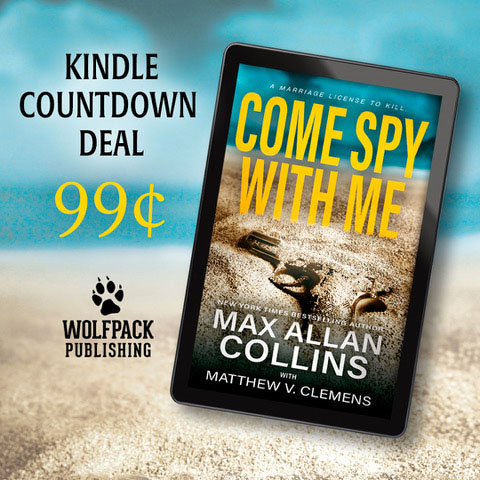
Thanks to all of you who took advantage of the week-long 99-cent sale for the Kindle edition of No Time To Spy, which collects the three John Sand novels by Matt Clemens and me.

We did not hit number one on any of the Amazon bestseller lists (The Shrinking Island recently did) but we got into the upper reaches.

For those of you who (like me) prefer physical media, the “real” book of No Time to Spy is a fat thing of beauty.

You can get it here for $15.99.

* * *

Finally, here’s another of those “movies you didn’t know were based on comics” pieces, but not a bad one (on Road to Perdition of course).

M.A.C.

No Time to Spy 99, OSS 117, and Stranger Things 4

May 31st, 2022 by Max Allan Collins
No Time to Spy
E-Book: Amazon
Paperback: Amazon

No Time to Spy – the collection of the three John Sand novels by Matt Clemens and me – is going on sale for an astonishing 99-cents (for the e-book) at Amazon starting today (May 31 at 12 a.m.) and ending June 6 (at 11 p.m.). Those are Pacific times.

For those of you who haven’t tried these books, this is an excellent low-cost opportunity. The response has generally been very good to the Sand novels, but a couple of supposed “big fans” of mine have attacked them for various reasons that seem specious to me. For one thing, they apparently don’t understand that the John Le Carre school of spy fiction (which I admire) is different from the Ian Fleming school (which I adore).

The premise of the trilogy, as you may know from previous updates here, is that John Sand is the real-life spy that James Bond was based on, and that Ian Fleming was a colleague who used Sand’s experiences as a basis for his fiction. The publicity that Sand receives as the basis of Bond forces him out of the spy game; also, he marries a very wealthy young woman – a Texas oil heiress – in an echo of what occurs in both the book and film of On Her Majesty’s Secret Service, minus the tragedy.

Matt and I never mention Bond and Fleming by name, but it’s obviously an open secret. The books are larger than life, in the fashion of the Bond novels and films, but are at the same time quite tough and the frequent action can be violent, even shocking. The sexual content is largely limited to the married couple’s couplings.

The novels are, in order: Come Spy With Me; Live Fast, Spy Hard; and To Live and Spy in Berlin.

Matt and I had hoped to do at least one more Sand novel, but despite general positive reader response, sales have not encouraged us to do so. If this 99-cent sale pushes us onto Amazon bestseller lists, even briefly, that could change.

The ignorance of the handful of readers who have denigrated the books for being spoofs are the kind who can’t see the difference between Harry Palmer and Austin Powers.

OSS 117: From Africa With Love

This is not to say I don’t like a good Bond spoof, and a third in the film series of what is (in my opinion) the greatest satiric response to Bond is now available – OSS 117:
From Africa With Love
, again starring Jean Dujardin (of The Artist fame) as secret agent Hubert Bonisseur de La Bath. The third film does not seem to be on any of the streaming services, but can be purchased on Blu-ray and DVD at Amazon.

The first two films, OSS 117: Cairo, Nest of Spies (2006) and OSS 117: Lost in Rio (2009), are also available from Amazon in French with English subtitles on both Blu-ray and DVD. E-bay has both of these from various sources. E-bay also has From Africa With Love, but I ordered editions listed as having English subtitles and it wasn’t till my third try that I landed on a version that had that essential option. I would stick with ordering from Amazon.

What’s great about these films – they are strictly parodies of the Connery era, the star physically resembling the “real” James Bond – is that they work as Fleming-style spy stories with the hilarious inclusion of a Bond clone who is bone-headedly politically incorrect and in some ways a dope…and yet he’s a credible action hero. None of the other parodies of Bond accomplish that.

This new film finds OSS 117 actually growing and changing by the final scene…perhaps not dramatically, as it would appear his growth is largely limited to not patting the asses of the pretty females at the spy office as a greeting.

And you will adore the opening credits with the fake Bond theme song and faux Maurice Binder visuals.

I love these movies and wish they were more readily available. But if you’re a Bond fan, you need to see them. Also worthwhile is the boxed set of the original French OSS 117 films, which are among the better Bond imitations of the ‘60s.

* * *
Stranger Things Season 4 poster

I wrote at some length last week about the assorted streaming mini-series we have been watching. We picked up on season four of Stranger Things, which Netflix has just “dropped” as they say (an expression I could do without). I will tell you right now that Barb bailed before the end of the first episode, and I don’t blame her.

Having really liked the preceding seasons, I hung in there and watched the first two episodes – which were long, around an hour and twenty minutes each, far too long for a premise as wispy as that of Stranger Things. I have continued on and will stick it out to the end.

But the opening two episodes are a tough go. They present a version of high school that is simplistic and ridiculous – for example, El (who has lost her powers and apparently also her spine) is picked on by…everybody, at a school filled only with bullies. Several new annoying characters are introduced right when we’re trying to remember who the recurring characters are, some of whom are hard to recognize at first. After all, it’s been three years, real time, since the previous season. The kid actors all look much too old for the six months, story time, that have elapsed. Those annoying new characters include a rebel who looks to be about 35 and a pizza delivery hippie whose sub-Cheech-and-Chong comedy relief is painful to endure.

When the high school stuff fades and the sci-fi/horror stuff kicks in, Stranger Things gets back on recognizable track, uneven but rewarding. The biggest problem is the shifting tone, with the Winona Ryder storyline comic (despite tragic circumstances) and her sidekick conspiracy theorist, bearded Brett Gelman, often uncomfortably hammy.

The first two very long episodes are written and directed by the creators, the Duffer Brothers. Surprisingly, it’s the subsequent episodes by other hands that are what bring the season around. The creators seem to let their actors go over the top, unbridled, with Gelman (much better in non-Duffer-directed episodes) and newcomer Joseph Munson (the rebel Eddie Munson…get it, Munster?) their chief victims. These first two episodes are weak on Direction 101 items like matching action and, well, pacing.

The pop culture references get laid on a little thick, too. We have Robert Englund repeatedly scratching his insane asylum-cell table with his fingernails (Freddie Krueger, get it?) and the kids entering a haunted house right out of (the much better) It. Krueger is playing Victor Kreel (Victor Crawley horror franchise, check) as he subs for Hannibal Lecter offering convicted-serial-killer advice from his cell.

Why watch?

Well, once you get past the first two ill-judged episodes, the Eleven story kicks in, in a satisfying way. Most of the young actors are terrific, especially Sadie Sink (and her character is into Kate Bush, which reveals good taste on somebody’s part, probably the Duffers, giving credit where it’s due). Really, all of the recurring characters are fine, with Millie Bobby Brown a standout, once she ditches the suddenly-El-is-a-five-year-old bit. Of the original group Gaten Matarazzo remains winning – the heart of the ensemble.

It’s not the Duffer Brothers’ fault that Covid happened and three years passed, damaging the believability of cast members as kids younger than they’re playing. That a number of new actors were cast as teenagers and look at least thirty is the creators’ fault.

What I think happened is this: the brothers were in the right place with the right idea at the right time to be one of the first binge-worthy shows, really jump-starting Netflix. But in the meantime some other gifted creators have taken advantage of the limited-season, limited-series approach, and upped the ante. This season of Stranger Things does not compare to Gaslit, The Offer, The Staircase, or Better Call Saul.

Not even close.

* * *

Road to Perdition is on this list of the best noirs to date of the 21st Century.

M.A.C.

A New Novella, TV Mini-Series Reviews and Legacy Books

May 24th, 2022 by Max Allan Collins

This week I am working on my draft of the last five chapters of Cutout, the novella Barb and I are doing for Neo-Text. It will appear as a trade paperback, available through Amazon, and of course an e-book. No pub date yet, but Neo-Text moves fast.

Cutout marks Barb’s return to her tight, third-person style that she honed in her years writing short stories, which culminated in the novels Regeneration and Bombshell, co-written by me (now available from Wolfpack – the trade paperbacks are lovely).

We have, of course, been writing the Antiques series since then, and it’s been a long-running success, although we were not offered a new contract by Kensington and moved to Severn, where Antiques Liquidation (our second Trash ‘n’ Treasures mystery for the UK house, after Antiques Carry On) will be published on October 4.

Barb had begun to get an itch to do something else, as evidenced by a short story we co-wrote that appeared not long ago in Ellery Queen Mystery Magazine (July/August 2021) under our “Barbara Allan” joint pseudonym. For over a year she’s been mulling (her maiden name is Mull) doing an espionage-tinged novel called Cutout, and we discussed it often, plotting it over a restaurant lunch (as is our habit). I came to feel it was either a novella or a young adult novel, in part because its protagonist is a young woman in her freshman year of college, but also because it needed to be probably no longer than 40,000 or at most 50,000 words – at least as initially conceived. Barb had in a mind a very spare, almost minimalist style for this one.

With Neo-Text a market for my novellas – witness Fancy Anders Goes to War – we decided to go with that length, which will be in the neighborhood of 30,000 words.

We were able to sell it to Neo-Text on a basis of the first third or so of the manuscript plus a fairly detailed synopsis. I’ve been doing my drafts of chapters with Barb out ahead of me, and now she’s completed her draft and I have five chapters (of sixteen) to go.

All I can tell you is it seems very, very good to me.

I will keep you posted.

* * *

We seem to be in a sort of Golden Age of TV mini-series, thanks to the hungry eye of streaming services. I would like to point out a few that might be worthy of your time.

The Staircase

The Staircase (HBO, streaming on HBO Max) charts the notorious Michael Peterson case, in which the author of Vietnam thrillers is accused of the murder of his wife. This true-crime-based drama was already the subject of a well-known documentary, streaming on Netflix, also called The Staircase. The documentary is fascinating and, while somewhat flawed in stacking the deck at least slightly in Peterson’s favor, a worthwhile watch, despite its thirteen-episode length. But the dramatic mini-series is its own animal and quite good, dealing with material not covered in the documentary, including much more about Peterson’s wife and family, his experiences in prison, and the seemingly ridiculous but actually compelling theory that the wife was killed by an owl (!). Peterson in real life is a complex character, at first an apparent sociopath but then seemingly human and even a victim. It’s a whipsaw experience, watching both the documentary and the dramatic version. The centerpiece of the latter – a meta experience that includes the making of the documentary within its own narrative – is the remarkable Colin Firth as Michael Peterson.

Two more true-crime based mini-series may be of interest to you – they were to me. But both take a less serious approach to the material, casting real-life melodrama in a manner reminiscent of a John Waters movie.

Candy

Candy recounts the at-one-time household name murder case from 1980 in which one church-going housewife killed another church-going housewife with an axe, wielding enough blows to make Lizzie Borden look like an under-achiever. Candy Montgomery – the case is the subject of a famous true crime book co-written by John Bloom (Joe Bob Briggs!) – plotted her affair with Betty Gore’s husband as if it were a Brinks truck robbery. But she somehow killed Betty with that axe (the jury agreed) in out-of-control self-defense. The dark absurdity of the case lends itself to creator Nick Antosca staging everything Waters-style, with kitschy late ‘70s/’80s sets and Sears catalogue costuming and blatantly fake wigs and a musical soundtrack more appropriate for a sitcom than a tragic docudrama. Jessica Biel plays Candy peanut-brittle brittle, aggressively upbeat. The subtext here is that Candy was guilty.

But if you watch the 1990 TV movie with Barbara Hershey (it’s on You Tube and out-of-print DVD) – A Killing in a Small Town – you’ll find a strikingly similar film as to content, with the tone and approach wildly different. For one thing, Barbara Hershey is a world-class actress who actually sells Candy’s unlikely innocence. For another, the tragedy is treated not as a dark joke but…a tragedy. The 1990 film (only ten years later, after all) looks like real life, not an over-the-top, if admittedly compulsively watchable, kitsch fest.

The Thing About Pam

But The Thing About Pam, an NBC mini-series streaming on Peacock, makes Candy look like The Thin Blue Line. Reneé Zellweger has gotten heat for wearing prosthetics (including a “fat suit”) instead of putting herself through the unhealthy but somehow admirable effort of gaining a bunch of weight. A better argument might be hiring a plus-size actress, but Zellweger is so good in the role, even that’s doubtful. What did seem questionable to me, as I watched the mini-series, was how far down the John Waters rabbit hole the filmmakers had gone.

The absurdity was shameful! They even had that creepy Dateline guy do the narration! They outright played it like black comedy – how could they?

But then I looked at some of the documentary material on the case and you know what? It plays like laughably bad melodrama in real life – an idiot prosecutor who ignores the most obvious suspect, white cops who badger an Hispanic suspect for a quick arrest, a manipulative, greedy woman who sees herself as funny and smart and is just an unmistakable monster. That creepy narrator was the only thing absent from the real deal…and even there, the murderer herself pretended in her last desperate homicidal ploy to pass herself off as a Dateline producer!

I don’t know if I can recommend either Candy or The Thing About Pam, but…forgive me…I enjoyed every minute of both. The world we live in seems to me more and more like a John Waters movie. Why shouldn’t both of these mini-series reflect that? Didn’t I write this already? Wasn’t it called Mommy?

Similarly, perhaps the best mini-series going right now draws upon an entirely different kind of true crime – Gaslit on STARZ, starring Julia Roberts as Martha Mitchell and Sean Penn as her husband John. Both are excellent, though this Watergate mini-series belongs to Dan Stevens as a somehow lovable weasel of a John Dean. This one also plays as an absurd comedy, but doesn’t need to overdo it to make the point that the reality was similarly wack-a-doodle. Everybody in this is good, but another standout is Shea Whigham, who makes a terrifying and yet hilarious G. Gordon Liddy.

The offer

As good as Gaslit is, The Offer is my favorite of all these, the series both Barb and I savor every moment of. Streaming on Paramount (a company the series regularly skewers), The Offer is a behind-the-scenes look at the making of The Godfather. This, too, finds comic melodrama in the proceedings but is less heavy-handed than Candy and Pam (yet how I would love to see Candy Montgomery Vs. Pam Hupp: The Final Showdown). Some reviewers haven’t liked The Offer, but actual humans probably will. The cast is wonderful, with Matthew Goode’s Robert Evans a stunning thing to behold, while quietly charismatic Miles Teller holds everything together as producer Al Ruddy, the pole that holds the tent up. Also outstanding, among a flawless ensemble, are Juno Temple, Dan Fogler and Giovanni Ribisi.

Finally, Better Call Saul on AMC is in its final season (broken in two, as was the case with Ozark). I find its narrative style fascinating – often the story proceeds at a crawl, raising more questions than answers, and yet you hang right with it. I keep thinking about how that approach could transfer to prose.

* * *

Scott D. Parker, in his article “Legacy Authors and That Last Book,” compares aging rock bands who record a last song and/or album, knowing it will be their last, to authors who may write a book about an enduring character, knowing it will be the last.

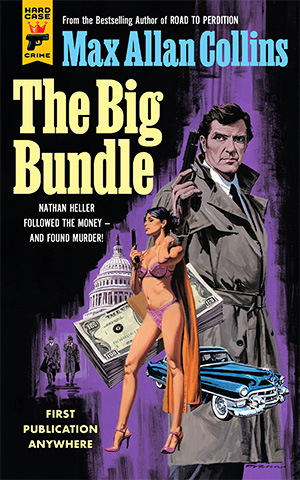
Parker invokes me and some of my ruminations here about slowing down, and specifically wonders if I’ll know when I’m sitting at the computer to work on my final Heller novel. The truth is I don’t know. I have one more Heller to write on the current Hard Case Crime contract, and – as The Big Bundle won’t be out till early December – I don’t yet know how the HCC audience will take to Nate Heller. I am confident that Heller is my most important work and my best shot at being read years after I’m gone.

And Sir Arthur Conan Doyle was convinced his enduring contribution would be those historical epics nobody reads any more.

For me, it’s a matter of paying attention to my health. I’ve had two good reports in recent days and it looks like – aside from getting hit by a bus or something the docs overlooked – I’ll be around a while. I have every expectation this next Heller will get written.

Will it be the last?

I don’t know. Parker wonders if mystery writers realize their characters are getting older. Well, some ignore it. Stout would have characters from previous novels show up on Archie and Wolfe’s doorstep having aged, while Goodwin and Nero remain in the same frozen-in-time state. Mickey Spillane, in advertising for The Killing Man, appeared in Miller Lite trenchcoat-and-fedora drag saying, “I got older – Mike didn’t.”

But he did. Like Jack Benny, Mike Hammer didn’t admit to being older than 39, but he clearly was. He was a guy who’d fought in the Pacific in World War II, using a cell phone in Black Alley (1996). I have made a point, in my collaborations with Mickey, to be more up front about Mike’s age. I fudge it a little, though.

In our Antiques series, Barb and I have to dance around the aging problem all the time. We want the books to be contemporary, so mentions of current political figures and pop culture come in – but we only move the pieces on the chessboard ahead one-season-per-book. In other words, for every four books, one year has passed in the lives of Brandy and Mother. Less than five years in real time elapse over 15 or 16 novels, yet they are moving through time at the same rate as the rest of us.

My late friend Paul Thomas, my musical collaborator, used to say about such things, “If you buy any of it, you buy all of it.”

I think I am more inclined to age my characters more normally than most mystery writers. Quarry’s age can be calculated, and so can Nate Heller’s. But one thing is for sure: me? I am moving only in one direction.

* * *

Here are eleven “intoxicating” crime books set in Las Vegas. They include Skim Deep, but should have made it a dozen with Neon Mirage.

I get a nice mention in this very good article, “A Primer on Crime Fiction.”

I receive a left-handed compliment in this look at the great Batman eras.

M.A.C.