Posts Tagged ‘Reviews’

Short Cuts

Tuesday, February 23rd, 2021

I came to short stories late in my career. I had written a good number as a teenager and, in the Writers Workshop format at the University of Iowa, writing short stories was expected. But I didn’t submit anything professionally until the mid-1980s, and then almost always when I was invited. I believe the first professionally published short story was “The Strawberry Teardrop” (a Heller story) for a PWA anthology. I did allow several early things to be published in Hardboiled, back when my pal Wayne Dundee was the editor, but I don’t recall the exact time frame.

The limited number of markets discouraged me, and they still do. I tried Ellery Queen Mystery Magazine with “A Wreath for Marley,” but the editor turned it down as too long (and it’s a novella, so that’s valid) although claimed to like it. I sold a Heller story to them later – don’t recall which one – and since then, on the rare occasions I submit to EQMM, they haven’t turned anything down. This to me is a real honor. I’ve never submitted anything to Alfred Hitchcock, their sister magazine, simply because I have a good relationship with the editor at EQMM.

The response there to my submissions of Spillane/Collins short stories has been favorable – I did both “A Killer is on the Loose!” (from an unproduced Spillane radio play) and “The Big Run” (from an unproduced TV script by Mickey, done for Suspense). And now, for the first time, a Mike Hammer story appears in EQMM (the March/April 2021 issue) and the Spillane & Collins team has made the cover. [Amazon Link]

This, frankly, delights me.
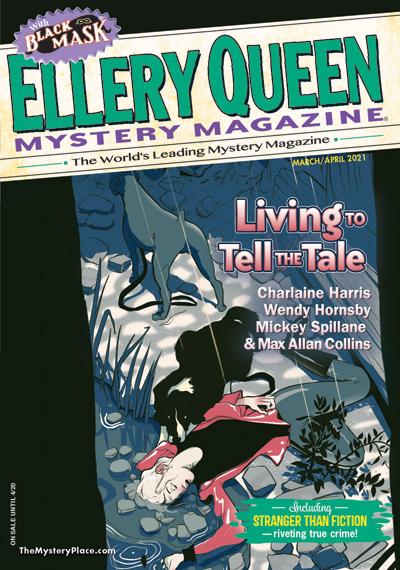
Ellery Queen's Mystery Magazine March/April 2021

We are the issue’s Black Mask Department story, and are the lead story, which is a thrill. And here is what editor Janet Hutchings says by way of introducing “Killer’s Alley,” adapted by me from a short Hammer film script:

“Although Mickey Spillane’s Mike Hammer stepped onto the crime-fiction scene in 1947, just six years after EQMM was founded, he’s never appeared in our pages. As we celebrated the magazine’s 80th year, it’s high time he joined EQMM’s panoply of iconic characters.”

One of the joys of being the keeper of the Spillane literary keys is to see how warmly he is now regarded. This is, frankly, a big deal, getting the EQMM seal of approval. Folks my age (and a few of us are still kicking) know how less than warm the reception was to Mickey and his success in the early ‘50s from a lot of critics and writers who should have known better, but were seized by a fit of jealousy.

Short stories have been on my mind of late, because I’ve been dealing with going over the galley proofs of two new collections of my short fiction, Reincarnal & Other Dark Tales and the forthcoming Suspense – His and Hers: Tales of Love and Murder. The latter, due out in September, is a follow-up to Murder – His and Hers, and again collects stories written individually by Barb and me, and together.

Assembling these has not been without speed bumps. Wolfpack has been incredibly supportive, bringing out much of my remaining back list – the four Eliot Ness novels, the two Mommy novels, and Shoot the Moon, though I haven’t seen a physical copy of that yet. They will be bringing out Regeneration and Bombshell by Barb and me, stand-alone novels.

Already they have Murderlized (by Matt Clemens and me, a new collection I’ve very proud of) and the existing collections, Blue Christmas and Murder – His and Hers. Barb’s Too Many Tomcats is out, too, with an intro and a co-written story by me.

Again, there have been problems. I think Wolfpack’s covers are great, but I’ve had copy-editing problems; but editor Paul Bishop has been patient with my fussiness with both Reincarnal and Suspense – His and Hers. Not every problem can be blamed on copy editors, though. These stories span something like 37 years, and each tale is a file, sometimes going back to (ready for this?) WordStar days. So what we delivered sometimes had glitches I hadn’t caught. A typical problem was that, for a long time, editors wanted italics indicated by underlining; maybe a decade ago, they switched to wanting italics indicated by, yes, italics.

And Wolfpack had to get a bunch of my books out all at once. Reincarnal has a problem that a number of you have pointed out – the table of contents page is messed up. One story is not included and the numbering is wrong. I missed this. I frankly never thought to check the table of contents.

The nice thing about the e-book age is that we can correct things like that. So anyone ordering Reincarnal now, whether e-book or physical book, will have a corrected table of contents. The rest of you – well, what do you know? You own a collector’s item!

Seriously, though, folks – if you catch a typo in anything of mine, whichever of my publishers has put it out, let me know at macphilms@hotmail.com. We will at the very least be able to correct the e-book version.

Barb, by the way, has been a natural from the start where short stories are concerned. She grew up on Alfred Hitchcock Presents and The Twilight Zone and developed a real feel for a compact form with a twist ending. From the start she got great reviews and reactions for her stories, including getting slots in “best of the year” anthologies. For her, novel-writing was a stretch, but she has adapted beautifully. Nonetheless, her touch with the short form remains a strength – we have a story together (conceived by her) in – yes! – an upcoming issue of Ellery Queen Mystery Magazine.
* * *
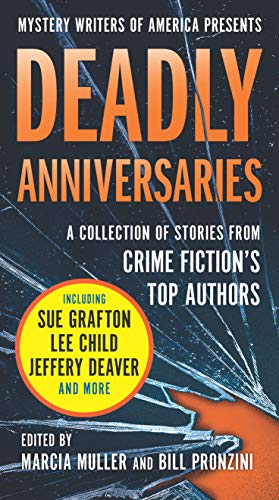
Deadly Anniversaries Ebook Cover

I am pleased to share with you something from another of my favorite newsstand publications, Mystery Scene. The great Jon Breen included Do No Harm in an article about recent legal thrillers; a lovely color reproduction of the cover of this latest Heller novel accompanied it.

“Max Allan Collins’s excellent series about Zelig-like private eye Nate Heller fictionalizes major crimes of the past century. Occasionally, Heller drops in on classic trials, perhaps most notably in Damned in Paradise(1996), featuring a complexly characterized Clarence Darrow appearing for the defense in a 1932 Honolulu rape case. The latest in the series, Do No Harm (Forge), considers the murder of Marilyn Sheppard for which her husband Dr. Sam Sheppard, a Cleveland osteopath, was tried and convicted in 1954 and retried in 1966, this time with famed advocate F. Lee Bailey heading the defense. Both trails are visited in a total of about a dozen pages, the first summarized to Heller by newspaper columnist Flo Kilgore (a transparent pseudonym for Dorothy Kilgallen), the second viewed by Heller and including some well-selected quotes from Bailey’s cross-examinations. All the real people in the cast – Bailey, Kilgore/Kilgallen, Erle Stanley Gardner, Eliot Ness, and especially Sam Sheppard himself – come to life as convincing fictional characters. As usual, Collins’ concluding author’s note provides a bibliographic essay on his sources to make the fact/fiction demarcation clear.”

Getting back to short fiction, a story that I consider one of my best – “Amazing Grace” – appears in the MWA anthology, Deadly Anniversaries. It’s on sale now in e-book form for under two bucks, right here.

Here is an absolutely stellar Come Spy With Me review at Bookgasm.

Here’s a mixed but smart review, mostly favorable, of Skim Deep. But for the last effin time, it’s Nolan, not Frank Nolan. He has never been Frank Nolan. Stop it already.

Finally, here’s a nice if belated (but appreciated) UK review of Girl Most Likely.

M.A.C.
Book Give-Away, Noir Alley Clips, and a Current Interview

Tuesday, February 2nd, 2021
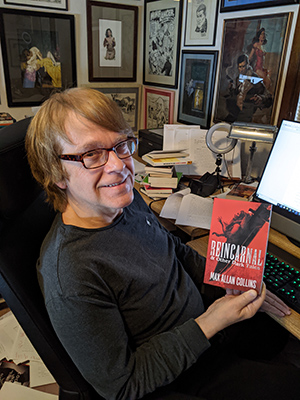
Max Allan Collins holding up a trade paperback of Reincarnal & Other Dark Tales

This week we have fifteen copies of the beautiful Wolfpack trade paperback edition of Reincarnal & Other Dark Tales to give away. I’ve written about this book here before, but I only now have physical copies in hand.

[All copies have been claimed. Thank you for your support! New updates are posted every Tuesday at 9 Central. — Nate]

If you miss out on the giveaway, I hope you’ll order it anyway, either on Kindle or this very cool trade paperback, which is a rather massive 330-some pages. It collects virtually all of my horror short stories, including two radio plays written for Fangoria’s Dreadtime Stories.

Be forewarned (or enticed, as the case may be) that many of the stories in Reincarnal (as the title may indicate) have a strong sexual element. This has to do with many of them originally having been published in erotic horror anthologies, back in the day when such stalwarts as Marty Greenberg, Jeff Gelb and Ed Gorman were turning out wonderful “theme” anthologies of original stories.

As I said here before, horror is a strong element of my fiction – you can see it in the Mommy novels (available from Wolfpack), many of the Quarry novels (The Wrong Quarry), a number of Hellers (Angel in Black), Eliot Ness (Butcher’s Dozen) and novels by Barb and me (Regeneration). Even the recent non-fiction work, Eliot Ness and the Mad Butcher (by A. Brad Schwartz and myself) qualifies as horror-tinged. The only horror tales not collected in Reincarnal can be found in the Wolfpack collections Murderlized (gathering collaborative stories by Matt Clemens and me), Blue Christmas (holiday horror and dark suspense), and Murder – His and Hers (stories by Barb and me).

While I am first and foremost a novelist, I do enjoy writing short stories and it’s long been an ambition to see collections of my shorter fiction, like Reincarnal, give those stories a certain permanence.

* * *

If you missed my second guest shot with Eddie Muller on Noir Alley, here is the intro and the outro for Born to Kill, a great crime movie you should see (the TCM streaming service has it right now).

* * *

Publisher’s Weekly has a great article by Lenny Picker about Hard Case Crime. I can’t share it with you, because PW requires you to subscribe for the link to go through.

I was interviewed for the PW article on HCC, and a grand total of one paragraph was used (in part) in that article. So, since that interview is very up-to-date as to what I’m up to, I’ll share it here:

What led you to have some of your books published by Hard Case Crime? In other words, what makes a Collins book a better fit for HCC?

When editor/publisher Charles Ardai began Hard Case Crime, he featured a number of reprints among the originals, from the classic likes of Erle Stanley Gardner and Lawrence Block. He approached me about reprinting the second Nolan novel, Blood Money, and I suggested he reprint both it and the first in the series, Bait Money, under one cover, which he did, as Two for the Money. Later he approached me about doing another reprint and I offered instead to write an original. It was obvious to me Charles and his partner Max Phillips had a love and feel for classic hardboiled fiction and represented a home for what I most like to write in a market not terribly conducive to that.

Another fact was the retro packaging, the covers that were not only fully illustrative in the fashion of ’50s and ’60s paperback suspense novels, but depicted beautiful femme fatales and handsome tough guys, in a fashion that had become essentially forbidden due to politically correct restraints at other publishers. HCC has a way of saying, “We’re retro, not Neanderthals. We have our tongue slightly in cheek as we celebrate a form of American mystery fiction pioneered by such greats as Raymond Chandler and Dashiell Hammett.”

What makes them different from other publishers/imprints?

They go their own way and are motivated by a love for the noir genre, taking risks with new talent and respect older talent. Charles Ardai encourages me to write what I want to write. I’m at a point in my career and, frankly, at an age where being able to write what I want means more than financial considerations, an approach that can pay off better than a more market-driven, cynical one.

For example, the first original I did for HCC was a return to my Quarry series, which had become a cult favorite after its initial four-book run in the mid-’70s and a one-shot comeback ten years later. I’d always wanted to complete the series and The Last Quarry was intended to be the final book about my hitman character…the first contract killer to “star” in a book series. The Last Quarry was popular and widely well-reviewed. Charles said, “Too bad you’ve written the last book in the series.” And I said, “How about I write, The First Quarry?” Since then another dozen or so have followed. An award-winning short film I wrote led to a Quarry feature film (The Last Lullaby), and a few years ago HBO/Cinemax did a Quarry TV series.

What led you to revive Nolan last month?

Charles has been after me to do that dating back to Two for the Money. I resisted, feeling my novel Spree was the proper ending to the series. But he said he’d bring the early books back out if I did a coda to the series, which I have — the current Skim Deep. Now I’m writing a coda to The Last Quarry called Quarry’s Blood. My hitman is 68 years old in the novel, which is younger than me.

How hard was it to return to the character after so many years?

Not at all. I spent almost two years, when I was at the University of Iowa Writers Workshop in the late ’60s, writing that novel. My instructor was Richard Yates, the great mainstream novelist. I also studied with Walter Tevis, whose reputation is getting a boost from The Queen’s Gambit mini-series. So I spent a lot of time with Nolan and his young sidekick Jon, and then there were the other six novels and several versions of a Nolan screenplay I wrote a while back…unproduced as yet, but it got optioned. A movie is brewing now combining elements of several of the novels.

How was writing him different?

He was an old man of 48 when I conceived him at age 20. Now he’s 55 and really something of an old man, so my perspective on him has shifted.

Are there other characters that you’re planning on reviving?

I get requests to do another Mallory, but that character was based on me, which doesn’t interest me. My recent Krista Larson series I hope to keep going, and when the political world settles down, if it ever does, I might do another Reeder & Rogers novel with Matt Clemens, who I’m writing the James Bond-ish “John Sand” novels with now for Wolfpack. My wife Barb and I are continuing the long-running Antiques series we write together as Barbara Allan, with Severn now.

The biggest thing will be taking Nathan Heller to HCC. I consider the Heller novels – which as you know are traditional tough private eye novels dealing with major crimes of the Twentieth Century – my best work, my signature work. But I don’t spend all my time looking backward. I’m working on two projects for Neo-Text, one a ’40s female private eye, Fancy Anders, who solves mysteries involving an aircraft plant, a movie studio, and the Hollywood Canteen. The other is a science-fiction-tinged noir collaborating with SCTV star Dave Thomas, who was a writer/producer on Blacklist and Bones, for which I wrote a tie-in novel.

I should note that HCC has been a supporter of my work building up the legacy of my friend and mentor, Mickey Spillane. We’ve done several books at HCC, and something like fourteen Mike Hammer novels at HCC’s parent company, Titan. These all reflect my completing unfinished manuscripts from Mickey’s files, something he asked me to do shortly before his passing in 2006. Next year is the 75th anniversary of Mike Hammer, and I’ll be doing a biography of him with James Traylor for Otto Penzler at Mysterious Press. It’s people like Charles and Otto who nurture and keep the hardboiled genre alive in the face of changing times.

What would you most want article readers to know about HCC?

HCC is a boutique publisher that cares about books, readers, and authors. I am extremely grateful to them for letting pursue my work my way.

* * *

A reader in this You Tube piece recommends five HCC titles to represent that publisher’s output, and The First Quarry is one of them!

And, finally, this fantastic review from the UK of the current Mike Hammer, Masquerade for Murder.

M.A.C.

New Horror and Dark Suspense Antho from Wolfpack

Tuesday, January 19th, 2021
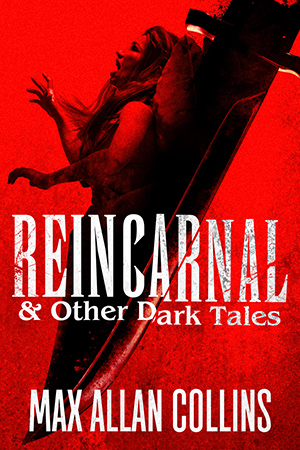
Book cover for Reincarnal and Other Dark Tales
E-Book: Amazon Purchase Link

In about a week, my latest Wolfpack release – Reincarnal & Other Dark Tales – will be available on Kindle, and shortly thereafter as a physical book.

When I have copies of the trade paperback, I will announce a book giveaway here. For those that haven’t noticed, this update/blog has a new post every Tuesday morning. [10 Eastern/9 Central unless I mess something up. –Nate] So check in – they go fast.

Obviously, Wolfpack has provided me with another outstanding cover. I continue to be delighted by what they come up with. I realize some of you may be overwhelmed by how much of my material Wolfpack has unleashed upon an unsuspecting world pretty much all at once. Publisher Mike Bray and editor Paul Bishop were good enough to take on virtually all of my remaining backlist, as those who come here regularly know. Nine of these books are novels, but the others are anthologies. Of those anthologies, only three (including a forthcoming one by Barb and me, Suspense – His and Hers) are new collections…new books.

Reincarnal is one of them.

It’s a special one for me, because it collects virtually all of my horror short stories. In addition, the book includes two radio plays that I wrote for Fangoria’s Dreadtime Stories: “House of Blood” and “Mercy.” I adapted a number of the yarns in the collection for Dreadtime Stories, but the two radio plays were original to the series.

While I’ve spent most of my career writing suspense and crime fiction, the horror genre has been an interest since childhood, undoubtedly having to do with watching old monster movies on TV. In Reincarnal, you meet the big three: Frankenstein’s monster, a werewolf, and more than one vampire.

Some of the stories are more in a “dark suspense” vein, though the majority have a supernatural element. And they have another element that may either please or not please you: this is definitely a “parental advisory” type book. Several stories were originally written for the famous Hot Blood and Shock Rock series, whose co-editor Jeff Gelb was my co-editor on Flesh and Blood. The format of those anthologies was to combine horror with an erotic element.

I mention this because – much to my surprise – in recent years some readers are offended by sexual content, and many of you are undoubtedly saying, “Boy, did they sign up with the wrong writer.” In re-reading the stories, I realized that changing times and attitudes are reflected therein, but I made no edits to bring them up to date. They were written over a thirty-year period and, like Popeye, yam what they yam.

But also in re-reading the stories I discovered that some of these dark tales are among my best work. I would be hard-pressed to come up with a better story of mine than “Traces of Red,” for example. “Reincarnal,” the lead story, was much praised at the time of its original publication, and I adapted it into a screenplay. That project still rears its head now and then. “Interstate 666″ was written originally as a screenplay, and the story herein is actually a condensed version. It came very close to being made as a TV pilot (one iteration involving Rob Zombie!).

Both radio plays in the new collection were conceived in hopes of movie production and they too are not yet off the table in that regard. Those stories are collected in audio anthologies available at Amazon and elsewhere. Producer Carl Amari did a great job on them.

My interest in horror should come as no surprise to my regular readers, even though they may missed the stories collected in Reincarnal when originally published. Such novels of mine as Butcher’s Dozen, Angel in Black, and What Doesn’t Kill Her, as well as the two J.C. Harrow novels by Matt Clemens and me, are in part horror novels. So is Regeneration by Barb and me (a new edition is coming from Wolfpack).

Speaking of which, let me get back to Wolfpack. You supporting my efforts there by ordering Reincarnal & Other Dark Tales and the John Sand novel, Come Spy With Me, paves the way for me to do new novels in various series that have run their course at other publishers. When fans ask a writer, are you ever going to do another novel about such-and-such a favorite character, the true answer is: it’s not up to the authors. We need publishers who believe in us, and frankly most publishers want the next big thing, not the last modestly successful thing.

* * *

We lost Parnell Hall recently, and the parade of hurtful losses to the mystery genre continues. The great John Lutz of Single White Female fame is gone.

outdoor portrait of author John Lutz wearing a black shirt and jacket.

This from Janet Rudolph:

John Lutz: 1939-2021.

I was lucky to know John Lutz over the years. John wrote over 50 novels of political suspense, private eye novels, urban suspense, humor, occult, caper, police procedural, espionage, historical, futuristic, amateur sleuth, thriller — just about every mystery sub-genre. He also wrote over 200 short stories and articles. John was a past president of both Mystery Writers of America and Private Eye Writers of America. Among his awards were the MWA Edgar, the PWA Shamus, The Trophee 813 Award for best mystery short story collection translated into the French language, the PWA Life Achievement Award, and the Short Mystery Fiction Society’s Golden Derringer Lifetime Achievement Award. And, he was a kind, supportive, and generous man. He’ll be missed.

I knew John well, and Barb and I know his wonderful wife Barbara, too. John was a terrific writer and also displayed a dry wit second to none. For many years, John was a welcome, low-key presence at Bouchercon, one of those friends I saw almost exclusively in that manner. He was shy and modest, but that sense of humor came through, or I should say sneaked up on you.

This one hurts.

* * *

This mind-bogglingly wonderful review of Skim Deep is at Book Reporter. Please feast your eyes upon it.

M.A.C.

Fate of the Union and More Queen’s Gambit

Tuesday, January 12th, 2021

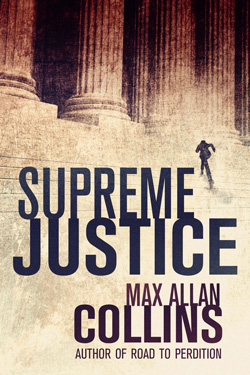
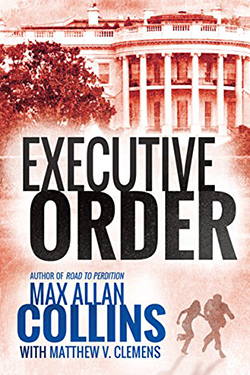
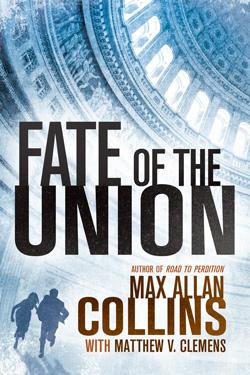
As many of you know, my friend and longtime collaborator, Matthew V. Clemens, and I wrote a trilogy of political thrillers a few years ago, with the three branches of our government represented by individual novels. They are Supreme Justice (the Supreme Court), Fate of the Union (Congress), and Executive Order (the Presidency).

Supreme Justice cover
Executive Order cover

Fate of the Union cover

As it happens – not really as part of any plan – all three deal with threats from within, essentially domestic terrorism. Somewhat chillingly, the second novel – Fate of the Union, published in 2015, posited a run for the Presidency by a billionaire populist as well as an attack on the United States Capitol building.

After the events of last Wednesday, January 6, occurred, I asked Matt, “Shall we sue Trump for plagiarizing us on Fate of the Union?” His response: “Can we? Can we please?”

Last week I neglected to announce that all three Reeder & Rogers titles are on sale on Kindle until the end of this month (January). Supreme Justice and Fate of the Union are $1.99 and Executive Order is 99 cents.

* * *

I’ve had many nice comments about my update last week, in which I talked about (among other things) my time at the Writers Workshop in Iowa City with Walter Tevis as my instructor. That included my thoughts on the wonderful Netflix mini-series based on his 1983 novel, The Queen’s Gambit.

Barb and I enjoyed that mini-series very much – we watched it twice – and I found myself compelled to take the novel off the shelf (it, and Walter Tevis’s other books, are in my office in one of two bookcases of honor) to read it for the first time. Years ago I had, wrongly, set it aside because of its chess theme, thinking that I needed to be intimate with the game to enjoy the novel.

I was stunned to discover how incredibly faithful the mini-series was to its source, perhaps the most faithful film adaptation of a novel I’ve encountered in years. Oh, they are out there – for example, you can follow The Maltese Falcon in the book while you watch the John Huston film, skipping only the scenes (and they are few) that didn’t make it into the movie.

The Queen’s Gambit, the mini-series, not only replicates almost all of the dialogue from the novel, it endeavors to turn interior monologue into speech and pays close attention to descriptions of clothing and particularly setting.

When Beth enters fellow chess player Benny’s basement apartment in New York, Tevis tells us, “There were plastic bags of garbage in the entryway,” and details the pump Beth must pedal with her foot to inflate a rubber mattress. Earlier, when Beth spends the night with a college boy and wakens to find herself alone in a post-party house, the note to her on the refrigerator is held by “a magnet in the shape of Mickey Mouse’s head.” And that’s what is depicted in the mini-series.

Countless details, including mannerisms of Beth’s chess opponents, are recounted, like a young man who brushes back his hair. Someone – or many someones – loved this book! It’s astounding.

Now, differences do crop up, though mostly it’s expansion of scenes. The major ones have to do with Beth’s mentally disturbed mother, a boy she loves who the mini makes gay, and a somewhat opened-up last few chapters, with an almost Capra-esque long-distance-call reunion of many of Beth’s chess-world friends when she can use some help with the big match. The scene is in the book, but only involves Benny and a couple of chess experts, not a reunion of characters – which is a good change, because it shows that this lonely girl has friends and needs friends. The gay (bisexual?) sort of love interest shows up in Moscow in the final section, also to be supportive, and it’s a good change. A less good one is having Beth’s black friend, Jolene, seek Beth out as an adult when the book shows our troubled protagonist reaching out to that old friend. Tevis shows Beth struggling to help herself and not just being rescued out of the blue.

These differences are well within the rights of the adaptors, and I generally feel that a film only has a responsibility to be faithful to the spirit of its source. I was fine with most of the liberties taken with Road to Perdition (and any writer who cashes the check should shut the hell up, anyway).

But seeing filmmakers who view the text as, if not sacred, something to be plumbed for inspiration and guidance, well…that is as refreshing as it is unusual.

Now, I’m going to shift gears but stay on the subject of Walter Tevis and The Queen’s Gambit.

If you’ve followed these updates or read interviews with me, you may be aware that I read little fiction. The reasons are numerous, but among them is avoiding being influenced by style. I’m enough of a natural mimic that I can get myself in trouble.

A major reason is that a book I am writing is, in a very real way, a book I am reading. And I’ve never been one to read two books at a time, going back and forth between them. Not my way. So, immersed in the narrative I’ve been trying to get down on paper, I avoid other people’s prose narratives.

Now, that does not include reading non-fiction, even biographies. Nor does it include listening to a book in the car on a trip, back when we took trips in cars. Remember that? And I watch a lot of movies and TV in the evenings, winding down.

But there’s another difficulty I have reading fiction. I don’t really believe in rules of fiction writing – to me, storytelling is mostly strategy. For example, is this a story better told in third-person or first-person? Where in the story should I begin? Should I end a dialogue scene when I get to a snappy, memorable line, or let it play out? And a million other things, or anyway thousands.

I have been writing professionally since 1971, but I was trying to write professionally starting in 1961 and worked at a newspaper in the summers of ‘66 and ‘67. So I’ve been at this a while, and though I studied at the Writers Workshop, and benefitted from it, I learned early on that you can’t be taught to write by anybody but yourself. You can get tips from a pro like me, but to learn to write you must do things: you read and you write. You read because you love it and, later, you read analytically; and you write by trial-by-error.

So in these many years, I have come up with those thousands of strategies that have become, in a way, my rules. Not your rules, not anybody else’s rules; but mine. Some of my approach has bled over into collaborators like Barbara Collins and Matthew Clemens, but they have developed their own rules/strategies, too…as well they should.

Okay, I said above that part of learning to be a writer is reading books. And for the years leading up to becoming a professional novelist, I did. So why don’t I read much fiction any more? (I do read some – mostly the people I read before becoming a pro, however, like Hammett, Chandler, Stout, Spillane, Christie, etc.).

Which brings me to The Queen’s Gambit again. Tevis is a wonderful writer, and I learned things from him then (and now), although probably more from The Hustler than his classroom teaching. I was struck by how beautifully Queen’s Gambit is written and came upon passages that I stopped and re-read aloud.

Not often.

A book that has you doing that all the time is a book by an effing show-off. Some highly respected writers in my genre, much more respected than me, are dedicated to making themselves and their readers feel important. Well, I already feel important enough, so to hell with that, and anyway I’m here to try to tell you a good story. Don Westlake told me, “Good writing is invisible.”

Tevis writes simply but is not afraid to use a word you may not know. He is clear and he is precise. I have been criticized by blog-type reviewers and even mainstream reviewers, as well as an editor (former editor), for writing about clothing and setting. Tevis does both and gives you not only a sense of place, but by doing so a sense of who those characters are. He wrote these detailed descriptions so thoroughly and well that they made it into the mini-series that everybody loves.

So I felt validated by that.

But I also stumbled on a writing strategy of his that began to bother me. He uses the “There is” and “It was” construction often. I find that passive, even lazy. It’s something that, in recent years, I’ve tried to avoid (though I didn’t in this sentence).

When Tevis would break one of my “rules,” it stopped me and I would find myself rewriting him, like Beth Harmon looking at the chess board on her ceiling and moving pieces around, replaying a famous game and looking for errors. It broke the spell.

Don’t get me wrong. I loved the novel. Tevis is a great writer and having books like The Hustler and The Queen’s Gambit on my list of credits would be a dream come true. But he had his strategies and I have mine, and as much as I enjoyed reading The Queen’s Gambit, it demonstrates why I rarely read fiction.

But please, please, everybody out there (both of you) – keeping reading stories. It’s what separates us from the apes.

That and opposable thumbs.

* * *

This is a fabulous review of Skim Deep, and I swear I didn’t write it myself.

I get mentioned on the great podcast Paperback Warrior again, but run into The Fanboy Gambit – the reader who won’t read the new book till he’s read all the others in the series!

M.A.C.