Posts Tagged ‘Nate Heller’

Celebrating the Release of the Mad Butcher

Tuesday, August 4th, 2020
Eliot Ness and the Mad Butcher
Hardcover: Indiebound Purchase Link Bookshop Purchase Link Amazon Purchase Link Books-A-Million Purchase Link Barnes & Noble Purchase Link
E-Book: Amazon Purchase Link Google Play Purchase Link Nook Purchase Link Kobo Purchase Link iTunes Purchase Link
Digital Audiobook: Amazon Purchase Link Google Play Purchase Link Kobo Purchase Link
Audio MP3 CD: Indiebound Purchase Link Bookshop Purchase Link Amazon Purchase Link Books-A-Million Purchase Link Barnes & Noble Purchase Link
Audio CD: Indiebound Purchase Link Bookshop Purchase Link Amazon Purchase Link Books-A-Million Purchase Link Barnes & Noble Purchase Link

Today is the publication date of the non-fiction tome Eliot Ness and the Mad Butcher by A. Brad Schwartz and myself. I am celebrating this by giving away ten copies.

[Edit: All copies have been claimed. Thank you!]

The four Eliot Ness novels covering his Cleveland years – a quartet that eventually led to both the play/film Eliot Ness: An Untouchable Life and the two non-fiction works, Scarface and the Untouchable and the new Eliot Ness and the Mad Butcher – are available at Amazon from Wolfpack as An Eliot Ness Mystery Omnibus for $2.99. Even with my meager math skills, I can tell that’s a penny under three bucks for four novels.

While we hope to offer new print versions of the novels (perhaps in two-novels-to-a-volume form), right now they are Kindle e-books only. So no giveaways are in the cards for now. But if you have already read the novels – any of them – and liked them, reviews of the Eliot Ness Omnibus would be much appreciated. Right now we have a paltry two reviews at Amazon and that doesn’t go very far at getting the Omnibus noticed. Even if you haven’t bought the books in this new form, don’t hesitate about reviewing them under the Omnibus listing.

Since I’ll be talking about Eliot Ness this week, I’ll remind you that Eliot Ness: An Untouchable Life is available on Blu-ray now at Amazon.

It’s also available on DVD for $9.99.

Reviews for Untouchable Life at Amazon are also appreciated. We only have two at the moment, and no one has specifically talked about the Blu-ray.

Also, the entire five-book Mallory series will be available for 99-cents each as Mystery, Thriller & Suspense Kindle book deals from now through the end of August. Included in the sale will be the thriller Regeneration by Barb and me (as “Barbara Allan”), also at 99-cents.

The Mallory titles are: No Cure for Death; The Baby Blue Rip-off; Kill Your Darlings; A Shroud for Aquarius; and Nice Weekend for a Murder.

* * *

Is it undignified to celebrate the career of a law enforcement icon who could not be bribed by offering a giveaway, and hawking various titles pertaining to him? I don’t really care, since I never claimed to be untouchable myself.

But Eliot Ness and the Mad Butcher (it has a subtitle but I decline to use it, because I dislike it intensely) marks the final stage of an interest in the real-life lawman that reaches back into my childhood. My interest in such things begins even before the first Untouchables of two installments on Desilu Playhouse aired on April 20, 1959. The Dick Tracy comic strip (by way of comic book reprints) had ignited that interest; but, in fairness, since Ness was the real-life basis of Chester Gould’s Tracy, the Untouchable was already in the mix.

There’s no question that Tracy and Ness got me interested in stories about detectives, but more significantly The Untouchables TV series (and the autobiographical book that spawned it) got me interested in the factual material that generated so much of the guns-and-gangster pulp fiction I adored. My novel True Detective (1983), after all, deals with the same crime – the assassination of Mayor Cermak – as a two-part Untouchables episode I saw as a kid. Granted, that two-parter only nodded at history, but that nod was enough to get my attention.

Ness became the Pat Chambers to Nathan Heller’s Mike Hammer in a number of the Heller novels. At the request of an editor at Bantam, I spun Ness off into the four novels that dealt with his Cleveland years (previously explored, somewhat inaccurately, in Oscar Fraley’s Untouchables follow-up, Four Against the Mob, but otherwise little written about).

Two things are, I think, significant about those novels, including that they represent the first time actual cases of this real-life American detective had been the basis of stories about him (excluding the initial two-part telefilm). More importantly, the writing of the books led to research by myself and George Hagenauer that uncovered new (or at least forgotten) information about Ness.

In addition to his occasional role in the Nathan Heller saga, Ness appeared in my graphic novel Road to Perdition (drawn by the great Richard Piers Rayner) and in my prose sequel, Road to Purgatory (available from Brash Books). The latter, to some degree, dealt with Ness’s little-known role in fighting venereal disease on military bases and elsewhere during World War II.

For unknown reasons, Ness was not depicted in the film version of Road to Perdition, but that nonetheless led to the play (and 2007 video production of) Eliot Ness: An Untouchable Life. Initially, actor Michael Cornelison and I were planning to do a one-man show about Perdition antagonist John Looney. We intended to mount it in Rock Island (where Looney had been the local crime boss in the early Twentieth Century) and shoot the film in one of the two existing houses were Looney had lived.

Somewhere along the line, one of us – it may have been Mike – suggested that Ness would have greater appeal to a wider national audience. Also, over the years I had heard from editors and readers that I should do a non-fiction treatment of Ness, since I had done so much research into and about him. Much of what George and I uncovered about Ness was making its way into the accounts of non-fiction writers (fiction writers, too) without credit.

As an independent filmmaker, looking for productions that could be produced cheaply but well, I found a one-man show appealing. I also had the possibility of a grant from Humanities Iowa, for whom I’d made an appearance at a University of Iowa event with editorial cartoonist, Paul Conrad. We mounted the play at the Des Moines Playhouse, where we shot the film between performances. My eventual co-author Brad Schwartz saw the play and that sparked our collaboration.

I had intended An Untouchable Life to be my final statement on Ness. While it is written from Ness’s point of view, skewed to his own memories and perceptions of his life, and some dramatic liberties were taken (by both Ness and me!), the play represents the most accurate depiction of Ness on screen to date.

Eventually, however, Brad convinced me to join him in writing the definitive biography of Ness. We embarked on doing that only to discover another, apparently major Ness biography was about to come out. I had once considered doing a massive, Godfather-style novel on both Capone and Ness, cutting back and forth between their stories. Now I suggested we follow that approach, but in a strictly non-fiction fashion. That would set us apart from any Ness bio or Capone bio, for that matter.

Obviously that approach – particularly since we intended to do cradle-to-grave accounts of both men – turned out to be too big for one book. Now we have a two-volume work that I feel confident is the definite treatment of the life of Eliot Ness. The research George and I did for the novels has been greatly enhanced by further research, much of it by my co-author, who crisscrossed the country in his efforts, even talking to surviving friends and associates of the long-deceased lawman.

It must be said that I have written about several different Eliot Nesses. The Ness of the Heller books serves a specific function – he is Heller’s conscience, the Jiminy Cricket to his Pinocchio. The portrayal darkens in Angel in Black and Do No Harm. The Eliot Ness Omnibus of Cleveland novels is a basically accurate but somewhat romanticized version of Ness – far closer to reality than Robert Stack, but splitting the difference between them. The same is true of Ness in Road to Perdition and Road to Purgatory. Eliot Ness: An Untouchable Life is only slightly romanticized, and (in my view at least) portrays him as he saw himself.

The real Ness can be found in Eliot Ness and the Mad Butcher (and Scarface and the Untouchable). My co-author and I did not always agree on what – or who – the research added up to. We wrestled our way into a joint presentation that is probably more accurate than if either of us had been turned loose alone.

I can look at these two works and feel that, at last, I have done right by this complex real-life Dick Tracy. With the publication of Eliot Ness and the Mad Butcher, with the recent publication of Do No Harm (which ends Ness’s story in the world of Nate Heller), and with the four Ness-in-Cleveland novels gathered into Omnibus form, I feel I’ve come full circle.

* * *

Here’s a great Wall Street Journal review. Here is the link, but it requires a subscription to read.

‘Eliot Ness and the Mad Butcher’: An Untouchable Second Act

After helping to put Al Capone behind bars, lawman Eliot Ness came to Cleveland, where he did battle with a vicious killer.

Moviegoers of a certain age will remember Eliot Ness—the upright law-enforcement figure who battled corruption and organized crime from the 1920s to the ’40s—as portrayed by a tough-talking Kevin Costner in Brian De Palma’s 1987 movie “The Untouchables.” Television viewers from an even earlier era will recall Ness depicted by the stern-faced Robert Stack in the ABC series (1959-63) of the same name. But the real-life Ness, as revealed in Max Allan Collins and A. Brad Schwartz’s “Eliot Ness and the Mad Butcher,” was less the hard-boiled hero of popular culture than a humane and forward-thinking lawman as interested in preventing crime as in punishing it.

The Chicago-born Ness (1903-57) came to prominence as a Prohibition agent in the Windy City, doing battle with Al Capone and other bootleggers as head of his own hand-picked squad of agents. His men were dubbed the “Untouchables” for their refusal to accept payoffs or gratuities. As a friend observed of the incorruptible lawman: “Honesty amounted to almost a fetish.”

The government put Capone behind bars in 1932 via the prosecution of a tax-evasion case, but the work of Ness and his men was central to establishing the extent of the mobster’s criminal activities. With Capone out of the picture, the Untouchables were disbanded, and Prohibition ended soon after. Ness, a nationally known figure (his physical and professional image inspired Chester Gould’s comic-strip police hero Dick Tracy), looked beyond Chicago for new opportunity. He found it in Cleveland, the site of his next significant successes—but also of the disturbing case that gives Messrs. Collins and Schwartz’s book its title.

Ness was named Cleveland’s director of public safety in 1935 and was put in charge of the city’s police and fire departments. He found the cops to be sloppy, uncooperative and demoralized. Once more he formed his own discrete unit of Untouchables to weed out incompetent and corrupt officers and hire smart new ones. “Intelligence,” he counseled, “must supplant brutality.”

But even Ness was stumped trying to apprehend the “torso murderer” responsible for a series of ghoulish killings, in which parts of dismembered and beheaded corpses were strewn about the woods and dumpsites of Kingsbury Run, one of the city’s poorest areas. “The mystery of the headless dead” drew national and international attention. In Germany, the Nazi press mocked America’s inability to apprehend the “Mad Butcher of Kingsbury Run.” With no witnesses and sometimes no way even to identify victims—and with advanced forensics techniques far in the future—police were stymied.

By 1938, the authors write, “the Butcher had become the subject of the largest manhunt in Cleveland’s history.” Thousands of citizens wrote and called the cops with worthless tips. “The investigators, after years of fruitless searching, grew desperate, pursuing ever more eccentric lines of inquiry.” At last a few tantalizing leads brought an alcoholic and mentally disturbed doctor named Francis Sweeney to the attention of the detectives.

Ness and his crew subjected the 44-year-old Sweeney—who had shown signs of psychosis and had been verbally and physically cruel—to judicially inadmissible polygraph examinations that convinced all present of his guilt. Still, despite an abundance of circumstantial indicators, Ness had no hard evidence. Complicating matters was the man’s being a cousin of a local congressman, a vocal Ness critic. Prosecution was not an option. Ness handled the matter privately, helping to arrange Sweeney’s commitment to a mental hospital. Sweeney, who was institutionalized for much of the rest of his life, sent a series of bizarre and taunting postcards to Ness through the mid-1950s.

Though Ness was sure that the killer had been caught and dealt with, he couldn’t officially close the case and so swore himself and his men to secrecy. The public was left with the impression that the culprit might still be at large. The case of the Mad Butcher, with its unsatisfying non-finale, fits a bit awkwardly into Messrs. Collins and Schwartz’s wider narrative. In the latter stages of their book, the authors ably follow Ness through an unsuccessful foray into city politics and a disappointing business career. But given this work’s title and its subtitle—“Hunting America’s Deadliest Unidentified Serial Killer at the Dawn of Modern Criminology”—one sometimes gets the feeling of two different books uneasily hitched.

That said, the authors have done Ness justice. It’s discouraging to learn that a man who refused a fortune in bribes died $9,000 in debt. Shortly before his fatal heart attack at the age of 54, he finished work on the memoir that would revive and romanticize his reputation and bring his third wife and their adopted son a modicum of income.

Messrs. Collins and Schwartz, in this, their second deeply researched book about Ness, don’t gloss over their subject’s failings and blind spots, but they do show that he tried harder than many to leave the world a better place. His “signature achievements in Cleveland—fighting juvenile delinquency, reorganizing the police department, promoting traffic safety—stemmed from a deep well of humanity and compassion,” they write. Now more than ever, the authors conclude, Ness’s name “should remind us of the rigorous standards he brought to law enforcement—professionalism, competence, honor, and decency—and a determination to make everyone safer by addressing the systemic root causes of crime.”

Review by Tom Nolan.

* * *

My favorite Jeopardy! question popped up again on a rerun this week:

MAC on Jeopardy!

Here’s a great interview with my buddy Charles Ardai, editor of Hard Case Crime. He mentions me several times, bless him.

Check out this wonderful review of The First Quarry.

M.A.C.

52 Cards and a Joker

Tuesday, June 2nd, 2020

Today, as I write this (June 1, 2020), is the 52nd wedding anniversary of Max Allan Collins and Barbara Jane Mull, aka Al and Barb Collins, aka Barbara Allan.

Fifty-two cards in the deck and one joker.

We are celebrating almost not at all, as we continue to shelter in place. Our splurge is a bottle of champagne, some wine-cheese spread, and crackers. This evening we plan to watch The Billion-Dollar Brain (a film we saw together on its initial release) as the third entry in our Michael Caine as Harry Palmer Blu-ray festival, having watched The Ipcress File and Funeral in Berlin on the preceding two evenings.

In recent years we’ve spent our anniversary in Galena, Illinois, at the Irish Cottage hotel, with two days of dining and shopping and doing touristy stuff. It’s something we enjoy very much and hope to do again one day. But going on such an excursion before there’s a Covid-19 vaccine is highly doubtful.

I try to stay away from politics here, though it does creep in. Forgive me, but it’s going to be unavoidable today.

You see, fifty-two years ago was 1968. Barb and I went to Chicago on our honeymoon. We ate at George Diamond’s and Augustino’s, restaurants that would eventually find their way into Nate Heller novels. We saw a bunch of movies, including (if memory serves and it often doesn’t) 2001: A Space Odyssey and a re-release of Gone With the Wind. We went to the Museum of Science and Industry. I also somehow got Barb to accompany me to countless old bookstores, all around the city, looking for the two Richard Stark “Parker” books I lacked, one of which was The Mourner. Not sure what the other one was. All I know for sure is I probably endangered our lives.

At the tail end of the honeymoon, we watched in our room at the Bismarck Hotel the coverage of the murder of Bobby Kennedy. We were both Bobby supporters and it hit us hard. The rest of the trip had been so much fun that even this tragedy wasn’t enough to taint the experience. But it was certainly a strange, haunting way to complete it.

But the year itself brings so much to mind. Barb was working fulltime at the First National Bank, where she would rise to an officer’s position. I was playing in the Daybreakers – our record “Psychedelic Siren” came out early in 1968 and we did many gigs promoting it – and starting at the University of Iowa where Richard Yates became my mentor at the Writers Workshop. I had several hard years of rejection slips ahead, but would sell both Bait Money and No Cure For Death before graduating with my MFA.

That lay ahead. In 1968 assassinations and racial turmoil and general political turbulence had the country by the throat. June 1, 2020, seems uncomfortably familiar. We seem to have made precious little progress, and it’s disheartening.

The only good thing about this familiarity is the woman I’m married to, who remains lovely in just about every way imaginable.

I never dreamed another time as troubling as the one we lived through would come around for Barb and me to experience. I am hopeful, guardedly, that things will change in November. That the cruelty and stupidity around us lessens, and that the partisan divide decreases in intensity. That the absurdity of white supremacy and racial prejudice can finally be overcome. And that Americans, politicians included, will learn the lesson that a pandemic is not red versus blue. That a virus doesn’t give a good goddamn who you voted for.

* * *

The excellent book review podcast, The Inside Flap, has nice things to say about Girl Can’t Help It and includes a long interview with me on that novel and on Nate Heller, as well as excursions into Dick Tracy, Nolan and the Antiques series. The Girl/MAC stuff starts at the 24-minute point.

Jerry’s House of Everything is a wonderful blog by Jerry House, who has been a big booster of my work. As a generous postscript to a look at the IAMTW, the organization for writers of tie-ins that Lee Goldberg and I founded, he has written a very nice piece on Girl Can’t Help It, with You Tube links to performances by the Daybreakers, Crusin’ and Seduction of the Innocent.

I’m taking the liberty of reprinting the Girl Can’t Help It review here.

MAC ‘n’ Roll: Mention of Max Allan Collins above allows me to segue ever so briefly to one of his latest novels, Girl Can’t Help It, the second in his series about Galena, Iowa, sheriff Krista Larson (a highly recommended book; pick it up now!). {I’ve made no secret that I am a Max Allan Collins fan-boy; well, fan-geezer, really.) In addition to having a number of best-selling and award-winning series, Collins has had a long career as a comic strip/book writer (Dick Tracy, Batman, Road to Perdition), tie-in writer (CSI, Bones, Saving Private Ryan), film writer/director (Mommy, Mommy’s Day, Eliot Ness: An Untouchable Life), and cultural historian (The History of Mystery, Men’s Adventure Magazines, For the Boys: The Racy Pin-Ups of World War II). Collins has also authored trading card sets, video games, mystery jigsaw puzzles, and Lord knows what else. If all this wasn’t enough, he has also been a professional rock and roll musician since 1966. His bands the Daybreakers and Crusin’ have both been inducted into the Iowa Rock ‘n’ Roll Hall of Fame. He also was part of a “comic con band,” Seduction of the Innocent, with actors Bill Mumy and Miguel Ferrer, comics artist Steve Leialoha, and comics fan John Christensen.

Girl Can’t Help It is the first novel by Collins that made use of his rock and roll background. Regional band Hot Rod & the Pistons is inducted into the Iowa Rock ‘n’ Roll Hall of Fame and murder begins striking the band members. It’s a well-crafted mystery that seamlessly blends a lot of that state’s rock and roll history — something I was not fully aware of until now.

Here’s some of Collins’ music, beginning with the Daybreakers’ regional hit “Psychedelic Siren”:

And here’s 60’s retro band Crusin’ playing “Incense and Peppermints” at the St. Louis Bouchercon:

And here’s Seduction of the Innocent doing a set at the 1988 San Diego Comic Con:

For those of you who’d like to read Jerry’s piece on the International Association of Media and Tie-in Writers, it’s right here.

* * *

Yet another of these movies-you-didn’t-know-were-based-on-comic-books articles features Road to Perdition.

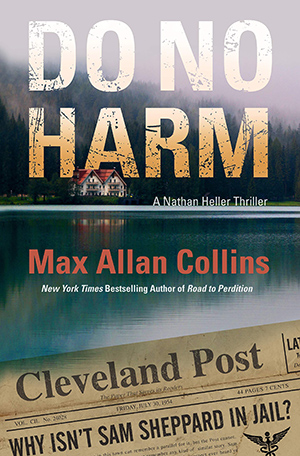
Finally, the Seattle Mystery Bookshop blog has a nice write-up by “JB” on Do No Harm. The reviewer, like several others looking at this novel, suggests I leave certain things unresolved that the novel really does clarify at least in terms of what happens in Heller’s world. I think the problem (and this is on me) is that part of what I wanted to do was examine every major theory about what happened in the Sam Sheppard case, and that seems to have muddied the waters for some readers. This is a long blog entry about a lot of things, so you may want to scroll down till you come to the Do No Harm cover image.

M.A.C.

Mommy Streams, Backlist Bubbles, We Binge

Tuesday, May 12th, 2020

Both Mommy and Mommy’s Day are now streaming on Amazon Prime. (Links: Mommy; Mommy’s Day) How long they will be there I can’t say (Eliot Ness: An Untouchable Life has disappeared, though some other streaming services have it). If you’re a Prime member, it’s included.

[Note from Nate: Eliot Ness: An Untouchable Life is currently on Tubi, free (with ads?)]

So if you haven’t seen both or either of these films, now’s your chance. If you have the earlier full-screen versions, this is an opportunity to see the widescreen versions that Phil Dingeldein and I recently labored to create. I do warn everyone not to expect HD quality (despite being streamed as HD) – the picture (particularly on Mommy) is rather soft. But it’s probably the best either one is going to look.

As I’ve said, compromises were made to be able to afford the wonderful casts.

remain proud of these films, and the Blu-ray double-feature release has received mostly good to great notices. People seem to understand where these little movies were coming from – which is to say blackly humorous melodrama, and a tribute to The Bad Seed and to Patty McCormack herself.

Mommy and Mommy’s Day are streaming on Fandango, too, for a couple of bucks. It may show up elsewhere (I am not kept terribly well in the loop by the distributor). (Links: Mommy; Mommy’s Day)

The novel versions will be coming out again one of these days, part of a package I am negotiating with a major e-book publisher for the seven remaining novels on my backlist (Amazon has most of the rest, Dover has the first two Jack and Maggie Starr novels).

We are also discussing a group of collections of my short fiction (and Barb’s), reprinting Blue Christmas, Too Many Tomcats, and Murder – His and Hers, plus a follow-up to that last title, a collection of my horror stories, and two collections of the stories Matt Clemens and I have done together.

Pulling these stories together has been a big job. They go back to the nineties in many cases, and were written using the word-processing program (wait for it) WordStar, and then converted to now nearly obsolete versions of WordPerfect maybe twenty years ago, and finally to Word. So while I have most of the files in some form, the dizzying array of conversion glitches causes twitches.

For the horror collection I decided to include the radio scripts of “Mercy” and “House of Blood,” written for the Fangoria radio show, Dreadtime Stories. I had adapted a number of my short stories for producer Carl Amari, but had two indie movie ideas I wanted to get up on their feet, and that’s how the two scripts above came to be written. The scripts were in a format (basically a very narrow strip of copy, maybe four inches wide, that required hours of work transforming them into more standard pages of text that wouldn’t bewilder or annoy readers. Fortunately, I have a staff to do such scut work. No, wait – I don’t!

Ultimately, though, it will mean the vast majority of my work will be available in e-book (and real books), with only a handful of things lost to the mists of time.

* * *

What have Barb and I been watching lately? Now that we don’t go to the movies anymore?

We finally got around to Ozark, which had been recommended to me by smart people, who were right. It’s a terrific show, very well-acted and full of twists and turns. Several people had told me that somebody (or somebodies) at the series seemed to be fans of mine or were influenced by me, and I think that might be the case. If so, it’s flattering. If not, it’s not the first time I’ve been deluded.

But there’s a hillbilly family reminiscent of the Comforts from the Nolan novels, a character called Boyd (Quarry’s partner in those novels), and a major villain in the first of the three seasons so far is played by the actor (Peter Mullen) who was the Broker in the Quarry TV series. And the good man doing bad things to keep his family afloat is Road to Perdition 101. Maybe half a dozen times I turned to Barb and said, “At least somebody’s reading me.”

The series itself is obviously something that wouldn’t exist without Breaking Bad, and it challenges you (in a Quarry-like way) to root for and identify with people who are making really poor choices. I don’t mean to overstate any debt anybody owes me, because (a) I owe plenty of debts myself, and (b) I may be full of shit about this.

The Guardian describes Ozark thusly: “Ozark follows the misadventures of Marty Byrde (the perpetually clenched Jason Bateman), a financial adviser forced to relocate from Chicago to Osage Beach, Missouri, where he launders money on a scale that would give Al Capone a cluster migraine.”

Bateman uses his standard glib, slightly put-upon persona to nice comic effect initially, and you are slightly amazed at first by how well that persona works in a dark melodrama. But as that melodrama grows darker, and the consequences ever more dire, Bateman’s performance deepens. Other mesmerizing performances come from Laura Linney, as Bateman’s even more glib wife, whose sunny smile delivers manipulative self-interest in such a “helpful” way; and Julia Garner’s Ruth, the most original and unique character in Ozark, a hillbilly girl with a good heart and a crushed soul, capable of kindness and murder, when either is called for.

I like the series and I think you will, too.

We also have recently enjoyed the surprise gift of a second season of Rick Gervais’ After Life, the touching drama/comedy (you don’t think I could ever type the vile word “dramedy,” do you?) that explores the road back for a husband consumed by grief over the loss of a wonderful wife.

The very special thing about After Life is its signature combination of mean humor and genuine sentiment. It’s a show about a man so depressed that suicide is an understandable option, and it’s often frequently hilarious.

I am a Gervais fan and have been for a long, long time. This little series isn’t much talked about, but it may represent his best work.

On the film front, we have watched a lot of British comedies of the late ‘40s and 1950s – such Alastair Sim gems as our perennial favorite, The Belles of St. Trinian’s, but also Laughter in Paradise and School for Scoundrels; and Alec Guinness in All at Sea, The Captain’s Paradise and Last Holiday.

And the most current season of Midsomer Murders, a favorite comfort food of ours, seemed particularly strong after a few missteps the season before.

* * *

Bookgasm, which is a book review site you should be regularly visiting, has posted a wonderful review of Girl Can’t Help It that’s been picked up all over the place, and I provided a link last week. But in case you haven’t seen it, I’m going to share it here, right now:

Notoriously prolific author Max Allan Collins has added a second entry to his Krista Larson series, GIRL CAN’T HELP IT. It’s also a stretch back to Collins’ past (and present) as a rock and roll musician. True! I didn’t know this either but Collins apparently wrote the song “Psychedelic Siren” recorded by The Daybreakers in 1968 (here, watch it on YouTube). In the author’s note, he states this is the first time he has mined his rock and roll experience for a book. Well dang it, more of this please. Mr. Collins.

The first book in the series, Girl Most Likely, features Krista Larson as the Chief of Police in Galena, Illinois. She is assisted by her able staff but also by her father, a retired cop from the Dubuque Police Department who does invaluable detective work. In this second work, Girl Can’t Help It, the Larson duo is back on the job.

The book title refers to a song title recorded by local Galena band Hot Rod & The Pistons. They scored a huge hit with the song in the 80s when retro rockabilly hit big (think Stray Cats). They managed two albums and then faded away. But after their election into the Iowa Rock and Roll Hall of Fame, they’re set for a reunion gig and maybe even a little tour. The town of Galena is excited and creates a special musical festival to kick off the whole thing. All well and good.

Until one of the members is found dead of a heart attack in a bathtub. Oh well, old guys do die. But then a second band member commits suicide and his apartment has been ransacked. This hits the Larsons as fishy, and they’re fairly convinced that both deaths are murders.

Of course, we the readers know these are murders because we have chapters written from the point of view of the murderer. The crimes continue to escalate and it’s a battle between the murderer and the police department to see who will come out on top and if the entire lineup of Hot Rod & The Pistons will be killed off one by one.

Everybody knows Max Allan Collins by now. He has multiple series in place, writes another successful series with his wife (the duo goes by Barbara Allan) and is one of the solid bricks in the pyramid of genre writers over the past 40+ years. A lovely, smooth and polished style coupled with a brisk pace makes for quick reading short chapters, believable characters, behaviors and dialogue. If you like any of Collins’ works, you’ll like GIRL CAN’T HELP IT. I think this series has real promise. Recommended. —Mark Rose

Get it at Amazon.

A fun podcast about books, The Inside Flap, was kind enough to give Do No Harm and Nate Heller some attention. The Do No Harm stuff happens a bit after the hour mark. You’ll hear one of the participants wish that I would have Heller solve the JFK assassination (guess what books I sent along to them).

The great blog Paperback Warrior is posting their all-time ten favorite posts, and the one focusing on The First Quarry is #4.

Here’s a great interview with my buddy Charles Ardai, touching on our projects together.

The fantastic Stiletto Gumshoe site talks about Mike Hammer and Masquerade for Murder, and provides some links to things you may have missed.

This nice review of Antiques Fire Sale is a little quirky – doesn’t like all the talking to the reader, and thinks referring to Vivian as “Mother” is disrespectful – but some nice insights are on hand, as well. Loving us is preferred, but liking us is just fine, too.

Finally, check out this terrific Mystery Tribute piece about Mike Hammer and Masquerade for Murder.

M.A.C.

Music Is the Best Medicine

Tuesday, May 5th, 2020


Digital Audiobook: Google Play Kobo iTunes

I’m going to discuss audio today, specifically (but not exclusively) music.

I have been blessed with having some incredible narrators read the audio versions of my novels, with “the voice of Nate Heller,” Dan John Miller, out right now with Do No Harm. Also current is Masquerade for Murder read by Stefan Rudnicki, whose Quarry readings have been favorites of mine and many of you. Jack Garrett, who did a fine job on Last Stage to Hell Junction, has Hot Lead, Cold Justice coming this month.

Our habit is to listen to the audio books of our stuff in the car. So we have yet to adjust to listening at home. Since we are liable to be sheltering in place (in some form or another) until a vaccine arrives, that will probably change.

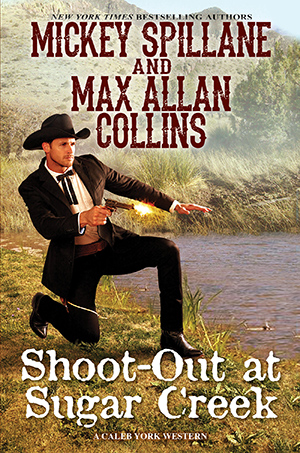
I depend on habit – on routine – to keep me sane in what I cheerfully think of as the random terror of the chaos that is life. Just this weekend, I finished writing the new Caleb York, Shoot-out at Sugar Creek, although I have not done the final read-through in search of typos, inconsistencies and the need for occasional tweaks. That’s a process that takes a couple of days. Barb enters the corrections and changes for me. More habit. More routine.

When I finish my draft (final but for what I mentioned above), I clean my work space. I begin projects with a pristine office and by the end of a project, my office has had a nervous breakdown. Perhaps it’s the historical nature of so much of what I write, but books and other research materials, and discarded drafts of pages and even chapters, are flung and scattered on a floor increasingly difficult to traverse.

When I clean the office, which takes a day or so, I listen to music. Right now, that’s about the only time I do listen to music, despite a CD collection as voluminous as my DVD/Blu-Ray library. As with audio books, music has been relegated to listening in the car. Which means it, like audio books, is hampered by not much driving happening.

And another habit, another part of our routine, is to take a day or two or even three off at the end of a project and do a getaway. No, not to some exotic vacation spot – just to Galena, Des Moines or suburban Chicago (trips to St. Louis were part of that, for the years when Nate and Abby and son Sam, and later daughter Lucy, were living there). Nothing elaborate – just dining and shopping and maybe a movie. Another habit is to take a day off during the writing process – working six days a week – to either Iowa City/Cedar Rapids or Davenport. More audio in the car gets listened to on those days.

Days not happening right now.

So the audios of our books are piling up. A year from now or so, if a vaccine or other credible treatment has emerged, and we can emerge too, we’ll have plenty to listen in the car. Including the new Weezer CD I just ordered.

And yet music has been an important part of how I’ve settled into the new routine here in Corona-ville. (This score just in – Corona 19, Trump zero).

You may recall – if you’re bored enough or perhaps masochistic enough to follow these update/blogs regularly – that I have resumed my ‘90s and early ‘00s obsession with collecting laserdiscs. I had dumped many of my discs, cheap, since I’d upgraded to DVD and Blu-ray on most of them, and hung onto only the things not available in those later formats.

But laserdiscs look terrible on flat screen TVs, so I invested in a 19″ CRT and bought a used laserdisc player from e-bay and set it up in my office. And, much to my wife’s dismay, I started buying laserdiscs again (through e-bay). Sometimes these are movie titles otherwise unavailable; but mostly they are music – a lot of stuff from the ‘80s and early ‘90s isn’t available elsewhere, as well as things from the ‘50s and ‘60s that got laserdisc-only releases (usually collections, like Rock ‘n’ Roll: The Greatest Years).

I won’t bore you with details, but Japan put out of lot of laserdiscs with clips from the UK’s Beat Club and the USA’s Shindig and other sources that were rarely available here, except on the gray market. These laserdiscs look and sound particularly good. And I eventually had to replace my player with a cool silver one made in Japan, which is superior to our models.

The Japanese in particular put out collections of British invasion material, including discs dedicated to single groups, sometimes with interview and documentary footage. Wonderful discs include some of my favorite bands, like the Animals, the Yardbirds, and the Dave Clark Five. Artists of the mid-‘60s through the early ‘70s are represented in collections with incredible performances, like the Vanilla Fudge doing “Keep Me Hangin’ On” and “Shotgun,” and Dusty Springfield doing…well, anything.

Now what I’m about to say is no revelation, not even to me. But at my age, listening to this music, and seeing the artists performing it, hits me emotionally harder than I expected. I got these discs because I liked the music and the artists. But seeing those artists, back in the day, performing that music, swept me back; memories and feelings surged and swelled.

People talk about music – particularly the pop music you grow up with – being the soundtrack of your life. That’s a cliche, I know, but like all cliches, it has more than a kernel of truth. Nothing takes me back to the ‘70s more fully than seeing Karen Carpenter singing Paul Williams tunes, although Three Dog Night doing Paul Williams comes close.

Barb and I encountered Karen and Richard Carpenter (we didn’t exactly meet them, just exchanged a few pleasantries) in the green room at Good Morning America when I was promoting Dick Tracy in the early ‘80s. Karen was skeletal, probably a few months away from dying, and Barb and I were shocked by the alarming sight of her. Apparently she had low self-esteem (also an observation that is less than revelatory) but it’s so damn tragic to think of that incredible, rich voice living inside that frail, damaged body and soul.

I wasn’t particularly a huge Carpenters fan. I remember liking “Merry Christmas, Darling,” and I was not an imbecile, so I knew a lovely voice when I heard it. But like a lot of us at the time, I dismissed the Carpenters as corny and the production as too slick and a sign that the rougher-edged ‘60s were over. It was Paul Williams and Phantom of the Paradise (still among my favorite movies) that began my reassessment, largely thanks to Jessica Harper’s rich, Karen Carpenter-like singing, and seeing Richard Carpenter’s sister in the disturbing flesh – a victim of her own self-doubt – added a tragic patina.

Likewise seeing Eric Burden or Rick Nelson or Bobby Vee (I already had every scrap of Darin, so little of him has turned up on laserdisc, though a few great “Mack the Knife” renditions are collected here and there) stirred memories specific and general. For me, the funny thing is I’ve always been into nostalgia – but mostly second-hand nostalgia, for the ‘30s and ‘40s of my parents, thanks in part to Warner Bros cartoons and the Three Stooges, and for the ‘50s which I remembered only vaguely from early childhood – my first record was a 78 of Elvis (“Hound Dog”/”Don’t Be Cruel”).

But I never really understood – never experienced – nostalgia in a meaningful, personal way until I saw these laserdiscs. I now realize that the best years of my life are indeed over, even as lucky as I am and as happy as I am to still be on this planet, despite a pandemic and a political scene that dismays and discourages daily.

Like Karen Carpenter, Carly Simon is an artist I had taken for granted. Carole King I always valued, as did Barb; but somehow when I thought of Carly Simon, what came to mind was her first album’s jacket with that fetching bra-less photo of her. But what I, in my continuing male wretchedness, failed to appreciate at the time was how many great songs, performed in a warmly personal and open style, this woman gave us. A live laserdisc reminded me – Simon has an incredibly winning awkward grace in performance – and a three-CD boxed set of hers is what I listened to cleaning my office.

Watching Cyndi Lauper on laserdisc, performing wildly and well and with complete abandon to an audience in Paris, reminds me how much I enjoyed the early ‘80s…how fantastic those years were, when both Nate Heller and Nate Collins came into the world, when Barb and I were loving New Wave music and in so many ways coming into our own. And how, now, astonishingly, the ‘80s are suddenly a long time ago. I mean, I already knew the ‘60s and even the ‘70s were a long time ago.

But the ‘80s?

And weren’t the ‘90s last week?

The mingled joy and sadness of revisiting this music – hearing it, seeing it – has helped me adjust to sheltering in place. Hey, I know we’re lucky. I can still work – in fact, I have now hit my stride and thrown off any initial sluggishness and am working pretty much every day. But with a laundry list of underlying health issues, at a ripe old age, I am not going anywhere for a while, except the pharmacy and supermarket.

Even Warren Zevon, faced with cancer’s death sentence, got to see the latest James Bond movie before he passed. And maybe that says it all – that my biggest worry right now is not being able to see the new James Bond movie in a theater.

Music is calming and reassuring and the only method of time travel science has yet come up with. Back in the ‘80s, when I was having a lot of stress on Dick Tracy due to editorial interference, I found the only things that soothed me were Johnny Mathis and Sade records…they were mellow, and mellowed me out. You go to the shrink; I’ll listen to “Chances Are” and “Smooth Operator.”

And when I hear Eric Burden or the Vanilla Fudge or Rick Nelson or so many other artists, I feel the urge to play music again…even though I haven’t touched my organ (get your mind out of the gutter) since the pandemic began. But it does seem that, whenever I tell myself I have hung it up where rock and roll is concerned, something comes on the radio that gets the juices flowing again.

Yesterday I cancelled my band’s July 4 gig. We have only one date this year that I haven’t cancelled – it’s in September. We’ll see.

Never say die.

Also, never say never again.

* * *

Thanks to those of you who participated in the Antiques Fire Sale book giveaway. The books were sent out last week.

Check out this great review of Girl Can’t Help It from Bookgasm.

This is part two of a really nice article/interview about/with me, with an emphasis on Mike Hammer and Masquerade for Murder.

Here’s an essay I wrote about the process of writing the Mike Hammer novels – ground I covered here a while back, but a somewhat different take.

I was asked to write about my five fictional private eyes. Check it out here.

This is a look at my graphic novel (with Kia Asamiya), Batman – Child of Dreams, with a ton of scans.

Finally, here’s a link to the interview Barb and I wrote for Brandy and Vivian Borne to boost Antiques Fire Sale.

M.A.C.