Posts Tagged ‘Bait Money’

Return of the Maltese Falcon, Nate Heller & Nolan Get Some YouTube Love

Tuesday, August 4th, 2026

This week is a YouTube fest, and we begin with a fan of The Maltese Falcon taking a smart look at Return of the Maltese Falcon.

There’s something on You Tube called Private Eye July, and Mystery and Mayhem host Jim (don’t know his last name) took a look at both True Detective (and the Nathan Heller series) and Return of the Maltese Falcon.

First, on what appears to be a regular show, Jim offers Mystery and Mayhem recommendations.

Second, he offers a wrap-up of this year’s Private Eye July, including a look at Return of the Maltese Falcon.

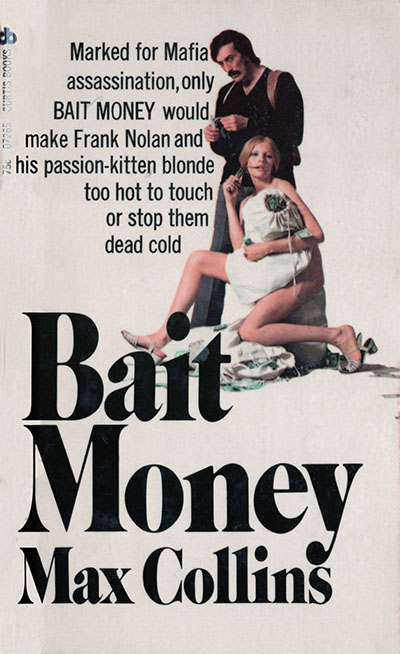
Finally the Book Graveyard has a review of my first published book, Bait Money.

Though the Graveyard host is knowledgeable, and apparently a big fan of my work, he is unaware that the 1981 edition from Pinnacle of Bait Money is a somewhat revised reprint of the Curtis Books original that had appeared in 1973. A Nolan book preceded it, Mourn the Living, but it didn’t see publication till much later (this early work is included with Spree in the Hard Case Crime title, Mad Money).

The Book Graveyard host is obviously an enthusiast of paperback originals in the men’s adventure and Executioner-type crime vein, and I admit to being delighted for my early ‘70s self when he talks about my writing being on a whole other level than what he regularly reads.

M.A.C.

A Richard Stark Christmas

Tuesday, December 16th, 2025

I was recently asked to do an interview for a website dedicated to Donald E. Westlake’s Parker novels (written under his pseudonym Richard Stark). That website is right here: tough business: a parker site

I agreed to the interview, but warned that my answers would likely be extensive, because Westlake was the last writer I read who had greatly influenced me (the others being Hammett, Chandler, Spillane and Jim Thompson). Westlake’s Parker led to me naming my first three series characters (Nolan and Jon, Mallory and Quarry) each with a single name, in honor of the Richard Stark tradition.

Quarry grew out of the Parker novels, too, in a fashion, as the first book (The Broker, 1975, since published under my preferred title, Quarry) was a response of sorts to the Stark series, which served up its anti-hero fiction at a distance (third-person) and sticking to heists (and avoiding civilian deaths). I wanted to take it up a notch with a first-person narrator who was a professional killer.

The interview tells of my relationship to Don Westlake as a mentor, friend and fellow professional writer. He knew of the first Nolan, Bait Money, and had encouraged me and (as you’ll see below) helped me get the novel seen in the publishing world. After my parents, he was the first one to hear from me about the novel’s acceptance for publication. on Dec. 24, 1971. His response was, “Sometimes God acts like O. Henry and there’s nothing you can do about it.” The footnote is that I received published copies on Dec. 24, 1972, both Bait Money and Blood Money bearing 1973 publication dates.

That story isn’t included below, but a lot else is.


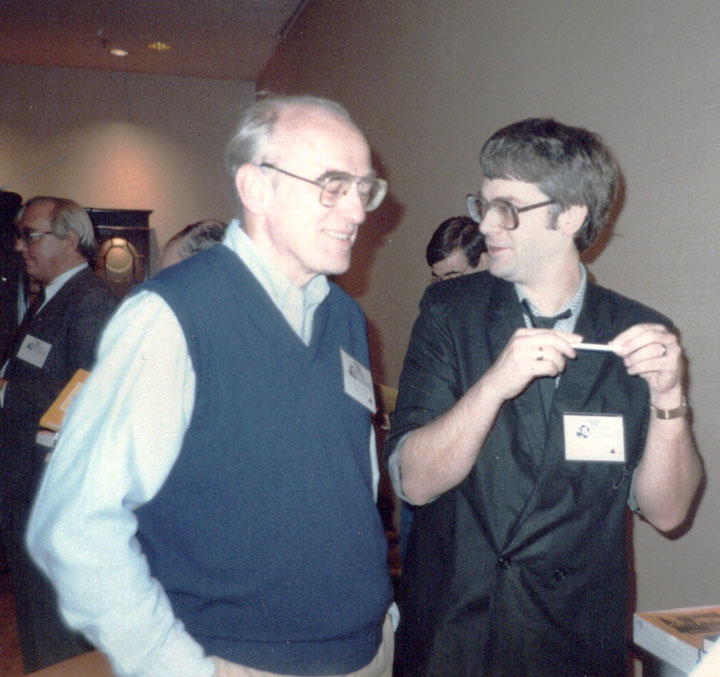
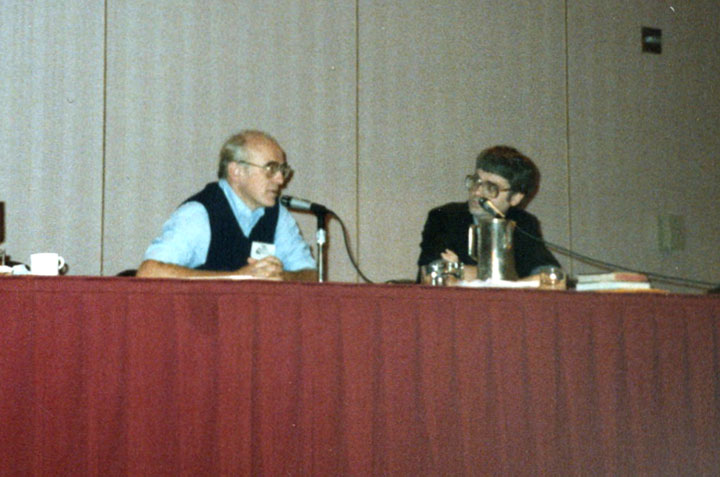
Don Westlake and me at the 1986 Bouchercon, where he was Guest of Honor, and I interviewed him.
1) How did you first discover Richard Stark’s Parker?

My then-girlfriend (and now, and always, wife) Barb and I saw Point Blank at a drive-in theater on the film’s first release. I remembered seeing a movie tie-in paperback on a spinner rack at a local supermarket, which stayed open all night…and I immediately went there, late that night, and bought it and the handful of other Parker reprints (and one new one) Gold Medal issued at the same time.

I eagerly consumed those books and sought the ones that Gold Medal hadn’t reprinted, finding all but one (The Mourner) at various used bookstores. When Barb and I honeymooned for a week in Chicago in 1968, we did (among the usual honeymoon activities) dine at terrific restaurants, go to plays, see movies, and scour sketchy used bookstores all over the city looking for The Mourner. And finding it.

Here’s an interesting, perhaps bizarre footnote: when I ran out of Richard Stark books, I decided I wanted to read something that wasn’t so dark, as a kind of palate cleanser. I picked up a paperback of The Fugitive Pigeon, a comic suspense novel by someone called Donald E. Westlake, and was hooked. I had no idea Westlake and Stark were the same writer. In my room at home (in my parents’ house), I had a shelf of honor for my two favorite writers – Stark and Westlake, separated by a slim metal bookshelf. I collected Westlake as obsessively as I did Stark.

In Anthony Boucher’s mystery-fiction column in The New York Times, I finally learned Stark and Westlake were the same writer (as well as Tucker Coe). I removed the metal book-end separating the two writers.

Don loved that story, by the way.

2) You’ve often spoken about the Nolan series being an homage to Parker. How did that come about? Did you start with the intention of writing a Parker-esque thief or did the character develop naturally?

I started writing novels in late junior high and on through high school, writing them during summer vacation and submitting them to publishers (unsuccessfully) during the school year. I did several imitation Mickey Spillane novels and one imitation Ian Fleming. In my high school years, I discovered Ennis Willie, an obscure writer of what were sold as softcore porn (but weren’t): Willie wrote crime novels about a one-named character, Sand, who had been a second-tier mob guy who betrayed his bosses in some fashion and was on the run. Sand also solved mysteries along the way, and – although the books were in third person – Willie wrote the best imitation Spillane I ever found (and I was looking). As the years passed, I became one of a handful of professional writers who loved the Sand books and extolled them and Willie, who had written prolifically for perhaps three years and disappeared. All the latter-day discussion of Sand and his author, in fanzines and such (very much pre-Internet), chiefly by myself and the late Steve Mertz, finally caught Willie’s attention. He turned out neither to be Black (as we had speculated) or dead (which we had also speculated), but had gone into his family’s printing business for the rest of his working life. In retirement, he was thrilled to learn he’d been rediscovered and published two collections of the Sand novels (Sand’s War and Sand’s Game, still available at Amazon).

Sand and Parker are similar characters, to say the least, though there’s no sign either Don or Willie ever read each other. They first appeared at about the same time – they were just swimming in the same slipstream. But I made a connection between them, and that led to my one-name character, Nolan, developed while I was still at community college, in Mourn the Living. That novel wasn’t published till the later Nolans were, and can be found as a sort of “bonus feature” in Hard Case Crime’s Mad Money (with Spree).

3) Speaking of Nolan, the addition of his surrogate son Jon both differentiates him from Parker and humanizes him in a way readers may find easier to relate to. Did you find that relationship to be something that was lacking with Parker?

The first published Nolan novel, Bait Money, was fairly overtly – and the entire series is – born out of my enthusiasm for Parker (and to a lesser degree Sand). I had already started a long (again, pre-Net) correspondence with Don. He wrote me wonderful lengthy letters, and a lot of his mentoring happened in those.

He was instrumental – along with my University of Iowa Writers Workshop instructor, Richard Yates – in landing me my first agent, Knox Burger, famously the Gold Medal Books editor who revitalized John D. MacDonald’s career by getting him to create Travis McGee. Burger was a gruff, no-nonsense guy who was also Don’s agent – Don said of him, “Knox thinks tact is something you put on the teacher’s chair.”

I knew how heavily in debt to Don’s Parker my Nolan character was, and I had never intended Bait Money to be anything but a one-shot. In fact, Nolan died on the last page – he was designed to be, in a way, Parker at the age of fifty and old before his time, due to the harrowing life he led. So the book was meant to be a story about a tough guy’s last stand – the end of the Great American Hardboiled Anti-Hero.

Burger hated the ending, but I insisted on it, and he took the novel to half a dozen publishers, unsuccessfully. In those days, you had to submit a type-written manuscript on good bond paper – you couldn’t send a carbon, and anything with corrections (Liquid Paper included) was looked upon as amateur. Typewriter days for pro writers meant enduring a nightmare of making small revisions that required retyping pages, chapters and even books.

The sixth or seventh publisher spilled coffee on the manuscript. Burger said, “Since you have to retype it before I send it out again, change the ending. Let the guy live. Have the kid accomplice come back and save him.” I did just that and Bait Money sold next time out.

The publisher (Curtis Books) asked for a series – offered a five-book contract. I called Don and said, “Are you okay with this? Once is homage, twice is grand larceny.” He couldn’t have been more gracious. He said Nolan was a much more human character than Parker, made so by the presence of the younger character, Jon. There was a kind of father-and-son relationship (a recurring theme of mine). Also I had (as a college student in the late ‘60s) included things that hadn’t been in many, perhaps any, mystery novels yet – specifically hippies, the drug culture, and Beatles-era rock ‘n’ roll.

So, with Don’s blessing, I went ahead. It was my first series, and I thought I’d shut it down with the rather epic Spree, and am rather amazed I was talking into doing another not long ago for Hard Case Crime, Skim Deep. The same thing sort of happened with Don, who lost interest in Parker and shut him down with the expansive Butcher’s Moon, then returned almost twenty-five years later with Comeback.

4) You’ve referred to Mr. Westlake as a mentor. How did you first get in touch?

My first fan letter went out, effusive but fairly literate; he replied by return mail. Receiving that letter was one of the great events of my life. We had a long correspondence, lasting into the 1990’s.

One afternoon I got a call from Don – we knew each other well by now, via letters, but I think this was the first time we spoke. I live in Muscatine, a little Iowa river town on the Mississippi. So the last thing I expected was to get a phone call from Donald E. Westlake saying he and his wife Abby were in Muscatine. I do not remember why, just that they were on their way somewhere and, without telling me, he had detoured to swing by. Did I want to get together?

Was he kidding?

My parents were out of town, so we put the Westlakes up there, and Barb and I ordered food from our favorite Italian restaurant and fed our new friends. It was a lovely, lovely evening. Don and I talked movies mostly, which had been what much of our correspondence was about.

That may have been when I learned Don didn’t always go to the movies made from his books. If he didn’t like the script, or other aspects of a production bothered him, he just stayed home. He did like Point Blank, however, though he thought the script was weak but the direction strong.

I can’t imagine a universe where I would not want to go to a movie made from one of my books.

5) One of our favorite anecdotes about Mr. Westlake comes from Charles Ardai, who told us he was exactly like he’d expected a writer of comic capers to be right up until he observed what he defined as a Richard Stark moment — “it was like sitting down to a hand of cards opposite a professional poker player – you just know instantly how far out of your league you are.” Did you ever experience anything like that?

No. I am ridiculously self-confident.

Don and I never had a falling out, but there was a point where I became enough of an established writer to not need, or desire, mentoring. He knew about my big project, the historical detective novel, True Detective. He told me 100,000 words for a private eye novel was not practical. He also advised making Nate Heller a reporter, not a P.I. (He was no fan of private eye novels). He read the book in manuscript and had problems with it. While I took some of his advice, but not much, that marked an end to a certain aspect of our relationship. Later he gave me a blurb for True Detective, claiming he did so because I had fixed it (again, I hadn’t followed many of his suggestions). True Detective was the Private Eye Writers of America “Best Novel” Shamus winner for 1984, and I have continued to write Heller throughout my career – there are 19 novels.

By the way, Don said Westlake became Stark when he woke up and it was raining.

6) I recently read Transylvania Station, which is about the mystery weekends the Westlakes would host at Mohonk Mountain House, and you were mentioned as being one of the guests/speakers. Can you tell us a little bit about that?

I was privileged to be the murderer in one of those mystery weekend games. It was a wonderful experience. We met a number of well-known (Joe Gores) or on-the-rise (Harlan Coben) mystery writers; and the atmosphere, and food, were a summer-camp delight in the winter. Don put together program of movies for the evenings, including the 1931 film of The Maltese Falcon, which I’d never seen before. He was a defender of that much dismissed first version.

I agreed with him (still do), though we both knew the John Huston version was the masterpiece. We discovered we’d both, at some point, followed the Bogart movie along in the book. It’s that faithful. And now I’ve written a sequel called Return of the Maltese Falcon, coming out from Hard Case Crime on January 6 (I’m allowed one plug, aren’t?). Don was definitely a Hammett man, not a Chandler acolyte, and he saw merit in Mickey Spillane, but was not a huge fan.

I wrote a mystery novel, Nice Weekend for a Murder (1986), about the Mohunk experience. I split Richard Stark and Donald E. Westlake into two characters, one of whom was the murderer (turnabout being fair play).

You mention Hard Case Crime, who have published many of my novels, in particular the Quarry series. Don had sent me a novel about a Bob Hope-type performer who was kidnapped. It was bylined Westlake but wasn’t humorous, which seemed to be the problem editors had with it. He hadn’t had any luck with it, and sent it to me, saying if I cared to, I could do a fresh pass and we’d co-byline it and “split anything” we hauled to shore. I was preparing to start the rewrite when Don called and said, “Stop! This new Scorcese movie, The King of Comedy, beat us to the punch – makes the book impossible to market.”

So I shoved the book in a drawer. But after Don’s passing, a few unpublished novel manuscripts emerged and Charles Ardai at Hard Case Crime was publishing them. I told him about the Bob Hope-type book and he wanted to see it. He published it as The Comedy Is Finished. A tiny bit of my writing is still in there – the final paragraph I believe, which I’d shown to Don and he approved of.

I am happy to have that novel out there, and complimented beyond words that Don turned to me. That we might have had a genuine collaboration is a huge missed opportunity.

Toward the unanticipated early end of his life, we had grown apart somewhat. The last time I saw him, and that we spent time together, was when the British Film Institute brought us in to showcase John Boorman’s Point Blank and Sam Mendes’ Road to Perdition. I have a vivid memory of a small moment that I perhaps overplay in my mind. In an upscale British restaurant, we were seated at a table for perhaps six or eight, our hosts and our wives and ourselves. From down the table, Don noticed me being questioned earnestly, being taken very seriously, by some fairly erudite “chaps” and I had a sense he was thinking, There’s that kid I knew who actually grew up to be a writer. My last moment with him was when, as we walked out, I fell in with him and told him how much his support and friendship meant to me. He was shy about receiving such compliments, but he smiled and thanked me.

My last contact with him was by e-mail, when I wrote him about the latest of his new batch of Parker novels and told him how terrific it was, and that it reminded me of how much impact he and his character Parker had on me and my work. He wrote me back warmly, really appreciating my words of praise, and expressing a human lack of confidence in whether he “still had his fast ball.” He sure did.

7) As both a crime fiction author and comic book writer whose work has been adapted for the screen, do you have a favorite Parker adaptation? Have you read Darwyn Cooke’s graphic novel adaptations?

Point Blank remains the best film from Don’s work. He would write such great premises that Hollywood would be attracted to the set-ups, then ignore the rest of the great book. Bank Shot, anyone?

Before I touch upon the graphic novel adaptations by Cooke, I should discuss a few comics-related things about Don and me. When we corresponded, and he learned I was a comics fan (not yet a writer of comics), we sent things back and forth. I showed him Richard Corben’s Den, for example, and various underground comix, and he loaned me Harvey Kurtzman’s rare, ill-fated Trump (Hugh Hefner’s attempt to do a comics-oriented slick magazine – ran two issues). So Don was hip to comics. He gave me a blurb for my graphic novel Road to Perdition, which he seemed to like. When the movie came out, and got lots of press and praise, he called to congratulate me on “riding the Zeitgeist.”

Calls from him were rare but a treat. Once when a New York Times review of a Heller short story collection included an introduction making it sound like I had passed away, Don called, and when I answered, he said, “Good! You’re alive.” And hung up.

When I landed the job as the writer of the DICK TRACY comic strip – my first big break – Don and his wife Abby invited Barb and me to stay on a whole floor of their apartment while we were in NYC for an event related to my being signed by the Chicago Tribune Syndicate. They threw a cocktail party for us and invited publishing friends to meet and congratulate me. Among the attendees were Otto Penzler, Martin Cruz Smith, and Lawrence Block. Obviously this was an incredibly gracious kindness.

After I became an established comics writer, we talked seriously about me doing Parker graphic novels, but the publisher wanted originals and Don would only allow adaptations. So that fell through.

Now here comes the awkward part.

I don’t like Darwyn Cooke’s Parker adaptations. Cooke was a terrific artist, but his cartoony take on Parker strikes me as wrong. Something more “real,” frankly like Road to Perdition’s artist Richard Piers Rayner might have provided, would have been more appropriate. Or something grittier like Joe Kubert.

Don’t get me wrong. Both Westlake and Cooke were geniuses, gone much too soon. I just – personally – don’t think they made a good fit. But anyone who enjoys them, great.

8) In a January 2009 tribute to Mr. Westlake for The Rap Sheet, you wrote that there are several references to your work in Parker and Dortmunder. Are there any in particular that stand out?

I don’t recall any, just that Don would do that now and then. I think Butcher’s Moon might have included me in a dedication to several of his friends. And I know, a couple of times, when he needed to name somebody who was just an off-stage spear carrier or something, he’d use my name in part or in whole.

That’s a disappointing answer, so I’ll end with something better.

When we did the Mohunk mystery weekend, Don had me do a presentation about Dick Tracy, which was my calling card at the time. He introduced me, cheekily, as having written a series of novels (Nolan, obviously) that made me the Jayne Mansfield to his Marilyn Monroe. When I got to the microphone, I said, “I consider myself more Don’s Mamie Van Doren.”

He loved that.

I am pleased, even thrilled, when a Richard Stark fan likes the Nolan novels. I told Don once that the Nolans were the methadone to his heroin. But there’s only one Parker.

* * *

Here’s a terrific piece on the 10 smartest noir detectives – Mike Hammer in Kiss Me Deadly is on there, with a mention of me.

Hey Kids! It’s Book Giveaway Time

Tuesday, September 30th, 2025

We’ve not had a book giveaway here at the Update for some time, and I’m about to remedy that.

Last year Hard Case Crime reissued The Last Quarry in trade paperback form (with some bonus material in back, two of the three Quarry short stories from the ‘80s). Now HCC is taking the same trade paperback approach with The First Quarry (minus the bonus short stories).

What makes these reissues notable?

Well, the first three Quarry novels Hard Case Crime published (The Last Quarry, The First Quarry and Quarry in the Middle) appeared in the smaller original mass-market paperback size. This is for all of you who like to shelve your titles together – whether you are OCD or just particular – and would prefer your row of Quarry novels be all of the same format/size. Now you we no longer have to suffer with the indignity of the first three novels not lining up perfectly with the rest! Even the first four novels, as originally published by Berkley Books, were originally in mass market size. The fifth, Primary Target, re-titled Quarry’s Vote at HCC, was in hardcover and then a mass-market-sized paperback. All five are now HCC trade paperbacks.

I believe, though I am not absolutely certain, that Quarry in the Middle will also receive a trade paperback edition from Hard Case Crime, next year.

So, even if you have the original edition of The First Quarry, you are welcome to participate in this book giveaway. It works like this: e-mail me requesting the book at macphilms@hotmail.com. Even if you’ve won a title in a previous giveaway of mine, you must include your snail-mail address. Though no strings are attached, it would be nice if you’d review the book at the Amazon and/or Barnes & Noble sites, or your own blog, if you have one. The offer is open to US residents only, due to shipping costs.

[All copies have been claimed! Thank you for your support. –Nate]


I’ve talked about this before, but just in case you didn’t hear it from me, on an Update or otherwise, here’s why The Last Quarry was not the last Quarry, and why The First Quarry is not the first Quarry.

When Hard Case Crime got started, editor Charles Ardai approached me about reprinting Blood Money, the second book in my Nolan series (the first being Bait Money). I requested he collect both books in one volume, asking for no extra money, as I thought it awkward to start with the sequel to a long-out-of-print book, which Bait Money was at the time. He agreed and you can now get those books together as Two for the Money.

The Nolans did well enough for Charles to request I do another in the series. I said I’d prefer to do a Quarry novel. The series had something of a cult following (of course, as Donald E. Westlake said, a cult author is seven readers short of making a living) and I’d always felt the character should have put me on the map, which it hadn’t. The series was in fact dropped by Berkley Books after those first four entries.

But I’d recently made (with director Jeffrey Goodman) a short film about Quarry, based on my short story “A Matter of Principal.” The film did well at festivals and was warmly received when screened at a Bouchercon.

For this reason, and my own affection for the character, I wrote The Last Quarry for HCC, telling Charles I was thrilled to be able to wrap the series up (as the title suggests). I’d also been promised a Robert McGinnis cover, which I got. (And I should note that The Last Quarry was based on my screenplay of the eventual film called The Last Lullaby. The final film differs somewhat from my novelization.)

Then the damnedest thing happened: The Last Quarry was a success, garnering good sales and terrific reviews.

CUT TO: Charles and I are standing in a buffet line at a subsequent Bouchercon when he says, “It’s too bad you ended the series with The Last Quarry.” And I say, “Why don’t I write The First Quarry?”

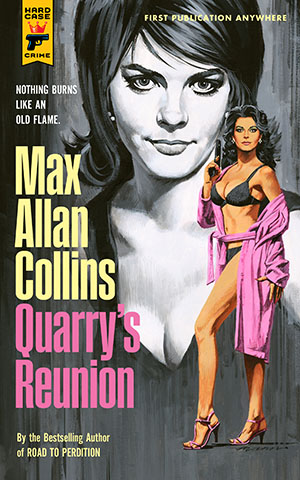
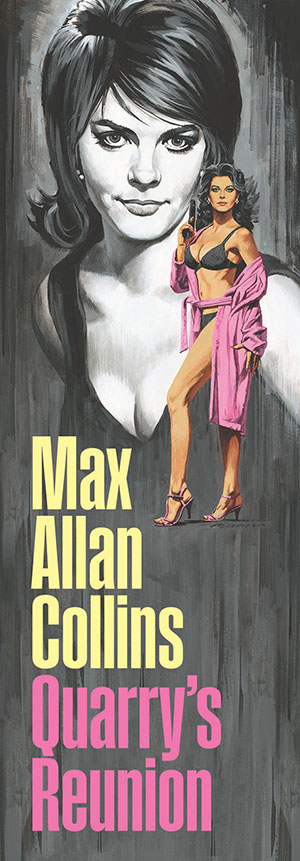
Thus began a long series of Quarry novels (I’m working on Quarry’s Reunion, the thirteenth for Hard Case Crime), novels that have earned several Shamus nominations from the Private Eye Writers of America and two Edgar noms from the MWA. And there was a one-season of a QUARRY TV series from HBO/Cinemax, focusing on Quarry’s origin.

Not bad for a busted mid-‘70s paperback series.

Most of the new novels have me exploring the premise of Quarry using the late Broker’s list to track assassins to their next target, and offering a service to that target: stopping the hit by killing the assassins and discovering who bought the kill contract. This is what was set up in Quarry’s List, the second of the original four novels.

Some of these subsequent novels, like The First Quarry, tell of contracts Quarry carried out prior to – it gets confusing now – the events of the first Quarry novel (originally published as The Broker, currently carrying my preferred title, Quarry). Among these contract-killer novels are Quarry’s Choice and Quarry in the Black.

Another sub-set in the series are the “old man” Quarry novels, where the character is roughly my age Quarry’s Blood, Quarry’s Return).

I run into potential readers wanting to know what order to read the books in. I always say, I didn’t write them in order, so why read them that way? I would prefer to point such readers to two particular favorites of mine, Quarry’s Choice and The Wrong Quarry.

Is there a difference between the first four (Quarry, Quarry’s List, Quarry’s Deal and Quarry’s Cut) and subsequent entries, including the one I’m working on now?

Yes. There is more humor – dark humor, but more – in the later books.

One reason I didn’t try to take the series elsewhere, when Berkley dropped it, was my feeling that each novel had to top the last in extreme violence. Why did I feel that way? It’s not because I’m a sadistic nincompoop. It’s because, structurally, the early books are about showing Quarry in the first chapter or so doing something terrible, then in subsequent chapters (the bulk of the book) getting the reader to kind of forget that and come to like Quarry and view him as a reasonable guy (and a point-of-view character you could take the ride with). Then, at the end, faced with a situation that an actual normal human would otherwise deal with, Quarry again does something terrible.

All of this grew out of my desire to, in my way, top the great Richard Stark (Don Westlake) Parker novels. I had already written the first five Nolan novels, which were frankly imitative of the Parker series. I instead wanted to show readers (like me) of “crook books” with protagonists who worked the left-hand side of the street just what kind of “heroes” we (me) were identifying with.

The Parker novels were heist yarns told in third-person, giving readers some distance between them and the criminal events. I decided to do, instead of a professional thief, a hired killer, and tell the stories in the first person – put the reader inside Quarry’s head, and ultimately confront readers with just who it’d been they were rooting for.

To some degree, this approach is inherent in the later Quarry novels, yes, but the dark humor (I think) leavens the often nasty events of the narratives. That frees me from sense that I need to top the last book with some truly awful thing that Quarry does at the finish (although even then, in the Mike Hammer tradition, he is removing a bad guy or two or three).

The original novel – The Broker AKA Quarry – has this ambivalence built in. In that novel – never intended to launch a series – hired killer Quarry, to save his own ass, must solve the murder he committed.

Now Quarry’s 50th anniversary is just ahead (2026). I’ll try not to disappoint with Quarry’s Return.

* * *

Here is a list from Collider of the 20 best comic book movies. Guess what’s number two?

M.A.C.

A Quarry Discussion Plus a Book Giveaway!

Tuesday, April 1st, 2025

It’s book giveaway time, with the new trade paperback edition from Hard Case Crime of The Last Quarry on offer to the first ten of you who ask for it.

As usual, if you’re interested, you write me directly at macphilms@hotmail.com. If you receive a copy, you agree to write a review at Amazon and/or Barnes & Noble, and/or your own (or someone else’s) blog. If you hate the book, you’re relieved of this obligation. Mixed reviews are fine, and only mildly resented. USA only, due to postal restrictions. Be sure to include your snail-mail address.

This trade paperback includes two of the four Quarry short stories as in-the-back-of-the-book bonuses: “Guest Services” and “Quarry’s Luck.” The other two short stories, “A Matter of Principal” and the fourth (the name of which escapes me – it appeared in The Strand) [“Quarry’s Gamble”, The Strand #52 — Nate] were swallowed up in the novels for use in The Last Quarry and Quarry’s Climax respectively.

The cover of this new book is particularly handsome. It’s by the great Robert McGinnis, one of the premiere paperback cover artists of the golden age of noir paperback originals and the guy who did some of the most iconic James Bond movie posters. I’ve told the story frequently, but I’ll go into it briefly here for you newer comers.

When Charles Ardai started up Hard Case Crime, I was one of the authors he approached (most of the others were dead, so it was their estates Charles approached). He did a reprint (in one volume) of the first two Nolan novels (Bait Money and Blood Money) called Two for the Money. He came back for more reprints and I said I’d rather do an original, even if it was just for reprint-level money. I believe he at first wanted a new Nolan, but I preferred doing a Quarry, the character having always been one of my favorites, and the series one I thought should have lasted and received more recognition.

The final negotiating point between Charles and me was my saying essentially, “I’ll do the novel if you get me a McGinnis cover.” And I’ll be damned if he didn’t.

At this point I’d written one more Quarry novel (Primary Target, aka Quarry’s Vote) in the wake of the initial Nate Heller success, and a nifty little Quarry short film that was burning up the festival circuit. I used that film in an anthology of my other short films as well as the Spillane documentary; this was called Shades of Noir, and the original paperback of The Last Quarry was sort of the movie tie-in to that boxed set of DVD’s.

Quarry was inspired by three things – well, two people and one thing. The thing was the Parker series by Richard Stark (Donald E. Westlake) that I loved then and love now; and Nolan was my direct take on Parker, humanizing him with a young sidekick. But I always thought there was a cop-out nature to that series, and my own – Parker was a thief and when he was forced to kill somebody, that somebody was another bad guy. Same was pretty much true of Nolan. It occurred to me nobody had really done this kind of novel – a “crook book” where the heroic protagonist (okay, anti-heroic) was a hitman. I wanted the reader to have to deal with the point of view character being, unapologetically, a hired killer.

I did not have a series in mind but did leave the door open for a follow-up novel or two. (Nolan had not been conceived as a series either, and even died in the original draft of Bait Money.)

The two people impacting the creation of Quarry were Audie Murphy, the most decorated soldier in the European Theater in World War Two, and later a movie star, mostly in westerns. I’d read enough about him to know he had been traumatized – had PTSD, though nobody was calling it that yet – which I found interesting. A normal kid who became a cold-blooded killer (of the enemy, but that counts).

The other inspiration was Jon McRae, a high school pal of mine who went on to several very bloody tours in Vietnam. Unlike some friends of mine, he came home recognizably his eccentric self, but he was nonetheless clearly traumatized by what were then still ongoing experiences. To give you the idea, he was the machine gunner in the tail of a rescue ‘copter.

Stir my Mickey Spillane obsession into the mix, and my admiration for “Richard Stark,” and you have Quarry. I was approached by Berkley Books to do three more novels about him and snapped up the chance. The subsequent three novels were increasingly violent and black humor-tinged. I was, frankly, worried about the direction they were taking – not the four books I’d done, but what the fifth book might be, and any future ones. I feared I’d gone down a road of having to top myself with some terrible thing Quarry did toward the end of a given novel – the basic idea having been to lure the reader into accepting Quarry as a narrator and even identifying with him, then getting slammed with something awful he does, and making readers question their own ease in going along with Quarry, to accept him as a “hero.”

That became no problem when Berkley Books asked for no further Quarry entries.

Over the years, however, I had more mail about Quarry than any other character of mine (pre-Heller). That, and my feeling that Quarry was an original creation, served poorly by the original publisher, made the series an itch that called out for scratching.

So when Charles gave me the opportunity to write The Last Quarry, an opportunity to answer whatever-happened-to-Quarry and wrap up the series, I grabbed it. When the book became a surprise success, both in terms of sales and reviews, this old war horse didn’t have to hear the bell ring twice. I was off and running with The First Quarry and my series of novels about the missing years in the character’s life between already written books.

Series have a way of knowing when they are either over or evolving, and Quarry is no exception. Almost from the start, the concept of Quarry evolved into him using the list of his dead Broker (murdered by Quarry) to approach targeted victims and taking out assassins…a kind of prolonged metaphorical self-suicide…which eclipsed the hitman aspect. Some of the flashback books depict Quarry in his hitman years, but the initial novel (The Broker aka Quarry) is essentially his last job before his transition to the “list” approach.

Killing Quarry emerged from somewhere in my subconscious to conclude the “list” cycle. The next book, Quarry’s Blood, in part returned to hitman days and then mostly was about Quarry at a much older age – essentially mine, maybe a couple of years younger – and I found that interesting enough to pick that up again in the more recent Quarry’s Return.

Now I will soon be embarking on Quarry’s Reunion, which will almost certainly be another of the Quarry-in-old-age novels. I had promised a while back that any further novels would revert to the “list” days, most likely; but if you’re expecting consistency from me, it’s only to be found in my ability to write readable books.

I realize much of what I’ve just shared is already known to some of you – maybe many of you – but it seemed like returning to the evolution of this series was appropriate with a Last Quarry book giveaway.

Here’s another story you may have already heard from me. I was so thrilled with McGinnis cover to The Last Quarry that I coaxed the artist’s phone number out of Hard Case Crime editor Charles Ardai. I called Bob McGinnis and told him what a career high it was for me to have a cover by him on a novel of mine. I was undoubtedly effusive and he took my fannish enthusiasm with grace. Then he asked me if I’d like the original art of the cover. That threw me, because I was next expecting him to offer it to me at a price I could not afford.

But I could afford it, all right. All he wanted was my address to send me the art.

It hangs near my desk now, an incredible reminder of how lucky I’ve been to have this career of mine, getting everything I ever wanted out of it (except getting rich). I have four other original covers from Quarry novels on my walls, by various artists, and all of those I did find a way to buy. One I particularly like, The Wrong Quarry painted by Tyler Jacobson, hangs near my desk, as well. Not all the covers (and I like them all) for Quarry novels have depicted him. But the ones that do that also match the image in my mind’s eye are the McGinnis and Jacobson ones.

When I’m asked who my favorite is among the heroes (and heroines) of my various book and comics series, it always comes down to Quarry and Nate Heller. Don’t ask me to choose between them, because they are both me.

* * *

Here is a particularly good YouTube video about the film version of Road to Perdition, provided to me by Terry Beatty himself.

* * *

Here is info and pre-ordering for Law and Order, the 1932 Wyatt Earp movie starring Walter Huston and Harry Carey derived from the hard-to-find 1930 W.R. Burnett novel. This has the commentary by me and the great Heath Holland of Cereal at Midnight, a recording I mentioned last week that I was about to do.

It’s a terrific movie. Don’t miss it.

* * *

I also teased last week about working on a screenplay. I can’t (or anyway won’t) give any details, but I’ve just completed my first Nathan Heller feature film screenplay, which will tie in with True Noir, the ten-episode audio adaptation of True Detective written by me and directed by Robert Meyer Burnett. The producers include Mike Bawden, Phil Dingeldein and Christine Sheaks.

This screenplay is not an adaptation of True Detective, however – it’s from another published work in the series. It’s a speculative effort but one that I think has a good shot at paying off. The only previous Heller screenplay I wrote was the pilot episode for FX of a Stolen Away mini-series that never happened (I did, however, get paid).

Speaking of True Noir, the last two episodes will be dropping soon. Then you can order it all at once. The almost five-hour production, starring Michael Rosenbaum as Nate Heller, will eventually be available on Blu-ray. A Blu-ray of an audio? Yes! This production with its incredible cast (https://www.imdb.com/title/tt32507868/) will be on a disc that will also have all ten episodes of my History Behind the Mystery series (one per episode of the audio production) and a lengthy interview with me by Rob Burnett. A book of my ten scripts will also be available around the same time.

If this audio production is successful, our next productions of True Noir movies-for-the-mind will be the other two books in the Frank Nitti Trilogy, True Crime and The Million-Dollar Wound.

You can help make that happen, if you haven’t already, by going to truenoir.co and buying the entire ten-episode series for a modest $29.95.

Eventually there will be a soundtrack CD available of the excellent Alexander Bornstein score.

* * *

You may have already seen this nice little article about Ms. Tree, but it’s worth another look, anyway, particularly in the wake of the recent publication of the sixth and final volume of the archival series from Titan, Ms. Tree: Fallen Tree.

* * *

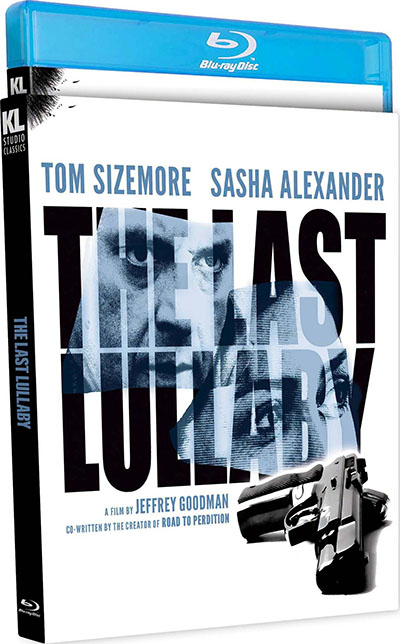
The Quarry movie, The Last Lullaby, is available on YouTube now. Tom Sizemore is “Price” (aka Quarry). I wrote the first drafts of the script and did a final punch-up, but another writer wrote a draft, too…so it’s not pure Quarry, but it’s pretty good.

M.A.C.