Posts Tagged ‘Return of the Maltese Falcon’

A Unique Take on Return of the Maltese Falcon

Tuesday, May 5th, 2026

I had a lovely and really interesting e-mail about Return of the Maltese Falcon I’d like to share with you…and the e-mail writer has given me permission to do so, including her review of the novel.

Dear Max Allan Collins,

You have earned yourself a new fan. I loved Return of the Maltese Falcon.

Several years ago, I convinced my local Big Read committee to adopt The Maltese Falcon for their community wide project. I was a teacher, and I wanted my students to love all genres of classic lit as much as I do. The closest thing we had to The Maltese Falcon in our curriculum was Edgar Allan Poe short stories. Those are great, but I wanted them to read something more modern, too.

My students studied the novel and then hosted a successful community event where they shared their Maltese Falcon-related research to the public in interactive presentations. That project continues to be one of my most favorite teaching moments.

Thank you for revisiting this fun story. I recently reviewed it on my Substack page. I hope you have time to check it out. It’s linked here.

Thanks again for all your stories.

Oh, one more thing. I watched your YouTube video and picked up several writing tips. You are an inspiration.

Deborah Linn McNemee
KeepingClassics.com

Now here is Deborah’s really unique take on my novel.

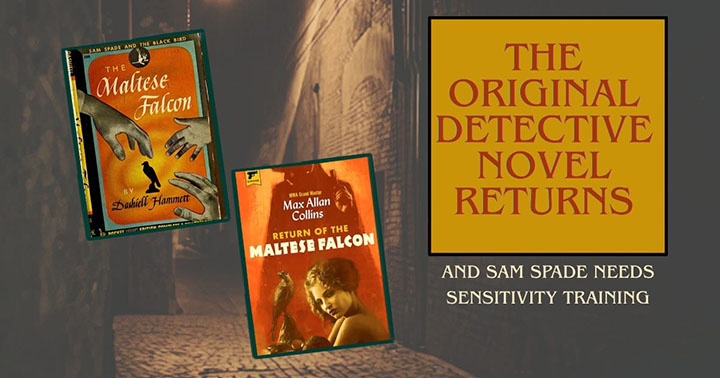
It’s 2026 and Sam Spade Needs Sensitivity Training
How Max Allan Collins Nails a Sexist Detective
in Return of the Maltese Falcon

Deborah Linn McNemee
Apr 27, 2026

Sam Spade is a sexist pig.

We know this, right? He’s been a sexist pig since 1939. A good mystery is timeless, but we all can agree a man like Spade should leave his sexist behavior in the past.

Or maybe not because earlier this year, MWA Grand Master Max Allan Collins brought him back, problematic attitude and all, in the much anticipated Return of the Maltese Falcon. Collins has earned the title of MWA Grandmaster from a lifetime of great writing, such as Road to Perdition, and his work on well-known series like Dick Tracy, Mickey Spillane’s Mike Hammer, and even the Batman comic book.

Sam Spade was originally brought to literary life by Dashell Hammett in the 1930 classic detective novel, The Maltese Falcon. Sam Spade became the template for all the cynical, hard-nosed detectives that came after him. As problematic as these womanizing anti-heroes are, the biggest problem of all is that we like them, especially Sam Spade.

I’ll give you a moment to gasp and fan your face. You know it’s true. Readers, and probably the general public, love a bad good guy, especially when paired with a femme fatale and a wisecracking secretary who calls him out.

But–and it’s a big but–today’s culture will cancel writers for creating these characters just to make ourselves feel righteous.

If I weren’t already salivating at the thought of a sequel to Dashiell Hammett’s The Maltese Falcon, I would have picked up Collins’ book simply out of cancel culture curiosity. How would Collins handle writing a womanizing, sexist character like Sam Spade and a setting like 1928 San Francisco for someone reading him in 2026?

I am an author of retellings, so I know the dilemma. In my current work in progress, I’m navigating one of Mark Twain’s characters, Joe. You know him with the proper adjective Injun placed in front. The retelling needs the character and his storyline. It definitely does not need the moniker. It’s not a name I would ever consider using. It would never pop into my author brain, but it’s in the original. It must be dealt with. It’s delicate work to honor the character and the writing and not insult my readers or myself.

So how does Collins deal with one hundred year old norms? Brilliantly. He nails the sexist detective. And he does it with the help of a woman.

Return of the Maltese Falcon starts two weeks after The Maltese Falcon ends. Brigid O’Shaughnessy and Joe Cairo are languishing in jail for murder, double-crossing, fraud, and a myriad of other shady behaviors. Sam Spade, with his blonde Satan-esque face, is seated at his desk, considering a Christmas tree standing where his former partner’s chair used to be. It was erected by Effie Perrine, his secretary, who enters on cue with her “thin tan woolen dress” clinging to her as her heels clack on the linoleum floor.

We’re barely off page one and the only femme who’s not fatale is already having her way with Sam Spade. He’s not crazy about the holiday decor, but, in some ways, he’s crazy about Effie Perrine, so the tree stays. He knows this and doesn’t fight it as lights and tinsel and ornaments show up throughout the book.

Collins doubles down on Perrine’s power by giving her the last dig in this opening repartee. Perrine introduces Spade to a new client, Miss Smith, saying, “‘You’ll like her…She’s female and young.’”

Okay, so we like Effie Perrine. She is spunky and smart and takes Spade’s machismo in stride. But what about Spade? How does Collins nail him? And why do we like it that he does?

Writers of retellings have the benefit of ready made descriptions. In a Cereal at Midnight YouTube interview, Collins explains that even though Sam Spade has made appearances in short stories and movie adaptations, none of those likenesses could be represented in The Return of the Maltese Falcon because those works aren’t in the public domain. So the blonde hair, the V-shaped facial features, and yellow-grey eyes all come from the original novel. Hammett describes Spade as looking “rather pleasantly like a blond satan”.

This blond Satan idea is the seed that grows into our bad good guy for whom we can’t help cheering. Traditionally, Satan is a red dude with black skin or red horns where hair should be. We don’t think of him as blonde. We certainly don’t think of him as pleasant. But these are Hammett’s words that Collins runs with. It’s as if Spade is the middle ground embodiment of the little angel on one shoulder and the little devil on the other.

That combination continues as Spade smirks and smiles and calls his secretary and every other babe in the story honey or sweetheart or rattle-brained angel. In the original, a frustrated Spade rubs his face into Effie Perrine’s hip for comfort and in the same conversation discusses how he won’t marry his dead partner’s wife just because he was hooking up with her before the poor son-of-a-gun died. Somehow, we don’t hate him for it. We scowl with Effie Perrine as Spade then walks out the door to visit Miss Wonderly for what will become more than strictly a business call, but we don’t hate him.

Throughout both novels, we watch with voyeuristic delight as Spade plays every girl he calls on. Most of them are much younger, but it still doesn’t seem to upset us. Even Collins’ 2026 audience won’t protest too much. Maybe that’s because those honey-sweetheart-angels answer their hotel room doors still damp from a shower, barely covered with thin, see-through negligees and look up at him with doughy eyes and pouting lips. They flaunt their feigned vulnerability because they are playing him right back.

The truth is that Hammett’s Brigid O’Shaughnessy and Collins’ Rhea Gutman and Corrine Wonderly don’t only bring the game to the party, they write the rules, too.

Before you come at me with a lecture on it’s always wrong for older, wiser men to take advantage of younger women, let me concur. It’s wrong. Always. In real life.

Fiction is another world. What we abhor in real life, we often excuse in fiction. It’s a tough pill to swallow, but swallow it we must because Sam Spade is not the only devil getting away with it. Think of James Bond. Think of Indiana Jones when he walks into Marion Ravenwood’s pub to be welcomed with a punch to the face. She adds a certain desperation to her voice. “I was a child,” she says, “I was in love.” He responds with a barely considered, “You knew what you were doing,” and she drops the subject. By the end of the scene, she’s partnering up with him, and by the end of the movie, they’re in love again.

And the crowd goes wild.

Collins is a bit smarter. In that same Cereal at Midnight interview, Collins makes the statement to never write down to your reader. Always assume they are smarter than you. He does not assume the reader will so easily forget and forgive Spade’s escapades, so he brings on women who deserve comeuppance way more than Marion Ravenwood ever does.

Collins also says that the mystery of his novel is not the Maltese Falcon. The mystery is Sam Spade, himself. Who is Sam Spade, really, and what’s he gonna do?

Even if the statue was Hammett’s MacGuffin first, and Spade was his mystery, Collins enacts the concept perfectly. In The Return of the Maltese Falcon, we also have the return of Sam Spade’s libido. He seduces not one, but two young women. Just like in The Maltese Falcon, the women and the reader think maybe he’s gone soft-hearted. Maybe he’s finally met the dame to crack his gumshoe code.

And who knows, maybe Sam Spade isn’t even sure he hasn’t it. In The Maltese Falcon Returns, there’s a point when Effie Perrine watches one of those young ladies walk away and shudders. “‘I was afraid I wouldn’t be able to help you after all, as close as she was to you.’”

“‘She was,’ Spade admit[s]. ‘Too close’”

The point is that Sam Spade does have a code. It might not work for everyone, but it works for him. He doesn’t carry a gun in case he’s tempted to use it. He basically tells it straight. He keeps his word. And he likes women. He especially likes women who think they can pull one over on him, but he never likes them well enough to let them. Smart ones like Effie Perrine who tell it straight, too…well, he more than likes them. He respects them.

And maybe that’s why we like him.

Ultimately, Sam Spade doesn’t get a pass without the women in his world. We don’t mind him blowing off Iva Archer because she’s awful. The femme fatales with all their aliases and alliances are even worse. Their codes make his code seem darn near gallant.

There is one woman, though, who is everyone’s saving grace, Effie Perrine. She’s so sharp, so witty, and so good that if she can see something redeemable in Sam Spade, the sexist pig, we can forgive ourselves for seeing it, too.

* * *

Barb and I have been slowed down these past three weeks by bronchitis. We initially thought we had a reaction to working in the dust and detritus encountered while getting our basement back in shape – the book area, what has been the band room since we moved in and now is more a rec room. We worked hard for days and did not wear masks, so we figured that was the problem.

But we gave what we had to Nate and his family up the street, so if we were contagious, it wasn’t the basement. Barb is about two days behind me, but she’s had it even worse. We both made Emergency Room and Urgent Care visits, and I had an unrelated episode repeating some of the crazy verbal difficulties I experienced back when I had my zany hospital stay (in which I hallucinated I was solving a murder).

We are both doing much better, but we tire easily. It seems bronchitis has a bad habit of holding on.

In the meantime, I’ve started writing the new Sam Spade novel and that seems to be the best medicine.

Speaking of which, here’s some nice Spade coverage from Jeff Pierce at Rap Sheet.

M.A.C.

Sam Spade News & A Fruitcake Near-Rave

Tuesday, April 28th, 2026

I’m pleased to announce I’ve signed with Hard Case Crime to do two more Sam Spade novels.

Launching a new Spade series wasn’t my intention in writing Return of the Maltese Falcon. I merely wanted to be out there first with a sequel to the classic original, now that it was in the public domain, and was presumptuous enough to think I could get it right.

As I’ve mentioned here, when I finished writing the book, and was pleased with it, my wife Barb warned me to brace myself – she said, Not everyone would like me appointing myself to a task that some might think ought never have been attempted. My thinking was, Somebody’s going to do this, and it might as well be me.

And I was surprised and pleased that the reactions were overwhelmingly favorable, generating some of my best reviews ever. A few naysayers weighed in, though were very much in the minority. Don’t get me wrong: I didn’t feel vindicated, I felt relieved.

Only when I saw how well Return of the Maltese Falcon was doing did I begin thinking about writing more Sam Spade. Spade is a character about whom Hammett might well have written another dozen or two novels, like Gardner with Perry Mason, Christie with Hercule Poirot or Rex Stout with Nero Wolfe. And of course Hammett, before turning his back on mystery writing, had written three Spade short stories, plus there’d been the popular Spade radio show with Howard Duff.

But what came to my mind was offering my publisher a trilogy, the first of which would be the already existing Return. I found it interesting to suggest two more Spade novels, each separated by ten years or so – to see what Spade was up to in the war years and then the McCarthy-era ‘50s (which obviously have resonance with Hammett’s life).

I wrote a fairly lengthy proposal and Hard Case Crime’s Charles Ardai, with support from parent company Titan’s Nick and Vivian Landau and my editor Andrew Sumner, responded favorably. I am now about to begin work on Prey for the Maltese Falcon, set in 1939.

In some ways it’s more challenging than Return, which gave me the luxury of working within the parameters of the original novel – its characters, its locations, its themes. Now Spade is ten years older, and the case I’ve constructed takes him all sorts of places that the original novel and my sequel didn’t.

Wish me luck.

* * *

The UK’s Guardian has an excellent essay on the resurgence of interest in the private eye. It includes a nice reference to Return and me.

* * *

I was surprised and pleased to discover that the Overly Honest Reviews site has posted a terrific Death by Fruitcake review that I’ve been granted permission to share with you.

RAVING REVIEW: One of the best types of mysteries doesn’t pretend to be bigger than it is. DEATH BY FRUITCAKE leans into its small-town setting, its contained stage environment, and its personality-driven storytelling without trying to inflate the stakes beyond what the story can support. That restraint ends up being one of its biggest advantages. It knows the scale it’s operating within and, instead of stretching, digs inward into character, tone, and timing.

The setup is simple in the best way. A dress rehearsal collapses into chaos when a notoriously difficult actress drops dead mid-performance, and suddenly everyone in the room becomes a suspect. That kind of confined, single-location mystery has been done countless times, but what makes this one click is the attention it pays to the personalities circling the event. This isn’t about elaborate plotting or intricate twists stacked on top of each other. It’s about letting the audience sit in a room full of people who all have a reason to hate the victim and watching the tension build from there.

Paula Sands carries much of the story as Vivian, and what stands out isn’t just her presence but the way the performance embraces a slightly heightened delivery without tipping into parody. There’s a stiffness to her line reading at times, but instead of breaking the illusion, it almost feeds into the character. Vivian feels like someone who sees herself as more composed and authoritative than she actually is, and that disconnect becomes part of the charm. It’s not polished conventionally, but it fits the world the film builds.

Alisabeth Von Presley brings a different kind of portrayal as Brandy, and the contrast between the two performances becomes one of the film’s strengths. Where Vivian leans toward control and presentation, Brandy feels more fluid, more aware of the absurdity around her. The moments where she interacts directly with the camera could have come off as distracting. They’re used sparingly enough that they add personality instead of pulling you out of the story. It gives the film an edge, a reminder that it’s in on its own tone without constantly pointing it out.

The supporting cast fills out the ensemble, keeping the suspect pool engaging. No one is pushed into satire, but everyone is just exaggerated enough to feel distinct. That balance is important in a story like this. If the characters blend into one another, the mystery loses its shape. Here, each interaction carries just enough tension or humor to keep things moving, even when the narrative slows.

The investigation expands in a way that feels intentionally relaxed, but there are stretches where it could have used a sharper sense of escalation. Conversations feel a bit repetitive at times, suspicions shift without always adding new information, and the momentum dips as a result. It never stalls completely, but there’s a version of this that trims some of that repetition and lands with a bit more impact.

There’s a lightness to the humor that doesn’t undercut the mystery, and a sense of familiarity that works in its favor rather than against it. It feels like a story that understands its audience, especially those drawn to mysteries where the intrigue matters but the experience is just as much about spending time with the characters. The jokes land more often than not, and when they don’t, they still feel in line with the world the film has created.

The single-location setting becomes a strength rather than a constraint, forcing the film to rely on blocking, performance, and dialogue rather than on visuals. There’s a stage-like quality to everything, which makes sense given the setting, and instead of fighting that, the film leans into it.

What ultimately holds everything together is the film’s understanding of what kind of mystery it wants to be. It’s not chasing complexity for its own sake, and it’s not trying to reinvent the genre. Instead, it focuses on delivering a contained, character-driven story with enough intrigue to keep you guessing and enough personality to keep you invested.

There’s also an underlying appreciation for the setting itself. The small-town dynamics, the overlapping relationships, the way grudges and histories linger just beneath the surface, all of that feeds into the mystery without needing to be spelled out. It gives the film a sense of place that adds texture without complicating the narrative.

DEATH BY FRUITCAKE doesn’t aim for perfection. Its appeal comes from how comfortably it settles into its identity. The imperfections are part of the experience, but they don’t define it. What sticks is the chemistry between its leads, the playful tone, and the steady commitment to telling a story that fits its scale. It’s the kind of film that understands exactly what it’s offering, and more importantly, what it isn’t. And in a genre that often overreaches or overcomplicates itself, that clarity goes a long way.

Please visit https://linktr.ee/overlyhonestr for more reviews.

* * *

If you haven’t read Return of the Maltese Falcon yet, please do. And if you watch Death by Fruitcake on Prime or Roku or Apple TV, please leave a thumbs up if you’ve enjoyed it. And if you order the DVD from Amazon, a favorable review there would also be helpful.

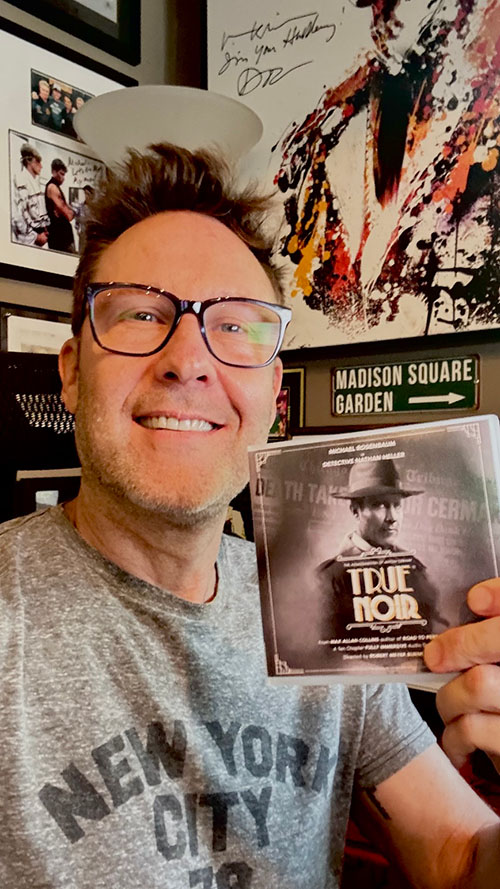
Finally, just a reminder that True Noir: The Assassination of Anton Cermak is out as a 4-CD set now, and can be ordered here for only $23.37 (on sale from its usual $35.95) [Also in a single-disc MP3-CD for $19.47 or digital download for a mere $12.97! – Nate] It’s a full-cast star-studded nearly five-hour audio drama written by me from the first Nate Heller novel, True Detective, and directed by my pal Robert Meyer Burnett.

M.A.C.

True Noir on CD, Love for Fruitcake & A Falcon Nice Review

Tuesday, April 21st, 2026

This week marks the release of the Blackstone/Skyboat four CD-set of True Noir: The Assassination of Anton Cermak (a one-disc MP3-format edition is also available). I’ve talked here often about the amazingly stellar cast (headed up by Michael Rosenbaum) and the direction by my buddy Robert Meyer Burnett. Rob and I both think True Noir is among the best things either of us has done.

You can order it here: https://downpour.com/products/book-101t

[Or here on Amazon. –Nate]

Incidentally, this link accesses 81 titles of mine, in all formats, including Return of the Maltese Falcon.

I get a few inquiries about why True Detective has been adapted under the name True Noir. The obvious (and correct) answer is that HBO used the title on its acclaimed series of a while back. But I like getting the word “noir” in there (and it was my suggestion).

For those of you unfamiliar with this project, here’s what True Noir is: a full-cast, fully scored (by Alexander Bornstein), complete with meticulous sound effects, scripted-by-me adaptation of the first Nathan Heller novel, True Detective. That book won the 1984 Best Novel “Shamus” award from the Private Eye Writers of America, and led to a long-running series (that I may return to one of these days). It really is a movie for the ears, running four and a half hours and providing several evenings of entertainment, or good company on a long road trip.

We hope to do more, but that’s up to you.

A big True Noir event at the Putnam in Davenport, Iowa, is coming up next month. Much more about that later.

* * *

Alisabeth Von Presley and Paula Sands in Death by Fruitcake

My old Ms. Tree cohort Terry Beatty stepped up to inform his Facebook friends about my little movie, Death By Fruitcake, which has just recently been offered here: Xumo (free); Roku Channel (free); Amazon Prime Video (free); YouTube ($2.99); Google Play Movies & TV ($2.99); and Apple TV ($4.99).

Here’s what Terry had to say:

My pal Max Allan Collins’ latest “no budget” movie is now available to stream on Amazon Prime — based on the cozy “Antiques” series of novels written by Max and his wife Barb, under the pen name of Barbara Allan. Well, this one’s based on a novella from an anthology of Christmas themed mysteries — but it features the mother/daughter amateur sleuths from the books. I’ve been providing illustrated maps of the fictional town of Serenity, where the books take place, for the whole run of the series, and just turned in a newly revised map for the next book this morning.

If you’ve been reading the books, you’ll know what to expect here. If “Brandy and Vivian” are new to you, you’ll have fun being introduced to them. As I noted — this is a super low budget movie, so don’t go in expecting Hollywood production values. You also shouldn’t expect a “tough guy” mystery here — this is drawing room/cozy stuff — but with the Collins touch all over it.

You’ll likely have to use Prime’s search function to find it, as they’re busy highlighting bigger budget fare. Enjoy — and don’t eat the fruitcake.

This nice post from Terry elicited this post from Steven Thompson:

HT (hat tip) to Terry Beatty for this morning’s entertainment, a delightful little cozy mystery on Prime written and directed by the estimable Max Allan Collins. The two leads playing mother/daughter small town sleuths are extremely charismatic and both quite well-known in other fields. The non-violent murder mystery is more fun than mysterious, with numerous winks and 4th wall breaks. The dialogue sounds stagey but hey, I talk that way sometimes myself. People tell me I sound odd. Having been an amateur actor myself, too, I certainly recognize that in the film’s entire cast but by no means is that saying they’re bad in any way. As a director, Max makes the most of his low budget quite well indeed, and he even gives a cameo to Dick Tracy, the strip he wrote for years!

Having looked into them now, I see where Paula Sands retired a couple years back from a 40 year career as an Iowa newswoman and talk show host. She is great fun as the theatre director attempting to solve the murder of her much disliked leading lady. Tall and sharply eyelashed Alisabeth Von Presley is really a singer and has appeared on shows like American Idol but she can deliver lines well and she has a wonderful grin and wink. Her relationship with Paula as her mother carries the show.

Highly recommended as long as you don’t expect Oscar-quality anything! A great way to start my morning.

And mine! Though Fruitcake is probably best watched some quiet evening over several glasses of wine with someone you love.

I’m grateful to all of you who have given Fruitcake a try, and especially if you’ve posted at Facebook or elsewhere, including Amazon reviews, where right now we only have two reviews but they are overwhelmingly positive.

* * *

In case you haven’t got round to picking up the current Return of the Maltese Falcon, this review from Matthew Legare should encourage you.

First serialized in 1929, The Maltese Falcon is one of the mystery genre’s most enduring titles. It’s been adapted, parodied, and inspired countless writers. But now, it gets a sequel in the form of Max Allan Collins’s Return of the Maltese Falcon.

Not an official sequel, mind you, but since Dashiell Hammett’s original novel entered public domain this year, any writer can use it however they wish. It’s a bit dicey, since only the original novel is public domain, not the famous 1941 film with Humphrey Bogart, probably the single most influential piece of media for film noir and the hardboiled PI genre. Whenever a stock or cliché gumshoe detective shows up, they’re imitating Bogie as Sam Spade, not the original novel.

(MAC: Hard disagree. The novel itself was already the seminal influence on the private eye novel when the Huston/Bogart film appeared.)

As such, the sequel’s Sam Spade is described as he is in the original novel, i.e. a “blond Satan” and distinctly opposite to Bogart. What’s more, it’s written in Hammett’s distinctive, staccato prose, and all in third-person. That’s a detail I appreciate as too many mystery novels are first person à la Spillane and Chandler, but I’m biased as I always prefer third-person.

The 1941 film (as well as the less famous 1931 adaptation) actually follow the novel pretty closely, so Collins’s sequel actually works pretty well if you’ve only seen the movie and never read the book. Even the cover (a glorious piece of art by the legendary Hard Case Crime imprint) is more evocative of the original novel, with Sam Spade younger and more hawkish than his film versions, the femme fatale a sultry flapper, and the black bird itself more spindly than its bulky movie counterpart.

It starts off shortly after the events of the novel, set in late 1929 (Hammett never specified a date but 1929 is a perfect year in my opinion), Sam receives another mysterious femme fatale in the form of Rhea Gutman, daughter of the villainous Caspar Gutman aka the Fat Man and mastermind of the original novel.

(MAC: a gentle correction. The novel takes place in December 1928 as the text says.)

She’s convinced the Maltese Falcon is not only real but still in San Francisco. If you will remember, the Falcon was procured by a shadowy Russian officer, General Kemidov, who duped Gutman and his two criminal associates, Joel Cairo and Brigid O’Shaughnessy, with a lead phony.

Spade isn’t so sure, but he believes Rhea’s money and visits Cairo and Brigid in jail, asking where Kemidov’s whereabouts may be. Cairo, who was probably the best character in the original novel after Spade himself (famously played by the legendary Peter Lorre) is used sparingly here, which is unfortunate, but there really was no way to get him out of jail after being arrested in the original novel I suppose.

Regardless, Spade does what he does best, snooping for clues and getting into trouble. Sketchy characters emerge out of the San Francisco fog, like our old pal Wilmer Cook, Caspar’s boy gunsel, who has a few violent run-ins with Spade.

Added to the mix are a few other characters like Dixie Monahan, briefly mentioned in the original novel as a dangerous Chicago gangster, who is now also looking for the Falcon. Stewart Blackwood, a refined Englishman from a museum who has, apparently, already paid for the Falcon. Also there’s Brigid O’Shaughnessy’s sister, trying to find the black bird to help pay for legal fees. Kemidov himself features prominently in this novel with his invisible presence felt everywhere, something I appreciate since he was just a name and plot device in the original novel.

Spade juggles multiple clients and leads, along with a mysterious dead body he’s asked to identify, until he finally gets on the Falcon’s scent. Not a decoy, not a misdirect, but the actual Maltese Falcon. This time there’s no going back, but the dangers get even more perilous for Spade – Wilmer Cook keeps popping up but even more troubling, the Police check up on Rhea’s backstory and it turns out, Caspar Gutman never had a daughter.

Everything is wrapped up in the classic “exposition room” scene with all the suspects together and facts laid out. Cliché, but it works.

The Maltese Falcon is one of my favorite novels and Hammett’s prose has influenced me in ways I am forever grateful. It’s a masterpiece and a great piece of American literature, albeit pulp fiction. There are definite problems, some important characters mentioned (like Kemidov) never show up and some of the plot seems rushed together, and the fate of several characters are explained to us off screen. However, all the elements flow together into a beautiful canvas by the end. If you’ve never read it, you don’t know what you’re missing.

(MAC: These are excellent observations. Hammett famously claimed not to have plotted the book in advance, rather writing it by the seat of his pants, as we pulp writers put it, which explains some of what Matthew has to say here.)

Max Allan Collins is what I call a “working man’s writer.” This guy has been writing for decades, across multiple platforms – novels, novelizations, comic books, comic strips (he used to write the official Dick Tracy strip) – and shows no signs of slowing down. He has over two hundred novels to his name with multiple series like the historical detective Nathan Heller, the hitman Quarry, and has collaborated with the legendary Mickey Spillane to finish off the Mike Hammer books. You can tell this man loves the crime genre with a passion and if there’s one living writer worth, and dedicated enough, to write its sequel, it’s Collins.

Return of the Maltese Falcon is a worthy addition to American pulp fiction and worth your time.

It’s incredibly gratifying to receive a smart review like this. I try not to be influenced by either good or bad reviews. I regard the good ones as positive publicity and the bad ones as negative publicity; but don’t allow myself to be influenced by either…though, like most people in the arts, I remember the bad reviews vividly while the good ones are a blur.

* * *

My son Nate and grandson Sam have been watching Cowboy Bebop on Blu-ray. It’s a favorite of Nate and mine, and it was a joy revisiting this incredible s-f/crime anime after so long a time. I would rank it with the original Star Trek and Lexx (a show criminally off my recent “favorites” list) as among my very favorite science fiction series (call it Number 6, although I should probably put The Prisoner there and give Lexx the Prisoner’s slot on the five favorites).

One of the things that characterizes the series is its outstanding music by composer Yoko Kanno and her band the Seatbelts. They just a few weeks ago performed in the United States. Here they are performing the opening theme of Cowboy Bebop (a theme rivaled only by Peter Gunn and James Bond). Enjoy!

M.A.C.

Dashiell Hammett and the Short, Guttural Verb

Tuesday, March 31st, 2026

I caution the easily offended – and even those who are understandably offended – but what I have to say in today’s update will frequently contain a certain word that likely originated from Germanic or Old Norse languages (e.g., ficken, fokken), meaning “to strike,” “thrust,” or “move back and forth.” It has for centuries been a forbidden, rude word. And it’s going to appear throughout this little essay.

So buckle up, or fuck off.

I remember the first time I heard the word. It was during recess on the schoolyard – specifically Grant School here in Muscatine, Iowa, in the mid-1950s. It came from a particularly scruffy kid and I knew, from the glee with which it was spoken, that I had heard something special, and not in a good way. I inquired of a fellow classmate and was told, in no uncertain terms, that this word was one that could get a kid (scruffy or not) in a world of trouble.

By junior high (this was now the late fifties/early sixties), the word sneaked out from the locker-room lips of my fellow classmates. The first time I saw it in print was in the novelization of the original Ocean’s Eleven (1960). It startled me enough that I remember the specific instance and where I was at the time (study hall).

And I didn’t see it again in print for perhaps a year – possibly in a Harold Robbins novel. But I read a lot of sleaze in those days (and nights) and can assure you its appearances on the page was infrequent.

By high school, however, the word ran rampant. My group of guys had nicknames for each other that we found absolutely hilarious – of course one of us was Fuck-head, another Fuck-nose, yes Fuck-butt and the supremely offensive Fuck-shit, which had us in stitches. Hard to believe as it may be, I do not remember which “Fuck” designate I bore.

By high school graduation in 1966, “fuck” was damn near casual among my male crowd, and by community college and my U of Iowa days it was beyond common among all sexes. Athletes and hippies alike were sporting and snorting language that had begun creepy-crawling into the American vocabulary after soldiers came back from fighting WW2 overseas.

As a budding writer – I began writing short stories and novellas in junior high, and novels in high school – I was struck by how rare the word “fuck” appeared in print, even as it had wormed its way into more casual conversational use. But even in those days, “fuck” had weight. It made a point.

I took great pride in being one of the first writers to use “fuck” and “fucking” and “fucked” rather freely in my fiction. I may have been the first to use the phrase “Jesus fucking Christ” (you’re welcome). I was breaking down, or anyway helping break down, a fairly stupid barrier. I felt that people in my novels needed to sound something approximating how people actually talked. “Fuck” coming out of the closet lost some of the word’s power, but that struck me as all right.

And yet.

“Fuck” has become something lazy writers use far too often, particularly in films. Recently Barb and I went to Ready or Not 2: Here I Come, a sequel to (not surprisingly) Ready or Not. We liked the first movie and had a great time with the second one, too. We were fine with the violence and the mean-spirited fun – we knew what we were getting into, after all. Not everyone likes those movies, but we find them enjoyable dark comedies.

And…yet….

The dialogue, as is so often the case now, was just one “fuck” (and its derivatives) after another. It’s a tempting word to use. It has a history of power, even if it’s lacking in power now. It’s so much more satisfying than “damn” or even “goddamn,” since you land on a soft “m,” and who is impressed by “god” anymore, anyway?

And “fuck” has that wonderful “fuh” at the start and hard landing on the “k.” But that hard landing is dulled by overuse. The opening episode of For All Mankind’s fifth season – a solid, smart show – presents an alternate history of the space program in which everyone seems to live on the planet “fuck.”

I’m not talking about the act of, you know, fucking. Just the word. I still like to use it for that special punch. That unexpected kick. Only it increasingly packs a lesser punch, and it’s become more and more the refuge of writers who think the more salt you shake onto the meal, well, the tastier it’s gonna be.

In writing Return of the Maltese Falcon, I had great fun doing variations on Hammett’s way around using the then-forbidden word “fuck,” when gunsel Wilmer Cook insults Sam Spade – “The boy spoke two words, the first a short guttural verb, the second ‘you.'”

So to all you aspiring writers, whether of novels or screenplays or comics, my advice is: use some goshdarn restraint. Sprinkle the salt on your prose, don’t pour the fucking shit – it’s not a Winter sidewalk.

Anyway, it’s Spring now, so back the fuck off.

* * *

Some folks have asked about the major missing list from my recent couple of rounds of lists, so here it is:

FIVE FAVORITE MYSTERY WRITERS
1. Mickey Spillane
2. Dashiell Hammett
3. Raymond Chandler
4. Rex Stout
5. Agatha Christie
(number six is Erle Stanley Gardner)

One of the reasons why I say “favorite” and not “best” is that these are personal distinctions, not absolute opinions.

Let’s rearrange the list.

BEST MYSTERY WRITERS
1. Dashiell Hammett (from which everything noir flowed)
2. Raymond Chandler (the biggest influence on the genre)
3. Mickey Spillane (the writer who transformed the genre)
4. Agatha Christie (the greatest plotter)
5. Rex Stout (the most entertaining)

So while Stout comes in #4 on my favorite list, and #5 on my best list, I have no trouble admitting that I’d rather sit down to read a newly discovered Nero Wolfe/Archie Goodwin mystery than something by anyone else on these two glorious lists.

No further explanations will be offered (probably).

* * *

I am pleased to see that Road to Perdition (the film) continues to attract attention, particularly as a notable movie based on a “comic book.” These are worth checking out.

https://intheseats.ca/the-its-lists-comicon-special-top-non-superhero-comic-book-movies/

https://fanboyfactor.com/2026/03/movies-you-didnt-know-came-from-comics/

* * *

My buddy Heath Holland’s Cereal at Midnight YouTube videos are always worth a look. Heath and I have been doing frequent commentaries for Blu-ray releases for the likes of Kino Lorber and Imprint. We’ll be doing one this afternoon.

Heath recently interviewed me about my return to indie filmmaking, by way of micro budgets. This covers ground no one else has. You may find this worthwhile.

* * *

The True Noir event at the Putnam Museum and Science Center in Davenport, Iowa, has been rescheduled for May 28 and 29 (the last Thursday and Friday of May). On the first night we’ll be screening the restoration of the 1941 Maltese Falcon on the Putnam’s IMAX screen, followed by Robert Meyer Burnett (flying in from California – I believe he’s lining up at the airport now) interviewing me about Return of the Maltese Falcon. On Friday we’ll be presenting in the IMAX theater the opening chapters of our full-cast audio drama (based on my novel True Detective), True Noir: The Assassination of Anton Cermak.

Much more about this as the event approaches.

M.A.C.