Posts Tagged ‘Road to Perdition’

Fancy Anders, Nic Cage, A Suspenseful Release and More

Tuesday, August 17th, 2021
M.A.C. and Barbara Collins holding Suspense - His and Hers
E-Book: Amazon Purchase Link
Trade Paperback: Indiebound Purchase Link Amazon Purchase Link Books-A-Million Purchase Link Barnes & Noble Purchase Link

Suspense – His and Hers (subtitled Tales of Love and Murder) is available now, both in Kindle e-book and a handsome trade paperback. It collects stories by Barb and me both individually and together. Two Quarry short stories are included (“Guest Service” and “Quarry’s Luck”) and a rare Ms. Tree short story (the Edgar-nominated “Louise”). It’s a pleasantly plump collection (almost 300 pages) and I think you’ll like it. Wolfpack did a marvelous job on the cover.

Fancy Anders Goes to War: Who Killed Rosie the Riveter?
E-Book: Amazon Purchase Link

Speaking of marvelous covers, feast you eyes on Fay Dalton’s cover for Fancy Anders Goes to War, which is available now for pre-order at $2.99 in Kindle form. There will be a trade paperback edition as well, but that isn’t up for pre-order just yet. This is the first of three novellas I’ve done for NeoText about Fancy, who is a 24-year-old (obviously) female detective in Los Angeles during World War II. The subtitle is Who Killed Rosie the Riveter? The fantastic Ms. Dalton has, in addition to the cover, provided a full-page illustration for each of the ten chapters.

If you like to read on Kindle, an advantage is that Fay’s artwork is presented in color (well, a couple were intentionally left black-and-white for film noir reasons) whereas only the cover art will be in color in the trade paperback. These are short novels (hence the term novella) but longish ones, running 30,000 words each. They will make nice additions to the shelves of Luddites like me who prefer “real” books.

It is my intention, my hope, that the three Fancy Anders novellas will be collected in one book with the Fay Dalton art properly showcased. (The Fancy Anders trade paperbacks are POD and only the cover will be in color.) I had a wonderful time doing these stories and hope more of Fancy’s cases will find their way through my fingers to the pages of books. These may not be as hardboiled as Quarry or Nolan or Hammer, but then what is? Fancy is like a younger Ms. Tree and is not shy about taking bad people down violently.

* * *

My classic rock band Crusin’ will be performing at the Muscatine Art Center’s Ice Cream Social this coming Sunday. Details here.

Right now this is the final scheduled gig of our short season. I had hoped to line up a few more, but with the surge in Covid the better part of valor for Crusin’ is to fade into rehearsals for our much-postponed CD of original material. Rehearsing and recording that CD is our winter project. It was supposed to be last winter’s project, but….

Here is a link to a video of the second set of our recent Sunday Concert series performance. I warn you that the instrumental is waaaaay back – you can barely hear the keyboards and the punch of the guitar is dialed down from the actual event. That’s because this is a sound board recording and you get mostly vocals.

I’m providing this because I do think it captures the casual intimacy of the event, which is quite different from working a larger venue. Thanks to Chad Yocum for shooting the video and providing the link.

* * *
Nicolas Cage in Pig (2021)

As I may have mentioned, my son Nate and I are fans of actor Nicolas Cage. It’s odd to be a Nic Cage fan, because you never know whether the film at hand will be gold or dross, or something in between.

Some time ago Cage began taking (apparently) any job that comes his way if his price is met, and that price must not be sky high considering how many jobs he takes. This practice began some years ago when he had a tax problem that sent him spiraling from A-list to Direct-to-Video.

Cage was always quirky and for some an acquired taste. But here’s the thing: Nic always gives 100%. The film can be utter shit (and occasionally is – a few have caused even the loyal Collins boys to bail) but you never know when something really special is going to crop up.

Willy’s Wonderland, with the sublime premise of a defunct Chucky Cheese wanna-be restaurant becoming a haunted house for its mechanical animal musicians, has Cage giving a full-bore eccentric performance that almost elevates it to something special. Not quite, but for some of us, essential viewing. Primal is terrible, A Score to Settle rather good. You never know. A Cage movie is the surprise package of cinema.

Now and then, however, Nic and his collaborators knock it out of the park. Often he does extreme action and/or horror stuff – common among low-budget indies – and Mandy is something of a masterpiece. It’s sort of The Evil Dead without the laughs (except very dark ones) or the zombies. I would recommend it wholeheartedly to any even mildly adventurous movie fan.

But the current Pig (streaming for a price at the moment) is a reminder of just how great an actor Cage can be when a director handles him well and the material is strong. On the surface, it seems to be a revenge story, but that’s an assumption you’ll make that will prove wrong. It has tension and one violent scene, but it’s not an action movie. The premise sounds fried even for Cage: a hermit in the forest survives on the truffles he and his truffle pig find, which are sold to a city-boy hustler regularly; somebody beats Cage up, steals the pig, and Nic goes to the big city (Portland) to get his pig back.

If this sounds like you asked somebody to imagine a movie that even Nic Cage would reject, you’d be very, very wrong. It’s a wonderful movie and about all sorts of things, but revenge isn’t really one of them. Unexpectedly it becomes about being a chef, as opposed to a hermit, but really it explores loss and father-son dynamics. Pig centers on (get ready for it) an understated Cage performance that is Oscar worthy, and includes one of the best scenes you’ll ever see in any movie – what is that scene about? The hermit makes a chef cry in the latter’s trendy restaurant.

You can dismiss me as a crazy hermit who lives in Iowa if you like, but the loss will be yours.

* * *

Here is a delightful review of Antiques Carry On from Ron Fortier’s Pulp Fiction Reviews. But…it isn’t written by Ron! Suspense killing you? Read on…

ANTIQUES CARRY ON
A Trash ‘N’ Treasures Mystery
By Barbara Allan
Severn House
Guest Reviewer -Valerie Fortier

Ron isn’t into Cozy mysteries and when this one arrived in the mail, he dropped it on my desk top with the suggestion I give it a go. Months later it’s still sitting there and I decided to give it a try. As a Mom myself, I totally get the mother-daughter dynamics. Sometimes they gel, other times they are nothing but oil and water.

I would recommend you take time to meet Vivian and Brandy. The mother-daughter team that never misses a chance to inject humor and fun while investigating a new mystery. I really enjoyed the book; especially the great twist at the end in regards to who done it. Just when you think you’ve got it solved, there’s more to be revealed.

The book offers up a truly wonderful cast of characters to “cozy” up by the fire and share some time with.

Final note – This is the start and end of my reviewing career. Thanks, Ron.

* * *

Finally, here is an interesting, in-depth look at the film of Road to Perdition.

M.A.C.

Sand, Free John Sand Book & More

Tuesday, July 27th, 2021

The Book Giveaway for the third John Sand novel, To Live and Spy in Berlin, by Matthew V. Clemens and me and published by Wolfpack starts right now – ten physical copies are available to the first ten of you who ask for one.

[All copies have been claimed! Thank you for your support!]

In return you agree to write a review at Amazon and/or other review venues (Barnes & Noble, Goodreads, various blogs). Should you dislike the book, you are absolved from that duty if you wish.

I would love to run J. Kington Pierce’s wonderful piece on the John Sand books for January Magazine, but you will need to follow the link here.

But it’s so encouraging to see a really intelligent professional and highly respected reviewer understand what Matt and I are up to in the Sand books. Good reviews are great for marketing, but it’s really gratifying when a smart critic “gets it.” (He also writes about it briefly at the Rap Sheet.)

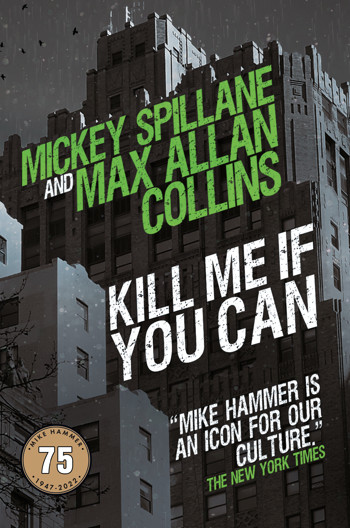
My pal and Titan editor Andrew Sumner did an interview with me for the at-home San Diego Comic Con. It runs an hour and he did his usual terrific job. We cover all the Titan stuff – the forthcoming Ms. Tree Volume 3: The Cold Dish, the current flurry of Nolan books from Hard Case Crime (including Double Down), and next year’s 75th anniversary Mike Hammer novel, Kill Me If You Can for Titan, which I’m writing now (and which is the reason so little content is available here this week beyond the giveaway and some news items). Generously Andrew asks me about non-Titan projects, including the Spillane bio I’m doing with Jim Traylor for Otto Penzler at Mysterious Press and, yes, the John Sand series (and more) at Wolfpack.

I’m also a guest at the home version of the Sentai con, where I discuss Lone Wolf and Cub and Asian action films in regard to Road to Perdition. Info here.

A couple other pieces of news/information.

First, the rights to the Nate Heller novel Better Dead have reverted to me and I hope to line up a new publisher because there’s never been a paperback edition. And for now the e-book is off the market.

Second, in a bizarre mistake, the paperback edition of the Caleb York western Hot Lead, Cold Justice was published with the art for the previously published Last Stage to Hell Junction. A new edition will be published soon by Kensington with the correct art (the same art as the hardcover edition of Hot Lead). I hope to be able to have a way for anyone with the a copy of the wrong cover to be sent a corrected version. More on this later.

Dead-End Jobs: A Hitman Anthology
Paperback: Indiebound Amazon Books-A-Million (BAM) Barnes & Noble (B&N) Powell's
E-Book: Amazon Google Play Nook Kobo iTunes

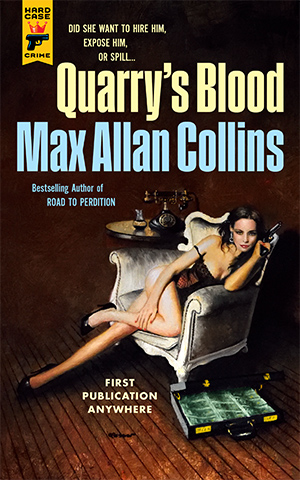
Andy Rausch, editor of Dead-End Jobs: A Hitman Anthology (which features a Quarry short story), is interviewed by Michael Gonzales on the subject of fictional hitmen here.

Book Bub has a $1.99 e-book deal on the Mike Hammer novel Murder Never Knocks, which they describe as a page-turning noir thriller: Legendary PI Mike Hammer scours Hollywood’s dark underbelly for the person who tried to have him killed. “This novel supplies the goods: hard-boiled ambience, cynicism, witty banter, and plenty of tough-guy action” (Booklist).

Check out this excellent write-up on an unfortunately out of print collection of my early Dick Tracy work with Rick Fletcher.

Finally, this should lead you to an excellent documentary about Walter Tevis, who (like Richard Yates) was one of my instructors at the University of Iowa Writers Workshop.

M.A.C.

Wolfpack Giveaway #2 – Untouchable Cats

Tuesday, October 13th, 2020

I am in the middle of the third of the three novellas I’m doing about a brand-new character (stay tuned) for Neo-Text. So I will try to distract you for the lack of a real blog entry this week with the second Wolfpack book giveaway.

Too Many Tomcats Wolfpack Edition

I have four trade-paperback copies of Too Many Tomcats, my wife Barb’s terrific collection of tales about evil, dead and stuffed felines. I co-authored a couple and wrote the intro. If you are a hold-out among my readers who has avoided reading Barb’s work and/or our collaborative work, now is your chance to finally get wise.

Barb’s short stories are in the vein of the old Alfred Hitchcock Presents TV show and Roald Dahl, and she’s been compared to both (and not just by me!).

In addition, I have two copies each of the four Eliot Ness trade paperbacks – The Dark City, Butcher’s Dozen, Bullet Proof, and Murder by the Numbers.

[All copies have been claimed. Thank you for your support! — Nate]

This is for USA only – mailing overseas and even to just Canada was expensive before the Pandemic.

Here’s the important part – this isn’t really about free books. It’s about getting reviews on Amazon and/or at your own review site, if you have one. Most of you participating in these book giveaways have been good about doing those reviews. But please hold up your end of the bargain.

Eliot Ness Saga, Wolfpack Edition
* * *

Here is a video interview wherein my pal Andrew Sumner talks to me about Ms. Tree, and specifically about the soon-to-be-published second Ms. Tree collection, Skeleton in the Closet.

And here is the appearance (via Zoom) by my co-author A. Brad Schwartz and I at the Mob Museum in Las Vegas in support of Eliot Ness and the Mad Butcher. Includes a power point presentation! Excited?

Finally, here is a nice look at Road to Perdition as Tom Hanks’ most under-rated movie.

M.A.C.

Celebrating the Release of the Mad Butcher

Tuesday, August 4th, 2020
Eliot Ness and the Mad Butcher
Hardcover: Indiebound Purchase Link Bookshop Purchase Link Amazon Purchase Link Books-A-Million Purchase Link Barnes & Noble Purchase Link
E-Book: Amazon Purchase Link Google Play Purchase Link Nook Purchase Link Kobo Purchase Link iTunes Purchase Link
Digital Audiobook: Amazon Purchase Link Google Play Purchase Link Kobo Purchase Link
Audio MP3 CD: Indiebound Purchase Link Bookshop Purchase Link Amazon Purchase Link Books-A-Million Purchase Link Barnes & Noble Purchase Link
Audio CD: Indiebound Purchase Link Bookshop Purchase Link Amazon Purchase Link Books-A-Million Purchase Link Barnes & Noble Purchase Link

Today is the publication date of the non-fiction tome Eliot Ness and the Mad Butcher by A. Brad Schwartz and myself. I am celebrating this by giving away ten copies.

[Edit: All copies have been claimed. Thank you!]

The four Eliot Ness novels covering his Cleveland years – a quartet that eventually led to both the play/film Eliot Ness: An Untouchable Life and the two non-fiction works, Scarface and the Untouchable and the new Eliot Ness and the Mad Butcher – are available at Amazon from Wolfpack as An Eliot Ness Mystery Omnibus for $2.99. Even with my meager math skills, I can tell that’s a penny under three bucks for four novels.

While we hope to offer new print versions of the novels (perhaps in two-novels-to-a-volume form), right now they are Kindle e-books only. So no giveaways are in the cards for now. But if you have already read the novels – any of them – and liked them, reviews of the Eliot Ness Omnibus would be much appreciated. Right now we have a paltry two reviews at Amazon and that doesn’t go very far at getting the Omnibus noticed. Even if you haven’t bought the books in this new form, don’t hesitate about reviewing them under the Omnibus listing.

Since I’ll be talking about Eliot Ness this week, I’ll remind you that Eliot Ness: An Untouchable Life is available on Blu-ray now at Amazon.

It’s also available on DVD for $9.99.

Reviews for Untouchable Life at Amazon are also appreciated. We only have two at the moment, and no one has specifically talked about the Blu-ray.

Also, the entire five-book Mallory series will be available for 99-cents each as Mystery, Thriller & Suspense Kindle book deals from now through the end of August. Included in the sale will be the thriller Regeneration by Barb and me (as “Barbara Allan”), also at 99-cents.

The Mallory titles are: No Cure for Death; The Baby Blue Rip-off; Kill Your Darlings; A Shroud for Aquarius; and Nice Weekend for a Murder.

* * *

Is it undignified to celebrate the career of a law enforcement icon who could not be bribed by offering a giveaway, and hawking various titles pertaining to him? I don’t really care, since I never claimed to be untouchable myself.

But Eliot Ness and the Mad Butcher (it has a subtitle but I decline to use it, because I dislike it intensely) marks the final stage of an interest in the real-life lawman that reaches back into my childhood. My interest in such things begins even before the first Untouchables of two installments on Desilu Playhouse aired on April 20, 1959. The Dick Tracy comic strip (by way of comic book reprints) had ignited that interest; but, in fairness, since Ness was the real-life basis of Chester Gould’s Tracy, the Untouchable was already in the mix.

There’s no question that Tracy and Ness got me interested in stories about detectives, but more significantly The Untouchables TV series (and the autobiographical book that spawned it) got me interested in the factual material that generated so much of the guns-and-gangster pulp fiction I adored. My novel True Detective (1983), after all, deals with the same crime – the assassination of Mayor Cermak – as a two-part Untouchables episode I saw as a kid. Granted, that two-parter only nodded at history, but that nod was enough to get my attention.

Ness became the Pat Chambers to Nathan Heller’s Mike Hammer in a number of the Heller novels. At the request of an editor at Bantam, I spun Ness off into the four novels that dealt with his Cleveland years (previously explored, somewhat inaccurately, in Oscar Fraley’s Untouchables follow-up, Four Against the Mob, but otherwise little written about).

Two things are, I think, significant about those novels, including that they represent the first time actual cases of this real-life American detective had been the basis of stories about him (excluding the initial two-part telefilm). More importantly, the writing of the books led to research by myself and George Hagenauer that uncovered new (or at least forgotten) information about Ness.

In addition to his occasional role in the Nathan Heller saga, Ness appeared in my graphic novel Road to Perdition (drawn by the great Richard Piers Rayner) and in my prose sequel, Road to Purgatory (available from Brash Books). The latter, to some degree, dealt with Ness’s little-known role in fighting venereal disease on military bases and elsewhere during World War II.

For unknown reasons, Ness was not depicted in the film version of Road to Perdition, but that nonetheless led to the play (and 2007 video production of) Eliot Ness: An Untouchable Life. Initially, actor Michael Cornelison and I were planning to do a one-man show about Perdition antagonist John Looney. We intended to mount it in Rock Island (where Looney had been the local crime boss in the early Twentieth Century) and shoot the film in one of the two existing houses were Looney had lived.

Somewhere along the line, one of us – it may have been Mike – suggested that Ness would have greater appeal to a wider national audience. Also, over the years I had heard from editors and readers that I should do a non-fiction treatment of Ness, since I had done so much research into and about him. Much of what George and I uncovered about Ness was making its way into the accounts of non-fiction writers (fiction writers, too) without credit.

As an independent filmmaker, looking for productions that could be produced cheaply but well, I found a one-man show appealing. I also had the possibility of a grant from Humanities Iowa, for whom I’d made an appearance at a University of Iowa event with editorial cartoonist, Paul Conrad. We mounted the play at the Des Moines Playhouse, where we shot the film between performances. My eventual co-author Brad Schwartz saw the play and that sparked our collaboration.

I had intended An Untouchable Life to be my final statement on Ness. While it is written from Ness’s point of view, skewed to his own memories and perceptions of his life, and some dramatic liberties were taken (by both Ness and me!), the play represents the most accurate depiction of Ness on screen to date.

Eventually, however, Brad convinced me to join him in writing the definitive biography of Ness. We embarked on doing that only to discover another, apparently major Ness biography was about to come out. I had once considered doing a massive, Godfather-style novel on both Capone and Ness, cutting back and forth between their stories. Now I suggested we follow that approach, but in a strictly non-fiction fashion. That would set us apart from any Ness bio or Capone bio, for that matter.

Obviously that approach – particularly since we intended to do cradle-to-grave accounts of both men – turned out to be too big for one book. Now we have a two-volume work that I feel confident is the definite treatment of the life of Eliot Ness. The research George and I did for the novels has been greatly enhanced by further research, much of it by my co-author, who crisscrossed the country in his efforts, even talking to surviving friends and associates of the long-deceased lawman.

It must be said that I have written about several different Eliot Nesses. The Ness of the Heller books serves a specific function – he is Heller’s conscience, the Jiminy Cricket to his Pinocchio. The portrayal darkens in Angel in Black and Do No Harm. The Eliot Ness Omnibus of Cleveland novels is a basically accurate but somewhat romanticized version of Ness – far closer to reality than Robert Stack, but splitting the difference between them. The same is true of Ness in Road to Perdition and Road to Purgatory. Eliot Ness: An Untouchable Life is only slightly romanticized, and (in my view at least) portrays him as he saw himself.

The real Ness can be found in Eliot Ness and the Mad Butcher (and Scarface and the Untouchable). My co-author and I did not always agree on what – or who – the research added up to. We wrestled our way into a joint presentation that is probably more accurate than if either of us had been turned loose alone.

I can look at these two works and feel that, at last, I have done right by this complex real-life Dick Tracy. With the publication of Eliot Ness and the Mad Butcher, with the recent publication of Do No Harm (which ends Ness’s story in the world of Nate Heller), and with the four Ness-in-Cleveland novels gathered into Omnibus form, I feel I’ve come full circle.

* * *

Here’s a great Wall Street Journal review. Here is the link, but it requires a subscription to read.

‘Eliot Ness and the Mad Butcher’: An Untouchable Second Act

After helping to put Al Capone behind bars, lawman Eliot Ness came to Cleveland, where he did battle with a vicious killer.

Moviegoers of a certain age will remember Eliot Ness—the upright law-enforcement figure who battled corruption and organized crime from the 1920s to the ’40s—as portrayed by a tough-talking Kevin Costner in Brian De Palma’s 1987 movie “The Untouchables.” Television viewers from an even earlier era will recall Ness depicted by the stern-faced Robert Stack in the ABC series (1959-63) of the same name. But the real-life Ness, as revealed in Max Allan Collins and A. Brad Schwartz’s “Eliot Ness and the Mad Butcher,” was less the hard-boiled hero of popular culture than a humane and forward-thinking lawman as interested in preventing crime as in punishing it.

The Chicago-born Ness (1903-57) came to prominence as a Prohibition agent in the Windy City, doing battle with Al Capone and other bootleggers as head of his own hand-picked squad of agents. His men were dubbed the “Untouchables” for their refusal to accept payoffs or gratuities. As a friend observed of the incorruptible lawman: “Honesty amounted to almost a fetish.”

The government put Capone behind bars in 1932 via the prosecution of a tax-evasion case, but the work of Ness and his men was central to establishing the extent of the mobster’s criminal activities. With Capone out of the picture, the Untouchables were disbanded, and Prohibition ended soon after. Ness, a nationally known figure (his physical and professional image inspired Chester Gould’s comic-strip police hero Dick Tracy), looked beyond Chicago for new opportunity. He found it in Cleveland, the site of his next significant successes—but also of the disturbing case that gives Messrs. Collins and Schwartz’s book its title.

Ness was named Cleveland’s director of public safety in 1935 and was put in charge of the city’s police and fire departments. He found the cops to be sloppy, uncooperative and demoralized. Once more he formed his own discrete unit of Untouchables to weed out incompetent and corrupt officers and hire smart new ones. “Intelligence,” he counseled, “must supplant brutality.”

But even Ness was stumped trying to apprehend the “torso murderer” responsible for a series of ghoulish killings, in which parts of dismembered and beheaded corpses were strewn about the woods and dumpsites of Kingsbury Run, one of the city’s poorest areas. “The mystery of the headless dead” drew national and international attention. In Germany, the Nazi press mocked America’s inability to apprehend the “Mad Butcher of Kingsbury Run.” With no witnesses and sometimes no way even to identify victims—and with advanced forensics techniques far in the future—police were stymied.

By 1938, the authors write, “the Butcher had become the subject of the largest manhunt in Cleveland’s history.” Thousands of citizens wrote and called the cops with worthless tips. “The investigators, after years of fruitless searching, grew desperate, pursuing ever more eccentric lines of inquiry.” At last a few tantalizing leads brought an alcoholic and mentally disturbed doctor named Francis Sweeney to the attention of the detectives.

Ness and his crew subjected the 44-year-old Sweeney—who had shown signs of psychosis and had been verbally and physically cruel—to judicially inadmissible polygraph examinations that convinced all present of his guilt. Still, despite an abundance of circumstantial indicators, Ness had no hard evidence. Complicating matters was the man’s being a cousin of a local congressman, a vocal Ness critic. Prosecution was not an option. Ness handled the matter privately, helping to arrange Sweeney’s commitment to a mental hospital. Sweeney, who was institutionalized for much of the rest of his life, sent a series of bizarre and taunting postcards to Ness through the mid-1950s.

Though Ness was sure that the killer had been caught and dealt with, he couldn’t officially close the case and so swore himself and his men to secrecy. The public was left with the impression that the culprit might still be at large. The case of the Mad Butcher, with its unsatisfying non-finale, fits a bit awkwardly into Messrs. Collins and Schwartz’s wider narrative. In the latter stages of their book, the authors ably follow Ness through an unsuccessful foray into city politics and a disappointing business career. But given this work’s title and its subtitle—“Hunting America’s Deadliest Unidentified Serial Killer at the Dawn of Modern Criminology”—one sometimes gets the feeling of two different books uneasily hitched.

That said, the authors have done Ness justice. It’s discouraging to learn that a man who refused a fortune in bribes died $9,000 in debt. Shortly before his fatal heart attack at the age of 54, he finished work on the memoir that would revive and romanticize his reputation and bring his third wife and their adopted son a modicum of income.

Messrs. Collins and Schwartz, in this, their second deeply researched book about Ness, don’t gloss over their subject’s failings and blind spots, but they do show that he tried harder than many to leave the world a better place. His “signature achievements in Cleveland—fighting juvenile delinquency, reorganizing the police department, promoting traffic safety—stemmed from a deep well of humanity and compassion,” they write. Now more than ever, the authors conclude, Ness’s name “should remind us of the rigorous standards he brought to law enforcement—professionalism, competence, honor, and decency—and a determination to make everyone safer by addressing the systemic root causes of crime.”

Review by Tom Nolan.

* * *

My favorite Jeopardy! question popped up again on a rerun this week:

MAC on Jeopardy!

Here’s a great interview with my buddy Charles Ardai, editor of Hard Case Crime. He mentions me several times, bless him.

Check out this wonderful review of The First Quarry.

M.A.C.