Posts Tagged ‘Mike Hammer’

Happy Birthday, Mike Hammer – All Year!

Tuesday, January 11th, 2022

So it’s 2022 and that makes it the 75th anniversary of Mike Hammer.

More specifically, it’s the 75th anniversary of the publication of I, the Jury (1947), the first Hammer novel. The character, arguably, begins with Mike Lancer, who appeared in one story written by Spillane and drawn by Harry Sahle, “Mike Lancer and the Syndicate of Death,” in Harvey’s Green Hornet comic in 1942. Lancer became Mike Danger, although none of the comics stories were published till 1954.

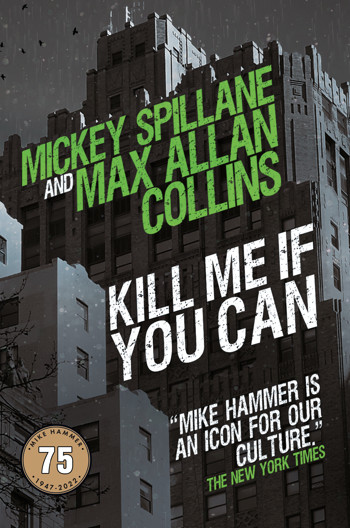
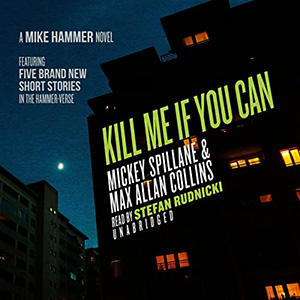
Kill Me If You Can cover
Hardcover:
E-Book: Google Play Kobo

If you’ve been following this update/blog, you may recall that we have a lot of special things in store this year for the Hammer birthday celebration. I have used several unproduced TV scripts by Mickey to write the 2022 novel, Kill Me If You Can, available in August (and for pre-order now). The book is the prequel to The Girl Hunters (1962) and deals with the missing period between it and Kiss Me, Deadly (1952), showing how Hammer dealt with Velda’s disappearance and apparent demise. (Hint: not well.)

But wait, there’s more: in addition to the full-length novel, we are including five short stories written by me from unpublished Spillane material; this includes two Hammer stories and three others in the Hammer-verse. These stories have appeared in The Strand, Ellery Queen’s Mystery Magazine and Mystery Tribune, and are collected here for the first time. I am very grateful to Titan publishers Vivian Cheung and Nick Landau and editor Andrew Sumner for giving me this opportunity to make the 2022 Mike Hammer book something really special.

Again, if you’ve been following these updates at all, you’re aware that Jim Traylor and I have completed Spillane – King of Pulp Fiction, the long-in-the-works biography of Mickey. It’s in the hands of Mysterious Press publisher Otto Penzler who, after some tweaks and minor rewrites, has sent the book into copyediting. In recent weeks I’ve compiled the photos for the book and written captions, all of which have been approved by Jim and which are now in the hands of my son Nate to prepare them for the book designer.

I don’t have an official pub date yet, but the idea is for the biography to be out toward the end of this birthday year.

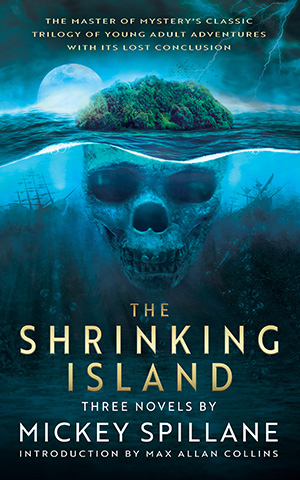
Additionally, I am working with Wolfpack editors Paul Bishop and James Reasoner, as well as publisher Mike Bray, to bring out several major Spillane books during this celebratory year. First, a collection of Mickey’s YA adventures novels will for the first time gather all three of those books into one volume, The Shrinking Island, named for the previously unpublished final book in the Josh and Larry trilogy. Hardcore Spillane fans have been waiting for this for a long time.

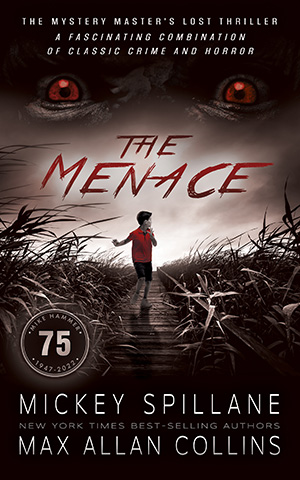
In addition, I have novelized and expanded Mickey’s unproduced screenplay, The Menace – the only work of his that was designed as a horror property – into a novel. Wolfpack will be bringing that out this year, possibly under their recently acquired Rough Edges Press imprint.

Finally, I am in the process of putting together a collection of Spillane’s short fiction – not all that short, because mostly this is novellas – plucked from two long out-of-print collections I edited (Tomorrow I Die and Together We Kill). This new book – Stand Up and Die! – will excise from previous two collections assorted non-fiction and non-mystery-fiction works and leave only vintage Spillane crime yarns.

Included will be a new edit by me of “The Night I Died,” the Mike Hammer short story that marked the only Hammer collaboration between Mickey and me during his lifetime (we of course worked on the revival of Mike Danger together). It is based on an unproduced radio play Mickey wrote around 1953. I am taking a new look at it because I now feel it was too literally a translation of the script.

The novellas, including the title one and the little-seen “Hot Cat” (aka “The Flier”), are particularly strong. This will be a fine addition to the books published in the Hammer birthday year.

In addition, I am working with Bob Deis, the mastermind behind Men’s Adventure Quarterly, to present a raft of other Spillane novellas in at least one collection including the original men’s adventure magazine illustrations.

We had great success with Mickey’s 100th birthday celebration a few years ago; this represents a new – and perhaps last – bite at the apple. I hope to do a few more Hammer novels for Titan, including Mickey Spillane’s The Time Machine (originally Mike Danger but now Mike Hammer) before wrapping up the saga. And if Wolfpack is successful with the Spillane publications above, I have one more unproduced Mickey screenplay to novelize and half a dozen novels he began that are waiting to be finished.

I’m sorry to report that Kensington has not requested a new Caleb York, but Wolfpack has been very successful with their western line, and – again, depending on how these Spillane titles to for them – we may see Caleb (and me) back in the saddle. I don’t have a pub date, but I think Kensington will still be bringing out Shoot-out at Sugar Creek in a mass market edition as yet another Spillane title in the Hammer anniversary year.

As usual, the success of all this is in your hands.

* * *

Here’s a very smart review of the new Hard Case Comics Ms. Tree collection from Titan, third in the series.

Check out this fabulous review of Fancy Anders Goes to War from Ron Fortier.

Some interesting thoughts about the film version of Road to Perdition here.

This list of the best mysteries of all time includes a number of my titles. Aw shucks, he said. About time, he thought.

M.A.C.

Gilbert Gottfried, Get Back and Sondheim

Tuesday, November 30th, 2021
M.A.C. and Dave Thomas on Gilbert Gottfried’s Amazing Colossal Podcast with Frank Santopadre

I haven’t heard much of it yet, but my appearance with Dave Thomas on Gilbert Gottfried’s Amazing Colossal Podcast with Frank Santopadre – in support of The Many Lives of Jimmy Leighton – is available now. Check out the podcast web site here.

* * *
The Beatles: Get Back

The Beatles: Get Back, the new three-part documentary streaming on Disney Plus, may be destined for as much controversy as the original Let It Be (1970), which at the time Ringo Starr described (rightly) as “joyless.” The director of that previous documentary, Michael Lindsay-Hogg, is revealed as a vapid, unimaginative baby who substitutes a cigar for a rattle.

Already reviews have called the nearly eight-hour documentary both “aimless” and “riveting,” and it is admittedly as exhausting as it is exhaustive. But only the most casual of Beatles fans would not be engaged and moved by spending unfiltered time with these four young musicians who were – and are – so pivotal to worldwide popular culture.

Peter Jackson is a master filmmaker – this is the guy who made the great Meet the Feebles and Dead Alive, after all – and his storytelling via cutting and choice of image is as purposeful as it might seem random. He uses reaction shots – culled not necessarily from what is happening at the moment – for glue and to underline character, a technique that might seem dishonest but is vital to making something like this flow and achieve coherence.

The most basic aspect of Get Back is its immediacy – John Lennon and George Harrison are alive, Paul McCartney and Ringo Starr are young men, and the right-now-of-it is startling. It doesn’t take long to realize these are real people, interacting in flawed, personal ways, and anyone who has been in a band will recognize at once the conflicts and alliances within this world of four humans.

These aren’t just any four humans, of course, although their Liverpool-lad humanity comes through – these are consequential humans. Laugh if you will, but this is something like having behind-the-scenes footage of the making of the Constitution, with Jefferson and Franklin on camera.

Perhaps the most fascinating and startling aspect is watching songs that have become a familiar part of our lives created before our eyes and ears. McCartney and Lennon struggle to find the right lyrics, Paul looking for something natural, Lennon something surrealistic – Ringo at a piano playing just the opening of “Octopus’s Garden” and Harrison leaning in and helping him take it further…all very casual.

Primarily it’s a character study although it’s in the context of ticking-clock suspense – Ringo has a film start coming up and the band has only a few weeks to write the new album and perform it live for a TV special. A lot of compromises and rescheduling accompanies the band’s apparent inability to do much more than screw around in the enormous movie studio they’ve been burdened with. But they get down to work (although a lot of warming up and goofing off follows) with the goal shifting but staying essentially similar. The documentary aspect of the TV special evolves into a feature film, but the pay-off – where to hold their first live performance in three years – remains elusive. Lindsay-Hogg has spectacularly bad ideas about where that might be shot – he is a one-man reminder of how dead-on This Is Spinal Tap was.

The doc shows a band in free fall. They have reached a point where all of them – even Ringo – need to go off on their own. The real, largely unspoken question is whether or not breaking off for solo albums and individual projects can stay in the context of the Beatles – can they be individuals and group members at the same time. This is the issue they haven’t faced.

In Part Three, Harrison – who quits the band in Part One, which becomes a major dramatic turning point – rather timidly suggests that maybe since he only gets a couple of songs per album he might want to do a whole album of his own. Lennon reacts favorably, but with a bit of surprise, as if that possibility had never occurred to him.

In Part One, McCartney tries hard to be the leader, to get things organized, and throughout he’s focused – really, obsessed – with having a goal, expressed as the documentary paying off in some way (likely a live concert). Lennon seems rather passive-aggressive – he’s not a problem, just less than enthusiastic and showing up late, with Yoko Ono sitting close beside him. While she is not disruptive, her presence changes the dynamic. Harrison quitting brings McCartney and Lennon together, in an effort to coax George back into the band, which (obviously) they do. By Part Three, McCartney swaps roles with Lennon, becoming vaguely passive-aggressive, often off by himself developing melodies and lyrics – his own engine now, not the band’s.

Still, Lennon and McCartney are working together, smiling, laughing, creating. You see, right before you, their spark. Their magic. And you understand why Harrison feels left out. Strangely, they are always accepting of each other’s music but rarely offer a compliment. Harrison comes in with several now-familiar songs, wonderful things, that receive nods and little smiles, but not much else.

Ringo, perhaps realizing the trouble he’s caused with his looming film start, says very little – he just does his job. Now and then that wonderful smile flashes, but mostly he seems melancholy, as if he alone knows the Magical Mystery Tour is nearly over.

And it’s almost frustrating, if fascinating, to hear such now-familiar songs as “Get Back,” “I Dig a Pony,” “The Long and Winding Road,” and “Two of Us,” refusing to come together. Even when an actual song emerges, they rarely get a take that satisfies them or longtime producer George Martin, a quietly looming presence. When the idea of a rooftop performance as the pay-off comes up, the shaggy shape these songs are in is almost frightening.

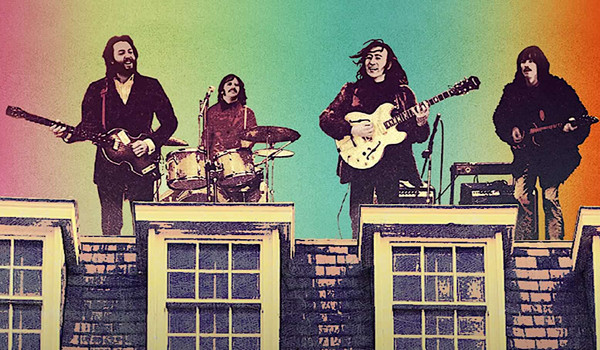
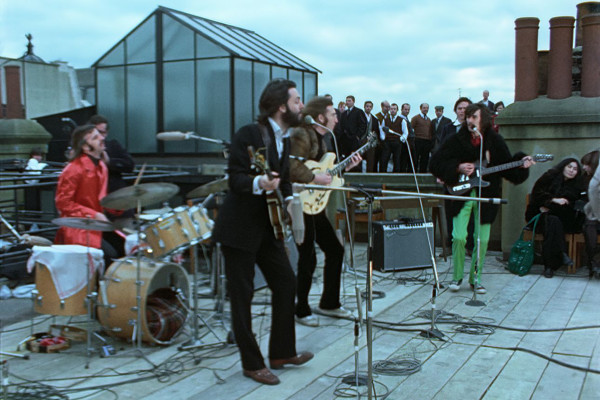
The Beatles, rooftop performance

And then the Beatles are on that rooftop and their performance is tight, dazzling, classic – definitive versions that made it onto the Let It Be album. And Lennon and McCartney are smiling at each other, grinning. Ringo smiles, too; even the reluctant, remote, jealous Harrison, is having fun. When they play “One After 909” – a formative Lennon/McCartney composition dating back as early as 1957 – their sense of the journey they’ve been on is palpable.

And joyous.

But it’s also the very definition of bittersweet – there they are, alive and well and playing their hearts out. We try not to linger on what we know that they don’t – death by gunfire, lung (and breast) cancer – and revel in their living presence.

Their undying presence.

* * *

When someone dies at 91, I suppose you can’t call it a tragedy. But losing Stephen Sondheim is a loss nonetheless. For many years he was somewhat off my radar – Company, A Little Night Music and Sunday in the Park With George seemed (from a distance) arty, the kind of thing New Yorkers get excited about…and I admit I am still not a fan of Sunday in the Park with George, which has an unsympathetic protagonist and a weak second act.

I got on board the Sondheim train by way of Sweeney Todd, thanks to a laserdisc of the Broadway production. I was (as the British say) gobsmacked, the tuneful darkness of it hitting me in the same spot that had turned me into a Bobby Darin fan at age 10, thanks to “Mack the Knife.” I found a laserdisc of Into the Woods and loved it, too – fairy tale fun in the first act, something Grimm in the second.

In 2001, with son Nate along, we witnessed a wonderful, intimate production of Pacific Overtures at the Chicago Shakespeare Theater. This was the first time we’d seen a live, professional performance of a Sondheim musical, one of his best shows. At the same theater in 2007, we took in Passion with SNL’s Ana Gasteyer (so wonderful in the film version of the musical of Reefer Madness); a much undervalued show with a James M. Cain feel.

In 2003, Barb and I saw Bounce, Sondheim’s last produced musical, in Chicago (it was also known as Wise Guys, Gold!, and Road Show). It was a troubled show that never quite came together despite seemingly endless rewrites; but it was an opportunity to see a new Sondheim musical. The hilarious Richard Kind starred.

The only time we saw a Sondheim show on Broadway was a revival of Into the Woods in 2002 starring Vanessa Williams that was unfortunately dumbed down for tourists (like us?). The film version is good, but not a patch on the Broadway production (available on DVD and Blu-ray); same is true of Sweeney Todd – an interesting Tim Burton take on the material, but the original with Angela Lansbury can’t be beat (also on DVD and Blu-ray).

I came to realize I’d been a Sondheim fan long before Sweeney Todd – I just didn’t know it. But he was the co-lyricist of two musicals I liked very much – West Side Story and Gypsy – and he had written the music and lyrics for A Funny Thing Happened on the Way to the Forum.

Stephen Sondheim

Sondheim appeals to the writer in me for his attention to language and character; the musician in me admires the way he does so while still coming up with memorable melodies. Some say he wasn’t a good man with a melody, but I’ve had too many Sondheim ear-worms for that to be true.

No question he’s on my short list of Broadway musical composers with Richard Rodgers, Lorenz Hart, Oscar Hammerstein, Lerner & Lowe, Frank Loesser, and Newley & Briccuse (Briccuse recently passed as well).

* * *

We also saw an excellent TCM bio: Dean Martin: King of Cool directed by Tom Donahue. A star-studded (if somewhat alarmingly elderly) group of celebrities reminisce about Martin, who seems to have been something of an enigma even to those closest to him.

It’s a lovely piece, a little hard on Jerry Lewis, though Jerry probably has it coming – still, I loved seeing him and Dean together. Martin was an extremely shrewd, instinctive performer who knew his weaknesses and his strengths and could play off both. He was a singer in the Sinatra/Crosby mold until Jerry Lewis turned him into a straight man, and Martin was instantly one of the best. When he and Lewis broke off, he became a movie star, landing a straight role in The Young Lions – astonishing everyone with his ease in front of the camera…as if he hadn’t just starred in a blockbuster sixteen Martin & Lewis films.

When he needed a new nightclub persona, he crafted the well-known slightly inebriated version of himself, using Joe E. Lewis as a model. Reportedly his on-stage glass was filled with apple juice.

He resisted Sinatra’s insistent carousing, preferring to watch westerns in his hotel room. He relished his family life (though remained somewhat distant) and probably avoided extended social interaction with Hollywood royalty knowing his uneducated Steubenville, Ohio, background wasn’t up to it. He played a lot of golf and made his TV series accommodate his schedule and whims.

It’s sad to have to watch his decline, leavened by his truce with Lewis, but scarred by the loss of his son. The filmmakers, interviewed after the doc by TCM’s Ben Mankiewicz, make an interesting observation. Figures in popular culture like Martin – and the Beatles and Stephen Sondheim – are human beings who decline and eventually die like the rest of us. But once they are gone, they snap back into place at their peak – their best – and John Wayne becomes the star of Rio Bravo and The Searchers and not a frail shell of himself, dying of cancer as he receives an honor. In their prime again.

They live on in the way we want them to. The Beatles’ music has already lasted over half a decade. Sondheim’s musicals will be presented as long as there are stages. Dean Martin will charm and serenade us, just as he and Jerry are still able to crack us up.

But I am at an age when I find myself tearing up at the damnedest things.

Like four lads from Liverpool playing “One After 909″ on a rooftop while clueless bobbies try to shut the music down.

* * *

Titan Books celebrates 40 years, and my Mike Hammer editor Andrew Sumner says nice things! You’ll have to scroll down, but on the trip pause when you see an interesting book, even if I didn’t write it.

Finally, there’s a good review of Quarry’s Vote here, if you scroll down; too bad the reviewer expected Quarry and me to be “woke” thirty-six years ago (I got knocked down a “star” for that!).

M.A.C.

Happy Anniversary – Everybody!

Tuesday, August 3rd, 2021
Suspense His and Hers cover
E-Book: Amazon Purchase Link
Trade Paperback: Indiebound Purchase Link Amazon Purchase Link Books-A-Million Purchase Link Barnes & Noble Purchase Link

We hope to have advance copies of Suspense – His & Hers before too long. The pub date is September 8. Wolfpack has done another outstanding job on the cover of this collection, a companion piece to Murder – His & Hers, also published by Wolfpack (originally published by Five Star).

These two His & Hers collections are unusual in that they gather individual stories by Barb and me, as well as collaborative ones. I feel my best individual short story I’ve ever written is in Suspense (“Amazing Grace”) and a collaborative one that is primarily by Barb (“What’s the Matter With Harley Quinn?”) is a particularly strong example of her work. These are both recent stories and reflect how personal experience impacts our writing. Also included are two Quarry short stories and the Edgar-nominated Ms. Tree prose tale, “Louise,” by me. Several “best of the year” stories by Barb are included.

“Amazing Grace” was suggested by my great grandparents’ Golden party. It was particularly significant in real life, and I had told Barb about it several times (my great grandfather, with all the family gathered at a big anniversary party, announced she was divorcing my great grandfather, a sweet tippler who deserved the boot). When I got the assignment to write a story involving an anniversary for an MWA collection, Barb reminded me of this true event and I was off and running.

“What’s the Matter With Harley Quinn?” derives from Barb’s experiences at the most recent San Diego Comic Con we were able to attend when she spent two days trying to get collectible pins for our (very much grown) son Nathan, who did not attend the con that year. Not a comics fan herself, Barb was thrown into a rather wild and wooly lion’s den and, typically, she came out bloody but unbowed, and with a story in mind. If Alfred Hitchcock Presents will still on, her stories would be a staple there. Our friend the late Ed Gorman frequently compared her work to Roald Dahl’s.

Our Antiques Carry On is out right now, and I hope you’ll look for it. Frankly, we haven’t seen it (a hardcover) in a Barnes & Noble or BAM! yet, the only bookstores we’ve been to in post-Covid. The book is very handsome and (I say with zero modesty) funny as hell, as well as a good mystery, so your support is encouraged. We have a new publisher, the British house Severn, and they packaged the book very well indeed. But the future of Brandy and Vivian Bourne is in your hands.

Speaking of bookstores, a friend of the family sent in this lovely display from Powell’s Books in Portland:

Powell's Books M.A.C. display.

I have completed the 75th anniversary Mike Hammer novel, Kill Me If You Can, which will have five bonus Spillane/Collins short stories that include two Hammer tales. It’s going to be a special book, just one of a number of things I’m working on to make Mike Hammer’s anniversary (yes, this is an anniversary-themed update) special. The anniversary in question is the first appearance of the detective in I, the Jury (1947).

I should say first published appearance, because as those of you who have really been paying attention know…the first appearance of the character, as Mike Lancer, was in a Green Hornet comic book (#10, December 1942) and the character was first developed by Mickey as Mike Danger as a comic project that did not come to fruition, and in an unfinished novel that became the Spillane/Collins collaboration, Killing Town.

Kill Me If You Can is based on mid-‘50s material Mickey wrote with radio and later TV in mind, and gave me the opportunity to deal with the younger, psychotic Hammer in a more direct way than ever before. Basically it bridges Kiss Me, Deadly and The Girl Hunters (the film of which is on several streaming services right now, by the way).

Tom Sizemore and Sasha Alexander in The Last Lullaby

The Last Lullaby, based on the Quarry novel The Last Quarry with a screenplay co-written by me, is streaming in HD on Amazon Prime right now, included with your Prime membership (if you have one, of course). [And $2.99 to rent / $6.99 to buy if you don’t have Prime.–Nate] It’s a good film and is probably more in line with the novels than the Cinemax series was, though Quarry is called “Price” because I didn’t want to grant sequel rights.

M.A.C. holding a copy of To Live and Spy in Berlin at his desk

Finished copies of the trade paperback edition of To Live and Spy in Berlin by Matt Clemens and me were sent out to the winners of the most current book giveaway. It’s a thing of beauty, and that wonderful essay Jeff Pierce wrote about the series in January Magazine has sparked real interest.

And now the estimable Ron Fortier has written the following rave review, which I will (still immodest) share with you:

TO LIVE AND SPY IN BERLIN
By Max Allan Collins with Matthew V. Clemens
Wolfpack Publishing 221 pgs

With this third installment of the John Sand series, Collins and Clemens put forth a proposition many past mystery writers have tackled; can marriage still be romantic and sexy? Following the events that were detailed in “Come Spy With Me” and “Live Fast, Spy Hard,” former British Agent John Sand and his Texas Oil Heiress wife, Stacey, have together joined the new international spy organization called GUILE created by U.S. President John Kennedy and run by former British Spy Chief Sir Lord Malcolm Marbury; known affectionately as Double M.

As we rejoin the Sands, the major issue between them is whether or not Stacey becoming an operative was a good idea or not. A series of lethal encounters with a team of professional assassins has John rethinking his decision. At the same time certain intelligence comes to the surface that former Nazis who escaped capture at the end of World War II may be active in Berlin, after having disappeared for several decades in certain South American countries. Bomb making uranium has been stolen and the likelihood of these renegade Nazis creating their own atomic bomb is a threat that cannot be ignored.

As in the first two entries, Collins and Clemens cleverly work in actual historical settings throughout the thriller, weaving their fiction skillfully around real people and the volatile political atmosphere of the early 1960s. Yet despite this outer layer of narrative, it is the relationship between John and Stacey that is truly captivating. It was impossible not to recall other literary and cinematic spouses from the past. From Nick and Nora Charles, to televisions Hart to Hart and McMillan & Wife, married duos sharing outlandish adventures worked remarkably well in the past and they are very much the pedigree of this thrill-a-minute new series.

As always, Collins and Clemens offer up a whole lot more than any back cover blurb can properly define. This series is brilliant in all its many aspects. If you’re a spy junkie like us, its time you met the Sands.

Ron does entertaining and informative reviews regularly at his Pulp Fiction Reviews blog.

And if you’re not a regular reader of J. Kingston Pierce’s Rap Sheet, you should be. There’s a mention of my stuff in this incredibly packed installment of his informative Bullet Points.

M.A.C.

Sand, Free John Sand Book & More

Tuesday, July 27th, 2021

The Book Giveaway for the third John Sand novel, To Live and Spy in Berlin, by Matthew V. Clemens and me and published by Wolfpack starts right now – ten physical copies are available to the first ten of you who ask for one.

[All copies have been claimed! Thank you for your support!]

In return you agree to write a review at Amazon and/or other review venues (Barnes & Noble, Goodreads, various blogs). Should you dislike the book, you are absolved from that duty if you wish.

I would love to run J. Kington Pierce’s wonderful piece on the John Sand books for January Magazine, but you will need to follow the link here.

But it’s so encouraging to see a really intelligent professional and highly respected reviewer understand what Matt and I are up to in the Sand books. Good reviews are great for marketing, but it’s really gratifying when a smart critic “gets it.” (He also writes about it briefly at the Rap Sheet.)

My pal and Titan editor Andrew Sumner did an interview with me for the at-home San Diego Comic Con. It runs an hour and he did his usual terrific job. We cover all the Titan stuff – the forthcoming Ms. Tree Volume 3: The Cold Dish, the current flurry of Nolan books from Hard Case Crime (including Double Down), and next year’s 75th anniversary Mike Hammer novel, Kill Me If You Can for Titan, which I’m writing now (and which is the reason so little content is available here this week beyond the giveaway and some news items). Generously Andrew asks me about non-Titan projects, including the Spillane bio I’m doing with Jim Traylor for Otto Penzler at Mysterious Press and, yes, the John Sand series (and more) at Wolfpack.

I’m also a guest at the home version of the Sentai con, where I discuss Lone Wolf and Cub and Asian action films in regard to Road to Perdition. Info here.

A couple other pieces of news/information.

First, the rights to the Nate Heller novel Better Dead have reverted to me and I hope to line up a new publisher because there’s never been a paperback edition. And for now the e-book is off the market.

Second, in a bizarre mistake, the paperback edition of the Caleb York western Hot Lead, Cold Justice was published with the art for the previously published Last Stage to Hell Junction. A new edition will be published soon by Kensington with the correct art (the same art as the hardcover edition of Hot Lead). I hope to be able to have a way for anyone with the a copy of the wrong cover to be sent a corrected version. More on this later.

Dead-End Jobs: A Hitman Anthology
Paperback: Indiebound Amazon Books-A-Million (BAM) Barnes & Noble (B&N) Powell's
E-Book: Amazon Google Play Nook Kobo iTunes

Andy Rausch, editor of Dead-End Jobs: A Hitman Anthology (which features a Quarry short story), is interviewed by Michael Gonzales on the subject of fictional hitmen here.

Book Bub has a $1.99 e-book deal on the Mike Hammer novel Murder Never Knocks, which they describe as a page-turning noir thriller: Legendary PI Mike Hammer scours Hollywood’s dark underbelly for the person who tried to have him killed. “This novel supplies the goods: hard-boiled ambience, cynicism, witty banter, and plenty of tough-guy action” (Booklist).

Check out this excellent write-up on an unfortunately out of print collection of my early Dick Tracy work with Rick Fletcher.

Finally, this should lead you to an excellent documentary about Walter Tevis, who (like Richard Yates) was one of my instructors at the University of Iowa Writers Workshop.

M.A.C.