Posts Tagged ‘Mike Hammer’

A Sumner/Collins Interview and Where To Find Sympathy

Tuesday, August 9th, 2022

My friend and editor at Titan in the UK – the great Andrew Sumner – did an interview with me about the Mike Hammer novel being published September 13th (Kill Me If You Can) as part of the 75th anniversary of Mickey Spillane’s great private eye.

Andrew has edited the last three or four Hammers, at my request. Several previous editors at Titan – while good, smart people – were not familiar with Hammer or Collins or the quirky way of American tough-guy argot. Andrew is, and he’s been a pleasure to work with.

I will spoil the punchline of the interview by revealing here that I have signed with Titan to complete the Mike Hammer Legacy series with two final Mike Hammer novels, to be published in 2023 and 2024. These final two books will, as have all of the books in this series of Collins completed novels, contain genuine Spillane content.

What an honor and pleasure it has been to undertake this task. It’s not entirely over, because a number of non-Hammer fragments remain that may generate Spillane novels, and there’s even the possibility of a couple of Hammer short stories. But the novel saga of Mike Hammer is drawing to a close, with the shelf of 13 expanding to 29 plus a short story collection (A Long Time Dead) rounding the series to an impressive 30.

I should also thank Otto Penzler at Mysterious Press, who published the first three Spillane/Collins Hammer novels (The Goliath Bone, The Big Bang and Kiss Her Goodbye, all under the Titan umbrella now) as well as the short story collection. Otto’s understanding and appreciation of Mickey and Mike’s legacy will continue with the January 2023 publication of Spillane – King of Pulp Fiction (by James L. Traylor and myself).

This will be a somewhat short update because, frankly, I am dealing with a health issue. I hesitate to mention it because – as with the recent passing of our family dog, Toaster – this might elicit an outpouring of support, good thoughts and even prayers. Which is always appreciated, but I don’t think any of this is a big deal – just the price of living this long and trying to stay active.

One aspect of my heart problems – which my open-heart surgery in 2016 dealt with effectively – is an occasional recurrence of Afib. Some people can handle Afib as a part of their daily lives, but it throws me for a loop. Nonetheless I didn’t realize I’d slipped back into Afib until I took a previously scheduled PET stress test a few days ago.

I’d been dragging around and fighting sleepless nights for about a week, and had suffered through a band job where I could barely tear down and set up and tear down my keyboards, and where my performance was perfunctory at best. Having been through Afib several times before, I should have tipped to it immediately. But didn’t. The stress test had barely begun when the nurse informed me I was in Afib.

Actually, what she said was, “Did you know you were in Afib?”

I said I didn’t, managing not to proceed that with “duh,” as I’d been experiencing every symptom.

Anyway, luckily I am able to go in tomorrow (Monday) for cardioversion, which is essentially jump-starting your heart. Usually it’s just one long day in the hospital. This is Sunday as I write this, and will happen Monday, while this Update appears on Tuesday, so good wishes are not necessary – the shooting match will be over.

I share this with you because, obviously, it’s on my mind. I began writing F.O.M.A.C. (Friends and Family of Max Allan Collins) updates decades ago. This was prior to using the Internet for that purpose – these were literal, physical newsletters that went out once or twice a year, and announced bookstore and convention appearances, and let readers know what novels and comics and even movies were coming out.

At some point – and I have zero memory when – we moved this to the Internet, and again the occasional postings were prompted by appearances and publications. My son Nate suggested the infrequence and irregularity of these updates were not helpful and nudged me into more regular postings. Before long we switched to weekly ones.

Frankly I focused on promo of my work, links to favorable reviews, and not much else for a while, until again my son said I needed to be more personal (something he came to regret to a degree). Nate particularly encouraged me to pull back the curtain on the writing process – talking about how Nate Heller is researched and so on. To mix metaphors, to share how the sausage is made.

Now and then I wandered into politics and again my son warned me against it, and he was right. I weaken now and then, and still make no secret of my politics; but no real political opinion stuff appears here. What I drifted into was reviews and other discussion of popular culture, which I enjoy doing and get good response doing it. A more personal side began creeping in.

I was a big fan (and a friend) of Harlan Ellison’s. I told him often that I loved his collections of stories where he introduced and discussed his own work. I really loved (and love) that sense of who was behind the fiction being part of the mix. This has crept into my books, with introductions and afterwords (particularly of reprinted material), containing autobiographical looks at how novels or stories came to be written – for example, the convoluted tale of how Nolan began at Curtis Books in the early ‘70s, with only two of the five books seeing print by that company before they were swallowed up by Popular Library; and how the remaining three and one new one were picked up by Pinnacle in the ‘80s. And how Don Pendleton thought I was stealing from him because Nolan rhymed with Bolan.

And the Nolan story is a lot more complicated than that, but my essays about it can be found in the Hard Case Crime two-fer collections of the novels.

A turning point came in 2016 when I had open-heart surgery and wrote about the experience here. My writer pal Steve Mertz said that was some of my best stuff ever, and he knows whereof he speaks. So I have been more frank here, although my son from time to time protects me when I get out of hand…as when recently I went ballistic about a review that irritates me and he reminded me it was a three-year-old review and I should probably get over it. So we cut that bit.

Maybe someday I’ll collect some of the best of F.O.M.A.C. and let the censored stuff see the ill-advised light of day.

Anyway, this is a long-winded way to say that I don’t write about sad and personal and medical things here to get your sympathy. As my late friend Paul Thomas used to say (quoting his father), “If you want sympathy, it’s between shit and syphilis in the dictionary.”

Nonetheless, I want to thank you for reading these blog entries. With luck, I’ll see you here next week.

* * *

This is an interesting column by a reader who has picked up Girl Most Likely and is experiencing it via the book and audio being able to sync up. She promises a review of the novel soon.

In the current entry of the Rap Sheet, J. Kingston Pierce talks about my announcement of Too Many Bullets, and how it will deal with “the 1968 assassination of Robert F. Kennedy, he explains, but will also ‘cover both Jimmy Hoffa and Sirhan Sirhan,’” and how it may be the last Nate Heller novel. Turns out I am an unreliable narrator, because (with editor Charles Ardai’s blessing) I have already decided to turn Too Many Bullets into two Heller novels. Too Many Bullets will be the RFK assassination novel. The as yet untitled Heller after that will go back and deal with the Jimmy Hoffa story. This came about because – as is always the case – the research has led me places I did not expect to go.

Fifteen movies are recommended here, and one of them is Road to Perdition.

And Road to Perdition is also one of the best movies that have moved to Amazon Prime.

M.A.C.

A Darling Deal, and Heller on My Mind

Tuesday, July 19th, 2022
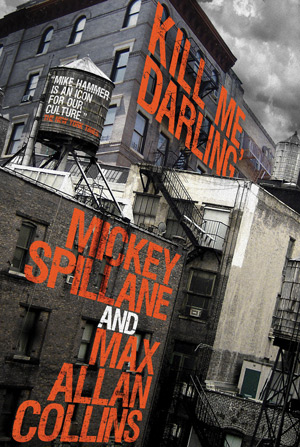
Kill Me, Darling cover
E-Book: Google Play Kobo

Another book deal has popped up, this time BookBub, and it applies to Kill Me, Darling, one of my favorite of the posthumous Spillane collaborations. I was working from a false start on The Girl Hunters where Velda’s disappearance didn’t have to do with Russia and espionage, but rather Florida and vice. (So in the Hammer canon Velda now disappears twice…not counting kidnappings.)

Anyway, I don’t understand BookBub and if someone wants to straighten me out, I’m fine with that. But it would appear this deal lasts for about a month. Like the still ongoing Girl Most Likely and Girl Can’t Help It offers, Kill Me, Darling is 99-cents on e-book. Unlike the Amazon deal, this extends to Nook and other e-book platforms.

Here’s how BookBub describes Kill Me, Darling:

From the authors of Murder Never Knocks. Private investigator Mike Hammer heads to Miami to find his ex-lover Velda — and figure out her connection to the disturbing murder of her old colleague. “Mike Hammer is undeniably an icon of our culture” (The New York Times).
$0.99 (regular price $7.99).

* * *
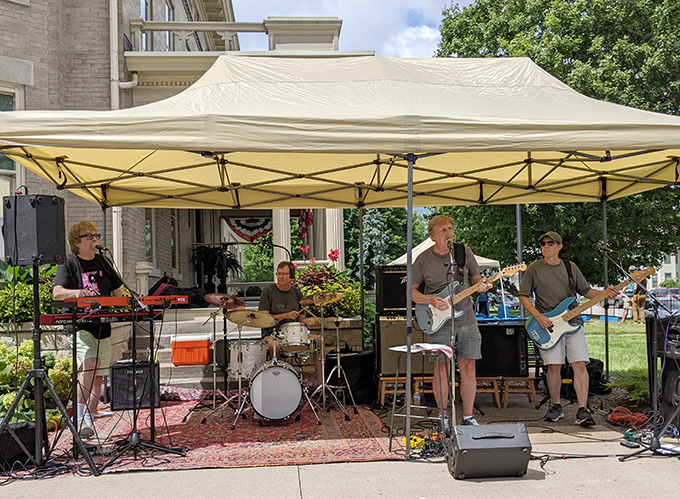
Seduction of the Innocent band photo

You may have seen my Seduction of the Innocent bandmate Steve Leialoha’s query to me in the comments last week, regarding my current project, Too Many Bullets, Nate Heller looking into the RFK assassination. He asked me if I’d ever talked to Miguel about the night of the assassination at the Ambassador Hotel, saying that Miggie and his mom were there that night.

This was news to me, and I kicked myself, because I’ve known for years I would eventually do Bobby Kennedy, and I never discussed it generally with Miguel. Why would I? You might ask.

Well, Miguel was a big Nate Heller fan. He always requested signed copies to read on set in his trailer (actors have a lot of down time). We talked Heller a lot. We were hoping to do a movie at one point with him in the lead (the novella Dying in the Post-war World was written with that in mind). Didn’t happen but I sure do wish it had.

Miggie’s (and my) pal Bill Mumy, a fellow Seductive One, was…and probably still is…a Heller fan, too. Like Miguel, he has read Heller novels during on-set downtime, and after all he wrote the song “True Detective” for our CD, The Golden Age. I’m proud to have these two among Heller’s supporters. And it hurts that Miguel didn’t get to read any Heller past Ask Not. Maybe, somewhere, Miggie and Bill Crider and Ed Gorman are in a book club, keeping tabs on me.

Chris Christensen, the other Seduction bandmate, also reads Heller, or anyway he used to. Chris did the music for my documentaries Mike Hammer’s Mickey Spillane and Caveman: V.T. Hamlin and Alley Oop). Very talented guy, and like all the Seductive Ones nice and fun.

If you were unaware of my friendship with Miguel, or even if you were and this is old news, you may wish to read this post from January 2017. It’s one of my favorites.

That Miguel could have shared his memories about a tragic, historic night about which I have yet to write gives me an extra pang in an already sensitive part of my psyche. But it also points out how weird the experience of writing Nathan Heller can be.

Miguel and his mom (Rosemary Clooney!) had been at the Ambassador Hotel that wonderful-turned-terrible night, and in an odd way that connected me. I already had an odd Kennedy connection because Jackie Onassis had been my editor on a book I co-wrote with a political figure (a ghost job). I had spoken on the phone with her many times and got to know her in that “phone friendship” way that can be very real. I have a letter she wrote me saying what a great job I did on the book. My University of Iowa mentor, Richard Yates, had been a Bobby Kennedy speech writer, as I learned after I plucked a copy of The Enemy Within off my mentor’s shelf and saw that it had been warmly signed to him. My collaborator Dave Thomas is a fellow assassination buff who knows Paul Schrade and promises to connect me with him. Paul Schrade was standing in back of Bobby Kennedy that night and also got shot in the head, but survived and is now 97 and still researching the case he was in the middle of.

This brings up an interesting point or two. I never know, in doing a Heller, whether I should talk to living participants in the cases I explore. They tend to have their own agendas and I can get caught up in them. For years after writing Stolen Away, I got phone calls from two of the men who thought they were the Lindbergh baby (and one might have been). I need to have my own point of view. My own take.

The other thing is weirder yet. Barb and I were on our honeymoon in Chicago – we were married on June 1 – when the Robert Kennedy assassination occurred in the early hours of June 5. We were staunchly anti-war and were RFK supporters. The news, made strange by not being home at the time, hit us hard, but…and this is the weirdest thing…I remember that I felt (can’t speak for Barb) that American political assassination had become just something to be expected. I was in high school when JFK got it, and not long before Bobby was killed MLK had been taken down, and I was at least vaguely aware of Malcolm X being in the same category. I remember thinking, “So this is how it’s going to be now.”

Maybe the lone nuts decided to find a new hobby (they certainly have one now). Or maybe the powerful figures in the darkness moving chess pieces decided their moves were getting too obvious. But the next time I had a similar feeling was on Jan. 6, last year. I paused writing in my office and went downstairs to get something to drink, and flipped on the TV, and saw Trump’s mob crawling over the face of the Capitol like bearded ants.

And with a shrug I said softly to nobody, “That’s about right.”

It looked like this was how it was going to be now.

Getting back specifically to Nate Heller, my overriding job with all of these cases – unsolved or controversially solved – is to write a hard-hitting private eye novel, with the humor and sex and violence that people expect out of me. That I expect out of me. Part of a Heller novel can be disturbing and even sad, like Chinatown. But it also has to be exciting and interesting and, yes, fun. Like Chinatown.

So how do I face something as terrible, as nation-shaking as Bobby Kennedy’s death without trivializing it?

That is very much on my mind right now. Serving history. Serving my readers. And not doing either of them an injustice.

* * *

Here’s a story about Mickey Spillane walking out on I, the Jury in 1953. Maybe it’s true. The sentiment on his part is accurate. But the movie’s actually pretty good.

The great James Reasoner writes about the collection of the Mike Hammer comic strip that I edited and introduced for Hermes Press a while back.

Nice Road to Perdition (the film) essay here.

This review looks at Headed for a Hearse by Jonathan Latimer and my introduction (which was written some time ago for an earlier edition, though the writer seems unaware of that). It’s a pretty good essay but drifts into the area of judging yesterday’s fiction by today’s politically correct attitudes. The reviewer better not read the first chapter of Farewell, My Lovely.

M.A.C.

Mike Hammer, John Shaft & James M. Cain

Tuesday, July 12th, 2022
Kill Me If You Can Audiobook cover
Hardcover:
E-Book: Google Play Kobo
Audiobook: Google Play Audiobook Store

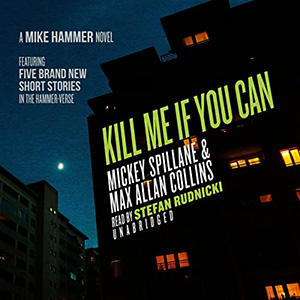
Coming in August, by Mickey Spillane and Max Allan Collins, is Kill Me If You Can, the 75th anniversary Mike Hammer novel (Hammer debuted in I, the Jury in 1947). It includes five Spillane/Collins short stories, two of which are Mike Hammer, both significant additions to the canon.

Kill Me If You Can will also appear on audio, read by the great Stefan Rudnicki, who for the past several Hammer novels has performed the impossible task of stepping in after Stacy Keach. The five short stories are included.

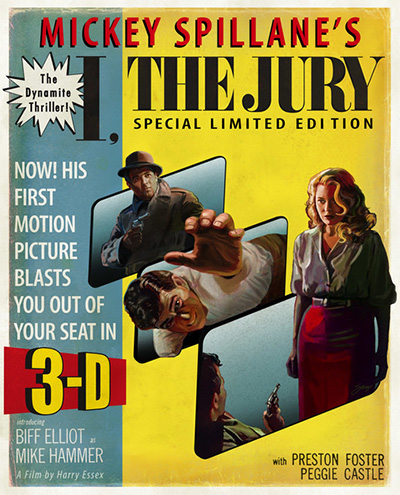
I have now done the commentary for the ClassicFlix Blu-ray 4K/3-D release of the 1953 I, the Jury. I think it went well, although I can’t compete with the likes of Tim Lucas and Tom Weaver (much less Eddie Muller) in their Blu-ray commentaries. Lucas and Weaver and Muller are always extremely well-prepared and organized, while I just watch what’s on the screen and blather on about all the useless information I’ve gathered and opinions I’ve formed over the years. I worked with my pal and partner Phil Dingeldein on this one – he shares credit but no blame. The Blu-ray comes out in early December.

Phil and I are preparing to shoot new material for an expanded Mike Hammer’s Mickey Spillane (1999) documentary as well as introductory material for the Brian Keith/Blake Edwards written-directed 1954 Mike Hammer pilot, which will be a bonus feature on the I, the Jury disc.

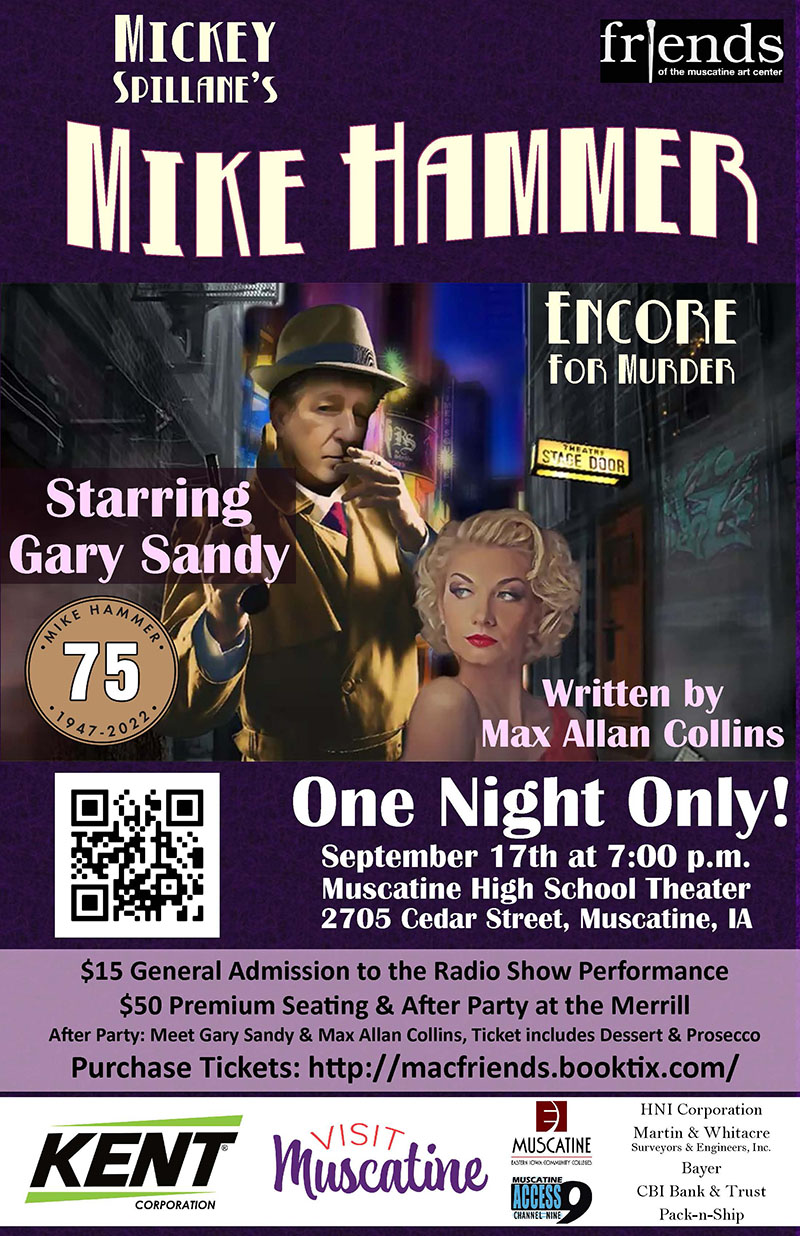
We are in the early stages of mounting an amateur stage production of Encore for Murder and are hoping to entice Gary Sandy to come to Muscatine, Iowa, to again play Mike Hammer. A few years ago, Gary starred as Mike in pro productions of Encore in Owensboro, Kentucky, and Clearwater, Florida. The play is performed in the style of a ‘40s radio show. Much more to follow, but the date to save is September 17.

A reminder – the Kindle editions of the two books in my Krista and Keith Larson series, Girl Most Likely and Girl Can’t Help It, are on sale this month – right now through July 31. You can buy them as a pair for $1.98, or 99-cents each.

They are not on sale, but both Girl novels are also available on audio, read by my other favorite Collins narrator, Dan John Miller. [The Girl audiobooks are only $1.99 each if you own the eBooks. –Nate]

* * *

If you swing by here now and then – or, God help you, on a regular basis – you will have noticed I seldom review books but frequently talk about movies and TV – of late, streaming mini-series more than anything. This week is no exception.

But first let me explain that I am indeed still reading books. Right now I am swimming in them, preparing to write Too Many Bullets, the RFK Heller novel that will cover both Jimmy Hoffa and Sirhan Sirhan. I am dizzy from it and driving Barb nuts with my ever-shifting notions about how I will approach this thing.

The degree of difficulty may make this the final Nate Heller novel, or at least one of such size and sweep. I can imagine doing shorter ones, more the length of a Quarry or Caleb York, which if Heller’s home remains Hard Case Crime makes sense. But the upcoming The Big Bundle was meant to be a “short” Heller and it ran over 400 pages in manuscript. As we say in the funnies, Sigh.

During intense research phases, little recreational reading happens. My brain wants something less proactive than reading, hence film and TV. I do read before bed and chip away at books. And my ambition is to read the entire Tarzan series by Burroughs and dig seriously into the complete Race Williams stories by Carroll John Daly and also the Zorro stories by Johnston McCulley. I read most of Burroughs’ Tarzan novels as a kid, but only recently have the complete Race Williams and Zorro stories been collected in book form.

Also on my reading list are books on Anthony Mann’s crime films, the handful of Willam March-penned novels I haven’t got to, a few remaining items by F. Hugh Herbert (creator of Corliss Archer), and autobiographies of Mel Brooks, Chuck Berry and Brian Cox. I’m also salivating to read Hell’s Half Acre about Kate Bender, one of my favorite true crimes of the Lizzie Borden era.

Am I alone in noticing that time is the enemy?

On the streaming front, Barb and I greatly enjoyed The Dropout, the jaw-dropping story of Elizabeth Holmes and her blood-exam scam. Stranger Things wrapped up in excruciatingly self-indulgent over-stuffed style – the Duffer brothers have got to stop writing teen romance! – but the horror aspects remained strong. And Star Trek: Stranger Worlds ended its season boldly going, and we continue to consider it the best post-Shatner/Nimoy/Kelley iteration.

Of course I am a hopeless addict of physical media, and snapped up two great Criterion 4K Blu-rays on their current Barnes & Noble 50% off sale – Shaft (1971) and Double Indemnity (1944).

Shaft is one of my favorite private eye films and it shows what might have been done with a Mike Hammer film had it been shot on gritty NYC locations (the 1982 I, the Jury remake comes close). Richard Roundtree is the most charismatic screen private eye since Bogart, and the Issac Hayes score ties with Mancini’s Peter Gunn for best P.I. theme. It’s really a pretty standard private eye yarn and very much on the Mike Hammer template – Shaft has a Homicide detective pal who scolds and yet uses him, and there’s a regular girl friend who the detective cheats on without a twinge, the violence is shocking and the P.I. is almost supernaturally tough, though he gets beat up before the end. Standard. But the Black twist on everything, those stark NYC locations, the pulsing soul score, the magnetic Roundtree…changes everything.

The movie looks great, sounds better, and the bonus features go on forever, though none of the experts mention Mike Hammer (the original hardcover novel had presented Shaft as the Black Mike Hammer) with no sense of the debt to Spillane on display here. There’s lots of feminist blather from a Black perspective, apologizing and rationalizing for what if this were a Hammer film would be labeled misogyny. But there’s a lot of good bonus material just the same, with Roundtree and Gordon Parks interviewed and much more. That includes the snappy quick sequel, Shaft’s Big Score (1972), on Blu-ray; it lacks the grit of the first film but has an incredible if absurd climax. Sadly M.I.A. is the underrated Shaft in Africa (1973). And if I’d have been in charge I’d have cherry-picked an example of the short-lived Shaft TV series, the episodes of which were movie length.

Double Indemnity blu ray cover

James M. Cain was one of the four writers who (sixty years ago) inspired me to go down the hardboiled path (the others being Hammett, Chandler and Spillane). Double Indemnity is generally considered the best of the screen versions, and was Cain’s own favorite. I could build a case for The Postman Always Rings Twice (1946) because it really does have a love story at its twisted heart. Double Indemnity, wonderful though it is, is cold at the center. Ironically (intentionally), the real love story is between Fred MacMurray’s Walter Neff and Edgar G. Robinson’s Barton Keyes, the insurance investigator who leads Neff and Barbara Stanwyck’s Phyllis Dietrich to their well-deserved fates.

It’s a great film, with Raymond Chandler’s crackling dialogue staying just to one side of self-parody; then there’s the prison-stripe window-blinds cinematography of John Sietz and march-to-doom direction of Billy Wilder. As Hammett’s The Maltese Falcon did with the private eye novel, Double Indemnity seems to invent, define and perfect the post-war film noir. Eddie Muller and Imogen Sara Smith do right by the film in their terrific bonus-feature discussion (accomplished by editing together craftily two sides of a chat shot in separate locations).

I disagree with them on only one thing: they describe both Neff and Phyllis as sociopaths. I think Double Indemnity is a dance between a guy who’s been getting away with things and a woman who’s been getting away with murder. There’s a throwaway line very early on where MacMurray mentions having sold vacuum cleaners door-to-door; this is code for the traveling salesman who is on the make for available housewives. He sizes Stanwyck up as one of those, with no idea how in over his head he is. He’s a regular guy with a sleazy streak who gets pulled into a murder plot because (a) he’s hot for the dame, and (b) he’s always dreamed of putting one over on the insurance company he works for. Stanwyck, on the other hand, has immediately sized him up as a horndog who is a perfect candidate for the inside-man accomplice she needs.

Muller and Smith discuss the difference between Cain’s novel dialogue and Chandler’s film dialogue, and are again on the money; but they don’t share the key anecdote in full.

Here’s what Cain himself said in that regard: “When they were making Double Indemnity in Hollywood, Billy Wilder complained that Raymond Chandler was throwing away my nice, terse dialogue; he got some student actors in from the Paramount school, coached them up, to let Chandler hear what it would be like if he would only put exactly what was in the book in his screenplay. To Wilder’s utter astonishment, it sounded like holy hell. Chandler explained to Wilder what the trouble was that Cain’s dialogue is written to the eye. That ragged right-hand margin that is so exciting and wonderful to look at can’t be recited by actors. Chandler said, ‘Now that we’ve got that out of the way, let’s dialogue it with the same spirit Cain has in the book but not the identical words.’ Wilder still didn’t believe him. They got me over there, purportedly to discuss something else, but the real reason was that Wilder hoped I would contradict Chandler, and somehow explain what had evaporated. But, of course, I bore Chandler out….”

* * *

Lots of lists of the best Film Noirs have popped up lately, but this one is solid, and does a fine job discussing Kiss Me Deadly. And, of course, Double Indemnity is on it.

M.A.C.

Mickey Spillane and Bobby Darin

Tuesday, April 5th, 2022
The Shrinking Island
Trade Paperback:
E-Book:

The Shrinking Island – the YA novel by Mickey Spillane (collected with the preceding two novels in the Larry and Josh Trilogy) – is out now from Wolfpack/Rough Edges. It is unlikely (though not impossible) you’ll find it in a brick-and-mortar book store, so please seriously consider ordering it from Amazon or Barnes & Noble.

This third Josh and Larry was announced in the mid-‘70s, so it has been (ahem) a long wait. Spillane fans should be used to that by now. Among the novels that were announced but did not come out during Mickey’s lifetime are The Consummata (the sequel to The Delta Factor), Complex 90, and King of the Weeds. I completed all of them from the unpublished, unfinished manuscripts. Novels whose stories he clearly referred to in interviews (though sans titles) include The Big Bang, Murder Never Knocks and the non-Hammer Dead Street. All of these I have completed, Mickey having requested I do so with his unfinished manuscripts.

Another announced (but never published) example is the Mike Hammer novel, Tonight I Die, which existed in Mickey’s files in three forms: radio, TV and movie scripts. One of these became a short story, “The Night I Died,” the radio play version of which I adapted during Mickey’s lifetime for the anthology The Private Eyes. I have done another pass on that and it will finally appear under the original title, “Tonight I Die,” in the forthcoming Wolfpack/Rough Edges collection, Stand Up and Die! Another version (the screenplay one) has become Kill Me If You Can, a Hammer novel that will be published in August.

Confused yet?

The Menace
Trade Paperback:
E-Book:

Allow your head to clear, then pre-order The Menace, which will come out later this month, again from Wolfpack/Rough Edges. The outstanding cover appears here for the first time. This is a novel I developed from a screenplay that appears to have been either a feature film or the pilot for an unrealized anthology series. Mickey had been toying with an Alfred Hitchcock Presents type of show for years, intending to host it himself. This script dates to the early ‘80s (possibly a bit earlier) and, while he always spoke to me of it as a movie project that he would produce and perhaps direct, the surviving version is rather short (under fifty pages).

That required fleshing it out some, and it became a full-length (but not lengthy) novel of 40,000 words. (We are including a short story and a non-fiction true crime piece by Mickey to round out the book somewhat.)

The Menace is unusual in that it’s a horror story, although it does have mystery elements (but then horror stories often do). Mickey conceived it as a sort of response to the overwhelming success of Stephen King in the literary marketplace. He disliked King’s use of the supernatural – he avoided that in his own writing – but considered King “a great writer.”

More on this later.

* * *

Those of you who have followed these updates over the years are well aware of my enthusiasm for Bobby Darin, the late great singer who gave us everything from “Splish Splash” and “Dream Lover” to “Mack the Knife” and “Beyond the Sea,” as well as “If I Were a Carpenter” and “Simple Song of Freedom” and memorable film appearances in Pressure Point and Hell is For Heroes.

I discovered Darin at age eleven when I saw him singing “Mack the Knife” on a Heart Fund special. I have never been the same since. The combination of a confident, sardonic singer, who moved with a dancer’s grace, and the dark story of a Jack the Ripper figure, widened my eyes in a way that hasn’t shut them yet.

I’d been aware of him, a little, because of “Splish Splash,” which at age ten I’d loved as a novelty record in the vein of “Purple People Eater” or “Witch Doctor.” “Mack” was something entirely different. I somehow scraped together enough to purchase his swinging standards album, “That’s All,” and received “This Is Darin” for my birthday, 1960. I collected everything I could get my hands on, searching record stores for his (even then) rare Decca releases going back to ‘56. A year or so later, I discovered Mickey Spillane, and my classmates at Grant Elementary (and later Central Junior High) were divided into two groups: those who knew me as the Bobby Darin guy, and those who knew me as the Mickey Spillane guy.

The bloody storytelling of “Mack the Knife” was the connective tissue. As I grew older – something Darin did, too, but not for long, dying at 37 in 1973 – I came to learn Darin had suffered a heart condition from childhood and had been told he wouldn’t live past thirty. And I now understand that “Mack the Knife” – and “Artificial Flowers” and such lesser known fare as “Gyp the Cat” and “Goodbye Charlie” – were the singer thumbing his nose at death. Even “Beyond the Sea” seems to have that resonance.

Darin has never gotten his due. I have long felt that if one singer/songwriter of the 20th Century was chosen to represent every facet of popular music, Darin was the obvious choice – not that he was the best in every category, but his curiosity as an artist, and his death-sentence desire to explore everything that interested him while he had time, makes him unique. His two major areas – rock ‘n’ roll and the Great American songbook – tend to get him dismissed in both genres. But try to imagine Frank Sinatra singing “Splish Splash” or Jerry Lee Lewis doing “Mack the Knife” and you’ll get the idea.

The other day I stumbled onto something that might be called an epiphany, if I could put it into words. Having turned 74, I feel more and more removed and detached from the younger world. For the first time, I can find nothing in popular music that I can relate to. Even movies interest me less, and pop music and mainstream movies have always been at the center of my adult (and childhood) life. It’s easy for people my age to feel the world moving away from them. Maybe it’s God’s way of making it easier to let go.

But then, quite by accident, I came upon something delightful. Something that made me smile and even laugh and feel a sense of common humanity with people decades younger than me. None of these people were old and white; most were Black and young. And I got such a kick out of sharing time with them on You Tube.

You may be hipper enough than me to already know about this, but a genre of You Tube posting has people younger than me (which is most people) reacting to music from earlier generations, hearing for the first time very famous songs from another era. Mostly this is ‘50s and ‘60s and ‘70s rock and pop music. Now, as someone who has difficulty – extreme difficulty – finding anything to admire about Rap and Hip Hop, with the notable exception being that those forms are at least not Country Western – I can’t properly express the life-affirming joy I felt seeing young people listening to Bobby Darin for the first time and being blown away.

There are at least a dozen of these out there, but I’m going to share a few of my favorites with you.

Here’s the Rob Squad, a cute, smart couple hearing “Mack the Knife” for the first time. Watch the young woman start picking up on the subject matter of the song, and then nudge guy – who’s been grooving along – to pay attention to the lyrics.

India Reacts has a very fun young woman picking up almost immediately on the murder spree and her reactions are wonderfully entertaining. She had earlier heard and loved “Dream Lover” and is not prepared for the dark alley Darin goes cheerfully down.

Another fun couple, Shawn and Mel, discover the magic of Darin doing “Beyond the Sea.” It should be noted this is Darin lip-syncing on a Dick Clark nighttime show (the standard practice) and he is probably all of 24 years old…but his smooth confidence and humor and ease is on full display. But the real point here is the infectious, positive energy of Shawn and Mel, and the power of Darin and good popular music spanning the decades like they’re nothing.

Dani’s “I’d Rather Be Listening” gives us a great live performance of “Mack the Knife,” and her reaction is smart and fun.

This older gent, Harry, reacts beautifully to “Beyond the Sea.” And then he looks Darin up and lets his audience know what a genius he’s stumbled upon. A great post. Thank you, brother!

I am so relieved to known that smart, cool people will be here after I’m gone.

M.A.C.