Posts Tagged ‘Interviews’

Gilbert Gottfried, Get Back and Sondheim

Tuesday, November 30th, 2021
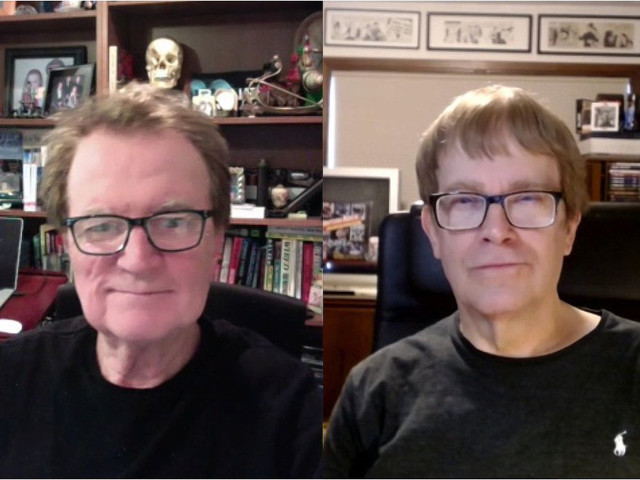
M.A.C. and Dave Thomas on Gilbert Gottfried’s Amazing Colossal Podcast with Frank Santopadre

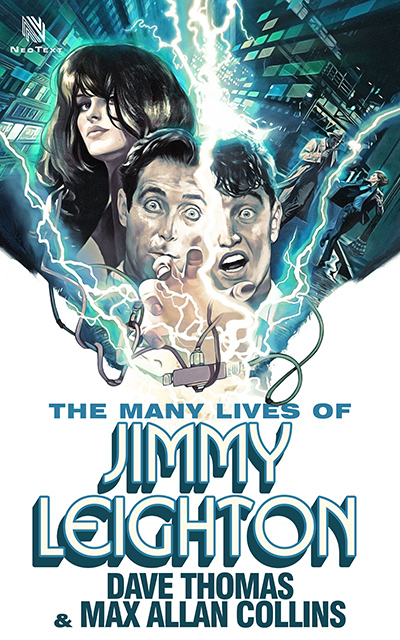
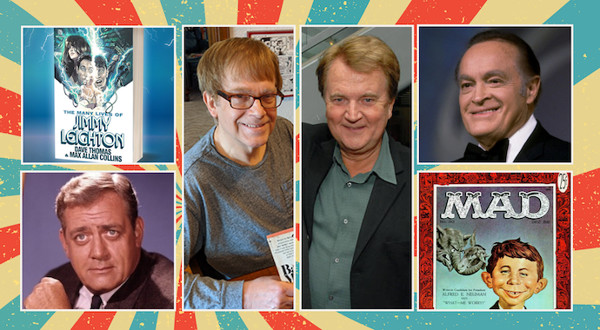
I haven’t heard much of it yet, but my appearance with Dave Thomas on Gilbert Gottfried’s Amazing Colossal Podcast with Frank Santopadre – in support of The Many Lives of Jimmy Leighton – is available now. Check out the podcast web site here.
* * *
The Beatles: Get Back

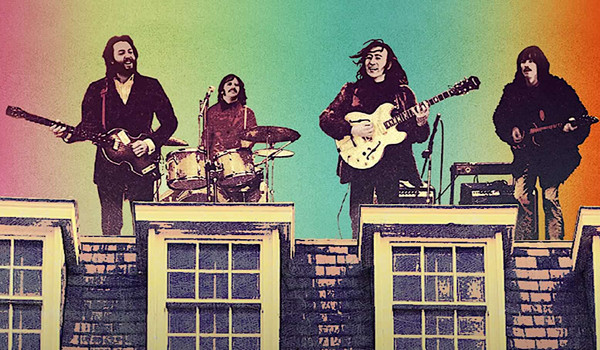
The Beatles: Get Back, the new three-part documentary streaming on Disney Plus, may be destined for as much controversy as the original Let It Be (1970), which at the time Ringo Starr described (rightly) as “joyless.” The director of that previous documentary, Michael Lindsay-Hogg, is revealed as a vapid, unimaginative baby who substitutes a cigar for a rattle.

Already reviews have called the nearly eight-hour documentary both “aimless” and “riveting,” and it is admittedly as exhausting as it is exhaustive. But only the most casual of Beatles fans would not be engaged and moved by spending unfiltered time with these four young musicians who were – and are – so pivotal to worldwide popular culture.

Peter Jackson is a master filmmaker – this is the guy who made the great Meet the Feebles and Dead Alive, after all – and his storytelling via cutting and choice of image is as purposeful as it might seem random. He uses reaction shots – culled not necessarily from what is happening at the moment – for glue and to underline character, a technique that might seem dishonest but is vital to making something like this flow and achieve coherence.

The most basic aspect of Get Back is its immediacy – John Lennon and George Harrison are alive, Paul McCartney and Ringo Starr are young men, and the right-now-of-it is startling. It doesn’t take long to realize these are real people, interacting in flawed, personal ways, and anyone who has been in a band will recognize at once the conflicts and alliances within this world of four humans.

These aren’t just any four humans, of course, although their Liverpool-lad humanity comes through – these are consequential humans. Laugh if you will, but this is something like having behind-the-scenes footage of the making of the Constitution, with Jefferson and Franklin on camera.

Perhaps the most fascinating and startling aspect is watching songs that have become a familiar part of our lives created before our eyes and ears. McCartney and Lennon struggle to find the right lyrics, Paul looking for something natural, Lennon something surrealistic – Ringo at a piano playing just the opening of “Octopus’s Garden” and Harrison leaning in and helping him take it further…all very casual.

Primarily it’s a character study although it’s in the context of ticking-clock suspense – Ringo has a film start coming up and the band has only a few weeks to write the new album and perform it live for a TV special. A lot of compromises and rescheduling accompanies the band’s apparent inability to do much more than screw around in the enormous movie studio they’ve been burdened with. But they get down to work (although a lot of warming up and goofing off follows) with the goal shifting but staying essentially similar. The documentary aspect of the TV special evolves into a feature film, but the pay-off – where to hold their first live performance in three years – remains elusive. Lindsay-Hogg has spectacularly bad ideas about where that might be shot – he is a one-man reminder of how dead-on This Is Spinal Tap was.

The doc shows a band in free fall. They have reached a point where all of them – even Ringo – need to go off on their own. The real, largely unspoken question is whether or not breaking off for solo albums and individual projects can stay in the context of the Beatles – can they be individuals and group members at the same time. This is the issue they haven’t faced.

In Part Three, Harrison – who quits the band in Part One, which becomes a major dramatic turning point – rather timidly suggests that maybe since he only gets a couple of songs per album he might want to do a whole album of his own. Lennon reacts favorably, but with a bit of surprise, as if that possibility had never occurred to him.

In Part One, McCartney tries hard to be the leader, to get things organized, and throughout he’s focused – really, obsessed – with having a goal, expressed as the documentary paying off in some way (likely a live concert). Lennon seems rather passive-aggressive – he’s not a problem, just less than enthusiastic and showing up late, with Yoko Ono sitting close beside him. While she is not disruptive, her presence changes the dynamic. Harrison quitting brings McCartney and Lennon together, in an effort to coax George back into the band, which (obviously) they do. By Part Three, McCartney swaps roles with Lennon, becoming vaguely passive-aggressive, often off by himself developing melodies and lyrics – his own engine now, not the band’s.

Still, Lennon and McCartney are working together, smiling, laughing, creating. You see, right before you, their spark. Their magic. And you understand why Harrison feels left out. Strangely, they are always accepting of each other’s music but rarely offer a compliment. Harrison comes in with several now-familiar songs, wonderful things, that receive nods and little smiles, but not much else.

Ringo, perhaps realizing the trouble he’s caused with his looming film start, says very little – he just does his job. Now and then that wonderful smile flashes, but mostly he seems melancholy, as if he alone knows the Magical Mystery Tour is nearly over.

And it’s almost frustrating, if fascinating, to hear such now-familiar songs as “Get Back,” “I Dig a Pony,” “The Long and Winding Road,” and “Two of Us,” refusing to come together. Even when an actual song emerges, they rarely get a take that satisfies them or longtime producer George Martin, a quietly looming presence. When the idea of a rooftop performance as the pay-off comes up, the shaggy shape these songs are in is almost frightening.
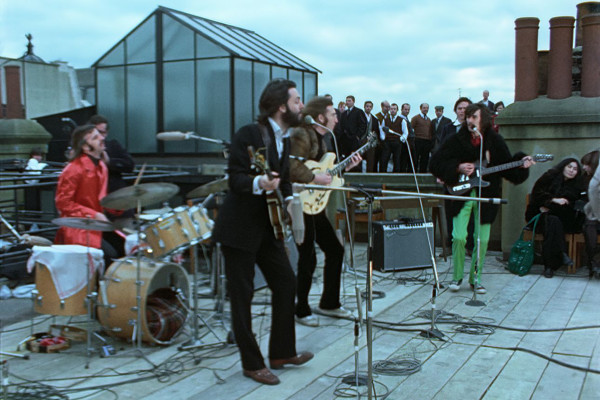
The Beatles, rooftop performance

And then the Beatles are on that rooftop and their performance is tight, dazzling, classic – definitive versions that made it onto the Let It Be album. And Lennon and McCartney are smiling at each other, grinning. Ringo smiles, too; even the reluctant, remote, jealous Harrison, is having fun. When they play “One After 909” – a formative Lennon/McCartney composition dating back as early as 1957 – their sense of the journey they’ve been on is palpable.

And joyous.

But it’s also the very definition of bittersweet – there they are, alive and well and playing their hearts out. We try not to linger on what we know that they don’t – death by gunfire, lung (and breast) cancer – and revel in their living presence.

Their undying presence.

* * *

When someone dies at 91, I suppose you can’t call it a tragedy. But losing Stephen Sondheim is a loss nonetheless. For many years he was somewhat off my radar – Company, A Little Night Music and Sunday in the Park With George seemed (from a distance) arty, the kind of thing New Yorkers get excited about…and I admit I am still not a fan of Sunday in the Park with George, which has an unsympathetic protagonist and a weak second act.

I got on board the Sondheim train by way of Sweeney Todd, thanks to a laserdisc of the Broadway production. I was (as the British say) gobsmacked, the tuneful darkness of it hitting me in the same spot that had turned me into a Bobby Darin fan at age 10, thanks to “Mack the Knife.” I found a laserdisc of Into the Woods and loved it, too – fairy tale fun in the first act, something Grimm in the second.

In 2001, with son Nate along, we witnessed a wonderful, intimate production of Pacific Overtures at the Chicago Shakespeare Theater. This was the first time we’d seen a live, professional performance of a Sondheim musical, one of his best shows. At the same theater in 2007, we took in Passion with SNL’s Ana Gasteyer (so wonderful in the film version of the musical of Reefer Madness); a much undervalued show with a James M. Cain feel.

In 2003, Barb and I saw Bounce, Sondheim’s last produced musical, in Chicago (it was also known as Wise Guys, Gold!, and Road Show). It was a troubled show that never quite came together despite seemingly endless rewrites; but it was an opportunity to see a new Sondheim musical. The hilarious Richard Kind starred.

The only time we saw a Sondheim show on Broadway was a revival of Into the Woods in 2002 starring Vanessa Williams that was unfortunately dumbed down for tourists (like us?). The film version is good, but not a patch on the Broadway production (available on DVD and Blu-ray); same is true of Sweeney Todd – an interesting Tim Burton take on the material, but the original with Angela Lansbury can’t be beat (also on DVD and Blu-ray).

I came to realize I’d been a Sondheim fan long before Sweeney Todd – I just didn’t know it. But he was the co-lyricist of two musicals I liked very much – West Side Story and Gypsy – and he had written the music and lyrics for A Funny Thing Happened on the Way to the Forum.
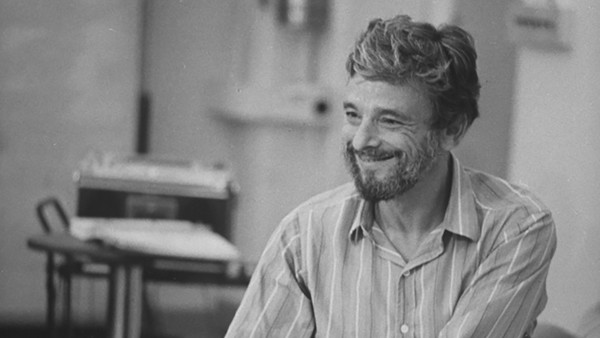
Stephen Sondheim

Sondheim appeals to the writer in me for his attention to language and character; the musician in me admires the way he does so while still coming up with memorable melodies. Some say he wasn’t a good man with a melody, but I’ve had too many Sondheim ear-worms for that to be true.

No question he’s on my short list of Broadway musical composers with Richard Rodgers, Lorenz Hart, Oscar Hammerstein, Lerner & Lowe, Frank Loesser, and Newley & Briccuse (Briccuse recently passed as well).

* * *

We also saw an excellent TCM bio: Dean Martin: King of Cool directed by Tom Donahue. A star-studded (if somewhat alarmingly elderly) group of celebrities reminisce about Martin, who seems to have been something of an enigma even to those closest to him.

It’s a lovely piece, a little hard on Jerry Lewis, though Jerry probably has it coming – still, I loved seeing him and Dean together. Martin was an extremely shrewd, instinctive performer who knew his weaknesses and his strengths and could play off both. He was a singer in the Sinatra/Crosby mold until Jerry Lewis turned him into a straight man, and Martin was instantly one of the best. When he and Lewis broke off, he became a movie star, landing a straight role in The Young Lions – astonishing everyone with his ease in front of the camera…as if he hadn’t just starred in a blockbuster sixteen Martin & Lewis films.

When he needed a new nightclub persona, he crafted the well-known slightly inebriated version of himself, using Joe E. Lewis as a model. Reportedly his on-stage glass was filled with apple juice.

He resisted Sinatra’s insistent carousing, preferring to watch westerns in his hotel room. He relished his family life (though remained somewhat distant) and probably avoided extended social interaction with Hollywood royalty knowing his uneducated Steubenville, Ohio, background wasn’t up to it. He played a lot of golf and made his TV series accommodate his schedule and whims.

It’s sad to have to watch his decline, leavened by his truce with Lewis, but scarred by the loss of his son. The filmmakers, interviewed after the doc by TCM’s Ben Mankiewicz, make an interesting observation. Figures in popular culture like Martin – and the Beatles and Stephen Sondheim – are human beings who decline and eventually die like the rest of us. But once they are gone, they snap back into place at their peak – their best – and John Wayne becomes the star of Rio Bravo and The Searchers and not a frail shell of himself, dying of cancer as he receives an honor. In their prime again.

They live on in the way we want them to. The Beatles’ music has already lasted over half a decade. Sondheim’s musicals will be presented as long as there are stages. Dean Martin will charm and serenade us, just as he and Jerry are still able to crack us up.

But I am at an age when I find myself tearing up at the damnedest things.

Like four lads from Liverpool playing “One After 909″ on a rooftop while clueless bobbies try to shut the music down.

* * *

Titan Books celebrates 40 years, and my Mike Hammer editor Andrew Sumner says nice things! You’ll have to scroll down, but on the trip pause when you see an interesting book, even if I didn’t write it.

Finally, there’s a good review of Quarry’s Vote here, if you scroll down; too bad the reviewer expected Quarry and me to be “woke” thirty-six years ago (I got knocked down a “star” for that!).

M.A.C.
Processing Spillane and Heller

Tuesday, November 23rd, 2021

I should probably dispense with asking you to buy and then Amazon-review both Fancy Anders Goes to War and The Many Lives of Jimmy Leighton (co-written by the great Dave Thomas). I won’t even remind you what wonderful Christmas gifts they would make.

I just have too much class for that.

Instead, I’ll talk about process this week. Who doesn’t love process? A few weeks ago I touched on the challenges and difficulties of Spillane: King of Pulp Fiction, co-written with James L. Traylor. We are waiting with anticipation for the editorial notes to come back, which will require tweaking but I hope nothing major, as I am very proud of my draft, and Jim likes it, too.

What surprised me was reading all the material about Mickey I’d gathered going back to my junior high days – I literally used the scrapbook I kept, because it had various articles and reviews pasted in among my carbons of indignant letters to anti-Spillane reviewers and my cartoony portraits of Mickey. What I hadn’t anticipated was the picture all of that material would paint when, for the first time, I read it all at once…not just in dribs and drabs as articles and such first appeared.

I feel like I put together pieces of the Spillane puzzle that had eluded me, despite my close personal relationship with the man for the last 25 years of his life. Many assumptions I’d made – and had cockily presented as fact in various pieces and introductions about Mickey and his work over the recent years – proved short-sighted…not wrong exactly, but lacking nuance.

For example, I no longer think his conversion to the Jehovah’s Witnesses had anything much to do with the near decade-long respite he took from novel writing. I do think his style shifted, and the violence and sex were both more restrained; but not absent. Re-reading The Deep recently, I saw how he used the threat of impending violence to create a story about a tough hero who really only kills once, and then in self-defense. In The Girl Hunters, Hammer kills nary a soul, though he does trick the “evil one” (as Traylor puts it) into self-destruction.

This probably had as much to do with his attempt to develop as a writer and to respond through his work to the incredibly unfair and even vicious attacks upon him throughout the 1950s. Other than perhaps Elvis Presley, no figure in popular culture had ever seen so much success and, simultaneously, so much condemnation. But the bio will, for the first time, reveal the major reason he stopped writing novels at his popular peak.

Writing about Eliot Ness with Brad Schwartz was a similar experience for me. So often Ness had been presented as a glory hound when the research showed he was primarily responding to pressure from above to get positive press. Additionally, things routinely dismissed by the Ness naysayers – including events reported in his autobiographical The Untouchables (mostly ghosted by sportswriter Oscar Fraley) – turned out to have really happened. It shouldn’t have been surprising to learn that Eliot Ness was actually Eliot Ness, but it was.

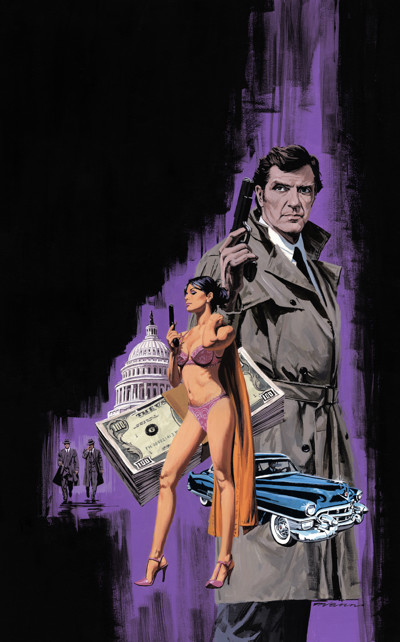
The Big Bundle Cover, Without text
The Big Bundle (Cover Sneak Peak)

And now, for the first time in several years, I am digging into the research for the upcoming Nathan Heller novel, The Big Bundle (for Hard Case Crime). The case I’m dealing with – the Bobby Greenlease kidnapping of 1953 – is not as famous as most of those I’ve examined; it was at the time, but today it seems mostly forgotten. What gives it the needed household-name-crime aspect that a Heller novel requires is a sinister connection to Jimmy Hoffa and the Teamsters. It is, in fact, the first of two novels about Hoffa and Bobby Kennedy, although this first one focuses primarily on the Greenlease case.

The Heller process is an odd one. First I have to select the true crime that seems appropriate for Nate’s attention (and mine, and yours). Second, I have to familiarize myself enough with the crime to write a proposal to be submitted to an editor/publisher, who must first sign on before I start serious work. Once we’re at that stage, I have to dig into the research, where the proposal was just a superficial look at the case. The approach has always been to look at the subject as if I were preparing to write the definitive non-fiction treatment of the case and then write a private eye novel instead.

A real problem with the proposal stage is that I am only guessing what the book will be about. The in-depth research (you will not be surprised, many of you, that I am in touch with George Hagenauer right now) is what reveals the book to me. And it always surprises me.

Here’s a small example. In True Detective, in what is essentially the origin of Nate Heller, Heller sells out to the Chicago Outfit to get promoted from uniform to plainclothes – to become a detective. He fingers the fall guy (who is playing along) to get somebody blamed and put away for the publicity-attracting murder of reporter Jake Lingle. The willing patsy, very minor in all of this but a seminal part of Heller’s story, is a real-life low-level mob guy named Leo Vincent Brothers.

So I’m researching The Big Bundle yesterday. For reasons I won’t go into right now, a taxi cab company run by a St. Louis racketeer named Joe Costello is instrumental in the story. I went in familiar with Costello in, again, only a superficial way – his name came up in the preliminary research and got him on my radar. So now, reading a book called A Grave For Bobby by James Deakin, I learn that Joe Costello’s partner in the taxi cab company…wait for it…was Leo Vincent Brothers.

This kind of thing always sits me on my ass. This tiny fact isn’t key to the story – it’s just an odd resonance, and a reminder that Heller’s life is just one long story, not really a succession of novels. Another name turned up yesterday, a Chicago thug with ties to the JFK assassination.

It would help if I had a steel-trap mind. But I don’t. I didn’t in my thirties and I really, really don’t in my seventies. So such discoveries send me scrambling back into the research.

In the meantime, I am looking for a way to insert Nate Heller into this narrative in a meaningful, credible way.

Wish me luck.

* * *

Two brief Blu-ray recommendations.

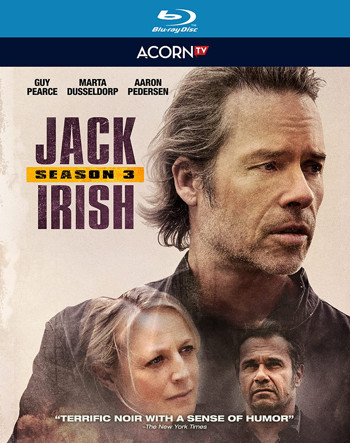
Jack Irish Season 3, Blu-ray

Jack Irish Season 3 is out from Acorn. It’s the final season of this series (there are actually five seasons, but the first two were movie-length episodes) and it’s a four-hour movie, essentially – one story, wrapping up the series in a smart, thoughtful way. I will go so far as to say it’s one of the best wrap-ups of a series, certainly one of the most satisfying, I’ve ever seen.

Guy Pearce plays a solid modern version of a private eye in this Australian neo-noir with all the surviving regulars back. Three years have passed since the preceding series and the passage of time and the need to learn, grow and move on is the central theme.

Great series.

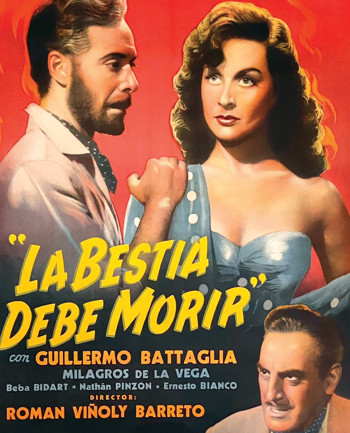
Speaking of great, Eddie Muller has delivered one of the best Blu-rays of the year in the Flicker Alley presentation of The Beast Must Die (La Bestia Debe Morir), a 1952 Argentinian noir based on the Nicholas Blake novel, The Beast Must Die. Blake was really Cecil Day-Lewis, a UK poet laureate who is also the father of actor Daniel Day-Lewis.

While it’s a bit pricey, the blu-ray is essential for noir enthusiasts, and if you spring for it, be sure to watch Muller’s introduction, which provides context and more, including how-to-watch Spanish-language melodrama of this period, i.e., the acting tends not to be subtle.

You can get it directly from Flicker Alley here.

The Beast Must Die Blu-Ray
The Beast Must Die Theatrical Poster
* * *

Check out this lovely review of Fancy Anders Goes to War.

Here’s a Ms. Tree: The Cold Dish preview with info.

Also here.

I did a Mike Hammer interview for what, uh, appears to be an interesting magazine….

M.A.C.

Spillane, Soho & Jimmy Leighton

Tuesday, November 9th, 2021

The last book giveaway of the year – our biggest – is still underway – we have three copies left. If you want either The Many Lives of Jimmy Leighton by Dave Thomas and me, and Fancy Anders Goes to War with Fay Dalton illustrating my novella, you still have a shot.

As usual, write me at macphilms@hotmail.com and provide your snail-mail address (even if you’ve won before) and your preference between the two books (if you don’t want a specific title, say so please). You pledge to write a review for Amazon – where both books are exclusively available – unless you hate what you read and don’t want to.

Amazon reviews and ratings are always important, but with these NeoText titles – unavailable in brick-and-mortar bookstores, and issued too late for the trade reviewers – they are crucial. If you like one or both of these books, please leave a review (and it can be short, a line or two). You can even rate them without posting reviews.

There are a bunch of links below to interviews Dave Thomas and I did together, but first you may wish to check out these links to sample chapters from The Many Lives of Jimmy Leighton.

And at Crime Reads.

* * *

If you’ve been following these updates of late, you know that I have been deferring somewhat to the serialized chapters of my literary memoir in progress, A Life in Crime at the NeoText site. The first ten chapters have appeared and now the memoir goes into sleep mode. I will post more of these when new books come out that can use some background (and a push).

The plan was two-fold – the chapters allowed me to promote both Jimmy and Fancy, and – as I wrote the chapters well in advance – provide me time to work on the Spillane biography. I have completed that, or will very soon – my co-author Jim Traylor is going over the manuscript now.

It’s a big book and I hope will be perceived as a major one – it’s over 100,000 words, the complete life of Frank Morrison “Mickey” Spillane with all of his novels discussed, as well as the film and TV adaptations. The bio itself is 85,000 words, the remaining 15,000 (“The Spillane Files”) consisting of bibliographic material and odds and ends…sort of deleted scenes, like little essays about Spillane and Ayn Rand, the gangster named Mickey Spillane, and the possibility Mickey wrote as “Frank Morris” for the pulps.

With luck, the book will be out from Mysterious Press in about a year as part of the 75th anniversary of Mike Hammer celebration.

This one really is years in the making. Just short of a decade and a half ago, Jim Traylor spent weeks in Murrells Inlet, South Carolina, digging through Spillane’s letters and other papers. Over the intervening years he interviewed numerous Spillane friends and family – obviously, Mickey’s contemporaries were getting up there and Jim spoke with any number of them who are now gone. He did several passes on the manuscript over the years. We interrupted the work on the bigger book to do Mickey Spillane On Screen for McFarland in 2012. We’ve worked hard not to repeat ourselves, having done One Lonely Knight: Mickey Spillane’s Mike Hammer decades ago.

While a lot of critical ground is covered in the book, I took the approach of making a linear story out of Mickey’s life, which was a colorful one to say the least. I gathered material I had collected on Spillane – magazines, newspaper articles, books – since I was in junior high, and my office floor looked like I was expecting the film crew from Hoarders to arrive any minute.

I considered suggesting the title The Mystery of Mickey Spillane as I began to realize that all of his disparate material provided puzzle pieces that could be assembled into the picture of a man. I knew the man in his later years, but I never met the young or even middle-aged Spillane. Many revelations emerged in the intense three-month process of writing the final draft.

Immodestly I will say I think Jim and I have written a major book on the most interesting figure in mystery fiction. In a year or so, you’ll be able to see if you agree.

* * *

Barb and I, regular filmmgoers (usually once-a-week) for many, many years, have gone out to the movies only rarely since Covid hit. Even though we are now triple-vaxxed, we are still careful – for one thing, our six year-old grandson Sam has asthma and Barb has been sitting with him and his three year-old sister in the afternoons while son Nate and their mother Abby work from home.

Barb is, of course, an amazing human being. She writes in the morning and then afternoons plays with those kids Monday through Thursday at my son and his wife’s house half-a-block up the street, and then we entertain the two kids Friday afternoons here. Sam and I generally watch a 3-D movie together.

Things are changing as Sam’s sister Lucy is now in Day Care, and Sam is going to get his Covid shot this afternoon. In a matter of weeks, he’ll be fully vaccinated and we can return to something more like normal. Or anyway the new normal.

Barb and I have only attended a handful of movies in a theater over these last vaccinated months – I believe Wrath of Man, Black Widow, No Time to Die and now Last Night in Soho are the only cinematic excursions we’ve made. We tend to go at off-times – yesterday, for example, we went to a 5:10 pm show. Only three other people were in the theater.

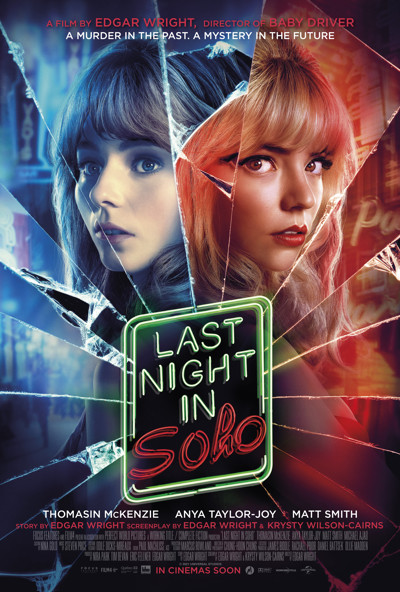
One Night in SoHo poster

That didn’t surprise me, really, because few people seem to be attending Last Night in Soho, and let me tell you (as Bob Hope used to say) it’s their loss.

I might have waited until this one was streaming if my Ms. Tree co-creator Terry Beatty hadn’t written me to say Last Night in Soho was “the best Brian DePalma movie Brian DePalma never made.” Now, Terry and I were at one time stone DePalma freaks, based upon Sisters, Obsession, Blow Out and especially Phantom of the Paradise. Most early and mid-period DePalma rated high with the Collins/Beatty team.

I lagged, and I think Terry did too (but I can’t speak for him), when the likes of Snake Eyes and Mission to Mars came along. But Terry’s description of Last Night in Soho resonated – I knew I had to see it in a theater.

Also, the writer/director Edgar Wright is sizing up as a major filmmaker. We’re talking Shaun of the Dead, Hot Fuzz, and Baby Driver. And I think Last Night in Soho may be his best work yet, though it’s difficult to discuss without spoiling it, because it takes a number of surprising and yet satisfying turns, delighting here, disturbing there.

Here’s a little bit of plot for you. A shy young woman – beautifully played by Thomasin McKenzie – from the sticks gets accepted into a fashion school in London; she has an affinity for tuneful 1960s music – the soundtrack swims in the stuff – and when the realities of modern Soho disappoint, she finds herself dreaming or fantasizing or possibly even time traveling to the area in the mid-sixties, where she begins to identify with what seems to be a fantasy projection of herself played by the dizzyingly charismatic Anna Taylor-Joy of Queen’s Gambit fame. There are strong hints that this Alice through the looking glass has had mental problems in the past, and we know that her mother was a sensitive, troubled soul who took her own life.

I loved No Time to Die, but it pales next to the thrill of seeing the young woman at the heart of this tale walk into a Soho landscape where a gigantic looming marquee for Thunderball glows in the night like a neon memory. That moment alone is worth seeing Last Night in Soho on a big screen. In a theater.

I’m not sure this movie is for everyone. It helps to have a feel for ‘60s music (anyone who considers what’s been happening for the past twenty years in music, at least in mainstream popular music, may be bewildered by things like an actual melody attached to accessible poetic lyrics). And you have to be willing to take the ride, a ride that doesn’t always go where you expect it to (what an effing pleasure)!

A lot of movies try to create the feeling of a dream, and this one accomplishes that, including the shifts in time and place and the feeling of being at the center of a dream and watching it at the same time. And yet you sense there’s a grounded story underneath all the questions being raised and the moods being bumped up against each other. But you have to be patient.

Not a movie for stupid people. That’s why you’ll like it.

* * *

Dave Thomas and I have been getting some nice attention for The Many Lives of Jimmy Leighton.

Here Dave and I are on Sci-Fi Talk.

Here’s a wide-ranging, long Jimmy-centric interview with me at Word Balloons.

Here’s Dave on a Canadian news program, starting with his Bob Hope impression and winding up with Jimmy Leighton!

Finally, here’s a great print interview with Dave that really lets you know what Jimmy Leighton is about and talks about how the collaboration came to be.

M.A.C.

Hey Kids – The Last and Biggest Book Giveaway of 2021!

Tuesday, November 2nd, 2021

This is the last book giveaway of the year – ten copies of Fancy Anders Goes to War and ten copies of The Many Lives of Jimmy Leighton. Write me at macphilms@hotmail.com with your order of preference. You pledge to write a review at Amazon for these – I specify Amazon because both books are exclusive with Amazon on Kindle and (for now at least) as physical media…you know, books.

If you hate the book, you are released from your pledge to review it, though of course you may anyway. This is a USA only book giveaway. Be sure (IMPORTANT) to include your snail-mail address, even if you’ve won previously.

Here, by the way, is a link to NeoText and their announcement of The Many Lives of Jimmy Leighton, where you can also buy it.

Anybody out there who reads and likes either of these books, your Amazon reviews are vital this time around. As I mentioned last week, neither book went out to the publishing “trades” – Publisher’s Weekly, Kirkus, Library Journal and Booklist. The reason is boring, so try not to let your eyes glaze over: NeoText is an e-book publisher, and fairly late in the game I convinced them (they are good people) to do print versions as well. These are Print-On-Demand books (and they look great). But “late in the game” means we weren’t able to get them to the trade reviewers on time.

Some of the Internet reviewers and a few newsstand magazines will get copies, though. But obviously it’s vital that my fans (both of you) review these books, preferably favorably, and get the word out.

Dave Thomas and I are doing our best to let the world know about Jimmy Leighton. We recorded a two-part Gilbert Gottfried podcast last week, which should “drop” (God I hate that expression) soon. We have done other podcasts together and separately, and some online interviews, too. Some links will follow at the end of this update.

Dave and I have become good friends, which I can hardly believe, stone SCTV freak that I am. He is a great guy, warm and funny but also with a genuine streak of Bill Needle (SCTV fans will understand). While we met a couple of times (unmemorably for Dave) before, during the writing of The Many Lives of Jimmy Leighton we did not. The plan had been for one of us to travel to the home/locale of the other, before we dug in to the writing – to plot the book, get a synopsis together, in person.

Then Covid came along.

So The Many Lives of Jimmy Lives became a Covid book – developed by Zoom and daily telephone calls (more than once a day, often). Dave did the first pass of each chapter, but called me frequently during the writing – he would read me what he’d written so far, I’d give notes, and we’d kick around where the chapter might go from there. Dave gets bored with just executing the synopsis, so the story became fluid in an interesting and positive way. I have never worked this way, and it was a glimpse into how SCTV and TV writers’ rooms work.

Dave had a bad health scare along the way – not Covid-related, other than the anxiety caused by having to deal with a health crisis when hospitals were overflowing with Covid cases – at a point where we had the first five chapters and a synopsis ready. We had already decided that we would do just that much before taking it out to market.

With Dave in the hospital, quite frankly fighting for his life, I set about to sell our book. I tried a couple of venues where I’ve had some success and got the kind of frustrating responses that longtime pros are used to – glowing enthusiasm and delight leading up to “not right for our list” as the punchline.

I was not prepared for that, though should have been. It is always difficult to sell a genre hybrid, and Jimmy Leighton was exactly that – half contemporary science fiction, half gritty crime novel. I brought my agent on board to try Canadian publishers, because Dave is a national treasure up there – a genuine superstar, as Bob and Doug are among the few Canadian icons. We got nowhere.

My agent was about to take it to other American publishers (only two had seen it) when I mentioned the project to my editor at NeoText, where I had just delivered Fancy Anders Goes to War. He was eager to see the chapters and proposal. The sale came quickly.

The Many Lives of Jimmy Leighton, without text, trimmed
E-Book: Amazon Purchase Link
Trade Paperback: Amazon Purchase Link

Fancy Anders was set up to be published as three novellas, and each – although designed to add up to one book – was a stand-alone. We had brought the great Fay Dalton aboard to do elaborate illustrations for the Fancy novellas, so to give her time to accomplish that, we set up a program whereby the publication of the three Fancy novellas would be staggered over six months at least.

Initially we were going to publish Jimmy Leighton the same way. But first Dave – then I – became concerned that the three sections of Jimmy didn’t each stand alone in the way Fancy did. And we had early on abandoned the idea of illustrations for the book, other than the cover art. So – again – fairly late in the game, we lobbied for NeoText to publish Jimmy as a single book. The novel had been written that way and it began to make sense following that path, not the Fancy one.

It’s cost us reviews, which is (as I’ve indicated) where you come in.

I know I harp on this a lot. But the nature of the beast these days is that you nice people who actually still read books need to support the authors you like with reviews online, particularly at Amazon.

I irritated some readers when I complained about self-professed fans of mine who would (in my view) attack novels of mine that didn’t suit what they wanted from me. On artistic grounds, my hopping around from here to there has a lot to do with me staying fresh and also pursuing various interests, which takes me various places, obviously. But on practical grounds, I write a lot to stay in business and bad reviews from people who only like some of my work, and go out of their way to complain about what they don’t like, costs me money. Worse, it can cost me venues.

This is true for all of us telling stories in the very old-fashioned prose fiction way. Support the authors you like. Don’t just write reviews of my stuff, but theirs, too (I’m fine with me being at the top of your list, though). Even a couple of sentient sentences will do, but longer expressions of delight are good also (very Jerry Lewis cadence there)…even balanced, well-reasoned opinions are encouraged. Those numbers – how many reviews and even just star ratings have been logged – are key for the success of a book, and for an author to continue producing.

Novelists are an endangered species, like the spotted owl. Keep us healthy and fed, would you? Spotted owl is delicious, by the way.

* * *

I’ve had some wonderful comments on my ten-part literary memoir, A Life in Crime. I hope to write a few more entries over time, and eventually collect them into a book. Among the things I did not discuss at length in the series are my adventures in indie filmmaking, comics/graphic novel writing, the Spillane novels (Caleb York deserves a chapter of his own), and a bunch of other stuff.

The serialization of A Life in Crime allowed me to focus on the Spillane biography, which I completed my draft of over the weekend. I still have the lengthy “Spillane Files” appendix to work on, although most of that was already put together by Jim Traylor, who has been working on this project literally since Mickey’s passing in 2006.

This will absolutely be the definitive book on Mickey Spillane – the story of his life, and the story of his life’s work. We hope to send it to our publisher, Mysterious Press, this month.

* * *

I was disappointed in Halloween Kills. The same writing/directing team who did the much superior Halloween reboot stumbled here, sacrificing a political allegory about Jan. 6 and the divisiveness in America to a humorless and unpleasant gore fest. I understand this is the second of a trilogy and I liked the first film enough to give the third one a try.

Barb and I watched Halloween 3: Season of the Witch, which is flawed but very entertaining and underrated. Halloween Kills could have benefitted from this much unloved non-sequel’s strong but fleeting gore, and heavy-handed but effective satire.

In the Halloween spirit, I showed Nate The Final Girls, the 2015 horror comedy that has a group of current teens getting stuck inside an ‘80s slasher movie. It’s somewhat little known but is well-worth checking out, if you are at all a fan of the Halloween/Friday the 13th genre.

* * *

Here’s a great Fan Base interview with Dave Thomas on our novel, The Many Lives of Jimmy Leighton.

Check out the Dave Thomas Appreciation Page at Facebook.

Finally, here’s the Word Balloon podcast with Dave about the book (and his SCTV adventures).

M.A.C.