Posts Tagged ‘Blue Christmas’

Quarry’s Return, Rodriguez, Barry Newman & William Friedkin

Tuesday, August 22nd, 2023

I have completed Quarry’s Return and shipped it to my editor Charles Ardai of Hard Case Crime and to my longtime agent, Dominick Abel. This included a long day of re-reading the 60,000-word manuscript and another day of entering my tweaks and corrections, assembling the chapter files into one big file, and doing a conversion from Word Perfect to Word, followed by a page-by-page check for glitches (and there were some).

This was something of a test case for me, as I have (as regular readers of this update/blog know) been dealing with health issues. My wife Barb has been encouraging me to slow down the writing process, and I have to a degree, but my approach is dependent to some degree on momentum, so I like to get a book done in as short a time as possible because I believe the narrative drive benefits.

This is the second novel I’ve written this year. The Mike Hammer novel, Dig Two Graves, was written starting in February and March. It’s a fairly short book, about 50,000 words, and I wrote it in three weeks, which impressed and sort of irritated Barb, who spends six months on her Antiques drafts before handing one over to me.

Between the two books I’ve written several book proposals, a short story with Matt Clemens (just sold to Ellery Queen Mystery Magazine!), and revised a couple of screenplays. Also, we completed the expansion of the Mike Hammer’s Mickey Spillane documentary and the edit on Mickey Spillane’s Encore for Murder, both with VCI releases yet this year.

The month I spent on Quarry’s Return included my hospital visit for a heart procedure, followed by a complication from which I am still recuperating (but doing very well). I only lost about three writing days due to the procedure – writing seems to be something I can do and feel “normal” doing, even when I’m under the weather.

Quarry’s Return is a coda to a coda, the latter being Quarry’s Blood. I did not expect to be writing about the older Quarry again (the Quarry who is about my age), but that’s the story that occurred to me and that my editor liked the sound of. What transpired was a novel that took Quarry back to Port City, Iowa – the site of his first recorded adventure, Quarry AKA The Broker (1976) – which plays into the title and to the coda of coda notion.

Will there be more Quarry? As long as there is more of me, probably…though any subsequent Quarry novel will likely be set in the past, as the other HCC Quarry books have been.

Quarry’s Return feels like a good one, but until I hear from Charles and Dominick, I won’t know for sure. Turning a novel in can be followed by requested rewrites in some cases. To me, it’s a nice combo of the Richard Stark-inspired crime novel side of the series and the Mickey Spillane-inspired private eye aspect of the series…in addition to being a hitman (various varieties of which depend on where a story falls in the timeline), Quarry often acts as a sort of P.I. That’s even got him occasionally nominated for a Shamus award from the Private Eye Writers of America.

The novel also has my trademark combination of human sentiment and inhuman behavior that no doubt confuses some, and keeps me off some readers’ preferred reading list.

I don’t recall when it’s scheduled to come out. Probably 2024. I’ll let you know here.

* * *

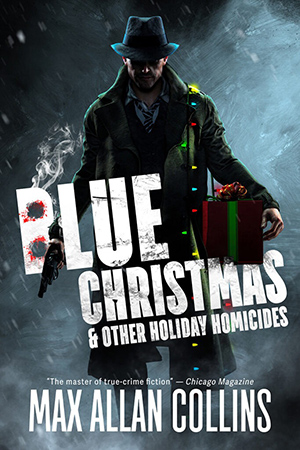
I have several meetings this week as we move into serious pre-production on my micro-budget movie, Blue Christmas. We suffered a blow when (apparently) we did not receive any Greenlight grant money. That parenthetical “apparently” reflects the failure of the program to come even close to when they were supposed to reveal the results of the competition, which they haven’t officially yet.

This blow puts us further into the micro budget area, and decisions have to be made, and will be made shortly. But unless my health intrudes, I intend to will this sucker into existence. I have great help from my collaborators Phil Dingeldein, Liz Toal and Chad Bishop.

I want to spend at least part of the next few years returning to film projects – sort of my last chance to do so.

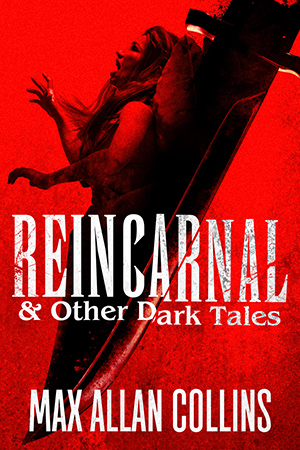
Phil and Liz and I, and my Hollywood “guy” Ken Levin, are working hard to get my horror film Reincarnal made. Some of you have read the novella it’s based on, the title story in a Wolfpack collection of mine (Amazon link). [And in the soon-to-be-released Max Allan Collins Collection Volume Four: Dark Suspense (Amazon link) – Nate]

I am in early stages of working with Phil, Mike Bawden and the great Robert Meyer Burnett to create a Heller podcast series that would, we hope, seed the clouds for a Nathan Heller movie or TV series. A long ago project that I was working on for (and with) the late Miguel Ferrer – a film based on my novella Dying in the Post-war World – is in the mix.

We still have an eye on getting Road to Purgatory produced. I have the rights back on my screenplay from my novel, the direct sequel to Road to Perdition.

Other things whirling in the currently strike-stalled land of the wooded holly: the recently announced Mike Hammer feature film from Skydance; a Nolan movie from Lionsgate; and an Eliot Ness in Cleveland mini-series from CBS Films.

Sounds glittering and great, huh?

If I were confident about the big-time stuff happening, would I be preparing to do a micro-budget Christmas movie?

I ask you.

* * *

Among the bad things about writing a weekly update like this at my age is how many people I admire do us the disservice of dying.

But two of my favorites have passed and I must comment.

Rodriguez is a musical artist I discovered recently, thanks to my guitarist in Crusin’, Bill Anson, turning me onto him. I’d had the documentary Searching for Sugarman (2012) on my DVD shelf for some time – my agent gave it to me for Christmas years ago – but had not gotten around to watching it. I finally did, and if you haven’t seen it, you need to.

The basic story is simple if incredible. A talented singer/songwriter out of Detroit, Rodriguez made two wonderful albums (Cold Fact, 1970, and Coming from Reality, 1971) that were mostly overlooked by critics and completely overlooked by the public. He returned to a life divided between playing in small venues and doing day labor, taking great pride in the latter. He essentially fell off the national grid, and legends grew up about him dying on stage, sometimes committing suicide at the end of his set. He became huge in South Africa and popular in Australia, as well, and continued to be unknown here until the documentary came out in 2012.

Some of you know that I am not a fan of Bob Dylan the vocalist, though I like much of his songwriting. His nasal off-key singing is fingernails-on-the-blackboard stuff to me, though I find it interesting that both Tom Petty and John Lennon used him as a vocal role model, but did so by restoring the concept of singing in key.

Rodriguez is often compared to Dylan, but it’s a pretty shallow comparison. You can’t deny Dylan was a prolific singer/songwriter, and his catalogue of compositions is staggeringly large and impressive. Rodriguez did two albums of beautiful melodies and poetic skill in a warm, eccentric vocal style that displayed a limited vocal range but is the perfect vehicle for emotional material delivered from a cool distance.

He’s great.

And he’s gone, at 81. After his discovery made him if not a household word but at least well-known among popular music buffs, new albums from him were limited to a couple of live performance CD’s. He copped to having continued his songwriting all those years, but no new album emerged. I am hopeful that there’s a vault somewhere at his regular label, Light in the Attic Records, that will bring more of his material to light.

* * *

My friend Bob King edits the great Classics Images (published right here in Muscatine, Iowa), in which he covers all kinds of wonderful mainstream and obscure aspects of classic Hollywood. I always check the obituaries (like George Burns, I’m checking to see if I’m there) and now and then a shock comes to the system: Barry Newman has died at 92.

Barry Newman was – no, damnit, is – one of my favorite actors. He came out of the gate fast and was a popular leading man and unlikely action star in the 1970s. He top-billed the cult classic Vanishing Point (1971) as well as Fear Is the Key (1972), and The Salzburg Connection (1972). He later became a star of TV movies, headlining twenty films in the ‘80s. Later he turned up now and then in bigtime films like Daylight (for which I wrote the novelization), The Limey and Bowfinger. But largely he fell off the radar. I never understood that and still don’t.

He made his first splash in The Lawyer (1970), which was based on the Sam Sheppard murder case and evolved from an intended biopic of then famous attorney F. Lee Bailey. His charismatic performance as the title lawyer, Anthony Petrocelli, led to a TV movie (Night Games 1974)) as that character and the two-season, Emmy-nominated Petrocelli TV series (1974-1976). The showstopping aspect of The Lawyer was Newman’s outrageous courtroom performance topped by his summation to the jury, in which he presented an alternate version of the crime to interpret the facts that ultimately got his client sprung. This trademark jury summation followed Newman and the character into the series.

Much of Newman’s success in The Lawyer is due to the dynamic direction of Sidney J. Furie, who put Michael Caine on the map in The Ipcress File (1965). But Newman rose to the occasion.
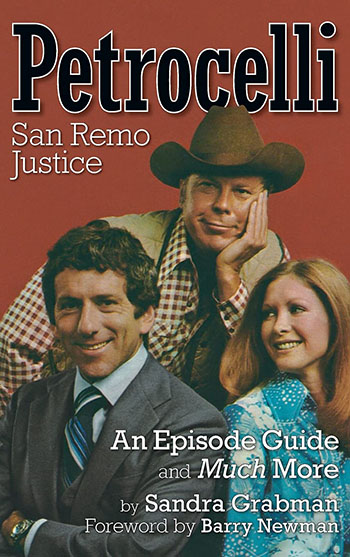
The Lawyer Episode Guide Cover

I got in touch with him a few years ago, in part because I’d written an introductory piece about The Lawyer and Petrocelli for a Bear Manor Media book about the TV series. Mostly I wanted to get in touch with him because it was The Lawyer (more than The Fugitive) that made me want to do a Nathan Heller novel about the Sheppard case.

When I called him – this is typical Newman behavior – he answered in an old man voice and pretended to be his own grandfather. When he determined who I was, and that I was worth talking to, he became Barry Newman again and might have been thirty or thirty-five, judging by voice alone. We had several wonderful phone conversations and I sent him my Sheppard “Nathan Heller” novel, Do No Harm (2020). He is thanked and recognized in both the text of the novel and the afterword.

He was very complimentary about my essay about him and his work on The Lawyer, and was nice enough to say that my piece was his favorite thing in the Bear Manor Media Book, which you can buy here.

The TV series is available here.

Unfortunately The Lawyer is not available legally on physical media, other than in the wonderful but expensive Sidney J. Furie boxed set currently out of print (but you can find it on e-bay).

The Lawyer is available on Amazon Prime.

I intended to call Newman to congratulate him on the Blu-ray box with The Lawyer finally doing him and that film justice. But I hadn’t got around to it. I do know that he and director Furie were trying to put a movie together with Newman starring. This was just before Covid hit.

But somehow I find it reassuring that in his late eighties, Barry Newman was looking for the next project.

* * *

I mentioned here that Robert Meyer Burnett’s enthusiasm for To Live and Die in L.A. (1985) had found me ordering a film that I’d despised in the theater on its first release.

I do occasionally discover a film I’d not enjoyed years ago turning out to strike me differently today. But I am more inclined to continue liking the films that I liked then. If you had asked me for a list of my favorite films, in 1985, I’d have said, Vertigo, Kiss Me Deadly, Gun Crazy, Chinatown and How To Succeed in Business Without Really Trying (can you spot the non-noir in that list?). I would have cited Alfred Hitchcock and Joseph Lewis as my favorite directors, and James Bond as my favorite film series. Hardly any change.

Revisiting To Live and Die in L.A. was a different ride. First off, its star – William Peterson – I have always liked, going back to Manhunter (1986) and Long Gone (1987); and I did (with Matt Clemens) my long run of CSI novels, comics and even video games with Peterson playing Gil Grissom not only on TV but in the theater of my mind. He even spoke my dialogue in the CSI video games.

What quickly became clear to me (I’d probably noticed this on first viewing, too) was that director William Friedkin was doing a West Coast variation on his very successful East Coast cop thriller, The French Connection. I’ve liked a lot of what Friedkin did, but I don’t think he ever topped The Exorcist and The French Connection.

His work generally strikes me as that of someone who is a great storyteller but not a great writer. He is at his best adapting a novel or play or non-fiction work. Left to his own devices, he can create a vivid movie filled with compelling scenes, and To Live and Die in L.A. certainly qualifies in that regard.

And it’s based on a book, but not a particularly good one. I don’t like to comment on other novelists’ stuff, so that’s all I’ll say.

But this narrative, as presented by Friedkin, has so many cliches, it’s no wonder it pissed me off in 1986. And, look, Friedkin was thinking about doing my True Detective and did this movie instead, which at the time undoubtedly pissed me off. Still, this is a movie that begins with the young lead character’s veteran cop partner having only three more days on the job, with only one dangerous gig ahead. This is a character who says the immortal line, “I’m getting too old for this shit.”

It’s also a cop movie where the naive, idealistic new partner eventually becomes the continuation of the corrupt veteran partner who has died in the line of duty. That this is an unbelievable character shift is in no way justified.

Many of the semi-improvised scenes work, a good number do not. It does have some interesting female characters and a car chase designed to out-do the famous one in French Connection. And it comes very close.

I now like this movie, with reservations. Like a beautiful pock-marked woman. SPOILER ALERT: …… killing the lead with fifteen minutes of the movie left was a bold move that irritated me then and makes me smile and nod now.

Incidentally, I accidentally ordered the Blu-ray, not the highly regarded 4K disc. They share the same transfer and special features and I thought it looked fantastic.

I should say that the fuss over 4K may be at least partially dependent on the size of your TV. I have three TVs – a 55″ flat screen in the living room (with a shallow viewing distance between my recliner and the screen), a 45″ TV in my office, and a 19″ tube TV also in my office, for viewing laser discs. The 55″ is from a brief period where you could find monitors that could present both 3-D and 4K. My 45″ is 3-D but not 4K.

Why do I mention this? Because some people say that you need 65″ or larger to appreciate the difference between Blu-ray and 4K. This isn’t entirely true, but there’s something to it. The Blu-ray of To Live and Die in L.A., which I almost sent back unopened to exchange against the 4K, really does look excellent on my 55″ screen.

And for me having the ability to screen 3-D is a must. I have too deep a 3-D library to feel otherwise.

I am also not as attuned (shall we say) to sound. I have a sound bar with a sub woofer and to me everything sounds great. Terms like Dolby Atmos and DTS and 7.1 are outside my area of interest and expertise. For one thing, the reality of my life is that once Barb goes to bed (at 10 pm) I can’t watch anything loud, anyway. I usually watch with subtitles, and still get scolded by the angry woman who storms out, my charming understanding bride having been somehow absconded and replaced by this unforgiving one.

It’s not unlike my situation where my collector gene comes in conflict with my realization that at my age, I have better ways to spend my time and money than upgrading everything from Blu-ray to 4K, and spending big bucks on collector sets with lobby cards and booklets and do-dads that I’ll look at once, smile, and stow away.

* * *

Here’s an article about filmmaking in the Quad Cities, covering a gathering at Phil Dingeldein’s dphilms stuido.

M.A.C.
Heroes Never Die, But Do They Get Old?

Tuesday, July 11th, 2023
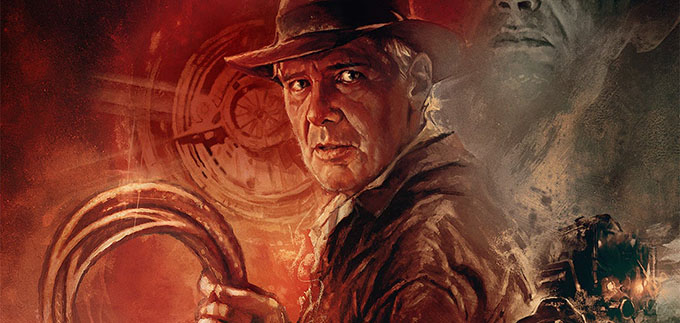
Indiana Jones and the Dial of Destiny, cropped movie poster showing Indiana Jones holding a whip.

The only thing I don’t particularly like about the film Indiana Jones and the Dial of Destiny is that uninspired secondary title. Oh, and a car chase goes on too long mid-movie.

Otherwise, I was swept up in the Indiana Jones-ness of it all, and have a hard time understanding why so many of the reviews have been tepid or even negative. Several people in the lobby afterward told me how unrealistic they thought it was (unlike, apparently, the incredibly real-to-life previous Indiana Jones movies) and my pal Leonard Maltin condemned it as formulaic (apparently this would have been a good time, in the final installment, to reinvent everything).

Well, I loved it, from the de-aged Harrison Ford in the epic Nazi opening, and the manner in which he kind of gradually eschews his grumpy archeology professor persona – which he’s apparently given in to for decades – and becomes recognizably Indiana Jones again. Right after the strong opening, moving from a Nazi encampment to a roaring train, we are in the present where we learn Jones is divorced from his love-of-his-life wife. Soon Ford strips out of his shirt to show us a decent-for-eighty-years-old physique, but definitely one that has seen all those years and plenty of wear and tear.

As usual, Indy is paired with a young woman, but this time not a love interest – in fact, it’s an apparent daughter (Phoebe Waller-Bridge), who very much holds her own with the old boy. The villain, the reliably odious Mads Mikkelsen, is a worthy one, and complaints about the ending – which pays off the dial of destiny theme and ends with a sweetly satisfying coda – is apparently deemed ineffective by some audience members.

My suspicion is that older viewers are jaded, and younger viewers are not sufficiently aware of the magic of Indiana Jones – for all the complaints about the middle movie of the initial trilogy, those three films were almost as impactful at their pop-cultural moment as Star Wars – and possibly had only the weak Indiana Jones and the Kingdom of the Crystal Skull (an even worse secondary title) to go on.

Look, the filmmakers were smart enough to kill Shia LaBeouf’s character (Mutt!) off between movies. What more do you want?

The soft response to an excellent summer blockbuster (or maybe would-be blockbuster) has to do with the same kind of ageism afoot in a country where that particular “ism” is the only one you can get away with. Ask Joe Biden.

For me, seeing Ford as Jones at his ripe old age (the guy is five years older than me!) is inspiring. No, I don’t believe Ford was doing all of his own stunts, just that I can see how interesting allowing an action hero to age can be. I recall the outrage (justifiable in my estimation) when the producers of a new Lone Ranger movie (in 1981) forbid TV’s Lone Ranger, Clayton Moore, from even wearing his mask at supermarket openings, let alone consider casting him in his iconic role. Hell, he was in his mid-sixties! Does the name Klinton Spilsbury ring a bell? (He’s 73 now.)

What it does for me, as an artist (note I did not spell that “artiste”), is provide food for thought. I would like, if my health cooperates, to write two more Quarry novels (one contracted for already) and two more Nate Heller novels (the subject matter chosen and research under way). The Heller novels require Nate to be the age he would be at the time of the famous historical events I’m planning to thrust him in the middle of. The final book would make him 67 and retired (67, coincidentally, is how old Clayton Moore was when they cast Spilsbury instead).

But I made Quarry around 70 in Quarry’s Blood. I am seriously considering keeping him in his early seventies for these last two books. Nobody complained about his age in Quarry’s Blood, so what the hell? Keeping his age close to mine allows me to write him from a point of view that continues the sort of through-a-glass-darkly autobiography that the Quarry novels represent. It’s, on one level, the story of what might have happened to me if I’d had to go to Vietnam; certainly it’s somewhat the story of what happened to my friend Jon McRae, whose career in the Marines was followed by mercenary work.

I know Mickey Spillane ducked citing Hammer’s age, and it got silly. Mickey insisted (in interviews, not the books) that Hammer was eternally 35. Yet Hammer remains a World War Two veteran in Black Alley, a book set in the year it was published (1996) with Hammer using a cell phone. At the same time, Mickey used health problems (echoing his own) in place of aging Hammer, to be able to present his hero as somewhat damaged goods. I have, in my novels working from Mickey’s unfinished manuscripts, attempted to adjust Hammer’s age (and Velda’s) somewhat closer to reality.

I have always been uncomfortable with series characters who refuse to age. My favorite mystery series, other than Mike Hammer, is Nero Wolfe; but Stout stubbornly refused to age either Archie Goodwin or Wolfe a day. The absurdity becomes abundant when a character from Too Many Cooks (1938) shows up in Right to Die (1964) having aged according to the calendar.

Poirot would have been well over 100, given the age Christie records in The Mysterious Affair at Styles (1920), later reporting him in Beatle-era London in The Third Girl (1966).

Heller has been writing his memoirs and his age, though he’s vain enough to fudge a little, has stayed pretty much even with reality. That’s a set-in-stone aspect of the saga. Quarry has been established to be taking place primarily in two eras (roughly, the ‘70s and ‘80s/’90s). I made him my age when I returned with The Last Quarry for Hard Case Crime, to (I thought) wrap up the series. Quarry’s Blood, for reasons of the age of a certain character who turns up, had by necessity to be set when he was essentially my age.

And I liked it.

So that, for now anyway, is the plan. Of course, as John Lennon said, life is what happens when you’re busy making other plans.

* * *

Among the plans I’m making, in my Pollyanna-ish way, is to do at least a couple more indie movies before I shuffle off to Buffalo (or meet the fate of buffalos).

My friend and longtime collaborator Phil Dingeldein and I are attempting to get a horror film mounted with a real budget ($1.5 mil). We will see if we can make that happen, but it’s not for lack of trying. The project is based on a novella of mine, Reincarnal, available in the collection of my horror short fiction of that name published by Wolfpack.

Reincarnal and Other Dark Tales, cover

Then there’s Blue Christmas. As I write this, we still don’t know if we got some funding from Greenlight Iowa – they are overdue in informing us (either way). But with my friend Chad Bishop – who edited Mickey Spillane’s Encore for Murder and helped Phil shoot the play and several rehearsals, from which we assembled a video – I will do it one way or another. The budget will be low, the cast largely pro-am. But it’s a way to get it done without the decision-making being controlled by Hollywood.

You can see “A Wreath for Marley,” the basis of Blue Christmas, here.

Reincarnal and Other Dark Tales, cover

I am working with Robert Blair at VCI Home Entertainment on getting the expanded Mike Hammer’s Mickey Spillane documentary out on Blu-ray before year’s end. It will include, as a bonus feature, Encore for Murder. We are also considering offering Encore as a DVD, designed primarily for the Golden Age Radio market (Radio Spirits, for example).

I’ll preview the Blu-ray and DVD covers here as soon as they are ready.

* * *

My listing of the Perry Mason TV episodes that appeared here a while back needs some revising, which I will do soon. But Paramount+ double-crossed me. Like so many streaming services, they drop stuff unannounced – and by “drop,” I don’t mean debut something, but literally drop it. A number of Mason episodes have disappeared from the service, including several Gardner adaptations. And the entire seventh season has vanished. The final season (the ninth) was never there, to my knowledge.

To fill in, I had to go to my DVD sets of Mason, which look good but not high-def like Paramount+ broadcasts.

Watching the Gardner adaptations in order, Barb and I find show always good, or at least fun; but it’s the first two seasons that are stellar. It’s interesting to note that by the time we get to 1960, the noir-ish flavor of the ‘40s and ‘50s that so permeates the first two seasons has disappeared…much like numerous episodes on Paramount+.

This all goes to show why physical media is where it’s at. I realize I am a nut about this stuff, and many of you could not care less about Blu-ray when you have a couple of shelves of DVD’s. Or maybe your VCR still works and you indulge in that flawed format VHS, which does have a nostalgia value for some, particularly those who raided the video store shelves on Friday to gather viewing material for the coming weekend.

But if you think “everything” is available, thanks to streaming, think again.

* * *

I mentioned Ellis Parker Butler last week, as the “other” somewhat famous mystery writer from Muscatine, Iowa. I should have noted another one, though this guy only wrote a few mysteries. His name was Samuel Clemens.

He lived in Muscatine for several years before he got famous; his brother ran the newspaper here.

It’s just possible I will never be as famous as Mark Twain.

* * *

THIS JUST IN: I completed this update – rather thought I had completed it – and then Barb and I went off to see the new Wes Anderson film, Asteroid City. I’d been looking forward to it, and both Barb and I really liked certain of Anderson’s other films, specifically Rushmore, Moonrise Kingdom, Isle of Dogs and especially The Grand Budapest Hotel. We were disappointed in Fantastic Mr. Fox, The Life Aquatic with Steve Zissou, The Royal Tanenbaums and The French Dispatch. But this was clearly a gifted filmmaker with a distinct and unique voice.

We walked out of Asteroid City, which is an unbearable exercise in fooling good actors into thinking they are in a movie. And probably for scale. It’s the kind of film where you come out humming the art direction. It is intentionally stilted and very intentionally artificial, making sure the viewer has no suspension of disbelief to hang onto. Beyond arch, the definition of twee, Asteroid City is the worst film I’ve ever seen (or anyway forty minutes of) by a talented director.

Certain movies by directors (or in film series) ruin their other movies for me. This is one of those.

I do not like to write reviews that are critical of movies because it’s tough to make even a really bad movie. Anderson has succeeded in doing the latter.

M.A.C.

2 Shamus Noms, 1 Birthday, 2 Gigs and Much Grumpy Kvetching

Tuesday, June 20th, 2023
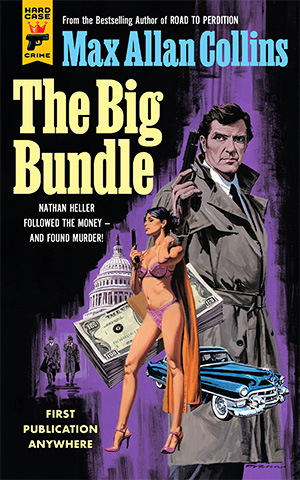
The Big Bundle cover
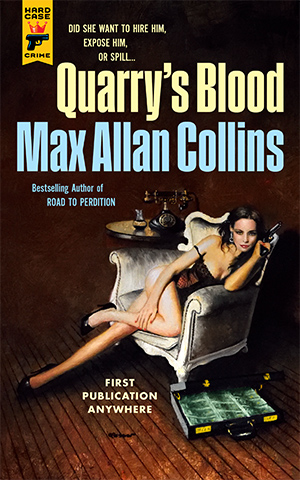
Quarry's Blood cover

I am pleased to be nominated in two categories in this year’s PWA Shamus Awards – The Big Bundle in Best Hardcover and Quarry’s Blood in Best Paperback. I don’t remember ever being nominated twice in one awards competition before, and am not sure this has ever happened to anybody in the Shamuses prior to this…though I’m not sure.

Here’s the full list of nominees.

I’m also not sure Barb and I’ll be attending the Private Eye Writers of America awards ceremony banquet, much as we’d like to. Some things look likely to be colliding with any trip to San Diego, including a couple of upcoming medical procedures. In addition, we may be gearing up for the Blue Christmas project, possibly in rehearsal or even shooting.

It is very gratifying to have both of my signature series – Heller and Quarry – honored in this way. Quarry began around 1971 at the University of Iowa Writers Workshop, and Heller started as a busted comic strip project in 1976. So both go back to the beginnings of my professional career. (I got the Dick Tracy strip in 1977, in part due to my rejected Heller proposal, which demonstrated I could write comics.) True Detective, the first Heller, winning the Best Novel Shamus in 1984 gave my career a much-needed boost.

Barb and I will make the decision about attending at the last minute. It’s not often I get to lose twice in one awards competition.

* * *

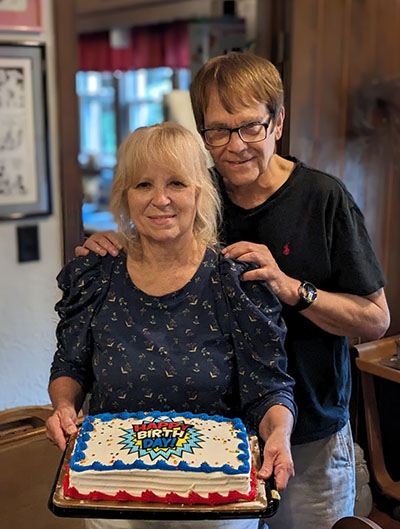
My eternally lovely bride Barbara Collins had a birthday on June 18 (as I write this). She has caught up with me in years, and I will do her the favor of not saying how many years that is. I will say having in my life a woman as smart, funny, giving and beautiful as this is the joy of my existence, the real blessing. Yes, I am a shallow son of a bitch who is pleased to be married to a woman who is still great-looking 55 years after I married her. Feel free to hate me on this score – I definitely do not deserve her or the good fortune that brought us together.

Barbara and Max posing with a birthday cake.
* * *

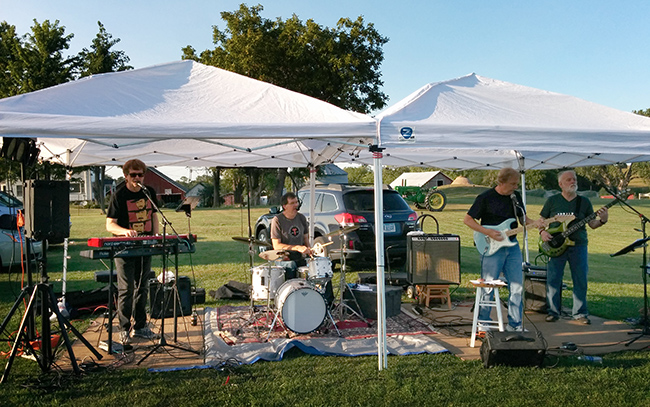
For those of you in or near eastern Iowa, my band Crusin’ is making two of (so far) only three appearances this summer season.

The first is at Ardon Creek Vineyard and Winery, a lovely outdoor event that is always well attended. We’ll be playing three hours and debuting some new original material for what will likely be our final CD. This is coming up Friday evening, June 23, at six o’clock. Info is here.

Directions are here.

Crusin' at Arden Creek, September 2017

Then on Sunday June 25, we’ll be appearing at the Muscatine Art Center Ice Cream Social, a great family event.

Crusin’ is the featured live music, and will perform from 1:15 to 3:45 p.m. Here’s the full info.

We have been prepping an album (remember those?) to appear on CD (remember those?) that will include eight or nine new songs (including “Christmas Blues” written for Blue Christmas) plus four with the Paul Thomas/Andy Landers/Steve Kundel/M.A.C. version of the band recorded for, and used in, Real Time: Siege at Lucas Street Market. Of the new material, I have written about half the songs, and other half are by guitarist Bill Anson, who is a terrific songwriter (and guitarist). The Real Time songs are either by me or the late, great Paul Thomas.

The current version of the band includes longtime drummer Steve Kundel, Bill’s son Scott on bass, Bill on guitar and lead vocals, and me on keyboards and lead vocals.

* * *

I’ll make a few comments about TV and movies, as some of you seem to get a kick out of my views in that regard.

I loved Dungeons and Dragons: Honor Among Thieves and, frankly, did not expect to. But it has a nice ability to be both comedic and frightening – action-packed, too – bringing a vibe that has hints of Princess Bride and even Monty Python and the Holy Grail. It also finally finds a good property post-Star Trek for Chris Pine, excellent here. It’s streaming now.

Speaking of Star Trek, you may recall I was very complimentary about the first season of Star Trek: Strange New Worlds, but the second season opener (though the Internet seems to love it) was a big disappointment and could bode ill for longtime fans of the original Trek and its able follow-up, The Next Generation. The lead, Captain Pike (so effectively portrayed by Anson Mount), is shuffled off-stage immediately to give the opening episode to the secondary lead (and fan fave), Mr. Spock (Ethan Peck). Spock uncharacteristically hijacks the Enterprise and then weeps a couple of times…huh? The cultural-moment bug seems to have bit the series, as the bridge crew appears damn near entirely female in what is supposedly a prequel to the first series. The bridge is also way higher tech than what the classic series gave us. I realize they want to spiff it up, but this makes the original Enterprise look like a garbage scow.

At least one older person appears to be joining the cast – Carol Kane, her quirky speech patterns explained as “an accent” – and while it’s nice to get somebody over thirty in the cast, it’s a woman in a role that might be filled by a young actor played Scotty. In the meantime, the plot involves a character from the first season who I’d entirely forgotten and dissolves into interminable fisticuff action scenes that surely had Gene Roddenberry spinning in his grave.

There is a real problem with TV and movies that become successful – this has been going on for a long time. They treat their previous movie (or in this case, TV season) as if it’s Holy Writ and we have all been studying it intently ever since. No catch-up is played, nor do the characters treated as beloved have any weight at all. Remember in Christmas Story when the Old Man is entering a contest about the Great Characters of Literature? And the answer to the question is, “Victor,” the Lone Ranger’s nephew’s horse?

This episode of Star Trek was just one Victor after another, and showcased a weeping, impulsive Spock who may make some fans’ little hearts go pitty pat, but I was blowing a raspberry.

Of course, my son Nate says I’m just a grumpy old man these days. (This was when he decided he liked John Wick: Chapter 4, though he grudgingly admits he didn’t love it.) I have also been this grumpy for a long, long time – the Old Man part just emphasizes it.

Nate and I have been watching a lot of Asian stuff lately, from the ‘80s mostly, and I’ll likely be talking about that soon.

I have had a surprising number of positive responses to my Perry Mason discussion and specifically my fannish inclusion of a hard-fought listing of the Raymond Burr episodes that are directly based on Erle Stanley Gardner novels. A few, I should mention, don’t get the “Erle Stanley Gardner’s” front-credits designation, because they are loose adaptions.

And, yes, the HBO Mason has been cancelled. I think that’s a shame, because it was on its way to being a quality series. But its snooty attitude toward both Gardner and a politically incorrect past doomed it, I think. Here’s the problem. This obsession with buying up famous I.P. (Intellectual Property) and making a new version out of it misses the point. Older people, like grumpy old me, want to see something at least vaguely resembling what is supposedly being adapted; and young people don’t give a damn – they don’t know Perry Mason from Mike Hammer. They should all be beaten with a stick, but that’s another story. There is no audience for disrespectful new versions of classic material.

Make up your own shit, guys/gals. That’s how that “I.P.” happened in the first place.

* * *

Bobby Darin’s record label Direction is being revived and will be releasing a lot of the great artist’s stuff, including previously released material. Check it out.

Here’s a nice rewrite of an article about me that was done in part because of my Muscatine Community College “Legends” honor.

For some reason the Cincinnati Enquirer picked this video up (a version of a Des Moines Register piece from a while back). It’s not bad.

Here’s the story of how the Mike Hammer comic strip got cancelled after an early success.

Lots of coverage about the Shamus nominations. Here’s just one, from the great Rap Sheet.

M.A.C.

The Awesome ‘80s Prom & Memorial Day Thoughts

Tuesday, May 30th, 2023

This past Saturday evening (May 27) Barb and I attended the Awesome ‘80s Prom put on by my buddy Chad Bishop, who is the producer of the Blue Christmas project. Chad is a fun, funny, gifted guy and the evening he put together was a blast. There were Arcade games (a whole room of ‘em), New Wave music, food and (spiked) punch, and potential prom kings and queens trolling for votes. It’s one of those almost-a-plays that have structured elements but also have a large cast circulating as characters (prom attendees) and make it an interactive event.

We were accompanied by Barb’s sister Judy and our brother-in-law Gary, who admittedly looked a little more like he was attending the Manson Family Reunion than the Awesome ‘80s Prom.

Max and Barb at the Awesome '80s Prom
’80s Prom Goers!
Manson Family Reunion?
* * *

J. Kingston Pierce, who for my money is the best friend the mystery/crime genre has here in the 21st Century, has posted info about the Blue Christmas crowd-funding effort – now in its final few days – that is better and more complete than I ever could:

Efforts by Iowa novelist Max Allan Collins to raise the money necessary to turn his A Christmas Carol-like detective short story, “Blue Christmas” (published in a 2001 collection), into a movie seem to be going well. With less than two days still to raise $5,000 through the crowdfunding site Indiegogo, he’s already brought in … $5,750!

Contributions are still being accepted here. As an incentive, if you pony up $25 to $500, Collins says you can write him at macphilms@hotmail.com to request copies of his older books to add to your collection. Click here to learn more about that offer.

Meanwhile, the author is hoping to score matching funds for this endeavor from the Produce Iowa-State Office of Film and Media’s Greenlight Grants program, which is designed to “support entrepreneurial projects that can accelerate business and careers in film.” Collins acknowledges, however, that there’s no guarantee he will succeed in this second venture, given the caliber of rival proposals. If Produce Iowa turns him down, he says he’ll mount a live production of Blue Christmas, which will be recorded.

More news on this matter to come.

Here is a link for the Rap Sheet post that includes this write-up.

* * *

Girl Most Likely will be promoted via Mystery, Thriller & Suspense Kindle book deals at Amazon, starting 6/1/2023 and running through 6/30/2023. The novel will be offered at 2.49 USD during the promotion period. If you haven’t tried one of the two Krista Larson novels, now is the time!

Fate of the Union (the second Reeder and Rogers thriller) is being offered during this same period at $3, and Flying Blind – one of my favorite Nate Heller novels – will be available at $1.99. The first of the three Reeder and Rogers novels, Supreme Justice, will be available at $2.99 for one day – June 3rd.

* * *

The great Paperback Warrior has posted a terrific review of Double Down, focusing on one of the two Nolan novels therein: Fly Paper.

Nolan #03 – Fly Paper

Max Allan Collins’ Nolan series is his pastiche of Richard Stark’s Parker series. The third novel in the chronology was Fly Paper written in 1973 but not published until 1981. The book has recently been repackaged by Hard Case Crime in a twofer marketed as Double Down.

For the uninitiated, Nolan is a hard-nosed thief who makes a living pulling heists that inevitably run into problems. Much of this book’s focus is on Jon, Nolan’s comic book collecting sidekick. The action kicks off with a colleague named Breen, who has a good thing going with a parking meter rip-off scam. Breen was working the coin theft organized by the redneck Comfort family before those hillbillies shot and double-crossed Breen landing him squarely in Nolan and Jon’s orbit.

This leads to a plan to rip off the Comfort family in a heist-the-heisters kinda deal. The action moves from Iowa to Detroit in the shadow of a large comic book convention. The heist itself is really a side-dish in the paperback with the main course being the commercial airline getaway that is interrupted by a skyjacking.

Between 1961 and 1972, there were 159 skyjackings in American airspace with the majority between 1968 and 1972. It was a vexing criminal social contagion without a clear solution – similar to the problem America currently faces with mass shootings. Collins draws upon this phenomenon as the backdrop of Fly Paper when a married guy plans a D.B. Cooper style airplane heist with a parachute getaway.

When Nolan and Jon are coincidentally on the plane as the dude takes control of the jet, the plotting and action soar. These are the best scenes in a book I’ve read in ages. The creativity at work with the dilemma facing Nolan and Jon sets Fly Paper apart from other heist novels of the paperback original era.

Fly Paper is also unquestionably the best of the first three Nolan novels. The inclusion of Jon as a sidekick gives the book its own identity rather than just being a cover song from a Richard Stark Tribute Band. The skyjacking storyline was brilliant, and everything about his slim paperback leaves the reader wanting more. Highest recommendation.

I would take slight issue with this review only in that it describes the Nolan series as a “pastiche” of Westlake’s Parker series. I usually describe it as an homage, but Westlake himself said that the series was distinct from its inspiration by the inclusion of the surrogate father-and-son relationship of Nolan and Jon, which humanizes Nolan in a way Parker never approached (nor wanted to).

The review got me to thinking, though. The first Nolan and Jon novel, Bait Money, was designed as a one-shot and really was me trying out everything I had learned from the Parker novels – not just the heist artist aspect, but the strict Point of View approach. As some of you already know, my original version of Bait Money had Nolan dying at the end. My then-agent Knox Burger, who had always disliked that ending, encouraged me to do a different ending in which Jon came back and rescued Nolan. After the original version got six or seven rejections, the new version sold first time out.

The second Nolan novel, Blood Money, was a direct sequel to Bait Money, really the second half of the first story. The two novels have been reprinted in the single volume, Two for the Money, by Hard Case Crime.

So in a very real way, Fly Paper was my first shot at doing a Nolan novel in a series format. I would always leave dangling aspects to be picked up in later novels; but this was nonetheless a self-contained series entry. More would follow.

Don Westlake and I made several appearances together, notably at Mohunk Lodge mystery weekends (see Nice Weekend for a Murder), where in my speech to the assembled fans/mystery gamers I shared the fact that Don referred to me as the Jayne Mansfield to his Marilyn Monroe, and I corrected him, saying I was the Mamie Van Doren. I remember seeing him laughing his generous laugh in the audience upon hearing that.

Don is a friend who is gone, however vividly he lives in my memory. Mickey Spillane is gone, too, of course, though he is with me every day. So many writers I’ve known and read and liked, who I’ve gotten to know personally, are gone now – one of the aspects of being 75 that never occurred to me till I got here.

On Memorial Day I reflect on my Dad, who served in the Navy as described in USS Powderkeg, and my Uncle Mahlon and Barb’s dad Bill Mull, who both endured horrific combat and came home with memories that must have been a burden.

It’s risky for me to do this, but as I write this Update on Memorial Day, friends who have passed seem to be looking over my shoulder. I will cite some, but not all of them. A good number were in either of my two bands, the Daybreakers and Crusin’ (or both), starting back around ‘65.

Paul Thomas was my chief musical collaborator for decades in both the Daybreakers and Crusin’. He came in as a tech wizard who ran sound, developed into a fine bass player and later was our lead guitarist. He was funny as hell and it’s a rare day when I don’t think of him.

Others of my bandmates have passed and yet remain vivid in my mind. Bruce Peters, the troubled genius who was the best showman, the finest guitar player, the most incredible songwriter, and the single funniest human being I ever knew. I quote him regularly.

Terry Beckey was a great singer and bass player and also very, very funny – murdered, goddamnit, on the road. Like Paul Thomas, he came into the Daybreakers as the sound man and worked his way up to front man.

Chuck Bunn was our first real bass player, a guy who didn’t hold grudges, he cherished them. But no one was ever a better band member, putting together lighting systems and other gizmos for us in his spare time – he lived for the band. He died shortly after this appearance at Bouchercon.

Brian Van Winkle came in as the brother of our then guitar player Jim after Chuck passed. He developed into a fine bassist and performer, and was incredibly fun to be around. Like so many of my bandmates, he had a wonderful if unprintable sense of humor. He also was the gentlest and sweetest member either band ever had. He appeared with us at the Indication Concert at the Iowa Rock ‘n’ Roll Hall of Fame in 2018.

Most of my best friends – maybe all of them – have been creative collaborators. People like Phil Dingeldein, who is alive and well. But some of our film collaborators are already gone, like Steve Henke, the skinny, cranky pro who kept us honest. Steve was my chief collaborator on Caveman: V.T. Hamlin and Alley Oop.

Probably the loss among my Film Family felt most deeply is Mike Cornelison, the actor who guided me through all of my indie projects. Mike appeared in Mommy, Mommy’s Day, Real Time: Siege at Lucas Street Market, and of course Eliot Ness: An Untouchable Life. He also took the leads in four short films of mine and was the narrator of both Caveman and Mike Hammer’s Mickey Spillane. He played Pat Chambers in both of Stacy Keach’s audio productions of my scripts, The Little Death and Encore for Murder.

Mike had spent almost a decade in Los Angeles appearing on top TV shows and movies as well as starring in a trio of pilot films. He was knowledgeable in ways that turned me from a rank amateur into, well, an amateur who knows a little about what he’s doing.

On the Mommy movies, when Mike wasn’t working as an actor, he was my right-hand man, whispering in my ear when I got something wrong or needed to be doing something. He was also a pop culture expert and our conversations in that area were more fun than should be legal.

These are the friendly ghosts who walk with me through the remainder of my Act Three.

* * *

The Dave Thomas/Max Allan Collins episode of Gilbert Gottfried’s Amazing Colossal Podcast got rerun recently, and has generated some nice buzz for our novel The Many Lives of Jimmy Leighton (have you read it yet?). And let’s raise a glass to Gilbert, as well, gone way too soon.

M.A.C.