
This week marks the release of the Blackstone/Skyboat four CD-set of True Noir: The Assassination of Anton Cermak (a one-disc MP3-format edition is also available). I’ve talked here often about the amazingly stellar cast (headed up by Michael Rosenbaum) and the direction by my buddy Robert Meyer Burnett. Rob and I both think True Noir is among the best things either of us has done.
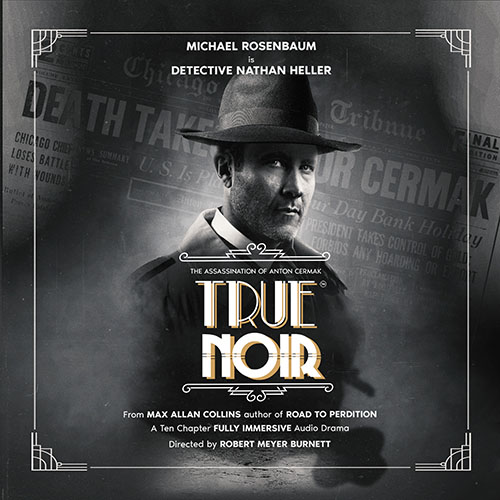
You can order it here: https://downpour.com/products/book-101t
[Or here on Amazon. –Nate]
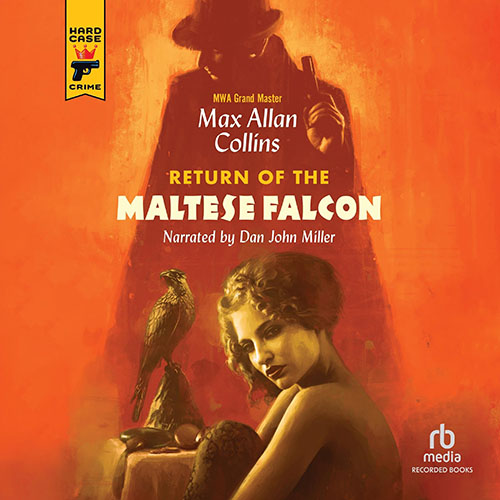
Incidentally, this link accesses 81 titles of mine, in all formats, including Return of the Maltese Falcon.
I get a few inquiries about why True Detective has been adapted under the name True Noir. The obvious (and correct) answer is that HBO used the title on its acclaimed series of a while back. But I like getting the word “noir” in there (and it was my suggestion).
For those of you unfamiliar with this project, here’s what True Noir is: a full-cast, fully scored (by Alexander Bornstein), complete with meticulous sound effects, scripted-by-me adaptation of the first Nathan Heller novel, True Detective. That book won the 1984 Best Novel “Shamus” award from the Private Eye Writers of America, and led to a long-running series (that I may return to one of these days). It really is a movie for the ears, running four and a half hours and providing several evenings of entertainment, or good company on a long road trip.
We hope to do more, but that’s up to you.
A big True Noir event at the Putnam in Davenport, Iowa, is coming up next month. Much more about that later.
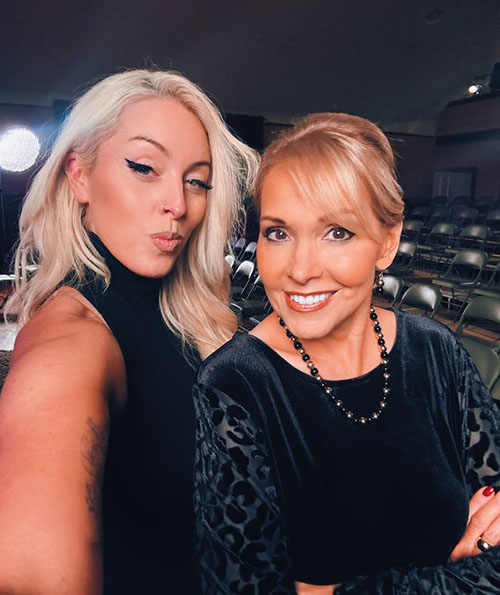
Alisabeth Von Presley and Paula Sands in Death by Fruitcake
My old Ms. Tree cohort Terry Beatty stepped up to inform his Facebook friends about my little movie, Death By Fruitcake, which has just recently been offered here: Xumo (free); Roku Channel (free); Amazon Prime Video (free); YouTube ($2.99); Google Play Movies & TV ($2.99); and Apple TV ($4.99).
Here’s what Terry had to say:
If you’ve been reading the books, you’ll know what to expect here. If “Brandy and Vivian” are new to you, you’ll have fun being introduced to them. As I noted — this is a super low budget movie, so don’t go in expecting Hollywood production values. You also shouldn’t expect a “tough guy” mystery here — this is drawing room/cozy stuff — but with the Collins touch all over it.
You’ll likely have to use Prime’s search function to find it, as they’re busy highlighting bigger budget fare. Enjoy — and don’t eat the fruitcake.
This nice post from Terry elicited this post from Steven Thompson:
Having looked into them now, I see where Paula Sands retired a couple years back from a 40 year career as an Iowa newswoman and talk show host. She is great fun as the theatre director attempting to solve the murder of her much disliked leading lady. Tall and sharply eyelashed Alisabeth Von Presley is really a singer and has appeared on shows like
American Idol but she can deliver lines well and she has a wonderful grin and wink. Her relationship with Paula as her mother carries the show.Highly recommended as long as you don’t expect Oscar-quality anything! A great way to start my morning
.And mine! Though Fruitcake is probably best watched some quiet evening over several glasses of wine with someone you love.
I’m grateful to all of you who have given Fruitcake a try, and especially if you’ve posted at Facebook or elsewhere, including Amazon reviews, where right now we only have two reviews but they are overwhelmingly positive.
In case you haven’t got round to picking up the current Return of the Maltese Falcon, this review from Matthew Legare should encourage you.
Not an official sequel, mind you, but since Dashiell Hammett’s original novel entered public domain this year, any writer can use it however they wish. It’s a bit dicey, since only the original novel is public domain, not the famous 1941 film with Humphrey Bogart, probably the single most influential piece of media for film noir and the hardboiled PI genre. Whenever a stock or cliché gumshoe detective shows up, they’re imitating Bogie as Sam Spade, not the original novel.
(MAC: Hard disagree. The novel itself was already the seminal influence on the private eye novel when the Huston/Bogart film appeared.)
The 1941 film (as well as the less famous 1931 adaptation) actually follow the novel pretty closely, so Collins’s sequel actually works pretty well if you’ve only seen the movie and never read the book. Even the cover (a glorious piece of art by the legendary Hard Case Crime imprint) is more evocative of the original novel, with Sam Spade younger and more hawkish than his film versions, the femme fatale a sultry flapper, and the black bird itself more spindly than its bulky movie counterpart.
It starts off shortly after the events of the novel, set in late 1929 (Hammett never specified a date but 1929 is a perfect year in my opinion), Sam receives another mysterious femme fatale in the form of Rhea Gutman, daughter of the villainous Caspar Gutman aka the Fat Man and mastermind of the original novel.
(MAC: a gentle correction. The novel takes place in December 1928 as the text says.)
Spade isn’t so sure, but he believes Rhea’s money and visits Cairo and Brigid in jail, asking where Kemidov’s whereabouts may be. Cairo, who was probably the best character in the original novel after Spade himself (famously played by the legendary Peter Lorre) is used sparingly here, which is unfortunate, but there really was no way to get him out of jail after being arrested in the original novel I suppose.
Regardless, Spade does what he does best, snooping for clues and getting into trouble. Sketchy characters emerge out of the San Francisco fog, like our old pal Wilmer Cook, Caspar’s boy gunsel, who has a few violent run-ins with Spade.
Added to the mix are a few other characters like Dixie Monahan, briefly mentioned in the original novel as a dangerous Chicago gangster, who is now also looking for the Falcon. Stewart Blackwood, a refined Englishman from a museum who has, apparently, already paid for the Falcon. Also there’s Brigid O’Shaughnessy’s sister, trying to find the black bird to help pay for legal fees. Kemidov himself features prominently in this novel with his invisible presence felt everywhere, something I appreciate since he was just a name and plot device in the original novel.
Spade juggles multiple clients and leads, along with a mysterious dead body he’s asked to identify, until he finally gets on the Falcon’s scent. Not a decoy, not a misdirect, but the actual Maltese Falcon. This time there’s no going back, but the dangers get even more perilous for Spade – Wilmer Cook keeps popping up but even more troubling, the Police check up on Rhea’s backstory and it turns out, Caspar Gutman never had a daughter.
Everything is wrapped up in the classic “exposition room” scene with all the suspects together and facts laid out. Cliché, but it works.
The Maltese Falcon is one of my favorite novels and Hammett’s prose has influenced me in ways I am forever grateful. It’s a masterpiece and a great piece of American literature, albeit pulp fiction. There are definite problems, some important characters mentioned (like Kemidov) never show up and some of the plot seems rushed together, and the fate of several characters are explained to us off screen. However, all the elements flow together into a beautiful canvas by the end. If you’ve never read it, you don’t know what you’re missing.
(MAC: These are excellent observations. Hammett famously claimed not to have plotted the book in advance, rather writing it by the seat of his pants, as we pulp writers put it, which explains some of what Matthew has to say here.)
It’s incredibly gratifying to receive a smart review like this. I try not to be influenced by either good or bad reviews. I regard the good ones as positive publicity and the bad ones as negative publicity; but don’t allow myself to be influenced by either…though, like most people in the arts, I remember the bad reviews vividly while the good ones are a blur.
My son Nate and grandson Sam have been watching Cowboy Bebop on Blu-ray. It’s a favorite of Nate and mine, and it was a joy revisiting this incredible s-f/crime anime after so long a time. I would rank it with the original Star Trek and Lexx (a show criminally off my recent “favorites” list) as among my very favorite science fiction series (call it Number 6, although I should probably put The Prisoner there and give Lexx the Prisoner’s slot on the five favorites).
One of the things that characterizes the series is its outstanding music by composer Yoko Kanno and her band the Seatbelts. They just a few weeks ago performed in the United States. Here they are performing the opening theme of Cowboy Bebop (a theme rivaled only by Peter Gunn and James Bond). Enjoy!
M.A.C.
Tags: Antiques Series, Barbara Allan, Death by Fruitcake, Death by Fruitcake Movie, New Releases, Return of the Maltese Falcon, Trash 'n' Treasures, True Detective, True Noir, True Noir: The Assassination of Anton Cermak, True Noir: The Nathan Heller Casebooks
Legare is a pretty good writer himself.