Posts Tagged ‘Prey for the Maltese Falcon’

Sam Spade and Me

Tuesday, June 9th, 2026

This week, or at the latest next, I will likely complete Prey for the Maltese Falcon, my follow-up to Return of the Maltese Falcon. It takes place in 1939 and posits what Sam Spade might have been up to around ten years later.

It’s an honor, and frankly a relief, to have had Return so warmly received. My wife Barb warned me I was really sticking my neck out this time – who was I to be writing a sequel to what many (including me) consider the best the best tough mystery novel ever written – the book that can be viewed as the paradigm for the entire sub-genre of the private eye novel?

I tried to answer that by respecting Dashiell Hammett and his creation, and honoring him with something more than just a pastiche. Readers coming to the book will always have to judge that for themselves.

A perhaps more interesting question is: why had I been thinking about doing a sequel to The Maltese Falcon for something like twenty years? When the novel was decades away from going into the public domain, making any such effort even possible? Prior to the novel gaining public domain status, I thought it highly unlikely the Hammett estate would come to me for the job.

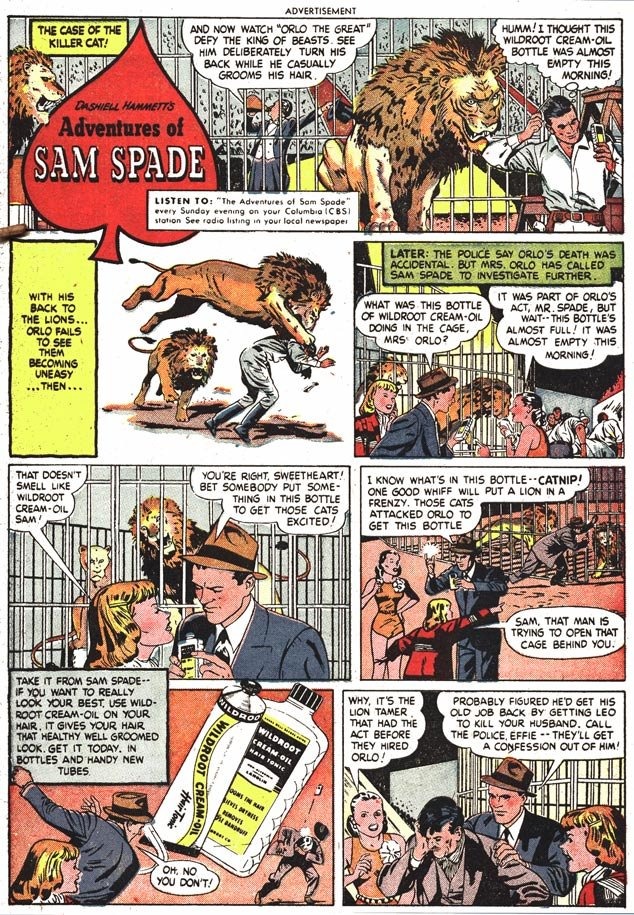
Sam Spade got on my little-kid radar by way of advertisements in comic-strip form that appeared in Sunday newspapers and occasionally comic books. My discovering those strips was in the mid-1950s and even then those ads/comics were old news – literally, old newspapers and comic books that had somehow gotten into my grubby little hands (and psyche).

It was common for advertisements in the Sunday funnies to disguise themselves as just another comic strip, or a page of comics in a comic. Sometimes such strips invented their own recurring characters, the better to fool readers into thinking they weren’t reading an ad at all (particularly kids). Sometimes advertisers went so far as to license existing comics characters to hawk their goods – famously, Al Capp’s Li’l Abner (for Cream of Wheat) and Fearless Fosdick (for Wildroot Cream-Oil) appeared in mini-comics in the pages of slick magazines like Look and The Saturday Evening Post, as well as comic books and Sunday comics sections.

Like Fosdick, Sam Spade appeared on behalf of Wild Root Cream-Oil (a hair tonic) in a strip called The Adventures of Sam Spade, tying in with a popular radio show of that name starring Howard Duff. The strip took up a lot of real estate in the funnies – a half- or even full-page – and each was a short mystery, solved usually in a way that (you’re ahead of me) had to do with Wild Root Cream-Oil.

They were lively strips, many of them beautifully drawn by Golden Age comics great, Lou Fine, a Will Eisner crony. Over a three-year period, at least 25 strips were published. This link will take you to some nice examples.

Because of these strips, I knew about the Sam Spade radio show, but missed out on those, because The Adventures of Sam Spade aired before my time, from 1946 to 1951 (on NBC). The series was enormously popular and made a star out of Howard Duff, who graduated to movies (and later TV) but never was as big a star as he’d been in radio. Another popular radio series, Suspense, did two episodes with Duff as Spade, one of which (“The Kandy Tooth Caper”) was a 60-minute sequel to The Maltese Falcon.


Howard Duff as Sam Spade

The series was a spoofy take on the genre not at all in keeping with Hammett’s original approach, but its success having almost as much to do with establishing Sam Spade as the iconic private eye character (maybe the ironic private eye character) as Bogart’s Spade had with the John Huston classic film.

The series might have lasted longer, and perhaps made the transition to TV, but the anti-Communist witch-hunt led to creator Dashiell Hammett, known for his association with left-wing causes, becoming a ripe target for Senator Joe McCarthy. Hammett, who had served his country in two wars, even did hard time when he refused to name names in the HUAC hearings. McCarthy’s odious assistant Roy Cohn even tried to have Hammett’s five novels banned from U.S. Information Service (USIS) overseas libraries. Cohn failed when Hammett fan, President Dwight D. Eisenhower, intervened.

In the witch hunt’s wake, the radio show was re-tooled as Charlie Wild, Private Detective (1951), with a new detective taking Spade’s place, although secretary Effie Perine stayed on board; the radio series didn’t last long, although it did make a shaky transition to TV (1950-1952). Effie came along (the setting now New York) played by young Iowa gal Cloris Leachman (later picked up by Mike Hammer at the start of the film Kiss Me Deadly).

I’m not sure when it was that I first saw the Bogart/Huston Maltese Falcon. I vaguely remember faking a stomach ache so I could stay home from church and see it on the Sunday Morning Movie. I loved it, of course. The likes of the Saint and Sherlock Holmes, two of my previous obsessions, couldn’t hold a candle to Bogie’s Sam.

Finally I caught up with the original Sam Spade in the Permabooks 35-cent edition of The Maltese Falcon with a great cover by Harry Bennett (a very ‘60s rendition of Brigid, Wilmer and Caspar Gutman). And at some point I discovered a Dell paperback of A Man Called Spade, with the three Hammett-published Spade short stories.

In my teens I was inhaling all the Hammett I could find, usually in ill-lit old secondhand bookstores; same with Raymond Chandler and Mickey Spillane – the Big Three, as far as I was concerned (and still am).

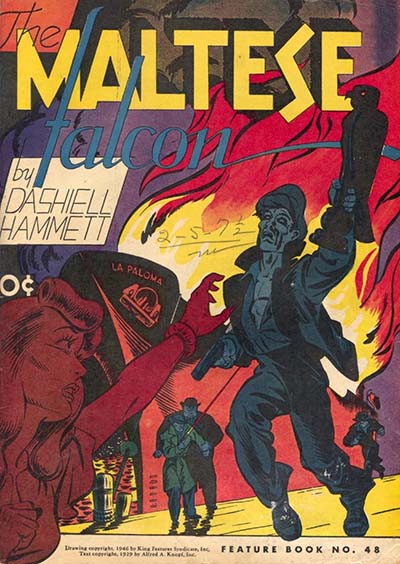
Periodically I discovered other Spade oddities, like the 1946 David McKay “Feature Book” adaptation of The Maltese Falcon in comic-book form, with funky art by Rodlow Willard; and one or two of the record albums of the several Falcon radio adaptations starring Bogart and other original cast members.

As I mentioned elsewhere, I have never watched an episode of the AMC series, Monsieur Spade, not wanting to be influenced; and I have not revisited Spade & Archer by the late Joe Gores. I frankly recall not being taken with it, and thinking I’d like to have a crack at the character myself someday (though I am otherwise a Gores fan).

It’s clear that Hammett did something very special in The Maltese Falcon, and a lot of it was Sam Spade, who despite appearing in one novel remains for many of us the quintessential private eye. The imprint of the author and his character on me was such that I could become intrigued with them both just by reading a comic strip advertising hair oil tonic.

* * *

Guess what movie is considered one of the best Irish mob movies ever?

M.A.C.

Sam Spade News & A Fruitcake Near-Rave

Tuesday, April 28th, 2026

I’m pleased to announce I’ve signed with Hard Case Crime to do two more Sam Spade novels.

Launching a new Spade series wasn’t my intention in writing Return of the Maltese Falcon. I merely wanted to be out there first with a sequel to the classic original, now that it was in the public domain, and was presumptuous enough to think I could get it right.

As I’ve mentioned here, when I finished writing the book, and was pleased with it, my wife Barb warned me to brace myself – she said, Not everyone would like me appointing myself to a task that some might think ought never have been attempted. My thinking was, Somebody’s going to do this, and it might as well be me.

And I was surprised and pleased that the reactions were overwhelmingly favorable, generating some of my best reviews ever. A few naysayers weighed in, though were very much in the minority. Don’t get me wrong: I didn’t feel vindicated, I felt relieved.

Only when I saw how well Return of the Maltese Falcon was doing did I begin thinking about writing more Sam Spade. Spade is a character about whom Hammett might well have written another dozen or two novels, like Gardner with Perry Mason, Christie with Hercule Poirot or Rex Stout with Nero Wolfe. And of course Hammett, before turning his back on mystery writing, had written three Spade short stories, plus there’d been the popular Spade radio show with Howard Duff.

But what came to my mind was offering my publisher a trilogy, the first of which would be the already existing Return. I found it interesting to suggest two more Spade novels, each separated by ten years or so – to see what Spade was up to in the war years and then the McCarthy-era ‘50s (which obviously have resonance with Hammett’s life).

I wrote a fairly lengthy proposal and Hard Case Crime’s Charles Ardai, with support from parent company Titan’s Nick and Vivian Landau and my editor Andrew Sumner, responded favorably. I am now about to begin work on Prey for the Maltese Falcon, set in 1939.

In some ways it’s more challenging than Return, which gave me the luxury of working within the parameters of the original novel – its characters, its locations, its themes. Now Spade is ten years older, and the case I’ve constructed takes him all sorts of places that the original novel and my sequel didn’t.

Wish me luck.

* * *

The UK’s Guardian has an excellent essay on the resurgence of interest in the private eye. It includes a nice reference to Return and me.

* * *

I was surprised and pleased to discover that the Overly Honest Reviews site has posted a terrific Death by Fruitcake review that I’ve been granted permission to share with you.

RAVING REVIEW: One of the best types of mysteries doesn’t pretend to be bigger than it is. DEATH BY FRUITCAKE leans into its small-town setting, its contained stage environment, and its personality-driven storytelling without trying to inflate the stakes beyond what the story can support. That restraint ends up being one of its biggest advantages. It knows the scale it’s operating within and, instead of stretching, digs inward into character, tone, and timing.

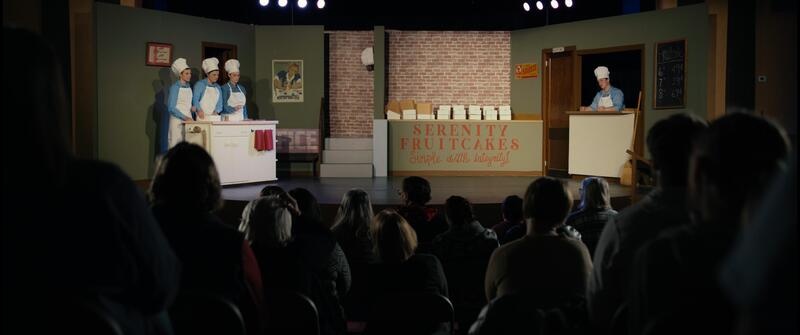
The setup is simple in the best way. A dress rehearsal collapses into chaos when a notoriously difficult actress drops dead mid-performance, and suddenly everyone in the room becomes a suspect. That kind of confined, single-location mystery has been done countless times, but what makes this one click is the attention it pays to the personalities circling the event. This isn’t about elaborate plotting or intricate twists stacked on top of each other. It’s about letting the audience sit in a room full of people who all have a reason to hate the victim and watching the tension build from there.

Paula Sands carries much of the story as Vivian, and what stands out isn’t just her presence but the way the performance embraces a slightly heightened delivery without tipping into parody. There’s a stiffness to her line reading at times, but instead of breaking the illusion, it almost feeds into the character. Vivian feels like someone who sees herself as more composed and authoritative than she actually is, and that disconnect becomes part of the charm. It’s not polished conventionally, but it fits the world the film builds.

Alisabeth Von Presley brings a different kind of portrayal as Brandy, and the contrast between the two performances becomes one of the film’s strengths. Where Vivian leans toward control and presentation, Brandy feels more fluid, more aware of the absurdity around her. The moments where she interacts directly with the camera could have come off as distracting. They’re used sparingly enough that they add personality instead of pulling you out of the story. It gives the film an edge, a reminder that it’s in on its own tone without constantly pointing it out.

The supporting cast fills out the ensemble, keeping the suspect pool engaging. No one is pushed into satire, but everyone is just exaggerated enough to feel distinct. That balance is important in a story like this. If the characters blend into one another, the mystery loses its shape. Here, each interaction carries just enough tension or humor to keep things moving, even when the narrative slows.

The investigation expands in a way that feels intentionally relaxed, but there are stretches where it could have used a sharper sense of escalation. Conversations feel a bit repetitive at times, suspicions shift without always adding new information, and the momentum dips as a result. It never stalls completely, but there’s a version of this that trims some of that repetition and lands with a bit more impact.

There’s a lightness to the humor that doesn’t undercut the mystery, and a sense of familiarity that works in its favor rather than against it. It feels like a story that understands its audience, especially those drawn to mysteries where the intrigue matters but the experience is just as much about spending time with the characters. The jokes land more often than not, and when they don’t, they still feel in line with the world the film has created.

The single-location setting becomes a strength rather than a constraint, forcing the film to rely on blocking, performance, and dialogue rather than on visuals. There’s a stage-like quality to everything, which makes sense given the setting, and instead of fighting that, the film leans into it.

What ultimately holds everything together is the film’s understanding of what kind of mystery it wants to be. It’s not chasing complexity for its own sake, and it’s not trying to reinvent the genre. Instead, it focuses on delivering a contained, character-driven story with enough intrigue to keep you guessing and enough personality to keep you invested.

There’s also an underlying appreciation for the setting itself. The small-town dynamics, the overlapping relationships, the way grudges and histories linger just beneath the surface, all of that feeds into the mystery without needing to be spelled out. It gives the film a sense of place that adds texture without complicating the narrative.

DEATH BY FRUITCAKE doesn’t aim for perfection. Its appeal comes from how comfortably it settles into its identity. The imperfections are part of the experience, but they don’t define it. What sticks is the chemistry between its leads, the playful tone, and the steady commitment to telling a story that fits its scale. It’s the kind of film that understands exactly what it’s offering, and more importantly, what it isn’t. And in a genre that often overreaches or overcomplicates itself, that clarity goes a long way.

Please visit https://linktr.ee/overlyhonestr for more reviews.

* * *

If you haven’t read Return of the Maltese Falcon yet, please do. And if you watch Death by Fruitcake on Prime or Roku or Apple TV, please leave a thumbs up if you’ve enjoyed it. And if you order the DVD from Amazon, a favorable review there would also be helpful.

Finally, just a reminder that True Noir: The Assassination of Anton Cermak is out as a 4-CD set now, and can be ordered here for only $23.37 (on sale from its usual $35.95) [Also in a single-disc MP3-CD for $19.47 or digital download for a mere $12.97! – Nate] It’s a full-cast star-studded nearly five-hour audio drama written by me from the first Nate Heller novel, True Detective, and directed by my pal Robert Meyer Burnett.

M.A.C.