Posts Tagged ‘Nate Heller’

True Noir in Session, an Antiques Indie, and M.A.C. on Film

Tuesday, June 25th, 2024

True Noir has a major recording session scheduled this week, and I hope to attend by Zoom. Participants are in California, New York and…? It’s a big, terrific name cast, bringing True Detective to life as an immersive audio drama from my recently completed ten-part script, and if you are a fan of the Nate Heller books, you’re going to be thrilled.

Our gifted director Robert Meyer Burnett is viewing the project as a movie – there’s even been discussion about animating it – and that brings me to a favorite topic around here: movies – and an announcement.

In what may be my swan song as a low-budget indie filmmaker, I will be directing (in tandem with my wife Barb) from a script we wrote together based on a novella we wrote (got all that?) the first ever movie based on the Antiques/“Trash ‘n’ Treasures” mysteries. The interest our forthcoming Christmas movie, Blue Christmas, has generated was encouragement enough to do another Yuletide mystery, Death by Fruitcake, based on the novella “Antiques Fruitcake” in the collection Antiques Ho Ho Homicides.

And the inability over the last ten years or so of two separate wonderful female showrunners to sell Antiques to TV prompted us to put the thing on its feet ourselves. As a little indie movie.

We have Brandy and Mother cast, with our first choices, whose identity won’t be announced for a while. For now, just know that many of our talented cast members from Mickey Spillane’s Encore for Murder and Blue Christmas will be back on board, including the latter’s star, Rob Merritt.

Pre-production is seriously underway, with producer/cinematographer Chad T. Bishop putting a crew together and meeting regularly with me for planning sessions. Barb has been gathering props and working with department heads on wardrobe and other areas of the filmmaking process. The script is finished, or anyway as finished as any movie script is until the cameras roll.

Why, particularly at this late date, am I wading back into indie filmmaking? A bunch of reasons.

Some of my markets for publishing fiction have dried up. I’m a white guy closer to eighty than seventy, and that makes me about as much in demand as a stale loaf of Wonder Bread. This lack of foresight on the part of a generation or two who have never heard of me will not stop me from creating. And I do love movies.

That was my mother’s fault, largely, as she took me to at least one movie every weekend, and often two; and the Uptown Theater had Saturday matinees, too. Plus, TV was full of old movies. I was part of the first generation born to TV-watching. I saw George Reeves play Superman, first run. I saw Martin and Lewis movies in the theater – never missed a one. And, after that, Jerry’s solo efforts, although it started getting challenging around Three On a Couch (1966).

Speaking of Jerry Lewis, I am proud to say that my regular Saturday afternoon movie-watching with my eight-year-old grandson Sam continues with his enthusiasm for Ray Harryhausen stop-motion Sinbad movies now equaled by his giddy joy at encountering both Martin and Lewis and Jerry Lewis himself. That I have made my grandson a Jerry Lewis fan is one of my proudest achievements. First up was Artists and Models, and lately it was The Disorderly Orderly. Plus You Tube gems like the following excerpt from Cracking Up.

Please don’t write me and tell me what a horrible person Lewis really was. How he left his kids out of his will and hit on female co-stars and supposedly did this and that reprehensible thing. I have wrestled with the difference between the public and private artist (and he was an artist) and have come to decide that all we’re owed as fans is the work. The rest is largely irrelevant and/or past understanding. Why were two of the most sensitive singers of the Great American Songbook – Frank Sinatra and Bing Crosby – such heels in certain private aspects of their lives? Don’t know. Don’t care.

They give us the gift of their talents, and they don’t owe us anything past that. That said, I don’t find O.J. Simpson that funny in the Naked Gun movies – of course, he always was the least funny things in those movies – and I haven’t been able to stomach Robert Blake post-his wife’s murder. Consistency isn’t my strongest trait.

Take Roman Polanski and the sexual misconduct that makes him a fugitive in the United States even today. Does that make Chinatown a bad movie? Unwatchable because the director may have more to do with Noah Cross than Jake Gittes? Not to me it doesn’t – not any more than I can comprehend what it would be like to have your beautiful pregnant wife butchered by Charles Manson’s minions.

Which brings us to Chinatown. Let’s get this out of the way: the current 4K Blu-ray release of that great film is a stunner. It looks wonderful, better than I’ve seen it since seeing it (multiple times) in the theater on its initial release. I never tire of it and always see new things in it. Or should I not like it because Faye Dunaway is supposedly unpleasant on set? Gonna give her a pass on that.

Gonna give a movie a pass on everything but the movie itself, which in the case of Chinatown seems to be more screenwriter Robert Towne’s doing than Polanski’s, although arguably Polanski’s Sharon Tate-inspired ending is what elevates it to its deserved stratospheric reputation. Polanski reportedly cast John Huston as Noah Cross, a decision that also elevated Chinatown and not just because Huston directed the other truly great private eye film, The Maltese Falcon (well, Kiss Me Deadly isn’t bad either).

What struck me about Chinatown this time around is something I would guess others have already noticed; but this was the first time I did. I knew it had the same kind of emotional impact as Hitchcock’s Vertigo (my favorite film); but I hadn’t realized that Chinatown and Vertigo are essentially the same movie. I’m almost embarrassed to admit that.

Both stories revolve around the following: a detective who well-meaningly caused a death in the past, while on the police, and is haunted by it; a client who presents the detective with a false narrative; a scenario that plays with and against the viewer’s boredom while following the detective shadowing a major figure in that false narrative; a female lead who pretends to be one thing and is something else; a detective who exudes confidence, but ultimately is taken down all the way to a tragedy of his own making, unintentionally destroying the woman he has come to love.

I could write a book about it.

And yet this film is one I’ve seen perhaps twenty times and none of this occurred to me before. Either I am very stupid or these movies resonate with me at least in part because of their structural and thematic sameness.

While I am on the subject of movies, let’s tip our hat in farewell to one of the screen’s most interesting actors, Donald Sutherland. Sutherland had a distinctive, quirky presence that should not have lent itself to a multiplicity of roles. And yet there was seemingly nothing he could not play. He put this down to not painting a character good or bad, benign or evil, but instead just trying “to act the fella.” To be the character. He understood that a villain never knows he is the bad guy. He knew that the line between comedy and drama was not just a fine one, but not a line at all.

As coincidence will have it, Barb and I watched one of our favorite films, Start the Revolution Without Me (1970), the evening before we learned of Sutherland’s passing. We revisited that film – which is not perfect, and in fact is rather ragged along the edges – because we’d watched the excellent documentary, Remembering Gene Wilder (2024), the evening before. The night before that we re-watched The Producers (1967), which we’d seen on its first release in a theater in Bettendorf, Iowa. To celebrate Wilder, who we have loved ever since that first Producers viewing. We loved him when he was not really famous yet, in the likes of Start the Revolution Without Me and Quackser Fortune Has a Cousin in the Bronx (1970). He wasn’t quite Willy Wonka yet.

Anyway, we were both struck by how perfect and perfectly funny Wilder and Sutherland were as separated twin brothers, one pair a poor peasant one, the other a rich unpleasant one, both hilarious. Wilder and Sutherland would have made a fantastic comic team had they embarked on a joint career. How funny? Abbott and Costello funny. And, yes, Dean and Jerry funny.

And on some level, this is what I love about the movies. I never met Gene Wilder. Or Donald Sutherland. Or Jerry Lewis (probably a good thing). But they fill some of my most priceless, precious memories. I remember, for example, how hard Barb and I worked to find theaters where we could see Start the Revolution Without Me multiple times. I remember, for example, how initially offended Barb was by the idea of Zero Mostel diddling little old ladies out of money for his latest flop play in The Producers…until she came to find it hilarious. I remember how it felt, as a ten year-old child, to see Vertigo for the first time and be as fooled by the plot as James Stewart. I remember seeing Chinatown for the first time and realizing there was potential in the private eye story to be something more than a mere genre piece.

These actors and directors are friends we encounter, and if in real life they are assholes, find someone else to care because I don’t. These are memories I cherish, as much or nearly so as actual experiences.

And I wonder, as we go to the movies less and less – and when we encounter more and more unspeakable behavior in the seats around us – if watching even the best binge TV available (Mad Men, Sopranos, Breaking Bad) can ever have the impact of that church of popular culture where the wine is Coca Cola and the Sacramental Bread is popcorn?

M.A.C.

Eliot Ness, Quarry, Writing Series Characters and More

Tuesday, May 21st, 2024

My YouTube appearances with Heath Holland at his Cereal at Midnight continue, with what I think is the best so far: a discussion of Eliot Ness on screen, kicked off by the current Blu-ray edition of The Scarface Mob from Eureka.

Also on the YouTube front, Robert Meyer Burnett, on his Robservations and Let’s Get Physical Media, continues to provide updates on his audio “movie for the ears” adaptation of my novel True Detective. It’s called True Noir: The Casebooks of Nathan Heller, and I am writing the scripts myself. I have delivered the first seven of ten of what will be a fully immersive audio presentation directed by Rob, with an incredible Hollywood cast, and will run at least five hours.

Todd Stashwick of Picard and Twelve Monkeys (and much else) makes a terrific Nate Heller. If this project resonates with the public, look for three more Heller novels to become movies for the mind, all adapted by Heller’s creator himself.

You know – me.

* * *

Paperback Warrior posted the cover of the upcoming (it’s a fall release from Hard Case Crime) Quarry’s Return. That was a post on X, which I guess is what they’re calling Twitter now. It’s from Elon Musk, who named a ship after Ms. Tree, then didn’t follow up on his people asking to license the name from Terry Beatty and me. Somehow I’m reminded of the penny-pinching kazillionaires in classic Li’l Abner by Al Capp.

Quarry's Return

But since this cover image is floating around out there, I thought I should share it, though we’re a few months away from the novel’s release. I didn’t expect to be writing another novel about Quarry in his (ahem) later years; but sequels have a way of worming into my brain as if I were a Presidential candidate and then percolating there (that’s what we writer folks call a mixed metaphor).

Now I have a notion for yet another “old Quarry” story that is wormily percolating, and we’ll see. I had thought that The Last Quarry would be the last Quarry; but then a whole slew (past tense of “slay”) of ‘em followed, filling in the blanks of his life and varied career. Then came Quarry’s Blood, which was really designed to be the last, only when it was warmly received for a book about a cold-blooded killer, I changed my mind (again). And now here’s Quarry’s Return, with Quarry again a geriatric retired hitman kicking younger ass.

It isn’t that I was planning to retire the character. I figured I might do the occasional younger Quarry novel while I am still above ground. I am never anxious to retire a character completely, in my imagination anyway. It wasn’t hard at all to bring Nolan and Jon back in Skim Deep something like forty years later. I knocked on their door and they promptly answered, not much the worse for wear.

I think the reason why I’ve stayed with my series characters is that good ones don’t come along that often. The only one I’ve really consciously retired is Mallory, because there really isn’t a premise there to generate more novels, and anyway he’s essentially me and that bores my ass off.

But I will never understand mystery and suspense writers who do a new character each and every time. Most of these scribes, well, many of them are simply hanging a new name on the old character. Also, I am too aware of how unsuccessful some incredible writers have been, trying to create a second series character. You may have noticed, if you’ve been paying very close attention, that I like Mickey Spillane – the man and his writing. But what’s your favorite Spillane series character after Mike Hammer? And Velda and Pat Chambers don’t count. (Velda could carry a novel, and some would say she carried a whole comic book series under a separate name. Hint: Ms. Tree. But can you imagine the sheer snooze factor of a Pat Chambers novel?)

So with apologies to you Tiger Mann fans, Mike Hammer can’t be created twice. Edgar Rice Burroughs came close by writing John Carter of Mars, but that character was no Tarzan (and Carson of Venus wasn’t even Carter). Going back to Mickey, his second greatest series protagonist was Morgan the Raider (The Delta Factor); but I had to finish the only other book that character generated (The Consummata) from a few chapters in Mickey’s files.

Barb, a while back (in the throes of writing an Antiques novel and enduring the suffering that process creates in my talented wife), started talking about ending that series, fed up with the difficulties of generating more stories about Vivian and Brandy Borne. I insisted that she stick with it (not that my insistence carried any particular weight) because the Borne girls are fabulous fictional creations, in my unhumble opinion. They live and breathe on the page, and act of their own volition, as all great series characters do.

Here’s the thing: Rex Stout was a genius. His Nero Wolfe books are among the most readable and re-readable novels of any kind ever written. No other two fictional characters live and breathe like Wolfe and Archie. They are as good as fiction gets in the world of the creation of mystery genre recurring characters. Holmes and Watson never breathed as fully, and before Nero and Archie, they were the top.

And yet Rex Stout’s publisher kept after him to create another series. And of course he was a smashing success with his other incredibly famous character, Tecumseh Fox. Right? Right? Okay, how about Alphabet Hicks? There’s a banger of a character! Or how about giving Inspector Cramer a mystery of his own? Or that famous female PI, Dol Bonner?

Nope. One of the few true geniuses of mystery fiction, Rex Stout, stunk up the place with these more contrived creations. So I’m of the opinion that when a mystery writer stumbles upon a character that resonates with the public, said mystery writer should give the public what they want.

Are there dangers? Yes, artistic ones. For example, what if I’d been hugely successful right out of the gate with Nolan, who was after all an homage to Don Westlake’s Parker (“homage,” as we all know, is French for “rip-off”). I might still be writing nothing but Nolan books. I’d have written, say, 40 or 50 Nolan and Jon novels…selling millions…and writing nothing else.

Writers do need to flex their talents. That’s why Robert B. Parker wrote westerns on the side and did his own unsuccessful Dol Bonner-type female private eye novel. So it’s risky, sticking with one series. I do think, with the Antiques books, you have two interacting characters – like Archie and Wolfe – who provide a kind of engine for the story beyond the plot machinations.

Mickey wrote about Mike Hammer throughout his sporadic career. Early on he came to feel he’d characterized Hammer so fully, there wasn’t anything else to say. He compensated by writing Tiger Mann and some standalones, though he drifted back to what was essentially the same protagonist under various names. What kept him artistically sane (not a word used much in relation to Mike Hammer, I grant you) was his decision to make Hammer always reflect where he, Mickey Spillane, was in his life. He allowed Hammer to grow somewhat older (not realistically so, but older) and to allow this indomitable character to have frailties – Hammer went on a seven-year drunk; he was, in several novels (including some I completed) recovering from wounds or otherwise physically impaired. This reflected Spillane’s own advancing years, and the on-and-off nature of his writing career.

Look, every mystery writer – every writer – has to do this his or her own way. I am only suggesting that for me it’s been an interesting, rewarding ride, following my characters through their advancing years (and mine). That was true of Nate Heller in the current Too Many Bullets. It was true of Nolan and Jon in Skim Deep. And Quarry in Quarry’s Blood and Quarry’s Return. And if I ever return to Ms. Tree, you can bet your ass she’ll be in menopause.

* * *

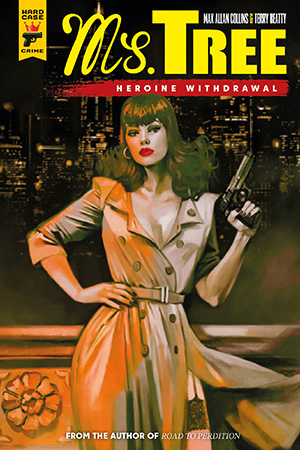
Speaking of Ms. Tree, Terry and I are working on the sixth and final Titan volume of the collected Ms. Tree, which gathers almost everything he and I did with the character and her supporting cast (no The P.I.s, though). She had an impressive dozen-year comics run (1981 – 1993) and represents one of the most gratifying collaborations I’ve ever enjoyed. Terry Beatty and I, I am glad to say, will always be thought of by many comics fans as a team.

Right now Terry is working on helping put together (much as he has on the Titan volumes of collected Ms. Tree) our Dark Horse Johnny Dynamite graphic novel, Underworld, in an improved publication that will happen later this year.

It’s an enduring frustration to me that we both worked on Batman but never together. And that we both did syndicated comic strips (Dick Tracy and Rex Morgan respectively), but not as a team. He’s still doing Rex Morgan, but he doesn’t need me – he writes it himself. I like to think he had a good teacher.

As for Dick Tracy, the VCI Blu-ray collection of the four RKO Tracy feature films – with two new commentaries by me and lots of bonus features – will be out in early August.

Getting back to Ms. Tree, here’s Comic Book Treasury’s best crime comics write-up (it invokes Road to Perdition, but lists Ms. Tree).

And speaking of Collins/Beatty, here’s a look at Wild Dog at Tvtropes. It says: “The series was writted by Max Allan Collins with art by Terry Beatty.” I don’t know who “writted” this otherwise nice piece.

M.A.C.

Winning and Losing

Tuesday, May 7th, 2024

NEWS FLASH: True Noir: The Nathan Heller Casebooks, the ten-episode full-cast, fully immersive audio adaptation of the first Heller novel (True Detective) is now in production! The Kickstarter crowd-funding effort will go live soon, to enable us to add physical media and other bells and whistles to the project. Watch Robert Meyer Burnett’s various YouTube shows and appearances for ongoing updates.

* * *

We did rather well at the Iowa Motion Picture Awards (held in Forest City, Iowa, on May 4).

Actor – Award of Achievement
Blue Christmas
Rob Merritt

Actress – Award of Excellence
Blue Christmas
Alisabeth Von Presley

Direction – Long Form (60 minutes +) – Award of Achievement
Blue Christmas
Max Allan Collins, Chad Bishop


Screenplay (Produced) – Award of Excellence

Blue Christmas
Max Allan Collins

We were also nominated in the Best Feature Film category and Best Supporting Actor (Chris Causey as Jake Marley).

There were any number of categories we were not considered in, because every category you enter in this award competition comes with a somewhat stiff entry fee. I settled on what I thought we had a chance at winning (roughly speaking, the Award of Excellence is first place, the Award of Achievement is second place).

What I like about the Iowa Motion Picture Awards is that each category has a separate slate of judges (and the second round is out-of-state). That gives a film several bites at the apple…though you have to pay for each bite.

This is, in a way, an important competition for us, because we were looking to do well enough to be able to legitimately put some impressive-sounding Laurel wreaths on our poster and on the Blu-ray and DVD sleeves. And we accomplished that. This is preferable to, say, the Cedar Rapids Film Festival, where they have a large slate of awards but only two awards (essentially first and second place) apply to indie feature film projects, the rest to corporate and student. No acting, writing, directing awards. That means being an official entry, as we were in that festival, is an accomplishment in itself; but it isn’t as impressive as, say, Best Actress.

I had originally hoped to attend the Iowa Motion Picture Awards, but it’s a twelve- hour round trip drive from Muscatine, Iowa, to Forest City, Iowa. And we had a conflict, too, which had us cancelling our motel room at the last minute and not making the trip. Our star, Rob Merritt – who won several awards not just for our production but a couple of others (he’s the busiest actor in Iowa and for good reason) – was there to represent us, as was Jake Marley, that is, Chris Causey.

We had also decided not to attend the Edgar Awards, which were just a few days before the Iowa Motion Picture Awards. That was a different situation. For one thing, we figured the NYC trip would cost probably at least $3000 and that was a conservative estimate. For another, the minute I saw that a biography of James Elroy was nominated in the same category as my (and Jim Traylor’s) Mickey Spillane bio, I knew we were (what is the term?) fucked.

Elroy is inexplicably (from my biased viewpoint) a writer worshiped by any number of readers, reviewers and, of course, Elroy himself. He’s the only writer whose work I truly despise. I have not hidden this view, nor have I hidden that it likely derives from my being jealous because he’s hugely successful working my side of the historical street. And I also have not hidden the fact that any number of smart people think he’s a genius.

The thought of shelling out three or more grand to go to New York and sit through a long evening to watch a book about a writer I abhor beat a book about a writer I admire was just one rubber chicken too far. There’s an irony here, of course, which is that many in the mystery field still feel about Mickey Spillane the way I feel about James Elroy. It just goes to show what a sick sense of humor God has (it’s uncomfortably like my own).

I have nothing against the writer of that book or the book itself, not having read it. It came down to, “Is this how I want to spend three grand?”

And it was a good call.

The award – the reward – for our Edgar-nominated book is the book itself. I am so happy to have written it and found in Jim Traylor a copasetic collaborator and in Otto Penzler an enthusiastic publisher/editor, who has a true affinity for the mystery genre and its history. I wouldn’t trade our book for a barrel of Edgars.

It is kind of funny that an Elroy book beat us.

Of course, in that same category there were two books about Poe (after whom the award was named) and another by an author who passed away recently, so even if the Elroy bio hadn’t been there, one of those would have likely beat us. And since I haven’t read any of the competition (including the Elroy bio), I have no opinion as to the quality of those books – any one of them could be better than ours…including the Elroy one.

Two Poe books up for the Edgars reminds me of when I was a presenter at the Eisner Awards at San Diego Comic Con a while back, and one of the two guys up for the award was Will Eisner himself. And I said to the audience, “I’m not sure which is worse – being up against Will Eisner for the Eisner, or being Will Eisner and losing the Eisner.” (He won.)

I should probably not be talking about this at all. Frankly, I’ve always been somebody who wants to be outspoken and yet loved by everyone…in other words, something that has zero chance of ever happening. To anyone. But it has made me reflect on my competitive nature and my desire to win. Which may be a little sick, but what would a desire to lose be but psychotic?

For me the ultimate award was being made a Grand Master Edgar winner by the Mystery Writers of America. That was something I had hoped for and dreamed about for decades. Anything else that followed would be gravy. So why at this late date do I still care about winning awards?

Actually, the people who say it’s a win just being nominated aren’t wrong. A few years ago, Jim Traylor and I did a really good book on Spillane and the film/TV adaptations and did not get nominated at all. Neither of the massive, extensively researched and groundbreaking Ness non-fiction books with Brad Schwartz – one about the Capone years, the other about Cleveland and the rest of Ness’s life – even got a nomination. So you bet it’s a “win” to be nominated.

But what is not a win is sitting through an endless banquet waiting to hear if you win or (much more likely) lose. I think I’m done with that. It’s a masochistic pursuit that, in the greater schemes of things, adds up to nothing. It’s much better to be at home, minding your own business, and learn by phone or e-mail that you’ve just lost or even won.

Don’t get me wrong. Awards are great, and so are nominations. But let me briefly return to the subject of bad reviews. As I mentioned last week (I think it was), I have been blessed with many good and some even great reviews. Even at this late date, the occasional bad one stings. Rarely – actually very rarely – something is pointed out by a reviewer that resonates with me and improves my writing by pointing out a weakness I can work on.

Generally, however, a bad review irritates me not because my feelings are hurt, but because it’s going to cost me sales. And a good review doesn’t make me feel good because it builds my ego, rather because I know there’s a pull quote in there I can use to promote that book in an ad, and/or that can appear on the dustjacket of my next book (or the interior opening pages of a paperback).

Which brings us back to Blue Christmas and the two competitions I entered here in Iowa. I love hearing that people like a film of mine, because it’s not just me being praised as a writer/director, but indicates my cast and crew are succeeding, and that is truly gratifying.

Yet ultimately it’s about how published, public praise can be utilized in promoting, in selling, the work. What we truly got out of the Iowa Motion Picture Awards (in addition to some nifty physical awards) was the right to affix Laurel wreaths bragging about our film on posters and on physical media. That is what we were after.

And we got it.

* * *

Here is a great piece on The Ten Best Mob Movies (That Aren’t the Godfather). Road to Perdition is number two! (Of course The Untouchables is number one, a great movie with a not-great Mamet script…I like Mamet almost as much as I like James Elroy!).

Finally, here is a link to variant versions of the True Noir proof-of-concept audio.

M.A.C.

Spirit of Seventy-Six

Tuesday, March 5th, 2024

The Muscatine premiere of Blue Christmas on March 16 is already about half sold-out, so if you want to attend, getting tickets now is not a bad idea. It’s reserved seating, which is another factor.

Advance ticket sales are available here.

Blue Christmas Horizontal Poster
* * *

Here’s a nice article about Blue Christmas and its upcoming Muscatine premiere.

Fridley Theatres to hold red carpet premiere
for local indie film on March 16

A red-carpet premiere is coming to Muscatine for a local indie production.

This month, on Saturday, March 16, the Palms 10 Theatre in Muscatine will be holding a premiere for Blue Christmas. The red-carpet event will begin at 6 p.m. with the movie starting at 7 p.m. A Q&A will be held with the film’s cast and crew afterwards.

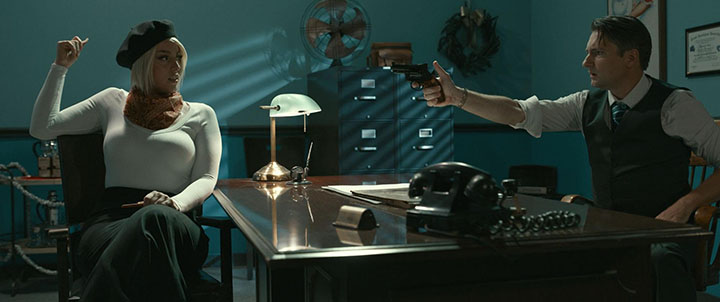
Taking place on Christmas Eve, 1942, in Chicago, Blue Christmas focuses on a private eye named Richard Stone, who is visited by the ghost of his late partner on the 1-year anniversary of his murder. Through the guidance of three visiting spirits, Stone is forced to visit his past, present and future to finally find his partner’s killer, as well as redemption for himself.

The film was written and directed by Muscatine novelist Max Allan Collins and stars Iowa actor Rob Merritt; Alisabeth Von Presley, who some may recognize from her time on America’s Got Talent; and Chris Causey. Chad Bishop helped produce and edit the film while Phillip W. Dingeldein served as the director of photography.

Collins described the film’s story as a mash-up of The Maltese Falcon and A Christmas Carol.

“They’re two of my favorite movies and two of my favorite novels, and I just saw a way to kind of do them both at the same time… So the material will be familiar to people, and it’s material that really resonates with people because it’s about a person who becomes better by the end of the story,” he said.

Although Collins is best known for his books and comics, this is far from the only time that he has worked in film. Throughout the ’90s and early 2000s, Collins had the opportunity to work on several independent film productions. After he was unable to get a sequel to the film adaptation of Road to Perdition, however, Collins shifted focus back towards his writing and left the film scene.

Then, in 2022, during the production of Encore for Murder, a Mike Hammer radio play that was performed live before then receiving a video recording, Collins was inspired to try doing film again, he said.

“(Encore for Murder) got me thinking about getting back into doing an indie film after about a decade and a half away from doing them,” he said. “I really do enjoy doing films because I enjoy the collaborative nature of it. Being able to bring talented people together is very rewarding, and it’s very different from the sort of solitary endeavor that writing a novel is.”

Reflecting on the production, which was filmed in October 2023 over the course of only six days, Collins had much praise to give the film’s cast and crew. He also thanked Naomi DeWinter and Muscatine Community College for its support in letting the production use its Black Box Theatre for nearly all of its filming.

“It was very much a Muscatine/Quad Cities affair,” Collins said. “I’m really proud of what we were able to do with it – and, boy, does it look good on the big screen.”

Tickets can be purchased on the Fridley Theatres website at https://www.fridleytheatres.com/movie/Muscatine-Palms10/BLUE-CHRISTMAS#.

For those who are unable to make it to these one-time showings, Collins said Fridley Theatres, the chain that owns Muscatine Palms 10, has shown interest in showing the film at each of its Iowa and Nebraska theatres during the 2024 holiday season.

“That’s something we’re really excited about,” Collins said.

You can read the article with photos here, at least for the present.

* * *

Our Cedar Rapids premiere (with Cedar Rapids-area stars Rob Merritt and Alisabeth Von Presley present, as well as me and Chad and various cast members) will be March 13. The house is already half sold out. Tickets can be ordered here.

Our final premiere will be at the Last Picture House in Davenport, thanks to our friends Beck and Woods (creators of A Quiet Place). Here’s where you can buy advance tickets for the Friday, March 22, event.

We are also an official selection in the Cedar Rapids Independent Film Festival, with a 9 a.m. screening and a 1:05 p.m. screening on April 6. Barb and I will be attending the latter screening.

* * *

For any birthday past 70, my late grandfather Ray Rushing used to answer questions about his age this way: “Over seventy, damnit!”

I know the feeling.

On March 3, yesterday as I write this, I turned 76 and the only thing that’s good about is that I’m not dead. There’s so much left to do and I’m going to try to do it. As Barb says, “Just keep on keepin’ on.”

That may explain why I did Blue Christmas at this ripe old age and have another indie film on the docket for later this year. More about that later. For now I have on my plate a final Heller, more Antiques novels with Barb (we were just offered a two-book contract from Severn), the final Mike Hammer novel for Titan, and a very exciting project that I’ve pitched (apparently successfully, but it’s early days) that I won’t be able to share with you until it’s signed, sealed and delivered. This year’s Quarry novel (Quarry’s Blood) may be the last, as well. Kind of feels like I’m wrapping things up, but there’s still a lot going on – one last indie movie after Blue Christmas, for example. And a Nate Heller series adapting True Detective (True Noir: The Nathan Heller Casebooks) and perhaps other of the novels as fully produced multi-part podcast. This involves my pals Robert Meyer Burnett, Mike Bawden and Phil Dingeldein.

My health seems to be relatively good, though I have a bad day now and then (one was on my birthday itself) that indicates I have to pace myself better if I want to stick around for a few more years.

On my birthday we went to Dune Part Two and I really didn’t care for it. Neither did Barb. Son Nathan, a science fiction fan, liked it more but termed it “slow and unpleasant.” We had all liked Part One, and the advanced praise for Part Two from a bunch of people whose opinions I trust make me question my own judgment. I found the film tedious in the desert sequences and over-the-top in the bad guy portions with two risible villains – the usually reliable Stellan Skarsgård (the Broker in the Quarry pilot!) and least-scary-sociopath-ever, Elvis actor Austin Butler, as well as Christopher Walken as the evil emperor or something, a particularly misguided choice.

Dune Part Two

But Barb and I seem to be alone on this. The best I can say for it is that the lead, Timothée Chalamet, did a creditable job. Best supporting players? The giant worms.

I love science fiction and fantasy movies and TV, particularly Star Trek (I am a stubborn Star Trek The Motion Picture apologist) and the first two Star Wars films, and Forbidden Planet and Outer Limits and on and on. But I’ve always found s-f novels, most of them anyway, clunky with prose worthy of the side of a paint can (Ray Bradbury and Richard Matheson excluded). I truly believe this to be my problem, because too many smart people love the stuff, and I was a shit science student. But man I love me some Kirk and Spock and Bones.

Here’s the thing. Feel free to love Dune Part Two. Too many smart people like it for me to be right about this for anybody but myself. The narrative arts (actually a lot of art in general) is the receptor plus the deliverer. Novels and short stories, and movies too, are inherently collaborative – the audience member plus the artist. I like to say, when somebody dislikes a book of mine, fair dinkum (as the Aussies put it) – sometimes I present my shows on Broadway, other times at the Podunk Playhouse.

In other words, your mileage may vary.

Certainly people who dislike my work are not wrong (though I prefer to think of them as misguided). I get complaints from readers (and reviewers) who think I go into too much detail about clothing and setting, when my approach is otherwise fairly spare. It confuses some readers and irritates others.

My frequent collaborator Matt Clemens always says something to the effect of, “Max doesn’t like to have his characters run around naked, unless they’re naked.”

Ironically, this has to do with my twin enthusiasms for prose fiction and motion pictures. From a very, very, I might say VERY, early age I sought out the books (prose novels and comic books) that movies I liked had been based upon. And I would admit, if pressed (and you’re pressing me now, aren’t you?), that the works I most admire tend to be movies. I probably like Chinatown better than Hammett and Chandler, and boy do I like Hammett and Chandler. I probably like the film Kiss Me Deadly more than Mickey’s actual Mike Hammer novels (maybe excluding One Lonely Night, Spillane at his most vivid and crazed).

So on some level I am trying to make prose fiction that plays like a movie in your mind. I may or may not be successful at that, but that’s the attempt, anyway.

Going back to Dune Part Two, the smartest response I’ve seen to it comes from people who love Frank Herbert’s novel and find the film a sort of visual adjunct to that work as opposed to a cinematic version of it.

But what do I know? If I tell you I liked the David Lynch Dune much more, would you have me locked up? Maybe in the cubicle next to David Lynch?

M.A.C.