Posts Tagged ‘Appearances’

Bam! Pow! Zap!

Tuesday, July 20th, 2021

To Live and Spy in Berlin received a nice boost from BookBub. The new release price is $3.99 for the e-book; it’s $14.99 for the “real” book.

And on Wednesday the San Diego virtual Comic Con link with my panel with the great Andrew Sumner of Titan will be available. The discussion includes the upcoming Titan Ms. Tree third volume, the Nolan reprints from Hard Case Crime, and the Mike Hammer 75th anniversary publications from various publishers…and more.

The trade paperback edition of Eliot Ness and the Mad Butcher, the non-fiction work by A. Brad Schwartz and myself, is available now. It has a slightly different, tighter subtitle, at my urging: Hunting a Serial Killer at the Dawn of Modern Criminology. The info is here.

It looks like both Mommy and Mommy 2: Mommy’s Day are available for streaming on Roku.

Getting back to Live and Spy in Berlin, the indefatigable J. Kingston Pierce at the definitive mystery fiction web site The Rap Sheet said the following about John Sand:

I read and enjoyed both Come Spy With Me and Live Fast, Spy Hard, Max Allan Collins and Matthew V. Clemens’ initial two John Sand espionage novels, though I haven’t yet had a chance to write about them. And now the pressure to do so is even greater: Collins writes in his blog that the series’ third installment, To Live and Spy in Berlin, is due out on July 14, from Wolfpack. That makes three fast-paced, James Bond-ish adventures published in just nine months! No wonder I can’t keep up. “Will there be more John Sand books?” Collins asks. “That’s up to you. We have left something of an incredible effing cliffhanger [in book three] that needs resolving, so it’s on your conscience not ours if sales don’t justify that resolution.”
* * *

Barb and I took in Black Widow this weekend and I’m happy to report it’s a good film. It concentrates on espionage and action/adventure, and character interaction, particularly between Black Widow and her sister, well-portrayed by Scarlett Johansson and a scene-stealing Florence Pugh. There’s a surprising amount of humor and the Marvel-style, sometimes wearying action sequences don’t really get out of hand till the last half hour.

I could not help, in watching Black Widow, but flash onto a complaint a reviewer had recently about To Live and Spy in Berlin, specifically that John Sand was not a realistic character but rather a “cartoon.” While I would prefer the more exact “comic strip character,” I don’t argue with that designation.

Ever since I began also being a writer of comics, my novel writing has frequently been the target of reviewers who (rather lazily I think) remind potential book readers that I am a lowly comics writer. This has happened less post-Road to Perdition, which was a key component of the new attitude toward comics, i.e., graphic novels.

But I used to have reviewers who would look at, say, Nate Heller and write, “Bam! Pow! Zap!” in regard to my prose writing – sometimes in a kidding way, others in a more dismissive manner. The idea that anyone would look at Nate Heller and think “comics character” is absurd, but these reviewers knew I was writing the Dick Tracy strip and took a predictable cheap shot.

I think generally – and again, Road to Perdition played a role in changing attitudes in and about the field – readers mostly now understand that the comics form accommodates everything from over-the-top superhero to grimly realistic real life and everything that falls between. It’s a storytelling form with as many, actually more, capabilities than most others.

When the comics label on a writer is used, however, it’s almost always disparaging – meaning the writer is producing kid’s stuff or ridiculously over-melodramatic junk.

So is John Sand a comic strip character in the sense that his adventures are unrealistic and run to outrageous melodrama? I would say yes to that. And it’s intentional. But that does not mean (as a few detractors of the series say) the John Sand novels are spoofs. I’m getting a bit tired of having to say this, but Austin Powers, Derek Flynt and Dean Martin’s Matt Helm are spoofs. John Sand is an homage to Fleming’s Bond (and the early Bond films) and something of a pastiche with a dollop of my historical fiction approach. Bond, by the way, was in addition to novels a long-running comic strip signed by Fleming and pre-dating the films (Connery cast, in part, because he resembled the James Bond of the UK comic strip).
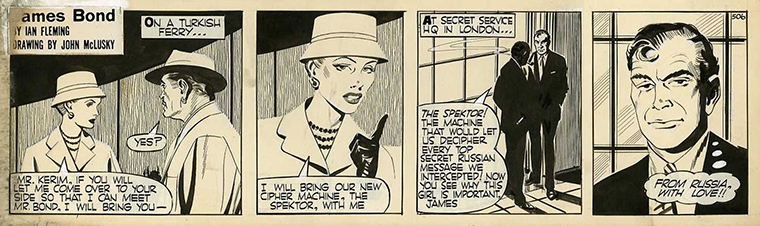
James Bond UK Comic Strip

The problem I run into – and those of you who drop by here frequently are aware of this – is the reader who likes one or two of the series (or one-shot novels) I write, and is confused, irritated or even angered by others. Of course, sometimes it’s easy to tell which Max Allan Collins is performing today – no one is likely to confuse Antiques Fire Sale with Killing Quarry or G.I. Joe with Nate Heller in Better Dead.

On the other hand, most – actually, much – of what I write is melodrama. Kitchen-sink realism interests me not a whit. My technique, which may or may not always be successful, is to layer a believable, even realistic surface on a story that is larger than life (“over the top,” in the view of detractors). That’s common to Antiques Fire Sale and Killing Quarry. No apologies.

I realize it can be confusing. Mike Hammer is more in the vein of John Sand (not surprisingly, since Bond was a British take on Hammer, largely) but would seem to be more along the lines of Quarry or Nate Heller. But my responsibility is to do the best job I can whichever road I go down on a given project.

And I am a professional writer. This is how I make my living, how I keep the lights on around this joint. This means I write for various markets and even multiple audiences. I admit it’s a frustration when a reader gets mad because, say, Girl Can’t Help It features people-next-door protagonists in a small-town setting. That’s actually a pretty good example – I do run into Antiques readers who love the Girl books, but would likely be appalled by Quarry.

Another aspect of course is the need for me to stay engaged. When I come to Quarry or Nate Heller after doing books that aren’t about them, I do so with renewed energy and interest. Robert B. Parker and I started out about the same time. You may have noticed he did just a bit better than I did in the world of publishing. But had one of my early series taken off – Nolan or Quarry specifically – I might have spent the bulk of my career writing chiefly about one of them…and going quietly nuts. Rich, but nuts.

I like that I have created a bunch of things, written over 100 books about a bunch of different protagonists in different settings and even eras.

Here’s an example of my approach, and it will demonstrate why some readers embrace my work and others don’t like it at all. The Caleb York books grow out of an unproduced screenplay Mickey Spillane wrote for John Wayne in the 1950s. When I was asked to write a series about York, I decided to approach it (and the first book, The Legend of Caleb York, a novelization of Mickey’s screenplay) as if I were doing a 1950s western movie that might have starred Randolph Scott or Audie Murphy.

In other words, the Hollywood Myth of the West, which had little to do with the actual Old West. I did this unashamedly and with a certain amount of delight. But at the same time, the world Caleb and his cast are plopped down in is a rather realistic one, with a lot of research brought to bear. York will shoot it out in the kind of Main Street gunfight that almost never really happened, but if he goes into a hardware store in the 1880s, by God it will be an 1880s hardware store. A bad guy right out of High Noon will have his roots in Quantrill’s Raiders. It’s a mix.

It’s trying to provide a recognizable realistic surface and undercarriage to a tale that is mythic, larger-than-life.

One of the things I try to do here is let you know what I’m up to with whatever my latest book is. I think I’ve made it clear than To Live and Spy in Berlin is neither Austin Powers nor John le Carré. Matt Clemens and I knew damn well we were over the top. But we did it with a twinkle in our eye but, while we were in the middle of the writing, a conviction in the reality of our fairy tale world.

* * *

The Wild Dog controversy raged on for a week but has cooled somewhat. I have nothing more to say about it, right now anyway.

However, one earnest soul reminded everyone that I had killed Moon Maid almost right out of the gate when I took over the writing of the Dick Tracy comic strip in 1977. This point was made, apparently, to show I had little respect for what had gone before. The Earnest Soul asked, “What did Chester Gould think?”

Well, here’s the thing. Chester Gould was still signing the strip with me and his assistant Rick Fletcher. Chet was consulting on a regular basis and knew, and understood, that the Tribune Syndicate wanted us to remove all remnants of the moon era from Dick Tracy. He had already dumped most of it himself.

So what did Chester Gould think? He may have been reluctant, but he went along. And, as I say, put his name on the strip…above mine.

* * *

Here’s a nice write-up about To Live and Spy in Berlin from our pal Sean Leary at quadcities.com.

M.A.C.

Don’t Bug Me, Baby

Tuesday, July 6th, 2021
Crusin' at Proof Social 2021
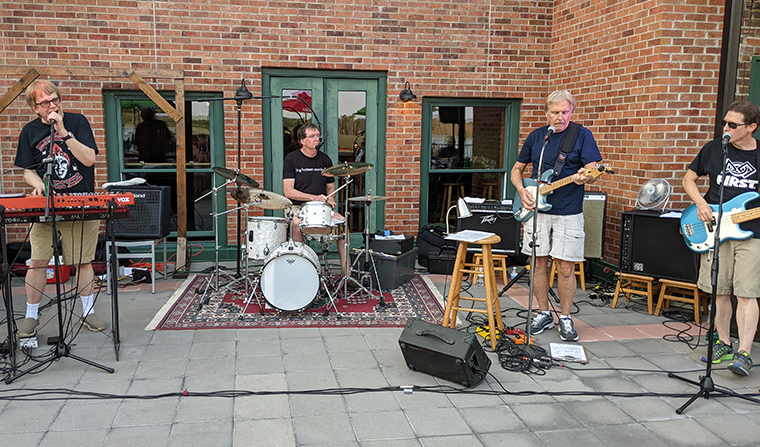
Crusin’ at Proof Social, l to r, M.A.C., Steve Kundel, Bill Anson, Scott Anson

The gig Saturday, July 3, at Proof Social in Muscatine went very well, especially considering it had been two years since Crusin’s last outing.

This was the first public performance with bass player Scott Anson (our guitar player Bill’s son). Scott filled in for Brian Van Winkle at the last performance – a private function in 2019 – before Covid sidelined us and everybody. He is a terrific bass player and a real asset to the band. Of course, it was bittersweet without Brian, whose premature, unexpected passing remains hard to accept.

We had a number of my fellow classmates of ‘66 Muscatine High School grads who came out for a kind of unofficial 55th reunion. But the performance on the patio outside the club (the same patio where we performed a number of times in past years for the Second Sunday concert series) enjoyed both nice weather and a standing room only crowd reflecting a broad demographic. My old pal from early Crusin’ days, Charlie Koenigsaecker, brought a group down from Iowa City. Charlie ran sound for us for back in the day and is a popular dj with great taste in addition to working at the Iowa City Library.

Another old friend, Doug Kreiger, came up to me and – once we’d kidded each other for a while – thanked me quite sincerely for all the music and stories I’d shared with my hometown (and beyond) over the years. It was a nice moment and an unexpected expression of sentiment.

I do find myself reflecting on all the years of music, knowing that the road ahead is limited in that regard whereas storytelling is less so. The loading in and out – as I mentioned last time – is so onerous that it calls into question whether or not it’s worth the effort. The day after, as I write this, I feel like I was hit by a truck. That was always the case after a band job, for the last three decades anyway, but now it feels like a bigger truck.

Gigs are unpredictable, always, and after a nice evening with weather cooperating, darkness fell and bugs attracted to the lights illuminating the band swarmed us, like Pappy Yokum getting assaulted by hordes of locusts as he tried to protect the turnip crop. These were tiny bugs, unidentifiable but similar to gnats, though they weren’t biting, just turning my keyboards into a gummy, sticky runway and clinging to my exposed flesh the same way. This didn’t happen till the last set, toward the end, and we limped through fifteen minutes of absolute insect invasion…and toward the end the notorious “fish bugs” joined the assault. They tell me fish bugs have only a 34-hour life span, and that’s way too long.

I’ve played in bands since 1965, frequently out of doors, and never had this happen before. And today I spent an hour cleaning the two keyboards of crushed bug carcasses, also a new experience.

Did God send the little devils to tell me I’d been doing this long enough?

* * *

On our recent trip to Minnesota for a family reunion, which centered around the graveside service of Barb’s mom, Barb and I went to a movie in Minneapolis. And I think I may be seriously out of step. I felt the same way this evening when I watched a movie on HBO Max.

In Minneapolis, we went to F9, as it’s being called, and it’s an appropriate title if “F” stands for what it should. I am easy to please with dumb action movies, and have seen every Fast and Furious movie in a theater and had fun. This one is sloppy and stupid, lacking both the Rock and Jason Stratham, but it did mark Barb and me officially getting back in the moviegoing swing – by walking out.

I didn’t walk out on director Steven Soderbergh’s No Sudden Move, with a cast so star-studded Matt Damon didn’t bother with getting a billing. But the only reason I didn’t walk out was because I was home. It’s a mess, incomprehensible and pretentious and frequently shot with distorting lenses that call attention to themselves. The great Don Cheadle spends the running time looking like he wished somebody had shown him the script. But the critics love it, so I am probably wrong.

F9 puts me out of step with the public and No Sudden Move puts me out of step with the critics. I’ve got all the bases covered!

* * *

Here’s a great review of Two for the Money (mostly about Bait Money but also the Nolan series in general).

And here’s a spiffy review of both novels collected in Double Down (Fly Paper and Hush Money).

Finally, here’s another Two for the Money review, generally not bad, but apparently the 22 year-old me in the early ‘70s was supposed to have better attitudes than “cringingly archaic” ones about women’s looks and tough guy prowess. You’d think I’d been writing a paperback crime novel with an early ‘70s mostly male readership in mind.

M.A.C.

Caleb York Rides…One Last Time?

Tuesday, April 27th, 2021

Hardcover: Indiebound Bookshop.org Amazon Books-A-Million (BAM) Barnes & Noble (B&N) Powell's
E-Book: Amazon Google Play Kobo iTunes
Digital Audiobook: Libro.fm Amazon Google Play Kobo Chirp

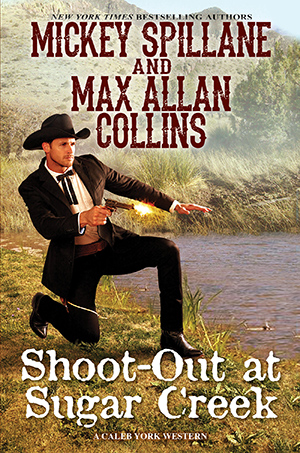
Today the sixth – and, for now at least, final – Caleb York western, Shoot-Out at Sugar Creek, goes on sale. Those of you who won advanced copies are now free to review it. It’s a hardcover. The previous Caleb York, Hot Lead, Cold Justice, is out simultaneously in mass market paperback.

I usually just provide a link, but this review from that first-rate writer Ron Fortier at his Pulp Fiction Review blog is too good not to share.

Here it is, and thank you, Ron:

SHOOT-OUT AT SUGAR CREEK
A Caleb York Western
By Mickey Spillane & Max Allan Collins
Kensington Books

The sixth chapter in the Caleb York series picks where the fifth ended, with the people of Trinidad New Mexico dealing with the aftermath of the worst winter recorded in the west. Many of the local ranchers, having lost most of their stock, have packed up and left the territory, while Willa Cullen, owner of the big Bar-O, is struggling with a decimated herd and a lack of clean running water to support them. The only unfouled source is Sugar Creek which sits on neighboring Circle G land.

As the story opens, the once abandoned ranch is bought by a beautiful widow named Victoria Hammond, who entertains grandiose plans to become the richest, most powerful figure in the county. Events get off on less than desirable footing when Sheriff Caleb York is forced to shoot and kill Victoria’s youngest of three sons for raping and savagely beating a local working girl. Upon meeting the woman to respectfully report the circumstances of the shooting, York discovers that she has no intentions of allowing any other ranchers access to Sugar Creek. She is also planning on buying out Willa for pennies on the dollar. No stranger to past range wars, York finds himself in the precarious role of peace-keeper, between the woman he loves and the ambitious widow Hammond.

Along about this time, we found ourselves musing over Collins’ ingenuous plot with its echoes of a several classic television settings. Thus far the adventures of Caleb York and Trinidad have seemed much like Matt Dillon in the popular Gunsmoke series. Whereas with this book, he offers up a dark-mirror image of another well known oater, The Big Valley; what with Victoria Barclay (note the same first name) and her three boys. That the two, York and Victoria Hammond are on a collision course is obvious from their first scene together. Then, in his usual masterful touch, Collins ups the ante and violence erupts quickly towards the tale’s second half leaving blisters on our fingers. We simply could not put it down. The end was so Mickey Spillane, it was eerie.

We’ve enjoyed all the Caleb York books but this one clearly stands out as a high mark. Nobody spins a yarn like Max Collins. Nobody.

As for why this is the last Caleb York, at least for a while, it’s simple: Kensington didn’t ask for any more. I have strong interest, however, from Wolfpack, who have (obviously) been incredibly supportive of my work of late, and they are a top publisher of westerns. So Caleb may saddle up there in the (as Mystery Science Theater puts it) not too distant future.

Well, somewhat distant, because I am booked up for the rest of the year and into the next. Ironically, a lot of this has to do with getting ready for the 75th anniversary of Mike Hammer next year. This includes a new Hammer novel, developed from an unpublished Spillane manuscript, and I haven’t started that yet. Very much under way is a biography of Mickey for Mysterious Press, which Jim Traylor and I are doing. I’m also considering an expanded version of my documentary, Mike Hammer’s Mickey Spillane, if I can work it in. Also on the docket is a possible non-Hammer novel based on an unproduced Spillane screenplay, which I may do for Wolfpack – still in the talking stages, but….

In addition, I have an Antiques novel to co-write and a Nate Heller(although that will slop over somewhat into next year). And currently I’m doing the third John Sand novel with Matt Clemens – working from his draft, I’m half-way through mine. It’s called To Live and Spy in Berlin.

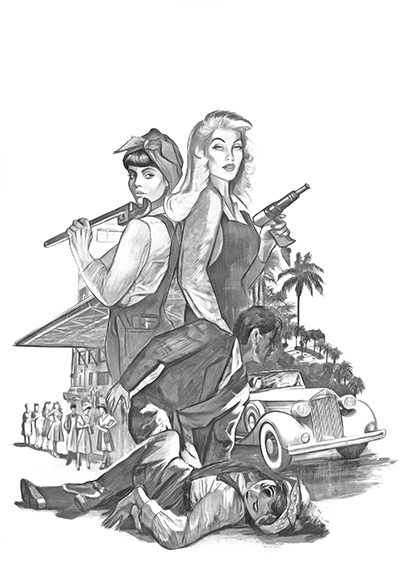
Besides all this, I’m involved with getting my ‘40s female PI Fancy Anders out to the reading public. She will appear in three novellas: Fancy Anders Goes to War; Fancy Anders For the Boys; and Fancy Anders Goes Hollywood. These are written. When they are collected into book form, I intend to title it Meet Fancy Anders. These are for Neo-Text, who will be bringing them out initially as e-books.

Neo-Text will also be doing e-books of the three-part serialized The Many Lives of Jimmy Leighton by Dave Thomas and me. That will be the title of the eventual collected edition. I’m pleased to announce that the incredible Howard Chaykin will be illustrating Jimmy Leighton.

As I’ve mentioned here before, artist Fay Dalton, a fantastic talent, is doing the illos for Fancy Anders. She’ll be doing cover illos as well as one illustration per chapter (numbering 10 per novella, not counting covers). Some will be in color, a few in black-and-white or partial color for a noir effect. We have not seen Howard’s work on Jimmy yet, but I know it will be outstanding. This is not comics, or graphic novels, rather prose novels that include a good amount of strong artwork, perhaps invoking the classic magazine illustration of the ‘30s through the ‘50s.

To give you the first look at Fancy, I’ve included one of her roughs, which I predict will knock your eyes out and your socks off. I am incredibly excited about both of these Neo-Text projects. They are at once typical of my work even as each charts a new course.

Cover sketch for Fancy Anders Goes to War

* * *

There was a bit of fuss last week over my stating that if a winner in a book giveaway here didn’t like that book, the responsibility to review the book could be considered optional.

A bait and switch went on to some degree, because the complaining parties seemed not to be winners in the book giveaways, but actual paying customers…and of course an actual paying customer can dislike a book and say so in an Amazon review with my (grudging) blessing.

But this seemed to be really about those who don’t like my complaining (which I did) about self-professed “big fans” advising other big fans not to read the book – scaring off other paying customers. No law against that, but I don’t think they understand the concept of Amazon reviews. When you write a review for Amazon, or Barnes & Noble or Goodreads, you are not a professional reviewer with the status and credibility of a critic in, say, Entertainment Weekly or for that matter The New York Times. You’re just a reader expressing an opinion. Which is fine. But the public forum you’re in does carry weight, and particularly at Amazon with its averaging of reviews, its reliance on the number of reviews, and policy of showing a “top” negative review.

I went into some detail about this in the comments last week, and so did people on both sides of this fence, and you may wish to check that out.

* * *

This is a long, freewheeling interview (audio only) with my buddy Andrew Sumner, one of my favorite people on the planet.

M.A.C.

Book Give-Away, Noir Alley Clips, and a Current Interview

Tuesday, February 2nd, 2021
Max Allan Collins holding up a trade paperback of Reincarnal & Other Dark Tales

This week we have fifteen copies of the beautiful Wolfpack trade paperback edition of Reincarnal & Other Dark Tales to give away. I’ve written about this book here before, but I only now have physical copies in hand.

[All copies have been claimed. Thank you for your support! New updates are posted every Tuesday at 9 Central. — Nate]

If you miss out on the giveaway, I hope you’ll order it anyway, either on Kindle or this very cool trade paperback, which is a rather massive 330-some pages. It collects virtually all of my horror short stories, including two radio plays written for Fangoria’s Dreadtime Stories.

Be forewarned (or enticed, as the case may be) that many of the stories in Reincarnal (as the title may indicate) have a strong sexual element. This has to do with many of them originally having been published in erotic horror anthologies, back in the day when such stalwarts as Marty Greenberg, Jeff Gelb and Ed Gorman were turning out wonderful “theme” anthologies of original stories.

As I said here before, horror is a strong element of my fiction – you can see it in the Mommy novels (available from Wolfpack), many of the Quarry novels (The Wrong Quarry), a number of Hellers (Angel in Black), Eliot Ness (Butcher’s Dozen) and novels by Barb and me (Regeneration). Even the recent non-fiction work, Eliot Ness and the Mad Butcher (by A. Brad Schwartz and myself) qualifies as horror-tinged. The only horror tales not collected in Reincarnal can be found in the Wolfpack collections Murderlized (gathering collaborative stories by Matt Clemens and me), Blue Christmas (holiday horror and dark suspense), and Murder – His and Hers (stories by Barb and me).

While I am first and foremost a novelist, I do enjoy writing short stories and it’s long been an ambition to see collections of my shorter fiction, like Reincarnal, give those stories a certain permanence.

* * *

If you missed my second guest shot with Eddie Muller on Noir Alley, here is the intro and the outro for Born to Kill, a great crime movie you should see (the TCM streaming service has it right now).

* * *

Publisher’s Weekly has a great article by Lenny Picker about Hard Case Crime. I can’t share it with you, because PW requires you to subscribe for the link to go through.

I was interviewed for the PW article on HCC, and a grand total of one paragraph was used (in part) in that article. So, since that interview is very up-to-date as to what I’m up to, I’ll share it here:

What led you to have some of your books published by Hard Case Crime? In other words, what makes a Collins book a better fit for HCC?

When editor/publisher Charles Ardai began Hard Case Crime, he featured a number of reprints among the originals, from the classic likes of Erle Stanley Gardner and Lawrence Block. He approached me about reprinting the second Nolan novel, Blood Money, and I suggested he reprint both it and the first in the series, Bait Money, under one cover, which he did, as Two for the Money. Later he approached me about doing another reprint and I offered instead to write an original. It was obvious to me Charles and his partner Max Phillips had a love and feel for classic hardboiled fiction and represented a home for what I most like to write in a market not terribly conducive to that.

Another fact was the retro packaging, the covers that were not only fully illustrative in the fashion of ’50s and ’60s paperback suspense novels, but depicted beautiful femme fatales and handsome tough guys, in a fashion that had become essentially forbidden due to politically correct restraints at other publishers. HCC has a way of saying, “We’re retro, not Neanderthals. We have our tongue slightly in cheek as we celebrate a form of American mystery fiction pioneered by such greats as Raymond Chandler and Dashiell Hammett.”

What makes them different from other publishers/imprints?

They go their own way and are motivated by a love for the noir genre, taking risks with new talent and respect older talent. Charles Ardai encourages me to write what I want to write. I’m at a point in my career and, frankly, at an age where being able to write what I want means more than financial considerations, an approach that can pay off better than a more market-driven, cynical one.

For example, the first original I did for HCC was a return to my Quarry series, which had become a cult favorite after its initial four-book run in the mid-’70s and a one-shot comeback ten years later. I’d always wanted to complete the series and The Last Quarry was intended to be the final book about my hitman character…the first contract killer to “star” in a book series. The Last Quarry was popular and widely well-reviewed. Charles said, “Too bad you’ve written the last book in the series.” And I said, “How about I write, The First Quarry?” Since then another dozen or so have followed. An award-winning short film I wrote led to a Quarry feature film (The Last Lullaby), and a few years ago HBO/Cinemax did a Quarry TV series.

What led you to revive Nolan last month?

Charles has been after me to do that dating back to Two for the Money. I resisted, feeling my novel Spree was the proper ending to the series. But he said he’d bring the early books back out if I did a coda to the series, which I have — the current Skim Deep. Now I’m writing a coda to The Last Quarry called Quarry’s Blood. My hitman is 68 years old in the novel, which is younger than me.

How hard was it to return to the character after so many years?

Not at all. I spent almost two years, when I was at the University of Iowa Writers Workshop in the late ’60s, writing that novel. My instructor was Richard Yates, the great mainstream novelist. I also studied with Walter Tevis, whose reputation is getting a boost from The Queen’s Gambit mini-series. So I spent a lot of time with Nolan and his young sidekick Jon, and then there were the other six novels and several versions of a Nolan screenplay I wrote a while back…unproduced as yet, but it got optioned. A movie is brewing now combining elements of several of the novels.

How was writing him different?

He was an old man of 48 when I conceived him at age 20. Now he’s 55 and really something of an old man, so my perspective on him has shifted.

Are there other characters that you’re planning on reviving?

I get requests to do another Mallory, but that character was based on me, which doesn’t interest me. My recent Krista Larson series I hope to keep going, and when the political world settles down, if it ever does, I might do another Reeder & Rogers novel with Matt Clemens, who I’m writing the James Bond-ish “John Sand” novels with now for Wolfpack. My wife Barb and I are continuing the long-running Antiques series we write together as Barbara Allan, with Severn now.

The biggest thing will be taking Nathan Heller to HCC. I consider the Heller novels – which as you know are traditional tough private eye novels dealing with major crimes of the Twentieth Century – my best work, my signature work. But I don’t spend all my time looking backward. I’m working on two projects for Neo-Text, one a ’40s female private eye, Fancy Anders, who solves mysteries involving an aircraft plant, a movie studio, and the Hollywood Canteen. The other is a science-fiction-tinged noir collaborating with SCTV star Dave Thomas, who was a writer/producer on Blacklist and Bones, for which I wrote a tie-in novel.

I should note that HCC has been a supporter of my work building up the legacy of my friend and mentor, Mickey Spillane. We’ve done several books at HCC, and something like fourteen Mike Hammer novels at HCC’s parent company, Titan. These all reflect my completing unfinished manuscripts from Mickey’s files, something he asked me to do shortly before his passing in 2006. Next year is the 75th anniversary of Mike Hammer, and I’ll be doing a biography of him with James Traylor for Otto Penzler at Mysterious Press. It’s people like Charles and Otto who nurture and keep the hardboiled genre alive in the face of changing times.

What would you most want article readers to know about HCC?

HCC is a boutique publisher that cares about books, readers, and authors. I am extremely grateful to them for letting pursue my work my way.

* * *

A reader in this You Tube piece recommends five HCC titles to represent that publisher’s output, and The First Quarry is one of them!

And, finally, this fantastic review from the UK of the current Mike Hammer, Masquerade for Murder.

M.A.C.