Archive for the ‘Uncategorized’ Category

Damn Fool Crusader, Dick Tracy, Wayne Dundee R.I.P.

Tuesday, June 10th, 2025

Through my dalliances with YouTube, I’ve been able to connect with some interesting people, who have become my friends or at least friendly acquaintances. I spend a little more time watching YouTube than I should, because my wife Barb and I almost always watch a movie in the evening, and sometimes my son Nate comes over (after he helps his wife Abby get his two kids to bed) (Sam and Lucy), making it a double feature. My beddy-bye time is, roughly, midnight and I sometimes have an hour or so to fill before closing out my day. The morsels of entertainment I encounter on YouTube are fun, often informative and, usually, not demanding.

This past week I did a commentary with Heath Holland of the respected Cereal at Midnight on the Chinatown sequel, The Two Jakes, which is one of my favorite movies but not a terribly well-regarded film. It was my opportunity to defend the film and explain myself. This commentary was for the upcoming 4K Blu-ray to be released by Kino Lorber.

Heath is a knowledgeable pop culture expert with an emphasis on film and music, as well as a winning presence on Cereal at Midnight, which appears sporadically but frequently on YouTube. We’ve done several movie commentaries together for Kino, and have several more to do. He’s a pleasure to work with.

I of course have a great creative relationship and friendship with Robert Meyer Burnett. Here’s him talking about our collaboration, True Noir: The Assassination of Anton Cermak, as a guest on a YouTube show dating back a few months (we hadn’t announced Michael Rosenbaum as our Nate Heller yet). The passion, talent and skill that director Rob Meyer Burnett brings to True Noir: The Assassination of Anton Cermak is on full display in this interview (done while we were stilling working on the True Detective adaptation – available at truenoir.co). (Not “com” – “co”!)

More recently I connected with one of the most unique presences on YouTube, Spencer Draper, who calls himself The Damn Fool Idealistic Crusader. He discusses pop culture with an emphasis on genre movies (and books), but has become known, well outside YouTube circles, as a watchdog for flaws on DVDs, Blu-rays and 4K discs. He points out mastering problems and particularly hones in on audio blunders. He is focused, relentless and very, very smart.

I reached out to him to inquire about his experiences on the Warner Bros “DVD rot” problem, which has to do with a batch of 2007-2008 DVDs that are out there rotting even as we speak. He’s been key in alerting collectors and a sometimes (sometimes) cooperative Warner Bros customer service about the problem, and the need – moral responsibility for – replacing defective discs.

There’s a spooky aspect to the contact between Spencer and me. I’ve never gotten in touch with him before, and I don’t believe he’s ever covered anything of mine on his YouTube offerings. I had no reason to think I was on his radar.

But it turns out he was, at that moment, doing a deep dive into my involvement with the Dick Tracy movie, studying my novelization and doing his general thorough digging job. We have now corresponded several times and the experience has been pleasant, even if the Warner Bros aspect hasn’t been. (I am definitely not talking about Warner Archive!)

For Spencer, and for those of you who are new here (even relatively so), I am reprinting an article about how I intersected with the Dick Tracy movie, Warren Beatty’s people, and the Good Folks at Disney. It’s an excerpt from an article I wrote for Lee Goldberg’s Tied In – The Business, History and Craft of Media Tie-In Writing. It is the behind-the-scenes amusing and horrifying story of my writing of the movie tie-in novelization of Dick Tracy.

I wanted to write the Dick Tracy tie-in novel because I’d been the writer of the syndicated strip since 1977, plus I was a mystery novelist. Landing the Dick Tracy strip was my first really big career break. I got the job after trying out for it, writing a sample continuity. I got the opportunity to try out chiefly because of some mystery novels I’d written as a kid that had a strong comics element (Bait Money and Blood Money, both 1973).

My re-boot of the strip got a lot of positive attention, and I loved the job, having been a stone Dick Tracy fanatic since childhood. Before getting the strip, I had even developed a friendship with creator Chester Gould – a rarity, because he was very private – although Chet played no role in my landing this plum assignment.

Some time in the ’80s, I was shown a potential screenplay for Dick Tracy, shared with me by my Chicago Tribune Syndicate editor. I thought it was lousy, and told him so, and he agreed. I figured that was the end of it.

But the Dick Tracy film was a project that wouldn’t die – Clint Eastwood was going to be the square-jawed dick for a while, which was exciting, and then finally Warren Beatty got obsessed with it, and it became a Disney project and a very big deal. I offered to do the novel version and, thanks to my credentials as the writer of the strip, got the gig. I was thrilled.

Then they sent me the screenplay – it was virtually the same lousy one I’d read seven or eight years before! I was shocked and dismayed. Lots of the classic characters, villains and good guys alike, some good situations…but no story. Not really.

I asked my agent what to do about it, wondering what kind of novel I could fashion from such weak material, and he said, “Just do whatever you want with it. Nobody’s going to read it at Disney – this is just small change to them.” Did I mention that my usually very savvy agent had never sold a tie-in before? And that this was the worst advice he ever gave me?

So I wrote a novel very loosely based on the screenplay. I added more characters from the strip, provided a story, even replaced what seemed to me to be unimaginative death traps with my own better ones. It was a terrific little novel, designed by and for a Dick Tracy fan like me.

I sent it in, went on about my business, and several months later my wife Barb and I were preparing to go on a research trip to Nassau (for my Nate Heller novel Carnal Hours) when my agent called with bad news. The Disney people hadn’t even made it through my book – got maybe a third of the way – before saying a faithful-to-the-screenplay page one rewrite was needed.

In seven days.

Dick Tracy is legendarily a movie that Warren Beatty micro-managed. Every tie-in aspect was overseen by Beatty and his top people. The novel I’d written was inappropriate for any film. To have taken these liberties on Dick Tracy was a blundering piece of farcical arrogance on my part that makes Fawlty Towers look like a documentary.

So with a 1989-era laptop (think about it), I went to Nassau and spent 70% of my time in the hotel room salvaging what little I could from my first version. Maybe 25% of it was workable. Actually, some of my non-screenplay stuff made it in, because it didn’t contradict anything (Vitamin Flintheart is in my novel, for instance, but not in the film, not even deleted scenes).

Barb and I were in Nassau four or five days, and I came home and wrote the rest of it, just blazing. What I came up with was pretty good. I was as happy with it as possible, considering the weak screenplay that was my source. But that, as they say, was just the beginning….

I spent many, many hours on the phone with the producer of the film, Barry Osborne (later involved in The Lord Of The Rings trilogy), a gracious, intelligent man, and way too far up the food chain to be giving a lowly tie-in writer such instructions as, “The chair on page 223? It’s green not red,” and, “You have 88 Keyes standing up from the piano too soon on page 187.” Most of the changes I was asked to make had to do with such surface things, and many substantial changes I had made in character motivation and dialogue were overlooked.

This was perhaps the most instructive thing I learned from the experience – if you follow the screenplay out the door, and do the surface of it accurately, you can slip in all kinds of substance where characterization and fleshing out of scenes are concerned.

Osborne actually liked the novel a lot, and he told me on several occasions that I had solved plot problems for them, which they had fixed by way of dialogue looping – and indeed the film has five or six lines I wrote.

Also, he asked me about a scene involving Tracy’s girl friend Tess and her mother, where Mrs. Trueheart says a lot of negative stuff about Dick, how she is delighted that Tess and Dick have broken up and how selfish the detective is, etc. I had softened this scene, making Tess’s mother much more positive about her potential son-in-law. The producer asked me why I’d done that.

“Because,” I said, “Tracy joined the police force to avenge the death of Mrs. Trueheart’s husband – Tess’s father, who ran a deli and got shot by robbers. Mrs. Trueheart adores Dick Tracy. Every Dick Tracy fan knows that.”

And they re-shot the scene along my lines.

So I take a certain pride in knowing that Dick Tracy is a film in part based upon its own novelization. The final battle, however, reached new heights of absurdity, and involved phone calls with high-level folks at Disney. How high level? How about Jeffrey Katzenberg? The “surprise” ending of Dick Tracy is that the mysterious masked bad guy called the Blank is actually Breathless Mahoney. Sorry to ruin it for you, but, yes, Madonna did it.

This surprise seemed painfully obvious to me, the kind of shocker you can damn near figure out in the opening credits. But Beatty, Disney and all associated were convinced they had a surprise on the level of The Sixth Sense (I figured that out, too, about five minutes in). So I was instructed to remove it from the novel.

Wait a minute, you’re saying. Remove what? The identity of the masked bad guy. The solution to the mystery. You know…who the killer is.

This surprise ending, the Disney folks told me, had to be guarded like the Coca Cola recipe or the unretouched Zapruder film. And when I pointed out that Dick Tracy was a mystery story, and that leaving the ending off a mystery story just might disappoint a few readers, this seemed of no particular import.

I did half a dozen rewrites of the ending, sneaking in hints of the Blank’s identity, such as, “Why, look who it is under the mask…” said Tess, breathlessly. No sale. About a page was cut from the book.

I won only one small concession – that any printings after the film came out would include the full ending. Only one small print run represents the complete novel (the sixth, distributed to school book clubs).

There can be no doubt that I hold a singular honor among mystery writers – I wrote a bestselling whodunit… without revealing whodunit.

Perhaps by way of apology, the Disney people flew my wife, son, mother and father and me to the film’s premiere at Disneyworld in Florida. They treated us great. Everybody attached to the movie treated us great, including Warren Beatty. We did a big press get-together with many of the stars. I was doing a Mumbles continuity in the Dick Tracy strip at the time, and Dustin Hoffman (who played Mumbles in the film) read me that day’s strip from a local paper, doing Mumbles’ dialogue in character. Doesn’t get much better than that.

Two postscripts: in our Disneyworld hotel, a coloring book on sale – an item that (it turned out) had been available to the public for several weeks – included the Breathless-is-the-Blank ending. As we say in the funnies, “Sigh….”

Also, the wonderful actress Estelle Parsons (who played Mrs. Truehart in the film) wandered into a bookstore at Disneyworld, where I was signing copies of my open-ended novel. We spoke, and she was very sweet, and I said to her, “You had to re-shoot your big scene, didn’t you?”

She looked at me, amazed. “How did you know that?”

And I told her.

* * *

I have no idea how long I’ve been writing these Update/Blog entries, but it’s been long enough that I’ve had to mark the passing of friends and heroes, as well as friends who were heroes.


Wayne Dundee

I can’t say Wayne Dundee, who passed away recently, was a close friend. There was a time when we were. Seeing him gone does make me feel like the Last Man Standing – of my closest mystery crew, we’ve lost Ed Gorman, Bob Randisi, Steve Mertz, John Lutz, Bill Crider and probably more that I am criminally forgetting.

Wayne was the founding editor of the long-running fan/prozine Hardboiled (more “pro” than “fan” because it was always a paying market). He was one of the first fans who reached out to me, and he specifically wondered if I had anything in my drawer that he might print in his ‘zine, which ran mostly to (as you might imagine) hardboiled crime and detective fiction. As it happened, I did. A novel called Mourn the Living with a character initially called Cord and later Logan and even later (and permanently) Nolan had been stored away long ago.

I got the moldering manuscript (literally, not figuratively) out of a box in the basement and talked Barb into retyping it for me. She did this, gracious partner and writer that she is; and I did a light edit, not wanting to interfere with what the young writer (I’d been 19 when I wrote it) had in mind. Wayne, who specifically described himself as a Nolan fan, eagerly took it and had me break it into several parts for serialization.

Eventually it was collected into a book, and it was recently a bonus feature of sorts in Mad Money, the latest reprint of my Nolan-heists-a-shopping-mall novel, Spree.

Thanks, Wayne.

I vaguely recall reading Wayne’s early work in manuscript, and providing some notes and encouragement; but that memory is vague. I do know he went on to do nine Joe Hannibal mysteries, wracking up several Shamus nominations. A career as a private eye writer is hard to maintain (tell me about it!) and he eased quite naturally into becoming a highly regarded western writer. The last time I heard from him, and it was a post here, was him encouraging me to show my grandson western movies, and to agree that Costner’s Horizon was woefully under-appreciated.

Wayne also appeared in one of my movies! He was the hulking, bearded prison guard who backed up the great Del Close in the scenes regarding the botched attempt to execute Mrs. Sterling (aka Mommy).

James Reasoner, one of the other last men standing, writes a brief but lovely tribute to Wayne here.

* * *

I seem to be a more or less contributor of a segment to Rob and Dieter Bastian’s infectious YouTube show, Let’s Get Physical Media. I’m on as a noir/crime/mystery expert. The weekly episodes usually are on Sunday afternoon, and I have been coming on around 2 pm Central for half an hour or so.

M.A.C.

The Noir Musical, A Fairy Godfather With a Cigar and More

Tuesday, March 25th, 2025

My last several Update/blogs have been to promote this and that of mine. Plus, I was deep in the writing of a screenplay and couldn’t come up for much air. You deserve better.

On my plate this week, among other things, is doing a commentary track with Heath Holland of Cereal at Midnight for the 1932 western, Law and Order, from a W.R. Burnett novel about Wyatt Earp. I’m also doing a podcast with my old buddy Matthew Clemens, and have several business calls on Zoom.

So there will likely be some follow-up on some or all of that here next week. What now, then? Well, the questions I continue to be asked most often are (a) what have you read lately, and (b) what have you seen?

As for what I’ve read, the two most current books are:
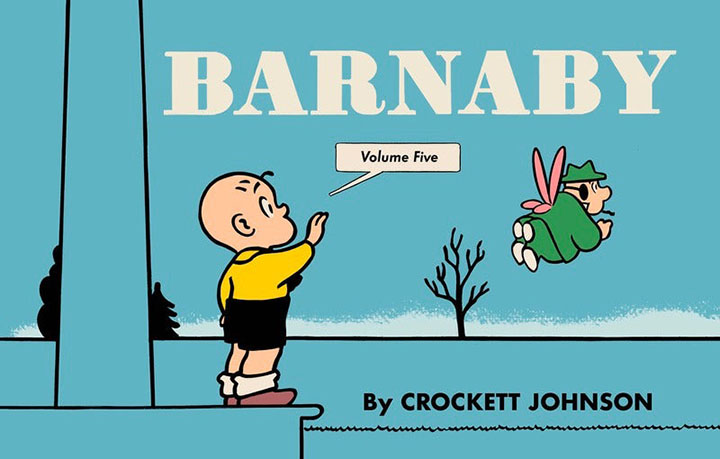
Barnaby Volume 5

Barnaby Volume 5 () from Fantagraphics, the final volume of the complete daily strips of this classic, too little-known comic strip, which (with Dick Tracy, Li’l Abner and Terry and The Pirates) is among my top favorites. Written and drawn (sometimes with Jack Morley’s help on art) by the great children’s book author, Crockett Johnson (Harold and the Purple Crayon), Barnaby is a deceptively simple strip of the ‘40s and early ‘50s that details the whimsical adventures of a five-year-old boy (Barnaby) and his Fairy Godfather (Mr. O’Malley). O’Malley is just as short as the child Barnaby and is a pleasantly pompous little pixie who looks like a middle-aged man with a fedora and, of course, pink wings.

Barbaby’s parents are distressed by their little boy’s insistence that his Fairy Godfather is real. A lot of the gentle humor comes from the reality of Barnaby’s opinion on this matter being true. Mr. O’Malley frequently almost meets one or both parents, and that becomes the chief running gag of the strip. The other is Mr. O’Malley’s cheerful incompetence, his magic wand (a cigar) frequently accomplishing nothing at all.

O’Malley’s friends and associates are fellow pixies and supernatural types, like Gus the Ghost, who wears glasses and is easily spooked; Atlas the Mental Giant (also no taller than Barnaby), McSnoyd the Invisible Leprechaun (who speaks in a Brooklyn accent); Barnbaby’s talking dog Gorgon (who never speaks around Barnaby’s parents); and many more. Johnson’s “clear line cartooning” is the most deceptively simple aspect of all: oddly elegant, beautifully understated, and unmistakably Crockett.

In this final volume, Barnaby turns six and must say farewell to Mr. O’Malley. It’s a sad moment, bittersweet but just another day in the life of a Fairy Godfather, who is definitely not imaginary and as real as anybody in the comic strip canon.
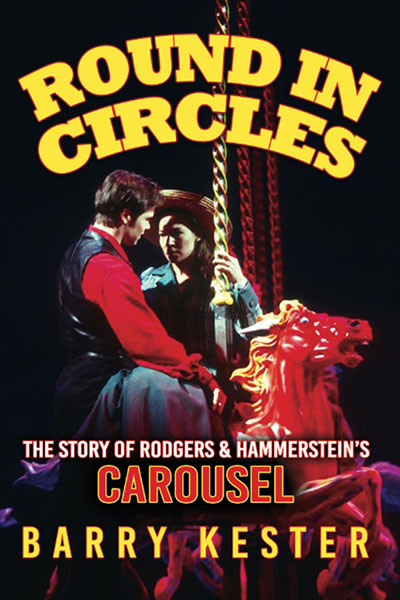
Round in Circles: The Story of Rodgers & Hammerstein’s Carousel

Round in Circles: The Story of Rodgers & Hammerstein’s Carousel () by Barry Kester takes an in-depth look at one of the greatest musicals ever written, and in my view (and that of many) the finest work by Rodgers (music) and Hammerstein (book and lyrics). From the 1901 play Liliom by Ferenc Molnar, fairly faithful but with a much less dark conclusion, Carousel focuses on the sudden romance between a carnival barker and a young mill worker lass; the latter’s friends in a New England fishing community provide a backdrop and counterpoint.

It’s most overtly noir musical I can think of, with its emphasis on crime and its tortured central lovers. Modern audiences – or at least those mounting this great work of art for those audiences – have problems with the thematic content of the play. Billy Bigelow is a roustabout roughneck who has, at least on one occasion, “hit” (probably slapped) his gentle wife, who puts up with her husband’s jobless state and foul temper. In modern terms, this is viewed as an abusive relationship, and Round in Circles explores that subject thoroughly and well. Author Kester makes the point that the year the play was produced (1945) was toward the end of the Second World War, when men were starting to return from combat in a traumatized state and sometimes had difficulty into getting back into a peacetime grove. Some brought violence home with them. This is probably why audiences of the day had little if any problem with the overstated “wife-beating” aspect of the narrative.

Today, people are liable to read in contemporary values and beliefs, and somehow ignore the tragic aspects of the story, growing from flaws in both characters, the volatile Billy and the passive Julie. But Oscar Hammerstein knew what he needed to do with this tragedy. In both Liliom and Carousel, the roughneck gets a chance to redeem himself by getting another day – a single day – back on earth. Liliom is the story of man who blows his chance to redeem himself; Carousel is about a man who does, ultimately, in the nick of time redeem himself.

The film version is often dismissed, but it has rewards; and the play itself appears to be a major influence on It’s A Wonderful Life with its angelic conceits.

Additionally, the play has some of the most beautiful words and music ever written for the musical stage – from “The Carousel Waltz” to “If I Loved You” and finally “You’ll Never Walk Alone,” few scores rival it.

Carousel has a particular resonance for me. My father, in the early 1950s, when he was a high school music teacher, mounted the first high school production of Carousel. I was very young but I was spellbound – my father had a working carousel on stage for the opening of the show! Amazing. What a showman my pop was – imagine getting a wonderful performance in a play this difficult from a bunch of high school kids in the early fifties. And as I witnessed my dad’s hometown triumph, those beautiful songs crept into my brain and made a permanent home there.

If you are interested in musical theater at all, Carousel is the ultimate noir musical, and Barry Kester’s Round in Circles does it justice.

Here’s what Barb and I (and sometimes Nate) have been watching (some of these remarks will be brief):

Black Bag – a solid, well-acted espionage tale in the John Le Carre vein, starring Cate Blanchett and Michael Fassbender, directed by Steven Soderbergh and written by David Koepp. This we saw at a theater.

Zero Day – a good but not great six-part mini-series starring Robert De Niro as a former president recruited from retirement to head up a commission into a devastating cyber- attack. Netflix.

Reacher Season 3 – a meat-and-potatoes series with a fine central performance by Alan Ritchson. The weakest of the three seasons so far, and at times painfully predictable and occasionally plot-hole-riddled, it’s nonetheless a fun watch. Amazon Prime.

Paradise – somewhat overrated but with a brilliant seventh (of eight) episodes. I just wish every character wouldn’t have a monologue about their back story delivered to some other character. I am interested to see where they go next, because the series seems to have painted itself into a corner. Hulu.

Adolescence – a four-episode limited British series that is one of the best things I’ve seen in years. Be forewarned: it’s harrowing, not so much for on-screen violence (which is limited) but for emotional impact. A young teen is accused of murder and we follow from the procedural end through the impact on the parents. Remarkable in approach, every episode is shot in a single unbroken take; how this was accomplished required a degree of difficulty I can barely imagine. The third episode, the least flashy in filmmaking terms, is a masterpiece thanks to the performances of Erin Doherty as psychologist Briony Ariston and Owen Cooper as young accused murderer Jamie meeting at a youth detention facility to prepare a pre-trial report on his mental health. Netflix.

The Thief of Bagdad – This 1924 film starring Douglas Fairbanks is one of the greatest fantasy films of all time. Barb loves silent movies and this one is terrific, with a wonderful orchestral score. The effects are mind-boggling. Eureka! Home Video.

Mission: ImpossibleDead Reckoning Part One – We decided to revist this before Part Two (no longer labelled that way) comes out. Underrated on its release, with an A-1 “bad guy” that seems more current now than when the film came out, this entry in the long-running series is a succession of over-the-top (in a good way) action sequences, often hilarious in their shameless excess. Paramount Home Video.

The Golden Buddha – From the boxed set Super Spies and Secret Lies, this is an Asian James Bond-era knock-off with eye-popping art direction and an amusing storyline anticipating Austin Powers. My son Nate and I watch one or two Asian movies every week, seldom artistic masterpieces but great fun. Eureka! Home video.

The Day the Earth Blew Up: A Looney Tunes Movie – We went with the (nearly) entire family to this one at the local theater, and it’s a blast – traditional animation that seemed more Ren & Stimpy than Warner Bros, but I was fine with that. Word is this was dumped by Warner’s (as was a Road Runner/Wile E. Coyote movie) and that’s a disgrace. Very funny.

Okay that’s what I’ve been reading and watching. It’s an eclectic bunch of stuff, but that’s how we roll around here. I don’t read as much fiction as I once did – particularly not mysteries – but I take in a lot of physical media and streaming shows/movies. It’s how I relax and put fuel in the boiler.

There’s a lot to dislike on TV and on the movie screen these days, but plenty’s still out there to enjoy.

* * *

This very nice, smart review popped up this week at Do Some Damage – it’s detailed and (to me) gratifying. I happen to think the two Krista Larsen books are top-notch Collins, but I got a lot of heat from some reviewers (mostly in the UK) and, frankly, from my Thomas & Mercer editor. The big complaint was too much clothing description, something that goes unremarked upon in this extended lovely review. I had hoped to do at least a third Krista novel, but Thomas & Mercer wasn’t interested. It is, admittedly, the only book of mine there that hasn’t “earned out” yet; but in my defense they’ve given that title zero support.

If you haven’t read Girl Most Likely, check out this review.

This is a very good article on Road to Perdition as a comic book movie that is also a masterpiece. Oddly, neither I nor Richard Piers Rayner are mentioned. But it’s nice,
just the same.

* * *

We have been getting complaints from a handful of you fine folks that the link to this page from Facebook listings doesn’t always work. We (that is, son Nate) are (is) looking into it.

For those of you who can get here, we will have a book giveaway next week.
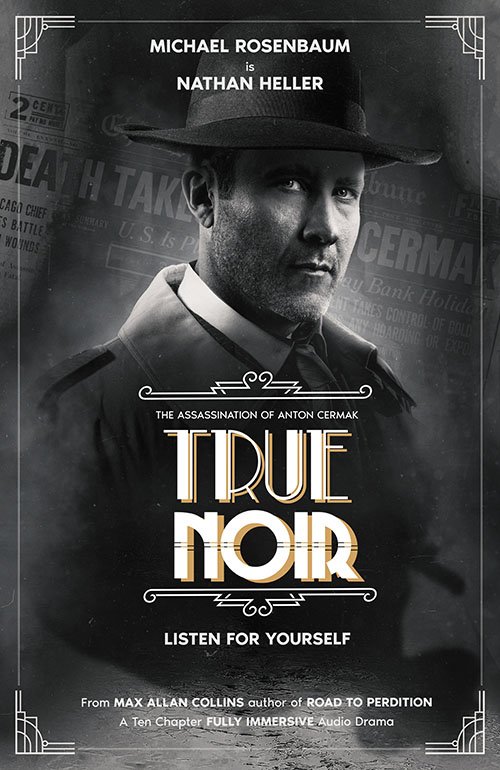
True Noir Poster

In the meantime, True Noir: The Assassination of Mayor Cermak is winding down – the last couple of the ten episodes will drop any moment now. Director Robert Meyer Burnett continues to do a great job.

If you order now, at least the first eight of ten episodes are available. Episode eight is, as Rob would say, “a banger.”

And this just in!

M.A.C.
An Irish-American Legend: Mickey Spillane

Tuesday, March 18th, 2025

I am in the midst of a project (the nature of which I’ll share here soon), so this will be a short update, at least on the news side.

It’s St. Patrick’s Day 2025 as I write this, and how better to celebrate that (sort of) holiday than to share with you this nice article on Mickey Spillane from Casa Carlini. I rate a single mention – not exactly accurate – but that doesn’t take away from what a nice piece this is…even I do wish there’d been mention of the current Baby, It’s Murder, the final Hammer novel of the fifteen books I’ve fashioned from partial manuscripts and synopses entrusted to me by Mickey himself in his final days.

Mickey Spillane in 2001
Hard-Boiled and Unforgettable:
The Legacy of Mickey Spillane

Mickey Spillane, the literary titan of hard-boiled crime fiction, left an indelible mark on the world of detective stories. His name is synonymous with gritty narratives, tough-as-nails protagonists, and a writing style that punches you in the gut. But Spillane’s legacy is more than just a collection of thrilling tales—it’s a testament to the enduring appeal of raw, unfiltered storytelling. In this deep dive, we’ll explore the man behind the typewriter, the cultural impact of his work, and why his stories continue to captivate readers decades later.

The Man Behind the Mike Hammer Mysteries

Mickey Spillane, born Frank Morrison Spillane in 1918, was a man who lived as boldly as the characters he created. Before he became a literary sensation, Spillane dabbled in various careers, including as a circus performer and a fighter pilot trainee during World War II. But it was his foray into writing that cemented his place in history.

Spillane’s breakout character, Mike Hammer, debuted in I, the Jury (1947), a novel that set the tone for his signature style. Hammer wasn’t your typical detective—he was a vengeful, no-nonsense antihero who operated by his own moral code. Spillane’s writing was fast-paced, visceral, and unapologetically violent, a stark contrast to the more polished detective fiction of the time.

The Hard-Boiled Revolution

Spillane didn’t just write crime novels; he revolutionized the genre. His work was a departure from the cerebral whodunits of Agatha Christie or the suave sophistication of Raymond Chandler’s Philip Marlowe. Instead, Spillane’s stories were raw, emotional, and often controversial. He didn’t shy away from depicting the darker side of human nature, and his protagonists were flawed, complex, and deeply relatable.

The term “hard-boiled” perfectly encapsulates Spillane’s approach. His stories were tough, gritty, and unflinching, much like the detectives who populated them. Mike Hammer wasn’t just solving crimes—he was navigating a world of corruption, betrayal, and moral ambiguity. This realism resonated with readers, making Spillane one of the best-selling authors of the 20th century.

Controversy and Criticism: Love Him or Hate Him

Spillane’s work wasn’t without its detractors. Critics often dismissed his novels as overly violent, misogynistic, or sensationalistic. Some accused him of prioritizing shock value over literary merit. But Spillane didn’t care. He famously quipped, “I don’t have fans. I have customers.” His focus was on entertaining his readers, not winning over the literary elite.

Despite the criticism, Spillane’s influence on the crime fiction genre is undeniable. His work paved the way for later authors like Elmore Leonard, James Ellroy, and even modern-day thriller writers. He proved that crime fiction could be both commercially successful and culturally significant.

Mike Hammer: The Antihero We Can’t Forget

At the heart of Spillane’s success was Mike Hammer, the quintessential hard-boiled detective. Hammer was a man of contradictions—brutal yet compassionate, cynical yet idealistic. He wasn’t afraid to bend the rules (or break them) to achieve justice, and his relentless pursuit of the truth made him a compelling character.

Hammer’s popularity extended beyond the pages of Spillane’s novels. He became a cultural icon, appearing in films, television shows, and comic strips. Actors like Darren McGavin and Stacy Keach brought Hammer to life on screen, each adding their own interpretation to the character. Even today, Mike Hammer remains a symbol of the hard-boiled detective archetype.

Spillane’s Writing Style: Punchy, Provocative, and Unforgettable

One of the hallmarks of Spillane’s writing was his ability to grab readers from the very first sentence. His openings were often explosive, setting the tone for the rest of the story. For example, the first line of I, the Jury is iconic: “I shook hands with the man whose brother I’d killed.” It’s a masterclass in hooking the reader and establishing the stakes.

Spillane’s prose was lean and mean, with no room for unnecessary flourishes. He had a knack for dialogue that crackled with tension and descriptions that painted vivid pictures with just a few words. This economy of language made his stories fast-paced and immersive, keeping readers on the edge of their seats.

The Cultural Impact of Mickey Spillane

Spillane’s influence extends far beyond the world of literature. His work helped shape the cultural landscape of mid-20th century America, reflecting the anxieties and complexities of the post-war era. The themes of his novels—corruption, justice, and the struggle between good and evil—resonated with a society grappling with rapid change.

Moreover, Spillane’s success demonstrated the power of genre fiction. At a time when literary snobbery often dismissed popular fiction as inferior, Spillane proved that genre writing could be both commercially viable and artistically significant. His legacy paved the way for future generations of genre authors to be taken seriously.

Spillane’s Later Years and Enduring Legacy

Even in his later years, Spillane remained a prolific writer. He continued to produce novels, short stories, and even comic books, proving that his creative spark never dimmed. In the 1990s, he collaborated with Max Allan Collins to complete several unfinished manuscripts, ensuring that his work would continue to reach new audiences.

NOTE FROM M.A.C.: Mickey and I did projects during his later years, from the Mike Danger comic book to numerous co-edited anthologies. The unfinished manuscripts were addressed after his passing, and represent posthumous works with considerable Spillane content.

Spillane passed away in 2006, but his legacy lives on. His novels are still widely read, and his influence can be seen in everything from modern crime fiction to film and television. The hard-boiled detective archetype he helped popularize remains a staple of popular culture, a testament to the enduring power of his storytelling.

Why Mickey Spillane Still Matters Today
In an age of complex antiheroes and morally ambiguous narratives, Mickey Spillane’s work feels more relevant than ever. His stories remind us that the line between right and wrong isn’t always clear, and that justice often comes at a cost. Mike Hammer may not be a traditional hero, but his unwavering commitment to his own code of ethics makes him a compelling figure.

Spillane’s writing also serves as a reminder of the power of storytelling. In a world saturated with content, his novels stand out for their raw emotion, gripping plots, and unforgettable characters. They remind us why we fell in live with crime fiction in the first place.

A Hard-Boiled Legend
Mickey Spillane was more than just a writer—he was a cultural force. His work redefined the crime fiction genre, introduced us to one of literature’s most iconic detectives, and proved that storytelling doesn’t need to be polished to be powerful. Whether you love him or hate him, there’s no denying the impact of Mickey Spillane.

So, the next time you pick up a gritty crime novel or watch a noir film, take a moment to appreciate the man who helped make it all possible. Mickey Spillane may have been hard-boiled, but his legacy is anything but forgettable.

* * *

J. Kingston Pierce at the indispensable Rap Sheet recommends Baby, It’s Murder as one of the most interesting of recent mystery novels. He also provides a link to Borg’s splendid review of the book, if you missed it.

A very good look at Road to Perdition (primarily the film version) is here.

* * *
True Noir banner

Director Robert Meyer Burnett’s eighth episode of True Noir: The Assassination of Mayor Cermak has just dropped, and it’s a banger, as Rob himself might say. Probably the most impressive episode in terms of sound design if nothing else. And we’re in the home stretch now! Two episodes to go….

M.A.C.

Encore For Paula

Tuesday, September 6th, 2022

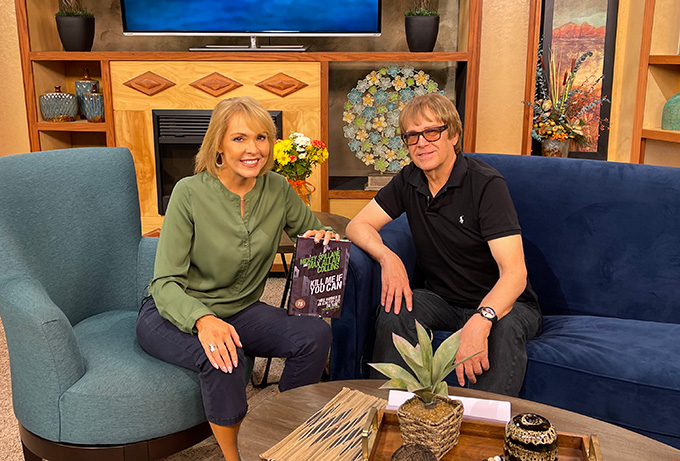
Last Thursday (Sept. 1) I appeared on the Paula Sands Live at KWQC TV in Davenport. Paula’s hour-long Monday-thru-Friday show is extremely high-rated in the Quad Cities market, and she herself – also the nightly news anchor – is celebrating an astonishing forty years at the station. (I accuse her regularly of having an aging portrait in the attic.) This was my first TV shot post-Covid lockdown, and it felt like coming home.

Paula Sands and M.A.C.

As some of you may recall, Paula Sands Live (or a satirized version thereof) appeared with Paula as herself in my movie Mommy’s Day. She was a major character in the film and did a terrific job. Also in that film was Gary Sandy, co-starring with Patty McCormack of course; Gary’s upcoming appearance in Encore for Murder as Mike Hammer on September 17 at the Muscatine High School Theater grows out of my friendship with him when he shot his scenes right here in Muscatine, Iowa, in 1996.

Gary is generously donating his time, reprising his performance as Hammer in the radio-style play Encore for Murder (we originally presented it several years back in Owensboro, Kentucky, and later at Clearwater, Florida), in this one-night-only benefit for the Muscatine Art Center.

Here’s the info, in case you missed it, for those of you close enough to this area (or crazed enough to drive or fly here).

We had our second table read via phone with Gary and the full cast on the evening of the day I appeared on Paula Sands Live. It went very well and the production is really coming together. The cast assembled by co-director Karen Cooney is excellent, and we have Chad Bishop (himself a filmmaker among his many talents) as the foley artist, which is a big, entertaining part of the play, as old-fashioned radio sound effects (and some newfangled computer effects) are generated right on stage.

We are planning to shoot footage at several rehearsals and the performance itself for use in the expansion of my 1999 Mickey Spillane’s Mike Hammer documentary, which is part of what I’m planning for the ongoing 75th anniversary of Mike Hammer celebration. We already have a video distributor lined up (which will include streaming).

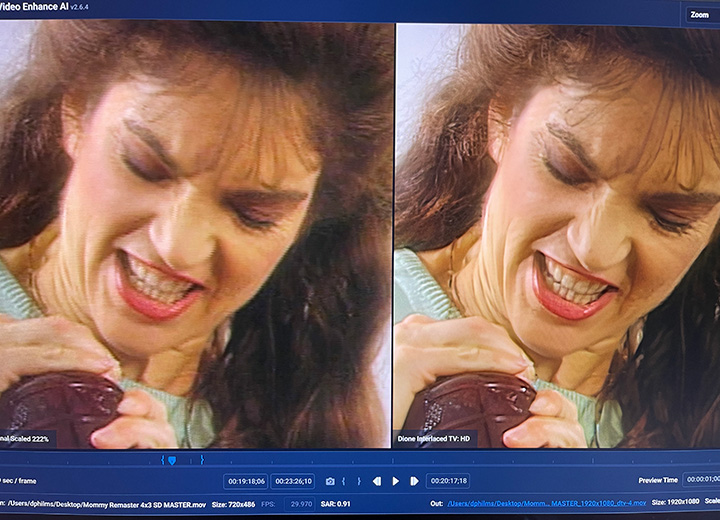
And speaking of Mommy’s Day, my filmmaking partner Phil Dingeldein and I are remastering Mommy and its sequel for another Blu-Ray release. We have vastly improved visuals and will return to the original 4:3 format as intended. For those of you who have bought the movies before, well, uh…thanks! But we are just trying to get the best versions out there so that we can appeal to more streaming services and make the physical media as doggone good as we can.

Mommy Before and After upscale/deinterlace.

And speaking of physical media….

So, all of you film and TV fans, remember when we were told that physical media – that journey from Betamax and VHS to laser disc and DVD, and more recently Blu-Ray to 4K discs – would soon be a thing of the past. Would die a much deserved death, because after all everything we could ever want to see will be permanently available in the “cloud.” It’ll all be out there, childishly simple to access, thanks to the wonder of (drum roll please) streaming services.

This is where you are free to either (a), laugh derisively, (b), laugh maniacally, (c), swear and pound a fist on a table or desk, (d), sit morosely staring into space, or (e), find a quiet corner to sit in and weep. (“All of the above” doesn’t seem a practical option, but attempt if you wish.)

After all, we now know several things about this Brave New Streaming World. Well, first it sucks. Sucks money from each of us and just plain sucks. But admittedly it offers a lot of options, if mostly taking the old So Many Channels and Nothing Is On paradigm to ridiculous heights/lows. But all of these streaming services offer their selection options for a limited time. Sometimes, as with HBO Max, they break promises to subscribers like a popular girl in junior high in 1960 (but I am not bitter).

Yes, movies and TV shows are out there somewhere in the ether, just not where you can access them.

Meanwhile, Blu-ray and 4K chug somewhat expensively along, and break the backs (or anyway banks) of film and TV buffs trying to build their non-cyber library. And yet what a wonderful thing a non-cyber library is. For me, my collection of DVDs, Blu-Rays and 4Ks are (nearly) as important to me as the thousands of books I’ve accumulated in my lifetime.

Now I am not against Kindle and Nook and other methods of reading books on little monitor screens. Some people even read books on their phones, probably the same troubled souls who watch 4K movies on those tiny screens, unless they are carrying large flat screens in their pockets and purses in the pursuit of making their lives seem even more absurd.

I am tolerant of Kindle especially because I have made much more money in recent years from e-books than from what I like to call real books. God bless people for utilizing that tool. And I am obviously berating the streaming services even as I seek to sell my wares to them. But here is a wonderful irony – several of the generations younger than mine (actually, that’s more than several) prefer to buy, read and collect physical books. Kindle use is much, much more predominant among older people, the kind of people still wondering when those flying cars are going to get here.

Listen, Kindle has its place. If I were in a big city commuting, I would be using the one that is gathering dust somewhere in this house (it was given to me by the Thomas & Mercer folks). But I like media in physical object form. I like to hold a book in my hands. I like to study a book’s cover (not the covers of most recent books, which are by and large cold and hideous beyond belief) and delight at how it reflects the book at hand (or bitch about how it doesn’t). I even like the smell of books. And I like the way DVDs and Blu-Rays and 4Ks have pictorial jackets and can be lined up on shelves like books with spines and everything. I am resolutely old-fashioned in that regard, and delighted that so many people younger than me are reading books not on glowing screens.

But glowing screens played an interesting role in all this. Yes, it’s annoying that people have their faces in their phones, and it will serve them right in thirty years when their radioactive noses fall off and they have to go searching for them in the dark (the detached noses will glow, so will be easy to find, don’t worry).

But it was Harry Potter, thanks to the now reviled J.K. Rowling, and the much criticized cell phone that taught several generations to read again. They read those Potter books, actual physical books, and on their phones they read (“read” both past and present tense here) e-mails and texts, and they write them, too. Like people used to write letters.

When I hear people of my generation say, “These kids don’t read today,” I think: that’s what old people were saying when I was a kid; and statistically more old people are reading on Kindles rather than actual books, so what are they talking about?

I find the return to vinyl interesting if odd, since I have loved CDs for their lacks of skips and crackles for decades now. But the CD is old-school physical media that truly is dying, because downloadable music is more closely infinite than the very not infinite “availability” of film and TV from the streamers. Downloadable music is the enemy because it has people creating their own play lists and the art of the album is damaged and maybe dying (you know, like most of Sinatra’s Capitol catalogue and Rubber Soul and Pet Sounds and My Aim Is True and the first Vanilla Fudge album and Weezer’s green album).

So it’s a mixed bag, and it will not sort itself out (if it does) while I am still here.

My son Nate – who is selling a lot more books with his Jo Jo translations than I could ever dream of – has a wonderful idea that I hope he carries through on. He wants to write a blog where each week or maybe day he plucks a random disc from my endless DVD and Blu-Ray collection and watches (and then reviews) it. These will be things he did not watch with me while I was on the planet. I will now walk across the room to a bookcase of Blu-rays, and a spinner of DVDs, and pluck five things at eyes-closed random.

Here are Nate’s first five columns. He will discuss:

The Bowery Boys Volume Four (okay, I cheated on this one); The Halliday Brand (a western directed by Gun Crazy’s Joseph Lewis; An Angel for Satan (with Barbara Steele); Haunt from Scott Beck & Bryan Woods (the Quad Cities boys who made good with A Quiet Place, and unlike the Bowery Boys a genuine chance selection); and Ernest Scared Stupid.

Man would I like to read that column.

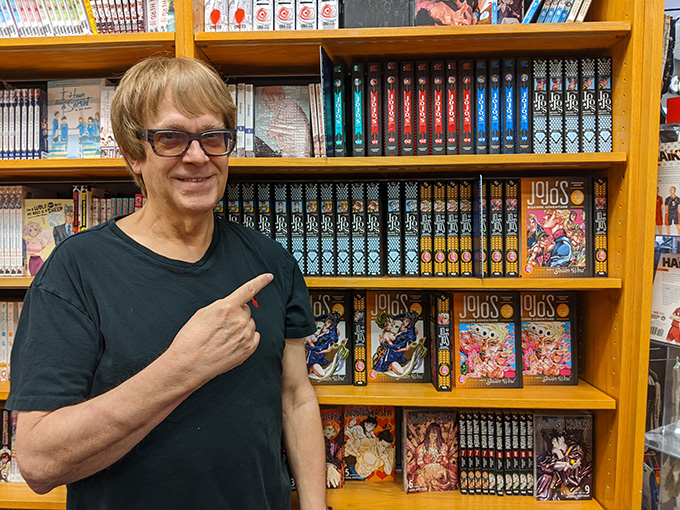
M.A.C. with JoJo's Bizarre Adventure shelves at BAM!
THAT’S MY BOY! Translator Nate Collins’ shelves of Jo Jo’s Bizarre Adventure at the Davenport BAM!
* * *

Here’s a nice write-up on the upcoming Encore for Murder.

Ms. Tree is on this cool list from Punk Noir (great name); but there’s an inaccurate suggestion that I’ve written more than just the one Ms. Tree prose novel for Hard Case Crime.

Finally, this Wealth of Geeks essay discusses the merits of ignoring canon in films from a book (or comic book) series, and uses Mike Hammer to demonstrate. Good piece.

M.A.C.