Posts Tagged ‘Mickey Spillane’s Mike Hammer’

Ever Wonder Who My Favorite Screen Mike Hammer Is?

Tuesday, June 30th, 2026

I guess I haven’t talked as much about Mickey Spillane’s Mike Hammer here as you might expect. But my pal Andrew Sumner – also my editor in the UK at Titan Books – sent me this fun audience-recorded clip of Ray Gelato and his band performing “Harlem Nocturne,” which was the theme of the Mike Hammer TV show. It’s a lovely job of it.

For Andrew and a lot of Hammer fans, the entry point for Mickey and Mike seems to be the three TV series and the various TV movies starring Stacy Keach, which were the last time Hammer hit the popular culture hard in the late twentieth century, a time when Mike Hammer ruled until James Bond came along, an imitator of sorts who usurped the original. Stacy was Mike starting in 1983 and as late as 1998 (not counting the early 2000’s audios I did with him).

You might expect my entry point to have been the novels themselves, and I started reading those and Mickey’s other books at a very young age. But my introduction to Hammer was through the 1958-1959 syndicated series starring Darren McGavin. Mickey Spillane’s Mike Hammer was a tough show with episodes written by various pulp writers and adapted from pulp stories with McGavin extraordinarily hardhitting and violent with just enough tongue-in-cheek humor to get past the censors despite the bevy of sexy ‘50s starlets who also inhabited the series.

Pat Chambers was present, played mostly by Bart Burns, but Velda – mentioned a few times – was not. (In my fannish mind she was absent because, in the books, she disappeared behind the Iron Curtain for a decade or so.) At times, in interviews, McGavin disowned the character, but the persona he developed on the series was one he carried with him into The Outsider, The Night Stalker and countless other TV appearances post-Hammer.

The series was mostly shot on the Republic backlot but with enough location shooting in NYC to sell it. McGavin was a great Hammer, though Mickey was unhappy that a .38 replaced the trademark .45. Part of what made McGavin work for viewers at a time when Spillane himself was a big media figure was McGavin’s physical resemblance to the character’s creator.

Check out this complete rendition by Martin of the full Riff Blues/Hammer theme, with some cool images.

Hammer on screen was always a problem. The first-person nature of the novels meant that everybody had a mental image of who this tough private eye was. That included Mickey, who didn’t think the original screen Mike Hammer, the still underrated Biff Elliot, was big enough. Mickey lobbied for his cop pal Jack Stang, who did a test film directed by Mickey and whose image appeared as Hammer here and there in the mid-‘50s.

But Stang was no actor. In the film Ring of Fear (1954), Stang was implied to be Hammer under an alias, but it was Mickey playing himself – famous mystery writer Mickey Spillane – who seemed like Hammer come to life.

That led to Mickey taking over the role in the first movie following McGavin’s TV run, The Girl Hunters (1962). Though not everyone agrees with me, I’ve always felt Mickey did a terrific job, and one that was actually compatible with McGavin’s take. Mickey also fit in well with the other accurate screen Hammer, the aforementioned Biff Elliot, who was the first motion-picture Mike in I, the Jury (1953).

Already you may have noticed there’s a small army of actors who have portrayed Hammer. Ian Fleming was lucky the producers of Dr. No (also 1962) stumbled onto Sean Connery. And a question I am often asked is: who’s your favorite Hammer on screen?

First, let’s rule Mickey out. Obviously he’s my sentimental favorite – The Girl Hunters (1963) is the most faithful to the character and the novels, and Mickey was and is Mike Hammer, so let’s set that aside.

Who are Hammer actors that are not favorite Hammers of mine? Robert Bray is physically correct but overacts blusteringly throughout the rather dismal My Gun Is Quick (1957). A bare-headed Brian Keith played Hammer well enough in the abortive pilot that preceded the McGavin series; but he’s not really Hammer. Kevin Dobson in Margin for Murder (1981) was just okay (Cindy Pickett was badly miscast as Velda). Rob Estes was Hammer in name only in Come Die With Me (1994).

Now it gets tricky.

Ralph Meeker is the best big-screen Mike Hammer, but his take – and director Robert Aldrich’s and screenwriter A.I. Bezzerides’ – is so counter to Spillane’s intention as to be irrelevant to this discussion. Meeker and Kiss Me Deadly (1955) are oranges while we are discussing apples. I love the movie – it’s my favorite Hammer film by a country mile – but it sits in a niche of its own, the anti-Spillane movie that nonetheless captures Spillane’s mood, sex, violence, pace and tone better than any other.

Who does that leave?

Stacy Keach did the impossible – he lightly kidded Hammer while remaining tough; in this he’s similar to McGavin. But McGavin – and Biff Elliot, Ralph Meeker and Mickey Spillane himself – were of the original Hammer era. The Keach Hammer is a man out of time, a motif the series effectively played with in its best episodes. I’m honored to have worked with this great actor on two audio dramas and hold his Hammer in high regard.

I have to rule out Gary Sandy, who appeared in the only stage version of Mike Hammer to date – in three live productions at three venues, the final time in Muscatine, Iowa, and captured on camera in Mickey Spillane’s Encore for Murder, which I wrote and directed.

But it was Darren McGavin’s Hammer who captured my adolescent imagination. And the episodes hold up. A good half dozen of the 78 episodes were rage-filled, vengeance-fueled visits to Spillane’s world at its harshest.

So, with my arm twisted, I have to tip my invisible fedora to Darren McGavin. And admit that Skip Martin’s “Riff Blues” – the Mickey Spillane’s Mike Hammer theme – will always take my personal first place over the great “Harlem Nocturne.”

Listen and look: here is the McGavin opening followed by the three Keach openings with some of the greatest private eye music you’ll ever hear.

M.A.C.
A Book Giveaway & A Preview of the Spillane Blu-Ray & DVD

Tuesday, September 5th, 2023
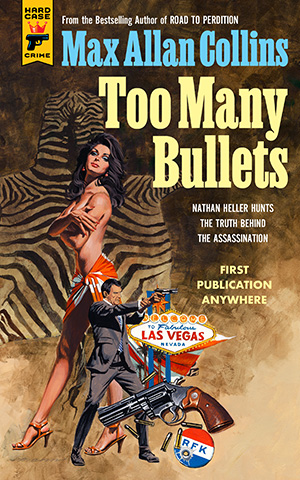
Too Many Bullets cover

Too Many Bullets, my new Nate Heller novel from Hard Case Crime, will be out on Oct. 10. I am offering ten copies of the trade paperback ARC (the actual book is hardcover) to the first ten of you who request it in exchange for a review at Amazon and/or Barnes & Noble or Goodreads (or your own reviewing site, if you have one).

[All copies have been claimed. Thank you for your support! –Nate]

This is for American readers only. That’s only because mailing outside the USA has become so expensive. Keep in mind you can’t review at Amazon until the book is actually available, which (again) will be Oct. 10.

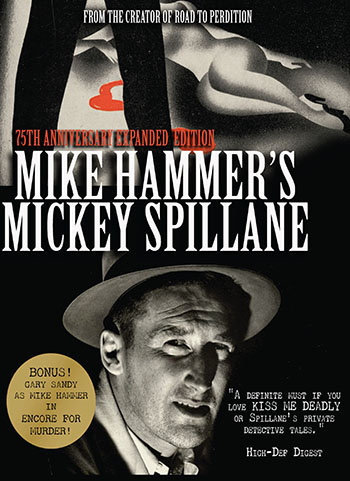
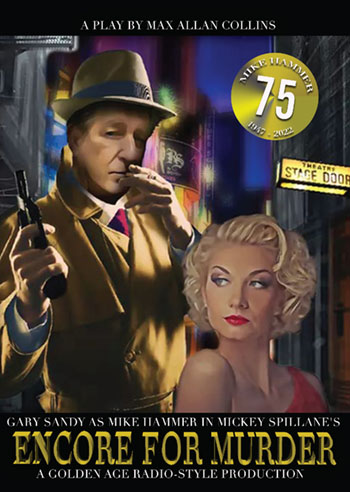
I also want to share with you the front jacket of Mickey Spillane’s Mike Hammer (the expanded documentary), a Blu-ray release from VCI that includes the 90-minute Mickey Spillane’s Encore for Murder with Gary Sandy in a Golden Age Radio-style live performance. When I say Golden Age Radio, I don’t mean this is audio only, but a movie experience much like being in the audience at a radio show of the ‘40s. Gary, who appeared in Encore at Owensboro, Kentucy, and Clearwater, Florida, is the only actor to date to portray Mike Hammer on stage.

Encore for Murder will be available separately on DVD and I’ll share that front jacket art with you, too.

These are teasers. We don’t have release dates yet, but it will be yet this year.

* * *

I want to share with you a particularly nice review of Dig Two Graves from the Crime Fiction Lover website.

Dig Two Graves by Mickey Spillane and Max Allan Collins
By Paul Burke 29 August, 2023

Once, when someone complained that Mickey Spillane had eight books in a top 10 chart, he replied along the lines that the reader should be thankful he didn’t write two more. It’s hard to overestimate Spillane’s popularity in the 1950s and 60s. He has sold over 225 million copies and when he died in 2006 left a wealth of unfinished stories, many of them featuring his hardboiled PI, Mike Hammer. That’s where Max Allan Collins comes in. A crime fiction author with a solid record of his own, including Quarry and The Road to Redemption, he was invited to carry on Spillane’s legacy and Dig Two Graves is the 14th Hammer novel he’s developed and finished.

The story is set in 1964 and Allan Collins has slotted it into place in the series at the appropriate point. Velma is Mike’s girlfriend, and the US has government borrowed her for a little job behind the Iron Curtain because she’s a former cop and secret service agent, but nobody told Mike. He hits the bottle hard thinking Velma has been kidnapped or, maybe worse, killed. Then Velma just turns up, Mike pulls himself around and they’re a team again.

There are other bridges to be mended though and Velma is about to meet up with her mother to smooth over her disappearing act. At the rendezvous the woman is mowed down in front of Velma and Mike. The Chevy responsible crashes a little bit further up the road and Mike is on the driver immediately but can’t squeeze anything out of the man before he dies.

Clearly it’s no accident. In the hospital Velma’s mother suddenly confesses that Velma’s father is not the man she grew up with, who died in the line of duty. Instead, it was a gangster named Rhinegold Massey – AKA Rhino. Is this somehow connected? Mike pumps his police friend Captain Chambers for info. It turns out Rhino died in an armoured car robbery and his then girlfriend, Judy, vanished years ago. But that’s all a cover and actually Rhino was placed in witness protection, the first such programme set up.

Rhino is linked to a retirement village in Phoenix called Dreamland Park so Mike decides to head out there, and there’s no way Velma will be left behind. When they arrive, it turns out a lot of people with connections to Rhino have been dying in mysterious circumstances lately. Mike books himself into the village and it’s not long before he’s being shot at and, naturally, he shoots back.

Blood and bullets are easier to come by than answers for much of the novel. A game of cat and mouse ensues, played out against the backdrop of lies, secrets, conspiracy and revenge. And, did I mention a double cross love betrayal? Allan Collins and Spillane riff nicely on a theme that goes back to Confucius: “Before you embark on a journey of revenge, dig two graves.”

Spillane wrote page turners and some of the best action scenes in crime fiction and that’s his great strength. Max Allan Collins knows that Mike Hammer readers want more and there’s no shortage of it here. He’s a subtler writer than Spillane so he nuances the plot, refines it for modern sensibilities without gutting the style. The characters have a little more depth but not too much.

The action is propulsive and the bodies drop regularly. It’s a deft art to recreating a novel that has to slot into a particular time in the Hammer cycle but the fact that Hammer has an arc means it’s crucial. In this case it’s Velma’s Russian sojourn and Mike’s descent into alcoholism in her absence. They add some humour to the plot, with references to his fitness and jibes along the lines of, “You used to be Mike Hammer.”

There’s a hint of sex smouldering behind the scenes and some cracking one liners in the snappy dialogue that give off a hardboiled vibe. Early in the book, the pace is a little more sedate than expected but it’s smoking by the denouement. Max Allan Collins really gets what makes Mike Hammer fun and never loses sight of that in the narrative. It’s a juggling act refreshing the form but maintaining the original ethos and mood, but mostly it is mission accomplished here. Hardboiled is alive and kicking; for a pulp fix this nails it pretty good.

For more revitalised Mike Hammer, see Murder Never Knocks.

As I say, a lovely review, but…the common mistake in reviews these days is calling Velda “Velma.” Apparently Mickey Spillane is getting confused with Scooby Doo.

* * *

Serious pre-production continues on Blue Christmas. We are hoping to secure Gary Sandy for the role of Jake Marley (the source novella is entitled A Wreath for Marley and is featured in the Wolfpack anthology, Blue Christmas).

We do need to raise some more money (having already raised $7000 from an indiegogo crowdfunding campaign). I am willing to dig into my stash of my stuff if you are missing anything in your M.A.C. collection. Tell me what you need and I will give you a price (it will not be outlandish) (maybe landish, though). Go this route and you’ll be listed in the credits.

* * *

Barb and I, as some of you may recall, are what might be called first generation Star Trek fans. We began watching when it was still on NBC, caught up with the first season via the James Blish short story collections (based on episodes), went to great lengths to see William Shatner in The Seven Year Itch at Pheasant Run outside of Chicago, saw Leonard Nimoy in The Fourposter at another dinner theater and also at a McGovern political event (recounted in Quarry in the Black), and cultivated a friendship with Walter Koenig.

Also, we stood in line for over an hour in the cold and snow to see, on opening night, Star Trek: The Motion Picture. We still consider it the best of the Star Trek films, not a widely held opinion, but Robert Meyer Burnett – who knows Star Trek as well as anyone alive – agreed with me when I shared this opinion with him. He feels it’s far and away the best original cast Star Trek film. So there.

Anyway, we did not watch Star Trek: The Next Generation when it aired. (I watched the opening episode and bailed.) But we did go to the four TNG motion pictures in the theater (usually on opening day) and liked all four, particularly the second one, First Contact. We also watched the handful of TNG laser discs that were issued, back in my laser collecting days. Liked those, too.

We have finally gotten around to watching the entire series – we started with Season Seven and worked our way back, for reasons too idiotic to share – and have more than warmed to TNG. We like it, perhaps even love it, and consider it a worthy continuation of the original series. We had been spurred to watch TNG by the excellent third season of Picard, which was essentially a long-form final movie for the original cast. (Picard season one was good, but the second season was dire, and like a lot of watchers, we only tuned in to season three because it restored the original TNG cast.)

Then Barb and I revisited the four TNG features, which we’d seen several times on Blu-ray and then 4K discs. And we discovered these films were much richer for us, a much more satisfying experience, having seen the entire run of TNG series.

And Star Trek: First Contact ties for second place (with Wrath of Khan) after Star Trek: The Motion Picture in our estimation.

Your warp speed may vary.

M.A.C.

Encore For Paula

Tuesday, September 6th, 2022

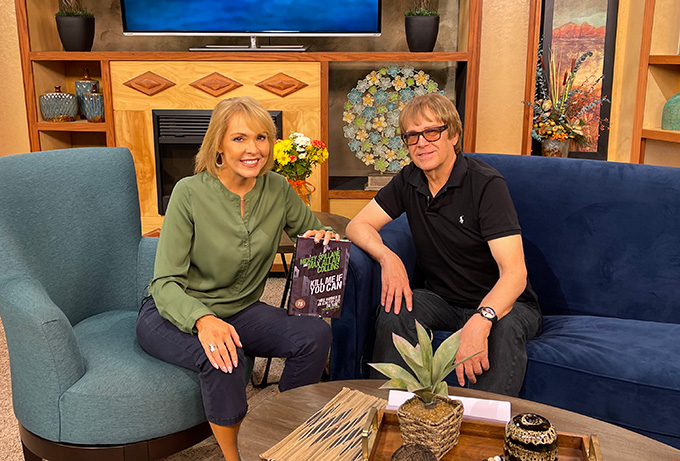
Last Thursday (Sept. 1) I appeared on the Paula Sands Live at KWQC TV in Davenport. Paula’s hour-long Monday-thru-Friday show is extremely high-rated in the Quad Cities market, and she herself – also the nightly news anchor – is celebrating an astonishing forty years at the station. (I accuse her regularly of having an aging portrait in the attic.) This was my first TV shot post-Covid lockdown, and it felt like coming home.

Paula Sands and M.A.C.

As some of you may recall, Paula Sands Live (or a satirized version thereof) appeared with Paula as herself in my movie Mommy’s Day. She was a major character in the film and did a terrific job. Also in that film was Gary Sandy, co-starring with Patty McCormack of course; Gary’s upcoming appearance in Encore for Murder as Mike Hammer on September 17 at the Muscatine High School Theater grows out of my friendship with him when he shot his scenes right here in Muscatine, Iowa, in 1996.

Gary is generously donating his time, reprising his performance as Hammer in the radio-style play Encore for Murder (we originally presented it several years back in Owensboro, Kentucky, and later at Clearwater, Florida), in this one-night-only benefit for the Muscatine Art Center.

Here’s the info, in case you missed it, for those of you close enough to this area (or crazed enough to drive or fly here).

We had our second table read via phone with Gary and the full cast on the evening of the day I appeared on Paula Sands Live. It went very well and the production is really coming together. The cast assembled by co-director Karen Cooney is excellent, and we have Chad Bishop (himself a filmmaker among his many talents) as the foley artist, which is a big, entertaining part of the play, as old-fashioned radio sound effects (and some newfangled computer effects) are generated right on stage.

We are planning to shoot footage at several rehearsals and the performance itself for use in the expansion of my 1999 Mickey Spillane’s Mike Hammer documentary, which is part of what I’m planning for the ongoing 75th anniversary of Mike Hammer celebration. We already have a video distributor lined up (which will include streaming).

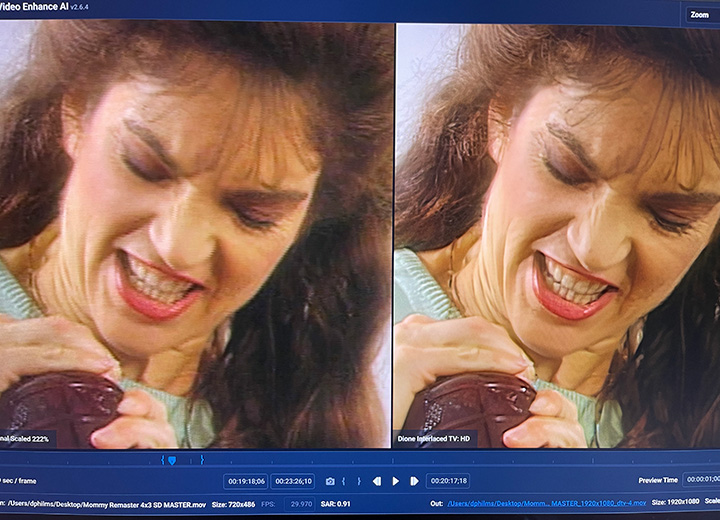
And speaking of Mommy’s Day, my filmmaking partner Phil Dingeldein and I are remastering Mommy and its sequel for another Blu-Ray release. We have vastly improved visuals and will return to the original 4:3 format as intended. For those of you who have bought the movies before, well, uh…thanks! But we are just trying to get the best versions out there so that we can appeal to more streaming services and make the physical media as doggone good as we can.

Mommy Before and After upscale/deinterlace.

And speaking of physical media….

So, all of you film and TV fans, remember when we were told that physical media – that journey from Betamax and VHS to laser disc and DVD, and more recently Blu-Ray to 4K discs – would soon be a thing of the past. Would die a much deserved death, because after all everything we could ever want to see will be permanently available in the “cloud.” It’ll all be out there, childishly simple to access, thanks to the wonder of (drum roll please) streaming services.

This is where you are free to either (a), laugh derisively, (b), laugh maniacally, (c), swear and pound a fist on a table or desk, (d), sit morosely staring into space, or (e), find a quiet corner to sit in and weep. (“All of the above” doesn’t seem a practical option, but attempt if you wish.)

After all, we now know several things about this Brave New Streaming World. Well, first it sucks. Sucks money from each of us and just plain sucks. But admittedly it offers a lot of options, if mostly taking the old So Many Channels and Nothing Is On paradigm to ridiculous heights/lows. But all of these streaming services offer their selection options for a limited time. Sometimes, as with HBO Max, they break promises to subscribers like a popular girl in junior high in 1960 (but I am not bitter).

Yes, movies and TV shows are out there somewhere in the ether, just not where you can access them.

Meanwhile, Blu-ray and 4K chug somewhat expensively along, and break the backs (or anyway banks) of film and TV buffs trying to build their non-cyber library. And yet what a wonderful thing a non-cyber library is. For me, my collection of DVDs, Blu-Rays and 4Ks are (nearly) as important to me as the thousands of books I’ve accumulated in my lifetime.

Now I am not against Kindle and Nook and other methods of reading books on little monitor screens. Some people even read books on their phones, probably the same troubled souls who watch 4K movies on those tiny screens, unless they are carrying large flat screens in their pockets and purses in the pursuit of making their lives seem even more absurd.

I am tolerant of Kindle especially because I have made much more money in recent years from e-books than from what I like to call real books. God bless people for utilizing that tool. And I am obviously berating the streaming services even as I seek to sell my wares to them. But here is a wonderful irony – several of the generations younger than mine (actually, that’s more than several) prefer to buy, read and collect physical books. Kindle use is much, much more predominant among older people, the kind of people still wondering when those flying cars are going to get here.

Listen, Kindle has its place. If I were in a big city commuting, I would be using the one that is gathering dust somewhere in this house (it was given to me by the Thomas & Mercer folks). But I like media in physical object form. I like to hold a book in my hands. I like to study a book’s cover (not the covers of most recent books, which are by and large cold and hideous beyond belief) and delight at how it reflects the book at hand (or bitch about how it doesn’t). I even like the smell of books. And I like the way DVDs and Blu-Rays and 4Ks have pictorial jackets and can be lined up on shelves like books with spines and everything. I am resolutely old-fashioned in that regard, and delighted that so many people younger than me are reading books not on glowing screens.

But glowing screens played an interesting role in all this. Yes, it’s annoying that people have their faces in their phones, and it will serve them right in thirty years when their radioactive noses fall off and they have to go searching for them in the dark (the detached noses will glow, so will be easy to find, don’t worry).

But it was Harry Potter, thanks to the now reviled J.K. Rowling, and the much criticized cell phone that taught several generations to read again. They read those Potter books, actual physical books, and on their phones they read (“read” both past and present tense here) e-mails and texts, and they write them, too. Like people used to write letters.

When I hear people of my generation say, “These kids don’t read today,” I think: that’s what old people were saying when I was a kid; and statistically more old people are reading on Kindles rather than actual books, so what are they talking about?

I find the return to vinyl interesting if odd, since I have loved CDs for their lacks of skips and crackles for decades now. But the CD is old-school physical media that truly is dying, because downloadable music is more closely infinite than the very not infinite “availability” of film and TV from the streamers. Downloadable music is the enemy because it has people creating their own play lists and the art of the album is damaged and maybe dying (you know, like most of Sinatra’s Capitol catalogue and Rubber Soul and Pet Sounds and My Aim Is True and the first Vanilla Fudge album and Weezer’s green album).

So it’s a mixed bag, and it will not sort itself out (if it does) while I am still here.

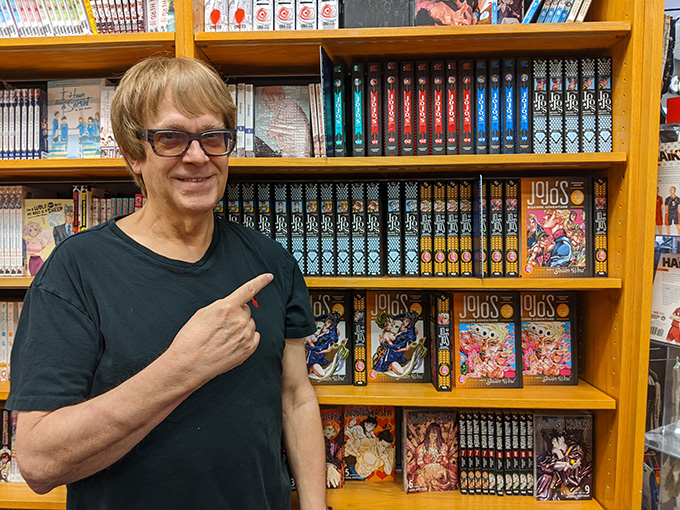
My son Nate – who is selling a lot more books with his Jo Jo translations than I could ever dream of – has a wonderful idea that I hope he carries through on. He wants to write a blog where each week or maybe day he plucks a random disc from my endless DVD and Blu-Ray collection and watches (and then reviews) it. These will be things he did not watch with me while I was on the planet. I will now walk across the room to a bookcase of Blu-rays, and a spinner of DVDs, and pluck five things at eyes-closed random.

Here are Nate’s first five columns. He will discuss:

The Bowery Boys Volume Four (okay, I cheated on this one); The Halliday Brand (a western directed by Gun Crazy’s Joseph Lewis; An Angel for Satan (with Barbara Steele); Haunt from Scott Beck & Bryan Woods (the Quad Cities boys who made good with A Quiet Place, and unlike the Bowery Boys a genuine chance selection); and Ernest Scared Stupid.

Man would I like to read that column.

M.A.C. with JoJo's Bizarre Adventure shelves at BAM!
THAT’S MY BOY! Translator Nate Collins’ shelves of Jo Jo’s Bizarre Adventure at the Davenport BAM!
* * *

Here’s a nice write-up on the upcoming Encore for Murder.

Ms. Tree is on this cool list from Punk Noir (great name); but there’s an inaccurate suggestion that I’ve written more than just the one Ms. Tree prose novel for Hard Case Crime.

Finally, this Wealth of Geeks essay discusses the merits of ignoring canon in films from a book (or comic book) series, and uses Mike Hammer to demonstrate. Good piece.

M.A.C.

Untouchable in Blu

Tuesday, June 26th, 2018

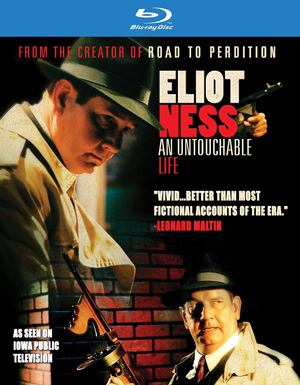
This weekend I watched the “check disc” for the forthcoming Blu-ray of Eliot Ness: An Untouchable Life. I was very pleased. We had gone to some trouble and expense to shoot in HD (at the time something rather new, particularly for low-budget productions), and having the feature appear as intended, looking rather beautiful, is gratifying. It’s made bittersweet by seeing the amazing performance of Michael Cornelison, who passed away in 2011. The loss of this key collaborator on my film and TV work remains painful.

Mike and my great friend and collaborator Phil Dingeldein are featured on the commentary, which listening to is also bittersweet…and I wish I hadn’t dominated it so. But I tend to do that in such situations.

The Blu-ray has everything on it that the DVD did, and “An Inconvenient Matter” – the short film that was the last collaboration between Collins, Cornelison and Dingeldein – is also in High-Def for the first time. It’s an overtly film noir piece written by Chuck Hughes, my fellow Iowan and the screenwriter of Ed and His Dead Mother, a cult fave. This is the only time to date I’ve directed a script I didn’t write, and it was fun and interesting. There’s a Collins/Cornelison/Dingeldein commentary on that, as well.

Obviously, the advance buzz about the “magnum opus” (as the publisher describes it), Scarface and the Untouchable: Al Capone, Eliot Ness and the Battle for Chicago by A. Brad Schwartz and me, inspired this release. The book is out in August, but the Blu-ray will bring up the rear in October.

You can pre-order the disc at Amazon (and I wish you would).

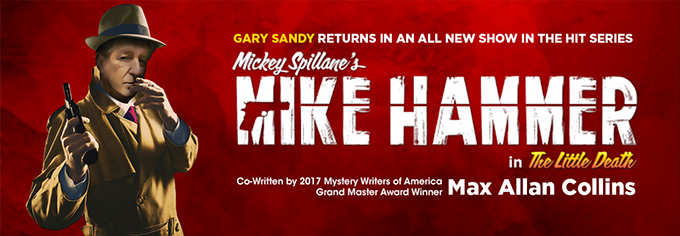
Phil and I are exploring a new film project around the second Mike Hammer play, The Little Death, that is scheduled for January 17 – 27, though if it sells out like the previous one did, an extra week may be added on. This will again star the wonderful Gary Sandy, and I am negotiating with legendary producer Zev Buffman to direct it myself. All concerned are hopeful that I will be able to direct a film version, somewhat in the style of the Eliot Ness: An Untouchable Life feature.

More as that develops.

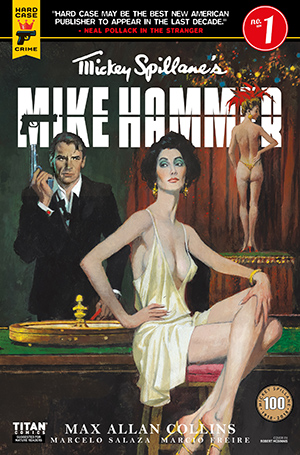
Speaking of Mike Hammer, the first issue of the serialized graphic novel, The Night I Died (developed from some of the same unpublished Spillane material that inspired The Little Death play) will be in comic book shops this week. A number of sites feature an advance look at the comic book, and this link will take you to one.

* * *

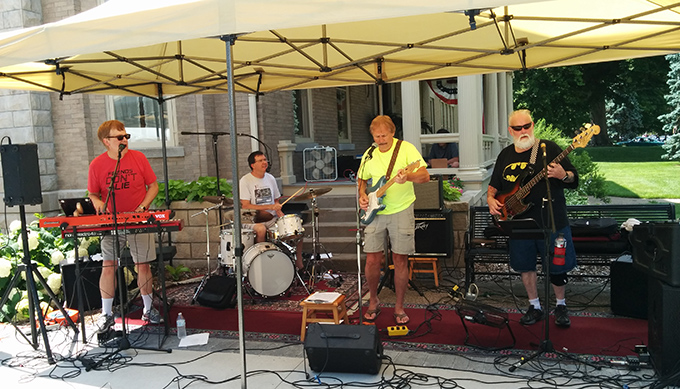
Crusin’s summer/early fall season (we mostly lay off in the later fall and winter) continued on Sunday with an appearance at the Muscatine Art Center’s annual Ice Cream Social. It was a fun, informal event, and the crowd liked us just fine, though I would be surprised if the ice cream and pie didn’t get even better reviews.

Our next appearance is in Muscatine at the Missipi Brew in their beer garden on the Fourth of July, which is on July 4 this year, interestingly. This can be a grueling event for us, particularly if we draw a hot day/evening. It’s also one of the longer shows we do, at least three hours. Lately we’ve been limiting ourselves to one- and two-hour gigs.

This does get more physically taxing, the loading in, setting up, tearing down and loading out in particular. How much longer I will be able to indulge myself in my rock ‘n’ roll fixation remains unclear.

* * *

Here is a very nice Quarry in the Black review. The cover of that one – I believe the great Glen Orbik’s last, completed by the very talented Laurel Blechman – is popping up all over the Net. It’s much admired, and I’m pleased to have acquired the original for my office (in my home with its sophisticated security system).

Here’s a little write-up about my long-ago Digest Dolls card set.

Finally, here is a really nice review of Scarface and the Untouchable in Publisher’s Weekly.

M.A.C.