Archive for the ‘Message from M.A.C.’ Category

Menace & Shrinking Island Giveaway…And Robert Morse

Tuesday, April 26th, 2022

The publication date of The Menace by Mickey Spillane and myself (from Wolfpack’s Rough Edges Press) is August 27 (Wednesday of this week, as I write). To jump-start some reviews of this and of The Shrinking Island (the collection of Mickey three YA adventure novels), I am announcing right now a book giveaway. Winners agree to write an Amazon review; other reviews are also encouraged.

M.A.C. holding copies of The Menace and The Shrinking Island

I have five copies of The Menace and five copies of The Shrinking Island for the first ten who request a book by writing me at macphilms@hotmail.com. Tell me which book you prefer, but if your choice is gone, the other will be sent. You must include your snail mail address, even if you’re entered before. These will go fast.

As usual, USA only.

The Menace is a special book. It is unusual in several respects. The Mike Hammer novels under the Spillane/Collins byline reflect me finishing books of Mickey’s in progress or put aside at the time of his death in 2006, or novels developed from synopses he left behind. I’ve also done from partial Spillane manuscripts two non-Hammer novels – The Consummata (with Morgan the Raider from The Delta Factor) and a standalone (Dead Street), with a very Hammer-like protagonist.

The Menace was developed from an unproduced screenplay in the Spillane files. It was apparently written shortly before or around the time he and I became friends in 1981, and he spoke to me of it frequently. He seemed to have an independent production in mind; he was friendly with South Carolina indie producer, Earl Owensby, who had his own studio, and the two had explored doing projects together. Nothing came of it, but The Menace indicates something might have.

But the screenplay was short – around 40 pages – and seems either to be a condensed version designed to attract investors or a version that could have been a pilot for a one-hour anthology series, probably with Mickey hosting. (In the forthcoming Mysterious Press biography by Jim Traylor and me, Spillane: King of Pulp Fiction, we explore Mickey’s efforts to put a mystery/crime anthology on the air with himself as the on-camera Rod Serling or Alfred Hitchcock).

What is particularly interesting about The Menace is the genre – while one foot is in a crime/mystery story, the other is in horror. Elements of horror were a part of Spillane’s novels from the beginning – he brought the horrors of graphic violence to his post-war crime fiction – the endings of Kiss Me, Deadly and My Gun Is Quick come to mind – and flirted with horror themes in The Twisted Thing and his last Hammer-in-progress, The Goliath Bone.

But The Menace is specifically Mickey reacting to the success of Stephen King. I go into this in my intro to The Menace, and will only say here that it was a Spillane reaction to King’s enormous success as a writer who became a media star and who carved out his own new niche in popular fiction. It’s fair to say that King has been imitated in much the same way Mickey was in his heyday.

Spillane did not, however, like the supernatural aspect of King and that other huge success, The Exorcist (book and film). As a Jehovah’s Witness, he took demons and the devil very seriously and did not consider them appropriate subject matter for fiction. He didn’t cry out for censorship, and in fact called King “a great writer”; but that type of horror was not for him.

The novel I’ve fashioned from his compact screenplay is unusual in its crime/mystery aspect having no Mike Hammer substitute at its center, though a tough small-town police chief is one of the two protagonists. The story is about a family where the husband (a self-made-man doctor) and wife (an artist from a wealthy family) have been driven apart by their disagreement over how to raise their ten-year-old “special needs” son. During much of the action, the estranged couple and their boy are in a big old spooky house, the grounds behind walls, which becomes the setting for a siege of sorts involving an Aztec mummy who may or may not still be breathing and a creature who may or may not be human. And at its heart is the story of a family coming back together in adversity.

Not typical Spillane elements, but typically compelling Spillane storytelling. Like the adventure stories he wrote in his last decade – The Shrinking Island, Something’s Down There and The Last StandThe Menace indicates an author trying to break away from Mike Hammer and flex other storytelling muscles.

I am very proud of the book and think it shows a whole other side to Mickey Spillane. It’s a relatively short novel – 40,000-words – but we have included as a bonus the original, previously unpublished version of the short story “The Duke Alexander” and a rare non-fiction crime story by Mickey, “The Too-Careful Killer,” unseen since 1952.

* * *

Yet another of my heroes has left the planet. As if losing Norm Macdonald and Gilbert Gottfried weren’t enough, a selfish God has taken Robert Morse away. Granted, Bobby Morse had a 90 year-run, and I admit when Barb and I screened How to Succeed in Business Without Really Trying in his honor over the weekend, we could not mourn. We could only get caught up again in the joy of experiencing the magical, shamelessly mugging musical comedy performance that is Robert Morse playing J. Pierpont Finch.

I started thinking about what I was going to say about How to Succeed and Morse, but thought I should check on what I’d said on the subject in this space before. And I discovered that in a post in 2017, I had already said the things that my mind was putting together for me to share now. So I’m going to do something I don’t believe I ever have here – I am going to rerun my response to seeing the Twilight Time Blu-ray edition of How to Success in Business Without Really Trying.

* * *
As you may have gathered, if you’ve stopped by here at all frequently, I am a collector of movies on Blu-ray and DVD. Many of my favorite films have made it onto Blu-ray, like Kiss Me Deadly and Gun Crazy (though I had to get that from Germany). And a fairly short list of my favorites remain on DVD only, like the Chinatown sequel, The Two Jakes, and the great film version of the Broadway musical, Li’l Abner.

One of my favorites, poorly represented with a terrible transfer on DVD, has finally made it to Blu-ray, in a limited edition of 3000, from Twilight Time, the boutique label that has brought us any number of terrific films, from The Big Heat to the Hammer Hound of the Baskervilles, from a Sinatra Tony Rome double feature to Pretty Poison.

But this time – and my birthday month yet – they have given me (and Barb and for that matter son Nate, who also loves it) a film I could watch once a week – How to Succeed in Business Without Really Trying.

There are those who can find reasons not to like this movie, just as there are people who can find a reason not to like ice cream. They are to be pitied. How to Succeed features a brilliant, witty, acid but not hateful score by the brilliant Frank Loesser. A Pulitzer Prize-winning musical (yes, Pulizter Prize-winning musical) in 1961, the Broadway version skewered the shallowness of big business in an up-to-the-moment manner. Unfortunately, the timing of the film’s release – 1967 – made How to Succeed’s cutting-edge satire seem dated, a lot having happened since ‘61.

Fortunately, time has been kind to this early ‘60s musical, with its bright Batman TV colors and cartoon images come to life (cartoonist Virgil Partch – VIP – was a consultant) and Bob Fosse choreography that is as witty and biting as the original play itself. (Fosse is not the actual choreographer of the film, but he’s credited as the source.)

A number of players from the Broadway show are retained, including Michelle Lee (who was the second Rosemary Pilkington in the original cast), the very funny Rudy Vallee, Ruth Kobart, and Sammy Smith, with Charles Nelson Reilly’s Bud Frump M.I.A., though decently replaced by Anthony Teague. Maureen Arthur – a live-action Little Annie Fannie – was in the national company of the musical and joined the Broadway run later.

I saw the national company in Chicago when I was in high school and fell in love with the musical then. The cast included Dick Kallman as Finch (later star of Hank on TV), who was excellent, with the second Great Gildersleeve, Willard Watterman, in the Rudy Vallee role. And of course the eye-popping Maureen Arthur was Hedy LaRue (“O.K. Charlie!”).

Two things make this film one of the best transitions of a Broadway hit to the big screen. First, director/writer David Swift – with credits like Pollyanna and Under the Yum Yum Tree enough to make one doubtful – had the surprising sense to film faithfully a show that had won seven Tony Awards, the New York Drama Critics Circle award, and the 1962 Pulitzer Prize for Drama.

The other thing is Robert Morse.

His J. Pierrepont Finch is my favorite performance in any musical film. He shamelessly recreates the Broadway role with only the slightest concession to movie technique. He understands, as does the rest of the cast (though not on this level), that he’s appearing in a cartoon. His character, who climbs from window washer to the chairman of the board in a few days, following a self-help book that provides the film’s narration – should be unsympathetic. He’s manipulative and dissembling and is never seen really working (not really trying, remember?); but the boyishness of Morse himself smooths the edge off.

Morse brings a remarkable energy to his songs and his loose-limbed dancing brings James Cagney to mind. In the ensemble, “Brotherhood of Man,” in the midst of a sea of Bob Fosse choreography, brilliant scene-stealer Morse knows just how to draw the viewer’s eye, chiefly by lagging like a jazz player behind the melody just enough to seem improvisional among all the precise dancers. He alone seems spontaneous.

Does he mug? Almost constantly. His performance is basically Jerry Lewis Goes to Graduate School. Somehow, playing a ladder-climbing nogoodnik, he seems joyful – the perfect conveyer of Loesser’s lyrics, with their hidden dark side.

Famously, the big hit love song from How to Succeed is sung by Morse’s Finch…to himself in a mirror. Few scores rival this one, though like Sondheim, Loesser writes to the story. The songs that were left out (“Paris Original,” “Happy to Keep His Dinner Warm”) are the weakest in the show. The only loss, besides Charles Nelson Reilly, is the great “Coffee Break,” which was filmed but cut for time. Too bad it doesn’t seem to have survived to be a special feature.

Morse and Reilly, by the way, were so successful on Broadway that they made an album together, “A Jolly Theatrical Season,” in 1963.

If the name Robert Morse seems vaguely familiar to smart younger people, he played Bertram Cooper on Mad Men, a role he was cast in, in tribute to his star turn in How to Succeed. Toward the end of Mad Men’s run, Morse was given a lovely song-and-dance farewell.

Morse’s career on Broadway was a stellar one, particularly his roles in Sugar and his one-man play, Tru, in which he played Truman Capote, winning his second Tony. But his film legacy is, largely, How to Succeed. No other film caught his magic, and a few really did him no favors – Honeymoon Hotel; Quick, Before It Melts – though The Loved One and Guide for the Married Man are worthy credits. I used to feel sad that this great talent had only one film to do him justice.

But with How to Succeed finally on Blu-ray, and with Mad Men as a wonderful, Emmy-nominated coda, I can only smile.

Nice modern-day (separate) interviews with Morse and Michelle Lee are special features. No “Coffee Break,” alas.

Buy it here.

* * *

UPDATE: The Twilight Time Blu-ray is still available but is pricey from some sources, although Screen Archives still has it at $20.

Let me add a few thoughts. Morse, who I describe above as “Jerry Lewis Goes to Graduate School,” shared with Lewis an inability to move from boyishness into anything else. It took the heavy make-up of his Truman Capone one-man show to briefly change that – he won a second Tony for it, after all – but he remained a boyish persona.

His rise to success (and Succeed) came from a string of stand-out youthful Broadway roles that culminated in J. Pierpont Finch being designed as a star vehicle for him. Two Broadway revivals have not shown their popular stars able to make their performances anything but reminders of how good Morse was.

He worked. He had a career. For a while he remained hot on Broadway, with Sugar (the musical version of Some Like It Hot) in 1972 a particular highlight. But mostly it was episodic TV and TV movies (he played Grandpa Munster in one), Pringle commercials and lots of cartoon voiceovers (Teen Titans, toward the end) – not what his dazzling How to performance promised.

That he had Mad Men as a last act is wonderful. But he deserved more. And we deserved more Morse.

* * *

Richard Piers Rayner’s phenomenal work on Road to Perdition gets some nice notice here in a piece on movies that recreated panels from the comic books they were based on.

M.A.C.

Robert Rydell/Siodmak/Odenkirk

Tuesday, April 12th, 2022

Last week I talked about Bobby Darin. Since then, my second favorite pop-music artist of the pre-Beatles era has passed – another Bobby.

Rydell.

Robert Ridarelli has received less acclaim than Darin, and he would have been the first to say he was fine with that. He was a humble man whose great accomplishments came early in life, as was the case with almost all the teen idols of the late ‘50s and early ‘60s. But he deserves better than just having a mythical high school named after him in Grease.

When Barb and I saw him perform with the other two Golden Boys of Bandstand, Frankie Avalon and Fabian – and while Avalon and Fabe were very entertaining – Rydell was the show stopper. For one thing, he was the only Golden Boy whose set was almost entirely his own hits; although the other two are somehow more emblematic of teen idols of the period, only Rydell was a consistent hitmaker. The only song he sang at the performance we saw that was not a chart hit of his was “Mack the Knife” – part of an excellent, obviously heart-felt tribute to Bobby Darin.

Darin was clearly Rydell’s model for moving into material that straddled teen and adult tastes – his “Old Black Magic” was patterned on Darin’s “Bill Bailey,” and Rydell’s biggest, arguably most memorable hit, “Volare,” was his “Mack the Knife.” “Sway” was another Dean Martin hit reimagined (Dino’s version of “Volare” informed Rydell’s) but his more rock-oriented numbers indicate the great “Wild One” and such fun numbers as “Wildwood Days” (which didn’t even make the Golden Boys set we saw) and “Swingin’ School.” His post-Beatles hit, “Forget Him,” is a fine ballad.

I met him twice and had an e-mail exchange with him once.

At the Iowa State Fair in 1981, Barb and I were strolling through the grounds one afternoon when I heard someone singing, “New York, New York.” I told her it sounded like Bobby Rydell and we made our way quickly to a bandshell stage in front of which fairgoers were on benches listening. It was indeed Rydell, and we heard most of a set that mingled standards with hits, including “Swingin’ School,” which I had always loved, though it’s a fairly idiotic song. But it had been in the Dick Clark-starring “Because They’re Young,” a major film event for the junior high kids of my era.

After the show, I tracked the performer to a small trailer – one of those two-wheel jobs, which would have provided him with just enough room to freshen up a little, maybe catch a nap and avoid pests. Well, not this one. I knocked and he came out and was very gracious to both Barb and me, giving me five minutes to gush about how I owned all of his albums. Which I did. Which I do.

We spoke a little bit about Darin and he seemed genuinely moved by my enthusiasm for that other teen idol of his era.

Very softly he said, “Ah, Bobby…Bobby….No one like him.”

Ten years or so later, Barb and I took in that Golden Boys of Bandstand show in Cedar Rapids. It really was a wonderful concert, but Rydell stole it. His “Mack the Knife” brought down the house, and he had more hits of his own to share than Frankie and Fabe put together.

Barb and I hung around the stage door like the wide-eyed fans we were, and all three came out and greeted a small group of fans, and took their time chatting and signing autographs. Rydell claimed to remember meeting us before. Avalon and Fabian were clearly impressed by how beautiful a woman I’d somehow convinced to go around with me.

In 2010 Rydell released a terrific CD, “Then and Now,” which was two albums – a re-visitation of his greatest hits, very nicely done, and a swing album in the Darin/Sinatra vein. I thought it was an outstanding job and wrote Rydell saying so, and got a warm personal reply – clearly not canned, as it responded specifically to my remarks. I dropped him a few notes after that, when he was suffering from health problems – he underwent several transplants (kidney and liver).

I tried, perhaps twenty years ago, to get a contract to do a book on the Bobby’s – Darin, Rydell and Vee. Bobby Vee I also met and he was a wonderful rock entertainer and a warm, lovely guy. My late musical collaborator Paul Thomas got to know him really well.

As for the other famous Bobby of that era, I’m not a big Bobby Vinton fan (don’t dislike him) and have one small connection. At a Vegas show, Vinton asked for a volunteer to duet with him and my father was enlisted. I wasn’t there, but I’m told Vinton was startled by my dad’s trained, commanding voice, and smilingly accused him of being a ringer sent to embarrass him.

The absence of Rydell and Vee from the Rock ‘n’ Roll Hall of Fame is criminal. I feel the same about Pat Boone, for his importance (his cover records opened doors for the original artists, plus for several key years he out-sold Elvis), and for the Association and Vanilla Fudge for obvious reasons.

When Rydell passed away at 79, the Hall of Fame oversight came jarringly to the fore.

John Lennon, by the way, confirmed that the “Yeah, yeah, yeah’s” of “She Loves You” were inspired by Rydell’s use of them in several songs (“We Got Love,” which “She Loves You” started out as an “answer” song to the Rydell hit).

Anyway, here’s a taste of two of Bobby Rydell’s hits performed years later.

And from the same show, here’s a look at his Darin/”Mack the Knife” Tribute.

* * *

I’d like to call your attention to two excellent films noir that had somehow slipped under my radar.

Shakedown Blu-Ray cover

Shakedown (1950) stars Howard Duff, whose big success on radio as Sam Spade led many in Hollywood to think he was a natural for big league stardom. That never quite happened, though he had success as a B-movie star and wound up on TV starring on Felony Squad (earlier, he and his then-wife Ida Lupino had a somewhat successful sitcom, Mr. Adams and Eve). His career was likely compromised by McCarthy-era accusations, but Shakedown reveals him as an interesting screen presence whose rather putty-like features (while handsome) suggest an unspoken moral laxity that really power this particular noir.

Directed by Joe Pevney – whose other noirs are pretty middling and whose claim to fame is helming episodes of the original Star TrekShakedown charts the rise and abrupt fall of a newspaper photographer who climbs to the top over anybody in his way and who blithely blackmails dangerous gangsters until (of course) it all catches up with him. The pace is fairly breakneck and the cast is amazing – Brian Donlevy and (yikes) Lawrence Tierney are among those Duff betrays or blackmails. Noir veteran Peggy Dow and former screen Tarzan Bruce Bennett are cheerfully trampled along the way. With a script co-written by Martin Goldsmith, who wrote both the novel and the film Detour, you know what you’re in for.

The Devil Strikes at Night Blu-Ray cover

The Devil Strikes at Night is a 1957 German film directed and written by noir master Robert Siodmak, after his long stay in Hollywood (Criss Cross, The Killers). It’s an anti-Nazi film made in Germany, a little more than ten years after war’s end. If that weren’t enough, it has a remarkably rule-breaking structure, cutting between a wounded war veteran who returns to his job on the homicide squad and the crimes of a serial killer who is presented with startling sympathy. On top of that, the film seems to wrap up at the one hour mark with a half hour remaining. That it continues on in its bleak, uncompromising way – including a “happy” ending that has the protagonist heading off to the front to likely die – is pleasingly head shaking. By the way, it turns out the SS were a bunch of crumbs.

Both Shakedown and The Devil Strikes at Night are available from Kino for you other dinosaurs who still like physical media.

* * *
Comedy! Comedy! Comedy! Drama! cover

People are always asking me what I’m reading.

Well, I just finished the excellent Comedy! Comedy! Comedy! Drama!, the autobiography of Bob Odenkirk. The triple comedies of the title should indicate to potential readers (perhaps even warn them) that there’s more here about Odenkirk’s many years as one of our best comedy performers and writers than on Breaking Bad and Better Call Saul. Both of the latter get paid attention, each about a chapter’s worth. But Mr. Show gets more space, probably because Odenkirk was a writer/creator (with David Cross of course) on it, whereas he’s “just” an actor on the great Breaking Bad and Better Call Saul.

To put this in perspective, I said to Barb, “I love this book! You wouldn’t like it.” Keep in mind we’ve been married over fifty years, so I have reason to know her fairly well.

But Odenkirk conveys his own voice in the book – you hear him speak, you crawl around in his brain, you understand how he thinks and how he makes career choices, about which he frequently, frankly criticizes himself.

The book also has some strange resonances for me. Odenkirk lived next door to Dick Locher, my second Dick Tracy artist, who had been his Scoutmaster. Odenkirk’s best friend was John Locher, he was his father Dick’s artistic assistant who I worked with and liked very much (he tragically died very young, while he was preparing to take over the strip from his dad).

Also, Odenkirk knew Del Close – even met him in a bookstore in Chicago (as did I, when Del came to a Nathan Heller signing). Some here may recall that I directed Del in Mommy’s Day. Odenkirk invokes Del many times in his book.

My son Nate (then living in Chicago) met Odenkirk at a Second City event; Bob signed a Mr. Show DVD to me. We have never met, but I feel we have.

* * *

Here’s an article on the making of The Expert, the movie I wrote back in 1994. I make some comments clarifying issues made in the piece.

Remember, The Menace by Spillane and Collins will be available later this month, and The Shrinking Island by Spillane (introduced by Collins) is available now.

M.A.C.

Mickey Spillane and Bobby Darin

Tuesday, April 5th, 2022
The Shrinking Island
Trade Paperback:
E-Book:

The Shrinking Island – the YA novel by Mickey Spillane (collected with the preceding two novels in the Larry and Josh Trilogy) – is out now from Wolfpack/Rough Edges. It is unlikely (though not impossible) you’ll find it in a brick-and-mortar book store, so please seriously consider ordering it from Amazon or Barnes & Noble.

This third Josh and Larry was announced in the mid-‘70s, so it has been (ahem) a long wait. Spillane fans should be used to that by now. Among the novels that were announced but did not come out during Mickey’s lifetime are The Consummata (the sequel to The Delta Factor), Complex 90, and King of the Weeds. I completed all of them from the unpublished, unfinished manuscripts. Novels whose stories he clearly referred to in interviews (though sans titles) include The Big Bang, Murder Never Knocks and the non-Hammer Dead Street. All of these I have completed, Mickey having requested I do so with his unfinished manuscripts.

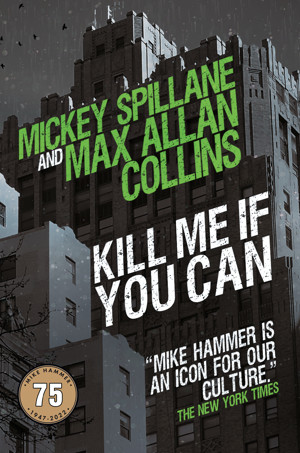
Another announced (but never published) example is the Mike Hammer novel, Tonight I Die, which existed in Mickey’s files in three forms: radio, TV and movie scripts. One of these became a short story, “The Night I Died,” the radio play version of which I adapted during Mickey’s lifetime for the anthology The Private Eyes. I have done another pass on that and it will finally appear under the original title, “Tonight I Die,” in the forthcoming Wolfpack/Rough Edges collection, Stand Up and Die! Another version (the screenplay one) has become Kill Me If You Can, a Hammer novel that will be published in August.

Confused yet?

The Menace
Trade Paperback:
E-Book:

Allow your head to clear, then pre-order The Menace, which will come out later this month, again from Wolfpack/Rough Edges. The outstanding cover appears here for the first time. This is a novel I developed from a screenplay that appears to have been either a feature film or the pilot for an unrealized anthology series. Mickey had been toying with an Alfred Hitchcock Presents type of show for years, intending to host it himself. This script dates to the early ‘80s (possibly a bit earlier) and, while he always spoke to me of it as a movie project that he would produce and perhaps direct, the surviving version is rather short (under fifty pages).

That required fleshing it out some, and it became a full-length (but not lengthy) novel of 40,000 words. (We are including a short story and a non-fiction true crime piece by Mickey to round out the book somewhat.)

The Menace is unusual in that it’s a horror story, although it does have mystery elements (but then horror stories often do). Mickey conceived it as a sort of response to the overwhelming success of Stephen King in the literary marketplace. He disliked King’s use of the supernatural – he avoided that in his own writing – but considered King “a great writer.”

More on this later.

* * *

Those of you who have followed these updates over the years are well aware of my enthusiasm for Bobby Darin, the late great singer who gave us everything from “Splish Splash” and “Dream Lover” to “Mack the Knife” and “Beyond the Sea,” as well as “If I Were a Carpenter” and “Simple Song of Freedom” and memorable film appearances in Pressure Point and Hell is For Heroes.

I discovered Darin at age eleven when I saw him singing “Mack the Knife” on a Heart Fund special. I have never been the same since. The combination of a confident, sardonic singer, who moved with a dancer’s grace, and the dark story of a Jack the Ripper figure, widened my eyes in a way that hasn’t shut them yet.

I’d been aware of him, a little, because of “Splish Splash,” which at age ten I’d loved as a novelty record in the vein of “Purple People Eater” or “Witch Doctor.” “Mack” was something entirely different. I somehow scraped together enough to purchase his swinging standards album, “That’s All,” and received “This Is Darin” for my birthday, 1960. I collected everything I could get my hands on, searching record stores for his (even then) rare Decca releases going back to ‘56. A year or so later, I discovered Mickey Spillane, and my classmates at Grant Elementary (and later Central Junior High) were divided into two groups: those who knew me as the Bobby Darin guy, and those who knew me as the Mickey Spillane guy.

The bloody storytelling of “Mack the Knife” was the connective tissue. As I grew older – something Darin did, too, but not for long, dying at 37 in 1973 – I came to learn Darin had suffered a heart condition from childhood and had been told he wouldn’t live past thirty. And I now understand that “Mack the Knife” – and “Artificial Flowers” and such lesser known fare as “Gyp the Cat” and “Goodbye Charlie” – were the singer thumbing his nose at death. Even “Beyond the Sea” seems to have that resonance.

Darin has never gotten his due. I have long felt that if one singer/songwriter of the 20th Century was chosen to represent every facet of popular music, Darin was the obvious choice – not that he was the best in every category, but his curiosity as an artist, and his death-sentence desire to explore everything that interested him while he had time, makes him unique. His two major areas – rock ‘n’ roll and the Great American songbook – tend to get him dismissed in both genres. But try to imagine Frank Sinatra singing “Splish Splash” or Jerry Lee Lewis doing “Mack the Knife” and you’ll get the idea.

The other day I stumbled onto something that might be called an epiphany, if I could put it into words. Having turned 74, I feel more and more removed and detached from the younger world. For the first time, I can find nothing in popular music that I can relate to. Even movies interest me less, and pop music and mainstream movies have always been at the center of my adult (and childhood) life. It’s easy for people my age to feel the world moving away from them. Maybe it’s God’s way of making it easier to let go.

But then, quite by accident, I came upon something delightful. Something that made me smile and even laugh and feel a sense of common humanity with people decades younger than me. None of these people were old and white; most were Black and young. And I got such a kick out of sharing time with them on You Tube.

You may be hipper enough than me to already know about this, but a genre of You Tube posting has people younger than me (which is most people) reacting to music from earlier generations, hearing for the first time very famous songs from another era. Mostly this is ‘50s and ‘60s and ‘70s rock and pop music. Now, as someone who has difficulty – extreme difficulty – finding anything to admire about Rap and Hip Hop, with the notable exception being that those forms are at least not Country Western – I can’t properly express the life-affirming joy I felt seeing young people listening to Bobby Darin for the first time and being blown away.

There are at least a dozen of these out there, but I’m going to share a few of my favorites with you.

Here’s the Rob Squad, a cute, smart couple hearing “Mack the Knife” for the first time. Watch the young woman start picking up on the subject matter of the song, and then nudge guy – who’s been grooving along – to pay attention to the lyrics.

India Reacts has a very fun young woman picking up almost immediately on the murder spree and her reactions are wonderfully entertaining. She had earlier heard and loved “Dream Lover” and is not prepared for the dark alley Darin goes cheerfully down.

Another fun couple, Shawn and Mel, discover the magic of Darin doing “Beyond the Sea.” It should be noted this is Darin lip-syncing on a Dick Clark nighttime show (the standard practice) and he is probably all of 24 years old…but his smooth confidence and humor and ease is on full display. But the real point here is the infectious, positive energy of Shawn and Mel, and the power of Darin and good popular music spanning the decades like they’re nothing.

Dani’s “I’d Rather Be Listening” gives us a great live performance of “Mack the Knife,” and her reaction is smart and fun.

This older gent, Harry, reacts beautifully to “Beyond the Sea.” And then he looks Darin up and lets his audience know what a genius he’s stumbled upon. A great post. Thank you, brother!

I am so relieved to known that smart, cool people will be here after I’m gone.

M.A.C.

Perdition Years Later, Proofing Copy-Edits & New Spillane

Tuesday, March 29th, 2022

As you may know, the Antiques books – the current one, Antiques Carry On is out now in trade paperback – are now published by Severn, based in the UK but also distributed here (and of course Mike Hammer’s publisher, Titan, is in England as well). So perhaps that explains the photo of a satisfied reader that we received, courtesy of our friend, Gene Eugene.

The Queen's Restorative Reading
* * *

Screening of Road to Perdition last week at the Figge art museum in Davenport was fun – it was nicely attended by a somewhat captive audience of Scott Community College students who’d been assigned the graphic novel, among others whose arms had not been twisted to attend.

There was a hitch that took it from the auditorium to the lobby, where the presentation was not ideal but it served the purpose. Matt Clemens and Barb and I took questions after, and I talked too much. Apologies to one and all on that score.

I hadn’t seen Road to Perdition since the Blu-ray came out in 2010 – twelve years! I was struck that my reaction to everything I liked about the film on first seeing it and everything I hadn’t liked (big and small and in between) remained exactly the same. I still wish I’d had a crack at the dialogue, some of which I find stilted, and that the ending were mine – that Jack Lemmon hadn’t died and left the narration (obviously written for an adult looking back on his life, as in the graphic novel) to young Tyler Hoechlin, the book’s real ending scrapped for a Hollywood one.

But I still love the thing. It has such a nice mood, and it picks up on so many visuals from the book (Richard Piers Rayner, God bless you), and stays mostly true to my story. I was after a combination of big city gangster film and rural outlaw movie, and the filmmakers got that. The Paul Newman/Daniel Craig father-and-son relationship is handled better than I did. The cast remains amazing, and I still feel like I’ve won the lottery. And the speech in the church basement is beautifully written.

Over the weekend, Barb and I watched the new 4-K remastering of the three Godfather movies, and how much influence the first Godfather had on the Perdition film was incredibly obvious – in a good way. Several critics at the time called Perdition the best mob film since The Godfather and Godfather 2, and I don’t disagree.

One of my few career regrets is that we never got Road to Purgatory made. My buddy Phil Dingeldein and I worked mightily to get that done. I still have a script for it that I’m proud of…and which I hold the rights to.

If anybody’s interested, now’s the time. Hoechlin has grown up in a super fashion, and Stanley Tucci can be found in a kitchen somewhere. (We killed everybody else.)

* * *

Things in publishing have two speeds: slooooooooow, and effing fast.

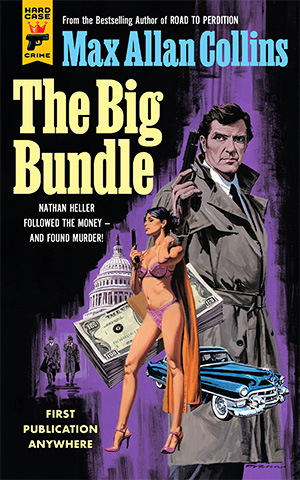
I just delivered The Big Bundle to editor Charles Ardai at Hard Case Crime last week, and he had it copy-edited and back to me by the weekend. Charles is incredibly fast, and has a terrific eye. He is respectful of what I write but calls ‘em as he sees ‘em, which is to my benefit. Amazingly, the book has been put to bed but for my eventually proofing the final copy-set copy.

On the other hand, Spillane: King of Pulp Fiction took quite a while to get to me from the editors at Mysterious Press (which is more typical). They have been gracious about giving me the time I need, but I will be tackling the job this week, which should be sufficient. A non-fiction book is a more demanding thing, at this stage, but I will face all kinds of fact-checking questions.

I dread the copy-editing stage, as I’ve made clear here many times. About one out of three times at bat, I get saddled with a copy editor who appoints him- or herself my collaborator, and not the person preparing the text for typesetting. I have been rewritten more times that the Holy Bible, and I take it just a little worse than God.

But this goes with the territory.

I also proofed the type-set version of The Menace, the crime/horror novel by Mickey Spillane and me, coming from Wolfpack’s Rough Edges Press. It’s a book developed by me from an unproduced film script Mickey wrote probably in the early 1980s. He had Stephen King on the brain, I think, seeing that King was developing into the kind of celebrity bestselling author that he (Mickey) had been.

In addition I read the galleys of Mickey’s The Shrinking Island (introduced by yours truly), which collects the three young adult adventure novels he wrote in the ‘70s. The title story has never been published before. It comes out soon – April 7 – and if you’re an adult Spillane fan, it’ll make a grinning kid out of you.

The first of the three Larry and Josh adventures, The Day the Sea Rolled Back, was a big influence on The Goonies. I was at Mickey’s house when he got a call from Steven Spielberg (not sure whether it was Spielberg himself or one of his “people”), inquiring about the availability of The Day the Sea Rolled Back for the screen. Mickey told whoever it was that he wasn’t interested in dealing with anybody in Hollywood except Jay Bernstein (his Mike Hammer TV producer). And before long came…The Goonies.

The other YA yarn is The Ship That Never Was. Check out this new collection. The cover, which I’m including here, is (obviously) a stunner.

The Shrinking Island
Trade Paperback:
E-Book:
* * *

Mystery Tribune lists its favorite Irish mob movies and Road to Perdition is included (no mention of the book’s author, though – who was that again?).

Syfy rates the top best eleven R-rated movies based on comic books and suggests that Road to Perdition may be the best one.

Here’s a great Bookgasm review of The Many Lives of Jimmy Leighton.

And another great Bookgasm review of Fancy Anders Goes to War.

M.A.C.