Posts Tagged ‘True Noir’

You Tube and Me (And How to Be a Fiction Writer!)

Tuesday, May 28th, 2024

I have gotten into the habit of looking at a lot of YouTube of late. Working on a big project like True Noir – the ten scripts for a massive audio production of the first Nathan Heller novel, True Detective (1983) – I find the bite-size offerings that YouTube serves up make ideal late night comfort food. Earlier in the evening, I have usually watched a movie on physical media with either my wife Barb or my son Nate – who comes down from his house up the street after he and his wife Abby manage to get our two grandkids Sam and Lucy to bed – and don’t feel like digging into another feature-length presentation.

The algorithm YouTube uses to generate new offerings on their “recommended” feed – fed by what you last watched and by your subscriptions – means there’s always something new to watch. Unfortunately the flaw is that if you sample something just to get a look at it in the “what’s this about?” sense, you get barraged with material generated by that sampling. Look at one Jordan Peterson video and you’ll get ten more. Look at one Jimmy Carr video and get you swamped in those, but also other “offensive” comedians. Check out Steve Schmidt’s The Warning and receive an avalanche of anti-Trump material. Videos on filmmaking often attract my attention, particularly ones on micro-budget indies.

Sometimes that’s okay. You learn things and at times your interests are fed (as opposed to simply your curiosity). I watched a Ballistics Burgers video and enjoyed it and now I’m on my way to learning how to make a delicious cheeseburger, if I ever get around to trying. And the algorithm thing led me to Robert Meyer Burnett of Robservations and Let’s Get Physical Media, who is now my collaborator on the Nathan Heller audio project, and Heath Holland, whose Cereal at Midnight I am now guesting regularly on (or irregularly – about once a month). Both Rob and Heath are now good and valued friends of mine.

You quickly learn that some of the presenters on YouTube are naturals at it – like Rob and Heath – and others are just guys in their basements with the appeal and communication skills of somebody who just starts talking to you in the supermarket. A YouTube video with a subject that interests you, or just intrigues you, is not guaranteed to include a presenter who ought to be presenting. It’s a democratic landscape, but we all know democracy is messy.

Recently I checked out a few videos purporting to teach novices how to write. I am always willing to learn – after all, I’ve only been doing this since I was in junior high in the early 1960s, and writing professionally since 1971. I have since been bombarded by tips on how to avoid “filter words” (a very popular phrase right now) and words to never use (like “very,” which I just did).

What is disconcerting about these videos – and I’ve sampled a bunch, meaning my YouTube feed will drown me in the damn things for a while – is they feature (A) very young writers…damn, I did it again!…or (B) writers you’ve never heard of, or (C), young writers you’ve never heard of. Many tend to be young woman (under thirty) who speak with clear-eyed confidence in training others how to do what has enabled them to become successful writers. Being a successful writer among these self-appointed teachers of the craft often means they self-publish, though that fact is usually glossed over quickly.

Not all of this advice is good, but neither is it necessarily bad. But who are these people, except up-talking young ‘uns who have no business giving advice to anyone? Never mind, because (as I say) not all their advice is bad, and they often do discuss important topics like writing a good first sentence and whether or not to outline.

The problem, beyond too much self-confidence and an overwhelming desire to fill a YouTube screen with their face, is that fiction writing can’t really, not exactly, be taught. I used to do seminars – for a long time, it was every summer at Augustana College in Rock Island, and a lot of my attendees went on to successfully publish – but I always made the point that fiction writing has no rules, just strategies. No right or wrong, just what works. For you. The individual.

I had tips and shared them. For example, I discouraged opening with a line of dialogue, a practice in which a lot of writers (including published ones, even successful ones) indulge. I would point out to those attending the seminars that opening with dialogue does not tell you enough – you don’t know who is speaking or where they are uttering this supposedly reader-catching bit of fake human speech.

Both opening with dialogue and avoiding doing so, however, are a strategies. Tactics. Not rules.

I have written here before about how useless I consider advice from the likes of Elmore Leonard and Stephen King is to wannabe authors. Not because I think Leonard and King are bad, but precisely because they are good. Better than good. They are great storytellers who have developed their methods by trial and error, and by having grown up as little Leonards and Kings consuming a lot of narrative storytelling, both novels and movies and maybe even the occasional play.

No quick path to learning how to write fiction is available. None. You have to be obsessive about storytelling – wanting to tell stories, wanting to read/see/and-ultimately create stories. But it’s mostly strategy.

What should the first line be? Is the basic story I have in mind better served by first person prose or third person? How is point of view best served in this piece of fiction? The answers to such questions come from the individual writers.


James M. Cain

Mickey Spillane

Donald E. Westlake

James M. Cain taught me to write dialogue (also Jack Webb on 1950s Dragnet). I never met Cain (or Webb), but they taught me by example. Raymond Chandler and Mark Twain schooled me in writing in first person. I came to know – personally know – Mickey Spillane and Donald E. Westlake. But I learned writing action/violence scenes from Mickey and sublime point-of-view technique from Don, long before I met either one outside of the pages of their books.

Some young blue-eyed girl, staring out at you from the television (or “monitor,” to you younger folks) is not going to tell you what a grown-ass woman like Fannie Flagg or even Ayn Rand will. Rand is a good example because she did a lot of things wrong, but also a lot of things right. That kind of successful writer can stimulate thinking along the “I should do this but not that” line. People of less than genius intelligence (like me) can learn more from Harold Robbins in The Carpetbaggers than Marcel Proust in Remembrance of Things Past – particularly when you are starting out to teach yourself in junior high school.

I don’t mean to pick on the females here, because plenty of guys – particularly in the screenwriting area – are turning their own experiences into rules for the easily swayed. I started watching a video where the interviewer was acting like he was in the presence of a real master of the craft – Robert Towne, maybe, or (again) Elmore Leonard – and when the uber-confident dispenser of screenwriting craft’s credit was finally mentioned, the guy had written a Charlie’s Angel movie.

When I was doing seminars, I worked with a lot of young women of all ages who wanted to be romance writers when they grew up (some of these young women were twenty, others sixty with all stops between). They did a lot of things right, in their fiction, and often came together in writers’ groups and helped each other learn and grow. I found then, and believe now, that this kind of thing is positive. Workshops, like the Writers Workshop at the University of Iowa where I fought many battles, gets you down in the trenches with other writers, discussing specifics like plot and character, not “rules,” learning tactics, not “never use adverbs.”

Most of the people telling you never to use adverbs do so in sentences that contain adverbs.

There is only one teacher who can teach you writing: you. The fiction you love will guide the way. Looking at novels and stories (and movies) that are favorites of yours, but doing so in an analytic way, can be helpful. Hitchcock can teach any writer and that isn’t even what he’s trying to do.

Of the young, clear-eyed women teaching others how to write on YouTube (often with pets lurking in the background, scene-stealing), almost none of them discuss first-person writing, or understand that many of the “filter” words to avoid are crucial to writing effective first-person. Barb and I (as “Barbara Allan”) use two narrators in the Antiques novels, neither of whom is a trained writer, which is a great source of fun for us in the books and, we hope, for readers.

One of these very young (“very” again!) writers weighed in on a topic I’ve explored here quite a bit – the wrestling match I sometimes have with editors and even readers about my insistence on describing what a character is wearing. This young writer said she got around that by simply stating something along the lines of “Joe was a sharp dresser” and never describing Joe’s wardrobe again in any way throughout the novel. That’s a choice. A tactic. But I consider physical description and a rundown on wardrobe to be key elements of characterization, at least as I approach it.

That’s all for today. I have Steve Schmidt and Jordan Peterson videos to watch.

* * *

The first Quarry’s Return reviewer has appeared and it’s a nice one.

How to read the Nolan books in chronological order.

And Road to Perdition is once again cited as an outstanding film from a comics source.

M.A.C.
True Noir News, Another Nomination Plus a Serving of Fudge

Tuesday, May 14th, 2024

The crowd-funding effort at Kickstarter for True Noir: The Casebooks of Nathan Heller has been postponed until June (exact date to be shared when I know what it is) because we’d be in conflict with another crowd-funder our star Todd Stashwick is involved with. We don’t want to be competing with somebody in the family. (True Noir is directed by Robert Meyer Burnett and is a fully immersive audio drama. In production now!)

Also, I’m going to be announcing soon the next indie film I’m doing, and I won’t be crowd-funding that, either. But any of you who are interested in contributing to the production will be invited to contact me directly. Associate Producer credits and first edition books of your choice will be in the offing.

* * *

After all the talk about winning and losing awards last week, another nomination has popped up for Spillane: King of Pulp Fiction by Jim Traylor and me. I’ve spoken here before about how meaningful this work is to both my co-author and myself – our many decades-long friendship grew out of the need for two Spillane enthusiasts to work together on one Spillane literary bio. We were stymied a bit by Mickey’s insistence that he would cooperate but only in terms of a book about the Mike Hammer/Mickey Spillane by examining his fiction and limiting the biographical material to a short single chapter.

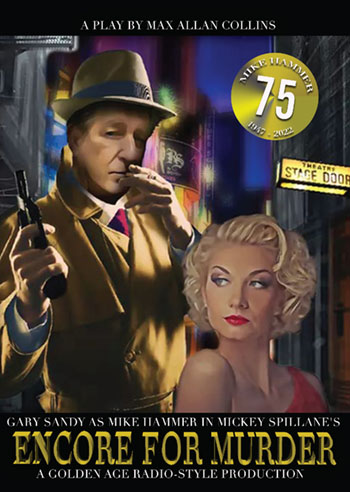
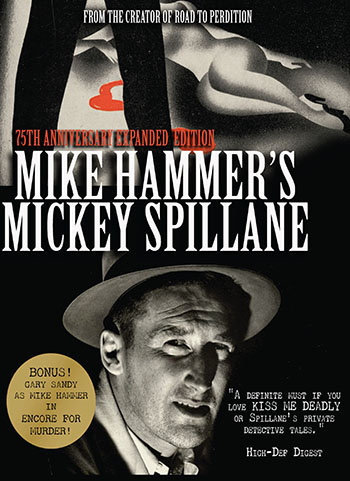
Mickey wanted to write his own biography – that is, autobiography – but he never got around to it. He did cooperate with me (and how) on doing a documentary on his life and work, which became Mike Hammer’s Mickey Spillane (1998), which has been expanded by my collaborator Phil Dingeldein and myself into a special edition now available from VCI (and on Amazon, of course). As a bonus feature it includes the 90-minute program (kinda a movie), Mickey Spillane’s Encore For Murder, the radio-style play we mounted here in Muscatine, Iowa, as a fund raiser for the local art museum. My Mommy’s Day star (co-star with Patty McCormack), Gary Sandy (of WKRP in Cincinnati fame) came in to play Mike Hammer. Gary was so terrific that, at the last moment, I decided to record the show (and our little movie version was edited by Chad Bishop and myself from one dress rehearsal and the lone performance).

Some of you will recall a longer radio version of Encore was done for Brilliance (there were two done, both Audie Award nominees and one winning, The Little Death) with Stacy Keach in his iconic role as Mike Hammer. Gary portrayed Hammer for me in two stage productions of Encore, one at Owensboro, Kentucky, another at Clearwater, Florida.

Anyway, the Spillane documentary is available on Blu-ray as mentioned above, with the 90-minute Encore for Murder as a special feature. Encore is also available alone as a DVD.

Some years ago, in its first incarnation, Mike Hammer’s Mickey Spillane won an Award of Excellence from the Iowa Motion Picture Association. And in 2023 I unexpectedly won Best Director from the Iowa Motion Picture awards for the production. So there have been various awards, I’m happy to say, connected to all of these endeavors.

We, of course, lost the Edgar (as I expected to) to a bio of James Elroy (not my favorite author). And now we’re up against that book, and a number of others, nominated for the non-fiction Anthony, the awards named for critic Anthony Boucher given at Bouchercon. I’ve won one of those before, in 2005, for The History of Mystery (written with George Hagenauer). I’m not going to Bouchercon in Nashville, August 28 – September 1, as I’ll be shooting my next indie movie at the time. Because it’s a fan event with the voting going on at the event, it would be a good thing to be there, since that amps up your possibility of winning. And I’ve been to many a Bouchercon, but just can’t make this one.

Which makes this a good time to request that those of you attending Bouchercon 2024, who liked the Spillane book, consider voting for it.

But, as I discussed here last week, I really did and do consider the Edgar nomination a major victory for this biographical study of the genre’s most controversial figure. And I could not be more thrilled by this surprise Anthony nomination – and I know editor Otto Penzler, co-author Jim Traylor and, hell, my agent Dominick Abel are also pleased.

To those of you out there whose votes got us included among the nominees, you have my sincere thanks. Two nominations among the handful of the genre’s major awards (no, it’s not a leg lamp) are nothing to sneeze at. And I ain’t sneezing.

Speaking of awards, I’m going to provide a window onto a January 1968 performance on The Ed Sullivan Show by a rock group that is not in the Rock ‘n’ Roll Hall of Fame. This may seem like a non sequitur to some, but longtime fans/readers of mine will probably recall that (as is the case with Bobby Darin) I am a huge fan of that particular, incredibly great, historically significant and hugely influential band who have been roundly forgotten by the rock organization that is too busy giving out its awards to Hip Hoppers and country western artists than to recognize true pioneers in the field.

But, as my wife says to me frequently, “At least you’re not bitter.”

M.A.C.

True Noir Is Coming, Criticism and Me, Plus Movies!

Tuesday, April 30th, 2024

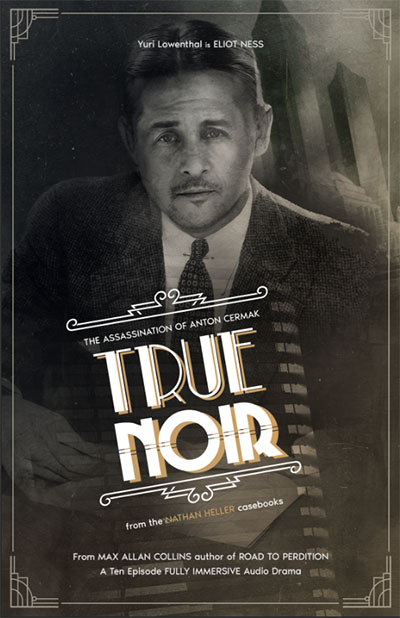
The Kickstarter crowd-funding campaign for my new project may go live as early as tomorrow (as you read this – it’s tentatively set for May 1). This is to support True Noir: The Nathan Heller Casebooks, a fully immersive audio production based on the first book in the series, True Detective. I am writing all ten scripts myself.

My talented director, Robert Meyer Burnett, is assembling a great cast, led by Todd Stashwick of Picard and the 12 Monkeys TV series (and much more). Impressive names are being sought, a number of whom have already said yes, but these will be parceled out to the public as the crowd-funding campaign continues.

Here again is a link to the 12-minute proof-of-concept audio we put together.

It’s based on the first chapter of Stolen Away, which is not the book we’re adapting but was chosen for its combination of establishing Heller in an action situation.

It’s truly odd returning to True Detective (no relation to the HBO show that came after) for the first time in over forty years (!). Also the form is one that has special challenges. The story has to be told in completely audio terms. Its length ultimately will be three times longer than a film adaptation, but still substantially shorter than the 100,000-word novel I’m adapting.

I do find myself pleased to tweak scenes and make them better than the first time around (in 1981!) but at the same time I’m trying to honor the work of the young writer who wrote the novel so long ago.

Fortunately, as some of you know, I wrote a number episodes of the web series Fangoria’s Dreadtime Stories, so I’ve written radio-style scripts before and feel I’m fairly adept at it. But nothing as long-form as this, a script of ten episodes that will ultimately add up to over 300 manuscript pages.

I have high hopes for the quality of what we’ll produce – and for its reaction among listeners. As the Heller series winds its way toward its last entry (which I am contracted to write for Hard Case Crime this year), I am happy to be revisiting where the saga began. And it may open the door to more adaptations, and bring more attention to Heller from new readers and perhaps even the TV and movie world.

There will be a strong physical media component. We’re planning a Blu-ray that will contain the entire audio drama, the production of which will be elaborate and truly a movie for the ears; but also an hour-long interview by Rob Burnett with yours truly, footage shot in Chicago of star Todd Stashwick, and much more (my longtime collaborator Phil Dingeldein shot this footage). There may even be a vinyl version!

* * *

You know what my greatest strength is as a purveyor of long elaborate lies? (AKA novelist.) It’s how well I take criticism.

Insert hysterical laughter here.

I have no idea what it is in my psychological make-up that makes me react so badly to criticism. I have a ridiculous amount of self-confidence, but the inflated balloon of my ego is easily pricked. Especially by pricks.

Recently I got dinged at Black Gate, an interesting genre-oriented website where this lovely review of (yup) True Detective appeared in 2018.

But someone named Thomas Parker (the word “Editor” is next to his name but he’s not listed among the Black Gate staff) criticized Charles Ardai and Hard Case Crime for using their line as “a Max Allan Collins manuscript dump.”

This gratuitous cruelty appealed to my poor judgment and I replied, but Black Gate did not post that reply. I never understand the reluctance of websites and publications to allow authors – even those like me with poor judgment – to respond to this kind of thing, when they allow people like Parker to prattle on in the first place.

My response was perhaps less-ill-judged than usual because I was defending a great publisher, and editor, who have almost single-handedly kept 1950s-style noir novels alive, both through reprints and books by contemporary authors.

Anyway, here’s what I wrote that did not appear:

HCC a “Max Allan Collins manuscript dump”? Well, yes. Among the manuscripts I dumped (or helped dump) at HCC are The Cocktail Waitress by James M. Cain; The Comedy is Finished by Donald E. Westlake (I provided the manuscript that Don had given me when he abandoned the project); and the first posthumous, 80% completed Mickey Spillane manuscript (Dead Street) and Mickey’s last completed novel (The Last Stand). I also encouraged the republication of Rex Stout’s early pre-Nero Wolfe novels. When editor Charles Ardai made me the first living author he published (in the first year of HCC), he sought to reprint the second Nolan novel, Blood Money. I gave him instead both the first Nolan (Bait Money) and Blood Money to be published together at the same rate he’d offered for just Blood. After that twofer was published, Charles wanted more reprints but I offered to write new novels at the reprint rate because I relished the chance to write whatever I chose. What I chose was The Last Quarry, designed to end that series but becoming surprisingly popular, which led to more, still at the same reprint rate (which is what I still get, actually a little lower now). That Quarry novel led to a feature film and an HBO/Cinemax series, which led to Charles reprinting the original Quarry novels with McGinnis covers. The Nolans followed, with the first new one in thirty years (Skim Deep) written at Charles’ request. He is, incidentally, the best editor I’ve ever had. Lately I’ve written two Nathan Heller novels — the Edgar-nominated and Shamus-winning historical PI series — for HCC, still at the same reprint-level rate despite being 100,000-word books. I will be doing one more for HCC, ending the series. You may prefer dead authors, but I am 76 so you don’t have long to wait.

I might add to this that I have not foisted any unpublished manuscripts from my drawer for HCC to publish or even consider. Nothing of that kind exists. The only unpublished book from my drawer that I did allow to be published was the first Nolan novel (sans the Jon character), Mourn the Living, which I let be serialized in a fan magazine back in the ‘80s. Later several publishers asked to collect the serialized novel into a book and I allowed that. And when Charles Ardai wanted to reprint all of the Nolan novels as two-fers, when we got to Spree (a rather overlong entry and, at the time I wrote it, another attempt to end a series), he asked to include Mourn in that volume as a bonus.

Look. I understand writers need to learn to take criticism well (I’m still working on that). And I have learned from critical reviews from time to time when the reviewer pointed out some weakness of mine I hadn’t seen or anyway been able to overcome; that’s called constructive criticism, and I may not love getting it at the time, but it can – and often does – pay off.

Sometimes readers, reviewers, just don’t like your stuff and that’s their privilege, obviously. I know that my propensity for describing characters and their clothing in some detail alienates some readers/reviewers. But I’ve explained why I do that, here, any number of times (it has to do with characterization). I’ve been a professional novelist since 1971 and that’s always been the technique I’ve used. That doesn’t make it right, but it does indicate a choice as opposed to some blind flaw. And I am still trying to exercise that approach in a more economical way.

I do not think it proper for me to respond to a thoughtful negative review. But a gratuitous swipe? I do not have enough character to just let that pass.

Or as my wife Barb says when somebody attacks me, “Don’t they know you’re the guy who created Quarry?”

* * *

I generally like Guy Ritchie’s films, which might best be described as British variants on Quentin Tarantino but funnier. Along those lines, I heartily recommend The Ministry of UnGentlemanly Warfare. I freely admit that I thought the bold on-screen claim at the start that the film was based on a true event had to be tongue-in-cheek nonsense.

Then at the end of the film came photos of the actual people and little whatever-happened-to paragraphs.

Turns out historical events and people are at the heart of it, but the outrageousness of its exaggerated version of those events (and the people therein) was such that my assumption that history had nothing to do with it seems reasonable.

Basically it’s a rousing adventure story in which many, many Nazis are slaughtered with relish (and catsup and onions) by the roughneck heroes. What makes it particularly interesting to me is its inclusion of Ian Fleming and Henry Cavill’s dashing and bloodthirty hero, a reflection of the historical figure Major Gustavus March-Phillipps, who was one of Fleming’s role models in creating James Bond.

And it’s cheeky fun that Cavill – often talked about but apparently looked over in the post-Daniel Craig Bond sweepstakes, is playing a guy the character was based on.

Cavill, who appears to be having the time of his life, is joined by a strong cast including Avan Richardson, Elza Gonzalez, and Babs Olusanmokum. I hope you don’t think less of me, but I could watch Nazis getting obliterated all day.

Speaking of the home-grown variety, many nasty folk meet their doom coming up against Jason Stratham (a Guy Ritchie graduate) in one of his best, The Beekeeper, out on home video and streaming here and there right now. I love Stratham, but his list of films is spotty. This one is high on the list (though it does go perhaps too far over the top in the final third), probably right behind the outrageous Crank movies.

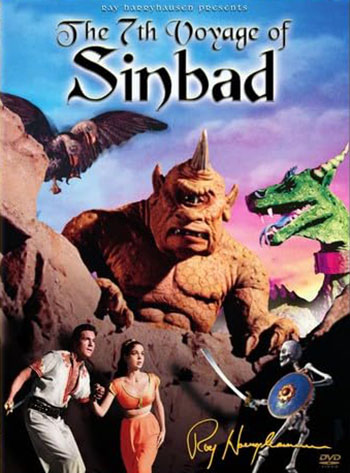
For those of you following the saga of introducing my eight year-old grandson Sam to movies not entirely designed for kiddies, we have gone from King Kong (1933), which he loved, to the Ray Harryhausen fest, The Seventh Voyage of Sinbad (1958), which he found utterly amazing. I did, too. It’s a movie I saw on it’s first release when I was probably ten and was blown away then, and now.

Lots more Harryhausen to come!

M.A.C.

True Noir, Dick Tracy and King Kong

Tuesday, April 23rd, 2024

The crowd-funding campaign for True Noir: the Nathan Heller Casebooks at KickStarter is set to go live on May 1. I have delivered the first of ten-episode scripts (the production is based on my novel True Detective) and everyone seems pleased. Director Robert Meyer Burnett has started casting. Todd Stashwick of Star Trek: Picard and the 12 Monkeys TV series has been onboard to play Nate Heller for a while now, and in fact you can hear the 12-minute sample starring him – our “proof of concept” – as Nate right now. Right here:

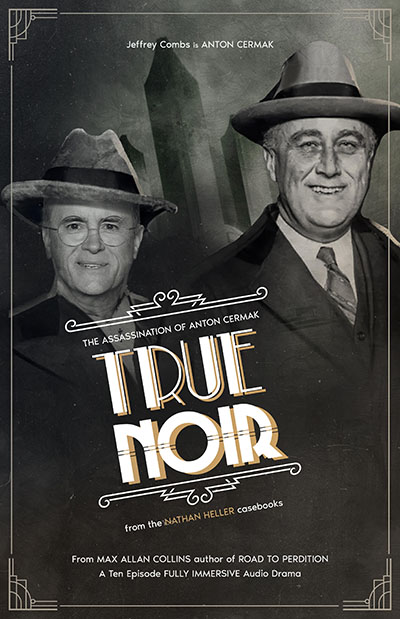
Longtime readers of the Heller saga will recognize this as the beginning of Stolen Away, but that was just chosen as a way to intro newcomers to Heller and to give director Rob Burnett a chance to get the concept on its feet. We’re starting with True Detective, the first novel of course. In addition to Todd, several other notable actors have signed on, including a favorite of mine, Jeffrey Combs of the Re-Animator movies, as Mayor Anton Cermak. The image we’re sharing here is still in progress but you should get a kick out of it.

Jeffrey Combs as Mayor Anton Cermak in True Noir

I am about to dive into the remaining nine scripts (each episode should be in the 35 – 40 minute range) and this is now my current major project. I have a very busy remainder of the year ahead: the last scheduled Mike Hammer novel (Baby, It’s Murder), another Antiques novel (we have just signed to do two more!), and what looks to be the final Heller.

This past week was a busy one. Work on preparing the materials for the VCI/MVD release of Blue Christmas continued, with producer Chad Bishop in the lead. I recorded three (!) Blu-ray commentaries – Chad and I did the Blue Christmas commentary (and he did a great job), and for VCI I recorded commentaries for two mid-‘40s RKO Dick Tracy movies: Dick Tracy Vs. Cueball and Dick Tracy Meets Gruesome. These are for an upcoming Blu-ray release of the four RKO features, a boxed set that looks to be a jam-packed affair with multiple commentaries and much more.

I had done commentaries for the other two Tracy films (Dick Tracy and Dick Tracy’s Dilemma) in 1999 for the late Cary Roan, and these are included. Now, a quarter of a century later, I found myself completing the quartet of B movies for Robert Blair at VCI. I’ve always been fond of these films, though the sometimes lauded Gruesome is by far my least favorite, but did not expect to revisit them ever again.

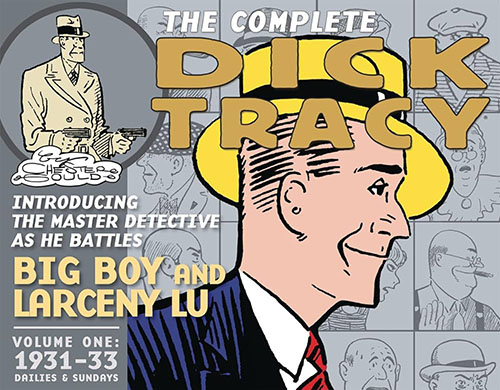
As I have expressed here on occasion, my bitterness over being essentially fired from Dick Tracy – the strip that I had, in my estimation and that of others, saved from cancellation – had been deep and abiding until I was called upon by editor Dean Mullaney (who had first published Ms. Tree) to put on my Big Boy pants (so to speak) and write introductions for the IDW volumes that would collect the complete Chester Gould. I took on that task, spanning a number of years, and reminded myself how much I liked the strip and basically came to terms with the firing that frankly opened the door on much else good that has happened for me. Probably no Road to Perdition, for example, had I still been on Dick Tracy.

This is not to say I don’t retain some bitterness. I was told by a reliable source that the Joe Staton and Mike Curtis team (who’d been approached to take the strip over after Dick Locher’s passing) asked why the Trib wasn’t returning to me. The editor there (a newer one I had never met) reportedly said, “Why would we make the same mistake twice?”

Nonetheless, revisiting Tracy in both the IDW volumes (a long-running series now completed) and again last week by way of those four fun RKO B-features was indeed like Old Home Week. Tracy was my childhood introduction to crime fiction (and comics), and the first big break of my career.

Speaking of Road to Perdition, I was pleased to see the movie version again turning up with some very impressive neighbors — number 17 on Ranker’s list of The 90 Best Mafia Movies Of All Time.

By the way, when I recorded the two Tracy commentaries I did so with my longtime collaborator Phil Dingeldein at my side. Phil is the Director of Photography on most of what I’ve done in the world of indie filmmaking starting with Mommy (1994) and continuing through this year’s Blue Christmas. Between the two recording sessions for the pair of Tracy movies, Phil and I took lunch and discussed the revision I did recently of my script for a proposed film of Road to Purgatory, my prose sequel to Perdition. It’s a low-budget version (not “low” in my usual scrounging sense, but the Hollywood sense) designed for me to be able to direct myself.

That, frankly, is part of why I undertook doing Blue Christmas and am preparing another feature to shoot late this summer – I want to see if the Old Boy still has it in him. And I’m not referring to Phil.

Road to Purgatory has been the dream project for a long, long time. We’ll see if a dream is all it is.

* * *

For several years now I have spent Saturday afternoons with my grandson Sam, watching movies. We began with animation, including classic Warner Bros and the Fleischer Popeye and Superman cartoons. After that it was 3-D Blu-rays that were mostly CGI – Pixar and others – with occasional live action like the Spy Kids movies (some of which are also 3-D – my obsolete 3-D screen got a workout).

In recent months we’ve delved into comedies, in particularly the Pink Panther movies (skipping the first two) and The Great Race, the latter being more of writer/director Blake Edwards at his comic best. I’ve been edging up on some things that I loved as a kid, and Sam’s father Nate also loved (though not Lone Wolf and Cub yet – Sam is just eight!) (of course so was Nate at the time).

So this week we watched the 1933 King Kong. Barb had warned Sam that the first half hour or so was pretty boring, a lot of it on the ship sailing to the island with Skull Mountain. But Sam never wavered. He wanted to see the whole thing. When Kong arrived in all his gorilla glory, I explained stop motion to Sam – that Kong was mostly a puppet recorded incrementally, and that also a giant head and hand had been used. He did not get frightened but he was into it.

At the end I searched YouTube and found a colorized clip of the fight between Kong and the T-Rex. Sam told me to make sure I stayed with it till we saw Kong flapping the defeated dead T-Rex’s jaw, which was his favorite part (mine too).

Then Sam announced that he liked the black-and-white version better.

There is hope for the world.

M.A.C.