Posts Tagged ‘True Detective’

Get Fancy, Stream at Your Own Risk & Plot, Plot, Plot

Tuesday, July 18th, 2023

Out of the blue, two nice reviews of my novella Fancy Anders For the Boys popped up on the Internet.

Here’s one from that pro’s pro, writer Ron Fortier, at his Pulp Fiction Reviews site. Ron has, in part, a very personal response that is quite fascinating.

FANCY ANDERS – FOR THE BOYS
By Max Allan Collins
Illustrated by Fay Dalton
Neo Text
118 pgs

This is Collins’ second book featuring Hollywood debutante turned detective, Fancy Anders, set in the early days of World War II. What with Pearl Harbor fresh in the minds of most Americans, the people in Los Angeles right worry about a possible Japanese invasion and the Army quickly establishes military outpost in the hills overlooking the city. Many of these set up with anti-artillery installations.

With that many boys in uniform soon flooding the streets of Hollywood, the movie community comes together under the leadership of actors John Garfield and Bette Davis to open a canteen exclusively to cater to these servicemen and staffed by cinema stars and young, beautiful ingénues.

When Army Intelligence learns of possible enemy saboteurs targeting the famous Hollywood Canteen, Fancy is recruited, along with several of her girl friends, to pose as canteen hostesses and ferret out the foreign agents. Once again, Collins uses his considerable imagination to drop the reader into the middle of one of Hollywood’s most memorable locales. Through his words, it is so easy to see the beautiful ladies, the eager young men away from home and hear the big band music. It all comes alive against a backdrop of a world turned upside in the throes of war.

“Fancy Anders – For the Boys” is a fun read. Especially for this reviewer, whose father, Pfc. George Fortier served on one of those gun crews and spend his 1942 Thanksgiving, along with two other men, at the home of crooner Bing Crosby and his family. All before he shipped out for the Philippines and three years of hell.

And here is another great review, this one from GoodReads (unfortunately, unsigned):

Fancy Anders plays hostess at the Hollywood Canteen where soldiers and sailors about to ship out mingle with movie stars in this second of three thrilling mysteries by Road to Perdition creator Max Allan Collins, with stunning illustrations by award-winning artist Fay Dalton.

October 1942. With her private detective daddy in the OSS chasing saboteurs, Fancy is stuck playing receptionist/cleaning-gal at the empty Anders Confidential Inquiries office. But then the 24-year-old Barnard grad – expert in shooting, flying and jujitsu – is recruited back into action.

Hollywood, with Bette Davis and John Garfield leading the charge, has put together a night club where servicemen are served by waiters and waitresses with famous faces, from Gable to Dietrich, from Abbott to Costello. With starlets acting as hostesses, gorgeous Fancy fits right in. But this pistol-packing mama knows her real job is solving the murder of Who Killed the Hostess – a Victory Girl who became an LA battle casualty. In the meantime, saboteurs are targeting the Canteen for maximum damage, hoping to wipe out half the stars in Tinsel Town and blast a hole in America’s morale.

Portraying the times vividly with his trademark historical accuracy, Mystery Writers of America grandmaster Max Allan Collins has created a series protagonist both of her time and far ahead of it. Lavishly illustrated by James Bond artist, Fay Dalton.

The three Fancy Anders novellas are designed as essentially a serialized novel, in the hope they will be collected (Fay Dalton’s great illos and all). My structural pattern was Hammett’s great The Glass Key. Fay is working on the third novella’s illustrations right now (Fancy Anders Goes Hollywood).

Fancy Anders Goes to War cover
E-Book: Amazon Purchase Link
Trade Paperback: Amazon Purchase Link
Digital Audiobook: Amazon Purchase Link
MP3 CD: Amazon Purchase Link
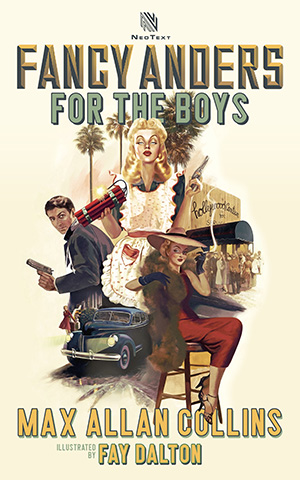
Fancy Anders For the Boys cover
E-Book: Amazon Purchase Link
Trade Paperback: Amazon Purchase Link
Digital Audiobook: Amazon Purchase Link
Audio MP3 CD: Amazon Purchase Link
Audio CD: Amazon Purchase Link

Neo Text bought them as e-books but, at my request, have also made them available in book form. This has caused some confusion from readers who can’t figure out why the books are so short, although the books at Amazon are clearly listed as novellas.

Fay’s illos (cover excepted) appear in black-and-white in the physical books and in color in the e-books. My hope is that they will be in color when the three novellas are eventually collected, and in fact I’ll probably insist they do. We have not gone out to publishers about the collected novel version as yet.

This was a Covid lockdown project, largely, and one I truly loved doing, from the research through the writing. Fancy is sort of a young Ms. Tree, though she definitely has her own personality. Within the context of my work, the novellas are reliably tough, though not as extreme in that regard as Mike Hammer, Nate Heller and Quarry.

You can get them at Amazon. Here’s Fancy Anders Goes to War.

And here’s Fancy Anders For the Boys.

As I’ve mentioned here before, Skyboat Media has done phenomenal audiobooks of the Fancy novellas, with full sound effects, music and a fine female narrator in Gabrielle De Cuir.

The Amazon links I provided will also take you to ordering info on the e-books and the audios mentioned above. But of course my preference is physical media.

Fancy Anders Goes to War is $6.99 and Fancy Anders For the Boys is $5.99 in physical book form.

* * *

My ongoing rants about my love of physical media and disdain for e-books and streaming video probably needs some clarification.

Nothing wrong with e-books. If I were younger, particularly if I were commuting by train to work or doing a lot of flying on commercial airlines for business, I would certainly have a Kindle. My son Nate has long read books on Kindle and, when he really likes them, gone on to buy those books in their proper physical media form.

A great deal of my income comes from e-books, as the links I provide here to Amazon sales on a fairly regular basis indicate. I have been very fortunate to have been one of the authors who early on was approached by Amazon, and they have kept me in print (and have sent regular checks) at a time in my career when that comes in very handy indeed. They publish physical media versions, too, but the e-books are the moneymakers.

Frankly, I was one of the handful of living authors approached by Amazon for my backlist – which included not only Nate Heller but Mallory and the “Disaster” series and a few standalones. Ian Fleming was one of the others, for example, all deceased except me. For a while they were publishing new novels of mine – including the very successful Reeder and Rogers political thriller trilogy, co-written by my pal Matt Clemens – though the current editorial staff expresses no interest in publishing new material by me.

No harm, no foul. What they already have continues to generate sales. The most recent titles are the two Krista Larson novels, Girl Most Likely and Girl Can’t Help It, which continue to sell if not at a clip at a steady pace.

But my frustration with the streaming services continues, and the writers and actors who are on strike are actively seeking help in that area, understandably. As a consumer, I am angry – but not even a little surprised – to see them (post-Covid lockdown) eliminating all sorts of stuff that I might have wanted to watch, and this includes things I bought for my library. Things like the 1950 Li’l Abner and the Sidney J. Furie The Lawyer have disappeared after I bought them, supposedly permanently.

If you drop by here regularly, you’ll know I set out to show Barb and myself every Raymond Burr-era Perry Mason episode that was based on an Erle Stanley Gardner novel or story. We have completed that mission, and I think it adds up to 90 episodes or so (remarkable that an American series did so many adaptations of the source material).

But during the relatively short time it took to do that, a whole season (season 7) disappeared from Paramount+, and a number of episodes from the other seasons disappeared without a trace much less a warning. These tended to be Gardner-derived episodes.

Fortunately, I owned the entire nine-season run on DVD and had been watching the Paramount+ episodes only because they were of the higher high-def quality. You haven’t lived till you’ve examined the wrinkles on the faces of Hamilton Burger and Lt. Arthur Tragg in high-definition.

“Incompetent, irrelevant and immaterial!” you say.

Well, I’m fussy. And some who’ve been witnessing these irrational tirades of mine frown and waggle a finger – maybe it’s all well and good for an incredibly wealthy, world-famous author (pause for my hysterical laughter) to spend some of his endless funds on one Blu-ray and actual physical book after another. And it’s true that I wallow in laserdiscs, DVDs, Blu-rays and 4K discs, and that books are stacked everywhere around here waiting in hopeless desperation to be read.

But I never meant to imply that the unreliability of the streaming services and the convenience of e-books meant that I expected you to spend your food money on physical media. Only an obsessive idiot like myself – and I am not alone, I assure you – would buy as many discs and books as I do, despite the dwindling number of years that I face ahead to actually watch or read them.

What I mean to suggest about DVDs, Blu-rays and 4Ks is that if you like a movie or TV series, if it’s one of your favorites or even if it’s just something you might think revisiting is a distinct possibility, buying those movies (and/or TV shows) on physical media is well worth considering.

And as for e-books, my son Nate’s approach makes a world of sense – read it on Kindle (or whatever), and if you really, really like it, invest in a physical copy for your book shelf.

Books by me, for example.

* * *

I intend to start writing a new novel tomorrow (Monday, July 17, as I type this) – Quarry’s Return. It is, not surprisingly, for Hard Case Crime.

I spent all of this past week (including earlier today) on plotting the novel – specifically, writing a 2500-word synopsis. In the past, I have not always plotted in this much depth. My first few novels – Bait Money, No Cure for Death, and The Broker (aka Quarry) – were not plotted at all. I just flew by the seat of my pants.

No Cure for Death – a mystery – found me having to write two chapters to explain what the eff had been going on. I swore to never put myself in that position again, and never did. Crime novels were less a problem, because they don’t always include a strong mystery element. But as the years passed, and boy have they passed, I gradually began to need to plot.

It begin with plotting just a few chapters ahead. By recent years, I’ve come to need a full chapter breakdown. On the other hand, I frequently depart from the synopsis when the characters decide to come up with things of their own to do that I hadn’t anticipated. So I almost always have to re-plot a few times during the writing of a novel.

The more detailed plotting began with True Detective in the early ‘80s – I was dealing with history and a certain amount of plotting had already occurred by way of events. Surprisingly, the historical nature of the material did prevent the need to re-plot as I went along, because the characters would again surprise me and, because I continue to research as I write, new information would present itself and demand attention.

* * *

The ESO network has published another Ron Fortier review, of the Spillane/Collins The Menace, a book you should consider picking up. It’s a horror novel, Spillane-style, plus two bonus stories. From Wolfpack.

Finally, this is a rather wonderful review (in French – you may have to rely on your browser to translate) of the graphic novel, Road to Perdition. One of the smartest, most in-depth reviews of that work I’ve seen.

M.A.C.

Half-Price Books, The Other Muscatine Mystery Man & More

Tuesday, July 4th, 2023

Barb and I, stepping our toes in the waters of life after Covid and heart surgery (me not her), took a brief getaway to Des Moines, where we’ve often gone to relax at a favorite hotel (the Wildwood), indulge in some favorite restaurants (Noah’s Arc, Ohana Steakhouse), and shop at some of our favorite brick-and-mortar stores.

Master Chef Cy Gushiken at our favorite Des Moines restaurant.

Unfortunately, Barb’s favorite of that latter category (Von Maur at Valley West) has moved to upscale Jordan Creek mall. West Des Moines/Clive (they are adjacent) has a very nice Barnes & Noble that is still open and apparently flourishing, despite a second B & N opening a while back at Jordan Creek.

The dog in my hunt, chiefly, is the West Des Moines Half-Price Books. I go to the Cedar Rapids Half-Price frequently, but I always considered the somewhat larger Des Moines outlet an outstanding one. This time I was less enthusiastic.

Now, let’s take a brief side trip into the competing worlds of streaming and physical media. Physical media has taken a bad hit – Best Buy has all but phased out the home video that was for decades their chief loss leader/draw. They dropped CDs several years ago. The younger world (the same one inexplicably drawn to vinyl) has done its best to convince everyone over thirty that physical media has gone the way of the dodo and dinosaur. That we will be able to get every, movie and TV-wise, that we could ever want from the streaming services.

Right.

What we really have in streaming is a combination of charging for everything (even the oldest content) or foisting commercials on us, and gradually…well, not so gradually…dropping the movies and particularly TV shows you were paying to get.

Thank God for physical media.

And thank God for Half-Price Books, right?

Sure, they rape you when you sell stuff to them, and pretend to care about the environment by eliminating plastic bags (and selling you five-buck cloth ones, if you insist upon transporting your purchases to the parking lot without encountering bodily harm). But at least they are the home of physical media.

Right? Right?

My visit to the Des Moines Half-Price Books began by the book/video buyer informing me they were now paying less (!) because so much was so easily available from the streaming services (!). Muttering, I trundled off to the wall of movies and TV shows on DVD, Blu-ray, and 4K to drown my sorrows in cinema.

What greeted me was indeed a wall of video. But it was also an ungodly video mosaic – DVDs were now interspersed with Blu-rays and 4K’s. No separation of titles – like Criterions, or classic cinema, or foreign, or any classification. Everything and anything that could be considered a “feature film” was lumped together – Bambi and Night of the Living Dead sharing only horrific death scenes. A secondary wall of TV series also consisted of interspersed DVDs and Blu-rays.

A few classifications remained, outside of the feature film area. In the Entertainment book section, you could find a row of interspersed opera DVDs and Blu-rays. And in the sports area was a row of wrestling DVDs. No opera-singing wrestler videos appeared to be on offer.

Here’s the thing: Blu-ray/4K collectors generally do not also collect DVDs. Nor do most people still buying DVDs want to be bothered with them uppity Blu-rays and 4K’s. And few of us in either group want to go through hundreds upon hundreds of unsorted (if alphabetized) mixed formats. I do not care to go through the entire inventory of a Half-Price Books looking for the five or six titles I might pick up. Nor do they benefit from people who come in looking for a title, check its alphabetical position, and find it, or not, make a paltry purchase and exit. Impulse buying? We don’t need no stinking impulse buying….

This unsorted morass is courtesy of (a) a generation or two who have contempt for physical media, with (again) the inexplicable hipster obsession with the delights of snap, crackle and pop common to Rice Krispies and vinyl records; and (b) corporate decision makers who don’t know what the fuck they are doing.

Imagine if the books within Half-Price were similarly rearranged – mass market paperbacks intermingled with hardcovers, cats and dogs living together, no separate sections for fiction or nonfiction, no categories like mystery or science fiction or true crime or humor. Madness. Lazy madness at that, with a complete disregard for customers.

I must add that the staff at the buying counter agreed with me whole-heartedly and hated the new corporate policy of shuffling the DVD and Blu-ray decks. In fact, they beamed when I complained, eager to hear (and pass along) the criticism. It was like sending your food back at a restaurant and having the wait staff say, “Damn right! This is shit!”

Some stores – Cedar Rapids included, so far – have ignored this idiotic policy.

* * *

There are three major mystery writers who were born in Muscatine, Iowa. My wife Barb is one of them. I am another. But arguably the most famous is Ellis Parker Butler, who wrote the very funny comic essay (published as a short book) Pigs is Pigs. Read about Butler at Wikipedia.

While Pigs Is Pigs is Butler’s most famous work, the second most famous is his detective character, Philo Gubb. (Butler’s Philo pre-dates Philo Vance, incidentally.) You can read about Gubb at Wikipedia, too, right here.

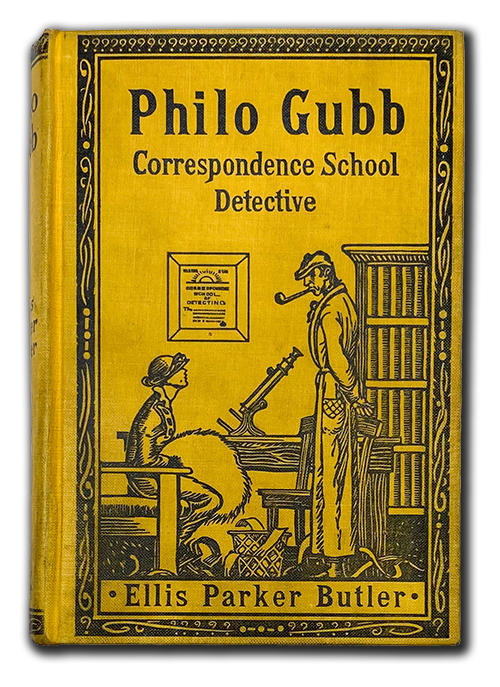
Philo Gubb Book Cover

Philo Gubb, Correspondence School Detective is one of Ellery Queen’s chosen best and most important mystery novels (though the book is a short story collection, really); it’s number 61 on their Queen’s Quorum. Here’s what Queen says about Philo Gubb:

“The year 1918 witnessed the arrival between covers of the first correspondence-school detective, a small-town paperhanger who commits a slight case of murder on the King’s English every time he talks. Philo Gubb performs his rustic ratiocination in a yellow-lemon book, its front-cover illustration showing a tall, gaunt Holmesian figure wearing a cap and dressing gown, a long pipe sticking out of his Sherlockian face, an enormous microscope on the table behind him, a beautiful damsel sitting in the client’s chair, a bookcase jammed with ponderous tomes in the background, and a framed diploma from the Rising Sun Detective Agency’s Correspondence School on the wall.”

It would seem Philo Gubb is more an ancestor of the Barbara Allan detectives, Brandy and Vivian Borne, than Nate Heller or Quarry. Like Barbara Allan (the Barbara and Max Allan Collins writing team), Ellis Butler Parker was noted for his stories being funny, even laugh out-loud funny. Not bad footsteps to walk in.

I was aware of Ellis Parker Butler, but only recently did I start collecting him. At an estate sale here in Muscatine, held at the Art Center where my band Crusin’ was playing (I was on a break), I picked up nine books by him, and have since ordered several more from e-bay and ABE Books.

Have to check out the competition, you know.

* * *

We have yet another Amazon deal for those of you who are e-book readers.

Thomas & Mercer team has announced that Fate of the Union will be promoted via Mystery, Thriller & Suspense Kindle book deals in the US, starting 7/1/2023 and running through 7/31/2023 at 2.99 USD.

Also, the Amazon Encore team has informed me that True Detective will be promoted via a $3 towards this selection of Kindle books in the marketplace, starting 7/1/2023 and running through 7/31/2023. This promotion offers customers the opportunity to purchase books at a discount within a curated selection using a promo code offered to them in an e-mail. Customers who have purchase history within this genre will be presented this offer. Not all customers will be offered the coupon. But if it turns up in your e-mail, have at it.

Ordering info plus sample chapters and examples of Fay Dalton’s magnificent art for Fancy Anders For The Boys is right here. It’s a novella, remember, not a novel. Available in both e-book and physical (yay!) media.

* * *

I should note that I usually post a link to these updates on half a dozen Facebook sites where these missives might seem to have relevance. But last week I wrote almost exclusively about my weekend of playing two gigs with my band Crusin’, and ran a bunch of photos thereof, so I thought perhaps I shouldn’t bother people whose interests are old paperbacks, and noir mysteries and films and so on.

But if you’re reading this but missed last week, and think you might have been interested, just keep reading.

M.A.C.

Rule #1: Never Respond to a Reviewer

Tuesday, June 6th, 2023

Before we get started, I want to share this link for a nice if unexpected endorsement of the first Nathan Heller novel, True Detective, by Paul Davis of the Washington Times.

* * *

I am going to share a review with you from the Borg site, a mixed one by C.J. Bunce, who has generally liked my work and to some degree likes it here. It’s almost never a good idea to respond to critics, but one aspect of the Borg review touches on a topic I feel requires at least some response. So I am going to take this opportunity – one writers generally do not get or at least have sense not to avail themselves of – to respond to that objection, and a few other negative aspects of the review. Let me say that as the author, my view is skewed and biased to say the least, and Bunce – a solid reviewer – has every right to his opinion.

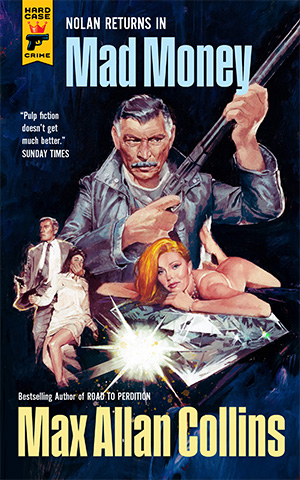
Mad Money cover
Retro fix–Max Allan Collins’ giant Nolan novel “Spree” returns in 2-for-1 volume “Mad Money”

BORG: If you were going to stage a heist at a shopping mall, how would you do it? Would you steal from all the stores in the mall in the same heist? Back in 1987, when malls were still in their prime, Max Allan Collins made an attempt in the pages of Spree, his longest novel in the Nolan series. His anti-hero Nolan is the Michael Corleone of grime fiction – they keep trying to pull the retired thief back in just as he’s ready to settle down (Collins pulls him back in each of his 9 novels). Collins knows how to reflect the ugliest people in the ugliest of underworlds, and he does it by creating criminals in Missouri that would make New York mobsters look like wimps.

COLLINS: Is “grime fiction” a knowing pun or a typo? Is it a term that’s previously been used by Bunce and others? Just asking. If it’s purposeful, I might use it myself sometime.

BORG: Spree sees a reprint this year thanks to Hard Case Crime in a 2-for-1 edition called Mad Money. It’s bundled with Mourn the Living, another Nolan novel, and the last of a series of reprints that provide some of the best value around for pulp crime readers and fans of Collins’ unique voice. I thought the hillbilly Comfort family of Missouri was vile in the last Nolan novel I reviewed here at borg: Hard Cash, the fifth Nolan novel. I had no idea.

As you see in the cover of Mad Money and the other novels in the series with art by Mark Eastbrook, Nolan is Collins’ Lee Van Cleef lookalike, a bad guy who thinks he’s a good guy in a world of creeps and criminals even worse. With Spree, Collins again pushed the boundaries of pulp crime. It’s full of the writer’s brand of rough sex, racist characters, and violence we’ve seen in his Quarry series and earlier Nolan stories, but this time that includes threats of incest and underage sex, the kind of cringey content that paints the darkness into the story’s villains. It’s also the kind of shock and awe that would later make Quentin Tarantino win movie awards. It all goes full circle, because Nolan was inspired by Donald E. Westlake’s Parker novels, which inspired every other pulp crime writer, including Tarantino. Spree takes Collins into horror territory, something that may give readers a Silence of the Lambs vibe.

I’m still reading and enjoying Nolan novels, with five more to look forward to, but I think Collins’ effort to stretch out the word count of this book is reflected in page after page of padding. Collins is a master of brevity in his books, and he spent more time in this book with descriptions that neither enhance the mood and setting nor further its plot. At a few points his leads Nolan and frequent sidekick Jon even make mistakes that the characters I thought I knew from Bait Money, Hard Cash, and Skim Deep were too smart to do. Maybe I was wrong about them?

COLLINS: I don’t ever knowingly pad. I understand it might come off that way, and I do get accused of it from time to time; but it’s not something I do to plump up page count or whatever. Nor am I in particular a “master of brevity.” If anything I am criticized for writing too much description of setting and wardrobe, which has irritated some readers and reviewers. I don’t care. My object is to use setting and wardrobe for purposes of characterization.

The book is a longer one than the other Nolans and was, like Stark’s Butcher’s Moon, designed to be more in depth than the somewhat brief paperback originals preceding it, and in a way to sum up the series (also like Butcher’s Moon). If by padding, Bunce means more characters than usual, I am guilty. The narrative technique in the Nolan books is to immerse the reader in point-of-view chapters of various characters, some rather minor. I learned this – borrowed (stole) this – from Westlake’s “Richard Stark” persona. This technique is an effort to make the world seem bigger.

BORG: Here’s the set-up for Spree: Nolan’s nemesis, hick Comfort family patriarch Cole discovers where Nolan has landed: owning a restaurant/nightclub named Nolan’s attached to a typical 1980s mall in Davenport, Iowa. Nolan previously killed some Comfort family members in a past exploit, and Comfort decides it’s time for payback. He stakes out Nolan and his mall and, along with his son and daughter, kidnaps Nolan’s girlfriend Sherry. Cole tells Nolan he must help him rob all the mall stores or he’ll kill her.

Collins provides the minimal details to show how the heist might be possible, but not quite enough to make it believable. The players are numerous: a few guys who worked jobs with Nolan before, plus a set of shoot-first triplets who can fence the loot later. Sherry, the great, tough, equal to Nolan, is relegated here to the victim role, and the 1980s shine through with Sherry as the only woman lead of the story. The only other woman is Cole’s “slutty-looking” daughter, who Cole hits on because she looks like her mom. Yikes. In no doubt Jon’s worst moment of the series, he has sex with the teen (who worships Jon from his days as small-time rock band member), which is bad choice #1, then instead of holding her to swap for Sherry he just lets her go (bad choice #2). Nolan has his worst moment by not grinding the story to a halt and holding the girl for a swap, maybe slapping Jon a few times. The story also just stops, and we don’t get to see the aftermath, which is a disappointment after all the build.

COLLINS: Sherry is held captive and (SPOILER ALERT) frees herself by way of a combination of her courage and ingenuity. Hardly a “victim” role. The structure becomes a back-and-forth report on the heist Nolan and Jon are forced into mounting for Cole Comfort and Sherry’s captivity and her efforts to free herself. At the time, I considered this effective and well-handled…and I still do.

The punchline of the massive robbery is (SPOILER ALERT) when Nolan makes his accomplices put everything back. The last dozen pages are devoted to the “aftermath.”

Of course, Bunce has every right not to like how I handled this, and for it not to work on him. Fine. A novel is a collaboration between writer and reader, and sometimes that collaboration goes better than other times.

Now, however, we arrive at the reason I have chosen to respond to this review. Bunce appears to be object to (or be offended by?) Cindy Lou, Cole Comfort’s seventeen-year-old daughter, being described as “slutty-looking.” But that description comes not from an omniscient author, rather a character in the novel, in that character’s point of view. The reviewer considers Jon’s “worst moment of the series” as having sex with this teenage girl. It’s a “bad choice.”

As we say in the funnies, “sigh.” I run into this with modern reviewers all the time. They object to sexism but not to homicide. Jon is a traveling rock musician in his early twenties; Cindy Lou is seventeen (the age of consent in Iowa is sixteen – making their consensual tryst “cringey” perhaps, but not “underage”). Still, that may indeed be a bad choice. You know what else is a bad choice? Being an armed robber. This is similar to the reviewers who criticize Quarry for sizing up women based on their attractiveness. I guess you’d expect better behavior from a murderer.

Nolan’s “bad choice,” Borg informs us, is that the retired thief does not kidnap Cindy Lou and try to swap her for Sherry. So we’re in favor of kidnapping now. In fact, the second section of the book concludes with a discussion, almost an argument, between Jon and Nolan about whether to kidnap Cindy Lou for this purpose, and how that might play out (not well)…or instead to manipulate this unhappy, abused girl (yes, manipulate – shame on them!), into helping get Sherry back. One of the darkly comic aspects of the novel, and that specific scene, is that Nolan and Jon are not as bad as Cole Comfort. Still, that doesn’t make them “good.” And the story does not “stop” here – it’s a cliff-hanger at the end of a section.

Also, and this is key, certain aspects of how the heist will go down are not revealed until (wait for it) the heist goes down.

BORG: Nolan, Jon, Sherry, and the reader know there is no way Sherry is going to get out of this alive. That’s the story Collins tells, but not quite where it lands – Collins doesn’t stick the landing as satisfying as in his other works (whether in his Nolan, Quarry, Heller, or Mike Hammer novels). Nitpicking aside, appropriate bad guys get theirs, just not directly proportionate to their level of vileness, and that’s a shame. But the bookending Collins incorporates is clever and almost delivers some satisfaction.

COLLINS: This grudging praise is for an aspect of the novel that I am rather proud of – the resolution of both Sherry’s escape from captivity and what Nolan does about the mall robbery he’s been forced into engineering. The fates of Cole and Lyle Comfort are very satisfying to the author and I believe probably are to most readers.

BORG: Jon returns as a slightly older young version of Nolan – who also has all those interests of a young Max Allan Collins – a guy who wants to create comic books for a living. He’s lost his apartment, which drives him back to Nolan for help, where he meets Sherry. He’s at a down point in his life with Nolan, but that doesn’t explain his extra dose of bad judgment this round.

COLLINS: Again…it just may be possible that Jon’s bad judgment was when he decided to be a fucking armed robber. Here, when he (like Nolan) has moved away from that into a more acceptable mode of living – the ironic theme of the series is that all Nolan wants is to realize the American Dream – Jon is still paying for the genuinely bad choice he made in this series, i.e., robbing a bank with Nolan in the first novel (Bait Money).

By the way, the supposed aspects of my life and interests as expressed in the Jon character are exaggerated by Bunce and others. I use my knowledge of comics and being a rock musician to provide some verisimilitude. But nothing else in Jon’s background or frankly character is drawn from me. On the other hand, the Mallory character (in No Cure For Death and other early novels of mine) is me, which is why I don’t write about him anymore – too boring.

BORG: Is there a worse pulp crime family than Collins’ Comforts? I don’t think so. Spree is not a typical Collins quick read, and that epic mall heist only gets to what you could imagine as the montage sequence in the movie adaptation. If the film rights were exercised today, the cast would need to be better developed and the execution a bigger part of the story. Here the idea is so good, but the delivery not so much.

COLLINS: I guess faint praise is better than no praise at all. In the context of my career, Spree was the first Nolan novel I wrote after the early Nathan Heller books (none of which is a “typical Collins quick read”). In fact, the success of those early Hellers got me the contract to do Spree (and Primary Target). Spree was a hardcover (not a paperback original, like the previous entries) and was a story designed to have some heft (not padding).

BORG: It may not be Collins’ best, but it’s still fun, and it will keep you engaged. Order Mad Money, including Spree and Mourn the Living, here at Amazon, and check out the other double-trouble sets, Two for the Money, Tough Tender, and Double Down, and the final novel in the series, Skim Deep (reviewed here). I reviewed Hard Cash here and Bait Money here. Keep coming back to borg where we’ll double back to the second novels in these 2-for-1 editions from Hard Case Crime later.

COLLINS: I am grateful for the attention Borg/Bunce brings to this series, and mean zero offense by this response. But I consider Spree the best Nolan novel, and feel it resolves the larger issues of the series, and the specific ones of the narrative at hand, rather well. So much so that I considered the series finished till editor Charles Ardai talked me into doing a coda by way of Skim Deep.

I also know that Spree is the Nolan novel most often cited as the favorite (or best) in the series by readers. Considering Bunce’s speculation that a modern screen version of Spree would probably improve it, I’ll mention two related facts: my own screenplay of Spree was optioned several times (twice by Bill Lustig), and right now Lionsgate is developing a Nolan film…based on Spree.

I want to make it clear that C.J. Bunce is an able reviewer and the Borg a worthwhile review site. Visit them here.

The issues I touch on above are nothing I usually would have bothered discussing – they are strictly a matter of opinion, and no one is more biased than the author. What made break Rule #1 (never respond to a reviewer in print) (or otherwise) is what I’ll call (for want of a better term) the Political Correctness Issue.

The first time I encountered this was with the publication of Bait Money in 1973, when I was criticized for Nolan thinking of young women as “girls.” A forty-eight-year-old-man in 1971 (when I wrote the book at age 21) would hardly think of a young woman in any other terms. But I began being careful about that.

Nate Heller was another matter, and he continues to be. Reviewers would occasionally complain about his sexism and racism, among other isms. Heller is a man in this twenties in the early 1930s and we are with him until he’s in his fifties in the mid-1960s. I try to be true to who the character would logically be, and what is appropriate to the year at hand. I tend to use “colored” and “Negro” most often, but have occasionally been beaten up for that. Heller indeed sizes women up by their looks, and has certain sexist tendencies (he hangs out at Hefner’s Chicago pad and dates Playmates, Bunnies, strippers, models and showgirls). A early lost love followed by an unhappy marriage made him a shallow swimmer in the male/female relationship pool. But he also treats women as equals and I am proud of the depiction of the major female characters in the novels, from Sally Rand to Amelia Earhart to Marilyn Monroe.

None of these offended critics has ever commented on the fact that Heller frequently murders the bad guy, Mike Hammer-style. Not once. As Tarzan might say, “Sex bad. Violence good.”

Quarry, similarly, is mostly a ‘70s and ‘80s character with views and modes of expression appropriate to those times. (Quarry’s Blood is modern-day and an exception; but Quarry remains a guy born around 1950) (a murderer, by the way).

Is a guy in a rock band in the mid-1980s, in his early twenties, making a bad choice having casual, consensual, legal sex with a teenage groupie? I’ll leave that up to you. But reviewers cheerfully accepting murder from Jon, Nolan, Quarry, Hammer and Heller, without comment, is an interesting commentary on what we consider acceptable in a fictional narrative.

* * *

A nice mini-write-up about the Antiques series is here (scroll down).

Finally, here’s an analysis of the graphic novel Road to Perdition.

M.A.C.

Tags: , , , , , ,
Posted in Message from M.A.C. | 5 Comments »

Spillane Giveaway, Bundle Sex & Errors, and Good Reviews!

Tuesday, January 31st, 2023

Yes, it’s another book giveaway!

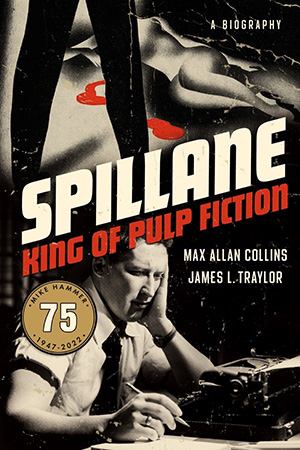
This time it’s Spillane – King of Pulp Fiction by James Traylor and me (published by Mysterious Press). I have ten copies available – eight hardcovers and two trade paperback-style Advance Reading Copies. [All copies have been claimed. Thank you!–Nate]

Is it worth reading?

Here’s what the Wall Street Journal thinks:

Mickey Spillane, in the role of his creation Mike Hammer, on the set of “The Girl Hunters” (1963) with co-star Shirley Eaton.
PHOTO: POPPERFOTO VIA GETTY IMAGES
‘Spillane’ Review: He Nailed Mike Hammer
By Michael Saler

Mickey Spillane knew how to make crime pay, and he transformed the American publishing industry in the process. Between 1947 and 1952, his first six novels featuring private investigator Mike Hammer, a sadist with a heart of gold, sold millions of copies in paperback—bringing legitimacy to the fledgling format. Spillane’s global sales now exceed 200 million.

His recipe for success appeared simple. Mix racy innuendo (“She was oozing out of a bikini suit like toothpaste out of a tube”) with graphic violence (“I snapped the side of the rod across his jaw and laid the flesh open to the bone”); season with stereotypes and vivid prose; knead these raw materials into a propulsive plot pitting good versus evil. Et voilà: “The chewing gum of American literature,” as Spillane cheerfully admitted. Many critics of the time, repelled by his vigilantism and sensationalism, condemned his books as nasty, poor, brutish and not short enough. Others found that Hammer’s sincere conviction exerted a powerful spell.

Noir fans know a lot about Mike Hammer, but who was Mickey Spillane? Max Allan Collins and James L. Traylor are Spillane experts who have championed the author’s works since the early 1980s. Mr. Collins, a noted crime writer, also collaborated with Spillane and has been completing drafts left by Spillane upon his death in 2006. The biographers concede their partisanship but avow they have been “hard-nosed” about their hard-boiled subject. “Spillane” is an engaging, capacious and largely celebratory account, presenting the writer, his works and their multimedia adaptations as worthy of serious consideration.

Spillane was born in 1918, the only child of a Catholic father and Protestant mother. Religion would play a significant role in his life: He became a Baptist, like his first wife Mary Ann, whom he married in 1945; in 1951 he converted to the Jehovah’s Witnesses. His biographers suggest that Hammer’s Old Testament, “eye-for-an-eye” justice is partly beholden to Spillane’s religious outlook. As a youth, however, Spillane may not have been devout; he loved adventure and crime fiction and claimed to have published short stories under pseudonyms soon after graduating high school. He left college after two years to join the nascent comic-book industry in New York City, honing his skills by scripting early adventures of Captain America and other crime fighters.

Spillane spent World War II stateside as a flight instructor. His biographers believe he suffered “survivor’s guilt,” which may have contributed to the macho postures he shared with Hammer. After the war he also came to loathe cities and their immoral, high-rise-residing “cliff-dwellers.” Needing money to build a house in the country, Spillane transformed an unsold comic story about “Mike Danger” into “I, the Jury” (1947), which introduced Mike Hammer as a traumatized combat veteran who relishes dispatching killers by employing their own methods. The book sold modestly in hardcover but proved a sensation in paperback, appealing especially to veterans accustomed to reading comics and “Armed Services” softcover editions during the war. Paperbacks had hitherto consisted of reprints; Spillane’s sales convinced publishers to issue original works—a sea change in the industry.

The authors find that the early Hammer novels portray a conflicted protagonist remaking his moral compass. In “One Lonely Night” (1951), Hammer searches for his own identity alongside that of the murderer. He concludes that God has fashioned him as a monster for the greater good: “I was the evil that opposed other evil, leaving the good and the meek . . . to live and inherit the earth!”

After reaching unprecedented popularity by 1952, Spillane ceased writing novels for a decade. Previous commentators assumed he was occupied with, and perhaps inhibited by, his new religion. But the authors suggest that his silence owed as much to his wealth and the distracting hobbies it permitted; he had also sold the film rights to his hero and was biding his time, waiting to reclaim them.

When Spillane returned to writing novels in 1962, with “The Girl Hunters,” his narratives were more polished but lacked the manic energy of earlier works. By this time, both Spillane and Hammer had become pop-culture touchstones. The author would portray Hammer in the 1963 film version of “The Girl Hunters,” and subsequently blurred the line between himself and his hero. Spillane divorced in 1962, marrying again in 1964. His second wife, Sherri, was half his age, a model who played the “doll” alongside Spillane’s public appearances as “the living embodiment” of Hammer. Spillane even assumed the Hammer persona for Miller Lite Beer commercials, a campaign that continued from the 1970s through the 1990s. The genial Spillane and the grim Hammer became coterminous in the public mind, leaching certain dark undercurrents from the fictional character.

“Spillane” emphasizes the gentler side of its subject, only fleetingly considering the charming writer’s crueller opinions and actions. Yet Mr. Collins does recall a frightening instance he witnessed in 1992. Spillane’s home had been burgled and the author, gesticulating with his fists, “told me vividly what he’d like to do to the thieves.” Then the squall subsided. “But I’m not like that anymore. I don’t do that now.”

The biography concludes on such grace notes. After an acrimonious divorce from Sherri, Spillane married for a final time, doting on his wife Jane and her two daughters. He continued to write bestsellers in multiple genres and attained literary honors, including a belated “Grand Master” award from the Mystery Writers of America in 1995. In language consonant with Spillane’s themes, author Donald E. Westlake saw this as “redemption” for a writer long considered a “pariah” among his peers.

Mr. Saler is a professor at the University of California, Davis.

Spillane: King of Pulp Fiction cover
Hardcover:
E-Book: Kobo
* * *

Here is a lovely and insightful Big Bundle review from borg’s C.J. Bunce (that doesn’t mean I don’t have a few quibbles).

Author Max Allan Collins doesn’t let up and neither does his A-1 Private Detective Agency hero Nathan Heller. His client list is one-of-a-kind, including the likes of Clarence Darrow, Amelia Earhart, and Dashiell Hammett. After 17 novels and three collections of short stories, Heller, the “P.I. to the stars” is back in The Big Bundle, an all-new 1950s crime story from Hard Case Crime, available for pre-order now here at Amazon. The first of two historical crime novels from Collins tying in a fictionalized version of Robert F. Kennedy, the story brings together again that classic 1950s triangle: RFK’s Congressional racketeering committee efforts, Jimmy Hoffa’s role in the labor movement and his questionable cohorts, and the antics of low-and mid-level members of the Mafia. But that’s really only the background for a real-life kidnapping that took place in Kansas City in 1953, and Heller, once handpicked by Lindbergh to find the villains in the case of his own missing son, is brought into another similar, gut-wrenching case. His first client was Al Capone. Frank Nitti was his father figure. His best friend was Eliot Ness. But that’s in the past when Nate Heller’s next story begins.
Collins and his well-dressed hero are in prime form–this is one of those Collins novels that one-ups his own famous Road to Perdition, blending in some nasty villains straight out of Quentin Tarantino’s From Dusk Till Dawn. His expert storytelling investigates whether or not bad guys have a code, and how much they’ll stick to that code when big money is at stake. Heller comes across bad cops, cops that are just bad at being cops, street thugs, minor and major mobsters, organized labor leaders, politicians, and just plain evil people with no soul. They all say the same thing: “I’d never touch that kind of blood money.” So who is lying and who is telling the truth?

The real-life facts are on the record, but if you believe an event 70 years ago can remotely be a spoiler to talk about, move along and come back after you’ve read the novel, but just note that the story isn’t the reason to read the novel–it’s Collins’ storytelling.

Keeping with his four-decade-long series, Heller sounds like a real person, but he’s not. Heller is Collins’ fictional private detective who has clients of every ilk, but notably each novel features Heller’s exploits with a famous celebrity or historical event–Heller this time has many clients, often with conflicting agendas. In The Big Bundle that includes RFK, Hoffa, and Kansas City multi-millionaire Robert Greenlease, Sr. It’s Greenlease whose six-year-old son Bobby was walked out of a Catholic school by a woman pretending to be his aunt, never to be seen again, as part of an infamous, nationally-reported kidnapping in 1953. A drug-addicted and alcoholic couple from St. Joseph, Missouri–a “Bonnie and Carl,” Bonnie Heady and Carl Hall–were sent to the gas chamber for their crimes, Heady notably as only the third woman ever killed by the federal government, following Lincoln assassination conspirator Mary Surratt and the convicted spy Ethel Rosenberg.

Greenlease, a wealthy Cadillac dealer, paid $600,000 to the kidnappers, the largest ransom ever paid at the time. Only $288,000 of the ransom was recovered by authorities. Collins breaks the story into what reads like two separate books. The first covers Heller as one of the shadowy figures that was brought in (as happened in real life) to help sleuth out the kidnappers and hopefully save the boy in time. The second follows Heller as he’s tapped by multiple factions to leverage his underworld relationships–many via characters introduced by Collins in his previous twenty-plus stories.

Collins makes a good effort upfront and in an afterword to make it clear how the events have been altered for storytelling purposes. Heller is an interesting storytelling device, a bit of a time traveler that didn’t exist that is thrust into these historical events as our tour guide. It works, but Heller’s voice may strike fans of Collins’ other voices, like Mike Hammer (who he shares with Mickey Spillane), Quarry, and Nolan, as the furthest away in style and manner. Without reading his past exploits it’s not clear why Heller can afford to be so confident. He strides into situations where others are getting killed for doing much less, and yet he walks out clean–like a protagonist in a slasher film.

The Big Bundle is a noir crime novel, so Collins splices in his dark hero getting a piece of the physical action, like getting beat-up by thugs, and also with the femme fatale/good-bad girl types, including a few sex scenes that seem a little too steamy for a plot about a real-life child kidnapping. But that may just be a matter of personal taste.

Collins’ use of real people gives this novel a cinematic feel in the vein of Oliver Stone, especially his JFK, and David Mamet’s Hoffa. The story shuffles back and forth from the real and fictional somewhat better than in the recent movie based on real facts, Amsterdam. Readers who are fans of The Untouchables will find the setting familiar, and St. Louis and Kansas City is a great undertapped (and the real-life) 1950s venue for a major work like this. Collins’ exhaustive research into the nooks and crannies of every bar, diner, and seedy hotel is evident. The approach reminded me at times of former Kansas City Star reporter Giles Fowler’s non-fiction work Deaths on Pleasant Street. It also plays out like another D.B. Cooper rabbit hole for federal investigators.

Paul Mann creates a very good spin on Heller as he might have been portrayed by Robert Lansing for his painted cover art.

The Big Bundle should land as a major work for Collins, and that’s saying a lot for someone who is so prolific. It’s prime for a movie, complete with a dozen odd characters to be filled by your favorite character actors. This is a must for all noir crime readers, fans of Collins and his detective Heller (especially his 1991 novel Stolen Away), 20th century crime stories found in the movie The Changeling and in the books In Cold Blood, Union Station, and A Bloody Business. Pre-order The Big Bundle in hardcover now in its first-ever publication here at Amazon, scheduled for arrival next Tuesday, January 24, 2023.

Big Bundle cover
Hardcover:
E-Book: Kobo Google Play
Digital Audiobook:

You could hardly dream of a better review than this, and seldom have I seen Heller analyzed better. Here’s where I take slight issue. (In addition to disliking David Mamet’s work and walking out of Amsterdam.)

This very generous reviewer expresses that now standard modern-day complaint about “steamy sex scenes.” The current attitude toward sexual content in tough mysteries is something I understand but don’t tolerate. I grew up reading books that were supposed to be racy and then the sex scenes always petered out (excuse the expression). During my college years, when I developed as a writer, the creative atmosphere was impacted by the sexual revolution – pubic hair in Playboy, Deep Throat playing at respectable theaters, soft-core sex scenes in mainstream movies. The idea of heterosexual men objecting to sexual content still bewilders me. When Heller and Hammer and Quarry (who are men of their time) notice the physicality of a woman, they are admiring them, not objectifying them, though admittedly sizing them up; and if men today tell you they do not notice a woman’s pretty face or shapely form, they are either lying or nuts.

In The Big Bundle, a real-life prostitute figures. In part one she tries to seduce Heller, who sends her packing, as he is depressed as hell about this kidnapping (he has a six-year-old son himself). Five years later, he does succumb in a very character-driven sex scene that to me isn’t terribly sexy.

There was very little sexual fun-and-games-type content in the previous Heller, Do No Harm, because neither Heller nor I were comfortable, due to the sex-crime aspect of the murder.

This reviewer rightly says, “It’s a matter of taste,” and I agree. But what in art isn’t?

Heller is indeed a device, a window through which to look at these crimes and mysteries. I try to make Heller as real as I can, and frankly think he’s far more real than most fictional private eyes, despite the historical baggage I make him lug around. When he gets the shit beat out of him, he bleeds and has to recover. He’s been known to fart. One well-known private eye writer criticized me for having Heller take a bribe; another for Heller using a condom. Part of what I was up to with Nate Heller was to make him, on some level, a real guy – which is why he starts out sleeping in his office and works his way up to a coast-to-coast operation. Which is why he marries (more than once) and has a son he loves very much.

In the first Heller, True Detective (1983), I set out to have my detective break every one of Raymond Chandler’s “Down These Mean Streets” rules. And Heller did that very thing, including deflowering a virgin.

I in no way mean to beat up on this reviewer, who did a splendid job; he actually understands what I’m up against, and I am very grateful for a writer this perceptive taking a look at my work. And a good critic, like this one, can see things, perceive things, in fiction writers’ work that the they might well miss, being too close to the material to detect the not necessarily obvious.

I have been accused, properly I think, accurately I’m afraid, of being thin-skinned. Just this week a longtime Heller reader, and a former bookshop proprietor, wrote a lengthy e-mail and sent it to me and to my editor/publisher about some errors in The Big Bundle.

Now, if you’re a regular reader of mine you may recall that in my bibliographic afterword I always state: “Despite its extensive basis in history, this is a work of fiction, some liberties have been taken with the facts, and any blame for historical inaccuracies is my own, mitigated by the limitations of conflicting source material.”

I responded to this reader in a manner that I think was polite and even friendly, answering each of the reader’s points individually. About half of them had to do with a small town that is mentioned but does not figure in the narrative in a major way. Another cited error was a possible numerical typo, but the rest I just didn’t agree with – for example, the FBI couldn’t know a state line had been crossed until they captured the perps and knew that those perps had in fact crossed a state line.

This reader grew up in the area where the book is set, and of course I did not grow up in the twenty-plus areas where Heller’s novels and short stories take place. From my point of view, this individual was lording it over me for not knowing things he did, as a local resident (as opposed to my book and Internet research).

I don’t think my irritation was obvious in my response, although I would have preferred he would have written me and not ratted me out to my editor/publisher. His response was lengthy and indignant, letting me know he was no longer a fan and would get rid of all my books in his collection, now that he had discovered that he couldn’t trust the details in my books.

As it happens, I dug deeper into the “errors” – about half of them I still do not consider errors. But I learned, after some effort, that there were two small towns, in Missouri and Kansas respectively, that shared the same name. That’s where the confusion came from, and my letter-writer didn’t seem to know that, either…or at least didn’t make that clear. The numerical address that he pointed out to me turned up in two ways in my research, and I have corrected that – and the small-town confusion – for the paperback edition. It shouldn’t cause you any problems reading the hardcover edition. This is minor stuff, but I still like to have it correct.

Look. I know readers just want to be helpful, in pointing our errors, and they are in fact being helpful when they do. I have made corrections in subsequent editions any number of times. But acting like you found a prize in the Cracker Jacks or being gleefully superior about it does not make you popular with the writer. In this case, the writer of the e-mail probably spent at most an hour on his missive, and likely much less. I spent six months writing The Big Bundle. It’s only natural I am irritated when someone seems to play “Gotcha” with me.

One of the reviewers I respected most, and who was a big supporter of mine – Jon Breen, for years the regular reviewer at EQMM – always gave Heller great reviews, if necessarily brief because he was writing a column, not a single review. Yet he always found time and space to list one or two things I got wrong.

Like I said, I am probably overly guilty of being thin-skinned. In reality, I try not to believe reviews – whether good, bad or in between – and only look at them from the aspect of whether they will help sell books or not (obviously, the bad reviews are not helpful sales tools!). I wish I had a better attitude about this, but it’s doubtful I will change.

The critic who is toughest on me is me. That’s why if you point out an error in a book of mine, I react negatively, even emotionally. Because I am mad at myself for making a mistake. I hate getting the history wrong (unknowingly – sometimes, of course, I “adjust” it for the sake of a story).

Two things I would ask the likes of my ex-reader/former bookseller error spotter: try to remember that my books are fiction; and that I am human.

* * *

Here’s a You Tube video about one reader’s Top Ten books written by me.

The Big Bundle is one of ten new books Crime Reads recommends.

CBR says Road to Perdition is one of the most faithful comic book movies.

Here’s a terrific review of Spillane – King of Pulp Fiction from the great Ron Fortier.

Finally, this excellent video review of the graphic novel, Road to Perdition.

M.A.C.