Posts Tagged ‘Road to Perdition’

Bulldog Edition

Tuesday, February 15th, 2022

It’s amazing! After my brief discussion/defense of the Ritz Brothers last time, fan clubs for the boys have sprung up all over America!

Okay, maybe not.

I’m just softening the blow that I’m not doing a book giveaway this week. Maybe next week. I am working on the new Nate Heller and found myself scrapping my intended final two sections and plotting instead one second section. This required re-reading a ton of research material and re-thinking it. I have been taxing my wife Barb’s patience utilizing her as a sounding board whose ideas and reactions are always helpful.

And how about that Super Bowl? Actually, as I write this, it hasn’t happened yet and I don’t care about it, so Barb and I will be going to the new Death on the Nile at a time when the theater should be largely empty.

* * *

Barb and I have now seen Death on the Nile (in an almost empty theater!) and we both found it a whipsawing experience. Kenneth Branagh’s version of Poirot is perfectly acceptable and often pays attention to detail courtesy of the Christie (and Suchet) characterizations; but he falls prey to an out-of-character attraction he has to a raucous blues singer, based on Sister Rosetta Tharpe, whose music is used throughout in a sometimes jarring way – where we should be getting a John Barry-esque score over the majestic Nile as backdrop to all this glitzy but murderous melodrama, we get guitar-driven blues (and a traditional soundtrack playing at a barely audible level, as if the theater left its Muzak going). I like guitar-driven blues, but as the soundtrack to Agatha Christie?
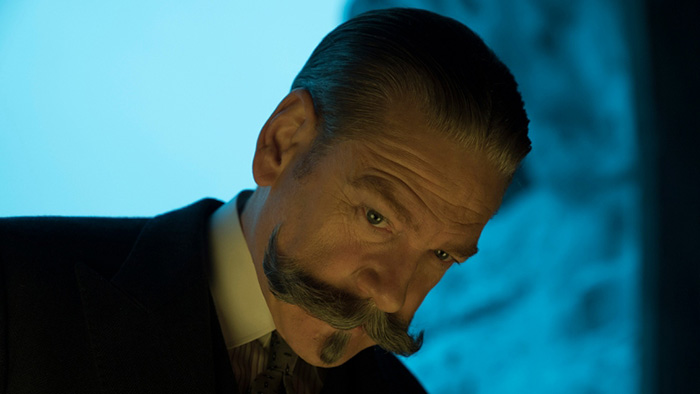
Kenneth Branagh in Death on the Nile

Though relatively faithful to Christie in general, the substitution of the blues singer and her manager/niece for the drunken romance novelist and her daughter seems at once forced modernity and a clumsy removal of a valid murder motive. A nice WW I origin story for Poirot and his mustache is followed by Poirot in 1937 going to a nightclub and sitting alone at a table watching over-choreographed lascivious dancing in quiet perverse contemplation – it’s a creepy sequence, turning the Belgian master detective into a raincoater in a porn-shop booth.

When the riverboat-board mystery kicks in, the cast proves less than star-studded (and filled, by accident of course, with cancelled or sort of cancelled celebrities of a few moments ago) though the direction is fine, save for circling cameras and other stunts during interrogation scenes that only detract from the importance of the information being gathered. When Branagh hews close to Christie, which he does about two-thirds of the time, his performance and the film itself are fine.

The biggest flaw is Gal Gadot playing the woman-stealing rich girl in a positive manner, not Lois Chile’s grasping, acquisitive proper murder victim of the superior 1978 version. And for all the emotion Branagh tries to stir up, no performance here touches ‘78’s Mia Farrow, the spurned woman of one of Dame Agatha’s most chillingly convoluted plots.

I’m glad to see Christie staying in the popular culture, although Covid and the mine field of who is cancelled by the time a film comes out has done this Poirot film no favors.

* * *

My discussion last week sparked quite a bit of response, after I revealed my negative opinion of a certain James Crumley first sentence, even while granting an I-hope-not-condescending-permission for others to like it. Some of those responses appeared in the previous Comments Section, but still others were sent to me by e-mail. One of the most interesting came in that fashion, and – with permission – I am sharing it here, so I can reply and perhaps have my response seen by more readers than if this had occurred in the Comments Section.

The following is excerpted from a missive courtesy of a reader who wishes to remain anonymous:

Your blog is your house. I think good discourse is important, but I also respect your site as your medium to transmit your message. No need to raise Cain in another man’s world. That said, I do like the Crumley line and state it here, privately. (NOTE FROM MAC: Privately until I got hold of it.)

“Perhaps it’s because, when my Dad was in the creative writing program in Montana, he met and drank with Jim (called some of his work mediocre too…you might have liked that!). Maybe it was the many ‘ramshackle joints’ like that one described that my Dad dragged us to as kids. Maybe it is because my college roommate was from Sonoma, who had an alcoholic father that just might have drank in the same bar. Maybe it is because I have never thought about a bulldog that was an alcoholic, much less an owner who would give him such a big name as ‘Fireball Roberts.’ Those all play, I’m sure, and made me want to know more. But, having lived on the Gulf Coast in my young adulthood, I know what it is like to ‘drink the heart right out of a fine spring afternoon.’ Maybe you can’t go back, but that sentence fragment brought me there for a short moment.”

My anonymous correspondent has made – or anyway implied – a point that I tried to make last time. It’s part of the overall concept of the reader as collaborator. I’ve discussed that my propensity for providing what some think is over-description (of clothing, or setting, etc.), and have tried to explain that this comes from my desire to be the in-charge half of the collaborative team.

First, I would like the reader to experience what I imagined, what I conjured, as close to the way I did. Second, I don’t think it should be the reader’s responsibility to do the writer’s work. Why should you have to clothe the damn characters? Why should they be allowed to run naked through the pages, unless it’s a sex scene or set in a nudist colony? Why should you have to describe the circumstances of where these fictional people live and put the flesh on the bones the stingy writer did not deign to provide?

Now I say this specifically in regard to my work. I don’t propose it as a schematic, or “rules,” other writers should follow. This approach reflects, as it has no choice other than to do, my way of seeing things. In the comments, one reader agreed with me about the overwriting in the Crumley line, then started quoting Elmore Leonard’s rules, most of which I disagree with…for me, not for Leonard. He was excellent at following his own rules and came up with something special…and his. I was a fan of Charles Webb, the little-known author of The Graduate, and he was the stingiest writer I ever encountered – he gave you nothing but the action and words of the piece, which may be why his famous novel became an even more famous movie…it was already almost a screenplay.

My anonymous correspondent’s comments about his dad, and the way his father related to bars and drinking (I am almost a non-drinker, despite the mimosa I had this morning), are him bringing himself to the party. He can’t help doing that any more than I can avoid bringing my opinions and personal history to the party. And neither of us should try otherwise. That’s where the collaboration between writer and reader becomes interesting.

It’s also why you can love a writer, and recommend that writer to a perfectly intelligent friend, and then have your own intelligence questioned by that friend because of your terrible taste in books. (This obviously also applies to movies and music.) That is why all reviews – mine included (see Death on the Nile above) – are essentially worthless…because none of us have the same experience when we read a book (or see a movie or listen to music).

You can tell somebody a book is great, but the truth is the version that person experiences will be at least somewhat different from yours, and probably a whole lot different. I have spent my life dueling with people who don’t like Mickey Spillane. I have very little respect for their intelligence. And they have very little respect for mine. Neither of us is wrong, at least not entirely.

The one area where I would disagree with my anonymous correspondent is a style issue. I don’t object to any of the things Crumley jams into the sentence (well, I think “Fireball Roberts” is a terminally cute name for a bulldog, and Abraham Trahearne is almost as bad for a human), it’s just the show-offy way he goes about it. It’s impossible (or difficult) (or maybe I’m just slow) to chug-a-lug all that one sentence’s information.

What I do like about that line is that it provides information even as it raises questions – that’s how many, perhaps most, good first sentences succeed. A good first sentence doesn’t require you to read it more than once to make sense of it, to process it, unless you think it’s a bad idea to pull your reader down immediately into the narrative and make forward progress.

This is a first sentence that I much admire:

“Later that summer, when Mrs. Penmark looked back and remembered, when she was caught up in despair so deep she knew there was no way out, no solution whatever for the circumstances that encompassed her, it seemed to her that June 7th, the day of the Fern Grammar School picnic, was the day of her last happiness, for never since then had she known contentment or felt peace.”

That’s plenty long, but you are right with it, and solid facts accompany cascading questions. It’s the first sentence of The Bad Seed by William March, and you can have your drunken bulldogs named Fireball What’s-It.

* * *

I can’t resist reprinting this great review of Tough Tender from Booklist.

Tough Tender.
By Max Allan Collins
Mar. 2022. Hard Case Crime, paper, $12.95 (9781789091434)

Collins’ Nolan series, starring the no-nonsense thief Nolan and his younger partner, comics crazed Jon, was written from the sixties into the eighties, but it had been largely unavailable for decades, until Hard Case Crime began reissuing the series as twofers under new titles. This is the third in that sequence, following Two for the Money (2021), and it combines Hard Cash and Scratch Fever. Nolan has no interest in robbing the same bank twice, but he’s blackmailed into doing so by the bank manager, who wants a share of the take this time. Naturally, it all goes crazy wrong. Scratch Fever picks up the story years later when Nolan and Jon encounter hairstylist-turned-entrepreneur Julie, who scammed them on the bank deal. Naturally, they’d like to get their money back, and just as naturally, Julie would like to get rid of them altogether. Collins displays his usual ability to round out the flat edges of what seem initially like stock genre characters, but he really outdoes himself with Julie, surely one of the most memorable femme fatales in hard-boiled fiction (“everything she touches turns to dead”).
— Bill Ott

And here is (incredibly enough) a really nice review of Double Down, another Nolan two-fer, from Kirkus.

Nolan also gets love at http://thebadnet.blogspot.com/, which gives me great pleasure, as it’s a site devoted to Lee Van Cleef. Scroll down when you get there (linger over the naked blonde if you like).

Finally, Road to Perdition gets a spot on this list of Best 21 books about the Mafia.

M.A.C.
A Free Quarry Book, Plus Why Reviews Do and Don’t Matter

Tuesday, January 25th, 2022

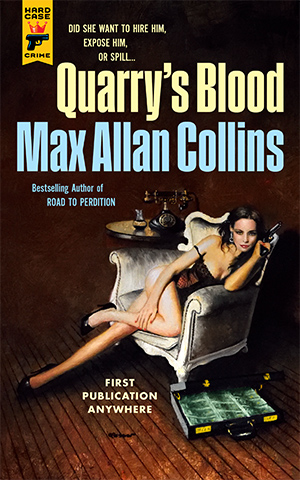
Here is an interview with me about two upcoming Hard Case Crime titles, Quarry’s Blood and Tough Tender, conducted by the great Andrew Sumner of Titan.

* * *
Quarry's Blood cover
Trade Paperback: Indiebound Purchase Link Bookshop Purchase Link Amazon Purchase Link Books-A-Million Purchase Link Barnes & Noble Purchase Link Target Purchase Link
E-Book: Google Play Kobo

And now – the first book giveaway of 2022. I have ten advance copies of Quarry’s Blood available to the first ten interested readers. [All copies have been claimed. Thank your for your support! — Nate]

More book giveaways will follow – I hope to get some copies of No Time To Spy to offer soon, and I have on hand advance copies of Tough Tender (which collects the Nolan novels Hard Cash and Scratch Fever), which will be given out possibly next time.

These reviews are extremely important in an era when I am no longer doing signings and haven’t done a convention since Covid came calling. Even brief reviews are appreciated, particularly since there are a handful of apparent trolls out there who want to make sure I can’t make a living during my dotage.

A No Time to Spy review, by the way, accuses you fine people of laziness, concluding: “And by the way most of the positive comments to the Sand trilogy as of today are copy and paste from the Collins blog.” (Feel free to defend yourself in the comments area under that review, which is by Robert Hölzl, who knows he hates all three Sand novels – would you keep reading a series you dislike? – but does not know how to spell my name.)

Just to clear the palate, here is a wonderful write-up from Facebook that just popped up out of nowhere, from Rick Greene:

I love the Quarry novels. They are all fast reads, masterful page-turners that one completes in one or two sittings, wildly violent, wickedly funny, the ultimate anti-hero. As much as I love Quarry – and the Spillane/Collins Hammer novels – I consider Max Allan Collins’ masterwork to be the Nathan Heller series. I’m just more than halfway through these detective thrillers that take real life crimes and revisit them via a fun house mirror. The Heller’s are NOT fast reads – they are dense, complex, deeply moving stories that often leave the reader emotionally shattered at the finale. You have to pay attention and turn the pages slowly. The Heller’s are books to savor, to immerse one’s self in. I’ve said before that the Quarry books are cake and ice cream where the Heller series are a five course gourmet meal. I love them all for different reasons. Collins is my favorite living author… and I hope he goes right on living and writing for a few more decades. Just imagine if Ian Fleming had lived another twenty years – the unusual and complex places he could have taken James Bond as they both aged together. I can’t wait to read about the true last Quarry adventure and to revisit Heller as much as Collins will indulge us with. Bring it on.

This came at a lovely time because (a) the new Quarry book is about to be published, and (b) I have just started writing the new Nate Heller. And the Hellers have always been hard to write, but I find that, at my age, the process may be the same but I am not. I was struggling with the first chapter and then Rick Greene’s nice words came along.

What was really nice about these words is that they were just a heart-felt reader’s outpouring of appreciation – not a review. I feel like I can take Rick’s words to heart whereas it’s dangerous to believe any review, good or bad. And then there’s karma….
Later the same day I read Rick’s celebration of my work, I came upon a current review of (the 39-year-old) True Detective that was patronizing and close to nasty in things it said about my work. I write “bad dialogue,” I’m told, and the reader has to slog through my work, and as a stylist I have all the poetry of the directions on a paint can. I would have shared this condescending thing with you, but I failed when I tried to track it back down via Google.

The review was well-written and not stupid, although – as usual – no proof backing the opinions was provided. How about quoting a few clumsy sentences to make your point, or reprinting a particularly bad patch of dialogue? (By the way, I have been publishing since 1971 and have never before had my dialogue singled out for anything but praise.)

The danger for a writer – and let’s pretend Rick Greene was writing a review and not just a sending me a valentine – is that if you take the good reviews seriously, you have to take the bad ones seriously, too. And doing so will make a real writer – which is to say, a working writer who makes his or her living this way – crazy. I will admit that the day after I read that largely negative True Detective review, I found myself back at work on The Big Bundle, second-guessing every Heller sentence I wrote.

The truth is, many of us in the arts can remember every bad review – can quote from memory reviews dating back decades – whereas the positive ones fly away like tissue paper on the wind. It’s human nature, I guess, but at the same time I know that I have to pay no real attention to any reviews. I am past the point, fifty-one years into my novel writing career, that I can learn much. I do still learn, but it’s incremental, and it comes from trial and effort, not something a reviewer points out or suggests.

The True Detective reviewer clearly considered me a pedestrian stylist. Hey, I think I can turn a pretty fair phrase. But I can guess the writers that this reviewer likes – the ones who are writing to impress, not to entertain. I pick up books at Barnes & Noble or BAM! and read the first paragraphs by writers with reputations as stylists, writers far more celebrated than I ever will be, and what I see is overloaded, overwritten, trying-too-hard bullshit (do not ask for names).

Reviews, as far as my growth is concerned, are irrelevant to a writer who has been working as long as I have. All I know how to do at this stage is write the book I would like to read. Really, I think that should be every novelist’s goal – write a book you wish somebody else would have. Please your own taste and hope enough others out there will have similar enough tastes to keep you in business.

And yet I am doing a book giveaway, soliciting reviews. I don’t do this so that you will tell me how wonderful I am (though feel free to do so). I do it to help sell books, so I can stay in business. To get the word out.

I talk a lot here about how, in recent years, in recent days, I have felt cut off from current popular culture. Today I went over the copy edited manuscript of the second Fancy Anders (Fancy Anders For the Boys) and was told I shouldn’t mention Mantan Moreland or Jap Zeroes. How am I supposed to react to that? As someone who writes about the Twentieth Century, must I clean up that century’s idiosyncrasies and failings? Or do I have a responsibility to depict that century as accurately as my flawed memory will allow?

But the truth is, it’s harder for me now to be accepted in a world of publishing where I am white and old and male. It’s not the marketplace’s fault – it’s just the reality. I am so very, very lucky that publishers like Hard Case Crime, Titan, Neo-Text and Wolfpack still find me a worthwhile addition to their lists. In a world where I have to explain to people who Mickey Spillane and Mike Hammer are, I am damn lucky to still be in business at all.

* * *

Some advance readers of Quarry’s Blood have nice things to say about it at Goodreads.

Check out this lovely piece at Crimereads on Marshall Rogers, who illustrated my brief run on the Batman comic strip.

Finally, has it really been twenty years since Road to Perdition was released?

M.A.C.

Happy Birthday, Mike Hammer – All Year!

Tuesday, January 11th, 2022

So it’s 2022 and that makes it the 75th anniversary of Mike Hammer.

More specifically, it’s the 75th anniversary of the publication of I, the Jury (1947), the first Hammer novel. The character, arguably, begins with Mike Lancer, who appeared in one story written by Spillane and drawn by Harry Sahle, “Mike Lancer and the Syndicate of Death,” in Harvey’s Green Hornet comic in 1942. Lancer became Mike Danger, although none of the comics stories were published till 1954.

Kill Me If You Can cover
Hardcover:
E-Book: Google Play Kobo

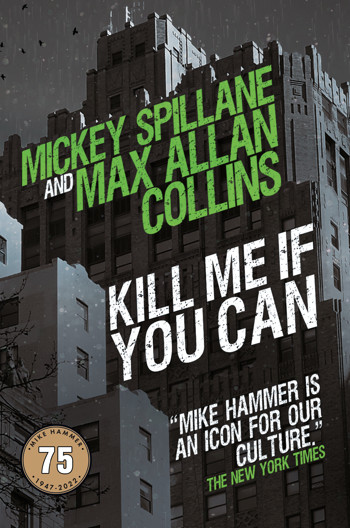
If you’ve been following this update/blog, you may recall that we have a lot of special things in store this year for the Hammer birthday celebration. I have used several unproduced TV scripts by Mickey to write the 2022 novel, Kill Me If You Can, available in August (and for pre-order now). The book is the prequel to The Girl Hunters (1962) and deals with the missing period between it and Kiss Me, Deadly (1952), showing how Hammer dealt with Velda’s disappearance and apparent demise. (Hint: not well.)

But wait, there’s more: in addition to the full-length novel, we are including five short stories written by me from unpublished Spillane material; this includes two Hammer stories and three others in the Hammer-verse. These stories have appeared in The Strand, Ellery Queen’s Mystery Magazine and Mystery Tribune, and are collected here for the first time. I am very grateful to Titan publishers Vivian Cheung and Nick Landau and editor Andrew Sumner for giving me this opportunity to make the 2022 Mike Hammer book something really special.

Again, if you’ve been following these updates at all, you’re aware that Jim Traylor and I have completed Spillane – King of Pulp Fiction, the long-in-the-works biography of Mickey. It’s in the hands of Mysterious Press publisher Otto Penzler who, after some tweaks and minor rewrites, has sent the book into copyediting. In recent weeks I’ve compiled the photos for the book and written captions, all of which have been approved by Jim and which are now in the hands of my son Nate to prepare them for the book designer.

I don’t have an official pub date yet, but the idea is for the biography to be out toward the end of this birthday year.

Additionally, I am working with Wolfpack editors Paul Bishop and James Reasoner, as well as publisher Mike Bray, to bring out several major Spillane books during this celebratory year. First, a collection of Mickey’s YA adventures novels will for the first time gather all three of those books into one volume, The Shrinking Island, named for the previously unpublished final book in the Josh and Larry trilogy. Hardcore Spillane fans have been waiting for this for a long time.

In addition, I have novelized and expanded Mickey’s unproduced screenplay, The Menace – the only work of his that was designed as a horror property – into a novel. Wolfpack will be bringing that out this year, possibly under their recently acquired Rough Edges Press imprint.

Finally, I am in the process of putting together a collection of Spillane’s short fiction – not all that short, because mostly this is novellas – plucked from two long out-of-print collections I edited (Tomorrow I Die and Together We Kill). This new book – Stand Up and Die! – will excise from previous two collections assorted non-fiction and non-mystery-fiction works and leave only vintage Spillane crime yarns.

Included will be a new edit by me of “The Night I Died,” the Mike Hammer short story that marked the only Hammer collaboration between Mickey and me during his lifetime (we of course worked on the revival of Mike Danger together). It is based on an unproduced radio play Mickey wrote around 1953. I am taking a new look at it because I now feel it was too literally a translation of the script.

The novellas, including the title one and the little-seen “Hot Cat” (aka “The Flier”), are particularly strong. This will be a fine addition to the books published in the Hammer birthday year.

In addition, I am working with Bob Deis, the mastermind behind Men’s Adventure Quarterly, to present a raft of other Spillane novellas in at least one collection including the original men’s adventure magazine illustrations.

We had great success with Mickey’s 100th birthday celebration a few years ago; this represents a new – and perhaps last – bite at the apple. I hope to do a few more Hammer novels for Titan, including Mickey Spillane’s The Time Machine (originally Mike Danger but now Mike Hammer) before wrapping up the saga. And if Wolfpack is successful with the Spillane publications above, I have one more unproduced Mickey screenplay to novelize and half a dozen novels he began that are waiting to be finished.

I’m sorry to report that Kensington has not requested a new Caleb York, but Wolfpack has been very successful with their western line, and – again, depending on how these Spillane titles to for them – we may see Caleb (and me) back in the saddle. I don’t have a pub date, but I think Kensington will still be bringing out Shoot-out at Sugar Creek in a mass market edition as yet another Spillane title in the Hammer anniversary year.

As usual, the success of all this is in your hands.

* * *

Here’s a very smart review of the new Hard Case Comics Ms. Tree collection from Titan, third in the series.

Check out this fabulous review of Fancy Anders Goes to War from Ron Fortier.

Some interesting thoughts about the film version of Road to Perdition here.

This list of the best mysteries of all time includes a number of my titles. Aw shucks, he said. About time, he thought.

M.A.C.

Bad Reviews, Christmas Movies, and Gift Cards

Tuesday, December 28th, 2021

Five readers have added their positive reviews/ratings to No Time to Spy at Amazon, pulling our average up to four stars. This is much appreciated. Never too late to join in!

The notion that I’m thin-skinned about bad reviews is one I’m hit with now and then, understandably. But my frustration with bad reviews – specifically the mean-spirited ones like the attempt to sabotage No Time to Spy – has almost entirely to do with the impact it has on sales, because sales impact whether I can make a living or not. And in this case it will determine whether Matt Clemens and I get to write the John Sand novel we’ve been planning.

As for being thin-skinned, I am to a degree. I think all people who work in the creative arts, particularly those who make their living at it, are sensitive individuals, otherwise they wouldn’t be very creative. Most of us learn to take bad reviews in our stride, although writers (the same applies to actors, cartoonists, etc.) handle bad reviews differently – some avoid reading them, others sort through looking for the thoughtful, intelligent ones, ignoring the dumb and/or cruel ones, and genuinely try to learn from constructive criticism.

One of the basic things I’ve learned about writing fiction is its collaborative nature – it’s me plus the reader. I’ve often said words to the effect of, “Sometimes I play Broadway, other times the Three Mile Island Dinner Theater.” I’m only as good as my collaborator. Also, if my collaborator – however intelligent (including those more intelligent than me, which isn’t a small group) – does not share my world view, or at least doesn’t find my world view palatable or interesting, then we are simply not a good fit. Nothing wrong with that.

But few reviewers are wise enough to simply say, “This isn’t bad on its own terms, but it’s not my cup of tea.”

I am at a stage of my career where I am not in sync with several generations. Though I am a liberal democrat, my views are not progressive enough for those who haven’t lived as long as I have. And I will not live long enough to see karma catch up with these generations, but I smile when I think about how it will.

What specifically am I talking about? Here’s one example. It’s becoming more and more common for reviewers and social commentators and even actual readers to complain about characters in novels not having the right attitudes reflective of this cultural moment. I am coming to dread the term “politically correct” (and already dread “woke”), but please take my word for it – it’s just about impossible to write an interesting narrative when everybody in it is “nice.”
Then there’s the peculiar thing I’ve noted here several times. People complain about the explicit sex scenes in my Quarry novels and about the way he describes women, based upon their physicality in terms of sexual attractiveness. These same people never comment on the fact that Quarry is a murderer. Sometimes the explicitness of the violence gets a comment, but what book did they think they were picking up? The Hard Case Crime covers should be an indication. That the “hero” is a hired killer might be another one. Yet another would be that the books all take place decades ago (with the exception of the forthcoming Quarry’s Blood).

Similarly, Nate Heller – whose adventures take place in the mid-20th Century – is criticized for his attitudes toward women and I am scolded also for the occasional explicit sex scene. Yet not once has a reader in a comment section or a reviewer in a magazine or newspaper or on a blog commented on the fact that Heller – like Mike Hammer – often flat out kills the bad guy. Sex bad, murder good?

And when was it, exactly, that I presented Quarry or Nate Heller or for that matter Mike Hammer as a role model for enlightened males?

Watch your step, everybody. It’s getting dumb out there. Be careful you don’t trip over the falling IQ points.

* * *

We had a delightful Christmas here – both Christmas Eve, when we exchange presents, and Christmas Day, with stocking presents. In both cases, Barb – who proclaims proudly that she is a bad cook – proves this to be a charade by way of preparing delicious meals on both Christmas Eve and morn.

We have been lucky throughout the Covid period to be able to interact with our son Nate, his wife Abby and our two grandchildren, Sam (6) and Lucy (3). I hope you other grandparents are bearing up under the realization that yours are not as cute and bright as ours.

But Christmas arrived much too fast, and I never got around to presenting my revised Christmas movies list here. All Barb and I watched were what have become perennials for us: both Bad Santa movies, Christmas Vacation, Office Christmas Party, the original Miracle of 34th Street and the Alistair Sim Scrooge.

The one new Christmas movie was Love Actually, which of course isn’t new at all, having been released in 2003. But we hadn’t seen it. We enjoyed it a great deal, but were struck by how practically every romantic relationship in it would be considered inappropriate today. It’s a sweet movie with a good heart, and yet I wonder when someone will attack it. Maybe they already have. Otherwise, AV and Huff Post are asleep at the switch. They better get with it – otherwise, somebody might enjoy it with a clear conscience.

* * *

If you’re like me, you probably got Amazon and or Barnes and Noble gift cards as at least part of your Christmas haul. While it’s true I cashed my Amazon cards in late on Christmas Eve, not one to allow gift cards to burn a hole in my psyche, it’s possible you haven’t used yours yet.

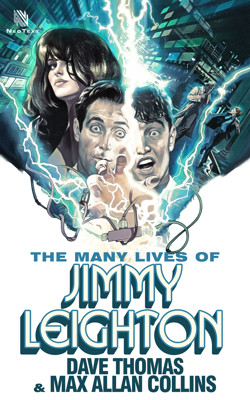
My top three suggestions are by me – Fancy Anders Goes to War, The Many Lives of Jimmy Leighton (with Dave Thomas), and No Time To Spy (with Matthew Clemens).


E-Book: Amazon Purchase Link
Paperback: Amazon Purchase Link
Digital Audiobook: Amazon Purchase Link

E-Book: Amazon Purchase Link
Paperback: Amazon Purchase Link

E-Book: Amazon
Paperback: Amazon

If you must use your gift cards on books I didn’t write, here are a few more suggestions:

Star Struck by Leonard Maltin. Full disclosure: Leonard is a pal, but I enjoyed this book immeasurably. It focuses on (as the secondary title tells us) his “unlikely road to Hollywood,” and his encounters with very famous people are shared in an intimate, fun, behind-the-scenes fashion. The way his love for movies, and how his fanzine led to greater things…much greater…is frankly inspiring.

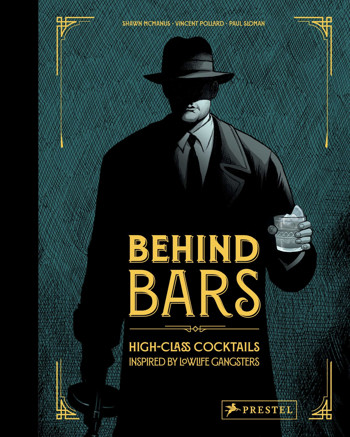
Behind Bars: High-Class Cocktails Inspired by Lowlife Gangsters

Behind Bars: High-Class Cocktails Inspired by Lowlife Gangsters by Shawn McManus, Vincent Pollar and Paul Sloman. This is a sort of recipe book for cocktails, but each one is attached to a famous real or fictional gangster with lovely illustrations of those gangsters by McManus. Now, I’m not a big drinker, but this resonated with me. Why? Michael Sullivan Sr (AKA O’Sullivan) of Road to Perdition fame/infamy is not only included…he’s on the cover! I am highly complimented! (Although not at all compensated.)

The Art of Pulp Fiction: An Illustrated History of Vintage Paperbacks by Ed Hulse. This is a lovely, lavishly illustrated history of paperbacks with info on artists. However…the first paperback cover of I, the Jury was not by the great Lu Kimmel, who did the next version; the original (pictured in Art of Pulp Fiction) was by Tony Varaday. And the hardcover edition did invoke Mickey Spillane’s famous last scene, just the aftermath not the build-up. But this isn’t the kind of book you read for text.

* * *

My old friend Paul Kupperberg was nice enough to include the Jake and Maggie Starr trio of comics-related mysteries on his list of comic book histories and biographies. We don’t exactly fit, but who cares? It’s nice to be noticed.

Happy 2022!

M.A.C.