Posts Tagged ‘Nolan’

Long-Form TV, Bait Money, Paul Newman and More

Tuesday, January 5th, 2021

Skim Deep should be available by now, the coda to the Nolan series that I’ve written at the urging of Charles Ardai, the guru of Hard Case Crime. It is, as you may know if you’re a regular visitor here, a book in a series I began back in college with my novel Bait Money. That book has been reprinted with its sequel Blood Money as Two for the Money by Hard Case Crime, originally as the first book of mine HCC did, but with an uncharacteristically weak cover, though a new edition from them is coming soon.

Cover of the Skyboat audiobook edition of Bait Money
Audible: Amazon Purchase Link

An audio book – the first ever – of Bait Money is available now, read by the incredible Stefan Rudnicki.

I’m going to touch on Bait Money again, but first…

Over the holidays I found myself bingeing (usually in four-episode stints) on long-form TV. I have begun to think that long-form television is the new great storytelling art form, more satisfying than most movies and novels. When some unifying artistic force (person or persons) has an overriding vision to control and deploy, the long-form’s depth of character and ability to span time and events can give it appeal, impact and power.

Post-Christmas, I indulged in three true-crime mini-series, all of which made compelling viewing – Manhunt: Unabomber and its follow-up, Manhunt: Deadly Games; and Waco, which leaves Netflix (home of all three) in less than two weeks. I probably liked Deadly Games best, because it opened up the Richard Jewell case more completely than the Clint Eastwood-directed film was able to, and featured a fine performance by Arliss Howard as a crusty ATF bomb expert. Cameron Britton and Jack Huston (as the falsely accused Jewell and real Olympics bomber Eric Rudolph respectively) also were excellent. In Waco, Michael Shannon as the chief negotiator Gary Noesner is typically strong, but Taylor Kitsch’s turn as cult leader David Koresh is a shattering, out-of-left-field career best for the star of TV’s Friday Night Lights and the bewilderingly underrated film John Carter – he makes Koresh human and charismatic without minimizing his madness. No small feat.

All three series, however, share a common problem. They are accurate as to the core true-crime material, but play very fast and loose with fictitious material that surrounds it.

Waco places the Branch Davidian siege’s real-life negotiator at Ruby Ridge, which is not true, and goes out of its way to make the Waco cultists seem reasonable and the FBI unreasonable, when it’s fairly clear that both sides were culpable in the tragedy.

Deadly Games – faithful to the Jewell story – adds a car chase and a bunch of risible material about backwoods redneck militia guys helping track Rudolph and even being led by a young, bossy black female FBI agent; also it has the bomber murdering several people in the woods, which never happened.

The male Unabomber profiler is provided with a love-interest female profiler based on the profiler’s (second) wife, who he hadn’t met yet when the events really happened. In an even more questionable liberty, the profiler – who was largely responsible for identifying the bomber – is placed in a Silence of the Lambs relationship with the perp, sharing numerous scenes, when in fact they never met.

I have to deal with this kind of thing in the Nate Heller novels all the time – balancing the needs of the story against what really happened. It’s not easy to stay true to history without being ruled by it, which is why I employ time compression and composite characters, for example. But TV “true crime” has no compunctions about steam-rolling history.

That may be why, in part, the best long-form mini-series I watched (Barb skipped the others, but watched this one with me) is the wholly fictional The Queen’s Gambit. It’s basically a reworking of The Hustler with chess traded for pool, which is perhaps not surprising because Queen’s Gambit is taken from a novel by Walter Tevis, the author of The Hustler (on which the famous Paul Newman film was based).

Several things make the mini-series work, despite chess being something not every rube knows how to play, and that includes this Iowa rube (Barb, of course, can play chess, though does not claim mastery). The story itself works extremely well – we follow a chess-prodigy orphan girl (taught the game by the orphanage janitor) into her early teens she’s adopted by a couple who live in world out of a Douglas Sirk movie, if that movie were written by Tennessee Williams. The teen evolves into an adult as she climbs to the top of the chess world, one match at a time. The 1950s and 1960s are accurately if acidly depicted, with stellar art direction and a cunning soundtrack of popular music.

But what sells it – beyond the screenwriters and directors making chess games as compelling as any competitive sport, even for a checkers guy like me – is the stunning performance of Anya Taylor-Joy, strikingly beautiful and brilliantly understated in her role, equally convincing as a sheltered teen and worldly young woman, and the various stages between. She also credibly portrays the chess star’s descent into pills and alcohol abuse.

This gave Queen’s Gambit a special resonance to me, and here’s where Bait Money comes back in.

At the University of Iowa, from 1968 to 1970, at the Writers Workshop, I studied with the great mainstream novelist, Richard Yates. I’ve told numerous times the story of how Yates overcame his prejudice against crime/mystery fiction to recognize me as a serious-minded young writer already working at a professional level. Along the way, he became perhaps the key mentor of my writing life.

I would have been content to take all of my classes with Yates, but the program insisted on students experiencing a wider range of instructors. At the Workshop, all of the teachers were respected published authors, which was great, but problematic for a budding mystery writer in the late 1960s. To put things in context, at one point Donald E. Westlake applied for a position – well into his glorious career – and was turned down. Yup, it was a snobby, literary place. Things loosened up some, but when I was there, I was – but for Richard Yates – largely alone on my path.

I was anxious to get through the process and get on with my writing career – even though I hadn’t sold anything yet – and took summer sessions to speed things along. One summer instructor was George Cain, an African American author whose novel about drug addiction, Blueschild Baby, was highly regarded. One day he asked the entirely white class to name their favorite black authors, and the names offered up were predictable (James Baldwin, Ralph Ellison, Richard Wright). Mine were Chester Himes and Willard Motley.

Cain was astonished by these choices, almost offended, and put them both down – Himes didn’t know a thing about the real Harlem, he said, and Motley didn’t count, because he wrote about white people, which made him a sellout. At the time, I didn’t know that Himes had based his Harlem on Cleveland’s Roaring Third Precinct; so I couldn’t defend him, except to say he was a great writer. As for Motley, I said the author was probably just trying to write for a mainstream audience in the ‘40s and ‘50s, the white characters in Knock on Any Door and Let Me No Man Write My Epitaph tackling the same kind of social problems facing African Americans.

Tragically, the talented Cain – who never wrote another book – died of drug addiction himself.

I had several instructors, good ones (Cain included), who were patient with me, despite my insistence on writing crime fiction. Then, in the summer of 1970, I had the opportunity to study with Walter Tevis. I was thrilled. Overjoyed. He was the author of one of my favorite novels! The Hustler was definitely in the hardboiled school, and what a great movie had been made out of it! Obviously Tevis would not share the prejudices toward me and my work that I had sometimes suffered at the Workshop.

And he didn’t. He was a very nice man. As a teacher, he seemed a little lost, and certainly preoccupied. He was, clearly, an alcoholic. He had the sleepy, rumpled manner and bleary eyes that went with it. Often he spoke of his Hollywood experiences and I frankly don’t remember anything else about his classroom approach. Of course, we were young writers in a workshop format and the classes were primarily critique sessions, students talking about each other’s work, the instructor a kind of referee.

Black and white photograph of Walter Tevis holding a lit cigarette.
Walter Tevis. Photo credit: E. Martin Jessee/Lexington Herald-Leader

I don’t remember what fiction I submitted that summer. I know that I had completed Bait Money, and that I was continuing my private sessions with Richard Yates, who had helped me get an agent. I was probably working on No Cure for Death. Anyway – I have no memory of how Tevis reacted to any of the student manuscripts we discussed in class.

I recall vividly him speaking of being approached by a Hollywood producer to write a book or film script about poker that would mirror The Hustler. He turned the opportunity down, but said the project became The Cincinnati Kid, about which he was dismissive and resentful. I managed not to tell him that The Cincinnati Kid was a terrific movie, and the book it was based on by Richard Jessup was another favorite of mine. And that I thought he’d made a big mistake not writing a poker version of The Hustler. But now and then I know when to shut up.

Another vivid memory is Tevis being late to class by a good fifteen minutes – we almost walked out, as a group, in his absence – because he’d been on the telephone talking about a movie deal. Someone was thinking about making a film of his novel The Man Who Fell to Earth, he said.

Now, at that time he’d only written two novels. And he admitted to us that he was having trouble writing fiction at all. In fact – and I thought this was very sad at the time, and a little irritating – he put a chapter of a science-fiction book he was trying to write in front of the class, as one of that week’s manuscripts. He wanted to know what we thought about his work-in-progress. I thought we were there so he could tell us what he thought about ours.

Nonetheless, I had bonded somewhat with him, because I’d told him I was a fan, and he was astounded that I had a copy of The Man Who Fell to Earth in its original edition – a Gold Medal paperback – and that I knew The Hustler began as a Playboy short story. We worked out a trade where he gave me a signed copy of a reprint edition of Man Who Fell (from Lancer Books, a minor league company of the day), as he was short copies. I made the trade. Later I found another Gold Medal edition.

The big thing about the summer session was a one-on-one with the instructor. I believe it was a half hour, and I’d been looking forward to it. I had given Tevis the Bait Money manuscript the first day and that’s what we would be discussing. My session with him was toward the end of the summer session – it’s the last time I saw him.

He said, with my manuscript in hand, “I read the first page of your book, and I read the last page. That’s all I needed to read. You’re going to sell it.”

He handed it to me. And that was the session.

Now he may have read more than that, but at the time I was quietly furious. I was driving eighty miles round trip to attend those classes; I was paying good money to attend. And he reads two pages? Hell, in his class, I’d read a whole chapter of his damn science-fiction novel!

On the other hand, he was a pro, and a writer whose work I admired, and he’d looked at my stuff and said I was going to get published – basically, “Don’t worry about it. It’s going to happen.” And, on Christmas eve 1971, it did happen – that’s when the letter came from my agent.

And I do think he may actually have read my whole book. Because his inscription on my signed copy of The Man Who Fell to Earth was: “To Allan – with great hopes for his good book. Walter, July 1970.”

So I had mixed feelings about Walter Tevis. I thought he was a nice, melancholy man with a drinking problem. I always bought his books, including three more science-fiction titles, the first of which didn’t appear till almost a decade later (Mockingbird). Alcoholics Anonymous had been a factor in an early ‘80s comeback, when in a period of about five years he wrote four of his six published novels.

I bought and read the last of these – his unexpected Hustler sequel, The Color of Money, and loved it. Read it in two sittings. I wrote him a letter telling him so, and reminiscing about my experiences as his student, going over much of what I’ve written here, being frank but also appreciative.

I had a stamp on the envelope and the letter was waiting to be mailed when a newspaper told me that Walter Tevis had died. Lung cancer. He’d struggled with a heart condition as well.

My instructor’s novel, The Queen’s Gambit, is – like so many novels by so many of us – a disguised memoir, chess champ Beth Harmon enjoying early success, succumbing to substance abuse, overcoming it, and making a stellar comeback.

As with Skim Deep to Bait Money, there’s a coda to my Walter Tevis story.

Whenever I meet someone famous, I endeavor to find some way I can connect with that person, as a person. With Tom Hanks, at the Chicago Road to Perdition after party, I talked to him about his directorial debut, That Thing You Do, and my having been in a combo much like the one in his film, opening for ‘60s era bands and so on. He lit up. We connected, however briefly.

I took a similar tack meeting Paul Newman at the New York Perdition premiere after party. I should say that of the famous people I’ve met, he was the most intimidating, with the most impenetrable wall up – not unpleasant or nasty in any way, but…he just seemed like a door that had been knocked on too often.

So I mentioned that I studied at the Writers Workshop with the author of The Hustler.

“We threw the whole book out,” Newman said. “Nothing made it into the film. We didn’t use anything.”

Now, I knew this not to be true. The film is a fairly faithful adaptation. So I was flustered. I said something like, “Well, I liked them both very much.”

We spoke a little bit longer, but I was really thrown. Was he sending me a coded message about how unimportant the source writer (me) was to a film like Road to Perdition? Nonetheless, I told him how honored I was to be part of a project of his, and that seemed to please him. We shook hands.

Much later I figured it out. Or anyway I think I did. Newman also starred in The Color of Money (1986), supposedly based on the Tevis sequel to The Hustler. And in that case, the novel really was thrown out, because the Tevis book had a lot to do with the return of Minnesota Fats.

The film version substituted a young pool player, portrayed by Tom Cruise, and the word in the Hollywood trades was that Newman didn’t like working with Jackie Gleason (nominated for an Academy Award for his portrayal of Minnesota Fats), and wouldn’t do the sequel with him in it. And Gleason was too associated with the role to recast, so a new story was written to go with the title of the Tevis book.

The press said Newman claimed he wanted Gleason in as a cameo, and Gleason said he passed after reading scripts that included small scenes with the character that he didn’t feel added to the story. On the other hand, Tevis apparently wrote a faithful adaptation of his book that included Fats as a key player in several senses of the word. The Tevis script was rejected.

In any event, I didn’t care for the film of The Color of Money. It seemed to pander after a young audience via Tom Cruise, and was not one of director Martin Scorcese’s best pictures, and is little talked of today. If you can find the novel, give that a read – it’s very good.

But I have to wonder about that book – did Newman even read the first and last page?

* * *

Here’s a lovely Skim Deep review by Ron Fortier.

Somebody has just discovered the Quarry TV show and likes it.

I made Today’s Word! [I had trouble getting a good link to this (for the time being, it should be the first result at the link above), but I think the newspaper got this from this page at Wordsmith, with some good comments too. — Nate]

Finally, that great podcast Paperback Warrior considers Killing Quarry one of the best ten books the co-host read in 2020.

M.A.C.
Short Takes – Books and Movies

Tuesday, December 29th, 2020
Book cover of Shoot the Moon by Max Allan Collins
E-Book: Amazon Purchase Link
Trade Paperback: Amazon Purchase Link Barnes & Noble Purchase Link

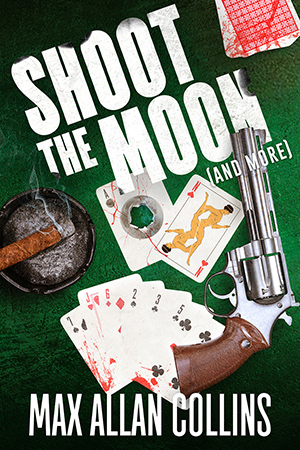
Wolfpack has announced the January 6 publication of Shoot the Moon in a reorganization of the collection Early Crimes. This new version is the novel Shoot the Moon with a “bonus feature” of short stories at the back of the book. Shoot the Moon was my attempt to do a Westlake-like humorous suspense novel. It can be ordered as either an e-book or a physical book.

Also announced by Wolfpack is Reincarnal & Other Dark Tales (with a January 27 pub date). Right now it can only be ordered as an e-book, but a physical book is coming. This collects virtually all of my horror stories to date.

Blue Christmas & Other Holiday Homicides is already available from Wolfpack in both e-book and physical book form. It’s a collection of holiday-themed stories by me, including the title tale, which is my favorite among my short fiction.

* * *

Barb and I revisited two of the Christmas movies I recommended last time.

It Happened One Christmas is the re-imagining of It’s a Wonderful Life with a female protagonist (Marlo Thomas). I love this little movie almost as much as the original, but the truth is that It’s a Wonderful Life is a film masterpiece and It Happened One Christmas is a TV movie. A very good one with a remarkable cast, but a TV movie.

When it first appeared, It Happened One Christmas benefitted from It’s a Wonderful Life having dropped out of sight. But not long after the remake aired, the public domain showings of It’s a Wonderful Life began on PBS stations and revitalized interest in the original film. Despite the gender role reversal, the films are much the same, right down to the dialogue. This will be problematic for many meeting the remake for the first time.

It’s too bad, and I’m glad I saw the remake first, because it didn’t hurt my appreciation of the original at all. But the Marlo Thomas version is, in my opinion, still worthwhile with its strong cast including Wayne Rogers, Orson Welles, Christopher Guest, Cloris Leachman, Archie Hahn, Doris Martin, Richard Dysart, and Barney Martin. And for me a special resonance is the cinematography by Conrad Hall, who won an Academy Award for Road to Perdition.

Twelve Days of Christmas Eve held up very well on what must be my fourth or fifth visit. While it’s rather shamelessly a Ground Hog’s Day variant, it does so in a clever manner and star Steven Weber is excellent, as is Molly Shannon. If you ever try this, stick with it for a while, because it seems at first like just another TV movie, but becomes something very special as it goes along.

* * *

Barb and I were excited about being able to see at home the new Wonder Woman movie (apparently called WW 84 – and I haven’t even seen WW 83 yet!), springing for the new HBO Max streaming service to do so. And guess what? WW 84 is one of the worst superhero movies I’ve ever seen. What did Barb think? She walked out – and we live here!

Where to start? The opening on Amazon Island (or whatever it’s called) is fine. But once we get to 1984, one problem after another presents itself. Let’s get this out of the way: nothing wrong with Gal Gadot, whose super-power seems to be emerging from this crock unscathed. If you are a man, this is not a movie you want to be in, unless you are Chris Pine or a homeless black guy, as every other adult male is a lout at best and a potential rapist at worst.

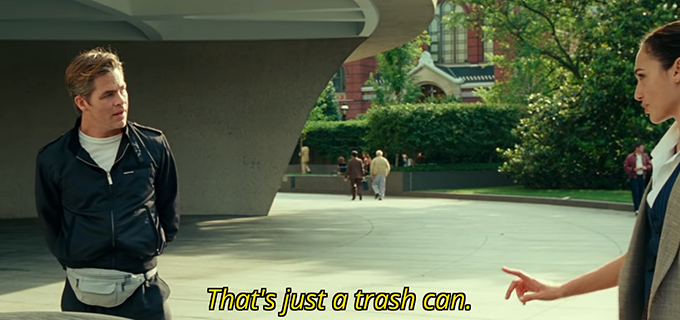
Chris Pine doesn’t fare that well himself, actually. He comes back from the Great War dead to be wide-eyed and astonished by such marvels as escalators (introduced around 1900) and a subway (introduced around 1890). He tries on a lot of groovy ‘80s clothes, which (as any 1910s guy would do) he finds really cool, particularly the man purse. By the way, in this movie where men are reprehensible, Diana Prince (SPOILER ALERT: Wonder Woman) allows an unknowing male to become the receptacle for her dead boy friend’s persona and almost immediately has sex with him.

What can you say about a film whose super-villain is a blithering jackass? Really, just another weak man who happens to be an a-hole? Or about a script whose theme is wishes coming true but at a cost…a cost that never defines its boundaries (i.e., some people immediately lose whatever they gave up to get their wish, but – so that she can participate in fight scenes – Wonder Woman only very gradually loses her powers).

Then there’s Kristen Wiig, who plays her role as a supposed nebbish girl like an SNL character, then unbelievably becomes a mostly CGI bad girl (the Cheetah, a recurring Wonder Woman villain, but never named in the film). What Kristen gave up for her wish was her…niceness.

This is a super-hero movie that made me want to reconsider Green Lantern. How could the first Wonder Woman film be so good, and this one so wretched? Same director. Different result.

Still from Wonder Woman 1984, captioned: That's just a trash can.
* * *

While I haven’t dug into it yet, the Taschen coffee table tome, The History of EC Comics, was my “big gift” from Barb this year. I love these books but they are difficult to deal with. A hernia is no way to start the New Year. But what a thing of beauty this baby is.

My son Nate gave me two books in Marc Cushman’s These Are the Voyages series of big, long, in-depth tomes about Star Trek. I have mentioned here that Barb and I were trek fans before the dreaded term trekkie was even coined. We attended one of the first Star Trek conventions, and watched the episodes in syndication over and over. I bought the comic books and James Blish paperbacks. We went to dinner theater plays in Chicago starring (separately) William Shatner and Leonard Nimoy. I got to know Walter Koenig, at first by mail (we traded Big Little Books) and then in person. (Later I would cast Majel Barrett Roddenberry in Mommy.) We went to Gene Roddenberry’s embarrassing film Pretty Maids All in a Row in the theater, and we stood in the cold for hours to see Star Trek: The Motion Picture (which remains one of my favorite films, for which I have no apology).

These books chronicle everything. The first three are about each original season, but now I’m reading book four, which is about the years leading up to the animated series. Cushman’s tomes are well-written and ridiculously thorough – how ridiculously thorough? How about reviews quoted at length from those dinner theater appearances I mentioned earlier? Or tons of the bad reviews Pretty Girls All in a Row got? Or what TV shows the secondary cast members appeared in between the series and the movies?

So you have to be something of a lunatic where Star Trek is concerned – the real Star Trek, that is – to want anything to do with these three-inch-thick books. And I qualify.

Thank you, son.

* * *

As a sidebar to the WW 84 review above, let me say that after recently adding movie channels to our cable and streaming channels to our Roku, I am underwhelmed and overwhelmed at the same time. “Over” because there is so much of it. “Under” because so little of it appeals to me.

Much of the new product seems so politically correct and painfully diverse to make me consider voting Republican (we all have our weak moments). “Free” content on most of the streaming services is commercial-ridden. But now and then I stumble onto something good.

In 2015, Colin Hanks (whose father, I understand, appeared in a very good gangster film) directed a documentary about Tower Records called All Things Must Pass. It’s an extremely well-made film in which Russ Solomon, the creator of the record-store chain, is interviewed at length; so are many of the original employees, who rose to high levels within the company, and such music luminaries as Elton John and Bruce Springsteen.

I loved Tower Records. Any time I was in a big city, I tracked Tower Records down. Each store was the same but different, reflecting the individual management and its employees. Those red letters on yellow thrill me to this day. I bought CD’s there. And books. And magazines. And laser discs. And DVDs.

In Chicago. In Los Angeles on Sunset. In New York in the Village. In Honolulu. In London. In Las Vegas. These stores were a pop culture paradise, and they still exist only in Japan, and in my memory.

I hate streaming. I hate e-books (except for the income they generate for me, of course). I am Old School. Physical Media. Physical Media. Physical Media.

Nice job, Mr. Hanks. Cool work on Fargo, too.

* * *

Among the oddball, quirky Blu-ray labels I support is Vinegar Syndrome. You should check them out. On their Black Friday sale, I bought Forgotten Gialli Volume 2 and a box set of The Beastmaster. The packaging is incredible and the bonus content mindboggling. They do intersperse “classic” porn titles between the horror and giallo and s-f titles, so take care. Some of their media gets pretty physical.

* * *

I will see you next year. By then, I will be working on Quarry’s Blood. Skim Deep was a coda to the Nolan series, and this one will be a coda to the Quarry series.

Shall we endeavor for 2021 not to suck quite so thoroughly as 2020? On the other hand, the thing I’m looking forward to about next year is getting a vaccine shot or two.

* * *

Here’s a nice recommendation for Skim Deep.

M.A.C.

Come Spy With Free!

Tuesday, November 24th, 2020
Come Spy With Me Advertisement

Yes, it’s yet another M.A.C. Book Giveaway!

I have ten copies to give away of the very handsome Wolfpack trade paperback of Come Spy With Me by yrs truly and Matt Clemens, the first in the John Sand series. Should you win a copy, you agree to write a review for Amazon and/or Barnes & Noble (review blogs are also kosher). [All copies have been claimed. Thank you for your support! — Nate]

These reviews are extremely important (and not just from those of you who get a free book now and then). Amazon is key, because the e-book version is available only on Kindle, Amazon’s format. The trade paperback can be ordered at Barnes & Noble and other on-line retailers. I think finding a copy at a brick-and-mortar store is unlikely, at least at this point.

Wolfpack has been very supportive and even ran a big ad in Publisher’s Weekly (reproduced here).

I should have mentioned when I announced the Skim Deep book giveaway a few weeks ago that you cannot post reviews at Amazon until the book’s publication date (Come Spy With Me is out now). Those were advance copies of Skim Deep, and a few of you tried to post reviews unsuccessfully. Amazon is listing that pub date as Jan. 5, although I believe that’s inaccurate – it’s actually going to be available early December. I will try to get this corrected at Amazon, but keep trying if you’ve written your review, when we get into December. I’ll try to have updated info on the official pub date soon.

(By the way, Nate always provides ordering links when you click on the first mention of a book title in any of these updates.)

Meanwhile, Booklist has given Skim Deep a very strong review:

Skim Deep. By Max Allan Collins Dec. 2020. 256p. Hard Case Crime, paper, $10.95 ( 9781789091397)

Collins’ first novel, published in 1972, was called Bait Money and was intended as a stand-alone homage to Donald E. Westlake’s Parker thrillers, which Westlake wrote as Richard Stark. The one-off homage, however, became a series starring Collins’ version of Parker, superthief Nolan, and his surrogate son, musician and comics artist Jon.

Now Collins returns to Nolan and Jon in a new adventure, set in the late 1980s. Nolan, living the straight life as a restaurateur in the Quad Cities, has decided it’s time to marry his longtime lover, Sherry. A trip to Las Vegas ensues, where the newlyweds reunite with Jon and settle in for a long weekend of fun and frolic. Not quite. Unfortunately, one of Nolan’s pals from the bad old days has a plan to steal a week’s worth of skim from a Mobbed-up casino and to use Nolan as the fall guy. Meanwhile, trouble’s brewing back in Iowa, too, where a Ma Barker–type wants Nolan’s head in a basket (literally).

This jaunty caper novel has a definite dark side—Nolan is no ersatz antihero—but Collins, as always, mixes blood and badinage with gusto. — Bill Ott

Ms. Tree, Volume Two: Skeleton in the Closet has made the Mystery Scene Gift Guide, as assembled by the great Kevin Burton Smith of the equally great Thrilling Detective web site. Burton describes Ms. Tree as “9mmm-toting Chicago private eye, Michael Tree, who’s been pushing envelopes and taking out bad guys since 1981 (scooping Grafton, Paretsky, et al., on women’s issues and Law & Order on “ripped from the headlines” plots in the process). This volume rounds up the rest of the uncollected stories from the DC Comics 1990s run (which Collins considers ‘the best’ of the long-running series), and it’s just waiting for a whole new generation of fans. As usual, Tree and her agency take the ‘edgy route,’ dealing with homophobia, date rape, POW/MIAs and…exorcism?”

November, of course, means Gift Guide and Black Friday deals and other holiday-oriented consumerism. In these Pandemic times, gift buying has been driven indoors even more than in recent years, and it also finds us (well, me anyway) in a WTF mood when it comes to, “Should I buy this or not?”

So here are a few suggestions for yourself and others.

Kino Lorber has a Noir-vember sale that ends today – November 24, 2020 – but if you read these updates the day they appear, you have time to partake of a number of noir (or anyway noir-ish) titles. But pertinent to our interests here, they have:

The Girl Hunters (Blu-ray $12.99 and DVD 9.99). I did the commentary and the interview footage with Mickey from the Mike Hammer’s Mickey Spillane shoot in 1999.

My Gun Is Quick (Blu-ray $7.99 and DVD 6.99)

I, the Jury (Blu-ray $9.99) The Armand Assante version.

Among other strong titles on sale are I Wake Up Screaming, Murder He Says (among my favorite comedies), and No Orchids for Miss Blandish.

Even if the sale is over, check the prices at Kino Lorber’s site. They run lots of sales and tend to be cheaper than ordering from other on-line retailers of their product.

For Spillane completists, the low-budget 1970 production of The Delta Factor (which Mickey co-produced) is available in a decent gray-market edition here.

Be advised that I haven’t found a really good-looking copy of this film anywhere, and this one at least comes in a fun full color package. If you’re into collecting oddball stuff (like I am), this seller – J4HI.com – has a wonderful off-the-wall selection. Regular sales and new titles are always in the offing. Buying several titles at once lowers the price per disc.

Tell Mike that Max sent you.

* * *

My production has slowed down for a few weeks. A very stressful situation having to do with a copy editor rewriting me practically line by line sent me into AFib. Atrial fibrillation is an occasional side-effect of my heart trouble of a few years ago, and I had to go into the hospital briefly for what is called cardioversion. This is basically getting your heart shocked back into its correct rhythm, or, as I like to put it, getting jump-started like an old Buick.

I appear to be fine, though I’m having to take it easy, which is generally against my nature.

What I am having to deal with is more psychological than anything else. I apparently care too much about my work. I’ve expressed my general hatred for copy editors here and that came to a head with this episode. Barb has drilled into me not to get bent out of shape about this kind of thing, with a “Is it worth dying over?” mantra.

She’s right, and I am working on it.

As for copy editors, I should amend my expressed hatred, which is deep and abiding, to apply only to the intrusive ones. All writers need a copy editor to check for inconsistencies, missing words, typos, etc. But about fifty percent of the copy editors I’ve dealt with over my career have appointed themselves co-authors. There appears to be an army of young people, fresh out of college and armed with a degree in English, whose goal in life is to teach a professional writer with fifty years in the business how to do what he does.

I attach a letter to the copy editor with every book manuscript, tweaked for that specific novel; but often my missive is ignored.

Anyway, I’m doing fine.

And the battle goes on. In a lower-key fashion, but on.

* * *

Here’s a nice review of Skim Deep at Crime Fiction Lover.

Please stay safe over this Thanksgiving holiday. We are back to sheltering in place interrupted by only a very early morning grocery run every week or two.

It’s like my raging against copy editors – Thanksgiving with family and friends…is it worth dying over?

M.A.C.

Hey Kids! Free Books & Nolan Returns

Tuesday, November 10th, 2020

First, here’s another interview of me by the great Andrew Sumner for Titan Books – this time regarding Nolan and Skim Deep.

Okay, show of hands – how many of you like books?

Seems to be everybody.

All right, how many of you like free books? Don’t fight!

Only so many free books are on hand, so how many of you like a really good bargain? Don’t pout! I mean, really good….

The entire Reeder and Rogers trilogy by Matt Clemens and me is on sale right now as part of Amazon’s Monthly Deals: Up to 80% off Kindle books. They will stay on sale till 11-30-2020, with [Amazon links:] Executive Order at $1.99 and Supreme Justice and Fate of the Union available at 99 cents each.

But wait, there’s more! (Look, I realize I shifted from classroom mode to infomercial, but I figure you can stay with me.)

The first of the two (so far) Krista Larson novels, Girl Most Likely (a Thriller Award best paperback nominee), is part of that same sale for just 99 cents.

Now for the free books. Don’t rush the stage! (Yes, I know, I did it again. Pretend it’s a running joke.)

I have ten copies of Skim Deep, the first new Nolan book in over three decades.

[All copies have been claimed! Thank you for your support. — Nate]

This doesn’t come out till Dec. 8, but I have these ten finished copies of the novel provided by Hard Case Crime. You’ll see me here posing happily with Skim Deep, the final Nolan novel, and the original edition of Bait Money, the first Nolan novel, published in December 1972.

That’s 48 years ago. Nolan is 48 years old in Bait Money, by the way, which at the time seemed really old to me. Those two 48-year periods represent one of those insignificant facts that take on weight in a barroom after enough time and tide has passed.

I’m going to walk you through how Nolan came to be. Some of you will have heard me talk about this, and/or write about it before, but go on reading – with my memory, it’s sure to come out different.

I started reading Richard Stark in 1967 after the film Point Blank came out, based on The Hunter, the first in a series about professional thief, Parker. Around the same time I discovered another writer, comic mystery author Donald E. Westlake, and these two were soon my favorites of then-current mystery writers. I had no idea Westlake was Stark – their books were so very different.

Westlake/Stark was the last author to have a major impact on my work. I was already reading Spillane, James M. Cain, Dashiell Hammett, Raymond Chandler, Ed McBain and Jim Thompson (and a few others). I had basically trained to be a writer of private eye novels or maybe cop books, but the times they were a changin’, and P.I.s were impossible to sell and, in 1968, cops were just guys clubbing my friends at the Democratic convention.

I’d already discovered an obscure series by Ennis Willie about an ex-hood named Sand, who had much in common with Stark’s Parker, though Sand was created first. A tough guy who was an ex-hood heist artist seemed a reasonable alternative to gumshoes. Hence, anti-heroes. Crook books.

A few paragraphs ago I called Bait Money the first Nolan novel. It kind of wasn’t. The same character, originally called Cord in a book titled Mourn the Living, I’d written in junior college. It didn’t sell, but it got me into the University of Iowa Writers Workshop thanks to Richard Yates, the great mainstream novelist.

Bait Money (and the first Mallory, No Cure for Death) were written for Yates and his class, and he worked one-on-one with me even after I was required to study with a few other instructors. He landed me an agent, Knox Burger, who had been a well-known editor at Collier’s and then Gold Medal Books. Among other things, Burger was instrumental in talking John D. MacDonald into creating Travis McGee.

Yates sent Burger Bait Money and praised me as a young Dashiell Hammett or Raymond Chandler. Burger, who was as no-nonsense as a hit-and-run driver, said, “More like a young W.R. Burnett.” Which was fine with me. In the same league as the guy who wrote Little Caesar, High Sierra and Asphalt Jungle? I understood how great that was, even if Yates didn’t.

Burger is the guy who called me a blacksmith in an automotive age. Again – fine by me.

I killed Nolan on the last page of Bait Money and Burger wanted me to un-kill him. I refused, but the book kept getting rejected. Then an editor at Pyramid Books spilled coffee on the manuscript, meaning I had to retype it (which I did, myself). Burger said, “You might as well take the opportunity to put the better ending on.”

I did.

It sold next time out and the editor wanted a series. This was a problem because I had conceived Bait Money as an homage to Richard Stark, or even a pastiche, using his distinctive method of organizing sections and using strict point of view.

I had, by this time, begun to correspond with Don Westlake. He began mentoring me, and had read Bait Money (Burger gave the manuscript to him) and professed to like it. I wrote Don and asked him how he felt about me doing a series about Nolan – I was uncomfortable because (as many of you have heard me say) homage is French for rip-off.

Don graciously insisted that the Jon character – the sort of hippie-ish comic book collecting “kid” who became Nolan’s surrogate son – made the books more human. Don also felt Nolan was more overtly human than Parker. He said by all means take the gig.

I did. The publisher was Curtis Books, an off-shoot of the same company that had published the enormously successful Saturday Evening Post. Their paperback line, however, was not enormously successful. I did four Nolan novels and the first two Mallory books for them, and they only published the first two Nolans (and neither Mallory) before Popular Library bought them out.

The editor at Popular Library put the books into inventory, while periodically insisting publication was imminent. It never happened. Meanwhile, I wrote Quarry (originally The Broker) and Berkley Books bought it and asked for three more.

In the early ‘80s, Knox Burger sold all five Nolan novels to Pinnacle, plus a new to-be-written one. They had recently lost the Mack Bolan series and apparently I was supposed to be the replacement, though Bolan and Nolan had nothing in common but rhyming.

I had to revise the first two novels somewhat, largely because Fly Paper pre-dated quite a few airport security measures. Bait Money came out and sold very well.

Then the creator of Mack Bolan, Don Pendleton, threatened to sue Pinnacle for publishing a series about somebody who rhymed with his character. So the last couple of books had Nolan’s name taken off the covers, and my contract was dropped.

My novel True Detective got some me some attention in 1983, and a few years later an editor at TOR asked me to revive Nolan, which I did with Spree. But then, for reasons not worth going into, that editor and I had a falling out and a contract to do a bunch more Nolans got dropped.

Seems Nolan and Jon led at least as perilous a life in the world of publishing as they did in fictional crime.

That was it for Nolan until, finally, Mourn the Living was published, with “Cord” changed to “Nolan.” Writer Wayne Dundee had serialized the novel in his magazine Hardboiled, and people started asking me to collect it in book form. I did. It was a hardcover from Five Star.

Felt like Nolan had come full circle, from Bait Money to the unintentional, Jon-less prequel, Mourn the Living.

Then, as is his habit in my publishing life, Charles Ardai came along. He was going to do some reprints and a few new books for his budding Hard Case Crime line. He was a fan of the second Nolan novel, Blood Money, and wanted to publish it. I felt Bait Money ought to be included, as Blood Money was its sequel. He put them together as Two for the Money.

As most of you know, I revived Quarry for Charles, who from time to time asked me to consider writing a new Nolan. I resisted, because I’d written Spree to be the last book. Finally he offered to republish all of the Nolans (two books to a volume) with spiffy retro covers if I’d do a new one.

And, so, all these years later, I have.

What was most interesting to me was that despite the many decades gone by, when I sat down to write about Nolan and Jon, bing! There they were. Waiting for me to check back in with them. I don’t know why it came so easy. It’s not like I haven’t written about other characters in the interim.

But Nolan in Mourn the Living, and Nolan and Jon in Bait Money, represented the start of my career, and both books took a lot of time. I’m known, I guess, for being able to turn out good books in not much time. But those first two novels were where I went to school, teaching myself (and cribbing from Stark and the rest).

Back then, I had to type pages over and over, because there were no photocopy machines yet and publishers got their noses out of joint if you sent a carbon copy. I would imagine I worked on Bait Money for a year and a half. Skim Deep took, I believe, three weeks. Maybe a month – I don’t really keep track.

So now Nolan has come full circle, and maybe so have I, and like Nolan, I have no intention of dying on the last page.

* * *

Here’s some nice love for the forthcoming Shootout at Sugar Creek, the new Caleb York.

M.A.C.