Posts Tagged ‘Movie Reviews’

A New Novella, TV Mini-Series Reviews and Legacy Books

Tuesday, May 24th, 2022

This week I am working on my draft of the last five chapters of Cutout, the novella Barb and I are doing for Neo-Text. It will appear as a trade paperback, available through Amazon, and of course an e-book. No pub date yet, but Neo-Text moves fast.

Cutout marks Barb’s return to her tight, third-person style that she honed in her years writing short stories, which culminated in the novels Regeneration and Bombshell, co-written by me (now available from Wolfpack – the trade paperbacks are lovely).

We have, of course, been writing the Antiques series since then, and it’s been a long-running success, although we were not offered a new contract by Kensington and moved to Severn, where Antiques Liquidation (our second Trash ‘n’ Treasures mystery for the UK house, after Antiques Carry On) will be published on October 4.

Barb had begun to get an itch to do something else, as evidenced by a short story we co-wrote that appeared not long ago in Ellery Queen Mystery Magazine (July/August 2021) under our “Barbara Allan” joint pseudonym. For over a year she’s been mulling (her maiden name is Mull) doing an espionage-tinged novel called Cutout, and we discussed it often, plotting it over a restaurant lunch (as is our habit). I came to feel it was either a novella or a young adult novel, in part because its protagonist is a young woman in her freshman year of college, but also because it needed to be probably no longer than 40,000 or at most 50,000 words – at least as initially conceived. Barb had in a mind a very spare, almost minimalist style for this one.

With Neo-Text a market for my novellas – witness Fancy Anders Goes to War – we decided to go with that length, which will be in the neighborhood of 30,000 words.

We were able to sell it to Neo-Text on a basis of the first third or so of the manuscript plus a fairly detailed synopsis. I’ve been doing my drafts of chapters with Barb out ahead of me, and now she’s completed her draft and I have five chapters (of sixteen) to go.

All I can tell you is it seems very, very good to me.

I will keep you posted.

* * *

We seem to be in a sort of Golden Age of TV mini-series, thanks to the hungry eye of streaming services. I would like to point out a few that might be worthy of your time.
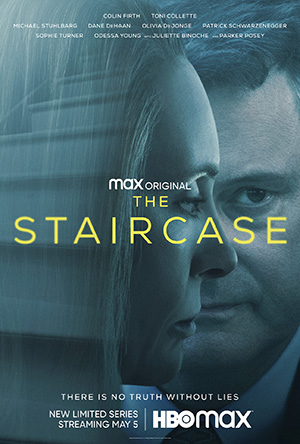
The Staircase

The Staircase (HBO, streaming on HBO Max) charts the notorious Michael Peterson case, in which the author of Vietnam thrillers is accused of the murder of his wife. This true-crime-based drama was already the subject of a well-known documentary, streaming on Netflix, also called The Staircase. The documentary is fascinating and, while somewhat flawed in stacking the deck at least slightly in Peterson’s favor, a worthwhile watch, despite its thirteen-episode length. But the dramatic mini-series is its own animal and quite good, dealing with material not covered in the documentary, including much more about Peterson’s wife and family, his experiences in prison, and the seemingly ridiculous but actually compelling theory that the wife was killed by an owl (!). Peterson in real life is a complex character, at first an apparent sociopath but then seemingly human and even a victim. It’s a whipsaw experience, watching both the documentary and the dramatic version. The centerpiece of the latter – a meta experience that includes the making of the documentary within its own narrative – is the remarkable Colin Firth as Michael Peterson.

Two more true-crime based mini-series may be of interest to you – they were to me. But both take a less serious approach to the material, casting real-life melodrama in a manner reminiscent of a John Waters movie.
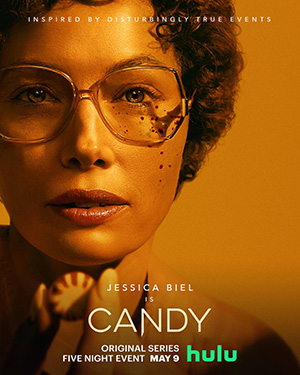
Candy

Candy recounts the at-one-time household name murder case from 1980 in which one church-going housewife killed another church-going housewife with an axe, wielding enough blows to make Lizzie Borden look like an under-achiever. Candy Montgomery – the case is the subject of a famous true crime book co-written by John Bloom (Joe Bob Briggs!) – plotted her affair with Betty Gore’s husband as if it were a Brinks truck robbery. But she somehow killed Betty with that axe (the jury agreed) in out-of-control self-defense. The dark absurdity of the case lends itself to creator Nick Antosca staging everything Waters-style, with kitschy late ‘70s/’80s sets and Sears catalogue costuming and blatantly fake wigs and a musical soundtrack more appropriate for a sitcom than a tragic docudrama. Jessica Biel plays Candy peanut-brittle brittle, aggressively upbeat. The subtext here is that Candy was guilty.

But if you watch the 1990 TV movie with Barbara Hershey (it’s on You Tube and out-of-print DVD) – A Killing in a Small Town – you’ll find a strikingly similar film as to content, with the tone and approach wildly different. For one thing, Barbara Hershey is a world-class actress who actually sells Candy’s unlikely innocence. For another, the tragedy is treated not as a dark joke but…a tragedy. The 1990 film (only ten years later, after all) looks like real life, not an over-the-top, if admittedly compulsively watchable, kitsch fest.
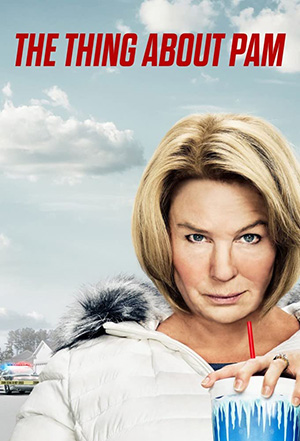
The Thing About Pam

But The Thing About Pam, an NBC mini-series streaming on Peacock, makes Candy look like The Thin Blue Line. Reneé Zellweger has gotten heat for wearing prosthetics (including a “fat suit”) instead of putting herself through the unhealthy but somehow admirable effort of gaining a bunch of weight. A better argument might be hiring a plus-size actress, but Zellweger is so good in the role, even that’s doubtful. What did seem questionable to me, as I watched the mini-series, was how far down the John Waters rabbit hole the filmmakers had gone.

The absurdity was shameful! They even had that creepy Dateline guy do the narration! They outright played it like black comedy – how could they?

But then I looked at some of the documentary material on the case and you know what? It plays like laughably bad melodrama in real life – an idiot prosecutor who ignores the most obvious suspect, white cops who badger an Hispanic suspect for a quick arrest, a manipulative, greedy woman who sees herself as funny and smart and is just an unmistakable monster. That creepy narrator was the only thing absent from the real deal…and even there, the murderer herself pretended in her last desperate homicidal ploy to pass herself off as a Dateline producer!

I don’t know if I can recommend either Candy or The Thing About Pam, but…forgive me…I enjoyed every minute of both. The world we live in seems to me more and more like a John Waters movie. Why shouldn’t both of these mini-series reflect that? Didn’t I write this already? Wasn’t it called Mommy?

Similarly, perhaps the best mini-series going right now draws upon an entirely different kind of true crime – Gaslit on STARZ, starring Julia Roberts as Martha Mitchell and Sean Penn as her husband John. Both are excellent, though this Watergate mini-series belongs to Dan Stevens as a somehow lovable weasel of a John Dean. This one also plays as an absurd comedy, but doesn’t need to overdo it to make the point that the reality was similarly wack-a-doodle. Everybody in this is good, but another standout is Shea Whigham, who makes a terrifying and yet hilarious G. Gordon Liddy.
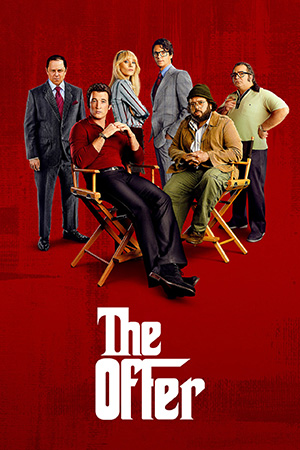
The offer

As good as Gaslit is, The Offer is my favorite of all these, the series both Barb and I savor every moment of. Streaming on Paramount (a company the series regularly skewers), The Offer is a behind-the-scenes look at the making of The Godfather. This, too, finds comic melodrama in the proceedings but is less heavy-handed than Candy and Pam (yet how I would love to see Candy Montgomery Vs. Pam Hupp: The Final Showdown). Some reviewers haven’t liked The Offer, but actual humans probably will. The cast is wonderful, with Matthew Goode’s Robert Evans a stunning thing to behold, while quietly charismatic Miles Teller holds everything together as producer Al Ruddy, the pole that holds the tent up. Also outstanding, among a flawless ensemble, are Juno Temple, Dan Fogler and Giovanni Ribisi.

Finally, Better Call Saul on AMC is in its final season (broken in two, as was the case with Ozark). I find its narrative style fascinating – often the story proceeds at a crawl, raising more questions than answers, and yet you hang right with it. I keep thinking about how that approach could transfer to prose.

* * *

Scott D. Parker, in his article “Legacy Authors and That Last Book,” compares aging rock bands who record a last song and/or album, knowing it will be their last, to authors who may write a book about an enduring character, knowing it will be the last.

Parker invokes me and some of my ruminations here about slowing down, and specifically wonders if I’ll know when I’m sitting at the computer to work on my final Heller novel. The truth is I don’t know. I have one more Heller to write on the current Hard Case Crime contract, and – as The Big Bundle won’t be out till early December – I don’t yet know how the HCC audience will take to Nate Heller. I am confident that Heller is my most important work and my best shot at being read years after I’m gone.

And Sir Arthur Conan Doyle was convinced his enduring contribution would be those historical epics nobody reads any more.

For me, it’s a matter of paying attention to my health. I’ve had two good reports in recent days and it looks like – aside from getting hit by a bus or something the docs overlooked – I’ll be around a while. I have every expectation this next Heller will get written.

Will it be the last?

I don’t know. Parker wonders if mystery writers realize their characters are getting older. Well, some ignore it. Stout would have characters from previous novels show up on Archie and Wolfe’s doorstep having aged, while Goodwin and Nero remain in the same frozen-in-time state. Mickey Spillane, in advertising for The Killing Man, appeared in Miller Lite trenchcoat-and-fedora drag saying, “I got older – Mike didn’t.”

But he did. Like Jack Benny, Mike Hammer didn’t admit to being older than 39, but he clearly was. He was a guy who’d fought in the Pacific in World War II, using a cell phone in Black Alley (1996). I have made a point, in my collaborations with Mickey, to be more up front about Mike’s age. I fudge it a little, though.

In our Antiques series, Barb and I have to dance around the aging problem all the time. We want the books to be contemporary, so mentions of current political figures and pop culture come in – but we only move the pieces on the chessboard ahead one-season-per-book. In other words, for every four books, one year has passed in the lives of Brandy and Mother. Less than five years in real time elapse over 15 or 16 novels, yet they are moving through time at the same rate as the rest of us.

My late friend Paul Thomas, my musical collaborator, used to say about such things, “If you buy any of it, you buy all of it.”

I think I am more inclined to age my characters more normally than most mystery writers. Quarry’s age can be calculated, and so can Nate Heller’s. But one thing is for sure: me? I am moving only in one direction.

* * *

Here are eleven “intoxicating” crime books set in Las Vegas. They include Skim Deep, but should have made it a dozen with Neon Mirage.

I get a nice mention in this very good article, “A Primer on Crime Fiction.”

I receive a left-handed compliment in this look at the great Batman eras.

M.A.C.
Who I Try To Please

Tuesday, February 22nd, 2022

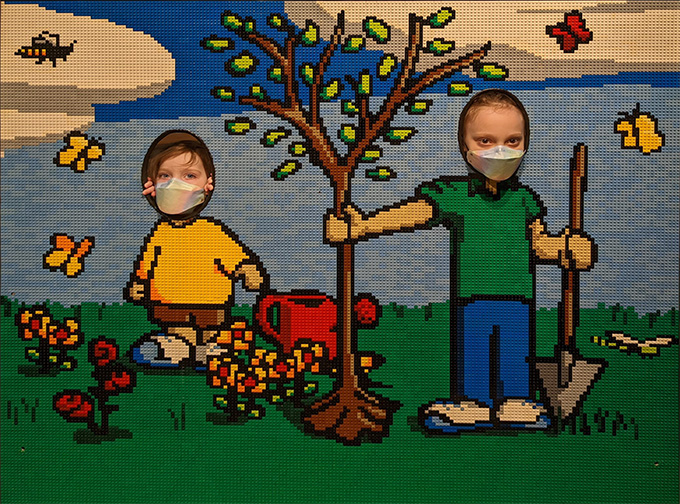
No book giveaway this week. To make up for it I am including a cute photo of our two grandchildren, Lucy and Sam, taken at the Muscatine Art Center’s lego display. You’re welcome.

Muscatine Art Center Lego Exhibit, Sam and Lucy
Muscatine Art Center Lego Exhibit, Rubber Duckie
* * *
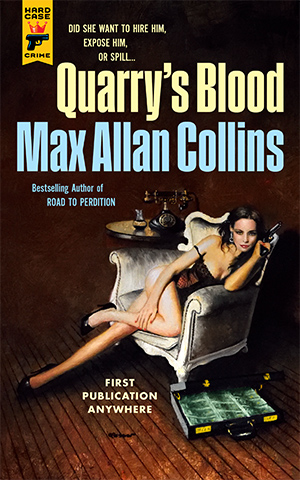
Quarry's Blood
Paperback: Indiebound Purchase Link Bookshop Purchase Link Amazon Purchase Link Books-A-Million Purchase Link Barnes & Noble Purchase Link Target Purchase Link
E-Book: Google Play Kobo

Patience – another book giveaway will come. I just don’t want to detract from the release today (Feb. 22) of Quarry’s Blood. And winners in that book giveaway, will on that date be able to post reviews on Amazon.

* * *

And speaking of Quarry’s Blood, I want to share this great review from Ron Fortier at Pulp Fiction Reviews:

QUARRY’S BLOOD
By Max Allan Collins
Hard Case Crime

Max Allan Collins has been writing stories about his Vietnam veteran hitman since 1976. It was obvious from the start that the author and his creation were the same age making it easy enough for him to place the stories in time. Collins did a few Quarry books and then walked away from them. When Hard Case Crime came along, publisher Charles Ardai, a fan of the character, urged Collins to bring Quarry back. Collins, obviously older, as was his hero, realized he had a golden opportunity to write a finale.

What his crystal ball couldn’t predict was how successful “The Last Quarry” would become among his ever growing audience. And there was Ardai wanting more. Collins pulled a very neat hat-trick and went backwards with “The First Quarry.” Which of course meant dusting off his own memories of those long ago times and their social environs. All of which he did making it seem effortless.

Having thus given us the alpha and omega, it seemed we mystery/crime fans had seen the last of Quarry. Again we’ve been proven wrong in this new “Quarry’s Blood.” It’s pretty much a gripping fast paced epilogue and so much fun. We catch up with an aging Quarry, almost about to reach seventy and widowed for the second time. He’s content with living a quiet, if lonely life, until a very savvy female writer named Susan shows up on his doorstep. As it turns out she’s the author of a bestselling true crime novel that was clearly inspired by Quarry’s lethal career and she’s convinced he is the real hitman she researched in her book.

Unnerved by all this, he maintains his false innocence and sends her packing. The following day, while taking a pre-dawn swim at a nearby indoor pool, he’s nearly killed by two professional assassins. No way is it a coincidence and Quarry finds himself once again being pulled into his old world of hunter/prey, kill or be killed. But what’s the connection to Susan? And who, after so many long years, wants him dead and why?

This is one of the best Quarry books ever. Maybe we think that because we’re seventy-five, a Vietnam veteran and often times think about all our brothers who never made it home to their families and loved ones. Who never got to drink another cold beer or read a damn good book like this one. Thanks, Max, for all of them.

Thank you, Ron, for reading them. When a Vietnam vet reacts well to these books, I am especially pleased.

* * *
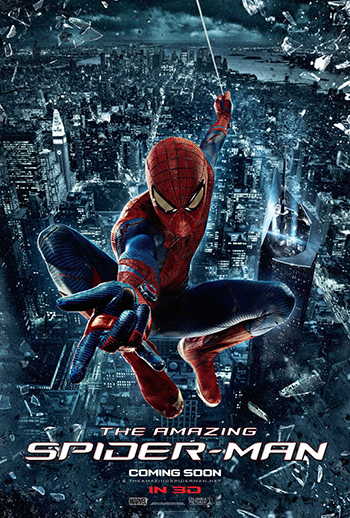
The Amazing Spider-Man

Okay, so sometimes I’m wrong.

Ten years ago, I thought The Amazing Spider-man with Andrew Garfield was lousy. But because I really liked the recent Spider-Man: No Way Home, in which all three big screen Spider-men were deftly woven into one narrative, I decided to pick up a 3-D Blu-ray of Amazing Spider-man (cheap) and Barb and I watched it tonight.

We loved it.

Part of this is our affection for Andrew Garfield in other films he’s been in that made us more open to his casting, and of course he’s very good in No Way Home. Part of it was how terrific the film was, really taking its time to explore the origin of the character in a way that was at once faithful to the original comic book and at the same time fleshed it out. Also, the attention by the filmmakers to mimicking artist Steve Ditko’s classic poses for Spider-man was thrilling to someone who had followed the character from Amazing Fantasy #15 and The Amazing Spider-man #1 to the end of the John Romita-drawn run.

Mostly our positive reaction, however, came from meeting the film on its own terms. This is true of novels and short stories, too. I’m a big believer in that, but I sometimes don’t take my own advice. In retrospect, I disliked the Garfield version of Spider-man, ten years ago, because I felt it was superfluous – that it was too soon to do a reboot (a term I don’t believe was in use yet). As a Sam Raimi fan – I saw Army of Darkness in a theater on its first release – I liked his version just fine, though the third one was not up to snuff. But Toby McGuire’s Peter Parker/Spider-man (should I have inserted a “SPOILER ALERT” there?) seemed definitive.

Now reboots are part of the plan, and No Way Home has rather brilliantly found a way to make all three versions of Spider-man at the movies exist in the Marvel Universe.

I mention this not just indicate any growth on my part, but as an adjunct to discussions here (on the update/blog itself and in the comments) about the value of reviews. I don’t recall if I reviewed Amazing Spider-man here ten years ago, but if I did, I probably panned it.

A review is just an opinion, and a snapshot of how the reviewer reacted to a film or novel at that time. Opinions can change, and they often should. I am always after my readers to post reviews at Amazon, and have made my preference for receiving good reviews no secret. But it really doesn’t have much with making me feel good (okay, a little), but mostly to help market the books. To draw attention to them and encourage new readers.

In the comment section last week, Bill P said the following:

So, if you as an author realize this is a collaboration with the reader, do you have an archetype in mind during writing for the intended audience? Does thinking of their acceptance/rejection of your choices guide you or limit you? And when you try to grow from that core audience from book to book, do you find some reject you extending those boundaries because they want the constancy of the world you have previously created?

I answered this last week, in the comments; but I think Bill raises topics worth discussing in a bit more depth.

I love my readers – money gets sent to my house because of them. But the truth is I write for only two people – Barb and myself. Primarily I write for me, because I am always trying to write a book that I would like to read. I am trying to satisfy my needs and express my ideas and to make something. Create something. Barb is secondary in this process, but incredibly important. I cannot imagine writing if she were not reading what I’ve written.

Now, that doesn’t mean she reads everything – she certainly skips introductions and essays and such that I occasionally write. But all of my fiction goes to her as my first reader (with novels, a chapter at a time). One reason for that is her abilities as a writer – even before she developed her skills along those lines, she had incredible story sense, and a remarkable bullshit detector. She knows when something isn’t working in a scene.

Also, and you’ll have to forgive the sentiment here, but I love her and want to please and impress her. To make her think I was worthy of her spending her life with me. I need to impress her because a lot of the time I am a buffoon.

Being my critic-in-chief isn’t an easy role for her. I hate criticism. I have a thin skin. (Not a desirable trait in a writer.) (Or anyone.) Sometimes I don’t react well. But generally she knows how to handle me (sad that she has to) and I know she is trying to protect me. Yes, from myself.

I don’t make any attempt to please readers by writing the same kind of thing every time out. For a long time, in the movie and TV tie-in days, I had to write all sorts of things to make a living. It was good for me, because I learned a lot writing in different genres – the movie novels, as I’ve mentioned here, included war, western, romance, science-fiction, sword and sorcery, horror and other themes forbidden to me in my narrowly defined role as a mystery writer.

But within mystery fiction, not everything I do pleases every reader of mine. When I do something like John Sand, occasional howls of displeasure have arisen. It’s probably no surprise that fans of Quarry might not be interested in the cozy comic Antiques novels. Quarry and Nolan fans sometimes find the longer length and historical approach of Nathan Heller off-putting, though Heller and Quarry and Nolan are cut from similar cloth.

I can’t help that. First, I need to make a living, and second, I need to stay fresh and interested. If I were doing one Quarry novel after another, in a row, I’d likely grow tired and to hate him. As it is now, it’s like spending time with an old, good friend (who kills people).

I do make concessions both to publishers/editors and to the type of book I’m doing. I have a sense of what’s appropriate for a given title. For John Sand, Matt Clemens and I decided to be very sparing with the “f” word – we hardly use it at all, whereas Quarry and Nolan and Heller readers know I am not fucking afraid to use it. In the Fancy Anders novellas and The Many Lives of Jimmy Leighton, that kind of effing profanity just didn’t seem appropriate. It wouldn’t be in the Antiques novels, either.

To me that’s just bringing to a given novel what is appropriate for that novel, and, yes, its audience. I don’t think that’s selling out – I think it’s being a conscientious professional.

I don’t know how to answer Bill’s archetype question. All of the first-person narrators are me – me in different circumstances, but me. In writing tough guys like Nolan, Quarry, Heller, even Mike Hammer, I strive to make their surfaces – and their inner lives – reflective of each being a real person. Not a type.

M.A.C.

Bulldog Edition

Tuesday, February 15th, 2022

It’s amazing! After my brief discussion/defense of the Ritz Brothers last time, fan clubs for the boys have sprung up all over America!

Okay, maybe not.

I’m just softening the blow that I’m not doing a book giveaway this week. Maybe next week. I am working on the new Nate Heller and found myself scrapping my intended final two sections and plotting instead one second section. This required re-reading a ton of research material and re-thinking it. I have been taxing my wife Barb’s patience utilizing her as a sounding board whose ideas and reactions are always helpful.

And how about that Super Bowl? Actually, as I write this, it hasn’t happened yet and I don’t care about it, so Barb and I will be going to the new Death on the Nile at a time when the theater should be largely empty.

* * *

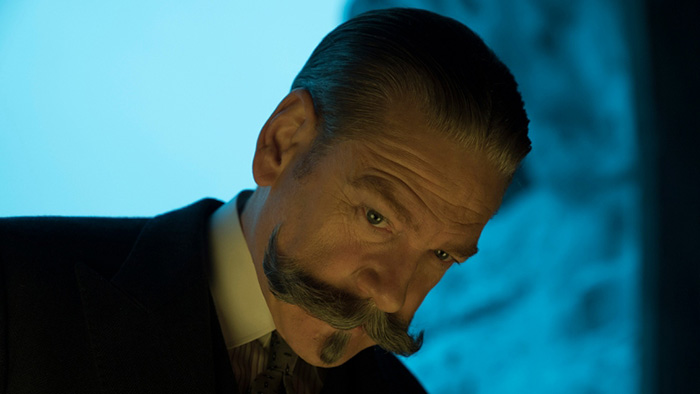
Barb and I have now seen Death on the Nile (in an almost empty theater!) and we both found it a whipsawing experience. Kenneth Branagh’s version of Poirot is perfectly acceptable and often pays attention to detail courtesy of the Christie (and Suchet) characterizations; but he falls prey to an out-of-character attraction he has to a raucous blues singer, based on Sister Rosetta Tharpe, whose music is used throughout in a sometimes jarring way – where we should be getting a John Barry-esque score over the majestic Nile as backdrop to all this glitzy but murderous melodrama, we get guitar-driven blues (and a traditional soundtrack playing at a barely audible level, as if the theater left its Muzak going). I like guitar-driven blues, but as the soundtrack to Agatha Christie?

Kenneth Branagh in Death on the Nile

Though relatively faithful to Christie in general, the substitution of the blues singer and her manager/niece for the drunken romance novelist and her daughter seems at once forced modernity and a clumsy removal of a valid murder motive. A nice WW I origin story for Poirot and his mustache is followed by Poirot in 1937 going to a nightclub and sitting alone at a table watching over-choreographed lascivious dancing in quiet perverse contemplation – it’s a creepy sequence, turning the Belgian master detective into a raincoater in a porn-shop booth.

When the riverboat-board mystery kicks in, the cast proves less than star-studded (and filled, by accident of course, with cancelled or sort of cancelled celebrities of a few moments ago) though the direction is fine, save for circling cameras and other stunts during interrogation scenes that only detract from the importance of the information being gathered. When Branagh hews close to Christie, which he does about two-thirds of the time, his performance and the film itself are fine.

The biggest flaw is Gal Gadot playing the woman-stealing rich girl in a positive manner, not Lois Chile’s grasping, acquisitive proper murder victim of the superior 1978 version. And for all the emotion Branagh tries to stir up, no performance here touches ‘78’s Mia Farrow, the spurned woman of one of Dame Agatha’s most chillingly convoluted plots.

I’m glad to see Christie staying in the popular culture, although Covid and the mine field of who is cancelled by the time a film comes out has done this Poirot film no favors.

* * *

My discussion last week sparked quite a bit of response, after I revealed my negative opinion of a certain James Crumley first sentence, even while granting an I-hope-not-condescending-permission for others to like it. Some of those responses appeared in the previous Comments Section, but still others were sent to me by e-mail. One of the most interesting came in that fashion, and – with permission – I am sharing it here, so I can reply and perhaps have my response seen by more readers than if this had occurred in the Comments Section.

The following is excerpted from a missive courtesy of a reader who wishes to remain anonymous:

Your blog is your house. I think good discourse is important, but I also respect your site as your medium to transmit your message. No need to raise Cain in another man’s world. That said, I do like the Crumley line and state it here, privately. (NOTE FROM MAC: Privately until I got hold of it.)

“Perhaps it’s because, when my Dad was in the creative writing program in Montana, he met and drank with Jim (called some of his work mediocre too…you might have liked that!). Maybe it was the many ‘ramshackle joints’ like that one described that my Dad dragged us to as kids. Maybe it is because my college roommate was from Sonoma, who had an alcoholic father that just might have drank in the same bar. Maybe it is because I have never thought about a bulldog that was an alcoholic, much less an owner who would give him such a big name as ‘Fireball Roberts.’ Those all play, I’m sure, and made me want to know more. But, having lived on the Gulf Coast in my young adulthood, I know what it is like to ‘drink the heart right out of a fine spring afternoon.’ Maybe you can’t go back, but that sentence fragment brought me there for a short moment.”

My anonymous correspondent has made – or anyway implied – a point that I tried to make last time. It’s part of the overall concept of the reader as collaborator. I’ve discussed that my propensity for providing what some think is over-description (of clothing, or setting, etc.), and have tried to explain that this comes from my desire to be the in-charge half of the collaborative team.

First, I would like the reader to experience what I imagined, what I conjured, as close to the way I did. Second, I don’t think it should be the reader’s responsibility to do the writer’s work. Why should you have to clothe the damn characters? Why should they be allowed to run naked through the pages, unless it’s a sex scene or set in a nudist colony? Why should you have to describe the circumstances of where these fictional people live and put the flesh on the bones the stingy writer did not deign to provide?

Now I say this specifically in regard to my work. I don’t propose it as a schematic, or “rules,” other writers should follow. This approach reflects, as it has no choice other than to do, my way of seeing things. In the comments, one reader agreed with me about the overwriting in the Crumley line, then started quoting Elmore Leonard’s rules, most of which I disagree with…for me, not for Leonard. He was excellent at following his own rules and came up with something special…and his. I was a fan of Charles Webb, the little-known author of The Graduate, and he was the stingiest writer I ever encountered – he gave you nothing but the action and words of the piece, which may be why his famous novel became an even more famous movie…it was already almost a screenplay.

My anonymous correspondent’s comments about his dad, and the way his father related to bars and drinking (I am almost a non-drinker, despite the mimosa I had this morning), are him bringing himself to the party. He can’t help doing that any more than I can avoid bringing my opinions and personal history to the party. And neither of us should try otherwise. That’s where the collaboration between writer and reader becomes interesting.

It’s also why you can love a writer, and recommend that writer to a perfectly intelligent friend, and then have your own intelligence questioned by that friend because of your terrible taste in books. (This obviously also applies to movies and music.) That is why all reviews – mine included (see Death on the Nile above) – are essentially worthless…because none of us have the same experience when we read a book (or see a movie or listen to music).

You can tell somebody a book is great, but the truth is the version that person experiences will be at least somewhat different from yours, and probably a whole lot different. I have spent my life dueling with people who don’t like Mickey Spillane. I have very little respect for their intelligence. And they have very little respect for mine. Neither of us is wrong, at least not entirely.

The one area where I would disagree with my anonymous correspondent is a style issue. I don’t object to any of the things Crumley jams into the sentence (well, I think “Fireball Roberts” is a terminally cute name for a bulldog, and Abraham Trahearne is almost as bad for a human), it’s just the show-offy way he goes about it. It’s impossible (or difficult) (or maybe I’m just slow) to chug-a-lug all that one sentence’s information.

What I do like about that line is that it provides information even as it raises questions – that’s how many, perhaps most, good first sentences succeed. A good first sentence doesn’t require you to read it more than once to make sense of it, to process it, unless you think it’s a bad idea to pull your reader down immediately into the narrative and make forward progress.

This is a first sentence that I much admire:

“Later that summer, when Mrs. Penmark looked back and remembered, when she was caught up in despair so deep she knew there was no way out, no solution whatever for the circumstances that encompassed her, it seemed to her that June 7th, the day of the Fern Grammar School picnic, was the day of her last happiness, for never since then had she known contentment or felt peace.”

That’s plenty long, but you are right with it, and solid facts accompany cascading questions. It’s the first sentence of The Bad Seed by William March, and you can have your drunken bulldogs named Fireball What’s-It.

* * *

I can’t resist reprinting this great review of Tough Tender from Booklist.

Tough Tender.
By Max Allan Collins
Mar. 2022. Hard Case Crime, paper, $12.95 (9781789091434)

Collins’ Nolan series, starring the no-nonsense thief Nolan and his younger partner, comics crazed Jon, was written from the sixties into the eighties, but it had been largely unavailable for decades, until Hard Case Crime began reissuing the series as twofers under new titles. This is the third in that sequence, following Two for the Money (2021), and it combines Hard Cash and Scratch Fever. Nolan has no interest in robbing the same bank twice, but he’s blackmailed into doing so by the bank manager, who wants a share of the take this time. Naturally, it all goes crazy wrong. Scratch Fever picks up the story years later when Nolan and Jon encounter hairstylist-turned-entrepreneur Julie, who scammed them on the bank deal. Naturally, they’d like to get their money back, and just as naturally, Julie would like to get rid of them altogether. Collins displays his usual ability to round out the flat edges of what seem initially like stock genre characters, but he really outdoes himself with Julie, surely one of the most memorable femme fatales in hard-boiled fiction (“everything she touches turns to dead”).
— Bill Ott

And here is (incredibly enough) a really nice review of Double Down, another Nolan two-fer, from Kirkus.

Nolan also gets love at http://thebadnet.blogspot.com/, which gives me great pleasure, as it’s a site devoted to Lee Van Cleef. Scroll down when you get there (linger over the naked blonde if you like).

Finally, Road to Perdition gets a spot on this list of Best 21 books about the Mafia.

M.A.C.

Spillane, Soho & Jimmy Leighton

Tuesday, November 9th, 2021

The last book giveaway of the year – our biggest – is still underway – we have three copies left. If you want either The Many Lives of Jimmy Leighton by Dave Thomas and me, and Fancy Anders Goes to War with Fay Dalton illustrating my novella, you still have a shot.

As usual, write me at macphilms@hotmail.com and provide your snail-mail address (even if you’ve won before) and your preference between the two books (if you don’t want a specific title, say so please). You pledge to write a review for Amazon – where both books are exclusively available – unless you hate what you read and don’t want to.

Amazon reviews and ratings are always important, but with these NeoText titles – unavailable in brick-and-mortar bookstores, and issued too late for the trade reviewers – they are crucial. If you like one or both of these books, please leave a review (and it can be short, a line or two). You can even rate them without posting reviews.

There are a bunch of links below to interviews Dave Thomas and I did together, but first you may wish to check out these links to sample chapters from The Many Lives of Jimmy Leighton.

And at Crime Reads.

* * *

If you’ve been following these updates of late, you know that I have been deferring somewhat to the serialized chapters of my literary memoir in progress, A Life in Crime at the NeoText site. The first ten chapters have appeared and now the memoir goes into sleep mode. I will post more of these when new books come out that can use some background (and a push).

The plan was two-fold – the chapters allowed me to promote both Jimmy and Fancy, and – as I wrote the chapters well in advance – provide me time to work on the Spillane biography. I have completed that, or will very soon – my co-author Jim Traylor is going over the manuscript now.

It’s a big book and I hope will be perceived as a major one – it’s over 100,000 words, the complete life of Frank Morrison “Mickey” Spillane with all of his novels discussed, as well as the film and TV adaptations. The bio itself is 85,000 words, the remaining 15,000 (“The Spillane Files”) consisting of bibliographic material and odds and ends…sort of deleted scenes, like little essays about Spillane and Ayn Rand, the gangster named Mickey Spillane, and the possibility Mickey wrote as “Frank Morris” for the pulps.

With luck, the book will be out from Mysterious Press in about a year as part of the 75th anniversary of Mike Hammer celebration.

This one really is years in the making. Just short of a decade and a half ago, Jim Traylor spent weeks in Murrells Inlet, South Carolina, digging through Spillane’s letters and other papers. Over the intervening years he interviewed numerous Spillane friends and family – obviously, Mickey’s contemporaries were getting up there and Jim spoke with any number of them who are now gone. He did several passes on the manuscript over the years. We interrupted the work on the bigger book to do Mickey Spillane On Screen for McFarland in 2012. We’ve worked hard not to repeat ourselves, having done One Lonely Knight: Mickey Spillane’s Mike Hammer decades ago.

While a lot of critical ground is covered in the book, I took the approach of making a linear story out of Mickey’s life, which was a colorful one to say the least. I gathered material I had collected on Spillane – magazines, newspaper articles, books – since I was in junior high, and my office floor looked like I was expecting the film crew from Hoarders to arrive any minute.

I considered suggesting the title The Mystery of Mickey Spillane as I began to realize that all of his disparate material provided puzzle pieces that could be assembled into the picture of a man. I knew the man in his later years, but I never met the young or even middle-aged Spillane. Many revelations emerged in the intense three-month process of writing the final draft.

Immodestly I will say I think Jim and I have written a major book on the most interesting figure in mystery fiction. In a year or so, you’ll be able to see if you agree.

* * *

Barb and I, regular filmmgoers (usually once-a-week) for many, many years, have gone out to the movies only rarely since Covid hit. Even though we are now triple-vaxxed, we are still careful – for one thing, our six year-old grandson Sam has asthma and Barb has been sitting with him and his three year-old sister in the afternoons while son Nate and their mother Abby work from home.

Barb is, of course, an amazing human being. She writes in the morning and then afternoons plays with those kids Monday through Thursday at my son and his wife’s house half-a-block up the street, and then we entertain the two kids Friday afternoons here. Sam and I generally watch a 3-D movie together.

Things are changing as Sam’s sister Lucy is now in Day Care, and Sam is going to get his Covid shot this afternoon. In a matter of weeks, he’ll be fully vaccinated and we can return to something more like normal. Or anyway the new normal.

Barb and I have only attended a handful of movies in a theater over these last vaccinated months – I believe Wrath of Man, Black Widow, No Time to Die and now Last Night in Soho are the only cinematic excursions we’ve made. We tend to go at off-times – yesterday, for example, we went to a 5:10 pm show. Only three other people were in the theater.

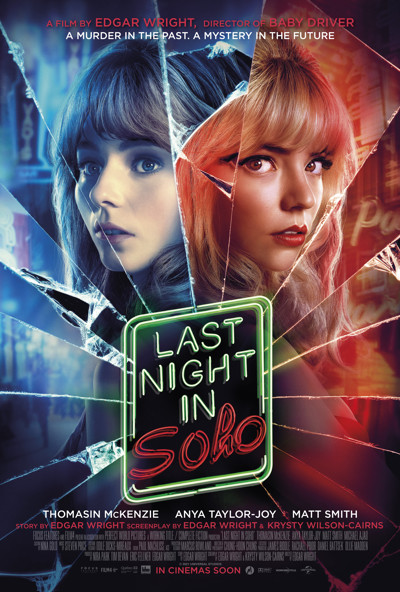
One Night in SoHo poster

That didn’t surprise me, really, because few people seem to be attending Last Night in Soho, and let me tell you (as Bob Hope used to say) it’s their loss.

I might have waited until this one was streaming if my Ms. Tree co-creator Terry Beatty hadn’t written me to say Last Night in Soho was “the best Brian DePalma movie Brian DePalma never made.” Now, Terry and I were at one time stone DePalma freaks, based upon Sisters, Obsession, Blow Out and especially Phantom of the Paradise. Most early and mid-period DePalma rated high with the Collins/Beatty team.

I lagged, and I think Terry did too (but I can’t speak for him), when the likes of Snake Eyes and Mission to Mars came along. But Terry’s description of Last Night in Soho resonated – I knew I had to see it in a theater.

Also, the writer/director Edgar Wright is sizing up as a major filmmaker. We’re talking Shaun of the Dead, Hot Fuzz, and Baby Driver. And I think Last Night in Soho may be his best work yet, though it’s difficult to discuss without spoiling it, because it takes a number of surprising and yet satisfying turns, delighting here, disturbing there.

Here’s a little bit of plot for you. A shy young woman – beautifully played by Thomasin McKenzie – from the sticks gets accepted into a fashion school in London; she has an affinity for tuneful 1960s music – the soundtrack swims in the stuff – and when the realities of modern Soho disappoint, she finds herself dreaming or fantasizing or possibly even time traveling to the area in the mid-sixties, where she begins to identify with what seems to be a fantasy projection of herself played by the dizzyingly charismatic Anna Taylor-Joy of Queen’s Gambit fame. There are strong hints that this Alice through the looking glass has had mental problems in the past, and we know that her mother was a sensitive, troubled soul who took her own life.

I loved No Time to Die, but it pales next to the thrill of seeing the young woman at the heart of this tale walk into a Soho landscape where a gigantic looming marquee for Thunderball glows in the night like a neon memory. That moment alone is worth seeing Last Night in Soho on a big screen. In a theater.

I’m not sure this movie is for everyone. It helps to have a feel for ‘60s music (anyone who considers what’s been happening for the past twenty years in music, at least in mainstream popular music, may be bewildered by things like an actual melody attached to accessible poetic lyrics). And you have to be willing to take the ride, a ride that doesn’t always go where you expect it to (what an effing pleasure)!

A lot of movies try to create the feeling of a dream, and this one accomplishes that, including the shifts in time and place and the feeling of being at the center of a dream and watching it at the same time. And yet you sense there’s a grounded story underneath all the questions being raised and the moods being bumped up against each other. But you have to be patient.

Not a movie for stupid people. That’s why you’ll like it.

* * *

Dave Thomas and I have been getting some nice attention for The Many Lives of Jimmy Leighton.

Here Dave and I are on Sci-Fi Talk.

Here’s a wide-ranging, long Jimmy-centric interview with me at Word Balloons.

Here’s Dave on a Canadian news program, starting with his Bob Hope impression and winding up with Jimmy Leighton!

Finally, here’s a great print interview with Dave that really lets you know what Jimmy Leighton is about and talks about how the collaboration came to be.

M.A.C.