Posts Tagged ‘John Sand’

No Time to Spy 99, OSS 117, and Stranger Things 4

Tuesday, May 31st, 2022
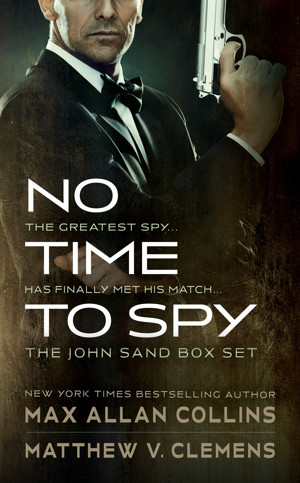
No Time to Spy
E-Book: Amazon
Paperback: Amazon

No Time to Spy – the collection of the three John Sand novels by Matt Clemens and me – is going on sale for an astonishing 99-cents (for the e-book) at Amazon starting today (May 31 at 12 a.m.) and ending June 6 (at 11 p.m.). Those are Pacific times.

For those of you who haven’t tried these books, this is an excellent low-cost opportunity. The response has generally been very good to the Sand novels, but a couple of supposed “big fans” of mine have attacked them for various reasons that seem specious to me. For one thing, they apparently don’t understand that the John Le Carre school of spy fiction (which I admire) is different from the Ian Fleming school (which I adore).

The premise of the trilogy, as you may know from previous updates here, is that John Sand is the real-life spy that James Bond was based on, and that Ian Fleming was a colleague who used Sand’s experiences as a basis for his fiction. The publicity that Sand receives as the basis of Bond forces him out of the spy game; also, he marries a very wealthy young woman – a Texas oil heiress – in an echo of what occurs in both the book and film of On Her Majesty’s Secret Service, minus the tragedy.

Matt and I never mention Bond and Fleming by name, but it’s obviously an open secret. The books are larger than life, in the fashion of the Bond novels and films, but are at the same time quite tough and the frequent action can be violent, even shocking. The sexual content is largely limited to the married couple’s couplings.

The novels are, in order: Come Spy With Me; Live Fast, Spy Hard; and To Live and Spy in Berlin.

Matt and I had hoped to do at least one more Sand novel, but despite general positive reader response, sales have not encouraged us to do so. If this 99-cent sale pushes us onto Amazon bestseller lists, even briefly, that could change.

The ignorance of the handful of readers who have denigrated the books for being spoofs are the kind who can’t see the difference between Harry Palmer and Austin Powers.
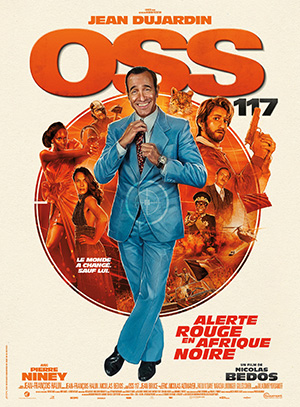
OSS 117: From Africa With Love

This is not to say I don’t like a good Bond spoof, and a third in the film series of what is (in my opinion) the greatest satiric response to Bond is now available – OSS 117:
From Africa With Love
, again starring Jean Dujardin (of The Artist fame) as secret agent Hubert Bonisseur de La Bath. The third film does not seem to be on any of the streaming services, but can be purchased on Blu-ray and DVD at Amazon.

The first two films, OSS 117: Cairo, Nest of Spies (2006) and OSS 117: Lost in Rio (2009), are also available from Amazon in French with English subtitles on both Blu-ray and DVD. E-bay has both of these from various sources. E-bay also has From Africa With Love, but I ordered editions listed as having English subtitles and it wasn’t till my third try that I landed on a version that had that essential option. I would stick with ordering from Amazon.

What’s great about these films – they are strictly parodies of the Connery era, the star physically resembling the “real” James Bond – is that they work as Fleming-style spy stories with the hilarious inclusion of a Bond clone who is bone-headedly politically incorrect and in some ways a dope…and yet he’s a credible action hero. None of the other parodies of Bond accomplish that.

This new film finds OSS 117 actually growing and changing by the final scene…perhaps not dramatically, as it would appear his growth is largely limited to not patting the asses of the pretty females at the spy office as a greeting.

And you will adore the opening credits with the fake Bond theme song and faux Maurice Binder visuals.

I love these movies and wish they were more readily available. But if you’re a Bond fan, you need to see them. Also worthwhile is the boxed set of the original French OSS 117 films, which are among the better Bond imitations of the ‘60s.
* * *
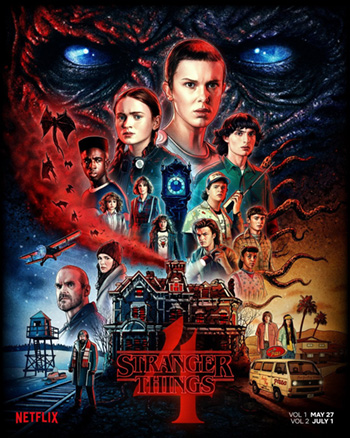
Stranger Things Season 4 poster

I wrote at some length last week about the assorted streaming mini-series we have been watching. We picked up on season four of Stranger Things, which Netflix has just “dropped” as they say (an expression I could do without). I will tell you right now that Barb bailed before the end of the first episode, and I don’t blame her.

Having really liked the preceding seasons, I hung in there and watched the first two episodes – which were long, around an hour and twenty minutes each, far too long for a premise as wispy as that of Stranger Things. I have continued on and will stick it out to the end.

But the opening two episodes are a tough go. They present a version of high school that is simplistic and ridiculous – for example, El (who has lost her powers and apparently also her spine) is picked on by…everybody, at a school filled only with bullies. Several new annoying characters are introduced right when we’re trying to remember who the recurring characters are, some of whom are hard to recognize at first. After all, it’s been three years, real time, since the previous season. The kid actors all look much too old for the six months, story time, that have elapsed. Those annoying new characters include a rebel who looks to be about 35 and a pizza delivery hippie whose sub-Cheech-and-Chong comedy relief is painful to endure.

When the high school stuff fades and the sci-fi/horror stuff kicks in, Stranger Things gets back on recognizable track, uneven but rewarding. The biggest problem is the shifting tone, with the Winona Ryder storyline comic (despite tragic circumstances) and her sidekick conspiracy theorist, bearded Brett Gelman, often uncomfortably hammy.

The first two very long episodes are written and directed by the creators, the Duffer Brothers. Surprisingly, it’s the subsequent episodes by other hands that are what bring the season around. The creators seem to let their actors go over the top, unbridled, with Gelman (much better in non-Duffer-directed episodes) and newcomer Joseph Munson (the rebel Eddie Munson…get it, Munster?) their chief victims. These first two episodes are weak on Direction 101 items like matching action and, well, pacing.

The pop culture references get laid on a little thick, too. We have Robert Englund repeatedly scratching his insane asylum-cell table with his fingernails (Freddie Krueger, get it?) and the kids entering a haunted house right out of (the much better) It. Krueger is playing Victor Kreel (Victor Crawley horror franchise, check) as he subs for Hannibal Lecter offering convicted-serial-killer advice from his cell.

Why watch?

Well, once you get past the first two ill-judged episodes, the Eleven story kicks in, in a satisfying way. Most of the young actors are terrific, especially Sadie Sink (and her character is into Kate Bush, which reveals good taste on somebody’s part, probably the Duffers, giving credit where it’s due). Really, all of the recurring characters are fine, with Millie Bobby Brown a standout, once she ditches the suddenly-El-is-a-five-year-old bit. Of the original group Gaten Matarazzo remains winning – the heart of the ensemble.

It’s not the Duffer Brothers’ fault that Covid happened and three years passed, damaging the believability of cast members as kids younger than they’re playing. That a number of new actors were cast as teenagers and look at least thirty is the creators’ fault.

What I think happened is this: the brothers were in the right place with the right idea at the right time to be one of the first binge-worthy shows, really jump-starting Netflix. But in the meantime some other gifted creators have taken advantage of the limited-season, limited-series approach, and upped the ante. This season of Stranger Things does not compare to Gaslit, The Offer, The Staircase, or Better Call Saul.

Not even close.

* * *

Road to Perdition is on this list of the best noirs to date of the 21st Century.

M.A.C.
The Amazing Colossal Gilbert

Tuesday, April 19th, 2022

Last week my son called me with the bad news – Gilbert Gottfried had passed at 67, an age that seems terribly young to me now. Nate was apologetic about having to share word of another death with me, but at my age that comes (as the Music Man said) with the territory.

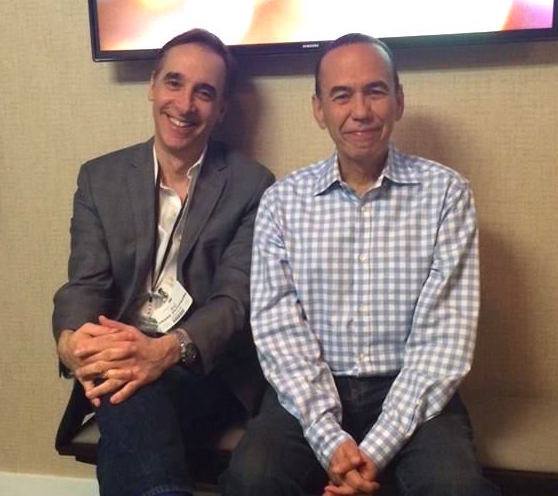
Frank Santopadre and Gilbert Gottfried

I hope Gilbert’s podcast partner, Frank Santopadre, will be able to continue their Amazing Colossal Podcast, which has been a glorious celebration and look back at all kinds of popular culture of the 20th Century, particularly film, but also TV and radio and even vaudeville. Gilbert was a master at impressions of obscure character actors, and a font of knowledge about show biz trivia (as is Frank).

When I did the show a few months ago, I was knocked out by Frank’s research, and his glee at being able to ask me, for example, why I liked the Ritz Brothers. Later, on the podcast, I explained myself – something I never expected to do in public, let alone in front of the smart, knowledgeable audience that had the sense to listen to this one-of-a-kind show.

The podcast, of course, is just one (if significant) part of Gilbert Gottfried’s contribution to popular culture. He laughed (and boy did he have a laugh) about me being a fan of his Saturday Night Live year (actually, twelve weeks); but I truly had been a fan (I liked Gail Matthius, too, and that Eddie Murphy kid showed promise). I have sympathy for that whole cast, who’d had the not enviable task of following in the original Not Ready for Primetime Players – after all, I followed Frank Miller into Batman, making me the Charles Rocket of Caped Crusader writers.

Gilbert’s character parts in various films were always funny stand-outs, from the Problem Child movies to Beverly Hills Cop II. Kids got to know that voice by the Aladdin movies and TV shows. But Gilbert’s bold adult delivery of the Aristocrats joke at the Friars’ Club roast of Hugh Hefner, less than three weeks after the 9/11 2001 terrorist attacks, was a shot across the bow at a humorless media. Perhaps the first victim of Cancel Culture – he lost his famous, lucrative Afflac duck gig after tweeting jokes about the 2011 Tōhoku earthquake and tsunami – Gilbert’s public exposure of the can-you-top-this backstage filthy private joke shared by comics became the subject of The Aristrocrats, an excellent 2005 documentary film by Paul Provenza and Penn Jillette.

If you’ve never seen it, track down Gilbert, the 2017 documentary that charts the life and some typical days and nights of a truly sweet, unique eccentric. More than any comedian in history, Gilbert Gottfried could make the punchline of a joke irrelevant – it was always about his delivery, the set-up, the commentary along the way. The journey, not the destination.

For those who are not faint of heart, I recommend Gilbert’s stand-up DVD, Dirty Jokes (2005); it’s also on Amazon Prime.

On the podcast, Gilbert always introduced his guests with long, elaborate, well-researched (thanks, Frank!) bios. I was stunned hearing Gilbert’s (shall we say) distinctive voice going on for several minutes detailing my accomplishments as well as a few embarrassing details.

Perhaps some of you will understand what a treat and frankly honor it was for me to be guesting with my co-author, Dave Thomas, on Gilbert’s show. It’s still unbelievable that as a stone SCTV freak I am now friends with Dave Thomas. And to have shared space with two of my comic heroes for a couple of hours – I will treasure the memory.

Dave said to me, recently, “You really love comedy, don’t you?”

Yes. Yes I do. But some of it died with Gilbert Gottfried, and we really could have used him sticking around in this horrific, humorless era, when people would rather take self-righteous offense than just fucking laugh.

* * *

Here, for your enjoyment, is the Amazon France translation to English of their description of my novel A Life in Red (aka Bait Money):

Among the thugs, quarantine is already the third age. It is still a matter of clinging to it. Nolan, an unlucky thug, tries to find a place in the sun. A nice combination, yes! With accomplices two inexperienced kids and a girl who has the fire in the buttocks and nothing in the cigar. And all for an old debt to the Mafia. What would it be like if he had to pay her to society!

I would love to read this novel!

* * *

Are you going to Bouchercon in Minneapolis this year? September 8-11, 2022? If so, and you’re registered, you’ve received an Anthony Awards ballot. The deadline for nominations is May 1st.

Here is a list of my books (some with Barb, one with Matt) that are eligible. If you haven’t voted yet, and liked any of these books, your vote would be appreciated. Here are the books (or in one a case a short story) that are eligible. You can vote for up to five in each category.

BEST HARDBACK NOVEL:

Antiques Carry On, Barbara Allan

BEST PAPERBACK ORIGINAL:

Skim Deep, Max Allan Collins

The Many Lives of Jimmy Leighton, Dave Thomas & M.A.C.

Fancy Anders Goes to War, M.A.C.

To Live and Spy in Berlin, M.A.C. & Matthew V. Clemens

BEST SHORT STORY:

“What’s Wrong with Harley Quinn,” Barbara Allan in EQMM July/August 2021

BEST ANTHOLOGY:

Suspense – His and Hers, M.A.C. & Barbara Collins

Reincarnal & Other Dark Tales, M.A.C.

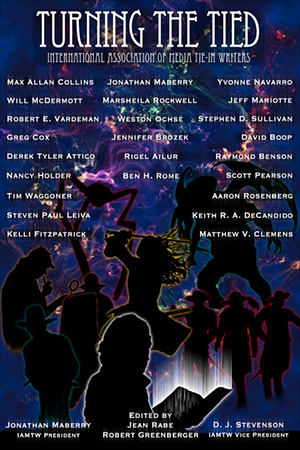
Turning the Tied, Jonathan Maberry (editor) – includes a story by M.A.C. and Matthew V. Clemens

This voting is only open to registrants of Bouchercon.

* * *
To Live and Spy in Berlin Audiobook
Paperback: Indiebound Bookshop.org Amazon Books-A-Million (BAM) Barnes & Noble (B&N) Powell's
E-Book: Amazon
Digital Audiobook: Amazon

Speaking of To Live and Spy in Berlin, the audiobook is out now – which puts the entire trilogy on audio. A great Brit-inflected job by Brian J. Gill!

Check out an excerpt here:

* * *

The Menace by Mickey Spillane and me comes out next week. Read about it here.

M.A.C.

Rondo Hatton Lives!

Tuesday, March 15th, 2022

I wound up sending seven copies of No Time to Spy in the latest book giveaway. They just went out – big honking packages!

Now here’s something I need to call your attention to. Matt Clemens and I have are part of the anthology Turning the Tied, recently nominated for the very cool Rondo Award, “fandom’s only classic horror awards.”

Rondo Awards

The ballot is here: https://rondoaward.com/rondoaward.com/blog/

We are in Category 12: Best Classic Horror Fiction. If you’re at all a classic horror fan, check out the other categories, too.

Turning the Tied cover
Paperback: Bookshop Purchase Link
Ebook:

Here’s a description of the anthology:

Turning the Tied, edited by Jean Rabe, Robert Greenberger (International Association Media Tie-in Writers, softcover, 453 pages, $19.99). Sherlock, Dracula, Frankenstein all figure in collection of stories by Max Allan Collins, Jonathan Maberry, Stephen D. Sullivan and others.

Back in 2016, Matt and I wrote a Sherlock Holmes short story, “The Adventure of Leonardo’s Smile.” We originally conceived it for a mystery puzzle and it was going to be done by the company that did our other puzzles (CSI, CSI: NEW YORK, NCIS: LOS ANGELES, THE MENTALIST, etc.). It was the last story I wrote before going in for heart surgery and at the time I wondered if it would be my last, period. When the puzzle didn’t happen, our Holmes story didn’t have a home.

And then the IAMTW antho came along and we were chosen as the lead story (among a bunch of really strong ones). I also contributed an afterword as the co-founder (with Lee Goldberg) of the organization.

It’s a wonderful book.

And as Al Capone said, “Vote early, and vote often!”

* * *

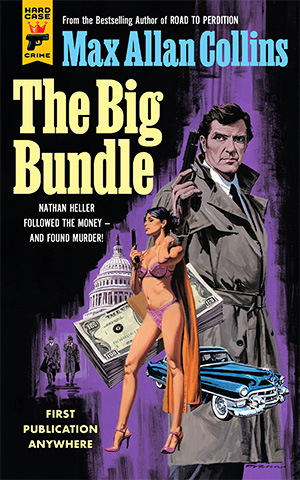
I am coming down the pike (as Barb puts it) on the new Heller, The Big Bundle…two chapters to go. With luck I’ll finish this week. That’s iffy, because I always re-read the whole manuscript and do final tweaks and sometime rewrites. So it could bleed into next week. But right now I’m caught up in the writing, so this week is a short update.

I had some very good comments come in last week and, rather than answer them in the comments section, I want to bring a few of ‘em centerstage.

Stephen Borer – a reader who has been with me for decades and is one of the nicest, most supportive fans Barb and I have ever been lucky enough to know – responded to my Chuck Berry stuff last week with this: Speaking of Mr. Berry, Max, could you please repeat your meeting him at an airport story for the newer readers?

Here you go, Stephen:

On the passing of CHUCK BERRY (from March 21, 2017):

I met him at an airport where we shared a gate. He was traveling with a guitar in its case, and appeared to be alone. But it was unmistakably him. As a longtime veteran of rock ‘n’ roll, I had to have a moment. I didn’t ask for an autograph, afraid I might start trouble for him, because a lot of people obviously didn’t recognize him.

“I just want to thank you for starting it all,” I said.

He smiled and said you’re welcome, and we shook hands.

I think I said something about having played rock ‘n’ roll for decades, and he said where he was headed, though I’ve forgotten. He was quiet but friendly.

What I said to him was about right. Little Richard and other black artists of the early rock days really were r & b starting to become rock, and Elvis fell in that category as well. But Chuck Berry, with his guitar-driven rock and his teenage subject matter, was not r & b, but at the very forefront of the new genre. Pure rock ‘n’ roll.

He was playing regularly in his home, St. Louis, until very recently.

Regan MacArthur made this observation:

Confession: I was initially intimidated by the heft of Stolen Away and I think it’s one of the best books in the series. Such a varied and interesting cast of characters. I thought, “Man, this is better than Twin Peaks!” Truly, I was riveted from beginning to end.

That’s great to hear, but I understand the reluctance of some to dive in to such big books. The Hellers do vary in size, however, and a couple – Chicago Lightning (short stories) and Triple Play (three novellas, with my beautiful wife on the cover) – are a way to try Heller out more bite-size. But, really, anybody who likes Quarry, Hammer or Nolan will probably like the Nathan Heller books. They have the same kind of violent action and steamy sex as my shorter noir novels. Because they endeavor to recreate eras, you might flip through and think the text looks at times dense (not in the dumb dense way!), but I like to think of them as rich.

Bruce Jones says:

I’m nearing the end of True Detective, and the insights into your process are fascinating. You’ve been using interesting locations from the start with Heller. The Chicago World’s Fair is beautifully recreated, and the Miami section with Cermak and FDR is a master class in historical crime fiction. I’m looking forward to the rest of the Nitti trilogy.

That’s great to hear, but I’d like to know if you are Bruce Jones the writer, because if you are, I’m a fan. And if you aren’t, that’s what you get for having a common last name like Jones or Smith or Collins.

Bill P is back to ask:

Max, I saw you gave recommendations on an earlier thread about where to start with Quarry. Any similar recommendations for places to start with Nate Heller?

That’s a tricky one to answer, and very similar to the Quarry dilemma. The books are written out of order. The excellent chronology from Bill Slankard will point you to reading the books and stories in chronological order.

But I am of several minds here. I would suggest reading The Frank Nitti Trilogy first: True Detective, True Crime, The Million-Dollar Wound. From an artistic standpoint, reading the books in order of publication follows the arc of my development as a writer…and Heller himself probably benefits from that. I am sure there are continuity goofs – I have been working on this saga since 1981, which is…forty years?

When someone asks me what a good book to try the series out on, I would suggest Carnal Hours and I think Angel in Black and Stolen Away are strong.

From a selfish standpoint, I’d say start with whatever is out there right now – The Big Bundle will be out this year! And supporting that one will get more written.

M.A.C.

Nate Heller, Chuck Berry, and Five Free Books!

Tuesday, March 8th, 2022
No Time to Spy Cover
E-Book: Amazon
Paperback: Amazon

Finally, our book giveaway of No Time to Spy, the massive collection of the John Sand trilogy, has arrived. We have only five (5) copies to give away. As usual, you agree to write an Amazon review (and/or at any other review site, like Barnes & Noble, Good Reads, your own blog, etc.). [All copies have been claimed. Thank you for your support! — Nate]

We really need the reviews, as No Time to Spy has stalled out at a meager 18 ratings. By way of contrast, the new Quarry’s Blood already has 34 (and thank you for that!). Now, I understand John Sand and Quarry are two different animals, but the individual titles in the Sand series have fared very well (229 ratings for Come Spy with Me for an average of four stars).

If you have read the trilogy as it came out, novel by novel, and liked what you read, please consider reviewing the collection at Amazon to help build up interest. Right now it’s looking like the fourth Sand, resolving a hell of a cliffhanger (if Matt Clemens and I may be so bold to suggest), will never be written.

On this subject – and I think I’ve made this clear before – I am well aware that not everything I write appeals to the same group of readers. Right now I’m working on The Big Bundle, the new Nate Heller novel (about 2/3’s in), and am cognizant of the fact that what some readers relate to in my work is my first-person voice. That’s not just one voice, of course – Mike Hammer and Quarry and Heller are not the same voice, but they are variations on my voice and reflect whatever facility I may have in first person. Some readers may not relate as well to a third-person voice, as used in John Sand, Nolan, the Perdition prose novels and more.

And some people who like, say, Quarry like to lambast me when I write anything else. But I need to stay fresh and nimble and that requires writing different things, although mostly I work in suspense/mystery. But I get it. I have writers whose work I like who occasionally throw me a curve I can’t catch. One of my favorite writers is Mark Harris – his baseball trilogy (The Southpaw is the first, Bang the Drum Slowly is the most famous) is to me a marvel of first-person storytelling.

Harris, who I met and then corresponded with, saw himself as a literary writer and throughout his career he tried all kinds of things. Usually I at least like what he did, at times I loved what he did, but on a few occasions I didn’t connect with him at all. When someone dislikes my work in general, I like to say the reader and I are not a good fit. When someone who likes some of what I do complains about a work that doesn’t work for him or her, I chalk it up similarly – that reader isn’t a good fit with that particular work.

A good example is the Antiques series that Barb and I write together. These are cozy mysteries, albeit somewhat of a subversive take on that sub-genre, told in the first person by two narrators. The novels combine what we think are good solid mysteries with a lot of fairly off-the-wall humor. A surprising number (surprising to me) of readers of noir-ish things of mine like Quarry, Heller and Hammer also like these books. But I completely understand the readers who, despite generally being fans of mine, don’t cotton to Brandy and Vivian Borne.

Writing this new Heller raises a number of issues in my aging mind. I understand that some fans of my Quarry and Nolan and Hammer novels don’t respond to Heller, despite my own feeling that the Heller saga is my signature work. While the Heller books have the violence and sex for which I am known and loved, they also are long books…this one will be 80,000 words and I believe Stolen Away was 125,000 words…and they are more detailed and explore the historical crimes they’re dealing with in depth. The violence and sex stuff is there, but not every other chapter.

The Big Bundle cover

Another factor I’m facing is the degree of difficulty. Even now I can write a Quarry novel in a month. The real-life case I’m dealing with in The Big Bundle is not as complicated (or frankly as famous) as, say, the assassination of Huey Long (Blood and Thunder) or the disappearance of Amelia Earhart (Flying Blind). But at this age I have to review the research extensively before working on a chapter covered by that material; this includes new research, beyond the several months of reading that preceded the writing, stuff I’m picking up on the fly.

I also find I am re-plotting several times as I go along. That happens with any novel, because I don’t let my synopsis dictate things – if characters want to do something different, I let them. If something occurs to me as an interesting turn to take, I take it.

That’s all well and good, but in a Heller novel I am dealing with history. The first book, True Detective, in the very title established the rules: these would be true stories. I allow myself some liberties – time compression and occasional composite characters are typical elements in a Heller. But mostly it’s just the facts, ma’am, presented in the context of a private eye novel and striving to come up with the truth…most happily (as has been often the case) with a new solution to a controversial real mystery.

What I am up against now is that pesky degree of difficulty. I think I’m writing as well as ever (possibly self-delusion, but it keeps me going). With Heller, however, the amount of time for me to feel I get it right is at odds with the speed at which I was long able to work. I understand that’s a function of old age; but knowing that doesn’t make it any easier. Just annoying. Frustrating.

I have committed to one more Heller after this one – the two books will complete the cycle of Heller novels involving JFK and RFK. Bobby Kennedy isn’t in The Big Bundle much, but he’s a vital element; next time he will be the focus.

I have been expecting to spend my remaining writing years with a focus on Heller. I am nearing the end of the Hammer manuscripts, and I’ve written and published endings to Nolan and Quarry (two each!). But I question whether I am up to the Heller degree of difficulty in relation to how much time it takes to arrive at what satisfies me.

On top of this are newer projects – like Fancy Anders and John Sand – that interest me. I am extremely proud of The Many Lives of Jimmy Leighton; it’s one of my best books (thank you Dave Thomas!). Barb and I are developing a standalone thriller, and I’m doing three novellas for Neo-Text on unlikely American heroes. There a few more Spillane/Hammer books left to write.

But Heller is what I’m proudest of. Probably the deciding factor will be if I can’t hit the mark, can’t write about him in a way that pleases me.

One interesting thing about Heller is how writing the books can lead me into rewarding areas that I didn’t anticipate. In Big Bundle, I decided to do a scene in St. Louis at a club where Chuck Berry was playing. Berry isn’t being used as a famous historical character in the novel – it’s just me looking for a fun setting for a scene.

That’s always a problem in private eye novels. The form is basically a series of interviews with witnesses and suspects – look at The Maltese Falcon. So I try in Heller (well, in all novels that touch on the PI form) to use interesting locations. With an historical saga like Heller’s, it’s an opportunity to suggest the times and put the place in context – using famous defunct restaurants, for instance.

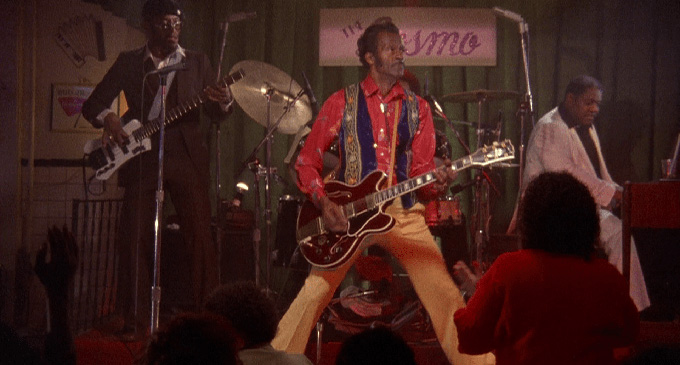
Chuck Berry at the Cosmo

I read about the Cosmopolitan Club, where Berry basically put rock ‘n’ roll on stage for the first time, and found that the documentary Hail! Hail! Rock ‘n’ Roll (1987) had refurbished the defunct East St. Louis club for a mini-concert celebrating (and sort of recreating) Berry’s tenure there. I got caught up in the documentary and it got me interested in Berry and his music, which I had frankly (stupidly) taken for granted. On reflection, I was reminded that everything from the Beach Boys to the Beatles came from him, and recalled how many, many songs of his my various bands had played.

So I sent for another documentary (Chuck Berry, 2018), and several books, and three CD’s. That’s a bonus that comes out of the Heller research – I stumble onto things that are only tangential to the book at hand but that roar into the centerstage of my personal interests.

If you’ve never seen Hail! Hail! Rock ‘n’ Roll, by the way, you haven’t lived till you watch Chuck Berry schooling Keith Richards on how to play rock ‘n’ guitar. One particular sequence is singled out as demonstrating how difficult Chuck could be; but for those of us who’ve played in bands, we know: Chuck was right.

One bittersweet aspect was my realization that I had blown a great opportunity. My son Nate lived in St. Louis for better than half a decade, and during that time Barb and I visited him (and later, Nate and his wife Abby, and later than that, grandson Sam too) often. Meanwhile, hometown boy Chuck Berry was playing once a month at Blueberry Hill, a fantastic club in the Delmar loop. And I – we – didn’t bother to see him.

As Fats Domino would say, “Ain’t that a shame.”

* * *

This Paperback Warrior review of Quarry’s Blood appeared on my birthday, March 3, and I couldn’t ask for a better present.

The New York Times recommended ten books last week, and Quarry’s Blood was one of them.

Finally, Daedalus Books has the hardcover of Eliot Ness and the Mad Butcher for $6.95.

M.A.C.