Posts Tagged ‘Interviews’

Fancy Cover and Year’s End/Year’s End Woes

Tuesday, January 10th, 2023
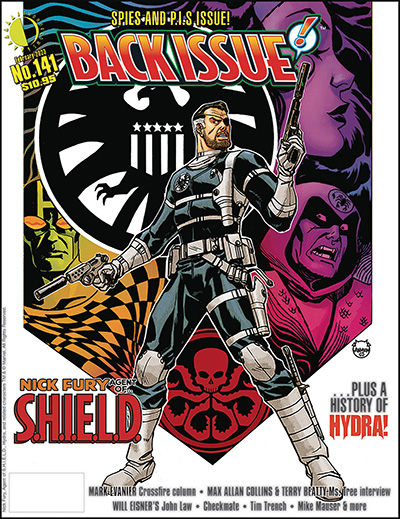
Backissue magazine cover

An in-depth Ms. Tree-centric interview with Terry Beatty and me appears in issue #141 of Backissue magazine (“SPIES AND P.I.S ISSUE!”). It proves beyond a shadow of a doubt that Terry’s memory is better than mine (a low bar, eh, Terry?). Thank you to interviewer Stephan Friedt for doing such a great and thorough job, and selecting images that show once and for all how good Terry Beatty is.

Backissue #141 with its beautifully laid out and illustrated article (we’re in the Mike Mauser article too) is available here.

* * *

Here is an advance review of The Big Bundle, the new Nate Heller. It’s from Deadly Pleasures, a long-running, very good mystery fanzine which I believe is strictly available as an e-zine now…or is it returning to print? I’ll check into that and get back to you.

In the meantime, here’s the review:

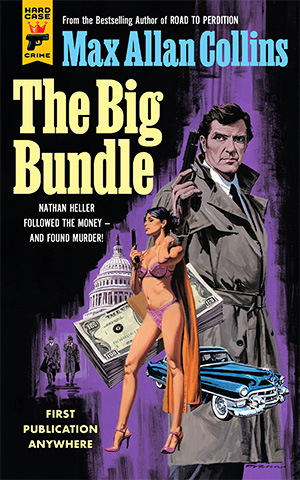
THE BIG BUNDLE by Max Allan Collins (Hard Case Crime, $22.99, December 2022) Rating: A

In 1953 six-year-old Bobby Greenlease is kidnapped. His wealthy parents call on the services of private investigator Nathan Heller, who had represented them in another matter some years earlier. Robert Greenlease insists on having the kidnapping of his son handled on his terms with as little interference from the FBI and police as possible. The kidnappers pick up the ransom, as scheduled, but Bobby is not returned. The kidnappers, however, assure the family that he’ll be back, safe and sound, within twenty-four additional hours. But then half of the $600,000 ransom disappears and things take a turn for the worse. Five years later Heller is called back to try to find the missing money. But Washington politics, Bobby Kennedy, and Jimmy Hoffa all manage to get tangled up with Heller’s efforts to help Greenlease once again.

All of the Heller novels are based in solid fact, thoroughly researched, with details of the characters and their eventual fates detailed at the conclusion of the story. Of course the real-life kidnapping of Bobby
Greenlease is nowhere near as well-known as the 1932 abduction and murder of the Lindbergh baby. Heller had investigated that crime, as well, in Max Allan Collins’ Stolen Away (1992). In spite of the outcome of that case, he is once again entrusted with finding and returning a missing child to his parents.

Collins is a master (actually an MWA Grand Master!) at finding a plausible method of inserting his long-running fictional detective into the events of the day. He does this by using actual places, events and real people such as Kennedy, Hoffa, Chuck Berry, and Drew Pearson to add authenticity to the narrative. In doing so Collins immerses the reader in the 1950s’ era lifestyle. What’s even more remarkable is that he’s been doing this for forty years, since his 1983 debut Heller novel, True Detective.

If you’ve never read a Heller novel, don’t be discouraged by the fact that this is the eighteenth book (plus a number of short stories) in the series. The chronicles are not published in any specific order, moving around in time from the days of Capone and Nitti to Monroe and the Kennedys. But this one, the first from Hard Case Crime, is as good a place to jump in as any other. Then you’ll want to go back to the 1920s and start with that first one in what is one of the finest historical crime novel series being published today.

Don’t know who wrote the review. Possibly editor George Easter himself. I’ll let you know when I know.

The Big Bundle is, according to Amazon, going to be available later this month (January 24). As it was officially (and actually) published in December of last year, this just about guarantees screwing me up for awards consideration, and of course the book was not read by most of the people who do year’s end “Best of” lists. This is not a plan to make my life miserable (I don’t think), just the books getting tied up in London in a dock strike.

The e-book has been available since the originally announced publication date, and I’m not sure about the audio book (read by the great Dan John Miller). I know the latter exists, because (like the hardcover edition) I’ve had the audio book since early December.

Sigh, as the great Charlie Brown frequently said.

But the Big Bundle reviews have been stellar so far, especially the starred Publisher’s Weekly, and (among others) Deadly Pleasures is a nice one, too, obviously.

A problem that few of you who stop by here will have is that a certain breed of dedicated mystery reader refuses to start reading a series with any entry but the first, and doggedly plows on ahead in order of publication. I am anal retentive enough to understand this. But it really hurts writers of a long-running series – it’s the sales and response to the current book in a series that determines whether there will be any more.

So when a reader who has (finally) decided to take a look at Nathan Heller (or any long-running series) feels obligated to start with the first book, he or she is actually decreasing the chances of that series continuing. The current entry’s sales dictate the future, or lack of one, for the series. My suggestion is: sample the current book, and if you like it, go back to the beginning. And in the case of Nathan Heller (and for that matter Quarry), keep in mind that the books were neither written nor published in chronological order.

At the beginning, the first four Heller novels were indeed written in chronological order, with the first three comprising the Frank Nitti Trilogy. But starting with Stolen Away (the fifth published Heller), I began jumping around – the famous unsolved (or controversially “solved” crime) at the heart of a Heller novel simply reflected what I was interested in writing about and/or what I could sell to an editor. So in Stolen Away (the longest entry in the saga), the novel begins before the first book (True Detective) and its last section takes place after the third book, True Crime. In fact, that last section of True Crime takes place after Blood and Thunder, as well. Confused yet?

This is bound to give the anal retentive among you a migraine. But in the case of Nathan Heller, you can’t easily read them in chronological order–Damned in Paradise, for example, takes place in the middle of Stolen Away! You have to read part of one book, move to another book, then come back again to the previous one you began.

Reading the books in the order in which they were written makes more sense, but not much. The danger for me is that some readers might skip a Heller because the famous case my guy is working on is not of particular interest to them. Then that reader has got out of the habit of reading Heller.

The Big Bundle is an unusual Heller in one sense: the famous crime (the Greenlease kidnapping) at its center is not as famous as it once was. Everybody remembers the Lindbergh baby, but few recall little Bobby Greenlease. The narrative does involve Jimmy Hoffa and Bobby Kennedy.

Interestingly, I get occasional complaints from readers who stay away from Heller – or have read one or two and bail on the series – because they can’t accept one private detective being involved in so many famous crimes. These are the kind of people who have no problem with Perry Mason handling 100 murder cases and Archie & Nero solving seventy-some murder mysteries. People! Take the ride.

The Greenlease case got on my radar a long, long time ago, and I knew I would get around to it. It’s frustrating to me that the book was published when it was – December books (which, as I say, The Big Bundle is – pub date is December 2022) – tend to fall between the cracks where Best of the Year lists are concerned. Not the reader/reviewers fault: they can only reflect back on what they’ve been able to read.

A few have. Reviewers who received ARCs or e-mail galleys have included The Big Bundle perhaps three or four times on best of year’s end lists. But it’s frustrating. It’s hard enough to get anybody to sing about a book in a long-running series without the music falling between the cracks of the piano.

And then there’s the Edgars – it’s tough enough under good circumstances to get acknowledged in that field of competition. But the confusion of a book published in December but not widely available till late January seems a guarantee for no attention at all.

I am not alone. Any writer who has a book published in December is up against it. Actually, any writer who has a book published in January (and the next few months) is, too. People have shorter memories than they do attention spans. Quarry’s Blood got fabulous reviews but it was published in February ‘22 and I don’t know a single year’s end best of list it made. (If you know of one, give me a shout.)

Why do you suppose is that there’s such a prejudice against long-running series in awards consideration? In many cases, it’s other mystery writers (many of whom write series) doing the judging. As fans of the mystery genre, we bow to the likes of Rex Stout, Sir Arthur Conan Doyle, Agatha Christie, Raymond Chandler, Erle Stanley Gardner, and Dorothy Sayers, who devoted themselves (well, Doyle reluctantly) to series that ran a good long while. Today, series entries are routinely ignored in awards consideration. Publishers scrap-heap series, even long-running ones, to make room for new series (which are also doomed to be dropped after an entry or two, because no publisher today wants to spend their time building a series).

I don’t know that anything can be done about any of this. Call me a whiner (and I certainly am!) but it’s a frustration that many mystery writers…perhaps most…feel from time to time.

* * *

The second of the three Fancy Anders short novels is soon to appear (March 7), Fancy Anders for the Boys. I just did the proof read on the galleys and was very pleased. The art, again by the great Fay Dalton (the cover and one full-page illo for each of the ten chapters) is superb. This week you get a look at the stunning cover Fay provided.
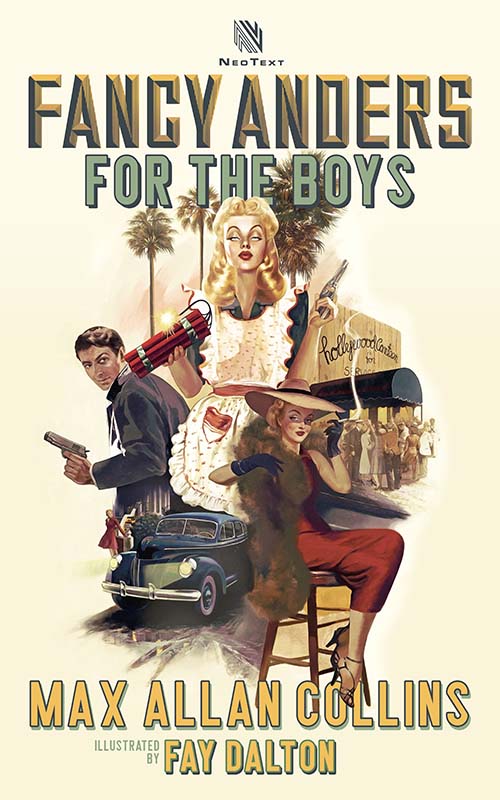
Fancy Anders for the Boys cover

The Fancy Anders novellas are primarily e-books, but Neo Text (who continue to be wonderful to work with) does a short print run followed by POD, so you physical media types (like me) can have an actual book version.

The advantage of the e-book over print is that Fay’s art is mostly in color and you get gray tones in the print version. The three short novels (which I wrote back-to-back during the Covid lockdown) were designed to tell one long story in the fashion of serialization that the pulp Black Mask indulged in – with Hammett’s The Dain Curse, for example, which told three stories each of which resolved but also intertwined into what is now seen as a novel.

The end game is going to be to find a publisher who will do all three books in a larger format with the illos in full color (a few have limited color) and that it will be seen as the novel I always intended.

I loved doing this project and adore Fancy and relish the ‘40s period. I hope I get to do more, though in what format I have no idea (yet).

* * *

Some of you may recall that I have at times in interviews I’ve mentioned the impact of certain writers (Alexandre Dumas père, author of Three Muskateers and its sequels, for example) of historical fiction on the true-crime based Nathan Heller novels. The name I cite most prominently is Samuel Shellabarger, author of two of my favorite books (and movies), Captain from Castille and Prince of Foxes. Shellabarger wrote several more novels in this vein, and a few other things (he died rather young, at least young by my standards), but I recently – to my delighted surprise – learned that he had started out as a mystery writer.

He was also an academic and scholar, so he published under pen names: John Esteven and Peter Loring. I have begun picking his mystery novels up, when I can afford them – they don’t run cheap – and I’m reading one now. Graveyard Watch (1938) by Esteven isn’t very good, though, and I’m hopeful others of Shellabarger’s mysteries are better.

This one is in first-person with an Irish-American narrator whose brogue drips off the page. Among other things, Shellabarger was a linguist, so this reflects an interest of his, but it doesn’t make the read any smoother. And he reports an accent from an Asian woman that I can’t begin to decipher (both the accent and the woman).

I will try others by him, though, because learning of Shellabarger’s mystery writer roots, I suddenly felt like I’d found a kindred spirit. Heller is definitely in the vein of Shellabarger’s fictional heroes who find themselves smack in the middle of non-fictional history.

Read about him here.

* * *

Here’s a nice write-up on the forthcoming Classic Flix release of The Long Wait (with my commentary).

Finally, the best crime comics are selected here (check out #8).

M.A.C.
Publisher’s Weekly, the Spillane Doc, Encore and More!

Tuesday, December 20th, 2022

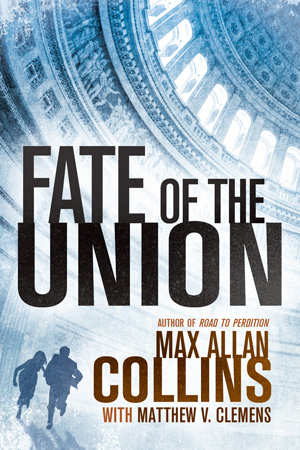
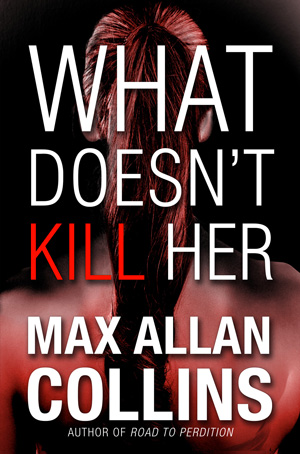
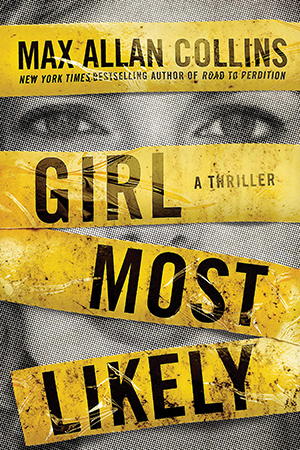
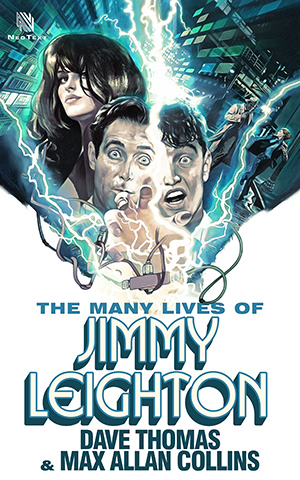
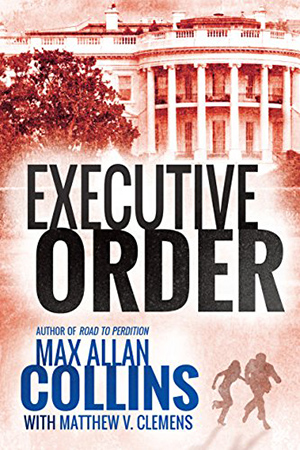
For those of you looking for cyber stocking stuffers, or who will need a way to use that Amazon gift cards you’ll be receiving, four of my books are on sale as Kindle titles right now for a meager $1.99 each until the end of 2022. You can avail yourself of the Collins/Clemens titles Executive Order, Fate of the Union, What Doesn’t Kill Her and my solo title, Girl Most Likely. Also available for $1.99 (not sure for how long) is my collaboration with SCTV’s Dave Thomas, The Many Lives of Jimmy Leighton, a science-fiction-tinged crime thriller.

The three Clemens co-authored titles are among my bestsellers at Amazon, and Girl and Jimmy are two of my personal favorites, which if you haven’t tried, you have this opportunity to brighten our mutual Christmases by doing so.

Executive Order cover
E-Book:
Fate of the Union cover
E-Book:
What Doesn't Kill Her cover
E-Book:
Girl Most Likely cover
E-Book: Amazon

The Many Lives of Jimmy Leighton cover
E-Book: Amazon Purchase Link

* * *

Spillane – King of Pulp Fiction (Mysterious Press) will be out February 7 of next year, which is sooner than it sounds. James Traylor and I had a nice if brief interview with longtime Spillane buff Michael Barson in the latest Publisher’s Weekly.

You can see it here, including color photos of me and of co-author Jim Traylor, which we are considering releasing as NFT trading cards at $99 each.

This week I’m planning to shoot the material for the expanded edition of my 1999 documentary, Mike Hammer’s Mickey Spillane. Several years ago, the doc was edited (and slightly updated) from forty-eight minutes to thirty-some) for the Criterion release of Kiss Me Deadly.

I’ve been planning to reinsert some footage we cut initially (it had run something like fifty-three minutes), and to insert new interview footage with myself, to cover things not discussed and to include what has happened regarding Mickey’s work since his death in 2006.

Phil Dingeldein, my partner in cinematic crime, has found a very good copy of the documentary among our materials and shared it with me. At risk of sounding foolishly boastful, I had forgotten had good it was. Further, it was tightly edited with Chris Christiansen’s terrific score playing almost non-stop beneath. That made it problematic to insert anything that had been previously edited out, material we would have to locate among the dozens of tapes from the 1998 shoot. Mickey’s interview footage had taken up ten Betacam tapes alone.

And as tempting as it might be to restore what I’d been encouraged to cut years ago, disrupting the smooth edit of what arguably is my best work as a filmmaker is not worth doing. For this reason, I’ve decided to expand the current cut in a new way. It will open with an explanatory introduction by me, and at the conclusion of the original documentary a sort of epilogue will follow, bringing the Spillane story up to date. It will also expand the doc to around an hour, which is considered feature length in the documentary game.

The tricky thing is that this new footage will be primarily me talking on camera, which is something not even my late mother would have relished seeing. Our challenge is to include enough interesting visual material to edit over my mug as we can manage. Oh, you’ll see plenty of me, just not enough to turn most stomachs.

We will be covering Mickey’s final novel (Something’s Down There) and his passing, including his request to me to complete the last Mike Hammer novel (The Goliath Bone) and to develop his unfinished material. But it will also briefly discuss our friendship and our collaboration on various projects, including anthologies of his and other mystery writers, the Mike Danger comic book series, and the documentary the viewer will just have seen.

The focus will be on the posthumous collaborative novels and conclude with the 75th anniversary of Mike Hammer’s debut in I, the Jury (1947). We’ll include documentary footage of the production here in Muscatine, Iowa, of Encore for Murder with Gary Sandy, including interview footage with Gary and the actors who play Velda and Pat Chambers. This should connect Mike Hammer’s Mickey Spillane – the 75th Anniversary Edition nicely to the feature version we’ve recently completed of the Encore for Murder live performance. I am hopeful that we will see a Blu-ray and/or DVD of the new version of the Spillane doc with Encore for Murder as a bonus feature.

As I said, the expanded documentary will come in around sixty minutes or a tad under, and should be a good length for the streaming services and possibly for PBS. Whether Encore for Murder will stream or not, I can’t say. But I will do my best to make it available to any of you who are interested. I am probably too close to know how good it is or isn’t. Clearly Gary Sandy is wonderful as Mike, and the local actors are much better than I could ever have hoped. Several clearly are professional level, and everyone does well.

The production’s MVP is Chad Bishop, who has (under the burden of my supervision) edited Encore for Murder from the actual performance and two dress rehearsals, with the bulk of the footage taken from the former. Chad was the on-stage foley person – part of the fun of doing a Golden Age Radio-style show is having the sound effects performed on stage. But in addition to doing all the foley work, Chad was mixing the sound and laying in recorded sound effects and music cues…all done live. If he had not pulled that feat off, we couldn’t even have considered putting together a “movie” version of our production.

I know I’ve talked about this before, but I look back on what we did in September of this past year with a bit of wonder.

I was initially approached to do a Dick Tracy radio show and refused, then offered the use of my play “Encore for Murder,” which in 2011 Stacy Keach had recorded with a full cast for Blackstone audio. Later Gary Sandy had starred in live productions in Owensboro, Kentucky, in 2012, and in Clearwater, Florida, in 2018. I had been present for both, not directing but able to work with the director and actors in both cases.

So when local theater maven Karen Cooney – who is affiliated with the Muscatine Art Center – asked me to do a Golden Age Radio-style play, I of course thought of “Encore.” Initially I was going to play Hammer myself, but Karen suggested I ask Gary. It was a long shot, and I said I’d think about it.

Before taking that step, I wanted to see what kind of cast Karen had put together. I attended the first table read and was impressed. I went home and told Barb I thought the actors were quite good, but didn’t trust my judgment – I wanted them to be good, after all. Barb, who is totally no-nonsense (she has to be), agreed to come to the next rehearsal. I read Hammer, which seemed to perk the players up even further. When Barb and I went home, she said, “You’re right. They’re good.”

I called Phil and got the project on his radar. I told him if this thing came together, we should try to shoot it with multiple cameras. Throughout the month or rehearsals, co-directing with Karen, I kept Phil in the loop. But it wasn’t till the week of the performance that I said, “Let’s do this thing. I don’t want it to disappear into the ether.”

We shot the two rehearsals and the performance with multiple cameras (four), some provided and operated by Phil, others by Chad, who runs Muscatine’s public access channel 9. On performance night, unbeknownst to us, one of the key cameras ceased to function for the last ten minutes of the show. That’s one of the places where having dress rehearsal footage came in handy.

Keep in mind Gary was only present for three days. The rest of our cast is amateur (a few are pro-am, having appeared in some indie films). But we would at the very least have something for Chad’s public access channel, and I was – and am – hopeful one of the two PBS stations in my area might be interested.

I think it’s likely that the Spillane documentary will be on some streaming services. Whether Encore for Murder will be deemed worthy remains to be seen. I will let you know, and be frank about our fate.

As I said last week, I will be entering this into a couple of Iowa film festivals.

* * *
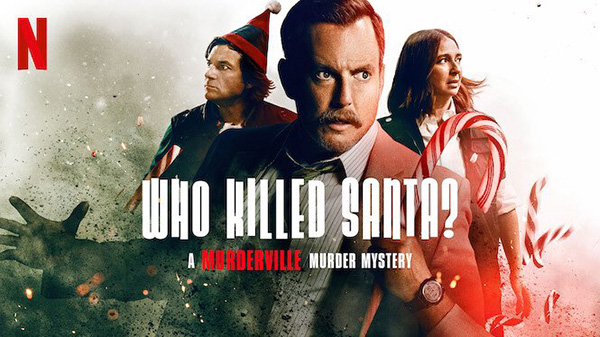
Who Killed Santa?  A Murderville Murder Mystery

If you have Netflix, I would guess you are occasionally disappointed, even frustrated, by their original fare. But when they get it right, they get it right. And their Who Killed Santa? A Murderville Murder Mystery is hilariously wonderful. You should probably watch the six episodes of the Murderville series on Netflix first; but it should work on you even without that.

The premise is that a famous actor or sports star portrays the partner of Terry Seattle, a homicide cop played by Will Arnett. The mysteries are actually clever and can be solved if you pay attention, which the guest stars sometimes don’t. You see, they have not seen the script, which makes them the butt of the jokes cascading through each episode – at least when Arnett isn’t taking the comic heat himself.

It’s based on a wonderful British series, Murder in Successville, which ran for three seasons. The celebrities on Successville are not always recognizable to an American audience, but it works just the same. You can find those original episodes on You Tube. (I wrote a little bit about Murderville before, back in February of this fading year.)

* * *

Matt Clemens and I did a joint interview on a podcast hosted by the talented and gracious Terrence McCauley that you may find of interest. Matt was excellent. I will tell you frankly that I sucked. I talked too much, I didn’t wait for the questions, I was searching for words, and my only excuse was the podcast hadn’t got on my calendar and I was caught flatfooted by it. But Matt is good.

Here’s a nice essay on the film version of Road to Perdition.

Here’s another.

This essay looks at the tropes that can be found – or in some cases were generated by – Mickey Spillane’s Mike Hammer. I am mentioned.

This years-late review of my Dick Tracy: The Secret Files anthology is well done, if a tad late in the game.

The article calls Road to Perdition one of the best crime comics of all time. You bet! But, uh…where’s Ms. Tree?

M.A.C.

Physical Media Lives – Sort Of

Tuesday, November 8th, 2022

A couple more great reviews for The Big Bundle have come in.

Big Bundle Cover
Hardcover:
E-Book: Kobo Google Play
Digital Audiobook:

This is from the DIS/MEMBER web site:

The Big Bundle
by Max Allan Collins

“What kind of world are we living in, Nate?” “A world where men like us can get ahead, Bob. Can make a nice life for ourselves and our families. But it’s also one where men of envy and greed and stupidity and flat-out evil are ready and willing to take everything away.”

The President of Chicago’s A-1 Detective Agency makes his grand Hard Case Crime debut in The Big Bundle. The latest from living, breathing noir encyclopedia and prolific genre staple Max Allan Collins.

The year is 1953 and six-year-old Bobby Greenlease, son of Kansas City Cadillac magnate Robert Greenlease, has been kidnapped. Following a series of cartoonish attempts to ransom the boy, Chicago detective Nathan Heller is called to K.C. Having been appealed to by the boy’s desperate family and hired on as one of the many caseworkers, both local and federal, drawn into the crime.

But what starts as a kidnapping quickly spirals into something much, much more complex. Pitting Heller against crooked Teamsters, thuggish cabbies, out-of-luck bent cops, and Robert F. Kennedy on the warpath for the mob. All immaculately strung across a colorfully detailed, powerfully researched depiction of the 1950s. A time when Jimmy Hoffa was in every newspaper and “The Outfit” (aka The Mafia at it’s height) kept everyone looking over their shoulders.

Though standing as the 18th Nathan Heller Novel (excluding short story collections and “casebooks”), The Big Bundle is immediately accessible for those who might be coming to the series fresh. From page 1, Collins provides a wonderfully succinct primer on Heller’s exploits thus far. Economically delivered and chock full of rich characterization, Collins eases readers into the life and immensely readable voice of Heller.

Better still, the novel’s main case is truly compelling. Made even more so by the liberal peppering of real-life history Collins deploys throughout the book. The Greenlease Kidnapping was huge news and compared to the Lindbergh case at the time. Yet another canny connection to our man Heller. But as such, Collins adapts and reconstructs real history, people, and places into the narrative. Providing his driving, constantly twisty plot with sumptuous detailing.

To say any more would spoil The Big Bundle‘s best turns. But trust when I say, if you are looking for old-school, eminently readable crime fiction, The Big Bundle is a damn safe bet. Chock to bursting with character and deftly delivered by well-practiced hand, this new effort from Hard Case Crime does right by Chicago’s A-1 gumshoe. And providing him a welcome new home at the publisher.

The Big Bundle by Max Allan Collins is available for pre-order now and releases December 6th.

Joe Maniscalco has done a review for Good Reads and Amazon that’s worth sharing:

After first meeting Nate Heller in True Detective back in 1983, this reader has eagerly read each of Max Allan Collins’ novels featuring the life and times of a former Chicago cop who goes on to meet some of 20th centuries’ most famous and most infamous. Nate Heller begins as a reluctant cop, who encounters the Chicago underworld, and then eventually morphs into the famous owner of the A-1 Detective Agency with several branches across the United States.

The Heller novels are notable for Collins’ extensive research that bring the felons and politicos of the years of each of the books to life. (And sometimes felons and politicos describe the same person.). Heller has gone on to solve real life historical mysteries, and even occasionally bedded some well known women of the day, not widely thought of as femme fatales.

The Big Bundle is set somewhat mid career for Heller as he is called on to investigate the kidnapping of a child of a wealthy businessman. Heller had investigated another kidnapping that made worldwide news twenty years earlier, thus his presence in this job makes perfect sense.

There is a moral principle that Heller follows which determines how much of his investigations remain strictly legal, but always justifiable. Here Heller deals with small time hoodlums, famous union bosses, and a young politician about to make his name as he investigates organized crime.

Heller himself hints that the union boss, the politician, and he will meet again, and perceptive readers will likely have some inking how those meetings will turn out, and will change the course of American history.

Readers do not have to start with Heller’s first “memoir.” What’s certain is that nearly 40 years after his first appearance, the author and his creation have not lost any of their power to entertain and put a new spin on twentieth century history and the mysteries and crimes which have brought us into the twenty first century.

Let me remind you that a dock strike in the UK means the availability of the physical book (what I like to call a book book) of The Big Bundle will be delayed till January 2023; but the e-book will be available Dec. 5. I will be doing a book giveaway of the trade paper ARC (the book itself is a hardcover) in a week or two.

In the meantime I am deep into the next Heller – the RFK assassination Heller – Too Many Bullets. I’m at 302 manuscript pages with five chapters left to go (plus the bibliographic essay).

Perhaps because the degree of difficulty – I no longer have George Hagenauer helping me on the research side – has made this one such a bear, added to health issues throughout, I am seriously considering making the follow-up to Too Many Bullets my final Heller.

On the health front, I had a very good report from my heart doctor and will soon be seeing my general practitioner about various other fun and games. But keeping the heart beating is a high damn priority and that looks positive right now.

* * *
‘The time has come,’ the Walrus said,
To talk of many things:
Of shoes — and ships — and sealing-wax —
Of cabbages — and kings —
And why the sea is boiling hot —
And whether pigs have wings.’

The time has come to discuss physical media.

First let me say I am fine with e-books for those of you who find them handy and dandy. They have their place – for example, on a commuter train or when a reader needs to control of the size of print to be able to read the stuff. Where they don’t have a place is on a bookshelf.

Now understand that e-books have kept me and my career alive. Thomas & Mercer (who have lost interest in me as a current contributer, but that’s another story) chose me a decade ago as one of three authors whose back list they would use to plump up their e-book library. The other two were Ian Fleming and Ed McBain, and if there’s better company than that I don’t know who it might be.

Even now the monthly sales of Heller, Mallory, the Disaster Series and the Reeder & Rogers Trilogy add up to a tidy little paycheck – of varying sizes, but steady. Readers having access to my backlist is a great thing. Heller sales are up over a million copies because of Thomas & Mercer’s good efforts. So I am not one to cast aspersions on e-books. They have kept me afloat.

And yet. They are not books. They are not those wonderful things with pages and covers and images on covers that can sit on shelves and be plucked out from the pack for perusal at a moment’s notice. I can tell you with certainty that books from the ‘30s and ‘40s are already disappearing. Even with ABE, you can’t find copies of any number of things, sometimes by authors who were fairly famous in their day.

Then there’s movies. I have far too many DVDs, Blu-rays and, yes, laser discs. If the Internet of a few years ago (and even now) was to be believed, all movies would soon be available to us with a mouse click. Anything we could dream of seeing, we could see, at our whim. Of course that was bullshit.

Any of us who have been paying attention know that a vast number of films are already gone, from the silent days on. A bunch of Charlie Chan movies starring Warner Oland are in the ether, for instance (of course the rest will probably be turned into guitar picks over political correctness, but never mind). And if you look something up on SEARCH on your Roku, you will discover that plenty of stuff is either not available or you have to pay for it, for a temporary rental or a “purchase” (which of course is air you’re purchasing, not something physical you can hold or put on a shelf). We are already used to Netflix and other such services announcing what titles are leaving this month. HBO Max has been one night of the long knives after another.

The death of physical media is more murder than natural causes. So I am not about to divest myself of my library of movies, which will be left to my son, who is also smart enough to know that physical media has its place.

If you think I overstate, take a spin into Best Buy, which for decades made movies a loss leader that brought movie fans in to go through aisle after aisle of cinematic and televisionary offerings. Yesterday, in Cedar Rapids, I entered a Best Buy and the child working the door asked me, “What brings you in today?” Really? I need an excuse now?

Well, maybe I do, because the Blu-rays and 4K discs on offer were a pitiful selection that took up so little space its former grand area was just partitioned off and empty. Shades of Suncoast, Tower Records, and Camelot….

So I come to celebrate the Blu-ray labels that are devoting themselves to obscurities – horror and science fiction and noir, giallo (Italian crime/horror), B movies, C movies, Z movies, and the two who tower over the rest for their superior packaging and extensive bonus features are Severin and Vinegar Syndrome. They are not alone, but these labels are outstanding in their bold selection. Also praise worthy (among a number) are VCI, Shout Factory (Scream Factory), and especially Arrow, who bridge the gap between Criterion’s arty fare and Severin/Vinegar’s aggressively grungy selections.

Severin, for example, recently offered a 4K release of The Changeling, a first-rate George C. Scott haunted house film; My Grandpa is a Vampire, a so so movie for older kids more than redeemed by a valedictory performance by Al Lewis (I hope you don’t have to be told he was Grandpa on The Munsters and a staple of Bilko); and two (so far) Blu-ray boxed sets of Christopher Lee’s European output.

Vinegar Syndrome has recently released The Werewolf Vs. The Vampire Woman (with an 80-minute documentary about Spanish cult horror star Paul Naschy as a bonus feature!); The Texas Chainsaw Massacre 2 on 4k with voluminous bonus features; and Cutter’s Way with Jeff Bridges in a VHS-style box. Vinegar Syndrome also does a lot of classic porn for those of you who think the words “classic” and “porn” can reasonably appear together in the same sentence. Like all their stuff, the porn has fancy schmancy sleeves and classy presentation.

Look, not all of this material is for everybody. Some of it seems to be for nobody, so we’re in that fuzzy area between “buyer beware” and “how cool!”

But this is a world of physical media that has been spawned by the real world’s lack of interest thereof. So we can find Arrow Video releasing Years of Lead: Five Classic Italian Crime Thrillers and (on 4K) Mike Hodges’ Croupier. And Scream Factory releasing a 4K of Army of Darkness and a boxed set of Jackie Chan (1976 – 1982).

Best of times, worst of times. Take your pick.

* * *

And, no, I haven’t forgotten Classic Flix. I am recording a commentary for Mickey Spillane’s The Long Wait tomorrow. And here is a terrific review of their I, the Jury 4K/Blu-ray/3-D release.

Finally, my friend and editor Charles Ardai of Hard Case Crime has a wonderful interview with my buddy Andrew Sumner of Titan about Charles’ terrific Gun Honey comic book, the archive editions of Ms. Tree, and a little something I like to call…The Big Bundle!

M.A.C.

M.A.C. Collection From Wolfpack & A Spillane Rave

Tuesday, October 18th, 2022

Another short update, I’m afraid.

My medical issues are coming to a head and I will be trying to deal with them this week. Good thoughts and crossed fingers are appreciated.

Here is the appearance by Barb and me on the Paula Sands Show recently, promoting Antiques Liquidation.

The first in a new series of e-book boxed sets from Wolfpack is available now – The Max Allan Collins Collection, Volume One: Eliot Ness. Works out to less than a buck a book!


E-Book:

There will be five e-book boxed sets in the overall Max Allan Collins Collection, plus a Mickey Spillane collection.

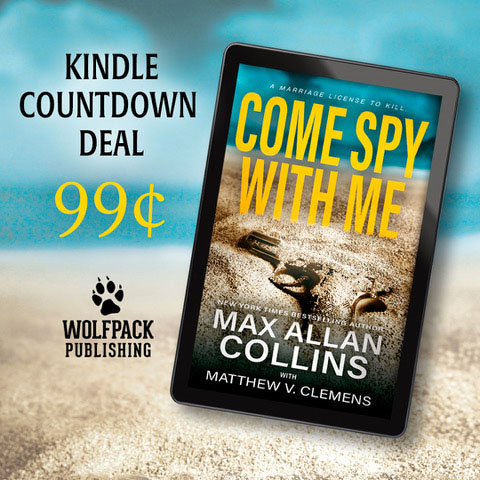
Come Spy With Me is set for a $.99 Kindle Countdown Deal Oct 19th – 25th.


E-Book:

The first review of the Spillane bio by Jim Traylor and me has just appeared, and it’s strong, despite being from the meanest, toughest reviewing service in the world: Kirkus.

SPILLANE King of Pulp Fiction
Author: Max Allan Collins
Author: James L. Traylor

Review Issue Date: November 15, 2022
Online Publish Date: October 20, 2022
Publisher: Mysterious Press
Pages: 400
Price ( Hardcover ): $26.95
Publication Date: January 10, 2023
ISBN ( Hardcover ): 978-1-61316-379-5
Section: NonFiction

A full-dress biography of the most polarizing practitioner of 20th-century crime fiction.

As Collins and Traylor note, nearly everyone deplored the sex and violence of Mickey Spillane’s (1918-2006) midcentury novels about private eye Mike Hammer—though that didn’t stop the millions of readers who catapulted him to the top of bestseller lists and kept him there. Delving into Spillane’s roots, the authors examine the evolution of comic-book hero Mike Lancer into Mike Hammer, cite contemporaneous reviewers who talked up or trash-talked Hammer’s adventures, and explore Spillane’s multimedia activities during the 10 years (1952-1962) of Hammer’s absence from the printed page. (Why the long silence? Collins and Traylor believe Spillane was waiting for his disadvantageous contract with film producer Victor Saville to expire). Warning in their opening chapter of spoilers ahead, the authors proceed to summarize the mysteries and solutions of all Hammer’s early novels. They’re at their best when mapping the Spillane metaverse, which includes novels, stories, articles, comic strips, radio broadcasts, TV programs, and movies, and weakest in their uncritical praise of their subject as a plotter, stylist, Jehovah’s Witness, and human being (a verdict his first two wives might have contested). “Mickey encouraged our best efforts, all the while sharing his humanity, generosity, and down-to-earth nature,” they write. “This book reflects not just our love for his work, but for the man, with thanks for his encouragement and friendship.” Spillane’s appealing directness provides an endless stream of anecdotes. The authors conclude with a formidable array of appendices, ranging from an autobiographical fragment that takes Spillane from birth to age 14 to an essay on “Ayn Rand and Mickey Spillane” to a brace of bibliographies and an account of some of their own extensive dealings with the author when he was alive and the work Collins has continued to complete since his death.

Fans who’ve been waiting for a life of Spillane will gobble this up.

A decent review of the new volume in the Titan archival Ms. Tree collections comes from the Slings and Arrows site.

M.A.C.