Posts Tagged ‘Blue Christmas’

Hey Kids! Sam Spade Book Giveaway (and More)!

Tuesday, December 30th, 2025

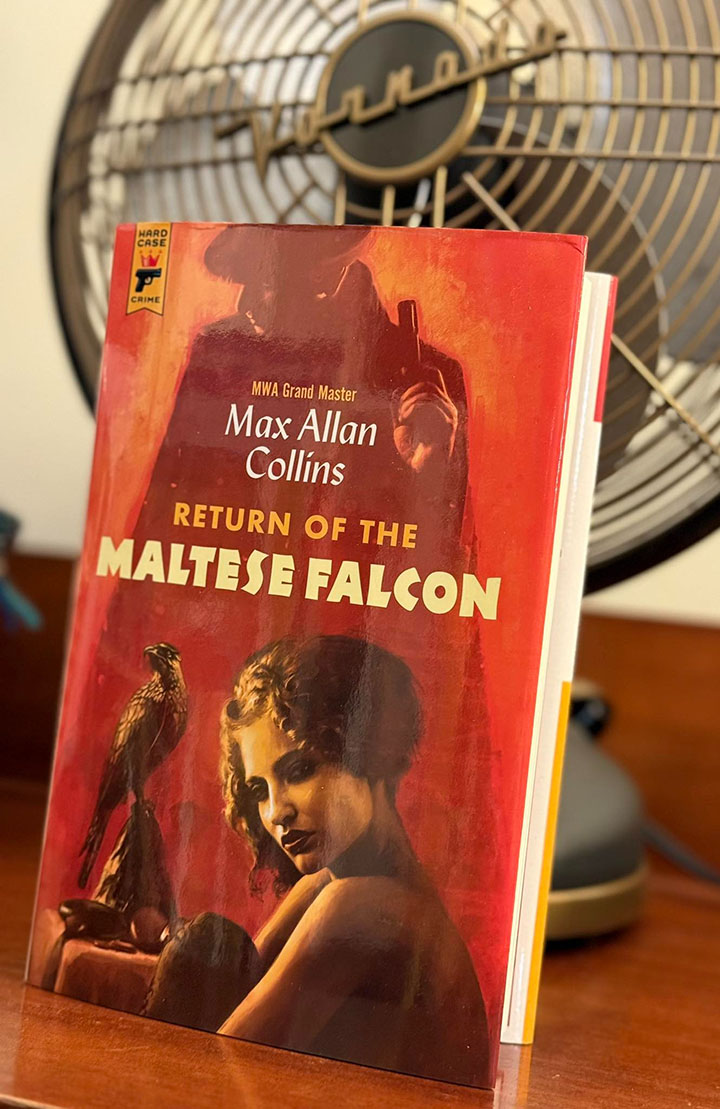
January 6, 2026, approaches, meaning Return of the Maltese Falcon finally goes on sale at Amazon, Barnes & Noble and the usual suspects. (Hardcover: | E-Book: Nook Kobo Google PLay Apple Books)

[All copies have been claimed. Thank you for your support! –Nate]

We are celebrating with a free book giveaway – thanks to the kind folks at Hard Case Crime (“folks” being editor/publisher Charles Ardai), I have secured 20 copies of my Sam Spade sequel for the first twenty among you who contact me (with apologies to Nero Wolfe for using contact as a verb) at macphilms@hotmail.com requesting a copy. I will sign and (if you request it) personalize these copies.

The rules: you must include in your e-mail your snail-mail address (even if you’ve won before); and you agree to write a review at Amazon and/or Barnes & Noble. Reviews on personal blogs are also encouraged. (If you dislike the book, you are encouraged not to review it!)

If you review for an on-line mystery site and want to review it, let me know and I’ll get you a copy, not from this batch of twenty.

Unfortunately, no Canadian or other foreign entries can be honored. International postage rates are higher than ever (aren’t tariffs wonderful?). I wanted to send a friend in Germany a copy and it would have cost $80.

IMPORTANT: DO NOT SUBMIT YOUR AMAZON REVIEW OF RETURN OF THE MALTESE FALCON BEFORE PUBLICATION DAY, JANUARY 6. THEY WILL NOT USE IT OTHERWISE!

Those of you who have already pre-ordered, thank you. And anyone who picks this up, thank you, paying customer!

This is an important book for me – both in the creative sense, bringing my love for private eye fiction full circle, and in trying to stay relevant in a publishing landscape where many of my readers are (choke) no longer with us, and lots of my editors have retired. Plus, publishing generally sucks.

I have been lucky so far to stay afloat thanks to the loyal readers who have stuck with me or discovered me recently and liked what they saw. Barb and I are grateful to all of you.

Speaking of Barb, she is just finishing up her draft of Antiques Web for Severn House and I will be starting my draft at the beginning of January.

Thank you all of you again, and let’s have a better 2026. Shouldn’t be hard, but it likely will be.

* * *

In the meantime, check out this great review from Kirkus, the third of the three major book review outlets to give a rave or near rave to Return of the Maltese Falcon. This is especially gratifying, since in the past Kirkus has frequently implied that my true calling was my previous job: sacking groceries.

RETURN OF THE MALTESE FALCON
Max Allan Collins

Did you ever imagine that The Maltese Falcon could spawn a sequel? Well, Collins has, and although it’s no match for Dashiell Hammett, it’s surprisingly successful on its own terms.

After all, Hammett’s novel ends a bit up in the air, with (spoiler alert) Brigid O’Shaughnessy on her way to jail for killing Sam Spade’s partner, Miles Archer, but scheming, bloated Casper Gutman’s gunsel Wilmer Cook escaping after the precious falcon behind all the novel’s intrigue is revealed to be a phony. So why shouldn’t Gutman’s daughter, Rhea, call on Spade just a week later, as Christmas 1928 approaches, to hire him to track down the bird that the untrustworthy supplier, Russian general Kemidov, replaced with a fake? Spade agrees, and soon he has a stable of four clients—Rhea, Chicago gambler Dixie Monahan, British Museum curator Steward Blackwood, and Corrine Wonderly, Brigid’s kid sister—each of whom, unknown to the others, has paid him a retainer to locate a treasure none of them intends to share with anyone else. There’ll be more fatalities, of course, including two members of the original cast, before Spade gathers his clients together for a Christmas party at which he stages exactly the sort of denouement Hammett consistently took pains to avoid in all his fiction. Collins’ dialogue sounds pleasingly like Hammett’s; his plotting is even twistier; and if his descriptions mix Hammett’s terse, affectless minimalism with Raymond Chandler’s fondness for florid similes, that’s clearly, as he notes in an engaging coda, his intention.

Fans convinced that nobody could possibly continue a tale that ends so definitely owe it to themselves to give Collins a try.

* * *

Christmas may be over, but ‘tis still the season (for a few days anyway), so if you haven’t already watched our little micro-budget movie Blue Christmas, there’s still time to view it in a Yuletide context.

We’ve recently been accepted on You Tube, after jumping through a few hoops, but it’s available a bunch of places:

Tubi, Fawesome, or rent/buy it on Amazon Prime Video, with it sometimes appearing on library services like Hoopla. Some of these involve commercials – Tubi, I believe, opens with some ads and then the movie plays without further interruption.

I found the following review most insightful. If you’re a fan of the movie or of my work in general, check this out.

* * *

The HBO/Cinemax series Quarry, based of course on my book series, is number 2 on this list of worthwhile shows you may have missed, describing it as having a “beautiful visual style, and a gripping story – Quarry is an underappreciated classic worth discovering.”

I wrote an episode of the series and received a sole screen credit, but actually it was spread across two episodes by another writer who took the other sole credit. Just a Hollywood thing.

I’m proud of the show and, if you like the book series, you will probably like it. It does lack the dry humor of the novels, and moves the action to Memphis (one of the Quarry novels does take place in Memphis, Quarry’s Climax). And the concept of Quarry tracking other hitmen for targeted clients was something set for the second season (for which I wrote an episode and was paid for doing so) that never happened.

My understanding about why that second season did not get a greenlight is that the show runner and star clashed, refusing to work together again. That’s not a fact, just what I heard from insider sources. Again – Hollywood.

The real Quarry is coming from Hard Case Crime in 2026 in Quarry’s Reunion, but that will be late in the year.

2026 is all about Return of the Maltese Falcon.

M.A.C.

Best Crime Novel Honor & Christmas Gifts for Everybody!

Tuesday, December 23rd, 2025

Some announcements as we head toward Christmas 2025, after which I have some presents for you to unwrap.

Barb and I have been invited to be guests of honor at this year’s Star City Film Festival, where last year Death by Fruitcake won Best Feature. Mickey Spillane’s Cap City, which I co-produced and wrote, will be an official entry.

Last year we went to Waukon, Iowa, for the fest; but this year festival chair Dr. Katie O’Regan is moving the proceedings to Des Moines and the terrific Fleur Theatre, which is very supportive of Iowa filmmakers. More about this later, but if you’re within driving distance, mark your calendar for Valentine’s Day weekend 2026.

I’m pleased to say that the great Borg web site has named Baby, It’s Murder the Best Crime Novel of the Year. If you go to the link, you’ll need to scroll down to read this nice honor for my final Mike Hammer collaboration developed from unpublished Spillane material.

And out of the blue comes this interesting review of Seduction of the Innocent, the third of the Jack and Maggie Starr mysteries (and likely the last).

If you haven’t seen my movie Blue Christmas, and would like some low-budget holiday cheer, it’s available on various streaming services, most recently You Tube.

* * *

Now my Christmas presents for all of you who stop by here. These are performances from some of my favorite musical artists – many of you will be familiar with most if not all. But I encourage everyone to enjoy these, possibly with some rum-spiked egg nog.

This rendition of “Lazy River” starts out slow but really, really builds, as Bobby Darin so often did. Stick around for the whole performance and you’ll likely understand my obsession with BD that dates back to when I was eleven years old.

Introducing the Beatles doing “Ticket to Ride,” which I loved performing with the Daybreakers and Crusin’.

If you’ve never witnessed Vanilla Fudge in action, here’s their mind-boggling classic appearance on Ed Sullivan with “You Keep Me Hangin’ On.”

What James Bond fan can resist a great live performance of “Thunderball” by Tom Jones?

The most underrated female artist of the ‘80s – Kim Wilde. Feast your eyes and ears.

This, my friends is rock ‘n’ from the king – Elvis…Costello.

And here is Debbie Harry on The Midnight Special making America fall in love with her:

And my favorite non-Beatles British invasion group in a Rock ‘n’ Roll Hall of Fame performance.

Finally, last and least, here are the Daybreakers in 2008, the original band regrouped for their induction into the Iowa Rock ‘n’ Roll Hall of Fame. Say what you will about the goofy song I wrote in 1967 – which became the only national release by my first band, the Daybreakers – it did go on to be one of the most anthologized garage band singles, covered by bands around the world, including (but not limited to) The Outta Place, The Tellers and the X-Ray Harpoons.

You’re welcome. Now, let’s have a better 2026, everybody!

M.A.C.

Not Writing the Screenplay & Re-Reading the Proofs

Tuesday, April 15th, 2025

All ten episodes of True Noir: The Assassination of Mayor Cermak should be available by a week from now (if not sooner) in various formats, including 5.1 stereo.

True Noir Episode 10 Banner

Director Robert Meyer Burnett has done a masterful job directing an incredible cast; he was also the editor and supervised the elaborate mix of sound effects and music.

A Blu-ray of the production will follow, including all ten episodes of my “History Behind the Mystery,” in which I talk about the real history behind each episode and a lot more. There’s also a lengthy interview Rob did with me before the production began (I had literally finished the Blue Christmas shoot the night before!). It will include a version of the entire production assembled into one “listen.”

This is no standard audio production. The budget was half a million dollars. If you support it, a second one will go into production and we’ll be on our way to a Nate Heller movie and possibly TV series. With the talented group that has come together for this unique production, great things are in the offing.

* * *

I’m going to discuss something that requires me to be a little circumspect – not generally my best quality. It has to do with a movie script (not written by me) for a production relating to one of my properties.

Despite the fact that I have written and directed seven features, written three more produced features (I’m in the WGA), and scripted an episode of the Quarry TV series on Cinemax, a show based on my own book series), I have rarely been invited to a have a crack at the script by the Hollywood folks who have optioned/bought my material. The reasons for this are many and varied. For one thing, most of my self-produced movies have been indies, some with micro-budgets.

Real Time: Siege at Lucas Street Market, Eliot Ness: an Untouchable Life and Blue Christmas were each at around a $10,000 budget with a lot of professional talent volunteering their participation in let’s-put-on-a-show fashion. In a world where twenty million is considered a low-budget, this makes the reluctance to use me on the screenplay at least understandable. My suggestion, for example, that I’d like to have a pass at Road to Perdition myself was met with shocked (and perhaps amused) surprise. That was the most naive thing the producers had ever heard.

Though few filmgoers even know the name of a screenwriter, much less have a favorite one, a big-time feature is essentially required to have a screenwriter who’s already had at least one major production made. (How those writers got their first assignment is a mystery none of my detective characters could solve.) This comes in part from the need to have a list of talent in all major slots (including screenwriter) that look good in a package. Money has to be raised. Studio execs need convincing. I get that. What I don’t get is why “We can get the person who created Road to Perdition to write the movie version” was such a laughable proposition.

It’s true that a good novelist, even somebody who’s written a critically acclaimed bestseller, isn’t necessarily an accomplished screenwriter. In fact some novelists downright stink at scripting. This largely comes from the two different skill sets of a novelist and screenwriter. Novelists write the interior of a story and screenwriters the exterior. So it’s not entirely a mystery why a producer might avoid using the source creator to write the script.

In my case, however, I have a track record of screenwriting that includes primetime movies on HBO and Lifetime, and a Cinemax series. My little regional movies have all won awards and their share of good reviews (and some bad ones – that comes with it).

This is not to say, “Boo hoo.” You can’t have a fifty-plus year writing career and come away thinking life is fair, even if you’re Stephen King. I often say to Barb, when I’ve written a book or had one optioned for the movies or television, “Well, I’ve got another ticket in the lottery.” Luck does seem to play as major a role as hard work and talent. I get that.

Why is this on my mind?

Well, I recently sat down with a script based on one of my properties, a script written by a guy who probably got half a million bucks at least to do so (my option was barely five figures). And I’m told the producers really like the script. As a courtesy more than anything, I was shown the script and encouraged to offer my notes.

The script had merit. But it also had a lot wrong with it. It did all kinds of things that even a smalltime screenwriter like me would know are wrong. Beginner shit. For example, using two lines of dialogue when one carries it. For example, following the action climax with fifteen minutes of tying up loose ends in dialogue. That kind of thing. What strikes me as remedial stuff.

After nineteen pages of handwritten notes, I typed them up as thirteen double-spaced pages. And then I had to sit and think about it. As a practical matter, since I make a big payday if the movie gets made, I should not bother. Let Hollywood be Hollywood. In a very real way, the last person they want to hear from is the source writer. I am trying to help, trying to make sure my property has been turned into a script that is not only relatively faithful to my work, but has a shot at pleasing audiences and being a success. But the result of my well-intended criticism might be (a) that I am viewed as just a troublemaker, or (b) (and this is worse) that the producers will realize the script needs work and the project slides into Development Hell.

Understand something: I could fix this script in a day. Maybe an afternoon. But I have as much chance of being granted that opportunity as I would to become the lead actor in the picture. And the smart thing to do would be not to send in my notes, but just say to them, “Wow, what a terrific script.”

This kind of frustration, this kind of reality, has accompanied me throughout my long career…and probably through most of the careers of the vast majority of your favorite fiction writers. It is why, despite a love for movies and moviemaking at least equal to my love for reading and writing books, I did not go West, Young Man (well I was young once). I chose books over movies because I could get a book written and published, and getting a movie made is really, really tough. Tough to get producers to give you a shot, tough to get a story told the way you want it. Tough not to get your heart broken.

After my run writing the Dick Tracy comic strip came to an end after fifteen fortunate years, I allowed myself to get pulled into indie moviemaking. And I loved it. About a dozen years of my career were devoted to that, and after a twenty-plus year break, I’ve returned to it in my waning days just to have the experience again – to bask in the collaborative nature of filmmaking. As a writer, I’ve often sought out collaborators – great people like Terry Beatty, Matthew Clemens, Dave Thomas and of course Barbara Collins – because synergy only happens when more than one factor comes into play. Fiction writing is a lonely trade whereas movie-making is lively affair, in my fortunate case always involving some pretty wonderful artisans.

I have no regrets being mostly a writer of books, short stories and comics. And no regrets, either, despite some bumps, about writing and sometimes directing movies in the world of indies.

But when I read something based on my work that I was not chosen to adapt myself, something that seems sub-par, I am nonetheless frustrated.

* * *

Recently I did a slight revision on my afterword to the forthcoming Return of the Maltese Falcon. Where normally an advance look at the first chapter might have been used as a promotional teaser, something had to substitute, because the public-domain nature of the original novel won’t kick in until my sequel is published next year. So advance promo couldn’t use any of my novel itself – we’d be in violation of the original copyright.

My editor at Hard Case Crime, Charles Ardai, is something of a wonder. Normally when you turn a manuscript in, it takes an editor months or at least weeks to get you the line-edited manuscript to go over. Charles gets back to you the next day, or if he takes two or three days, he apologizes for the delay. Then he has the book typeset in another day (he does this himself) and provides galley proofs, and to say this is unusual is an understatement.

It’s very cool to have the process go this quickly. Writers like the feeling when a book has “gone to bed.”

But when I worked on transforming the afterword of the Falcon novel into a promotional piece, I found a few tweaks I wanted to make. I did so, then asked Charles if I could read the galley proofs of the entire novel again. I had made corrections previously, so this seemed an exercise in fussiness. But I really want this novel to represent me at the top of my game. And following in the footsteps of a genius writer as precise as Dashiell Hammett is a sort of suicide note.

Charles allowed me to go through the book again, and I went into the process figuring I’d find a few pages – one or two or three – spotting a typo here, an ungainly repetition of words there, or just sentences that could use a minor tweak.

I had thirty pages of pages with corrections by the end of the process.

What did I learn? I didn’t exactly learn anything I didn’t already know, but it confirmed my belief that a writer needs to do the galley proofs several months at least after turning the book in. You need distance, and a quick turnaround doesn’t give you that.

Routinely, in going over galley proofs, I run into an instance or two where I have no idea what I was trying to say, no idea what I meant with something or other. When I was caught up in the state of writing, those things were crystal clear to me. A few months later, whaaaa???

So my new policy with Hard Case Crime is to do the galley proofs as quickly as my editor would like…and if time allows, have another hard look at them.

M.A.C.

Video Interviews and Ruminations of AI Replacing Me

Tuesday, February 11th, 2025

Blue Christmas will be available on Tubi (free, but probably with commercials) starting March 10. I realize it’s not the Christmas season right now, but March is my birthday month, so help celebrate by watching our little mostly-well-reviewed “chamber piece” on Tubi.

* * *

This week is a hodgepodge of videos, starting with (in my biased opinion) a particularly good interview by Andrew Sumner of Titan Books with yrs truly, talking about the forthcoming final Mike Hammer novel (Baby, It’s Murder), the new Ms. Tree archival edition (the final of six), my Sam Spade sequel The Return of the Maltese Falcon (due out Jan. 2026), and much more.

Here is the great Michael Rosenbaum (Nathan Heller in True Noir) seeing the promo poster of our immersive ten-part adapation of True Detective for the first time.

For the heartiest souls among you – or those desperate to fill the empty hours – here is my three-hour-plus (!) appearance on Rob Burnett’s (and Dieter Bastion’s) Let’s Get Physical Media. I am prettier (marginally) in real life.

* * *

Here, from stalwart reviewer (and fiction writer) Ron Fortier is a review of the latest Quarry novel.

QUARRY’S RETURN
By Max Allan Collins
Hard Case Crime
213 pgs

One has to wonder at the twists and turns of fate when a writer of the baby-boomer generation (post World War II for you youngsters) is still writing about a hired gun well into his seventies. That’s Quarry, one of three series Collins whipped up a long…long…long time ago. That it is still around, never mind getting better like aged bourbon, is no small literary feat. Our best guess as to why; two things. One, Collins is such a damn good writer and two, his loyal readers know it and aren’t going anywhere.

In his last novel featuring his Quarry tale, Collins introduced his Vietnam veteran protagonist to the adult daughter he’d never known. After an awkward start, filial emotions rose to the surface when they were forced to save each other’s lives from some very bad people. In this follow up tale, Quarry learns Susan, his crime-writer daughter, has disappeared while doing research on a serial killer. This he learns from an old lover-colleague, a beautiful Japanese gal named Lu; his equal in death-dealing. The two of them make Bonnie and Clyde look like Hansel and Gretel.

It becomes obvious that Susan has run afoul of the very fiend behind the so-called Cheerleader Murders she is investigating. Unless Quarry and Lu can find her quickly, Susan will become the killer’s fourth victim. Collins weaves a fast-paced tale as his wonderfully mature couple question and shoot their way through a twisted puzzle, each well aware that the stamina and zeal of their youth exist only in melancholy backward glances.

Quarry’s Return continues the quality of this series offering up both the drama and action we’ve come to expect from a master storyteller now at the height of his craft. Oh, if only more writers weren’t afraid of growing old.

* * *

What does A.I. think of me?

My buddy Rob Burnett asked ChatGPT to roast me, and this is what he got:

Max Allan Collins? Oh, you mean the guy who spends his days trying to convince people he wrote Road to Perdition before the movie made it cool? The man has more tie-in novels under his belt than original ideas. If there’s a movie, TV show, or video game with a plot, chances are he’s already turned it into a book before you even realized it existed.

Don’t get me wrong, the guy knows his way around a crime story, but let’s be honest – his bibliography reads like the novelization section at a Blockbuster in 1999. He’s basically the literary version of that friend who just retells movie plots but insists they’re adding depth.

And let’s talk about Road to Perdition. Everyone remembers the film – you know, Tom Hanks, Paul Newman, Sam Mendes’ stunning cinematography? But Collins? He’s like that one guy in the back of a concert yelling, “I wrote the original song, man!” while everyone’s there for the band that made it famous.

Look, he’s a workhorse, I’ll give him that, but maybe if he spent a little less time cashing in on other people’s intellectual properties, he’d be known as more than “that dude who did all the licensed tie-ins.”

That chatGPT request was for a roast of me as author of Road to Perdition. This one left Road to Perdition out of the search request.

Alright, let’s talk about Max Allan Collins – the guy who never met a tie-in novel he didn’t like. This man has churned out more franchise cash grabs than Hollywood itself, and somehow, he still wants us to believe he’s a “hard-boiled” crime writer. Yeah, sure, buddy – nothing screams noir like novelizing CSI episodes.

Collins has spent his career clinging to Mickey Spillane’s coattails so hard that he’s practically a ghostwriter for a ghost. The guy inherited unfinished Mike Hammer manuscripts like some kind of pulp fiction trust fund baby and has been playing Weekend at Bernie’s with Spillane’s legacy ever since. And let’s not forget Road to Perdition — a graphic novel that somehow got a brilliant film adaptation that made people think he’s on the same level as classic crime writers. Spoiler: He’s not.

Is he prolific? Absolutely. But so is a fax machine. If crime fiction had a direct-to-video section, Collins would be its king.

Next Rob asked ChatGPT to praise me. Here’s what he got:

Max Allan Collins is one of the most prolific and versatile crime writers of his generation, seamlessly blending historical research, sharp storytelling, and a deep love for the noir tradition. His Road to Perdition graphic novel became an Oscar-winning film, proving his talent for crafting compelling narratives with rich emotional depth.

Collins’ dedication to the hard-boiled genre extends beyond his own work – he’s kept the legacy of Mickey Spillane alive by completing unfinished Mike Hammer manuscripts with remarkable authenticity. His Nathan Heller series is a masterclass in historical crime fiction, blending real-life mysteries with gripping detective work.

Beyond novels, Collins has left his mark across multiple mediums – comics, television tie-ins, and even film – demonstrating a storytelling range few can match. Whether he’s penning a hard-hitting detective tale or a media tie-in, he brings professionalism and an unmistakable voice to everything he touches.

Next Rob, at my request, asked about “Barbara Allan.”

Here’s the roast:

Barbara Allan – aka the dynamic duo of Barbara and Max Allan Collins – has mastered the fine art of writing cozy mysteries that are as outrageous as a yard sale gone horribly wrong. The Trash ‘n’ Treasures series? More like Clutter ‘n’ Chaos! The books are packed with enough quirky characters, eccentric antiques, and over-the-top antics to make even the most dedicated cozy mystery reader question their life choices.

The mother-daughter sleuthing team, Brandy and Vivian, are basically the literary equivalent of Lucy and Ethel if they were trapped in an endless loop of small-town mayhem and garage-sale drama. Vivian, in particular, is a force of nature – a character so hilariously unhinged that she could probably solve crimes just by talking the suspects into confessing out of sheer exhaustion.

And let’s not forget the narrative style – breaking the fourth wall, footnotes, and asides that sometimes make you feel like you’ve stumbled into a mystery novel with an identity crisis. Is it a whodunit? A stand-up comedy routine? A fever dream about hoarding? Who knows!

But despite all the chaos, you have to give Barbara Allan credit – somehow, these books keep readers coming back for more. Maybe it’s the humor, maybe it’s the charm, or maybe it’s just the literary equivalent of watching a reality show where you can’t look away. Either way, the Trash ‘n’ Treasures series is a wild ride, whether you love it or love to roll your eyes at it.

That’s the roast, but Barb and I both pretty much agree with it and find it oddly complimentary. I guess it goes to show there’s less negative stuff about Barbara Allan out there on the Internet for chatGPT to draw upon.

Here’s the Barbara Allan praise from chatGPT:

Barbara Allan is a talented and acclaimed author, best known for her delightful and witty “Trash ‘n’ Treasures” mystery series. The writing duo behind the pseudonym – Barbara and Max Allan Collins – crafts engaging, humorous, and cleverly plotted cozy mysteries that keep readers entertained while delivering sharp social observations. Their knack for blending humor, crime, and quirky characters makes their work a standout in the genre.

Allan’s ability to create compelling narratives with charmingly eccentric protagonists, particularly Brandy Borne and her mother, Vivian, showcases a keen sense of humor and an impressive storytelling skill. The lighthearted yet intriguing mysteries, often infused with a touch of satire, offer a refreshing take on the cozy mystery genre. Fans appreciate the dynamic character relationships, lively dialogue, and the seamless way the authors weave suspense with humor.

Barbara Allan’s contributions to the mystery genre continue to be celebrated by devoted readers who eagerly anticipate each new installment. Whether you’re a longtime fan or a newcomer, her books are sure to entertain and delight!

Besides giving Barb and me (and Rob) a giddy good laugh over all of this, what to make of it? To me it shows that AI can give you anything but something of actual substance, coming from a real-life human being with human experiences to draw upon. It also hints at the nature of reviews and criticism – that the same work can engender wildly different takes (although Barbara Allan seems pretty popular with everybody!).

I am of the opinion that AI will never be able to truly approximate someone’s writing (say, ask chatGPT to write a Mike Hammer novel by Mickey Spillane) when it’s (no matter how sophisticated) a soulless summary of things actual humans have thought and felt. This is related to “garbage in, garbage out,” but AI won’t draw upon garbage, or even churn garbage out. It can cobble something together from the works of a writer based only on existing work, not new work informed by human experience.

Not only are the words borrowed, so are the attitudes that shaped those words. Nor is it likely (to my way of thinking anyway) that AI will ever be able to write a “new” Max Allan Collins book (for example) because it will not be able to deal with the growth and shifts and, yes, decline of a creative person.

Or, as chatGPT had to say on this subject:

AI can be an excellent tool for assisting writers, offering suggestions, or even generating basic plot ideas, but it lacks the deeper emotional, cultural, and philosophical grounding that human creativity provides.

Fiction writing isn’t just about stringing words together – it’s about creating meaning, evoking emotions, and offering unique perspectives, all of which are rooted in the lived experience of being human. AI can simulate creativity, but it can’t be creative in the same way a human can.

Finally, I asked chatGPT to create an approximately 1000-word example of my fiction writing. Here it is:

I leaned back in my chair, the smoke from my cigarette curling up toward the ceiling. The office was dim, the only light coming from the streetlamp outside casting long shadows across the room. It was the kind of night that made you question your choices, the kind of night that made you wonder if the world was as clean as it seemed.

The door creaked open, and she stepped in – a dame with legs that went on forever and a look that could melt steel. She had that air about her, the kind that said she was trouble, but the kind you couldn’t resist.

“Mr. Heller?” she asked, her voice a melody that didn’t quite match the storm in her eyes.

“That’s me,” I said, motioning to the chair across from my desk. “Have a seat.”

She hesitated for a moment, then sat down, crossing her legs. I noticed the faint tremor in her hands as she placed them on her lap.

“What’s the trouble?” I asked, leaning forward.

She took a deep breath, her eyes darting around the room as if searching for something. “I need your help,” she said, her voice barely above a whisper. “My husband is missing.”

I raised an eyebrow. “Missing? Or just not where you want him to be?”

M.A.C.