
Rondo Hatton Lives!

March 15th, 2022 by Max Allan Collins

I wound up sending seven copies of No Time to Spy in the latest book giveaway. They just went out – big honking packages!

Now here’s something I need to call your attention to. Matt Clemens and I have are part of the anthology Turning the Tied, recently nominated for the very cool Rondo Award, “fandom’s only classic horror awards.”

Rondo Awards

The ballot is here: https://rondoaward.com/rondoaward.com/blog/

We are in Category 12: Best Classic Horror Fiction. If you’re at all a classic horror fan, check out the other categories, too.

Turning the Tied cover
Paperback: Bookshop Purchase Link
Ebook:

Here’s a description of the anthology:

Turning the Tied, edited by Jean Rabe, Robert Greenberger (International Association Media Tie-in Writers, softcover, 453 pages, $19.99). Sherlock, Dracula, Frankenstein all figure in collection of stories by Max Allan Collins, Jonathan Maberry, Stephen D. Sullivan and others.

Back in 2016, Matt and I wrote a Sherlock Holmes short story, “The Adventure of Leonardo’s Smile.” We originally conceived it for a mystery puzzle and it was going to be done by the company that did our other puzzles (CSI, CSI: NEW YORK, NCIS: LOS ANGELES, THE MENTALIST, etc.). It was the last story I wrote before going in for heart surgery and at the time I wondered if it would be my last, period. When the puzzle didn’t happen, our Holmes story didn’t have a home.

And then the IAMTW antho came along and we were chosen as the lead story (among a bunch of really strong ones). I also contributed an afterword as the co-founder (with Lee Goldberg) of the organization.

It’s a wonderful book.

And as Al Capone said, “Vote early, and vote often!”

* * *

I am coming down the pike (as Barb puts it) on the new Heller, The Big Bundle…two chapters to go. With luck I’ll finish this week. That’s iffy, because I always re-read the whole manuscript and do final tweaks and sometime rewrites. So it could bleed into next week. But right now I’m caught up in the writing, so this week is a short update.

I had some very good comments come in last week and, rather than answer them in the comments section, I want to bring a few of ‘em centerstage.

Stephen Borer – a reader who has been with me for decades and is one of the nicest, most supportive fans Barb and I have ever been lucky enough to know – responded to my Chuck Berry stuff last week with this: Speaking of Mr. Berry, Max, could you please repeat your meeting him at an airport story for the newer readers?

Here you go, Stephen:

On the passing of CHUCK BERRY (from March 21, 2017):

I met him at an airport where we shared a gate. He was traveling with a guitar in its case, and appeared to be alone. But it was unmistakably him. As a longtime veteran of rock ‘n’ roll, I had to have a moment. I didn’t ask for an autograph, afraid I might start trouble for him, because a lot of people obviously didn’t recognize him.

“I just want to thank you for starting it all,” I said.

He smiled and said you’re welcome, and we shook hands.

I think I said something about having played rock ‘n’ roll for decades, and he said where he was headed, though I’ve forgotten. He was quiet but friendly.

What I said to him was about right. Little Richard and other black artists of the early rock days really were r & b starting to become rock, and Elvis fell in that category as well. But Chuck Berry, with his guitar-driven rock and his teenage subject matter, was not r & b, but at the very forefront of the new genre. Pure rock ‘n’ roll.

He was playing regularly in his home, St. Louis, until very recently.

Regan MacArthur made this observation:

Confession: I was initially intimidated by the heft of Stolen Away and I think it’s one of the best books in the series. Such a varied and interesting cast of characters. I thought, “Man, this is better than Twin Peaks!” Truly, I was riveted from beginning to end.

That’s great to hear, but I understand the reluctance of some to dive in to such big books. The Hellers do vary in size, however, and a couple – Chicago Lightning (short stories) and Triple Play (three novellas, with my beautiful wife on the cover) – are a way to try Heller out more bite-size. But, really, anybody who likes Quarry, Hammer or Nolan will probably like the Nathan Heller books. They have the same kind of violent action and steamy sex as my shorter noir novels. Because they endeavor to recreate eras, you might flip through and think the text looks at times dense (not in the dumb dense way!), but I like to think of them as rich.

Bruce Jones says:

I’m nearing the end of True Detective, and the insights into your process are fascinating. You’ve been using interesting locations from the start with Heller. The Chicago World’s Fair is beautifully recreated, and the Miami section with Cermak and FDR is a master class in historical crime fiction. I’m looking forward to the rest of the Nitti trilogy.

That’s great to hear, but I’d like to know if you are Bruce Jones the writer, because if you are, I’m a fan. And if you aren’t, that’s what you get for having a common last name like Jones or Smith or Collins.

Bill P is back to ask:

Max, I saw you gave recommendations on an earlier thread about where to start with Quarry. Any similar recommendations for places to start with Nate Heller?

That’s a tricky one to answer, and very similar to the Quarry dilemma. The books are written out of order. The excellent chronology from Bill Slankard will point you to reading the books and stories in chronological order.

But I am of several minds here. I would suggest reading The Frank Nitti Trilogy first: True Detective, True Crime, The Million-Dollar Wound. From an artistic standpoint, reading the books in order of publication follows the arc of my development as a writer…and Heller himself probably benefits from that. I am sure there are continuity goofs – I have been working on this saga since 1981, which is…forty years?

When someone asks me what a good book to try the series out on, I would suggest Carnal Hours and I think Angel in Black and Stolen Away are strong.

From a selfish standpoint, I’d say start with whatever is out there right now – The Big Bundle will be out this year! And supporting that one will get more written.

M.A.C.

Nate Heller, Chuck Berry, and Five Free Books!

March 8th, 2022 by Max Allan Collins
No Time to Spy Cover
E-Book: Amazon
Paperback: Amazon

Finally, our book giveaway of No Time to Spy, the massive collection of the John Sand trilogy, has arrived. We have only five (5) copies to give away. As usual, you agree to write an Amazon review (and/or at any other review site, like Barnes & Noble, Good Reads, your own blog, etc.). [All copies have been claimed. Thank you for your support! — Nate]

We really need the reviews, as No Time to Spy has stalled out at a meager 18 ratings. By way of contrast, the new Quarry’s Blood already has 34 (and thank you for that!). Now, I understand John Sand and Quarry are two different animals, but the individual titles in the Sand series have fared very well (229 ratings for Come Spy with Me for an average of four stars).

If you have read the trilogy as it came out, novel by novel, and liked what you read, please consider reviewing the collection at Amazon to help build up interest. Right now it’s looking like the fourth Sand, resolving a hell of a cliffhanger (if Matt Clemens and I may be so bold to suggest), will never be written.

On this subject – and I think I’ve made this clear before – I am well aware that not everything I write appeals to the same group of readers. Right now I’m working on The Big Bundle, the new Nate Heller novel (about 2/3’s in), and am cognizant of the fact that what some readers relate to in my work is my first-person voice. That’s not just one voice, of course – Mike Hammer and Quarry and Heller are not the same voice, but they are variations on my voice and reflect whatever facility I may have in first person. Some readers may not relate as well to a third-person voice, as used in John Sand, Nolan, the Perdition prose novels and more.

And some people who like, say, Quarry like to lambast me when I write anything else. But I need to stay fresh and nimble and that requires writing different things, although mostly I work in suspense/mystery. But I get it. I have writers whose work I like who occasionally throw me a curve I can’t catch. One of my favorite writers is Mark Harris – his baseball trilogy (The Southpaw is the first, Bang the Drum Slowly is the most famous) is to me a marvel of first-person storytelling.

Harris, who I met and then corresponded with, saw himself as a literary writer and throughout his career he tried all kinds of things. Usually I at least like what he did, at times I loved what he did, but on a few occasions I didn’t connect with him at all. When someone dislikes my work in general, I like to say the reader and I are not a good fit. When someone who likes some of what I do complains about a work that doesn’t work for him or her, I chalk it up similarly – that reader isn’t a good fit with that particular work.

A good example is the Antiques series that Barb and I write together. These are cozy mysteries, albeit somewhat of a subversive take on that sub-genre, told in the first person by two narrators. The novels combine what we think are good solid mysteries with a lot of fairly off-the-wall humor. A surprising number (surprising to me) of readers of noir-ish things of mine like Quarry, Heller and Hammer also like these books. But I completely understand the readers who, despite generally being fans of mine, don’t cotton to Brandy and Vivian Borne.

Writing this new Heller raises a number of issues in my aging mind. I understand that some fans of my Quarry and Nolan and Hammer novels don’t respond to Heller, despite my own feeling that the Heller saga is my signature work. While the Heller books have the violence and sex for which I am known and loved, they also are long books…this one will be 80,000 words and I believe Stolen Away was 125,000 words…and they are more detailed and explore the historical crimes they’re dealing with in depth. The violence and sex stuff is there, but not every other chapter.

The Big Bundle cover

Another factor I’m facing is the degree of difficulty. Even now I can write a Quarry novel in a month. The real-life case I’m dealing with in The Big Bundle is not as complicated (or frankly as famous) as, say, the assassination of Huey Long (Blood and Thunder) or the disappearance of Amelia Earhart (Flying Blind). But at this age I have to review the research extensively before working on a chapter covered by that material; this includes new research, beyond the several months of reading that preceded the writing, stuff I’m picking up on the fly.

I also find I am re-plotting several times as I go along. That happens with any novel, because I don’t let my synopsis dictate things – if characters want to do something different, I let them. If something occurs to me as an interesting turn to take, I take it.

That’s all well and good, but in a Heller novel I am dealing with history. The first book, True Detective, in the very title established the rules: these would be true stories. I allow myself some liberties – time compression and occasional composite characters are typical elements in a Heller. But mostly it’s just the facts, ma’am, presented in the context of a private eye novel and striving to come up with the truth…most happily (as has been often the case) with a new solution to a controversial real mystery.

What I am up against now is that pesky degree of difficulty. I think I’m writing as well as ever (possibly self-delusion, but it keeps me going). With Heller, however, the amount of time for me to feel I get it right is at odds with the speed at which I was long able to work. I understand that’s a function of old age; but knowing that doesn’t make it any easier. Just annoying. Frustrating.

I have committed to one more Heller after this one – the two books will complete the cycle of Heller novels involving JFK and RFK. Bobby Kennedy isn’t in The Big Bundle much, but he’s a vital element; next time he will be the focus.

I have been expecting to spend my remaining writing years with a focus on Heller. I am nearing the end of the Hammer manuscripts, and I’ve written and published endings to Nolan and Quarry (two each!). But I question whether I am up to the Heller degree of difficulty in relation to how much time it takes to arrive at what satisfies me.

On top of this are newer projects – like Fancy Anders and John Sand – that interest me. I am extremely proud of The Many Lives of Jimmy Leighton; it’s one of my best books (thank you Dave Thomas!). Barb and I are developing a standalone thriller, and I’m doing three novellas for Neo-Text on unlikely American heroes. There a few more Spillane/Hammer books left to write.

But Heller is what I’m proudest of. Probably the deciding factor will be if I can’t hit the mark, can’t write about him in a way that pleases me.

One interesting thing about Heller is how writing the books can lead me into rewarding areas that I didn’t anticipate. In Big Bundle, I decided to do a scene in St. Louis at a club where Chuck Berry was playing. Berry isn’t being used as a famous historical character in the novel – it’s just me looking for a fun setting for a scene.

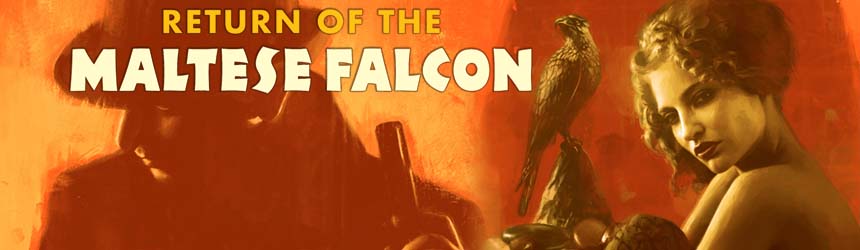
That’s always a problem in private eye novels. The form is basically a series of interviews with witnesses and suspects – look at The Maltese Falcon. So I try in Heller (well, in all novels that touch on the PI form) to use interesting locations. With an historical saga like Heller’s, it’s an opportunity to suggest the times and put the place in context – using famous defunct restaurants, for instance.

Chuck Berry at the Cosmo

I read about the Cosmopolitan Club, where Berry basically put rock ‘n’ roll on stage for the first time, and found that the documentary Hail! Hail! Rock ‘n’ Roll (1987) had refurbished the defunct East St. Louis club for a mini-concert celebrating (and sort of recreating) Berry’s tenure there. I got caught up in the documentary and it got me interested in Berry and his music, which I had frankly (stupidly) taken for granted. On reflection, I was reminded that everything from the Beach Boys to the Beatles came from him, and recalled how many, many songs of his my various bands had played.

So I sent for another documentary (Chuck Berry, 2018), and several books, and three CD’s. That’s a bonus that comes out of the Heller research – I stumble onto things that are only tangential to the book at hand but that roar into the centerstage of my personal interests.

If you’ve never seen Hail! Hail! Rock ‘n’ Roll, by the way, you haven’t lived till you watch Chuck Berry schooling Keith Richards on how to play rock ‘n’ guitar. One particular sequence is singled out as demonstrating how difficult Chuck could be; but for those of us who’ve played in bands, we know: Chuck was right.

One bittersweet aspect was my realization that I had blown a great opportunity. My son Nate lived in St. Louis for better than half a decade, and during that time Barb and I visited him (and later, Nate and his wife Abby, and later than that, grandson Sam too) often. Meanwhile, hometown boy Chuck Berry was playing once a month at Blueberry Hill, a fantastic club in the Delmar loop. And I – we – didn’t bother to see him.

As Fats Domino would say, “Ain’t that a shame.”

* * *

This Paperback Warrior review of Quarry’s Blood appeared on my birthday, March 3, and I couldn’t ask for a better present.

The New York Times recommended ten books last week, and Quarry’s Blood was one of them.

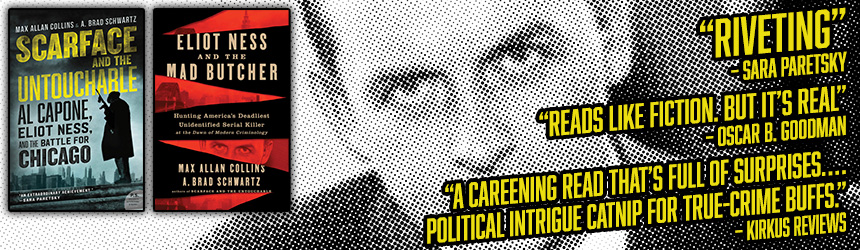
Finally, Daedalus Books has the hardcover of Eliot Ness and the Mad Butcher for $6.95.

M.A.C.

Quarry Hits the Big Times

March 1st, 2022 by Max Allan Collins

It’s been ages since I’ve had a New York Times review of one of my novels. I’ve had some nice write-ups there – don’t recall a bad one – but this is the first ever Quarry novel the Times has reviewed. Here goes:

With QUARRY’S BLOOD (Hard Case Crime, 224 pp., paper, $12.95), Max Allan Collins finally bids goodbye to Quarry, his Marine sniper-turned-professional assassin, more than 10 years after The Last Quarry, by its title, promised to do so. This time feels like it’s for keeps, as the novel is set more or less in the present (there’s a reference to a character dying of Covid), and Quarry, pushing 70, is looking forward to retiring after all those decades of killing for hire.

Retirement, however, is put on ice when a true-crime writer, Susan Breedlove, shows up at Quarry’s door looking for some answers. Her arrival opens a portal into full-on metafiction, as the line between what Collins has published since the mid-1970s and what has spilled out into the actual world (like a television adaptation) grows so porous as to cease existing.

It goes without saying that the body count will pile up, and that Quarry, despite his aching body and slower reflexes, still operates at a more ruthless clip than almost anyone he encounters. This is a sure-footed ending to a series that marinated in the excesses of pure pulp.

That’s a swell review, but what’s interesting to me is to how the word “pulp” has become a compliment in recent years – possibly thanks to Quentin Tarantino’s Pulp Fiction – when for decades it was a pejorative. Now it denotes a certain style of fiction (often consciously retro) viewed with a positive, even affectionate spin.

Equally interesting to me is that this is the first I’ve had a paperback original reviewed in the Times, at least that I can remember.

So far the reader response, and reviewer reaction, has been very warm indeed to the new Quarry. It was a risky novel to write, as you readers of the book already know, because I ventured into “meta” territory, big-time. I don’t want to say more, but I will say that one of the things I dealt with is just what exactly Quarry has been writing in these first-person narratives all these years.

Quarry's Blood Audiobook cover
Digital Audiobook: Audible Purchase Link

Out right now is the audio book of Quarry’s Blood, read by the wonderful Stefan Rudnicki. The cover is pictured here. I have not listened to the audio yet, but will begin sometime this week, when we take a day off to celebrate my 74th birthday. (It’s March 3rd, not yet a national holiday.)

Stefan has become the voice of Quarry for me, just as Dan John Miller is Nate Heller.

Check out an excerpt here:

* * *

I am working on the new Heller novel now, ridiculously immersed in it, and for that reason this will be a short update. I would like to respond to Bill P’s follow-up comment on a discussion about writing, readers and reviewers that’s been going on for a few weeks here. I misunderstood Bill’s use of “archetype,” thinking he meant the characters I write about; but he was thinking of the archetypical reader I envision.

I accidentally answered that, by saying that I write to please myself, and my wife Barb, who is my first reader as I go along (meaning she reads the chapters as I complete them). I do, however, envision a reader. I don’t think specifically of a male or female, just someone who shares my interests and tastes, and the ideal reader is probably of my generation or the generation or two on either side of mine. A major part of my approach is my assumption that the reader is at least as smart as I am. He or she might be smarter, but not so much smarter that my work seems childish or beneath them. I never assume – never – that the reader isn’t as smart as I am. I endeavor never to write down.

The only slight exception – the only “sort of” exception – is when I write a first-person story in the voice of someone not as smart as me. I’ve only done this a few times, and it’s tricky (Shoot the Moon is one). This relates as well to writing in the point of view (when in third person) of someone who isn’t as smart as me. Who might be dumb, like Lyle in Spree. All I can say is that these characters never think of themselves as dumb, just as the antagonists of the protagonists never think of themselves as the villains.

I’ve made it clear here that I abhor writing that tries to impress – that spends too much time showing off. In this approach, the story almost always pays the price.

* * *
La Guerra De Quarry (Quarry's War, Spanish Edition) cover

I wanted to share with you this cover of the graphic novel Quarry’s War in Spanish.

I don’t remember Quarry appearing in Spain before. Road to Perdition did, which may be what led to this edition.

Here is a very smart review of Quarry’s Blood. This reviewer is always worth reading.

M.A.C.

Who I Try To Please

February 22nd, 2022 by Max Allan Collins

No book giveaway this week. To make up for it I am including a cute photo of our two grandchildren, Lucy and Sam, taken at the Muscatine Art Center’s lego display. You’re welcome.

Muscatine Art Center Lego Exhibit, Sam and Lucy
Muscatine Art Center Lego Exhibit, Rubber Duckie
* * *
Quarry's Blood
Paperback: Indiebound Purchase Link Bookshop Purchase Link Amazon Purchase Link Books-A-Million Purchase Link Barnes & Noble Purchase Link Target Purchase Link
E-Book: Google Play Kobo

Patience – another book giveaway will come. I just don’t want to detract from the release today (Feb. 22) of Quarry’s Blood. And winners in that book giveaway, will on that date be able to post reviews on Amazon.

* * *

And speaking of Quarry’s Blood, I want to share this great review from Ron Fortier at Pulp Fiction Reviews:

QUARRY’S BLOOD
By Max Allan Collins
Hard Case Crime

Max Allan Collins has been writing stories about his Vietnam veteran hitman since 1976. It was obvious from the start that the author and his creation were the same age making it easy enough for him to place the stories in time. Collins did a few Quarry books and then walked away from them. When Hard Case Crime came along, publisher Charles Ardai, a fan of the character, urged Collins to bring Quarry back. Collins, obviously older, as was his hero, realized he had a golden opportunity to write a finale.

What his crystal ball couldn’t predict was how successful “The Last Quarry” would become among his ever growing audience. And there was Ardai wanting more. Collins pulled a very neat hat-trick and went backwards with “The First Quarry.” Which of course meant dusting off his own memories of those long ago times and their social environs. All of which he did making it seem effortless.

Having thus given us the alpha and omega, it seemed we mystery/crime fans had seen the last of Quarry. Again we’ve been proven wrong in this new “Quarry’s Blood.” It’s pretty much a gripping fast paced epilogue and so much fun. We catch up with an aging Quarry, almost about to reach seventy and widowed for the second time. He’s content with living a quiet, if lonely life, until a very savvy female writer named Susan shows up on his doorstep. As it turns out she’s the author of a bestselling true crime novel that was clearly inspired by Quarry’s lethal career and she’s convinced he is the real hitman she researched in her book.

Unnerved by all this, he maintains his false innocence and sends her packing. The following day, while taking a pre-dawn swim at a nearby indoor pool, he’s nearly killed by two professional assassins. No way is it a coincidence and Quarry finds himself once again being pulled into his old world of hunter/prey, kill or be killed. But what’s the connection to Susan? And who, after so many long years, wants him dead and why?

This is one of the best Quarry books ever. Maybe we think that because we’re seventy-five, a Vietnam veteran and often times think about all our brothers who never made it home to their families and loved ones. Who never got to drink another cold beer or read a damn good book like this one. Thanks, Max, for all of them.

Thank you, Ron, for reading them. When a Vietnam vet reacts well to these books, I am especially pleased.

* * *
The Amazing Spider-Man

Okay, so sometimes I’m wrong.

Ten years ago, I thought The Amazing Spider-man with Andrew Garfield was lousy. But because I really liked the recent Spider-Man: No Way Home, in which all three big screen Spider-men were deftly woven into one narrative, I decided to pick up a 3-D Blu-ray of Amazing Spider-man (cheap) and Barb and I watched it tonight.

We loved it.

Part of this is our affection for Andrew Garfield in other films he’s been in that made us more open to his casting, and of course he’s very good in No Way Home. Part of it was how terrific the film was, really taking its time to explore the origin of the character in a way that was at once faithful to the original comic book and at the same time fleshed it out. Also, the attention by the filmmakers to mimicking artist Steve Ditko’s classic poses for Spider-man was thrilling to someone who had followed the character from Amazing Fantasy #15 and The Amazing Spider-man #1 to the end of the John Romita-drawn run.

Mostly our positive reaction, however, came from meeting the film on its own terms. This is true of novels and short stories, too. I’m a big believer in that, but I sometimes don’t take my own advice. In retrospect, I disliked the Garfield version of Spider-man, ten years ago, because I felt it was superfluous – that it was too soon to do a reboot (a term I don’t believe was in use yet). As a Sam Raimi fan – I saw Army of Darkness in a theater on its first release – I liked his version just fine, though the third one was not up to snuff. But Toby McGuire’s Peter Parker/Spider-man (should I have inserted a “SPOILER ALERT” there?) seemed definitive.

Now reboots are part of the plan, and No Way Home has rather brilliantly found a way to make all three versions of Spider-man at the movies exist in the Marvel Universe.

I mention this not just indicate any growth on my part, but as an adjunct to discussions here (on the update/blog itself and in the comments) about the value of reviews. I don’t recall if I reviewed Amazing Spider-man here ten years ago, but if I did, I probably panned it.

A review is just an opinion, and a snapshot of how the reviewer reacted to a film or novel at that time. Opinions can change, and they often should. I am always after my readers to post reviews at Amazon, and have made my preference for receiving good reviews no secret. But it really doesn’t have much with making me feel good (okay, a little), but mostly to help market the books. To draw attention to them and encourage new readers.

In the comment section last week, Bill P said the following:

So, if you as an author realize this is a collaboration with the reader, do you have an archetype in mind during writing for the intended audience? Does thinking of their acceptance/rejection of your choices guide you or limit you? And when you try to grow from that core audience from book to book, do you find some reject you extending those boundaries because they want the constancy of the world you have previously created?

I answered this last week, in the comments; but I think Bill raises topics worth discussing in a bit more depth.

I love my readers – money gets sent to my house because of them. But the truth is I write for only two people – Barb and myself. Primarily I write for me, because I am always trying to write a book that I would like to read. I am trying to satisfy my needs and express my ideas and to make something. Create something. Barb is secondary in this process, but incredibly important. I cannot imagine writing if she were not reading what I’ve written.

Now, that doesn’t mean she reads everything – she certainly skips introductions and essays and such that I occasionally write. But all of my fiction goes to her as my first reader (with novels, a chapter at a time). One reason for that is her abilities as a writer – even before she developed her skills along those lines, she had incredible story sense, and a remarkable bullshit detector. She knows when something isn’t working in a scene.

Also, and you’ll have to forgive the sentiment here, but I love her and want to please and impress her. To make her think I was worthy of her spending her life with me. I need to impress her because a lot of the time I am a buffoon.

Being my critic-in-chief isn’t an easy role for her. I hate criticism. I have a thin skin. (Not a desirable trait in a writer.) (Or anyone.) Sometimes I don’t react well. But generally she knows how to handle me (sad that she has to) and I know she is trying to protect me. Yes, from myself.

I don’t make any attempt to please readers by writing the same kind of thing every time out. For a long time, in the movie and TV tie-in days, I had to write all sorts of things to make a living. It was good for me, because I learned a lot writing in different genres – the movie novels, as I’ve mentioned here, included war, western, romance, science-fiction, sword and sorcery, horror and other themes forbidden to me in my narrowly defined role as a mystery writer.

But within mystery fiction, not everything I do pleases every reader of mine. When I do something like John Sand, occasional howls of displeasure have arisen. It’s probably no surprise that fans of Quarry might not be interested in the cozy comic Antiques novels. Quarry and Nolan fans sometimes find the longer length and historical approach of Nathan Heller off-putting, though Heller and Quarry and Nolan are cut from similar cloth.

I can’t help that. First, I need to make a living, and second, I need to stay fresh and interested. If I were doing one Quarry novel after another, in a row, I’d likely grow tired and to hate him. As it is now, it’s like spending time with an old, good friend (who kills people).

I do make concessions both to publishers/editors and to the type of book I’m doing. I have a sense of what’s appropriate for a given title. For John Sand, Matt Clemens and I decided to be very sparing with the “f” word – we hardly use it at all, whereas Quarry and Nolan and Heller readers know I am not fucking afraid to use it. In the Fancy Anders novellas and The Many Lives of Jimmy Leighton, that kind of effing profanity just didn’t seem appropriate. It wouldn’t be in the Antiques novels, either.

To me that’s just bringing to a given novel what is appropriate for that novel, and, yes, its audience. I don’t think that’s selling out – I think it’s being a conscientious professional.

I don’t know how to answer Bill’s archetype question. All of the first-person narrators are me – me in different circumstances, but me. In writing tough guys like Nolan, Quarry, Heller, even Mike Hammer, I strive to make their surfaces – and their inner lives – reflective of each being a real person. Not a type.

M.A.C.