Sit Down and Read!

May 10th, 2022 by Max Allan Collins

STOP THE PRESSES: Supreme Justice and Midnight Haul are on sale for $1.99 each as Mystery, Thriller and Suspense Kindle book deals till the end of May. Amazon links: Supreme Justice | Midnight Haul

* * *
Stand Up And Die! cover
Trade Paperback:
E-Book:

Stand Up and Die!, the new Mickey Spillane collection from Wolfpack’s Rough Edges imprint, goes on sale next week (May 17) as both a Kindle e-book and a physical book. I edited it (and introduced it) and contributed a new version of my very first collaboration on a Mike Hammer story with Mickey, “Tonight I Die” (originally titled “The Night I Died” and published in the Spillane/Collins-edited anthology, The Private Eyes, 1998).

These novellas and short stories are culled from two long-out-of-print anthologies I edited, Tomorrow I Die (1986, Mysterious Press) and Together We Kill (2001, Five Star). This represents all of the crime stories from both volumes collected here in one place.

Here are the contents:

“Stand Up and Die!” (1958)
“Everybody’s Watching Me” (1953)
“Together We Kill” (1953)
“The Girl Behind the Hedge” (1953)
“The Pickpocket” (1954)
“I’ll Die Tomorrow” (1960)
“Tomorrow I Die” (1956)
“Hot Cat” (1964)
“The Gold Fever Tapes” (1973)
“Tonight I Die” (2022)

The final story is a Mike Hammer tale, and the reason why I’ve done a new version – not radically different, but enough so to rename it – is a story unto itself.

The basic story of “Tonight I Die” appeared in three versions in Mickey’s files – a radio play, a thirty-minute TV show, and a sixty-minute or more TV movie. There are significant differences between versions, and I did not become aware of all three until much later.

In 1998, when we edited the anthology Private Eyes for NAL, I felt it was key that we include a Hammer short story. But there weren’t any and getting Mickey to write a new one would have tough to impossible. He had already begun to share his unpublished materials with me, just for my interest (and perhaps he was already thinking of what I might do with his unfinished work some day), and I had run across the radio play version. It seems to have been written for the radio series That Hammer Guy, possibly as a pilot. It was not to my knowledge produced, though the series ran three years.

The script was heavy with narration and I asked Mickey if I could turn it into a short story, sticking to his script. He gave his blessing. The script was heavy with narration and the transfer was not difficult, though I felt some of it could have used some work, chiefly for clarity. But I did as little as I could in that regard, basically turning the script’s present tense script into past.

Now that I’ve done so many posthumous collaborations with Mickey – with his blessing – I felt this story should be properly prepared for publication…again, without taking too many liberties.

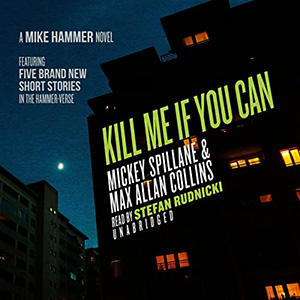
The things I did not include from the Tomorrow I Die and Together We Kill anthologies in this new one are interesting but not vital – like the science-fiction tale “The Veiled Woman,” ghosted by Howard Browne when Mickey missed deadline; a few memoirs for True magazine; a comic book “filler” story (now available in Vintage Spillane); and the script of a Mike Hammer screen test film starring Spillane’s policeman pal Jack Stang (a short story version appearing in the forthcoming Kill Me If You Can, this year’s Hammer 75th anniversary novel, which includes five bonus short stories). Also intentionally M.I.A. is Mickey’s good but non-crime tale, “Affair with the Dragon Lady.”

Stand Up and Die! is the definitive collection of Spillane crime/mystery short fiction, and its existence is due to not just my efforts but also Wolfpack’s Mike Bray, Paul Bishop and James Reasoner.

Mickey allowed a number of his crime novellas to be collected by NAL as paperbacks, mostly two-to-a-volume. This was part of his effort to raise last-minute funds for the troubled production of The Girl Hunters film. Possibly because that need for money was over, he did not bother to collect his other novellas and short stories similarly. Over the years I collected these in their original men’s adventure magazine appearances, sometimes off the newsstands, other times in used book stores. Convincing Mickey to let me collect some of them for the Mysterious Press anthology led to our first professional project together.

Not our last.

I can’t recommend a collection of tough fiction more highly than this one.

* * *

Here’s a good review of Quarry’s Blood by a reader who can’t seem to make up his mind whether he wants me to write more Quarry books or not.

This review of the film The Outfit, streaming now, says it’s a combination of Collins (me), Mamet (a writer whose work I don’t care for), and Sorkin (a writer whose work I do care for). So I went into watching it with one eye squinted. It’s an okay crime chamber piece, with a strong central performance by Mark Rylance. You may like it. I made it all the way through, Barb didn’t. Interestingly, Barb loves the film of Tinker, Tailor, Soldier, Spy (as do I), and the reviewer here in passing calls Tinker, Tailor “dreadfully boring.” Still, having my work referenced in a review like this was fun.

Some short, smart reviews here of three Quarry books and one Nolan. I’m blushing.

Road to Perdition is listed as one of the seven best movies debuting on Netflix in May 2022.

Here’s an interesting in-depth look at Wild Dog.

Finally, this brief, admiring look at the graphic novel and film of Road to Perdition.

M.A.C.

Paging Dr. Tongue, Plus Neal Adams and Martin & Lewis

May 3rd, 2022 by Max Allan Collins

In case you haven’t been listening, 2022 is the 75th anniversary of Mike Hammer’s debut in the 1947 novel I, the Jury. A lot of exciting things are already underway. So far we’ve got The Shrinking Island and The Menace out there from Wolfpack’s imprint, Rough Edges Press. And coming up in about two weeks from Rough Edges is a great anthology of Spillane novellas, Stand Up and Die!

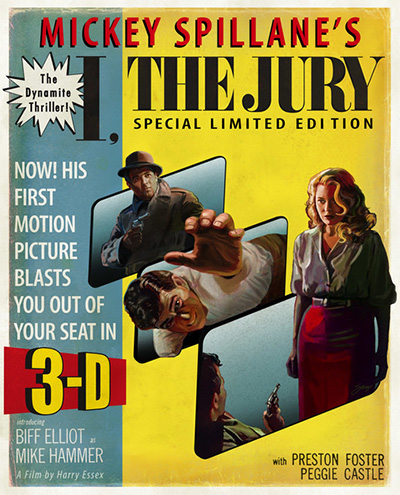
But perhaps most exciting of all (next to the January 2023 prose biography, Spillane – King of Pulp Fiction by Jim Traylor and me from Mysterious Press) is the long, long-awaited release of the 1953 film version of I, the Jury…and in 3-D!

I The Jury 3D announcement

ClassicFlix – who specialize in (not surprisingly) Blu-rays and DVDs of classic films from Hollywood’s 1930s/’40s/’50s Golden Age – is bringing it out (likely in the fall).
I will be doing the commentary.

The 1953 I, the Jury is a very underrated film (including by Mickey). Biff Elliot makes a fine Mike Hammer and the script and direction by Harry Essex are faithful to the source. Peggie Castle and Margaret Sheridan make the definitive Spillane women, and the great noir specialist, cinematographer John Alton, works in 3-D with his usual artistry. I put only Kiss Me Deadly ahead of it and would call the first I, the Jury a tie with The Girl Hunters for second place.

The publishing schedule for the Hammer anniversary includes The Menace, with me writing a horror/crime novel from an unproduced Spillane screenplay; a collection of the three YA novels, The Shrinking Island, with the previously unpublished title tale a Spillane fan Holy Grail; and the soon-to-be-published Stand Up and Die! (with a Spillane/Collins Hammer story) the best collection of Mickey’s novellas ever assembled.

In August Titan will bring out the novel Kill Me If You Can, again with me working from an unproduced Spillane screenplay and dealing with the period between Kiss Me, Deadly and The Girl Hunters – the direct aftermath of Velda’s disappearance. The book includes five Spillane/Collins short stories, including two Hammers.

And the capper of this wave of Spillane publishing will be the 100,000-word bio from Jim Traylor and me.

* * *
Two legends: Neal Adams (left), Batman (right)

I suppose being my age – 74, damnit – means a progressive thinning of the ranks of my heroes and friends (two groups not mutually exclusive). Now we have lost Neal Adams, at 80, who for my money is the best Batman artist of the “serious” period, which – let’s face it – he and Denny O’Neil (also gone) invented.

He did much more, of course. His work on the comic strip Ben Casey, in his very early twenties, is stellar – I have an original daily example on my wall. I loved his Deadman, the Green Arrow/Green Lantern work was groundbreaking, and, really, everything his pen touched turned to great.

But he also was a champion for the rights of his fellow cartoonists, and he was a big part of getting some recompense for Joe Shuster and Jerry Siegel, the teenagers from Cleveland on whose bones the DC empire was built.

I knew him a little, and I was complimented that he knew who I was…something which still seems to me a little unbelievable. I have a small but cherished memory of standing in line with him getting ready to ship things home from the San Diego Comic Con. I introduced him to my wife as a beginner I knew, and his grin couldn’t have been wider. He had a smile as dazzling as his artwork, and that’s plenty dazzling. We chatted and laughed for about five minutes, a small encounter that I will never forget. I always stopped by his booth at the con in subsequent years just to say hi.

Not a big relationship, by any means. But a big loss.

* * *

Another sign of advancing old age is my reading habits. I’ve never been one to start a book and then put it down without finishing it. But now I won’t waste my time if a book doesn’t engage me in a chapter or so. Like most of you, I have an ever-growing stack (stacks) of books I can’t wait to read. So some of this stuff just has to get out of the way if it can’t grab me.

Related to this is my experience with Judd Apatow’s new book, Sicker in the Head, a follow-up (of course) to his Sick in the Head. Both books are Apatow interviewing individuals in the world of comedy. I read every page of the first book. This time I read about a third of it.

Not the first third – I selected interviewees I was interested in – like the late John Candy, John Cleese, David Letterman, Peter Davidson, John Mulaney, Kevin Hart, Sasha Baron Cohen, Samantha Bee, and Will Ferrell. But I have no interest in people I have barely (or not at all) heard of – for example, Amber Ruffin, Ed Templeton, Hannah Gadsby, Lulu Wang, and on and on. Please don’t write telling me who they are, and/or defending their presence in a book with the comic legend likes of Candy and Cleese. I just don’t have time to let these people in unless they get up on their hind legs in the pop culture and make enough noise for someone my age to notice.

Now a book I read every word of is the massive, inch-and-a-half thick, 8.5″ by 11″, 772-page (!) Marketing Martin and Lewis by Richard S. Greene…with a foreword by Eddie Deezen! (Why didn’t Apatow interview him?!?). This is a Martin and Lewis fan’s dream, and worth the fifty-buck price tag (although I got it through Barnes & Noble for $40 using a coupon).

The book is predominantly pictures – movie posters and ads, TV ads, magazine covers, publicity photos, comic book art (Neal Adams!), and on and on; but the text is substantial and thorough, with every Martin & Lewis film discussed and the individual, post-team careers of both are examined. Greene is the ideal fan – his knowledge and the collectibles he shares are mind-bogglingly vast, but his opinions are frank, fair and well-articulated.

It also has the greatest cover of any book ever published. I shared this opinion with my wife, who looked at me as if about to say, “Are you for real?”

Marketing Martin and Lewis
* * *

Here’s a New Yorker article about a Muscatine, Iowa (my hometown) resident who inspired my Mallory novel, No Cure for Death.

An interesting Road to Perdition article is here, looking at the film’s shooting locations (cameras, not guns).

Netflix has added Road to Perdition to its roster.

This review of the Nolan two-fer, Double Down, begins with a left-handed compliment but evolves into a pretty decent write-up. I wrote these books around 1974 and it’s peculiar to see them judged in terms that don’t acknowledge it’s not unusual for writers to grow over time.

Finally, this article wonders whether Road to Perdition is based on a true story (the answer is “sort of”).

M.A.C.

Menace & Shrinking Island Giveaway…And Robert Morse

April 26th, 2022 by Max Allan Collins

The publication date of The Menace by Mickey Spillane and myself (from Wolfpack’s Rough Edges Press) is August 27 (Wednesday of this week, as I write). To jump-start some reviews of this and of The Shrinking Island (the collection of Mickey three YA adventure novels), I am announcing right now a book giveaway. Winners agree to write an Amazon review; other reviews are also encouraged.

M.A.C. holding copies of The Menace and The Shrinking Island

I have five copies of The Menace and five copies of The Shrinking Island for the first ten who request a book by writing me at macphilms@hotmail.com. Tell me which book you prefer, but if your choice is gone, the other will be sent. You must include your snail mail address, even if you’re entered before. These will go fast.

As usual, USA only.

The Menace is a special book. It is unusual in several respects. The Mike Hammer novels under the Spillane/Collins byline reflect me finishing books of Mickey’s in progress or put aside at the time of his death in 2006, or novels developed from synopses he left behind. I’ve also done from partial Spillane manuscripts two non-Hammer novels – The Consummata (with Morgan the Raider from The Delta Factor) and a standalone (Dead Street), with a very Hammer-like protagonist.

The Menace was developed from an unproduced screenplay in the Spillane files. It was apparently written shortly before or around the time he and I became friends in 1981, and he spoke to me of it frequently. He seemed to have an independent production in mind; he was friendly with South Carolina indie producer, Earl Owensby, who had his own studio, and the two had explored doing projects together. Nothing came of it, but The Menace indicates something might have.

But the screenplay was short – around 40 pages – and seems either to be a condensed version designed to attract investors or a version that could have been a pilot for a one-hour anthology series, probably with Mickey hosting. (In the forthcoming Mysterious Press biography by Jim Traylor and me, Spillane: King of Pulp Fiction, we explore Mickey’s efforts to put a mystery/crime anthology on the air with himself as the on-camera Rod Serling or Alfred Hitchcock).

What is particularly interesting about The Menace is the genre – while one foot is in a crime/mystery story, the other is in horror. Elements of horror were a part of Spillane’s novels from the beginning – he brought the horrors of graphic violence to his post-war crime fiction – the endings of Kiss Me, Deadly and My Gun Is Quick come to mind – and flirted with horror themes in The Twisted Thing and his last Hammer-in-progress, The Goliath Bone.

But The Menace is specifically Mickey reacting to the success of Stephen King. I go into this in my intro to The Menace, and will only say here that it was a Spillane reaction to King’s enormous success as a writer who became a media star and who carved out his own new niche in popular fiction. It’s fair to say that King has been imitated in much the same way Mickey was in his heyday.

Spillane did not, however, like the supernatural aspect of King and that other huge success, The Exorcist (book and film). As a Jehovah’s Witness, he took demons and the devil very seriously and did not consider them appropriate subject matter for fiction. He didn’t cry out for censorship, and in fact called King “a great writer”; but that type of horror was not for him.

The novel I’ve fashioned from his compact screenplay is unusual in its crime/mystery aspect having no Mike Hammer substitute at its center, though a tough small-town police chief is one of the two protagonists. The story is about a family where the husband (a self-made-man doctor) and wife (an artist from a wealthy family) have been driven apart by their disagreement over how to raise their ten-year-old “special needs” son. During much of the action, the estranged couple and their boy are in a big old spooky house, the grounds behind walls, which becomes the setting for a siege of sorts involving an Aztec mummy who may or may not still be breathing and a creature who may or may not be human. And at its heart is the story of a family coming back together in adversity.

Not typical Spillane elements, but typically compelling Spillane storytelling. Like the adventure stories he wrote in his last decade – The Shrinking Island, Something’s Down There and The Last StandThe Menace indicates an author trying to break away from Mike Hammer and flex other storytelling muscles.

I am very proud of the book and think it shows a whole other side to Mickey Spillane. It’s a relatively short novel – 40,000-words – but we have included as a bonus the original, previously unpublished version of the short story “The Duke Alexander” and a rare non-fiction crime story by Mickey, “The Too-Careful Killer,” unseen since 1952.

* * *

Yet another of my heroes has left the planet. As if losing Norm Macdonald and Gilbert Gottfried weren’t enough, a selfish God has taken Robert Morse away. Granted, Bobby Morse had a 90 year-run, and I admit when Barb and I screened How to Succeed in Business Without Really Trying in his honor over the weekend, we could not mourn. We could only get caught up again in the joy of experiencing the magical, shamelessly mugging musical comedy performance that is Robert Morse playing J. Pierpont Finch.

I started thinking about what I was going to say about How to Succeed and Morse, but thought I should check on what I’d said on the subject in this space before. And I discovered that in a post in 2017, I had already said the things that my mind was putting together for me to share now. So I’m going to do something I don’t believe I ever have here – I am going to rerun my response to seeing the Twilight Time Blu-ray edition of How to Success in Business Without Really Trying.

* * *
As you may have gathered, if you’ve stopped by here at all frequently, I am a collector of movies on Blu-ray and DVD. Many of my favorite films have made it onto Blu-ray, like Kiss Me Deadly and Gun Crazy (though I had to get that from Germany). And a fairly short list of my favorites remain on DVD only, like the Chinatown sequel, The Two Jakes, and the great film version of the Broadway musical, Li’l Abner.

One of my favorites, poorly represented with a terrible transfer on DVD, has finally made it to Blu-ray, in a limited edition of 3000, from Twilight Time, the boutique label that has brought us any number of terrific films, from The Big Heat to the Hammer Hound of the Baskervilles, from a Sinatra Tony Rome double feature to Pretty Poison.

But this time – and my birthday month yet – they have given me (and Barb and for that matter son Nate, who also loves it) a film I could watch once a week – How to Succeed in Business Without Really Trying.

There are those who can find reasons not to like this movie, just as there are people who can find a reason not to like ice cream. They are to be pitied. How to Succeed features a brilliant, witty, acid but not hateful score by the brilliant Frank Loesser. A Pulitzer Prize-winning musical (yes, Pulizter Prize-winning musical) in 1961, the Broadway version skewered the shallowness of big business in an up-to-the-moment manner. Unfortunately, the timing of the film’s release – 1967 – made How to Succeed’s cutting-edge satire seem dated, a lot having happened since ‘61.

Fortunately, time has been kind to this early ‘60s musical, with its bright Batman TV colors and cartoon images come to life (cartoonist Virgil Partch – VIP – was a consultant) and Bob Fosse choreography that is as witty and biting as the original play itself. (Fosse is not the actual choreographer of the film, but he’s credited as the source.)

A number of players from the Broadway show are retained, including Michelle Lee (who was the second Rosemary Pilkington in the original cast), the very funny Rudy Vallee, Ruth Kobart, and Sammy Smith, with Charles Nelson Reilly’s Bud Frump M.I.A., though decently replaced by Anthony Teague. Maureen Arthur – a live-action Little Annie Fannie – was in the national company of the musical and joined the Broadway run later.

I saw the national company in Chicago when I was in high school and fell in love with the musical then. The cast included Dick Kallman as Finch (later star of Hank on TV), who was excellent, with the second Great Gildersleeve, Willard Watterman, in the Rudy Vallee role. And of course the eye-popping Maureen Arthur was Hedy LaRue (“O.K. Charlie!”).

Two things make this film one of the best transitions of a Broadway hit to the big screen. First, director/writer David Swift – with credits like Pollyanna and Under the Yum Yum Tree enough to make one doubtful – had the surprising sense to film faithfully a show that had won seven Tony Awards, the New York Drama Critics Circle award, and the 1962 Pulitzer Prize for Drama.

The other thing is Robert Morse.

His J. Pierrepont Finch is my favorite performance in any musical film. He shamelessly recreates the Broadway role with only the slightest concession to movie technique. He understands, as does the rest of the cast (though not on this level), that he’s appearing in a cartoon. His character, who climbs from window washer to the chairman of the board in a few days, following a self-help book that provides the film’s narration – should be unsympathetic. He’s manipulative and dissembling and is never seen really working (not really trying, remember?); but the boyishness of Morse himself smooths the edge off.

Morse brings a remarkable energy to his songs and his loose-limbed dancing brings James Cagney to mind. In the ensemble, “Brotherhood of Man,” in the midst of a sea of Bob Fosse choreography, brilliant scene-stealer Morse knows just how to draw the viewer’s eye, chiefly by lagging like a jazz player behind the melody just enough to seem improvisional among all the precise dancers. He alone seems spontaneous.

Does he mug? Almost constantly. His performance is basically Jerry Lewis Goes to Graduate School. Somehow, playing a ladder-climbing nogoodnik, he seems joyful – the perfect conveyer of Loesser’s lyrics, with their hidden dark side.

Famously, the big hit love song from How to Succeed is sung by Morse’s Finch…to himself in a mirror. Few scores rival this one, though like Sondheim, Loesser writes to the story. The songs that were left out (“Paris Original,” “Happy to Keep His Dinner Warm”) are the weakest in the show. The only loss, besides Charles Nelson Reilly, is the great “Coffee Break,” which was filmed but cut for time. Too bad it doesn’t seem to have survived to be a special feature.

Morse and Reilly, by the way, were so successful on Broadway that they made an album together, “A Jolly Theatrical Season,” in 1963.

If the name Robert Morse seems vaguely familiar to smart younger people, he played Bertram Cooper on Mad Men, a role he was cast in, in tribute to his star turn in How to Succeed. Toward the end of Mad Men’s run, Morse was given a lovely song-and-dance farewell.

Morse’s career on Broadway was a stellar one, particularly his roles in Sugar and his one-man play, Tru, in which he played Truman Capote, winning his second Tony. But his film legacy is, largely, How to Succeed. No other film caught his magic, and a few really did him no favors – Honeymoon Hotel; Quick, Before It Melts – though The Loved One and Guide for the Married Man are worthy credits. I used to feel sad that this great talent had only one film to do him justice.

But with How to Succeed finally on Blu-ray, and with Mad Men as a wonderful, Emmy-nominated coda, I can only smile.

Nice modern-day (separate) interviews with Morse and Michelle Lee are special features. No “Coffee Break,” alas.

Buy it here.

* * *

UPDATE: The Twilight Time Blu-ray is still available but is pricey from some sources, although Screen Archives still has it at $20.

Let me add a few thoughts. Morse, who I describe above as “Jerry Lewis Goes to Graduate School,” shared with Lewis an inability to move from boyishness into anything else. It took the heavy make-up of his Truman Capone one-man show to briefly change that – he won a second Tony for it, after all – but he remained a boyish persona.

His rise to success (and Succeed) came from a string of stand-out youthful Broadway roles that culminated in J. Pierpont Finch being designed as a star vehicle for him. Two Broadway revivals have not shown their popular stars able to make their performances anything but reminders of how good Morse was.

He worked. He had a career. For a while he remained hot on Broadway, with Sugar (the musical version of Some Like It Hot) in 1972 a particular highlight. But mostly it was episodic TV and TV movies (he played Grandpa Munster in one), Pringle commercials and lots of cartoon voiceovers (Teen Titans, toward the end) – not what his dazzling How to performance promised.

That he had Mad Men as a last act is wonderful. But he deserved more. And we deserved more Morse.

* * *

Richard Piers Rayner’s phenomenal work on Road to Perdition gets some nice notice here in a piece on movies that recreated panels from the comic books they were based on.

M.A.C.

The Amazing Colossal Gilbert

April 19th, 2022 by Max Allan Collins

Last week my son called me with the bad news – Gilbert Gottfried had passed at 67, an age that seems terribly young to me now. Nate was apologetic about having to share word of another death with me, but at my age that comes (as the Music Man said) with the territory.

Frank Santopadre and Gilbert Gottfried

I hope Gilbert’s podcast partner, Frank Santopadre, will be able to continue their Amazing Colossal Podcast, which has been a glorious celebration and look back at all kinds of popular culture of the 20th Century, particularly film, but also TV and radio and even vaudeville. Gilbert was a master at impressions of obscure character actors, and a font of knowledge about show biz trivia (as is Frank).

When I did the show a few months ago, I was knocked out by Frank’s research, and his glee at being able to ask me, for example, why I liked the Ritz Brothers. Later, on the podcast, I explained myself – something I never expected to do in public, let alone in front of the smart, knowledgeable audience that had the sense to listen to this one-of-a-kind show.

The podcast, of course, is just one (if significant) part of Gilbert Gottfried’s contribution to popular culture. He laughed (and boy did he have a laugh) about me being a fan of his Saturday Night Live year (actually, twelve weeks); but I truly had been a fan (I liked Gail Matthius, too, and that Eddie Murphy kid showed promise). I have sympathy for that whole cast, who’d had the not enviable task of following in the original Not Ready for Primetime Players – after all, I followed Frank Miller into Batman, making me the Charles Rocket of Caped Crusader writers.

Gilbert’s character parts in various films were always funny stand-outs, from the Problem Child movies to Beverly Hills Cop II. Kids got to know that voice by the Aladdin movies and TV shows. But Gilbert’s bold adult delivery of the Aristocrats joke at the Friars’ Club roast of Hugh Hefner, less than three weeks after the 9/11 2001 terrorist attacks, was a shot across the bow at a humorless media. Perhaps the first victim of Cancel Culture – he lost his famous, lucrative Afflac duck gig after tweeting jokes about the 2011 Tōhoku earthquake and tsunami – Gilbert’s public exposure of the can-you-top-this backstage filthy private joke shared by comics became the subject of The Aristrocrats, an excellent 2005 documentary film by Paul Provenza and Penn Jillette.

If you’ve never seen it, track down Gilbert, the 2017 documentary that charts the life and some typical days and nights of a truly sweet, unique eccentric. More than any comedian in history, Gilbert Gottfried could make the punchline of a joke irrelevant – it was always about his delivery, the set-up, the commentary along the way. The journey, not the destination.

For those who are not faint of heart, I recommend Gilbert’s stand-up DVD, Dirty Jokes (2005); it’s also on Amazon Prime.

On the podcast, Gilbert always introduced his guests with long, elaborate, well-researched (thanks, Frank!) bios. I was stunned hearing Gilbert’s (shall we say) distinctive voice going on for several minutes detailing my accomplishments as well as a few embarrassing details.

Perhaps some of you will understand what a treat and frankly honor it was for me to be guesting with my co-author, Dave Thomas, on Gilbert’s show. It’s still unbelievable that as a stone SCTV freak I am now friends with Dave Thomas. And to have shared space with two of my comic heroes for a couple of hours – I will treasure the memory.

Dave said to me, recently, “You really love comedy, don’t you?”

Yes. Yes I do. But some of it died with Gilbert Gottfried, and we really could have used him sticking around in this horrific, humorless era, when people would rather take self-righteous offense than just fucking laugh.

* * *

Here, for your enjoyment, is the Amazon France translation to English of their description of my novel A Life in Red (aka Bait Money):

Among the thugs, quarantine is already the third age. It is still a matter of clinging to it. Nolan, an unlucky thug, tries to find a place in the sun. A nice combination, yes! With accomplices two inexperienced kids and a girl who has the fire in the buttocks and nothing in the cigar. And all for an old debt to the Mafia. What would it be like if he had to pay her to society!

I would love to read this novel!

* * *

Are you going to Bouchercon in Minneapolis this year? September 8-11, 2022? If so, and you’re registered, you’ve received an Anthony Awards ballot. The deadline for nominations is May 1st.

Here is a list of my books (some with Barb, one with Matt) that are eligible. If you haven’t voted yet, and liked any of these books, your vote would be appreciated. Here are the books (or in one a case a short story) that are eligible. You can vote for up to five in each category.

BEST HARDBACK NOVEL:

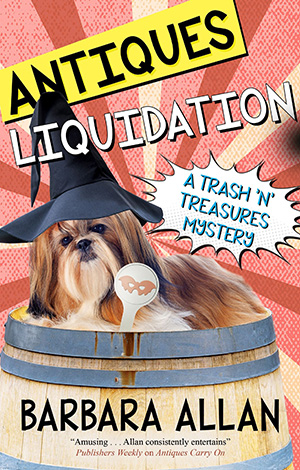
Antiques Carry On, Barbara Allan

BEST PAPERBACK ORIGINAL:

Skim Deep, Max Allan Collins

The Many Lives of Jimmy Leighton, Dave Thomas & M.A.C.

Fancy Anders Goes to War, M.A.C.

To Live and Spy in Berlin, M.A.C. & Matthew V. Clemens

BEST SHORT STORY:

“What’s Wrong with Harley Quinn,” Barbara Allan in EQMM July/August 2021

BEST ANTHOLOGY:

Suspense – His and Hers, M.A.C. & Barbara Collins

Reincarnal & Other Dark Tales, M.A.C.

Turning the Tied, Jonathan Maberry (editor) – includes a story by M.A.C. and Matthew V. Clemens

This voting is only open to registrants of Bouchercon.

* * *
To Live and Spy in Berlin Audiobook
Paperback: Indiebound Bookshop.org Amazon Books-A-Million (BAM) Barnes & Noble (B&N) Powell's
E-Book: Amazon
Digital Audiobook: Amazon

Speaking of To Live and Spy in Berlin, the audiobook is out now – which puts the entire trilogy on audio. A great Brit-inflected job by Brian J. Gill!

Check out an excerpt here:

* * *

The Menace by Mickey Spillane and me comes out next week. Read about it here.

M.A.C.