Posts Tagged ‘Road to Perdition’

Goings and Comings

Tuesday, August 15th, 2017

Dick Locher passed away last week.

As many of you know, I worked with Dick from 1983 until 1992, having taken over the writing of the Dick Tracy strip from Chester Gould in 1977, working first with Chet’s last assistant, Rick Fletcher. My relationship with Fletcher was occasionally rocky, due to my continuing friendship with Chet after Rick fell out with his former boss and father figure. But we did some very good work together.

I felt privileged to work with Locher, another former Gould assistant – one who went on to be a Pulitzer Prize-winning political cartoonist. Our relationship was generally a positive one, and we were friendly, though never really close. We lost contact when I was fired from the strip and I was somewhat resentful that he had not gone to bat for me. In my incredibly biased opinion, the strip under Dick never recovered from my exit.

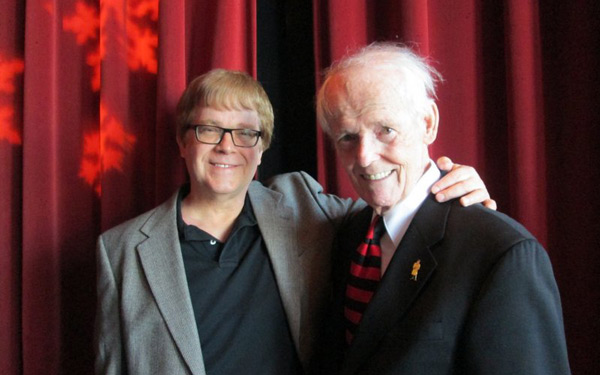
A few years ago I joined Dick at Woodstock, Illinois (Gould’s home city), for the screening of a Tracy documentary we were both a part of. We re-bonded very nicely and any bumps in our past road was smoothed. It became clear he was equally unhappy with the editor who’d fired me, but as a company man he’d kept that to himself. We stayed in touch and exchanged e-mails, artwork and books. It was a nice way for our collaboration to evolve into a professional friendship.

The Tribune did a nice write-up about him, but I’m too petty to give you a link, because the Trib has conveniently written me out of Dick Tracy’s history. So I’ll give you this nice link instead.

Here’s one last fond fedora tip to my partner Dick Locher.
* * *

I think I’ve quoted this before, but where Tracy is concerned I often recall what Dean Martin reportedly said about Jerry Lewis: “The two best things that ever happened to me were meeting Jerry Lewis, and splitting with Jerry Lewis.”

I hated getting fired off Dick Tracy. I felt I had revitalized the strip. Friends, like Mike Gold, told me I should only do ten years, since it wasn’t my creation, and Chet Gould himself advised me not to let Tracy dominate my career, since he would always be the creator.

But Tracy was my childhood obsession and I would be still be writing it, had I not been fired by an editor who despised me almost as much as I despised him.

And yet, just as getting Tracy was the best thing that happened in my early career, losing it was the other “best thing.” Road to Perdition came about because I was scrambling to find a new comics project. The dust had barely settled on my Tracy firing when Andrew Helfer approached me to create a noir graphic novel for DC. Off the top of my head I pitched Gun and Son (which became Perdition), combining my love for Lone Wolf and Cub with the real-life story of John and Connor Looney and a betrayed lieutenant in Rock Island’s mob scene of the early 20th Century. The latter had been something I ran across researching my novel True Detective but couldn’t find a way to use, except in passing.

The rest, as they say, is history. No Tracy firing, almost certainly no Road to Perdition. For a lot of years, the famous thing I was known for was Tracy. Now the strip has receded into something of an interesting footnote and “author of Road to Perdition” is the famous thing.

I am leading up here to a wonderful review by that talented writer Ron Fortier about my prose novel version of Road to Perdition. You need to read this review, and if you have not yet purchased for your reading pleasure and edification the Brash Books edition of the complete version of the novel, what are you waiting for?

* * *

Yesterday Crusin’ performed for a late afternoon concert on the patio at Pearl City Plaza in Muscatine.

It could have been a nightmare. A couple of weeks ago our guitarist walked out on the band at rehearsal and I had a very limited time to decide whether to cancel our remaining two gigs of the year, or find a replacement.

My way is not to roll over and die, however, and with the recommendation of our drummer, Steve Kundel, I approached a well-known area musician, Bill Anson, to fill in. We rehearsed four times, one of them a marathon session, and Bill proved to be a great guy as well as a skilled, gifted guitarist/singer. What we do is not really his genre of choice, but I am hopeful he will stick around for a while. (I have offered him the position of Permanent Temporary Guitarist, perhaps channeling “Permanent Latrine Orderly” from No Time for Sergeants.)

How did the gig go? The audience was large and appreciative, and while there were occasional train wrecks, there were also no fatalities, and I can say in all honesty I haven’t had a better, looser time on a band job in years.

Thanks, Bill. And thanks to Brian Van Winkle, our bassist extraordinaire, for sticking with us in a sticky personal situation.

We play at least one more time this year, at Ardon Creek Winery on September 1, 6 to 9 pm. It’s a wonderful outdoor venue. Check it out, if you’re in the area.

* * *

Here’s a lovely piece on the Quarry TV series.

Here’s a nice write-up on the new Bibliomysteries collection that includes “It’s in the Book” by Mickey and me – my favorite of the Hammer short stories.

Scroll down and read nice things about the forthcoming Quarry’s Climax.

M.A.C.
Browsing at B & N

Tuesday, July 11th, 2017

Remember a few weeks ago when I encouraged everyone to buy books at their favorite brick-and-mortar store? By this I wasn’t suggesting that you find a store where you can buy brick and mortar. Rather, I was hoping you would not spend all of your money online, hastening the death of retail.

One of the bookstores I encouraged you to frequent was Barnes & Noble. With Borders gone, and some communities having no indie bookstore, B & N is about all that’s still standing. We have a BAM! (Books-a-Million) in nearby Davenport, and I trade there a lot. If you’re a member of their frequent buyer club, you get a discount coupon for at least $5 on a $25 purchase every week. Nice store.

Barnes & Noble is good about giving members of their club 20%-off-a-single-item coupons frequently. These are nice little surprises in the snail mail every couple of months. Such things take the sting out of buying a book or blu-ray at a price higher than the online option. B & N is weird in that department, by the way – they are routinely cheaper online, and the stores don’t (or won’t or can’t afford to) match their own online price.

A bigger problem is that B & N corporate has made some decisions about their brick-and-mortars that are not helping the whole decline of retail thing. And now a personal story. (Warning: I’ve told better ones.)

I tend to work six days a week and take one unashamed day off. But when I am really swamped, as I have been lately, Barb and I will take half-days off, usually a morning where we drive to the nearby Quad Cities, have breakfast or an early lunch, shop at BAM! and B & N (that’s where I go – Barb usually has other retail destinations), and are back very early afternoon for more work. Such is our devotion to our readers. And the bill collectors.

On my last two trips to the Davenport Barnes & Noble – a lovely, big store with very nice and often knowledgeable staff – I have had several of those 20% off coupons burning a hole in my billfold. Now I am about as hard to get money out of at a bookstore as convincing a sailor on leave that debauchery is worth paying for.

And twice I have spent not a dime.

Here’s the problem. Barnes & Noble has been rearranging their stores in a fashion that indicates either (a) someone is secretly trying to end the brick-and-mortar aspect of their business, or (b) is desperately trying to get fired. For some years, B & N has had – in each section (Mystery, Biography, what have you) – a display at the head of that section that showcases new titles, face out. The corporate genius in question has decided to instead salt those new titles through the existing stock. Occasionally the new titles are face out, and of course the bestseller type books sit out on various new releases tables.

But for the most part, as a shopper, you either have to have the patience to sort through everything in a section to find new titles, or know exactly what you’re looking for. In the latter case, it’s obviously easier to do that online.

Someone clearly doesn’t understand the shopping experience. Someone associated with bookselling actually doesn’t seem familiar with the term “browsing.”

If searching within a section (Science Fiction, Humor, whatever) isn’t enough to frustrate you, might I suggest the B & N blu-ray/DVD/CD section? (Not all B & Ns have those, but many do.) To further make your shopping experience a Bataan Death March chore, B & N has abandoned individual sections to put all CDs (except classical) together, alphabetically. So you can pick up both the Sid Vicious and Frank Sinatra versions of “My Way” in the same area, if you know your alphabet.

For a blu-ray collector like me, the best (and by that I mean “worst”) is yet to come. The blu-ray section is no more. Instead, a massive section combining DVDs and blu-rays now awaits your browsing pleasure (I also don’t really mean “pleasure”) (sarcasm is fun). Blu-ray buyers tend to be snobs – they avoid DVD unless absolutely necessary. I’m not sure my son buys any DVDs any more. And I would under no circumstances buy a DVD of something available on blu-ray.

Also, the new release blu-rays were formerly displayed on a little shelf above the bins. No more. End caps and other displays may showcase new titles, but again blu-rays and DVDs are mixed.

This may in part reflect the cutting back on help in that section of the B & N stores. With no one to ask, “May I help you,” there are fewer places to look. If you know your alphabet, you’re in business! Hope you have plenty of time on your hands and don’t have to get home to entertain America with your fiction.

What these new policies at B & N are doing is discouraging the brick-and-mortar shopping experience. It’s now not only cheaper and easier to shop online, it’s no longer less fun. By which I mean, it’s more fun.

I still encourage you to shop at B & N, but also to politely complain about the new user-unfriendly sections throughout their stores. If I can go there twice on shopping expedition and return with my 20% off coupons still tucked away, something is seriously, seriously wrong.

* * *

Here’s a nice Jon Breen EQMM review of A Long Time Dead. Jon doesn’t really like Mickey Spillane, but he likes me. Watch him deal with that. (Answer to his question: Collins.)

This is an article on the newly turned-up photographic evidence that supports my Amelia Earhart theory as expressed in Flying Blind – back in 1999! That book is mentioned in the comments.

Here’s yet another of those write-ups about movies you didn’t know were from graphic novels, with Road to Perdition nicely mentioned.

Finally, here’s a lovely review of Quarry’s Vote.

M.A.C.

Holy Supper, Batman!

Tuesday, June 13th, 2017

When the Batman TV show was announced in late 1965, I was ecstatic. It would have been a dream come true had I ever thought to dream it. In January 1966, I was the only comic book fan in my high school in Muscatine, Iowa, and certainly the only person who had been reading the BATMAN comic since around 1954.

Perhaps there were others around me, closeted in four-color shame, but I didn’t know about them. I was open about it. Everybody knew I was into comics, just as everybody knew I was a Bobby Darin fanatic. That I was driven, intense, and wanted to be a writer or a singer or a cartoonist or something in the arts. I was cheerfully humored, although I’m sure this status was no help in getting me laid.

When I got into comics – trading two-for-one at a local antiques shop, or buying them used for five cents or new for a dime – MAD was still a comic book, the original Captain Marvel was still being published, and H.G. Peter was drawing Wonder Woman in a style so eccentric even I knew something was wrong, yet very right, about it. I saw MAD turn into a magazine and the EC horror comics disappear just as I was laying hands on them. Captain Marvel just disappeared, as if a super-villain had taken him out.

For a long time, I had an allowance of ten cents a week, which meant I could buy one comic book a week. Dick Tracy and Batman were the only certainties. The rest went to Dell comics like the sporadic Zorro comics and various movie tie-in issues, filled in with Superman and his “family” – Jimmy Olsen and Lois Lane.

Later I bought Amazing Fantasy #15 off the stands, as well as Fantastic Four #1 and Spiderman #1, and probably the first ten years of both. Sold the valuable issues for hundreds of dollars when I was a college student because, well, I was a college student and the money I got from playing in a rock ‘n’ roll band only went so far.

But I’m getting ahead of myself.

In January 1966, a senior in high school, I was delighted and amazed and astounded by the prospect of a Batman TV show. To say I was looking forward to it is an understatement of super-heroic proportions.

Then a disaster happened: on the night Batman would premiere, my church group (the MYF, which I believe stood for Methodists Youths getting Effed) was throwing a supper to raise funds for something or other (certainly not the poor or disadvantaged – probably to go on some trip). I had to serve. Define that any way you like, but it entailed bringing hot plates of food to the waiting victims in the church basement’s dining hall.

Understand that there were no VCRs or any other recording devices to “time-shift” a TV show you wanted to watch. That was as far-fetched as time travel itself. For days I tried to think of a way out. I was past being able to fake sickness for my parents, and the notion of saying I wanted to skip a church function to watch a TV show was as crazy as thinking that someday I would no longer be a Republican.

So I schemed. My parents would be at the church supper, too, which meant the house would be empty. Batman was only a half-hour show. We lived across town, a trip I could recklessly make in under ten minutes. It was possible. It could happen. A laugh oddly like the Joker’s echoed around inside my brain, bouncing off the walls, currently decorated with photos of Elke Sommer.

Wednesday, January 12, 1966. Arriving early at the church, I found a parking place near the kitchen’s side door, went in, and began being conspicuously (suspiciously?) helpful. Hungry Methodists arrived. I began serving. In the kitchen door at right you would go in, pick up your food, then carry a steaming hot plate of who-the-hell-remembers out the other door, at left. Deliver food, maybe get a smile and a thanks (usually not), and repeat the process. At 6:20 P.M., I began the process, entering the kitchen at right, then – not missing a beat – slipped out the side door into the alley and got behind the wheel of my Chevy II.

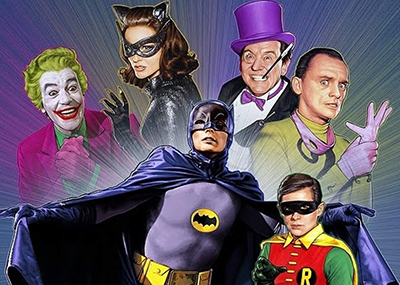
Like a madman I drove across down, and by 6:29 was seated Indian-style on the floor in front of the TV. The nah-nah-nah-nah-nah theme plays over cartoon credits, my mouth drops open and stays there as I witness a comic-book world awash in color, Adam West and Burt Ward portraying Bruce Wayne and Dick Grayson (SPOILER ALERT: the secret identities of Batman and Robin). Frank Gorshin appears as a manic, cackling Riddler, with whom I could identify. The Batusi is danced. Mesmerized, delighted, I watch as the comic book I had loved since age five comes alive in an amazingly deft manner that at once honored and spoofed it – I knew immediately a little kid could enjoy the adventurous, colorful surface, and an adult could enjoy the tongue-in-cheek spoof of it. Since I was both a little kid and an adult, I was the perfect audience.

As the episode (sort of) ended – “Same Bat time, same bat channel!” – I ran from the house to my car like West and Ward headed for the Bat-Pole and the waiting Batmobile, and headed back to the church, where my fellow Methodist teens (and my parents!) (choke!) awaited. I parked, ran to the side door, slipped into the kitchen, picked up a plate of food and exited the door at left, into the dining hall.

Some friend of mine frowned at me and said, “Where have you been?”

I smiled devilishly – more Riddler than Joker. “Home. Watching Batman.”

For a good 48 hours, I was legendary at Muscatine Senior High.

Then, two decades later, I would write the Batman comic book for a year and become perhaps the most reviled writer of the feature in history – because I didn’t take it seriously enough, according to fans who take it too seriously…who think the sixties TV show was the worst thing that ever happened to Batman, when in fact it was what made the (sometimes too) Dark Knight a pop-cultural phenomenon.

Who know more about Batman than the seventeen year-old who raced home to see the premiere of the TV show and risked not going to heaven for it. Or at least catching hell from his folks.

Farewell, Adam West.

* * *

There’s a nice review of Bibliomysteries, the Otto Penzler collection that includes the Hammer story, “It’s in the Book.”

Fun review of Supreme Justice here.

Here’s an interesting if patronizing review of both the novel and graphic novel of Road to Perdition by someone who loves the movie and came to the source later.

M.A.C.

How to Make Me Smile

Tuesday, March 28th, 2017

As you may have gathered, if you’ve stopped by here at all frequently, I am a collector of movies on Blu-ray and DVD. Many of my favorite films have made it onto Blu-ray, like Kiss Me Deadly and Gun Crazy (though I had to get that from Germany). And a fairly short list of my favorites remain on DVD only, like the Chinatown sequel, The Two Jakes, and the great film version of the Broadway musical, Li’l Abner.

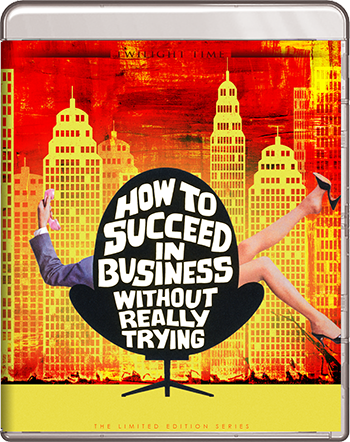
One of my favorites, poorly represented with a terrible transfer on DVD, has finally made it to Blu-ray, in a limited edition of 3000, from Twilight Time, the boutique label that has brought us any number of terrific films, from The Big Heat to the Hammer Hound of the Baskervilles, from a Sinatra Tony Rome double feature to Pretty Poison.

But this time – and my birthday month yet – they have given me (and Barb and for that matter son Nate, who also loves it) a film I could watch once a week – How to Succeed in Business Without Really Trying.

There are those who can find reasons not to like this movie, just as there are people who can find a reason not to like ice cream. They are to be pitied. How to Succeed features a brilliant, witty, acid but not hateful score by the brilliant Frank Loesser. A Pulitzer Prize-winning musical (yes, Pulizter Prize-winning musical) in 1961, the Broadway version skewered the shallowness of big business in an up-to-the-moment manner. Unfortunately, the timing of the film’s release – 1967 – made How to Succeed’s cutting-edge satire seem dated, a lot having happened since ‘61.

Fortunately, time has been kind to this early ‘60s musical, with its bright Batman TV colors and cartoon images come to life (cartoonist Virgil Partch – VIP – was a consultant) and Bob Fosse choreography that is as witty and biting as the original play itself. (Fosse is not the actual choreographer of the film, but he’s credited as the source.)

A number of players from the Broadway show are retained, including Michelle Lee (who was the second Rosemary Pilkington in the original cast), the very funny Rudy Vallee, Ruth Kobart, and Sammy Smith, with Charles Nelson Reilly’s Bud Frump M.I.A., though decently replaced by Anthony Teague. Maureen Arthur – a live-action Little Annie Fannie – was in the national company of the musical and joined the Broadway run later.

I saw the national company in Chicago when I was in high school and fell in love with the musical then. The cast included Dick Kallman as Finch (later star of Hank on TV), who was excellent, with the second Great Gildersleeve, Willard Watterman, in the Rudy Vallee role. And of course the eye-popping Maureen Arthur was Hedy LaRue (“O.K. Charlie!”).

Two things make this film one of the best transitions of a Broadway hit to the big screen. First, director/writer David Swift – with credits like Pollyanna and Under the Yum Yum Tree enough to make one doubtful – had the surprising sense to film faithfully a show that had won seven Tony Awards, the New York Drama Critics Circle award, and the 1962 Pulitzer Prize for Drama.

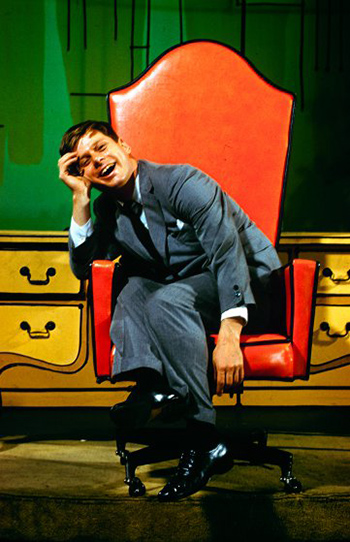
The other thing is Robert Morse.

His J. Pierrepont Finch is my favorite performance in any musical film. He shamelessly recreates the Broadway role with only the slightest concession to movie technique. He understands, as does the rest of the cast (though not on this level), that he’s appearing in a cartoon. His character, who climbs from window washer to the chairman of the board in a few days, following a self-help book that provides the film’s narration – should be unsympathetic. He’s manipulative and dissembling and is never seen really working (not really trying, remember?); but the boyishness of Morse himself smooths the edge off.

Morse brings a remarkable energy to his songs and his loose-limbed dancing brings James Cagney to mind. In the ensemble, “Brotherhood of Man,” in the midst of a sea of Bob Fosse choreography, brilliant scene-stealer Morse knows just how to draw the viewer’s eye, chiefly by lagging like a jazz player behind the melody just enough to seem improvisional among all the precise dancers. He alone seems spontaneous.

Does he mug? Almost constantly. His performance is basically Jerry Lewis Goes to Graduate School. Somehow, playing a ladder-climbing nogoodnik, he seems joyful – the perfect conveyer of Loesser’s lyrics, with their hidden dark side.

Famously, the big hit love song from How to Succeed is sung by Morse’s Finch…to himself in a mirror. Few scores rival this one, though like Sondheim, Loesser writes to the story. The songs that were left out (“Paris Original,” “Happy to Keep His Dinner Warm”) are the weakest in the show. The only loss, besides Charles Nelson Reilly, is the great “Coffee Break,” which was filmed but cut for time. Too bad it doesn’t seem to have survived to be a special feature.

Morse and Reilly, by the way, were so successful on Broadway that they made an album together, “A Jolly Theatrical Season,” in 1963.

If the name Robert Morse seems vaguely familiar to smart younger people, he played Bertram Cooper on Mad Men, a role he was cast in, in tribute to his star turn in How to Succeed. Toward the end of Mad Men’s run, Morse was given a lovely song-and-dance farewell.

Morse’s career on Broadway was a stellar one, particularly his roles in Sugar and his one-man play, Tru, in which he played Truman Capote, winning his second Tony. But his film legacy is, largely, How to Succeed. No other film caught his magic, and a few really did him no favors – Honeymoon Hotel; Quick, Before It Melts – though The Loved One and Guide for the Married Man are worthy credits. I used to feel sad that this great talent had only one film to do him justice.

But with How to Succeed finally on Blu-ray, and with Mad Men as a wonderful, Emmy-nominated coda, I can only smile.

Nice modern-day (separate) interviews with Morse and Michelle Lee are special features. No “Coffee Break,” alas.

Buy it here.

* * *

The Writers Workshop at the University of Iowa gives its mystery-writer black sheep some nice recognition.

And here’s a lovely look at Road to Perdition the film.

M.A.C.