Posts Tagged ‘Passings’

My Debt to Lone Wolf and Cub’s Genius Creator

Tuesday, April 23rd, 2019

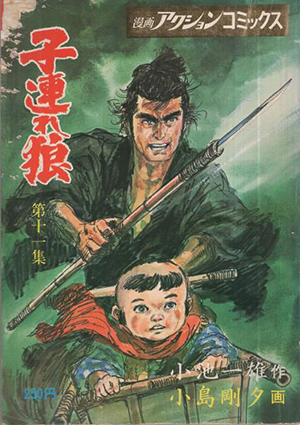
Kazuo Koike, the great creator of the manga classic, Lone Wolf and Cub, has died at age 82.

My name appears in many of his obits, along with Frank Miller and Quentin Tarantino, because of the influence he had on our individual work. Road to Perdition is often mentioned, of course, sometimes stating that it was an American version of Lone Wolf and Cub.

My interactions with this incredible writer were decidedly odd.

At one point, I received a very friendly e-mail from an associate of his saying Kazuo Koike would be in America soon and was an admirer of my work, and wanted to meet. This was perhaps a year after Road to Perdition, the film, came out. The meeting would have been in Los Angeles, if I recall, and I had to explain that I lived in Iowa, nowhere near L.A. I said I would have loved to meet with him, and that I was a great admirer of his work.

Then at the 2006 San Diego Comic Con, I attended a panel that was just Koike and a translator and someone from Dark Horse, his American publisher. During the question-and-answer session, Koike complained that his work had been plundered, and mentioned Road to Perdition as an example, complaining that these plunderers might at least have given him credit.

Afterward, I went up with my son Nate and caught Koike before he’d left the stage, and Nate startled the great man somewhat by introducing me in Japanese. (As many readers of these updates know, Nate is a translator of Japanese into English and has done novels, manga and video games.) Nate told him that I was a big fan and meant to pay homage to him, and would like to shake his hand. He shook my hand, and signed a book for Nate.
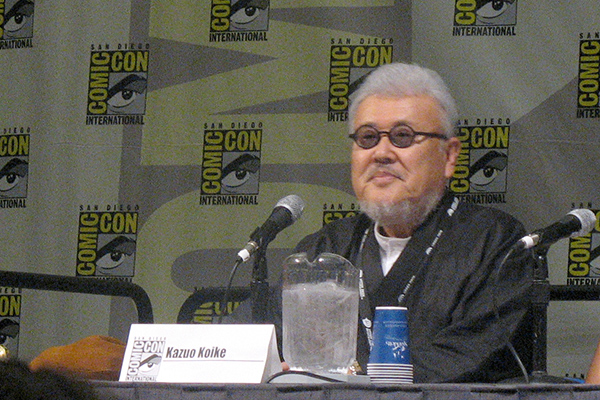

Kazuo Koike, SDCC 2006

A few years later, at another San Diego con, Koike was appearing again, and (Nate again with me) I approached the Dark Horse people about arranging a brief meeting between us. They checked with him. I was told he did not want to meet with me.

Lots of peculiarity here. First, why had I been approached for a friendly meeting earlier? Would it have been an ambush of some kind? Also, I have always gone out of my way to acknowledge Lone Wolf and Cub as one of the inspirations for Road to Perdition. Koike quotes serve as epigrams at the start of the graphic novel and the two prose sequels.

If anything, I have – and certainly others have – exaggerated Road’s debt to Lone Wolf. As I’ve mentioned in any of number of places, I was most of all drawing upon John Woo movies, including Heroes Shed No Tears (1986), a very overt (wholly uncredited) updating of Lone Wolf and Cub. In the ‘80s, I was watching a lot of Hong Kong crime movies, gray market VHS copies, when director/writer Woo was fairly unknown in America. I saw Heroes Shed No Tears before I saw any of the Lone Wolf movies.
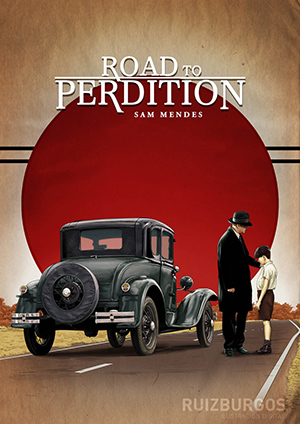
Further, in Road, I was drawing upon the real-life Rock Island gangster, John Looney, and his homicidal son Connor, and the falling out that several formerly loyal lieutenants had with Looney. In a more basic way, I was combining the movies about ‘30s bank robbers (Bonnie and Clyde, Gun Crazy) with gangster films (St. Valentine’s Day Massacre, Godfather). The notion was to bring the worlds of the rural outlaws and urban gangsters of the ‘30s together. And I’d already been doing Nate Heller for some time (Looney and son are mentioned in True Detective, 1983).

No question that Lone Wolf was in the mix. I specifically thought that the shogun and his assassin had parallels in a mob godfather and his chief enforcer. And the father and son seeking vengeance while they were being chased was an element, too, although my anti-hero’s son was an adolescent, not a baby in a cart. Robbing banks where the mob cached their cash came from the terrific Don Siegel-directed film, Charley Varrick (1973), and striking back at the mob for vengeance through their bank books was from John Boorman’s Point Blank (1967). The latter was also the start of what became my Nolan series

A lot of what I do draws from popular culture I like, but with a twist. Quarry has some of its roots in another Siegel film, The Killers (1964). Mommy is The Bad Seed flipped. Nate Heller is Philip Marlowe/Mike Hammer thrust into real unsolved crimes of the Twentieth Century. Girl Most Likely, to some degree, transposes the Nordic noir to the USA.

Lone Wolf did inspire the saga-like structure I originally had in mind. The idea was to have Michael O’Sullivan and his son on the road for 900 pages (in 100-page increments). But Road to Perdition (1998) was published as a single graphic novel (and not three 100-page “issues”) when Paradox Press (DC’s noir graphic novel line) went bust. After the film came out, I was able to go back to do another 300 pages of the father and son on the run (Road to Perdition 2: On the Road). The rest of the story was told in two prose novels – available from Brash Books – Road to Purgatory and Road to Paradise, and another graphic novel from DC, Return to Perdition.

My debt to Kazuo Koike is undeniable, if perhaps not as great as he imagined. What is great is his body of work, and his masterpiece, Lone Wolf and Cub. He might wince to know I turn up so often in his obits, but I am nonetheless honored to be in his company.

* * *

Another of my favorite manga creators, Monkey Punch (Kazuhiko Kato), also died recently, at 81. His Lupin III is a classic, and inspired perhaps the greatest anime, Cowboy Bebop. If you’ve never seen Monkey Punch’s thief in action, seek out the feature length Lupin III: The Castle of Cagliostro (1997), directed by the genius animator, Hayao Miyazaki.

* * *

Check out this write-up about Kazuo Koike’s passing.

Here’s a top-notch review of Girl Most Likely from Criminal Element.

Here’s a short but sweet Girl Most Likely review.

Another decent Girl review can be seen here.

And this may be my favorite review of Girl Most Likely yet.

M.A.C.

Prime Eliot Ness! And a Fond Farewell

Tuesday, February 19th, 2019

I am pleased to announce that my filmed version of the play Eliot Ness: An Untouchable Life is now available in HD on Amazon Prime, and included as part of your membership. Here’s a link so you can watch it at your leisure, and I hope you take time to give it a nice rating (as in five star). [Note from Nate: For non-Prime members, rental is $2.99 and you can own the digital HD for $9.99]

As you may recall, the film is a one-man show with my late friend Michael Cornelison bringing Ness back to life. It was made possible by a grant from Humanities Iowa, several airings by Iowa PBS, and a lot of hard work by my buddy Phil Dingeldein and myself (and many others).

This is very gratifying, and of course is the work that led directly to the current non-fiction book, Scarface and the Untouchable: Al Capone, Eliot Ness, & the Battle for Chicago by A. Brad Schwartz and me.

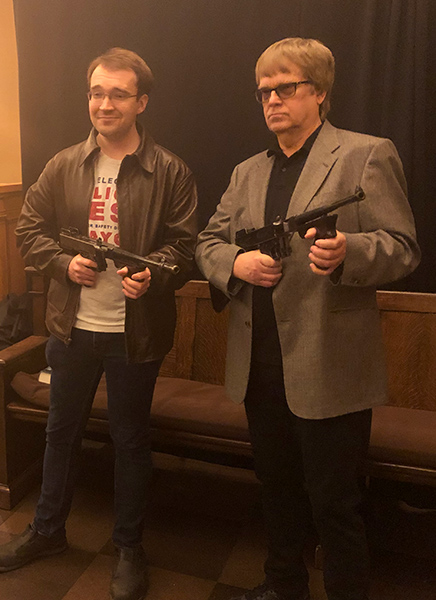
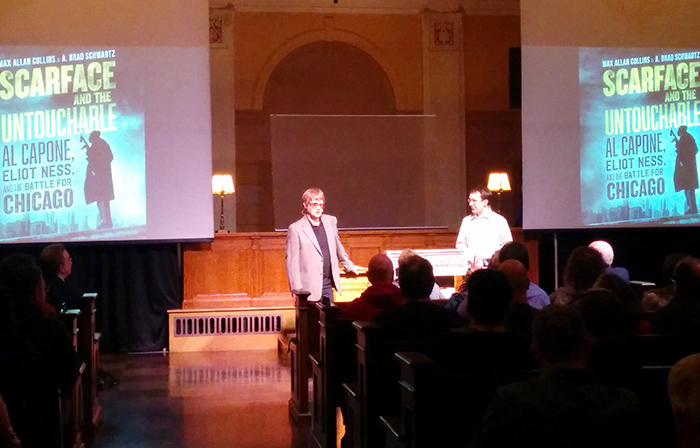
Coincidentally, I got this news while I was in Las Vegas with Brad making two appearances in support of our book at the Mob Museum. The museum itself is a terrific facility, and those who run it are outstanding. I was blown away by how much of what is on display relates to various things I’ve written, from Dick Tracy to the Nathan Heller saga and the four Eliot Ness in Cleveland novels. A wall of photos and descriptions of organized crime killings was virtually a greatest hits of my literary output (Willie Bioff, Mad Sam Destefano, etc.). I will include some highlights by way of photos, including my co-author and me in front of the actual St. Valentine’s Day Massacre wall as well as with the real machine guns used in that, uh, celebration. More photos may follow.

Because our appearance was in conjunction with the 90th anniversary of the massacre, and the seventh anniversary of the Mob Museum opening, the attendance reached record proportions. Both of our appearances were well-attended, as were book signings in the Mob Museum gift shop.

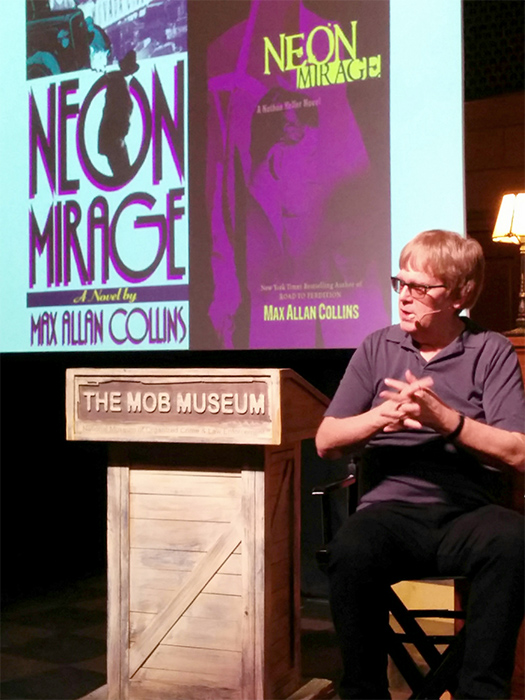
What’s interesting to me is how attitudes in Vegas have shifted on the mob influence that built the modern “sin city.” Back in the ‘80s, researching Neon Mirage – the Nate Heller novel about Ben “Bugsy” Siegel and Vegas – I encountered some resistance to my research into what was then seen by many as an embarrassing aspect of local history. That has definitely changed, as Vegas embraces its colorful past.

Brad did an excellent job, utilizing power point presentations (Baby Boomers – that’s “slide show” to you) and I was frankly not at my best at the first presentation, very tired from travel and a long day. The subsequent presentation, however, found me back on my game and Brad just as good as before. If we get a link to the video of it that the Museum made, I’ll provide it in the next few weeks.

Interestingly, nobody asked me a single question about CSI, which of course was set in Vegas, with my five years as its licensing writer (novels, video games, jigsaw puzzles, graphic novels, often with Matt Clemens) not rating a single inquiry. CSI seems to have retreated into the past, at least the Las Vegas past.

All in all, it was a great trip, and there’s a reasonable possibility we’ll be asked back next year to talk about The Untouchable and the Butcher (the sequel to Scarface and the Untouchable, currently in progress) and the new Nate Heller (Do No Harm, the Sam Sheppard murder case, due out in about a year).

* * *

My fellow classmates at Muscatine High School will be saddened to learn of the death of Steve Kochneff, a beloved figure in our collective past and one of my best friends from those years. As had been the case with Jon McCrea (who became the partial basis for Quarry), Steve was someone I stayed in touch with over the years. He spent much of his life in L.A., pursuing the Hollywood dream, and he and I and Barb often got together there, to catch up, meeting usually at the great deli restaurant, Cantor’s.

At MHS, Steve was a genial madman, an eccentric with a unique comic wit, very popular and known for his creativity and his athletic ability. His father had been a much-loved and successful basketball coach, and Steve – who was tall and lanky – was a center on our MHS team, and excelled in that role.

But Steve also was known for mounting crazy comic skits. He and I were collaborators on these. He would come to my house and we’d hole up in my room with me at the typewriter and Steve pacing and throwing around ideas. This was very much like the old Hollywood cliche, short only of Steve puffing on a cigar. At the height of the James Bond craze, we did a Goldfinger take-off skit at a pep rally about a villain called Purple-and-Gold-Finger (purple and gold being our school colors – why the villain bore the school colors is lost to history and my fading memory). The kids loved it.

I was always a little jealous of Steve’s popularity around the school, since we were collaborators and he got the credit, or anyway the love. I was too intense and needy, and Steve was just a big guy with a great laugh and a wide smile, and all that love came pouring in, unbidden. As with so many high school stars, those days were probably the best of his life. In years to come he would be jealous, in a very sweet and even supportive way, of the success I’d achieved in the arts, staying home in Iowa when he had made the Hollywood trek.

I have talked about how I wrote novels in high school and tried to sell them – writing all summer, marketing all year (unsuccessfully), and my career is based on that enthusiastic early obsessive behavior. Only Steve Kochneff was capable of topping me. He wrote a Laugh-In script a year or so after graduation and drove out to Hollywood to deliver it. My memory is fuzzy on this, but I believe he eventually did do some work on the show.

Over the years he had a lot of projects and many were interesting, and I believe some were stolen from him. He created potential shows, with scripts, for a comedy about female wrestlers, a cop show about a motorcycle-riding Hispanic female detective, and an ambitious film script about a cloning of Princess Diana. And much more. His biggest success, perhaps, was his pioneering production company shooting videos of high-ticket homes in Beverly Hills, Bel Air and other exclusive sections.

We talked a number of times about collaborating, and I offered several times to get involved with projects. But he always preferred to go his own way – to talk to me and get input, but make his own mark. Like many talented people in Hollywood, he came close. So close.

He came back to Muscatine from time to time and stayed with us at least once that I can recall. I know he envied my luck in having Barbara as a wife, so beautiful, so supportive, so talented herself. He knew I had really struck gold there, that this was an element that he wished he had in his life. I know he had close relationships with various women in Southern California and also, I think, in Arizona. But he never shared details with me.

I had a phone call from him a few months ago and it was a warm exchange, as always. I gave him a bad time for not coming to the MHS 50th class reunion, and he revealed to me that he was embarrassed to attend. He thought we all knew that he’d gone to prison for a while, apparently on a trumped-up, non-violent charge. But we hadn’t heard, and when he told me – rather haltingly – I said I was in the friendship business, not the judgement one. Typically, he was full of enthusiasm to write a movie script or TV pilot based on his experiences inside. Like any real writer would, Steve viewed incarceration primarily as an opportunity to do research.

Listen, I loved the guy. It broke my heart to learn he had died January 2 in a psychiatric hospital. But I am relieved that his search for fame and success is finally over, because I suspect as the years passed that effort grew only more frustrating and finally painful. I want to assure you that our phone conversation, perhaps two months before he passed, was filled with laughter.

I can hear that laugh right now. One of those distinctive laughs, a combination of glee and embarrassment.

He signed himself Starko, and I didn’t even get into what a terrific artist – in particular cartoonist – he was.

So long, Steve. Damnit. So long.

* * *

Yes, it’s yet another “Films You Didn’t Know Came from Comic Books” write-up in which Road to Perdition is included.

M.A.C.

Harlan and Harold

Tuesday, July 3rd, 2018

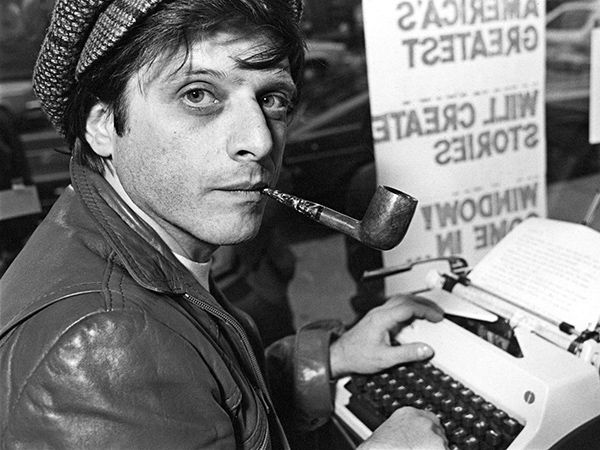
So Harlan Ellison is gone. Not dead, because his work will survive. He may not maintain the presence in the popular culture he once had, because he was chiefly a short story writer. Still, he might overcome that, because after all Edgar Allan Poe and Ray Bradbury were both chiefly short story writers, and they endure. Hard to imagine “I Have No Mouth, and I Must Scream” disappearing.

In the aftermath of Harlan’s passing, amid expressions of friendship and loss, came those who figured that while the body hadn’t cooled yet, it would be a good time to say that he was overrated and a “gasbag,” as one dweller in the dingy, dreary corners of Facebook put it. These nonentities who must disparage those who have actually contributed will be with us always –- perhaps more shrilly now, in the age of Trump and Social Media.

In my formative years – adolescence and teens – I read mostly crime/mystery writers. I followed only a handful of science-fiction authors, despite a love of comics, films and TV shows in that genre; among those authors were Bradbury and Ellison. I was particularly attracted by Ellison’s introductory material to his short story collections – I found it fascinating and exciting for the writer to come out from in back of his tales. To be a presence.

There’s no question that he influenced me in that regard. I talk about my work in that same way, if not with as much personality or gift for language; but I do it here, and have introduced many of the reprints of my work and the collections of shorter material.

I also enjoyed his fiction itself, very much, and was aware of his byline on TV scripts on such shows as Burke’s Law, The Outer Limits and Star Trek. Seeing his name on the screenwriter credit of a TV episode always made me sit up. And in my college years I loved his writing about TV, which covered his own experiences in the medium as well as unbridled reviews of various series (collected in The Glass Teat).

I met him in 1973 at a comics convention in Dallas, which happened to be the first such convention I ever attended. Knowing he was the guest of honor, I spotted Ellison in the dealer’s room on the first evening of the show and introduced myself, and told him my first two books had just been published (Bait Money and Blood Money). He congratulated me and asked me to accompany him as he took a stroll around the dealer’s room. He was friendly to me, even warm. Of course, I’d made it clear I was a fan and had brought a book along for him to sign.

Anyway, I accompanied him on his circuit around the room. About half a dozen times, dealers at the show took pot shots at him – picked verbal fights with him (I don’t remember the specific subjects), but were beyond rude. It was like walking down a street in the Old West with Billy the Kid and seeing various punks try to goad him into a shoot-out.

Harlan was soft-spoken, just nodded, said very little to them when he said anything at all. I was confused, knowing Harlan’s reputation for confrontation and not suffering fools. I told Barb about it in our hotel room, not sure whether I was impressed or disappointed.

Throughout the weekend I would stop and chat with Harlan, but we didn’t share a meal or head to a bar or anything – we were just friendly ships that had passed in the night. At the banquet on the final night of the con, with all the dealers and the other guests and many attendees present, Harlan was the scheduled speaker.

I said to Barb, as we sat and dined on rubber chicken, looking around at those who’d verbally assaulted the guest of honor earlier, “How I wish Harlan would take these sons of bitches on.”

And that’s what he did.

Harlan had noted the names of every face that insulted him on that tour of the dealer’s room, and in his keynote speech he reported their rude conduct and called them out individually. Told them it was a hell of a way to treat their guest of honor. And he shot each one of them down, leaving each writhing in a pool of embarrassment.

And I loved it. And I loved him for it, fan of revenge that I am.

A few years later, at a San Diego con, Harlan was going into a ballroom for a panel, accompanied by reps of the con. I paused, gave him a smile and a little wave, not thinking he’d even remember me. Then he called out, “Al! I can’t talk to you right now! We’ll get together later!”

We didn’t. I don’t believe we ever met face to face again, but over the years the damnedest thing happened: out of the blue he would call me. He treated me as if I were one of his closest friends, and as the years and these lovely sporadic calls kept coming, I began to feel that way myself. He made it clear he liked my work and that was extremely gratifying – little in a writer’s life is better than being admired by one of your favorite writers, particularly one who was a formative influence.

We did not agree on Mickey Spillane. He had a low opinion of Mickey typical coming from a progressive writer of his era. But he knew I loved Mickey and his work and he respected that.

One afternoon in my office at home I got a call from Harlan. Mickey’s The Killing Man, his first Mike Hammer in some time, had just come out.

“Al! Did you write this?”

“No. I’ve never ghosted Mickey. That’s his work.”

“Great! Now I don’t have to read it.”

He hung up.

Later he revealed to me that he had a standing order at his regular bookshop to set aside any novel of mine that came out. Only once did he criticize me.

“Al, stop using, ‘He shook his head no.’ Shaking your head is no.”

“Not all shakes of the head mean no, Harlan.”

“Fine. Then characterize those head shakes that way. Otherwise, it’s no!”

“Okay,” I said. “You sold me.”

“And can you watch your word repetition closer, please? You’re a better writer than that.”

Most good fiction writers try to avoid repeating words in the same paragraph or even on the same page (excluding articles like “a” and “the,” of course, and character names). Barb catches most of mine on her edits.

So I said to Harlan, “I admit I do that more often than I should. I try to catch them. But Harlan, a lot of words fly out of here in a year, and sometimes I slip. I’m trying to make a living.”

“Okay,” he said. “I can accept that.”

He was always gracious to me, friendly and funny, and very frank. His anecdotes about Hollywood, frequently ending with him trying to strangle an executive, were priceless. But a year or so ago, he confided that his failing health was something he wasn’t sure he could live with. He said sometimes he contemplated the choice Hemingway had made.

“Don’t do that,” I said, as if he were using too much salt on his food. “Hemingway taking his life colored his work forever. You don’t want that following you around after you’re gone.”

He allowed this was probably good advice.

I was troubled by his admission, but touched that he’d share something like that with me. Yet wasn’t that what had attracted me so as a teenager? This writer who came out from behind his fiction to confront you with his humanity?

And yours?

* * *

Lately I’ve read a number of books about improv comedy and Second City. If you follow these updates regularly at all, you know that I am a huge SCTV fan. When there was an SCTV reunion in 2009, as part of a 50th anniversary Second City celebration, Barb and I spent big bucks to attend the show, which included Joe Flaherty, Eugene Levy, Andrea Martin, Catherine O’Hara, Martin Short and Dave Thomas on stage together. Ramis performed with them, and also directed the performance. He had been a cast member the first season and head writer the second.

I embarrassed myself thoroughly bugging and fawning over any SCTV cast members I happened to encounter, and that was most of them. Why Barb remained married to me after such unconscionable fan boy behavior, I have no idea. But I was a teenage girl in 1964 talking to the Beatles – that bad. Maybe worse.

I’d met Ramis a few years before at a film festival in Chicago. That time I behaved myself, pretty much, getting introduced to him by a mutual friend. He was very gracious, quiet but nice, and he smiled when I mentioned how far I went back with him – to Swami Bananananda and kid show host Ol’ Muley (“These are the worst drawings yet, boys and girls”). We also talked about Stuart Saves the World, his Stuart Smalley movie with Al Franken; I told him how much I liked the film and that I wished it were out on DVD (later it was).

At Second City, though, I first flagged Ramis down the night of the reunion show and tried to remind him that we’d met (I don’t think he remembered) but he was friendly and expressed concern that they hadn’t had enough rehearsal time. He gave me an autograph, as well (I was on the hunt).

Throughout the weekend, I saw him a number of times, basically saying “The reunion was great” and hello, but it must have seemed to him that I was everywhere, maybe even stalking him (I wasn’t – it was sheer coincidence). Finally I caught him alone for a moment and apologized for bugging him (even as I bugged him again) and rather desperately said, “I just wanted to let you know how much I love Groundhog Day. It’s one of my favorite movies and it’s my son’s favorite movie, period. It’s a great, great film, it’s like…It’s a Wonderful Life.”

“It is,” he said with an enigmatic smile. “It is a wonderful life.”

I of course meant that his film Groundhog Day is on a level of importance with Capra’s It’s a Wonderful Life. But I am still not sure if he was agreeing with me, or saying his film was a variation on that film, or maybe just that…it’s a wonderful life. As in, it’s wonderful being alive.

I’m still thinking about that ambiguous reply, particularly now that I know a year later he would contract autoimmune inflammatory vasculitis, and be gone in 2014.

The books I’ve read recently about this remarkable actor, writer and filmmaker include Caddyshack: The Making of a Hollywood Cinderella Story by Chris Nashawaty, and Ghostbuster’s Daughter: Life with My Dad, Harold Ramis by Violet Ramis Stiel. The former is fascinating and covers the birth of The National Lampoon, Saturday Night Live and (to a lesser extent) SCTV, with the Caddyshack material starting about midway. It gives a good picture of Ramis at that important time of his life.

His daughter’s book I admit having some problems with, but I would still recommend it to fans of her dad. The book is her memoir, and only really interested me when it was dealing with Harold Ramis himself, although it did that frankly and with insight.

* * *

Here’s a really nice review of the first issue of the Mike Hammer serialized graphic novel from Hard Case Crime Comics (and Titan).

Here’s another good one.

And another.

Finally, here’s a review of Quarry’s Vote.

M.A.C.

Bye, Hef

Tuesday, October 3rd, 2017

The recent death of Jerry Lewis is a reminder that for Baby Boomers like me, our own mortality is continually underscored by the passing of the great media figures who shaped us.

Just as Jerry Lewis had a big impact on what I think is funny, Hugh Hefner – who recently passed away at 91 – was hugely important in my life. My uncle Richard had Playboys in his basement proto-man cave that I saw when I was as young as ten or eleven, learning well before puberty that I liked seeing pictures of beautiful naked women. When I was in junior high, my father received a Christmas present of a subscription to Playboy as a gag gift in a bridge club “Secret Santa” exchange. He had no interest in the magazine and soon forgot about the subscription, because I always got to the mailbox first.

I loved the magazine. I loved everything about it, including, yes, the articles. And the fiction, and the book and movie and record reviews. There was a sophistication an Iowa kid could only dream of. As a comics fan, I was bowled over by the incredible cartoons, not just their raciness but their artistry. And the incredibly beautiful photography of the centerfolds (this is circa 1964 – 1966) defined for me what a woman should look like. I should say “could look like,” because even then I knew this was an airbrushed fantasy. Still, I knew the names of every Playmate from the ‘60s through the mid-‘70s – the beautiful woman I married was completely unthreatened by the Playboy fantasy, and the magazines never had to be hidden around our home.

I came of age in the pre-hippie ‘60s. It was a world of the Rat Pack and sick humor and Beatniks and Ian Fleming’s James Bond and the early Beatles. I still prefer the early Beatles – you can have most of the White Album. But then the ‘70s came along, and magazines that were more frank about sex in prose and in photography – Penthouse, Hustler – began to make inroads for Hefner’s fabulous brainchild. (I write about this in the forthcoming Quarry’s Climax.)

Hefner was important in loosening up the sexual mores of this (and other) nations. For good or ill, he fired some of the first real volleys in the Sexual Revolution (the most important after Kinsey). But the later ‘60s and every decade that followed were problematic for him. He struggled with feminism and self-consciously wrote progressive essays that were very smart but pretty boring. He never found a way to square the circle of a woman having sexual freedom and full human rights. The female as sex object had been defined long before he came along, and he obviously made his fortune and fame expanding and redefining that image. But it limited him and made him seen a hypocrite.

I make no apologies for considering Playboy in its prime (and even for many years after) a great publication. Until the recent revamping (since abandoned) with nudity banished, a new issue always gave me a bit of a thrill reminiscent of getting to the mailbox before my parents noticed I had snagged Dad’s copy of Playboy. For many decades I subscribed, and I looked forward to no magazine more.

For the articles. And so much more.

I always felt Hef was a kind of nerd. He was a work-a-holic who loved publishing and awkwardly took on the sophisticated sybarite persona his magazine dictated. Oh, I realize he really did become a sophisticated sybarite, but when he appeared on TV, particularly on Playboy After Dark, he seemed so awkward and ill at ease.

Somehow that was his charm. It conveyed the possibility to nerds in Iowa and elsewhere that an Illinois nerd could be the man who lived in a mansion filled with beautiful models, movie stars, intellectuals, top nightclub talent, world-class chefs and a never-ending party. I much prefer the quiet life I’ve led with one beautiful woman, but fantasy is still fun to think about.

As some of you know, Hefner was Nate Heller’s friend and there are scenes at the Chicago Playboy mansion in the JFK Trilogy (Bye Bye, Baby, Target Lancer and Ask Not). So Nate tips his fedora to his old friend, while I just say, “Goodbye, Hef.”

* * *

Here’s a nice article on the Nolan series, marred a bit by the erroneous inclusion of the first name “Frank.”

Bookgasm has a nice review of the Bibliomysteries collection that includes the Hammer story “It’s in the Book.”

Gravetapping has a fine review of my pal Steve Mertz’s new novel.

Finally, here’s a brief review of Strip for Murder.

M.A.C.