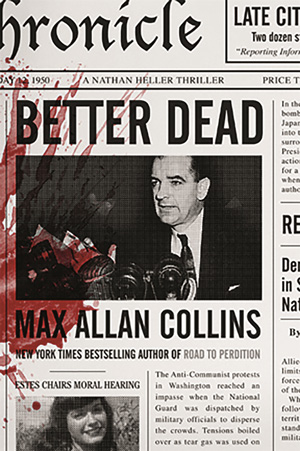
Bill Slankard of Arlington Heights, Illinois – a loyal (and perhaps demented) reader of the Nathan Heller novels – shared with me his personal chronology of Nate Heller’s career and personal history (and ancestry!). He’s given me permission to share it here, and I’m doing so, having a made a few minor corrections. Also, this does not include Do No Harm, which as you probably know isn’t out till March.
This is much more complete than what I put together for you last week.
Before we get to the new, improved chronology, I will share less-than-happy news – I’m told there is no paperback planned by Forge for Better Dead, the most recent Heller novel. So those of you waiting to buy it in either trade or mass market are out of luck. Let me encourage you to buy it in hardcover now, because it appears to be close to out of print.
Amazon (and a few other places) have it around $18 (and sometimes cheaper than that, for less than mint condition copies), but the book appears to be only available from second sellers.
And now….
NATE HELLER CHRONOLOGY (courtesy Bill Slankhard)
1840s
Reference: Jacob Heller working as a tailor in Halle, Germany [True Detective]
March 13, 1848
Reference: Jacob’s younger brother Albert killed in Vienna in general revolt against Metternich [True Detective]
1850
Reference: born Hiram Heller, youngest child of Jacob Heller [True Detective]
1853
Jacob Heller emigrates to United States with wife and children Jacob, Benjamin, Anna, and Hiram [True Detective]
c1855
Reference: wife of Jacob dies [True Detective]
1863
Reference: Hiram shot in both legs fighting for Union at Gettysburg [True Detective]
c1865
Reference: Jacob Heller (senior) dies in New York [True Detective]
1871
Reference: Hiram marries Naomi Levitz [True Detective]
1875
Reference: born Mahlon Heller, son of Hiram and Naomi [True Detective]
1877
Reference: born Louis Heller, son of Hiram and Naomi [True Detective]
1886
Reference: Hiram and Naomi Heller die in tenement fire. Mahlon and Louis are sent to live with their Aunt Anna in Chicago [True Detective]
c1898
Reference: Anna Heller dies [True Detective]
c1902
Reference: Mahlon Heller marries Jeanette Nolan [True Detective]
c1906
Reference: born Nathan Samuel Heller (NH) [“Kisses of Death”]; 28 years old in August 1933 [“The Blonde Tigress” EQMM Jun 2008]; mid fifties in 1962 [Bye Bye, Baby:Something’s Got to Give!]
1908
Reference: Jeanette Heller dies during miscarriage [True Detective]
1911
Reference: Mahlon opens Heller’s Books on South Homan in Douglas Park area with a loan from his brother Louis [True Detective]
1929
Reference: NH joins Chicago Police Department with help from his uncle
1930
Reference: NH arrests Willie Bioff for pandering [Million- Dollar Wound]
Summer 1930
Reference: NH as patrolman witnesses suspect in killing of Jake Lingle escape. Later commits perjury identifying another man as the the assassin
[True Detective]
1931
Reference: NH promoted to detective as a result of the Jake Lingle case. Mahlon Heller commits suicide [True Detective] NH meets Estelle Carey [The Million-Dollar Wound]
March 4, 1932
[Stolen Away: Prologue]
March 5 – April 18, 1932
[Stolen Away: 1 – The Lone Eagle]
April-May 1932
New York, NY – dinner at Sardi’s with Clarence Darrow. With Jimmy Walker (mayor of New York) [Damned in Paradise]
Honolulu, HI – NH working as Clarence Darrow’s investigator on Massie case. With Clarence “Buster” Crabbe (athlete), Chang Apana (Honolulu police detective) [Damned in Paradise]
June 1932
Reference: NH assigned as police liaison to Huey Long during the Democratic Convention [Blood and Thunder]
Late 1932
Reference: NH helps out Clarence Darrow “on a minor matter” [Damned in Paradise]
December 19-22, 1932
Reference: NH first office on fourth floor of building owned by Barney Ross on corner of Van Buren and Plymouth [True Detective]
Chicago, IL – detective NH coerced by Harry Lang (Chicago police detective) and Harry Miller (Chicago police detective) into assassination attempt on Frank Nitti (gangster), who is arrested for shooting HL. NH quits police department to open A-1 Detective Agency (A1DA). Hired by Charles Gates Dawes to supervise security at upcoming World’s Fair. Kills Frank Hurt. With Louis Campagna (gangster), Barney Ross (boxer) (gangster), Anton J Cermak (mayor of Chicago) [True Detective – 1: The Blond Pig]
January 7 – April 8, 1933
Chicago, IL – NH travels to Atlanta to see Al Capone (gangster) in prison who hires him to stop Frank Nitti (gangster) from assassinating Anton J Cermak (mayor of Chicago). Hired by Mary Ann Beame (actress) to find her brother James. Travels to Miami to guard AJC, who is assassinated by Giuseppe Zangara (bricklayer). NH testifies before grand jury indicting Frank Nitti (gangster) and helps get a not guilty verdict. NH breaks ties with his uncle Louis. With Eliot Ness (US Treasury agent), Barney Ross (boxer), George Raft (actor), Harry Lang (Chicago police detective), Harry Miller (Chicago police detective), Walter Winchell (radio newscaster), Franklin D Roosevelt (President-elect) [True Detective – 2: The Long Bellyache]
April 9 – June 25, 1933
Davenport, IA – NH travels to Iowa with girlfriend/client Mary Ann Beame to search for her brother Jimmy. In Chicago, NH trains and oversees security personnel at Chicago Exposition. He discovers that Frank Hurt was really Jimmy Beame. Kills blond gangster who killed Jake Lingle. With Ronald “Dutch” Reagan sportscaster), George Raft (actor), Frank Nitti (gangster), Louis Campagna (gangster), Eliot Ness (US Treasury agent), Barney Ross (boxer) [True Detective – 3: Tower Town]
Summer 1933
Chicago, IL – hired by Goldblatt’s department store to investigate vandalism – his “first” operative, Stanley Gross, is killed. With Barney Ross (boxer). [“Kaddish for the Kid”]
August 1933
Reference: A-1 Detective Agency in one-room office on Van Buren; lives in office; rent is free for keeping “an eye on things at night” in the building; also working at the Century of Progress World’s Fair [“The Blonde Tigress” EQMM Jun 2008]
Chicago, IL – hired by defense attorney to find evidence to help client – Eleanor Jarman. [“The Blonde Tigress” EQMM June 2008]
September 1, 1933
Chicago, IL – Eliot Ness leaves for Cincinnati. [True Detective – 4: The Big Fall]
November 1933
Chicago, IL – World’s Fair closes for the winter. NH contract is not renewed for next year [True Crime – 1: The Traveling Salesman]
December 1933
Reference: A1DA office on second floor of building on corner of Van Buren and Plymouth in Chicago [“Private Consultation”]
Chicago, IL – hired by Earle Wynekoop to investigate murder of his wife, Rheta (on 11/21/1933). With John Stege (Chicago police captain) [“Private Consultation”]
Summer 1934
Chicago, IL – NH tracked runaway girl to home of Rose Kasallis and her “school for crime” [“House Call”]
July 13-23, 1934
Chicago, IL – NH hired by John Howard to investigate his wife for adultery, which turns out to be a set-up for the killing of John Dillinger. With Sally Rand (exotic dancer), Barney Ross (boxer), Melvin Purvis (Justice Dept special agent), Martin Zarkovich (East Chicago police sergeant), Sam Cowley (Division of Investigation agent), Louis Piquett (mob lawyer), Frank Nitti (gangster), Anna Sage (“The Woman in Red”) [True Crime – 1: The Traveling Salesman]
August 24-September 1, 1934
Wisconsin – NH hired by Joshua Petersen to find his missing 19-year-old daughter Louise. He goes undercover as Jimmy Lawrence, and foils J Edgar Hoover kidnap attempt. With Sally Rand, Louis Campagna, Frank Nitti, Willie Bioff (ex-pimp), Kate “Ma” Barker, George “Baby-Face” Nelson, Arthur “Doc” Barker, Fred Barker, Alvin Karpis, Charles “Pretty Boy” Floyd, Sam Cowley, Melvin Purvis, J Edgar Hoover [True Crime – 2: The Farmer’s Daughter]
September 9, 1934
Chicago, IL – NH finds solace with Sally Rand [True Crime: 3 – Where the Bodies Are Buried]
March 11-May 16, 1935
Chicago, IL – [Flying Blind: 1 – Ceiling Zero]
August 30-September 12, 1935
New York, NY – NH hired by Huey Long (US Senator) to join bodyguard detail for a couple of weeks. With Phil Baker (radio star) [Blood and Thunder: 1 – A Vest for the Kingfish]
Oklahoma City, OK – NH nabs pickpocket while bodyguarding Huey Long at Oklahoma State Fair on Labor Day [Blood and Thunder: 1 – A Vest for the Kingfish]
September 2, 1935
Baton Rouge and New Orleans, LA – NH investigating enemies of Huey Long, who is shot on Sunday, September 8, dies the following Tuesday, and is buried Thursday. With Frank Wilson (IRS agent), Elmer Irey (IRS agent) [Blood and Thunder: 1 – A Vest for the Kingfish]
October 26-November 10, 1936
New Orleans and Baton Rouge, LA – NH hired by Mutual Life Insurance Company to investigate Huey Long death to determine if he was murdered or accidentally killed. With Rose Long (US Senator), Elmer Irey (IRS agent) [Blood and Thunder: 2 – A Lagniappe for Elmer]
November-December 1935
Los Angeles, CA – hired by Thelma Todd (actress) as bodyguard. Todd dies 12/19/1935 [“The Perfect Crime”]
January 1936
Reference: A-1 Detective Agency (A1DA) office in single room on fourth floor of building on corner of Van Buren and Plymouth in Chicago [“House Call”]
Chicago, IL – hired by Mrs Silber Peacock to find husband. With John Stege (Chicago police captain) [“House Call”]
February 3-March 7, 1936
Cleveland, OH – NH helps Eliot Ness with case [Dark City]
March 13–April 4, 1936
[Stolen Away: 2 – The Lone Wolf]
June 1936
Chicago, IL – hired by Mrs Joseph Bolton to investigate philandering husband. With John Stege (Chicago police captain) [“Marble Mildred”]
March 17-July 19, 1937
Chicago, IL – [Flying Blind: 2 – Dead Reckoning]
November 7, 1937
Chicago, IL – NH meets Eliot Ness at wake for Jack Whitehall [Bullet Proof]
1938
Reference: NH meets Peggy Hogan and Virginia Hill [Neon Mirage]
March 1938
Reference: NH attends funeral of Clarence Darrow in Jackson Park, Chicago [Damned in Paradise]
May 16-23, 1938
Caribbean Cruise Ship – NH and fellow private detectives solve killing aboard the ship [Caribbean Blues]
August 1938
Cleveland, OH – hired to track down a missing daughter, Ginger Jensen, who ends up being a victim of the Butcher of Kingsbury Run. With Eliot Ness (Public Safety Directory) [“The Strawberry Teardrop”]
1939
Cleveland, OH – hired by Eliot Ness (Public Safety Director) to investigate deaths for insurance of bums [“Natural Death, Inc”]
November 6-12, 1939
Reference: A1DA now a suite of 2 offices in building at corner of Plymouth and Van Buren, with 2 freshly hired operatives (Lou Sapperstein (NH boss on pickpocket detail for CPD) and Frankie Fortunato), and secretary (Gladys). NH living in a 2-room suite at the Morrison Hotel [The Million-Dollar Wound]
Chicago, IL – NH hired by Edward J O’Hare (president of Sportsman’s Park racetrack) to instruct his security staff in spotting and catching pickpockets. O’Hare is killed. With Barney Ross, John Stege (Chicao police captain), Sally Rand, Westbrook Pegler (newspaper columnist) [The Million-Dollar Wound: Nitti’s Town]
Hollywood, CA – NH hired by Westbrook Pegler to investigate Willie Bioff’s involvement with movie industry. Bioff hires NH to find out what his associates have been saying about him to the feds. With Robert Montgomery (actor), George Browne (gangster – president of stagehand’s union), Nicky Dean (gangster) [The Million-Dollar Wound: 2 – Nitti’s Town]
Chicago, IL – NH performs task for Bioff and throws Pegler out of his office. With Jack Barger (“king of the [Chicago] grind circuit), Estelle Carey (“queen
of the 26 girls”), Louis Campagna, Frank Nitti [The Million-Dollar Wound: 2 – Nitti’s Town]
December 8, 1939
Reference: Operatives Lou (Sapperstein) and Frankie working for A1DA [“Scrap”]
Chicago, IL – hired by Jake Rubenstein aka Jack Ruby (union treasurer) to help save Junk Handlers union. With John Stege (Chicago police captain) [“Scrap”]
Early 1940
Reference: Freelance Naval Intelligence job (failure) for James V Forrestal [Majic Man – Prologue]
May 6-June 4, 1940
Chicago, IL – [Flying Blind: 3 – Dead-Stick Landing]
September 1940
Washington DC – NH investigates Josephine Forrestal’s claims of being followed and that her children are in danger for her husband, James V Forrestal (Under Secretary of the Navy) [Majic Man – Prologue)]
May 22-24, 1941
Reference: “The A1DA had a suite of offices now, and … had two experienced ops and a … secretary” besides NH [“Screwball”]
Miami Beach, FL – hired by Frank Nitti (gangster) to warn Pete Clifton (comedian) to stop working “blue.” Clifton is killed 05/23/1941. With Eddie McGraw (gangster) [“Screwball”]
Early 1942
Reference: A1DA currently a 3-man (1 secretary) operation, with the youngest man about to enlist. NH and Barney Ross get drunk and enlist in the marines, and go to boot camp in San Diego. The A1DA is left in the hands of Lou Sapperstein [The Million-Dollar Wound]
March 1942
Reference: Eliot Ness leaves post of Public Safety Director of Cleveland under a cloud [Angel in Black]
October 1942
Reference: NH stationed on Pago Pago [The Million-Dollar Wound]
November 4-19, 1942
Guadalcanal – NH and Barney Ross in B Company, 2nd Battalion, 8th Regiment, 2nd Marine Division land at Guadalcanal, where NH comes down with malaria. With Robert Montgomery (actor and naval lieutenant) [The Million-Dollar Wound: 1 – The Island]
November 26, 1942
Congress Heights, MD – NH wakes up, not knowing who is is, in St Elizabeth’s Hospital after being transferred there from the naval hospital in Pearl Harbor, HI [The Million-Dollar Wound: Prologue]
February 1, 1943
Congress Heights, MD – NH honorably discharged from the marines with a Section 8, after earning the Silver Star for gallantry in action [The Million-Dollar Wound: Interim]
February 2 – March 20, 1943
Reference: Frankie Fortunato of A1DA is in the Army. Lou Sapperstein has been running the agency since NH enlisted. Gladys now married to Frankie, who is killed at Guadalcanal [The Million-Dollar Wound]
Chicago, IL – NH returns to civilian life and the government wants him to testify against Frank Nitti. Estelle Carey is murdered, and NH is hired to recover her diary. Frank Nitti dies. NH arranges to make sure Barney Ross can’t get illegal drugs in Chicago. With Eliot Ness, Bill Drury (Chicago police captain), Sally Rand, Louis Campagna, Paul “The Waiter” Ricca (gangster), Ralph Capone (gangster). Kills John and Olivia Borgia [The Million-Dollar Wound: 3 – The Ruptured Duck]
July 1943
Chicago, IL – [Carnal Hours]
August 1943
Los Angeles, CA – NH doing a job in Hollywood [Flying Blind: Epilogue]
Late 1944
Reference: NH in LA to work on the Louise Peete case. Meets Aggie Underwood (newspaper reporter) and Harry “the Hat” Hansen (LAPD detective), Jim Richardson (LA Examiner city editor) [Angel in Black]
May 1945
Reference: NH hired by James Ragen to protect his niece, Peggy. [Neon Mirage]
Reference: NH office is on Van Buren and has more than one man working for him [“That Kind of Nag”]
Chicago, IL – NH hired by Sylvester Vinicky who suspects his wife, Rose, is unfaithful. NH solves her murder in one day. With Patrick Cullen (Chicago police captain), Charles Mullaney (Chicago police inspector – worked on pickpocket detail with NH and Bill Drury) [“That Kind of Nag”]
June 24-August 31, 1946
Reference: 6 operatives (including Lou Sapperstein, Walt Pelitier, Bill Tendlar, O’Toole) working for NH. Tendlar betrays NH and is let go. NH interested in linking his agency with one run by Fred Rubinski (and 4 operatives) in Los Angeles [Neon Mirage]
Chicago, IL – A1DA hired to protect James Ragen (owner of Continental Press Service), but Ragen is gravely injured in an assassination attempt. With Bill Drury, Jake Guzik (gangster), Sylvester “Two Gun Pete” Jefferson (Chicago cop), Arthur “Mickey” McBride (ex-partner of Jim Ragen) [Neon Mirage: 1 – A Killing in Chicago]
Los Angeles, CA – NH goes to California to find Peggy Hogan. With George Raft, Virginia Hill, Tony Cornero (gangster), Mickey Cohen (gangster), Ben “Bugsy” Siegel (gangster) [Neon Mirage: 1 – A Killing in Chicago]
Chicago, IL – Jim Ragen dies in hospital of mercury poisoning [Neon Mirage: 1 – A Killing in Chicago]
October-November 1946
Reference: NH meets and eventually breaks up with Elizabeth Short in Chicago [Angel in Black]
December 15-30, 1946
Reference: NH in Los Angeles just prior to going to Vegas. Since August he merged with Fred Rubinski and became president of the new business, with Fred as vp. NH marries Peggy Hogan 12/30/1946 [Neon Mirage]
Las Vegas, NV – NH hired by Ben Siegel to train security personel for The Flamingo on spotting pickpockets. With Moe Sedway (gangster), Ben Siegel (gangster), Virginia Hill, George Raft, Westbrook Pegler [Neon Mirage: 2 – A Killing in Vegas]
1947
Reference: NH hired by Joseph Kennedy to undo the marriage of his son, John Fitzgerald, to “Dulcie Something” and make “the wedding documents in the local courthouse disappear.” [Bye Bye, Baby: Something’s Got to Give!] [Better Dead: Red Scare]
January 1947
Reference: NH in LA on extended honeymoon. Peggy works to break into show business. January 15, 1947 is referred to as the one-month anniversary for NH and Peggy. Teddy Hertel is an operative in the LA branch of A1DA [Angel in Black]
Los Angeles, CA – NH called by former girlfriend Elizabeth Short to pay for abortion. Wife Peggy announces she is pregnant. NH gets involved in murder of Beth Short, “The Black Dahlia.” With Aggie Underwood (newspaper reporter), Harry “the Hat” Hansen (LAPD detective), Jim Richardson (LA Examiner city editor), Orson Welles (actor), Eliot Ness, Barney Ross [Angel in Black]
March 1947
Reference: NH and wife on vacation, which is extended for a few weeks at the expense of the state of California so NH can testify at Overell trial [“Unreasonable Doubt”]
Los Angeles, CA – NH gets involved in Overell murders [“Unreasonable Doubt”]
June 20-21, 1947
Reference: NH working on lining up a New York office for A1DA. Chicago office has 10 operative and LA has 6 [Neon Mirage]
Los Angeles, CA – NH in LA on business with Fred Rubinski. He is with Ben Siegel when Siegel is killed. Kills Bud Quinn (head of security at The Flamingo), Joseph “Blinky” Leonard (bookie), Davey Finkel (bookie), and Snaden (mob doctor) [Neon Mirage: 2 – A Killing in Vegas]
July 1947
Reference: NH living in Lincolnwood, IL, with pregnant wife Peggy. A1DA just moved to Rookery Building in the Loop. Takes on 2 more operatives. [“Dying in the Post-War World”]
Chicago, IL – hired to find victim of kidnapping/murder, and gets involved with the Lipstick Killer. Kills George Morello (gangster) and James Watson (kidnapper/murderer). With Sam “Mooney” Flood aka Sam Giancana (gangster) [“Dying in the Post-War World”]
September 27, 1947
Reference: born Nathan Samuel Heller, Jr, to Nathan and Peggy Heller, who are living in a brick bungalow in Lincolnwood [“Dying in the Post-War World”; Angel in Black, Bye Bye, Baby:Something’s Got to Give!] [Ask Not]
Late 1948
Reference: NH and Peggy divorce [Angel in Black]
March 1949
Reference: A1DA now in the Monadnock Building on West Jefferson in Chicago “brimming with offices, operatives and secretaries” [Majic Man]
Washington DC – NH investigates James V Forrestal’s (Secretary of Defense)claims that he is being followed and his life is in danger. With Josephine Forrestal, Jack Anderson (legman for Drew Pearson), U E Baughman (Chief of the Secret Service), Frank Wilson (security consultant with the Atomic Energy Commission), Harry S Truman (President of the United States), Theodor “Teddy” Kollek (fund-raiser and recruiter for the Haganah), Drew Pearson. Also interviews Major Jesse Marcel (Strategic Air Command) about Roswell incident for Pearson [Majic Man – One: Red Scare]
April 1949
Roswell, NM – hired by Drew Pearson to investigate Roswell incident [Majic Man – Two: Blue Skies)]
May 1949
Washington DC [Majic Man – Three: White Lies]
July 1949
Reference: Fred Rubinski (vice-president of A1DA) is a business partner of NH – since late 1946 FR operates the Los Angeles branch of the A1A, operating out of the Bradbury Building at Third and Broadway. FR also co-owner of Sherry’s cocktail lounge/restaurant. NH divorce from actress wife not yet final [“Shoot-Out on Sunset”]
Los Angeles, CA – Consulting with Mickey Cohen (gangster) over some security matters. MC survives an assassination attempt. With Florabel Muir (newpaper columnist) [“Shoot-Out on Sunset”]
May 1, 1950
Reference: A1DA with Los Angeles Branch, and in the Monadnock Building in Chicago, with partner Lou Sapperstein, six operatives, and secretary Gladys Fortunato. [Better Dead: Red Scare]
Mosinee, WI – NH in town during a mock communist invasion to ask a favor of Joe McCarthy on behalf of a client. [Better Dead: Red Scare]
Summer 1950
Los Angeles, CA – NH bumps into Mickey Cohen (gangster) at Sherry’s [“Shoot-Out on Sunset”]
September 1950
Reference: NH recently divorced from Peggy on grounds of adultery [Chicago Confidential]
Los Angeles, CA – [Chicago Confidential]
August 1951
Cleveland, OH – NH finds “athletic midget” Eddie Gaedel for Bill Veeck (baseball club owner) [“Strike Zone”]
1953
Reference: Life magazine features article about Nate Heller, detective to the stars [“Kisses of Death”]
March 26, 1953
Reference: NH refers to “my new Manhattan branch.” [Better Dead: Red Scare]
Reference: Joe Kennedy was “an occasional client of mine since the mid-‘40s” [Better Dead: Red Scare]
Washington, DC – Dashiell Hammett hires NH to investigate Julius and Ethel Rosenberg, who are on death row. Joe McCarthy hires NH to investigate Hammett & friends. Drew Pearson will pay NH expenses on the Hammett job in return for exclusive access. With Bobby Kennedy. [Better Dead: Red
Scare]
April 1953
Reference: “the A1 office in the Empire State Building…” “…forty-sixth floor…” “Robert Hasty, who I’d stolen from Bradford Investigations in D.C. to head up my Manhattan branch. We’d only opened shop a few months ago.” [Better Dead: Red Scare]
Reference: NH: ”…I have a son, and an ex-wife…” [Better Dead: Red Scare]
Ossining, NY – NH visits the Rosenbergs in Sing Sing prison. [Better Dead: Red Scare]
New York City, NY – NH has encounter with Frank Costello. [Better Dead: Red Scare]
June 1953
Reference: A1DA in Monadnock Building [“Kisses of Death”]
Chicago, IL – hired by Ben Hecht (screenwriter & author) to escort Marilyn Monroe to benefit for Maxwell Bodenheim (poet). With Ric Riccardo(restauranteur) [“Kisses of Death”]
August(?) 1953
Reference: NH serves as bodyguard to Marilyn Monroe during Gentlemen Prefer Blondes junket [Bye Bye, Baby: Something’s Got to Give!]
November 1953
Reference: NH and Bob Hasty finish assembling a staff for the New York branch of the A1DA. [Better Dead: Deep Creek]
Reference: NH’s son, Sam, is five-years-old. [Better Dead: Deep Creek]
New York City, NY: NH meets with Bettie Page about getting her out of testifying before the Kefauver Committee. [Better Dead: Deep Creek]
Washington, D.C.: NH talks with Estes Kefauver about Bettie Page. He then sees Joe McCarthy who asks him to talk with scientist Frank Olson about the CIA. [Better Dead: Deep Creek]
Frederick, MD: NH talks with Frank Olson, who tells him about CIA toxins and mind control activities. Later in the month Olson goes missing from his home, and NH tries to find him. [Better Dead: Deep Creek]
New York City, NY: NH punches Roy Cohn. [Better Dead: Deep Creek]
1954
Reference: Frank Sinatra and Joe Dimaggio hired a detective attached to A1DA in L.A. to check up on Marilyn Monroe. Detective led them to wrong apartment and scandal ensued. NH clears both of the celebrities. [Bye Bye, Baby: Something’s Got to Give!]
February 1954
New York, NY – hired by Ben Hecht to find Maxwell Bodenheim to sign contract for book re-issue – ends up investigating Bodenheim and wife’s death [“Kisses of Death”]
1955
Reference: NH, vacationing in New York with Linda, runs into Seymour Weiss [Blood and Thunder]
1957
Reference: NH hired by Jimmy Hoffa to infiltrate the “Rackets” Committee run by Senator John L McClellan, but NH was secretly working for Robert Kennedy, chief counsel of the committee [Bye Bye, Baby: Something’s Got to Give!]
NH worked for Hoffa while being employed by Bobby Kennedy and the Senate rackets committee. The double-agent period was one he’d been lucky to survive. As of 1963, Hoffa was unaware of the duplicity. [Target Lancer]
Reference: A1DA begins $1500/year retainer with Playboy magazine, which lasts at least 5 years [Bye Bye, Baby: Something’s Got to Give!]
c1960
Reference: Working for Marilyn Monroe, NH tracks down Stanley Gifford, who Monroe believed was her father. [“more recently” Bye Bye, Baby: Something’s Got to Give!]
September 1960
Reference: At a party at the home of Hugh Hefner, presidential candidate JFK asks NH to be his intermediary with mobsters (like Johnny Rosselli or Sam Giancana), if he is elected. NH familiar with guests Frank Sinatra and Judith Campbell [Bye Bye, Baby: Something’s Got to Give!]
Fall 1960
Reference: NH’s 13-year-old son, Sam, is in junior high. [Target Lancer]
Chicago, IL – Edward Shepherd, a CIA security chief, asks NH to contact the mob about assassinating Fidel Castro. [Target Lancer]
Los Angeles, CA – NH tells Johnny Rosselli that the CIA wants the mob to assassinate Fidel Castro. [Target Lancer]
October 1960
Miami Beach, FL – NH meets with Sam Giancana, Johnny Rosselli, and Santo Trafficante about the Castro assassination, and they agree to take it on. [Target Lancer]
c1961
Reference: NH, for the CIA, approached Sam Giancana about assassinating Fidel Castro. [Bye Bye, Baby: Something’s Got to Give!]
June 1961
Reference: A1DA has “many operatives” [“Pinch-Hitter”]
Chicago, IL – hired by Bill Veeck (baseball executive) to investigate death of Eddie Gaedel (midget baseball player) [“Pinch-Hitter”]
May 23 – July 29, 1962
Reference: A1DA has locations in L.A., Manhattan, and the original Chicago office. NH is in L.A. interviewing new detectives with partner Fred Rubinski. L.A. office still located in the Bradbury Building (southeast corner of Third and Broadway), and had expanded to four suites on the fifth floor with ten operatives – eight male and two female. NH and Rubinski are part owners of Sherry’s, a restaurant, which they sell by 1963. Chicago office still in the Monadnock Building in the Loop where the agency had a large corner suite with a bullpen for its over ten agents and private offices for NH and semi-retired partner Lou Sapperstein, who was in his early seventies. NH’s ex-wife lives in L.A. with their son. [Bye Bye, Baby: Something’s Got to Give!]
NH and son attend filming of Marilyn Monroe’s new movie (Something’s Got to Give!). Later Monroe asks NH to tap her phones, then Jimmy Hoffa hires him to spy on Monroe. With Peter and Pat Lawford, Bobby Kennedy, Joe Dimaggio, Frank Sinatra, Johnny Rosselli, Sam Giancana. [Bye Bye, Baby: Something’s Got to Give!]
August 5 -12, 1962
NH investigates Marilyn Monroe’s death with Flo Kilgore. With Peter Lawford, Thad Brown, Bobby Kennedy. He kills the person who did the actual killing, but the instigators are too highly placed. [Bye Bye, Baby: What a Way to Go!]
Late summer, 1962
Reference: Las Vegas is A1DA’s newest branch. [Ask Not]
New Orleans, LA – NH working for Paul Fudala. Meets with Carlos Marcello (mob boss of Louisiana) who threatens JFK. [Ask Not]
October 25, 1963
Reference: A1DA took up much of the seventh floor of the Monadnock Building in Chicago, and included fourteen local agents with branch offices in Los Angeles and Manhattan. Tom Ellison had once “done some flack [public relations] jobs for me when he worked for a local agency.” [Target Lancer]
Chicago, IL – Tom Ellison asks NH for a (payable) favor to watch his back when he hands over an envelope of cash to “Jake” in the 606 Club. With Louis Nathan (Club 606), Jack Ruby, Lee “Osborne” [Harvey Oswald].
October 26, 1963
Reference: For a couple of years, NH lives in the top two floors of a brick three story house on Eugenie Street, one block north of North Avenue, in Chicago, which was purchased by his agency. The first floor is used as a guest apartment by the agency. [Target Lancer]
Chicago, IL – NH has a date with Sally Rand, who he hasn’t seen in about ten years. [Target Lancer]
October 27, 1963
Chicago, IL – NH attends a Bear’s football game as a guest of Jimmy Hoffa, who wanted to know NH’s connection with Tom Ellison. With Sally Rand.
[Target Lancer]
October 28, 1963
Reference: A1 office manager Gladys Fortunate (“I hired her in the early ‘40s”) married Lou Sapperstein (“now a full partner”) about 10 years ago.
Chicago, IL – At the invitation of the police, NH finds murdered Tom Ellison at the Pick-Congress Hotel. He meets with Tom’s wife that evening, and agrees to investigate Tom’s death. With Sally Rand, Jimmy Hoffa. [Target Lancer]
October 29, 1963
Chicago, IL – A Secret Service agent (Eben Boldt) escorts NH to Bobby Kennedy at the Glenview Naval Air Station, who drafts him as a special investigator attached to the Justice Department on loan to the Treasury Department, to work with the Secret Service and help protect JFK during his upcoming visit to Chicago. [Target Lancer]
October 30, 1963
Chicago, IL – NH talks to a man (Thomas Vallee) who threatened to kill the president. That evening he runs into Jack Ruby at a strip club. With Sally Rand, Candy Barr. [Target Lancer]
October 31, 1963
Chicago, IL – Chuckie Nicoletti and Mad Sam DeStefano, mob hitmen, are sent by Johnny Rosselli to fetch NH, who drives himself to see Rosselli. With Sally Rand. [Target Lancer]
November 1, 1963
Chicago, IL – NH and a Secret Service agent capture two Puerto Ricans who are suspected of plotting to assassinate the president. [Target Lancer]
November 2, 1963
Chicago, IL – NH finds and kills two assassins just before finding out the president cancelled his trip to Chicago. The CIA and the Secret Service cover up his involvement. He suspects a conspiracy to assassinate the president, and Dick Cain (Chicago Police/Cook County Sheriff/CIA operative/mob hitman) of involvement in the killing Tom Ellison. [Target Lancer]
November 22, 1963
Chicago, IL – NH learns of JFK’s assassination at Hugh Hefner’s Playboy Mansion in the company of Miss November. [Ask Not]
November 29, 1963
Chicago, IL – NH meets Eben Boldt & wife at a south side club to listen to Muddy Waters & Band and finds out more about the conspiracy that culminated in the death of JFK. [Target Lancer]
Summer 1964
Reference: NH runs into Deacon Jones, defendant in Massie trial, at Palmer House restaurant in Chicago [Damned in Paradise]
September 5, 1964
Reference: Sam Jr. “would be seventeen later this month…” NH still living in the three-story brick home on Eugenie Street, with the ground level furnished apartment used by A1DA. [Ask Not]
Chicago, IL – A1DA providing personal security for the Beatles enables NH and son meet the Beatles, and attend their concert that evening. Afterward, attempt made to kill NH by one of the Cubans who were involved in the attempted assassination of JKF in early November 1963. [Ask Not]
September 8, 1964
Reference: A1DA has been on retainer with Playboy since 1955. [Ask Not]
Chicago, IL – NH meets with Edward Shepherd of the CIA at the Playboy club to find out if the CIA is trying to kill him. [Ask Not]
September 12, 1964
Los Angeles, CA – NH meets with Johnny Rosselli at Chasen’s restaurant. [Ask Not]
September 14, 1964
Reference: A1DA on seventh floor of the Monadnock building in Chicago.
Lou Sapperstein still Vice-President (Fred Rubinski is listed as Vice-President at Los Angeles office). Millie (aka Mildred), late twenties, is the receptionist, and Gladys Sapperstein is still the office manager (hired in 1939, now about 60 years-old. Three Negro employees at this time. NH’s ex-wife, Margaret “Peggy” “Maggie” Hagen, was the niece of Jim Ragen, who ran a racing wire service in Chicago for bookies nationwide, and was killed when he refused to sell out to the Outfit. [Ask Not]
Chicago, IL – A1DA takes on a case involving the suicide of his client’s husband (Joseph Plett), and connections with Billy Sol Estes. [Ask Not]
September – October 1964
Reference: Bill Queen, ex-NYPD cop, is an agent of the Manhattan branch of the A1DA. [Ask Not]
Waco, TX – NH meets Captain Clint Peoples of the Texas Rangers to discuss the suicide of his client’s husband. He’s directed to investigate MacWallace, with the implication that LBJ may be indirectly involved. [Ask Not]
Dallas, TX – NH meets an old flame, stripper Jada (Janet Adams), who works where Mac Wallace is known to frequent, and who also worked for Jack Ruby. After confronting Wallace, NH’s client is notified that her insurance claim will be paid. Later he meets with Flo Kilgore who is in Dallas investigating the JFK assassination, and who wants to hire NH. [Ask Not]
Buffalo, NY – NH talks with Bobby Kennedy about working for Flo Kilgore. [Ask Not]
November 1964
Dallas, TX – NH and Flo Kilgore interview many witnesses over several days. They also interview Jack Ruby at the Criminal Courts Building. With Jada (Janet Adams), Barney Ross. [Ask Not]
Chicago, IL – NH gets a call from Flo Kilgore’s husband in New York telling him that Flo is dead of overdosing with “booze mixed with pills.” [Ask Not]
Riverside, IL – NH talks with Chuckie Nicoletti about Johnny Rosselli. [Ask Not]
New York, NY – NH visits Flo Kilgore’s home and interviews three individuals: her husband, hairdresser, and assistant. [Ask Not]
New Orleans, LA – Trying to keep from getting killed, NH goes to New Orleans to find out is Carlos Marcello had Flo Kilgore killed. NH is “taken for a ride” by Mac Wallace, and ends up killing him and two others. He warns Marcello of consequences should NH die unexpectedly. With Jada (Janet Adams), Jim Garrison. [Ask Not]
Chicago, IL – NH meets Edward “Shep” Shepherd at the Playboy club and discusses the JFK assassination and cover up. NH tells him not to contact him again. [Ask Not]
February 14, 1970
Boca Raton, FL – NH hired by JT “Buddy” Walsh to go to Saipan with him to find grave of Amelia Earhart [Flying Blind]
March 1970
Saipan – [Flying Blind: Epilogue]
December 1973
Chicago, IL – NH arranges for killing of Dick Cain in retribution for death of Tom Ellison. [Target Lancer]
1980
Reference: NH and wife attend USS Arizona memorial dedication at Pearl Harbor [Damned in Paradise]
February 1982
Reference: NH still chairman of the board of A1DA, but his son is president, working out of LA [Angel in Black]
Los Angeles, CA – NH talks with writer about Black Dahlia case. Kills Arnold Wilson [Angel in Black]
1990
Fred Rubinski dies. [Bye Bye, Baby: What a Way to Go!]
1991
Reference: NH partially responsible for exhumation of Dr. Carl Weiss, presumed assassin of Huey Long. [Better Dead: Deep Creek]
1994
Reference: NH retired in Boca Raton with his second wife. Son Sam runs A1DA and its six branches. NH has some grandchildren. [Better Dead: Deep Creek]
2002
Reference: NH still alive. [Better Dead: Deep Creek]