Posts Tagged ‘Bullet Proof’

Alisabeth Von Presley, Eliot Ness and the Basement from Hell

Tuesday, April 7th, 2026

This from Alisabeth Von Presley on instragram:

You guys!!! The movie I filmed last year is officially OUT and I’m screaming.

Death By Fruitcake is finally here!! I play the daughter of a local theatre diva, and together we accidentally (and very fabulously) get wrapped up in solving a murder… don’t worry, it’s chaos in the cutest, funniest way possible

You can stream it on Amazon or grab your own copy (which, obviously, you should).

Directed by the incredible Max Allan Collins. Truly one of the most joyful humans to work with. I loved every second of this experience with him and the entire cast & crew!!

* * *

Here’s Tim DeForest on Bullet Proof:

Eliot Ness #3: Bullet Proof, by Max Allan is the third of Max Allan Collins’ excellent hard-boiled series set in the 1930s and featuring Eliot Ness. It’s set after Ness’s Untouchable days, when he worked as Safety Director in Cleveland, running both police and fire departments.

Collins’ novels are fictionalized versions of cases Ness actually worked. In this case, he’s looking into labor trouble. A couple of smart racketeers are entrenched in important union positions, using this to extort money out of local business owners.

Ness’ problem is getting enough of the victims to testify, since doing so could be dangerous to their health. In the meantime, Ness recruits an old friend who is involved in the unions to help gather evidence. The friend is an old union hand, but recognizes that the racketeers aren’t doing the working class any favors.

Eventually, the situation escalates from vandalism and extortion to murder. There’s an attempt to hit Ness as well, but the top cop comes up with a clever plan to gather supposedly lost ballistics evidence and soon finds himself stalking a killer through a warehouse filled with plate glass.

It is yet another great entry in this great series. The story progresses logically and Collins presents Ness as a strong, smart protagonist. Characterizations of both good guys and bad guys are excellent.

It’s available here in a $10.99 trade paperback.

There is also a four-book collection of all my Ness novels in Kindle e-book format.

And Wolfpack has 16 of my novels (some with Mickey Spillane) as well as other e-book collections. If you haven’t read the three John Sand novels (Matt Clemens and I paying tribute to James Bond), the two Mommy novels, the Blue Christmas collection (with the novella that is the source of the film), or my pre-Antiques series collaborations with my wife Barb, this is where you’ll find them: https://wolfpackpublishing.com/collections/max-allan-collins

* * *

As I await hearing from one of my regular publishers on a book proposal, Barb and I have gone into Extreme Spring Cleaning mode.

To say our basement – home to many books, magazines, comic books, DVDs and laserdiscs – was overdue for attention would be a ridiculous understatement.

The shelves in what should be a library have become overstuffed and random, where for years they had been reasonably well-organized. Much of my Nathan Heller and other historical research lives there, until recent years decently curated. Now what should be an array of wonderful reading material looks like the Yard Sale from Hell.

Barb and I have spent most of two weeks on the project of sorting and culling, boxing up books and DVDs and magazines and comics to go to Half-Price Books and Davenport’s Source Bookstore. I admit to prefering the latter, because Half-Price Books is Complete Highway Robbery; but when stuff has gotta go, it’s gotta go.

This has involved going into nooks and crannies where previous books, comics and mags have been subject to water damage. These go unceremoniously into the trash. Here’s the thing about going through sixty years of collecting: you face not just your own mortality, but that of physical objects.

Sorting correspondence has been rewarding, however, with letters turning up from Chester Gould, Mickey Spillane, Ross MacDonald, Brian Garfield and (a huge stash from) Donald E. Westlake. Less rewarding have been decisions about which runs of magazines to keep and which to get rid of.

The difference between hoarding and collecting, particularly if you don’t collect carefully, is a surprisingly small one. Rob Burnett keeps his DVDs and Blu-rays and 4K discs alphabetized, and I bet Terry Beatty knows where every collectible he owns can be found.

I have always been good about not going overboard with multiple editions. I do have various editions of the Father, Son and Holy Ghost (Hammett, Chandler, Spillane), but mostly I keep only one copy of any book I love. And deciding what to keep that doesn’t fall into the “love” category, say a book you liked, or a not particularly good book by a favorite author, well…that’s where Barb comes in. She snatches me from the jaws of insanity and pitches what questionable item I’m contemplating into oblivion.

And I have to say she’s incredible. For example. Barb has, from the start, never minded me buying men’s magazines. She’s been beautiful as long as I can remember (going back to my crush on her in the fifth grade), and her self-confidence has never been shaken by paper images. We have pin-up paintings all over the house and she likes most and tolerates the rest. When our son Nate was a little kid, his friends would look around wide-eyed and say, “Does your dad like girls?”

But how many women would patiently pile copies of Hustler and Penthouse into box after box to take to be sold to a book dealer for pennies, nickels and dimes? Few, if any other wives, would. She even insists on loading up our vehicle with boxes of books, mags and comics, not wanting me to risk my heart condition.

And it’s true that I can only work for a couple of hours before either taking a long break or hanging it up for the day. This kind of sorting requires a lot of up and down and reaching for this or bending for that, which is hard for a guy whose meds all come with dizziness and balance side issues. If just you’re starting to feel sorry for me, which I sincerely doubt, my most recent check-up showed that I am in incredibly good health for somebody with so much shit wrong with him.

I have known for a long time that my possessions come seriously close to owning me. Now I am finally getting even with them.

And even at this stage – past the half-way point – our basement lair is looking more like a library and less like a embarrassment.

M.A.C.
“Real” Books Now Available from Wolfpack!

Tuesday, September 8th, 2020

This will be a brief update because my office is shutting down for my son Nate to install a new computer with various new programs.

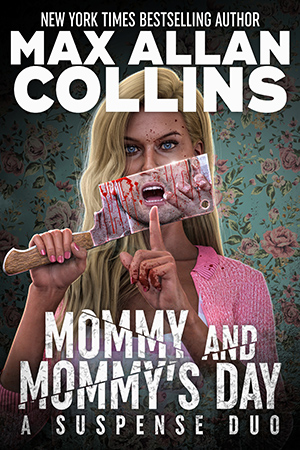
But I will take the time to announce the following: print versions of both Mommy and Mommy’s Day are available for $9.99. Be sure to click on PAPERBACK at the listing to get the right price (and cover). [Note from Nate: The links in this update go directly to Amazon.]

Also available as “real” books from Wolfpack are Murderlized – the collected short stories of Matt Clemens and me (10.99); all four Eliot Ness books, The Dark City, Butcher’s Dozen, Bullet Proof, and Murder by the Numbers ($10.99 each); and Murder His and Hers, stories by Barb and me ($9.99).

Your support of these titles will be much appreciated. Their success paves the way for new original books (and further reprints) by me, me and Matt, and me and Barb.

Yeah, I know – that’s an obnoxious amount of “me” – and “I” know it.

* * *

Here’s a great Kiss Her Goodbye review, reprinted from a long-ago post.

This is a rather tepid endorsement of Eliot Ness & the Mad Butcher.

Finally, here’s a list putting a story by Mickey Spillane and me on the “must-read” list.

M.A.C.

Charles Dickens, Anthony Newley and Real Books

Tuesday, September 1st, 2020
Dark City (Wolfpack Edition)

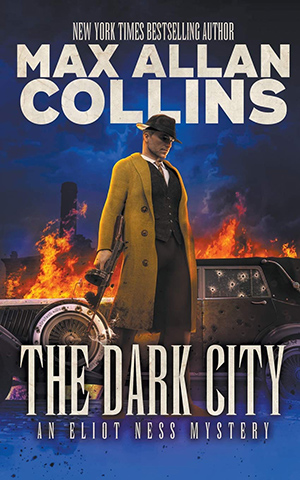
The physical editions of my books at Wolfpack have started to kick in! You can get Murder – His & Hers right now. And all four Ness novels are individually available – [Amazon links] The Dark City, Butcher’s Dozen, Bullet Proof, and Murder by the Numbers. They share the same cover as the Eliot Ness Mystery Omnibus, but with variant colors.

* * *

Barb and I – thanks to the efforts of our son Nate – were able to watch Bill and Ted Face the Music on its opening night, streaming it. We love Bill and Ted’s Excellent Adventure, and also like the sequel, Bill and Ted’s Bogus Journey; I would put this long awaited third installment on at least a par with the sequel.

Like its predecessors, it’s a very smart movie about a couple of lovable dudes who are perhaps not as dumb as they appear, rather are just of their time and generation. As Nate commented, in the midst of this Covid/Trump reality, for one sweet funny evening, the world felt normal again. Like nothing had changed.

But we shouldn’t get too cocky about the past. Of late, Barb and I have been watching a lot of film and TV adaptations of Charles Dickens novels, escaping from 2020 into the 1800s. That escape, though, has an uncomfortable number of parallels – homeless people (check), government-abused kids (check), an unfair court system (check), corrupt politicians (check), an uncaring wealthy class (check), pollution (check), disease (check)…and on and on.

Still, it’s another time and place and kind of a relief to be anywhere but here. So I’ll recommend a few of the really worthwhile Dickens adaptations. All of these are available on DVD and some on Blu-ray, with many available for streaming.

If you have the time, nothing beats the eight-hour-plus stage version (on video) of Nicholas Nickleby (1982), the Hamilton of its day. Standouts in a huge cast are Roger Rees in the title role and definitive Dickens actor Alun Armstrong as (among other characters) the ignorant, sadistic schoolmaster Squeers.

David Lean was one of the greatest filmmakers of all time, and his two Dickens adaptations are as good as movie versions get: Great Expectations (1946) with John Mills and Alec Guinness; and Oliver Twist (1948) with Robert Newton and Anthony Newley (not the main actors but favorites of mine). Add to that list, of course, Scrooge (1951) with Alistair Sim (which I’ve lauded here many times).

Andrew Davies has scripted two relatively recent BBC mini-series that are the gold standard of Dickens TV adaptations: Bleak House (2005) with Gillian Anderson and
Charles Dance; and Little Dorrit (2008) with Claire Foy and Matthew Macfadyen. The Mystery of Edwin Drood (2012), scripted by Gwyneth Hughes, is first-rate, too, especially Drood actor Matthew Rhys, who is now (of course) Perry Mason.

As good as David Lean is, the BBC’s early ‘80s long-form renditions (often a dozen half-hour episodes, which suggest the serialized format of the original Dickens works) are in some ways superior, as they tend to adapt each novel in its near entirety. When certain colorful incidental characters in Dickens are, understandably, omitted from films two hours or less in length, much of the richness and humor of the original novels is lost.

Also, aspects of Dickens are distorted in the shorter form of films and TV movies. Yes, there are wild coincidences, but when woven throughout a very long narrative, filled with characters, those coincidences seem a part of the fabric of life and not convenient plot devices. And without the deeper characterizations, the principal characters can seem to be chess pieces Dickens is moving, a feeling one doesn’t get from the books.

For example, not just including David Lean’s version, Great Expectations has been filmed a number of times quite effectively. The BBC mini-series with Gillian Anderson and David Suchet is excellent. But the far less lavish 1981 BBC mini-series, with its six-hour length, tells the entire story of the novel, with much deeper characterizations than any other adaptation, especially for Pip (Gerry Sundquist) and his convict friend (Stratford Johns. The definitive Miss Marple, Joan Hickson, turns outalso to be the definitive Miss Havisham, bringing remarkable depth to a character who can be a cartoon.

Less celebrated Dickens novels come to worthwhile life, too, in the longer-form ‘80s and ‘90s BBC adaptations – Domby and Son (1983), another Andrew Davies script; Martin Chuzzlewit (1994) with Paul Scofield and Tom Wilkinson; David Copperfield (1999) with Bob Hoskins and Maggie Smith; and Our Mutual Friend (1998) with Steven Mackintosh and Keeley Hawes.

I mentioned actor Alun Armstrong above. Of the films and TV versions I’ve mentioned here, he is in about half. He has played villains, lovable sorts, and even made a great Inspector Bucket. We thought he did a great job in Martin Chuzzlewit, too, until we realized that was Pete Postlethwaite.

Look, there are plenty of good and at least watchable Dickens adaptations. But these are worth your time. Are there any that aren’t?

Hard Times (1994) with Alan Bates and Richard E. Grant is a hard go. Bates is a fine actor but he hams it up here, in a grotesquely arty, misjudged take on Dickens.

The Old Curiosity Shop (1979) is, in my probably worthless opinion, as bad as Dickens ever got; he seems to be spoofing himself without his readers realizing it, like the Turtles doing a parody of themselves with “Elinore” (“I really think you’re groovy, let’s go out to a movie”) and nobody getting it. But the novel deserved better than the 1979 BBC mini-series with its cringingly over-the-top Trevor Peacock’s Quilp at centerstage.

Of course, the ridiculously villainous Quilp is part of why I think Dickens is having a laugh at himself and his audience (right down to, SPOILER ALERT, killing Little Nell). Much better, though little seen (particularly in its longer, richer version), is Anthony Newley sending Quilp and himself up in the 1975 musical variously known as Mr. Quilp and The Old Curiosity Shop. The assumption that audiences who enjoyed Carol Reed’s recent Oliver! would adore Dickens’ dreary self-parody was probably the first mistake; still, this version is pretty good.

Newley, who as a child star made his first major claim to fame playing the Artful Dodger for David Lean, was coming full circle with his outrageously over-the-top Quilp, throwing in for good measure a solid score he wrote himself (not his best, as that was invariably reserved for his collaborations with Leslie Briccuse). Newley, who died at 67, enjoyed a final triumph starring in the Briccuse musical Scrooge on the West End and touring the UK provinces.

I don’t recall if I’ve mentioned Newley here before. He is on my very short list of “ideels” (as Li’l Abner described Fearless Fosdick). It’s a list including people like Bobby Darin, Mickey Spillane, Audie Murphy and Jack Webb. My ideels, each and every one it would seem, somehow demand defending – Darin was an obnoxious pretender, Spillane ruined mystery fiction, Murphy couldn’t act, Jack Webb was a joke. I have defended all of them and will continue to do so till my dying day.

As for Newley…

He is a genuinely quirky and willfully mannered performer, his distinctive vocal style the kind of thing that kept impressionists in business in the ‘60s and ‘70s. He is also the primary influence on David Bowie as a singer and performer, something Bowie often admitted.

With Briccuse, Newley wrote two great Broadway scores, each filled with standards: Stop the World I Want to Get Off and Roar of the Greasepaint, Smell of the Crowd. With Briccuse and John Barry, he wrote the theme for Goldfinger. He and Briccuse wrote the music for Willy Wonka – “Candy Man” and “Pure Imagination” and even the ditty sung by the Oompah Loompahs.

While to my knowledge it’s never been revived (Stop the World has been a number of times), Roar of the Greasepaint has not. Among the songs are “Who Can I Turn To,” “On a Wonderful Day Like Today,” “The Joker,” and the remarkably resilient “Feeling Good.”

In 1965 in New York, on summer vacation with my parents, I saw Roar of the Greasepaint at the Shubert Theater. I have seen many musical plays, including any number on Broadway and many more in Chicago, and countless concerts by stars of both the Vegas variety and the rock persuasion.

I’ve never seen anything better than Roar of the Greasepaint, Smell of the Crowd. Nothing as compelling or as funny or as mesmerizing. Newley’s was the single best performance I’ve ever seen. He was not unsupported: Captain Hook himself, Cyril Ritchard, was a regal “Sir” to Newley’s cockney Cocky – both were tramps, bums, with more than a hint of circus clown. Amid urchins out of Oliver!, with other contestants a beautiful woman and a black man, they played the Game of Life, with Sir making up and changing and rearranging the rules as they went.

I am going to share with you some of what I saw that night. Newley, right around the time I saw him performing at the Shubert, appeared on Ed Sullivan. In costume and in character, he delivered an amazing “Who Can I Turn To,” a song brilliantly conceived by its authors to work as an unrequited love song and, in the show’s context, as being addressed by Cocky to the God who has abandoned him. Have a look.

We’ll talk about his film Can Heironymus Merkin Ever Forget Mercy Humppe and Find True Happiness? another time.

* * *

Eliot Ness and the Mad Butcher is deemed one of six true crime books you should be reading right now.

Finally, you kind of have to dig for it, but a discussion of one of my Batman stories can be found in this essay about Batman vs. Batman.

M.A.C.

What, Me Retro?

Tuesday, November 24th, 2015

I was watching the pilot of the Cinemax QUARRY with my wife, son and daughter-in-law (don’t tell HBO), and Barb turned to me when the character the Broker first entered and nudged me and smiled and said: “You did that.”

Well, I did, but a long, long time ago. About 43 years. At the Writers Workshop in Iowa City, where the instructor didn’t like the opening chapters I’d written very much, and most of the class wasn’t wild about it either.

At 67, I suddenly find myself aware of how very long I’ve been doing this, and am gratified that suddenly a lot of what I’d thought to be ephemeral works of mine are turning back up in print, and getting on the radar of a new generation or two of readers. Some of what I’ve written has almost by definition been ephemeral – specifically the movie novelizations and TV tie-in’s – though SAVING PRIVATE RYAN remains in print and a publisher is seeking permission from DreamWorks to do a hardcover edition.

But almost everything else with my byline is available again or soon will be, much of it from Thomas & Mercer, but also such boutique publishers as Perfect Crime, Speaking Volumes and Brash Books.

For these weekly updates, I routinely do a Google search to see what reviews and such have popped up on the Net, for me to provide links here. More and more I am surprised to find write-ups about older books of mine. It’s almost jarring, because often the reviewers are more familiar with the work than I now am.

Of course, the new Hard Case Crime editions of the first five Quarry novels have sparked interest, and in particular QUARRY (the first novel) has received some gratifying attention. Here’s one such write-up.

And here’s another.

And one more.

Fairly regularly, somebody comes along and praises either the entire “Disaster Series” or singles out one of the books in particular, like this piece that focuses on THE LUSITANIA MURDERS.

So many of these reviews of older work of mine just seem to appear out of the blue, like this look at the Eliot Ness novel BULLET PROOF.

But nothing could prepare me for this article specifically focusing on the musical side of my years on the planet, discussing both the Daybreakers and Crusin’.

Here, dealing with a somewhat more recent novel, is a nice review of the Jack and Maggie Starr mystery, STRIP FOR MURDER.

Coming full circle, the just published FATE OF THE UNION is pulling in some nice reviews, like this lovely one from Bill Crider, a writer I much admire.

Finally, my pal Ed Gorman brought in Ben Boulden of Gravetapping to review FATE OF THE UNION on Ed’s terrific blog, also a positive review.

M.A.C.