Posts Tagged ‘Blue Christmas’

Nathan Heller, Blue Christmas Project & Mickey Spillane

Tuesday, January 3rd, 2023

I have just completed my proofing of the typeset version of Too Many Bullets, the next (and perhaps final) Nathan Heller novel, coming from Hard Case Crime in the fall of 2023, which seems to be the year we find ourselves in.

A certain number of the hearty souls who check in here regularly (and also those who show up irregularly) are readers of my Quarry, Nolan and other series whose entries run in the traditional 60,000 words or so length. Some others may be comics fan who are interested in Ms. Tree, Road to Perdition and my other occasional forays into graphic noveldom.

This means, these readers have not yet sampled Nathan Heller, the series I consider my best and most significant work. It may be because the books deal with history and these readers are unaware that historical subject matter does not discourage me from trafficking in sex and violence; or perhaps they are put off by the length – these two HCC Heller novels are 80,000 words each. I say gently to these folks that another 20,000 words or so will not kill you, nor will the historical content, although the research for these two recent Hellers damn near killed me. I remind these readers that later this month (delayed by a dock strike in London) physical copies of the new Heller, The Big Bundle, will be available. The e-book and (I think) the audio versions are both available now.

But a certain kind of reader – I will not go so far as to invoke OCD or Anal Retentive tendencies, having both of those conditions myself – won’t start reading a new series anywhere but the beginning. Despite my concerted efforts to make each Heller novel stand alone, such readers are stubborn about starting at the start.

For that reason I am pleased to announce that True Detective (1983) will be promoted via Amazon Monthly Deals: starting 1/1/2023 and running through 1/31/2023, the first Nathan Heller novel (a winner of the Best Novel Shamus from the Private Eye Writers of America) will be offered on e-book at 1.99 USD.
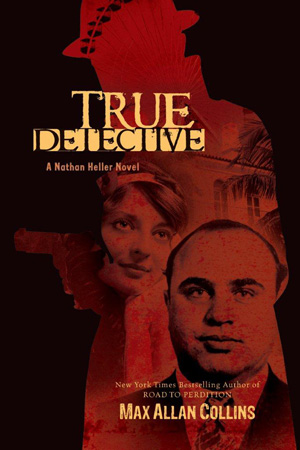
True Detective Thomas and Mercer cover
* * *

Doing the read-through (and tweaking of) Too Many Bullets was an interesting experience. I felt generally very good about the book – in fact, I was really satisfied with it and felt like it showed me at the top of my game.

And I was writing well during the months of actual writing (many months of research preceded that), despite having health issues then, including two brief hospital stays related to my A-fib. But despite what I felt was a high standard of work, I also came across uncharacteristic lapses – word repetition, pronoun confusion, and occasional lack of clarity.

It was odd to see me with my powers intact but now and then flagging, probably due to those health issues. Thankfully I am doing much better on that front, but it was sobering to see the lapses. I’m sure advancing age is another factor. But I will keep at this as long as my marbles are more or less intact.

Still, I’m sure my HCC editor Charles Ardai will wince when he sees I am sending 44 correction pages out of 300 hundred pages or so.

As for whether there will be another Heller novel after Too Many Bullets, that depends on sales, frankly. I have yet to write the major Heller/Hoffa novel I’ve had in mind for, oh, thirty years.

But we are at least nearing the end of Heller’s run. The research is just too daunting for a duffer.

* * *

About a month ago, here, I wrote this (feel free to skip):

I’ve told this story before, but I’ll tell it again on the occasion of the Christmas Season. Just before Thanksgiving 1992 – right before – I received a letter from the Chicago Tribune Syndicate editor letting me go from the Dick Tracy strip after my 15 year run. Shortly thereafter Bantam cancelled Nate Heller and returned the novel Carnal Hours to me after the editor there had accepted it enthusiastically. (The previous entry, Stolen Away, had won the Best Novel “Shamus” award from the Private Eye Writers of America.)

On Christmas Eve 1992, still shellshocked, I wrote “A Wreath for Marley,” the lead story in the Blue Christmas collection ($2.99 on e-book). It has been published several times, including in the Otto Penzler anthology, The Big Book of Christmas Mysteries. The story is what they call (hideously) a “mash-up” – of A Christmas Carol and The Maltese Falcon. Its significance is that it showed me getting back into the game after two bad batterings. The story is a long one, probably 15,000 words, and was done in one fevered sitting. It remains my favorite short story of mine.

It almost became my second indie movie – there’s a script, you will not be surprised to learn – but the success of Mommy led to us deciding to do Mommy’s Day instead.

Since I wrote this post, I’ve been exploring – with Chad Bishop, who put together Encore for Murder with me as a video presentation (stay tuned) – mounting a production of Blue Christmas here in Muscatine that could be presented as a live performance but also shot as a feature much as we did Eliot Ness: An Untouchable Life.

But Blue Christmas exists as a novella and as a film script, and no live performance version was ever written. Adding a second level of problems, er, challenges, a script for the stage is needed, with an eye on putting together the feature. So it needed to be a hybrid – a screenplay written for the live-performance stage.

Does your head hurt yet?

Still, I have long intended to someday take the time to write a stage play version of Blue Christmas. It’s a story I believe in and that has special resonance for me, as the piece of fiction I wrote on a long-ago Christmas eve that got me back up on the one-horse sleigh writing again after having my career get yanked out from under me.

Anyway, I spent a week on it, over Christmas (appropriately) and I’m very happy with it. Putting together a piece that was intended to have fairly elaborate special effects for a low-budget indie film and doing it instead live on stage…tricky. I am proud of how I solved the challenges…the problems…as the only stage play I’ve previously written is Eliot Ness.

But, as I say, it’s set up in a screenplay manner, in part because we are going after a couple of grants that are intended for backing low-budget feature films, not stage productions.

In the meantime, I’m entering Encore for Murder in a couple of Iowa film festivals, getting back in the game a little. As much as I love writing fiction – and even relish the solitary nature of it – I have to admit I’m never happier than when I’m in an editing suite working with my pal, Phil Dingeldein. And working with Chad Bishop has been a joy, as well.

Speaking of Phil, last Thursday he and a two-person crew – Justin Hall and Hannah Miner – came to Muscatine and shot the additional footage for our expanded version of Mike Hammer’s Mickey Spillane. The original documentary was shot in 1998 and released in 1999, and this brings the Spillane story up to date, from Mickey’s final years through the work I’ve done completing his unfinished manuscripts.

We are talking to VCI, who have released a lot of my stuff in the past (but never the Spillane doc) and hope to include Encore for Murder as a bonus feature. It’s a natural flow as we have Gary Sandy talking about playing Mike Hammer in the new documentary footage.

* * *

Here’s a two-party review of several of my Batman issues. These fans don’t realize that I was subjected to artist changes (artists who apparently didn’t have access to character designs from the previous issue!) and that no Batman “bible” existed, meaning I had to fly by my bat wings into unknown backstory territory. They do like my Penguin story, however.

Road to Perdition is back on Netflix.

Finally, here’s a great write-up on the forthcoming Nolan two-fer, Mad Money.

M.A.C.
A Stocking Stuffer and Christmas Crime

Tuesday, December 6th, 2022
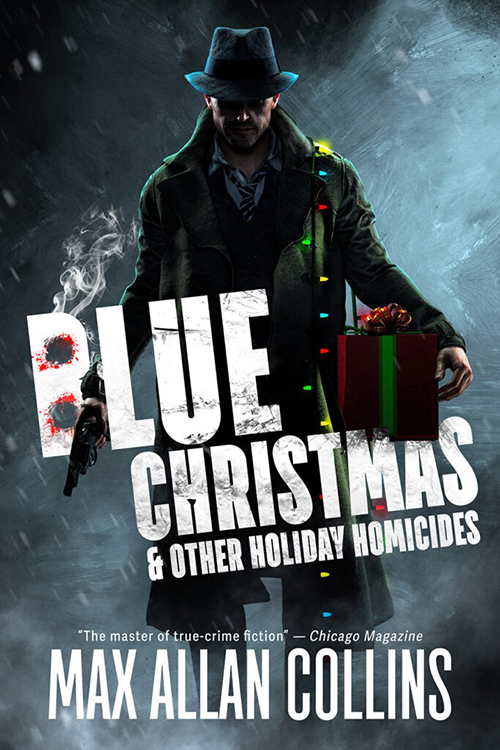
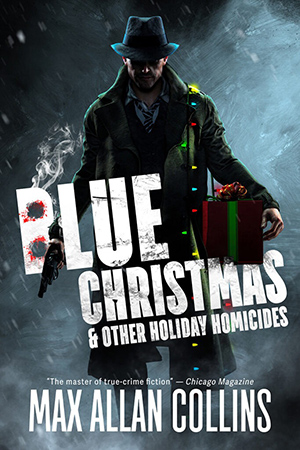
Blue Christmas cover
E-Book: Amazon Purchase Link
Trade Paperback: Indiebound Purchase Link Bookshop Purchase Link Amazon Purchase Link Books-A-Million Purchase Link Barnes & Noble Purchase Link

If you are looking for a stocking-stuffer type gift – a book, say – you might consider Blue Christmas and Other Holiday Homicides from Wolfpack, available in trade paperback (also e-book, but I’m not sure how you stuff one of those in a stocking).

I’ve told this story before, but I’ll tell it again on the occasion of the Christmas Season. Just before Thanksgiving 1992 – right before – I received a letter from the Chicago Tribune Syndicate editor letting me go from the Dick Tracy strip after my 15 year run. Shortly thereafter Bantam cancelled Nate Heller and returned the novel Carnal Hours to me after the editor there had accepted it enthusiastically. (The previous entry, Stolen Away, had won the Best Novel “Shamus” award from the Private Eye Writers of America.)

On Christmas Eve 1992, still shellshocked, I wrote “A Wreath for Marley,” the lead story in the Blue Christmas collection. It has been published several times, including in the Otto Penzler anthology, The Big Book of Christmas Mysteries. The story is what they call (hideously) a “mash-up” – of A Christmas Carol and The Maltese Falcon. Its significance is that it showed me getting back into the game after two bad batterings. The story is a long one, probably 15,000 words, and was done in one fevered sitting. It remains my favorite short story of mine.

It almost became my second indie movie – there’s a script, you will not be surprised to learn – but the success of Mommy led to us deciding to do Mommy’s Day instead.

Anyway, on the occasion of the Christmas season, what follows is largely a rerun from 2020, but reworked with some new stuff interspersed.

Let’s start with the five great Christmas movies:

1. Scrooge (1951). Alistair Sim is the definitive Scrooge in the definitive filming of A Christmas Carol. And let’s definitely not start with the current Spirited, an overstuffed turkey that some misguided souls are already calling a Christmas classic. It has a nice premise (the story told from the ghosts’ POV) and lots of songs, most of which sound like each other, and tons of gymnastic dancing and one shaky premise blending into another (Is it about people being able to change? Or about having no friends and finding one? Is it the story of the Ghost of Christmas Past falling in unlikely love, or the story of his charge getting over himself?). As an added bonus, it goes on forever. Actually, the stars – Will Ferrell and Ryan Reynolds – have nice, funny moments now and then. But we have a candy cane of an eighty-minute movie stuffed inside a two-hour stocking full of lumped coal.

2. Miracle on 34th Street (1947). Hollywood filmmaking at its best, with Edmund Gwen the definitive, real Santa Claus, Natalie Wood in her greatest child performance, John Payne reminding us he should have been a major star, and Maureen O’Hara as a smart, strong career woman/working mother who could not be more glamorous. Beware at all costs the 1994 remake.

3. It’s a Wonderful Life (1946). Heartwarming but harrowing, this film is home to one of James Stewart’s bravest performances and happens to be Frank Capra’s best. This one got a good TV-movie, gender-reversed remake that may turn up again this year: It Happened One Christmas (1977) with Marlo Thomas and Wayne Rogers.

4. A Christmas Story (1983), Jean Shepherd’s unlikely claim to fame, and a Christmas movie with Mike Hammer and Carl Kolchak in it. Now if only the four PBS specials about Ralphie and his family would emerge on legal home video! What we have instead is a weak Christmas Story 2, a true sequel with a tragically miscast Charles Grodin in the McGavin role (A Summer Story), and this year’s A Christmas Story Christmas with the original Ralphie, Peter Billingsley, uneven but worth a watch.

5. Christmas Vacation (1989) uncovers every Christmas nightmare possible when families get together and Daddy tries too hard. This holds up very well and has unexpectedly eclipsed the original film. Its secret is nailing every real Christmas-at-home horror and taking each up a notch. And it’s easily Chevy Chase’s best performance.

Other worthwhile cinematic Christmas cheer:

Bad Santa (2003). This dark comedy has a warm heart, but you have to wade through a whole lot of black humor to get there – well worth it, though. Billy Bob Thornton is wonderful, but the late John Ritter (who apparently died during the production) has the funniest moments in a side-splitting film. Its very underrated sequel, Bad Santa 2 (2016), is perhaps even funnier with Kathy Bates almost stealing the picture playing Billy Bob Thorton’s genuinely evil mother. The original film is out there in two versions, a Director’s Cut and an Unrated Cut (well, a third version if you want the theatrical cut). Both versions are good and you might alternate them from Christmas to Christmas, year to year. The unrated cut is twelve minutes longer.

Holiday Inn (1942) is easily better than White Christmas, although the latter has its charms – it’s helped keep Danny Kaye from being forgotten, and my pal Miguel Ferrer’s mom is in it. The original is funnier and ultimately more heart-warming, though the Lincoln’s Birthday blackface number is not just tasteless, it’s one of Irving Berlin’s worst songs (“Abraham”). Shudder for a few moments, then fast-forward.

Bell, Book and Candle (1958) is an old favorite of ours, the movie Kim Novak and James Stewart made together right after Vertigo, serving as kind of an unlikely happy-ending coda to that great film. With Jack Lemmon and Ernie Kovacs bouncing beautifully off each other, it’s a precursor to Bewitched with a great George Dunning score.

The Family Man (2000) with Nic Cage, a modern reworking of It’s a Wonderful Life, is heartwarming and funny. Cage may be an over-the-top actor, but the man commits – he gives one thousand percent to every performance, and this time he has a terrific movie to do it in. There is a melancholy feel to the ending, though, as the path not taken by Cage dissolves behind him at the close, meaning some cute kids bite the imaginary dust.

The Twelve Days of Christmas (2004). This shameless reworking of Groundhog’s Day as a TV Christmas movie is funny and rewarding – good-hearted but with a darkly comic sensibility. Steven Weber is excellent as the successful slick businessman who has twelve tries to get Christmas Eve right. Molly Shannon gets her best post-SNL role. If Hallmark movies were this good, we wouldn’t be bitching about them.

Three Godfathers (1948). This John Ford western stars John Wayne and is surprisingly gritty and even harrowing before a finale that you may find too sentimental – that combination is typical Ford, though. It’s dedicated to Harry Carey and “introduces” Harry Carey, Jr., who is very good, as is Pedro Armendariz.

Prancer (1989). This features a naturalistic performance from child actor Rebecca Herrell in a smalltown/rural variation on Miracle on 34th Street. Is the reindeer the little girl helps back to health really Santa’s Prancer? Sam Elliot is uncompromising as the father who doesn’t understand his daughter, whose mother has died.

Remember the Night (1940) is the second best (after Double Indemnity) of the films Barbara Stanwyck and Fred McMurray made together. Written by Preston Sturges, it makes its humanistic points with sentiment, not sentimentality, with an occasional noir jolt.

I, the Jury (1953). On the joyous occasion of its 3-D Blu-ray/4K release, note that this much underrated first Mike Hammer movie is set at Christmas and plays off of that throughout, with holiday cards and carols the connective tissue. Biff Elliott (like the movie itself) is much underrated, and the cast is filled with wonderful character actors. The great John Alton shot it. And I am thrilled that many of the reviews of the Classic Flix limited release are giving this strong private eye film reconsideration and overdue praise.

A Christmas Horror Story (2015) features William Shatner as the comic glue (a disc jockey) holding together inter-related stories about Krampus and Christmas. There are almost as many horror movies about Christmas as there are Christmas movies, but this is one of the best in a now cluttered field. It was put together by many of the Orphan Black people.

Office Christmas Party (2016) is a very funny raunchy comedy that eventually betrays a good heart. The great cast includes Jason Bateman and Kate McKinnon. I would recommend the theatrical release, as most of the raunch included in the unrated cut isn’t particularly funny and tends not to involve any key players.

Scrooge (1970) is the second-best Christmas Carol movie. Albert Finney is wonderful as Ebenezer in this musical version, with the Leslie Briccuse score perhaps the one most like his work with Anthony Newley, who did not contribute to this score but who played Scrooge in the much-seen British stage version (which came after the film). The best song in the current Spirited (“Good Afternoon!”) is a rip-off of this film’s “Thank You Very Much.”

Arthur Christmas (2012) is a CGI cartoon with a smart, witty script. The voices in this British production include James McAvoy, Hugh Laurie, Bill Nighy and Jim Broadbent. The neglected son of Santa rises to the occasion when a toy isn’t delivered despite a state-of-the-art technologically advanced system of his favored brother’s. My seven year-old grandson Nate likes this one and so do I.

There are several special Murdoch Mysteries Christmas movies, and not all are good. But one of them is: “The Night Before Christmas” (2021), a witty Agatha Christie Old Dark House tribute. This long-running show is comfort food for Barb and me, and this example shows why we put up with the occasional clinker (to quote Ralphie’s Old Man) for the joys of most episodes.

The two Poirot/David Suchet Christmas episodes are also worth seeking out for seasonal viewing: “The Theft of the Royal Ruby” and the movie-length “Hercule Poirot’s Christmas.”

* * *

Publisher’s Weekly chose The Big Bundle as one of its “Books of the Week.

Finally, here’s a great You Tube review of the I, the Jury disc.

M.A.C.

Short Takes – Books and Movies

Tuesday, December 29th, 2020
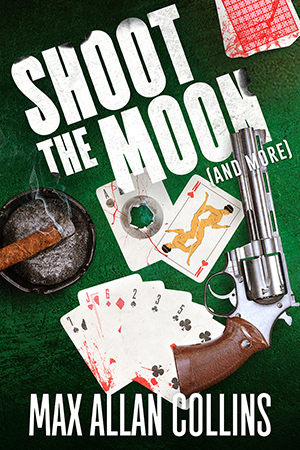
Book cover of Shoot the Moon by Max Allan Collins
E-Book: Amazon Purchase Link
Trade Paperback: Amazon Purchase Link Barnes & Noble Purchase Link

Wolfpack has announced the January 6 publication of Shoot the Moon in a reorganization of the collection Early Crimes. This new version is the novel Shoot the Moon with a “bonus feature” of short stories at the back of the book. Shoot the Moon was my attempt to do a Westlake-like humorous suspense novel. It can be ordered as either an e-book or a physical book.

Also announced by Wolfpack is Reincarnal & Other Dark Tales (with a January 27 pub date). Right now it can only be ordered as an e-book, but a physical book is coming. This collects virtually all of my horror stories to date.

Blue Christmas & Other Holiday Homicides is already available from Wolfpack in both e-book and physical book form. It’s a collection of holiday-themed stories by me, including the title tale, which is my favorite among my short fiction.

* * *

Barb and I revisited two of the Christmas movies I recommended last time.

It Happened One Christmas is the re-imagining of It’s a Wonderful Life with a female protagonist (Marlo Thomas). I love this little movie almost as much as the original, but the truth is that It’s a Wonderful Life is a film masterpiece and It Happened One Christmas is a TV movie. A very good one with a remarkable cast, but a TV movie.

When it first appeared, It Happened One Christmas benefitted from It’s a Wonderful Life having dropped out of sight. But not long after the remake aired, the public domain showings of It’s a Wonderful Life began on PBS stations and revitalized interest in the original film. Despite the gender role reversal, the films are much the same, right down to the dialogue. This will be problematic for many meeting the remake for the first time.

It’s too bad, and I’m glad I saw the remake first, because it didn’t hurt my appreciation of the original at all. But the Marlo Thomas version is, in my opinion, still worthwhile with its strong cast including Wayne Rogers, Orson Welles, Christopher Guest, Cloris Leachman, Archie Hahn, Doris Martin, Richard Dysart, and Barney Martin. And for me a special resonance is the cinematography by Conrad Hall, who won an Academy Award for Road to Perdition.

Twelve Days of Christmas Eve held up very well on what must be my fourth or fifth visit. While it’s rather shamelessly a Ground Hog’s Day variant, it does so in a clever manner and star Steven Weber is excellent, as is Molly Shannon. If you ever try this, stick with it for a while, because it seems at first like just another TV movie, but becomes something very special as it goes along.

* * *

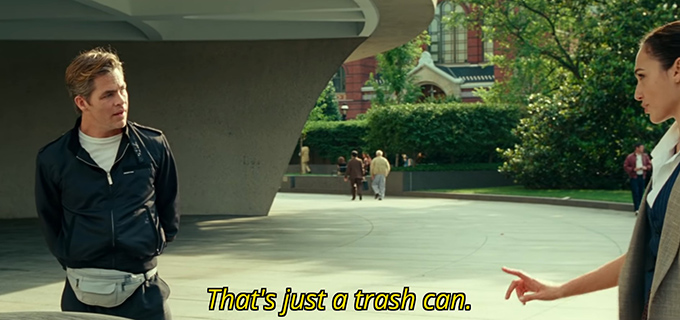
Barb and I were excited about being able to see at home the new Wonder Woman movie (apparently called WW 84 – and I haven’t even seen WW 83 yet!), springing for the new HBO Max streaming service to do so. And guess what? WW 84 is one of the worst superhero movies I’ve ever seen. What did Barb think? She walked out – and we live here!

Where to start? The opening on Amazon Island (or whatever it’s called) is fine. But once we get to 1984, one problem after another presents itself. Let’s get this out of the way: nothing wrong with Gal Gadot, whose super-power seems to be emerging from this crock unscathed. If you are a man, this is not a movie you want to be in, unless you are Chris Pine or a homeless black guy, as every other adult male is a lout at best and a potential rapist at worst.

Chris Pine doesn’t fare that well himself, actually. He comes back from the Great War dead to be wide-eyed and astonished by such marvels as escalators (introduced around 1900) and a subway (introduced around 1890). He tries on a lot of groovy ‘80s clothes, which (as any 1910s guy would do) he finds really cool, particularly the man purse. By the way, in this movie where men are reprehensible, Diana Prince (SPOILER ALERT: Wonder Woman) allows an unknowing male to become the receptacle for her dead boy friend’s persona and almost immediately has sex with him.

What can you say about a film whose super-villain is a blithering jackass? Really, just another weak man who happens to be an a-hole? Or about a script whose theme is wishes coming true but at a cost…a cost that never defines its boundaries (i.e., some people immediately lose whatever they gave up to get their wish, but – so that she can participate in fight scenes – Wonder Woman only very gradually loses her powers).

Then there’s Kristen Wiig, who plays her role as a supposed nebbish girl like an SNL character, then unbelievably becomes a mostly CGI bad girl (the Cheetah, a recurring Wonder Woman villain, but never named in the film). What Kristen gave up for her wish was her…niceness.

This is a super-hero movie that made me want to reconsider Green Lantern. How could the first Wonder Woman film be so good, and this one so wretched? Same director. Different result.

Still from Wonder Woman 1984, captioned: That's just a trash can.
* * *

While I haven’t dug into it yet, the Taschen coffee table tome, The History of EC Comics, was my “big gift” from Barb this year. I love these books but they are difficult to deal with. A hernia is no way to start the New Year. But what a thing of beauty this baby is.

My son Nate gave me two books in Marc Cushman’s These Are the Voyages series of big, long, in-depth tomes about Star Trek. I have mentioned here that Barb and I were trek fans before the dreaded term trekkie was even coined. We attended one of the first Star Trek conventions, and watched the episodes in syndication over and over. I bought the comic books and James Blish paperbacks. We went to dinner theater plays in Chicago starring (separately) William Shatner and Leonard Nimoy. I got to know Walter Koenig, at first by mail (we traded Big Little Books) and then in person. (Later I would cast Majel Barrett Roddenberry in Mommy.) We went to Gene Roddenberry’s embarrassing film Pretty Maids All in a Row in the theater, and we stood in the cold for hours to see Star Trek: The Motion Picture (which remains one of my favorite films, for which I have no apology).

These books chronicle everything. The first three are about each original season, but now I’m reading book four, which is about the years leading up to the animated series. Cushman’s tomes are well-written and ridiculously thorough – how ridiculously thorough? How about reviews quoted at length from those dinner theater appearances I mentioned earlier? Or tons of the bad reviews Pretty Girls All in a Row got? Or what TV shows the secondary cast members appeared in between the series and the movies?

So you have to be something of a lunatic where Star Trek is concerned – the real Star Trek, that is – to want anything to do with these three-inch-thick books. And I qualify.

Thank you, son.

* * *

As a sidebar to the WW 84 review above, let me say that after recently adding movie channels to our cable and streaming channels to our Roku, I am underwhelmed and overwhelmed at the same time. “Over” because there is so much of it. “Under” because so little of it appeals to me.

Much of the new product seems so politically correct and painfully diverse to make me consider voting Republican (we all have our weak moments). “Free” content on most of the streaming services is commercial-ridden. But now and then I stumble onto something good.

In 2015, Colin Hanks (whose father, I understand, appeared in a very good gangster film) directed a documentary about Tower Records called All Things Must Pass. It’s an extremely well-made film in which Russ Solomon, the creator of the record-store chain, is interviewed at length; so are many of the original employees, who rose to high levels within the company, and such music luminaries as Elton John and Bruce Springsteen.

I loved Tower Records. Any time I was in a big city, I tracked Tower Records down. Each store was the same but different, reflecting the individual management and its employees. Those red letters on yellow thrill me to this day. I bought CD’s there. And books. And magazines. And laser discs. And DVDs.

In Chicago. In Los Angeles on Sunset. In New York in the Village. In Honolulu. In London. In Las Vegas. These stores were a pop culture paradise, and they still exist only in Japan, and in my memory.

I hate streaming. I hate e-books (except for the income they generate for me, of course). I am Old School. Physical Media. Physical Media. Physical Media.

Nice job, Mr. Hanks. Cool work on Fargo, too.

* * *

Among the oddball, quirky Blu-ray labels I support is Vinegar Syndrome. You should check them out. On their Black Friday sale, I bought Forgotten Gialli Volume 2 and a box set of The Beastmaster. The packaging is incredible and the bonus content mindboggling. They do intersperse “classic” porn titles between the horror and giallo and s-f titles, so take care. Some of their media gets pretty physical.

* * *

I will see you next year. By then, I will be working on Quarry’s Blood. Skim Deep was a coda to the Nolan series, and this one will be a coda to the Quarry series.

Shall we endeavor for 2021 not to suck quite so thoroughly as 2020? On the other hand, the thing I’m looking forward to about next year is getting a vaccine shot or two.

* * *

Here’s a nice recommendation for Skim Deep.

M.A.C.

Santa Thought I Was Special

Tuesday, December 22nd, 2020

This great new edition of Blue Christmas is out now! Look at this wonderful Wolfpack cover!

Blue Christmas Cover
E-Book: Amazon Purchase Link
Trade Paperback: Indiebound Purchase Link Bookshop Purchase Link Amazon Purchase Link Books-A-Million Purchase Link Barnes & Noble Purchase Link
* * *

As I write this, Christmas is five days away, although we always celebrated – and still do, largely – on Christmas Eve.

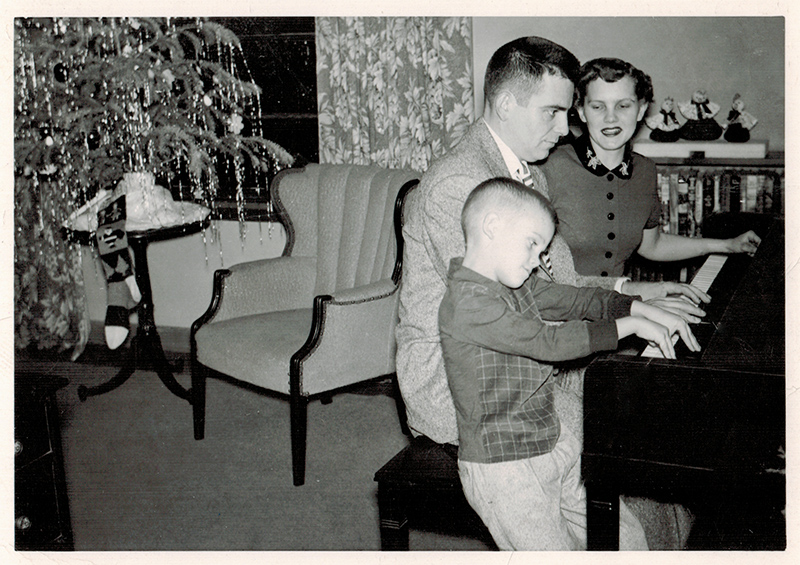
My father, Max A. Collins, Sr., was a talented man. He was for about a decade probably the most celebrated instructor of high school choral music in the state of Iowa. His students won every prize imaginable, and he put on the first high school musicals in the country of Oklahoma and Carousel, getting state-wide press. He also put on a musical written by Keith Larson, an early writing mentor of mine whose name I’ve given to one of the two main characters in the Krista and Keith Larson series (The Girl Most Likely and The Girl Can’t Help It). Dad left teaching to improve life for his family with a much bigger paycheck as the personnel man at HON Industries (later Human Resources Director).

More important to him, I venture to say, was the male chorus he directed for fifty years, the Muscatine Elks Chanters. In the 1950s, his group competed in the national championship for Elks male choruses. They competed against New York, Los Angeles, Chicago and choruses from every major city you can imagine. They won three years in a row, in fact, and were named permanent national champions with the contest shut down when nobody wanted to compete against them – “They’re ringers!” “He must be using professionals!” No, it was just men from the community, all walks of life (as they say), blue collar workers, doctors, lawyers, businessmen, and druggists, and whoever he had in his chorus, it always sounded the same. He could produce a unique sound from any chorus. He and the Chanters were once featured on the national TV show, People Are Funny (the funny thing they did was wear Bermuda shorts while performing) (hey, it was the ‘50s).

Perhaps I should mention that, right out of college, Dad turned down the opportunity to go professional with an opera company and instead took that teaching job in Iowa where he and my mother raised me. By the way, my late uncle Mahlon was the premiere high-school band director in Iowa in the ‘50s. The Collins brothers were legendary in those circles.

Dad served in the Pacific and his experiences were the basis of my book USS Powderkeg (I added the murders).

My mother was a housewife, as we described it then (and as I suppose Donald Trump still does). She was very active in charities, worked with Dad on the Chanters, and played a whole lot of bridge. She was also about the most attentive mother an only child ever had.

My best childhood memories are of the ‘50s. That was when my mom read to me at night, starting with (God love her) Tarzan. She introduced me to Dick Tracy comic books when I was six. What a gal! She took me to countless movies. She is definitely where I got my love for film and books.

My father was unusual in that he went to college on a split scholarship – music and sports. At Simpson College, he sang, played trumpet, played baseball and basketball and football. For years he was disappointed in me because I did not share his interest in sports. So I got involved in football in junior high. I had a growth spurt and, along with the face mask I wore to protect my glasses, that allowed me to take revenge upon many of the boys who had picked on me when I was a scrawny bookworm with specs. Anyway, I did well enough in high school to get a few football scholarship offers – I knew enough not to take them, because I knew how hard they hit in college – but that bonded Dad and me better.

Both my parents were incredibly supportive of my writing, and of my rock bands. The Daybreakers rehearsed in my parents’ basement for probably three years past my leaving home to marry Barb.

In high school, when all of my friends had summer jobs sacking groceries or pumping gas or building silos, I was told I could stay home and pursue my efforts to become a writer, if I treated it as a job, and worked at it every day. They believed in me. They even kept my allowance ($6.50) going in those summer months, including the $1.50 meal ticket money I was no longer giving Muscatine High School for the privilege of serving me mystery meat, supposed potatoes, and inedible vegetables.

The Collins family playing piano with a small Christmas tree in the background

But this is about Christmas, or anyway starting now it is. I was always informed by me parents that I was spoiled. I accepted this as fact until I grew older and realized that I wasn’t spoiled at all, but I’d had their love and support, which is better. When I was in grade school getting a ten-cent a week allowance (enough for a comic book till they went to twelve-cents), I didn’t feel spoiled. I didn’t in junior high either, when they raised my stipend to a buck (fifty cents of which was meal ticket).

Granted, my Christmases were special, even more special than most kids. For one thing, in a move that no doubt has given me undeserved confidence over my life, they hired a local Santa Claus to come by the house on Christmas Eve with his bag of gifts to see me personally. I was pledged not to tell any other kids that I was getting this special treatment – they might feel bad.

As a kid, I got gifts running to books and a few toys. No model trains, which was fine, because my friend Tom Hufford had a huge Lionel layout if I was ever in the mood, which frankly I rarely was. Once I became a Dick Tracy fanatic I got a lot of Tracy stuff, including several squad cars, and I scored a Robbie the Robot toy that I would love to have today. Also one of those stuffed monkeys with the red butt. The rest is a blur, although I remember my dad spending hours putting together a metal fort that cut him up like a gang fight.

Okay, here’s the thing about Santa coming early. Turns out I wasn’t that special. My father, in addition to teaching and later being an office-furniture executive, directed the church choir – Baptist, then Methodist (it was a paying gig). He had to be part of the midnight service, which I believe started at 11 p.m. (just another of the mysteries of world religion). We always had Christmas with both sets of grandparents – usually my dad’s folks first in Grand Junction, Iowa, and a couple days later a late Christmas with my mom’s folks in Indianola, Iowa.

The gifts from grandparents were so unmemorable I don’t remember any one of them, although my Grandpa Ray always gave me (not just on Christmas) two dollars, which was a fortune. It was also another indication that I was special, because my cousins Kris and Kathy only got a buck a piece (I was sworn to secrecy even as I was starting to learn life was unfair).

Anyway, I figured out – probably twenty years later – that Santa came on the 24th because we were traveling on the 25th. Getting my toys Christmas Eve actually was cruel and unusual punishment, because I was never allowed to bring any of them along.

But things changed in junior high and high school. Dad didn’t have a long Christmas break (as he’d had as a high school teacher) so the trips to the grandparents over the holidays were less frequent.

I got a lot of cool stuff, including a generic gun belt with a cap pistol (the Fanner 50 by Matel was out of reach, too expensive). One year I got This Is Darin, the new Bobby Darin LP – I still have it. Mom made sure I always got a box of cherry chocolates. The big prize was a typewriter, the best present they ever gave me. It was a very expensive gift for one thing, but mainly it said they believed in me. That they thought I really was a budding writer, from the very beginning.

If you’re going to “spoil” a kid, that’s not a bad way to do it.

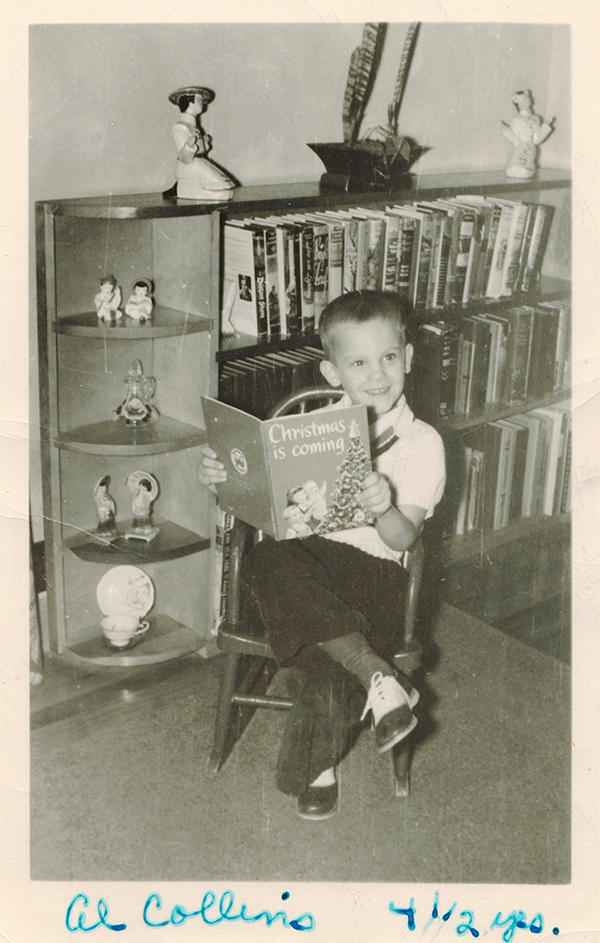
Max Allan Collins Jr., Age 4-and-a-half, seated in a rocking chair and reading a book titled
* * *

I am pleased to say Borg.com has named Masquerade for Murder one of the best books of the year – specifically Best Retro Read. Skip down and read all about it.

Here’s some Davenport history about the Col Ballroom where the Daybreakers and I get a nice mention. I feature the Col (now unfortunately closed) in The Girl Can’t Help It.

Road to Perdition (the film) gets some love here.

Indiewire thinks Nate Heller deserves to be on TV – you know, so do I!

The great J. Kingston Pierce pays tribute to my late friend Parnell Hall, thusly:

“Another loss for mystery fiction: Parnell Hall, a California-born former private detective and actor turned novelist, passed away on December 15 at age 76. He was best known for penning separate series about an ambulance-chasing New York City private investigator Stanley Hastings (Detective, A Fool for a Client) and ‘Puzzle Lady’ Cora Felton (Lights! Cameras! Puzzles!). In her obituary, Janet Rudolph remembers Hall as a “funny, supportive, musical, generous, and all around good guy. … Everyone loved him.” His most recent novel, Chasing Jack, was released by Brash Books in September. The Gumshoe Site says Hall died of COVID-19.”

I knew Parnell mostly through Bouchercons, but he was one of the sweetest, funniest and flat-out nicest writers I was ever lucky enough to meet. We played a lot of cards together, losing fairly consistently to others. Parnell was also a hell of a writer; and a gifted musician. He appears in my documentary Mike Hammer’s Mickey Spillane. As the Mick would say, Goodbye, buddy.

M.A.C.