Posts Tagged ‘USS Powderkeg’

Take the Day Off, Everybody!

Tuesday, March 3rd, 2026

This is being posted on my birthday, March 3, 2026. My birthdays are a stupidly big deal to me. Some of it’s for the usual reasons: cake, presents, and having your family sing “Happy Birthday.” It’s a childish fallback to…well, childhood.

Right around my eighth birthday I received (thanks to my mother having written him) a lovely letter from Chester Gould, including a drawing of Dick Tracy, and I think it’s fair to say it started me off on the road I’m still traveling. A birthday present from my folks a year later was a drawing board/easel – I wanted to be a cartoonist until mystery writing took over in my early teens, at which time I received another stellar birthday present from Max Senior and Patricia Collins – a typewriter.

I’ve often talked about another gift my parents gave me, though it wasn’t for my birthday. During high school, when all of my friends were out getting summer jobs, I was told that my allowance would continue through summer vacation – including my meal ticket money, even though I wasn’t in school eating the terrible cafeteria food for those three months! All I had to do was view writing as a job and write every day using my new typewriter.

I would write a novel in the summer and spend the school year trying to market it – emphasis on trying. Let’s stop there, as this is turning into a Horatio Alger story. (Can you picture little Allan Collins at his typewriter, writing away, his cheeks smudged with typewriter-ribbon ink? Not those cheeks!)

So what do I want for my birthday in 2026? Let’s start with another birthday in 2027 (and a few more after that). I find myself contemplating mortality because, first, I will be 78 tomorrow (assuming I wake up), and second, I still have books to write.

This birthday has an uncomfortable resonance because Max Allan Collins, Sr., died on his birthday at age 78. My father didn’t like thinking about death, and got angry if the subject came up (it took my mother forever to get him to get their wills made, and another forever or two to get him to purchase cemetery lots). He really never had to deal with dying. Never faced it.

And he didn’t have to, because on the morning of his 78th birthday, he said to my mother, “I think I need a nap” (or words to the effect) and went off to do that and passed away peacefully in his sleep.

My father and I had a sometimes contentious relationship – I was a headstrong smart-ass (not much has changed) and he was a sports guy and I wasn’t interested. But he was also a musician – his male chorus was around for fifty years under his leadership and won multiple national competitions – and that was common ground. During my rock ‘n’ roll days, specifically the last ‘60s, I grew a full-face beard and he didn’t speak to me for about two years. When I trimmed it to a mustache, I taunted him: “You gonna speak to me half the time now?” He smiled – he had an excellent sense of humor if not of irony – and the long family nightmare (“Ask your son to pass the salt”) was over.

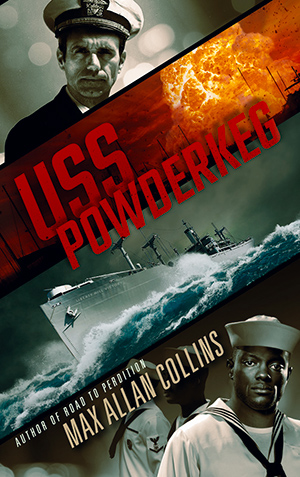
For a period of a year or so, Dad and I sat in the country club (he was a member, I was not) over lunch and in the lounge, while I interviewed him about his experiences in the Navy in the Pacific during WW 2. These experiences were the basis of my novel USS Powderkeg (also published as Red Sky in Morning by Patrick Culhane). He didn’t live to see it published, but he (obviously) knew it was in the works. If you haven’t read it, the USS Powderkeg edition is revised and my preferred version, under my name, available at Brash Books.

I am pleased to say my relationship with my son Nathan, Barb and my only child, is closer and warmer than I enjoyed with my father. But I loved Max Collins and I’m not talking about myself – I was always “Allan” and “Al” until a publisher slapped the “Max Collins” byline on my first novels and I was stuck with it, adding “Allan” after a while, at Don Westlake’s suggestion. Yes, my real name is somehow my pseudonym.

Obviously father-and-son relationships are at the heart of my work – not intentionally, but when I look back at it, there it is. Road to Perdition is the most obvious example (several scenes from my life with Dad are reworked there, in particular the driving lesson). But Nolan and Jon are a surrogate father-and-son relationship. So are Quarry and the Broker (Quarry’s own father turned his back on him). And, in Road to Purgatory, Michael O’Sullivan and Frank Nitti are father-and-surrogate-son. Strained familial relationships inform the Mommy movies and novels; the Jack and Maggie Starr series; and the Antiques novels, although that’s more about Barb’s relationship with her mother.

Pardon all this reflection, but it may be the only positive thing about birthdays at my age. They are like Thanksgiving, minus the turkey: I think about what I’m grateful for. At the top of that list are Barb and Nate and grandchildren Sam and Lucy (their mother, Abby, is a gem, too). Next would be my collaborators in writing and music, everyone I played rock with, a joyously long list headed up by the late Paul Thomas but also my Seduction of the Innocent bandmates, including the late very much lamented Miguel Ferrer. Then come my collaborators on fiction and comics, not including a couple who were difficult but definitely including the likes of Barb (again), Terry Beatty, Matthew Clemens, Dave Thomas and (most recently) Robert Meyer Burnett. My collaborators in the seven movies and two documentaries I’ve made is an incredibly long list, headed up the late Michael Cornelison, though Phil Dingeldein and Chad Bishop rate at least a mention. And Patty McCormack – my God, what an honor and pleasure knowing and working with her.

Hey, I’m leaving so many people out it indicates it was a mistake even getting into this. But I’ve somehow managed to live an interesting life while never moving away from Muscatine, Iowa. Life has taken me to Hollywood and New York and all around Chicago. Band jobs in San Diego and Omaha and Atlanta and St. Louis, opening for the Rascals and Gary Puckett & the Union Gap and the Buckinghams and the Turtles (Flo and Eddie) and Peter Noone and the Grassroots and….

It’s been a trip. Visits to England and Germany and Italy, but never France (had to turn down an all-expenses-paid invite to a Paris mystery con because I was about to shoot Mommy).

But the most important gift I’ve received, other than my family’s love, is a career that let me make a living writing. It really is readers that fuel my engine. And the reason why I want to stick around for a few more years, pacemaker and all, is this: I still have stories to tell. The only thing that could kill me, besides time and maybe dementia, is not having anybody out there who wants to read me.

That I couldn’t survive.

* * *

I don’t believe I’ve ever done this before, but I want to share a review from Amazon with you. It’s the first Death by Fruitcake review we’ve received there, and it’s a beauty.

5.0 out of 5 stars Solid Independent Film
Reviewed in the United States on February 24, 2026
Verified Purchase

Death By Fruitcake is an adaptation of a novella by Barbara Allan from the Trash ‘n’ Treasures cozy mystery series. Allan is the pen name used by noted crime and mystery writer Max Allan Collins and his wife Barbara who co-write these adventures of antiques store owner Vivian Borne and her daughter Brandy. The film is set in small-town Serenity, Iowa and focuses on a community theater production of a Christmas play centered around local fruitcake production during the FDR administration. Vivian is directing the production and it stars local star Louise Lamont, who has recently returned to her hometown roots while on the downside of her successful career in soap operas and other stage shows. Things go awry when Lamont, a diva who has rubbed the rest of the cast and crew the wrong way, dies in the middle of a dress rehearsal. Vivian, who views herself as something of an amateur sleuth, takes it upon herself to assist local police chief Tony Cassato in solving the crime.

The film stars Paula Sands, a long-time news anchor and reporter in the Quad Cities area, as Vivian Borne and Alisabeth Von Presley, best known for her music career and as a former contestant on American Idol, as her daughter Brandy. The film also features Rene Mauck, who portrayed Velda in the filmed stage radio-style production of Mickey Spillane’s Encore for Murder, as Lorraine; Rob Merritt (Richard Stone in Blue Christmas) as Chief Cassato; and Chris Causey (Jake Marley in Blue Christmas) as Paul, the theater’s lighting guru. While the cast may not contain a number of household names, there are some solid performances in the film. Sands does a solid job as Vivian, although some of her delivery certainly points to her past at a news desk. Von Presley, who had a minor role in Blue Christmas, stands out with an ability to easily speak to the camera in several scenes designed to break the fourth wall. Merritt, who was strong as the lead in Blue Christmas, puts in another solid performance as does Chris Causey, who has the presence of an experienced character actor (making it somewhat surprising that he’s not had more roles according to his IMDb profile). Kimberly Kurtenbach also stands out as Clara Buffet, head of Lamont’s fan club.

The film is a low budget, independent production, but that works just fine given that this is a character-driven, quick (89 minutes) whodunit film that takes place entirely in one setting (the community theater). There are several funny spots and one-liners as well as an ending with a twist that is to be expected in these types of mystery stories. Although I’m unfamiliar with the book series this is based on, it’s safe to assume it is a fairly true adaptation given that it is written, directed and produced by Max Allan Collins and also produced by series co-writer Barbara Collins. Overall fans of the series, of cozy mysteries, or of Collins’ work in general are likely to find this film a worthy watch.

(It’s signed: zagain.)

Now that’s a birthday present!
* * *

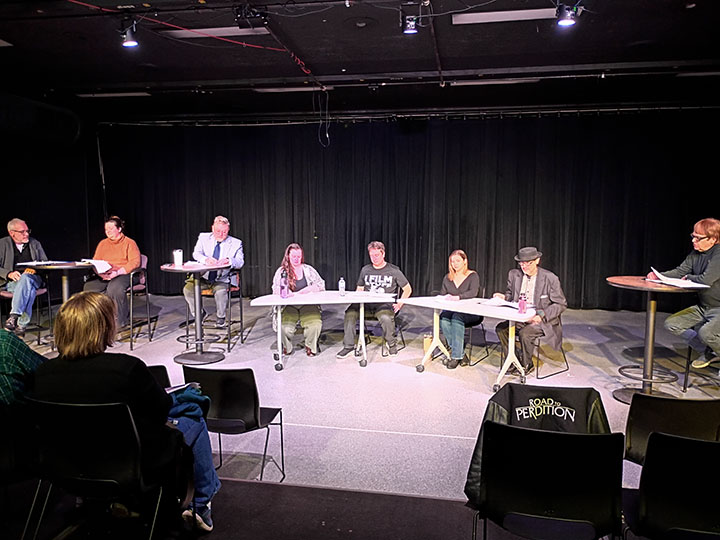
We had an open-to-the-public table read of my horror script, House of Blood, at the Muscatine Community College “Black Box” theater on Friday and Saturday evenings.

Much of the cast were veterans of either Blue Christmas, Death by Fruitcake or both (I read the stage directions). Friday was lightly attended, but we had a nice house on Saturday.

Will House of Blood be my next micro-budget production? Don’t know. The audience’s reaction at the reading was encouraging, and most of the actors would be asked back for the film, if there isone and they are available.

But the only way there will be another micro-budget M.A.C. production is if we do reasonably well with Death by Fruitcake. We have a new distributor (DeskPop) who have issued a DVD and got us onto a slough of streamers. Here, again, are the links.

AppleTV
YouTube Movies
Google Play
Amazon Digital Buy/Rent
Amazon DVD
Oldies.com

What would “reasonably well” be? Simple: if we make back our investment and enough beyond that to make another movie.

The reason why House of Blood is the probably our next film (again, if there is one) has to do with its ability to be staged on a micro-budget. A Death by Fruitcake sequel would require a bigger budget project based on one of the Antiques novels, which means more locations and more shooting days…and more money spent.

* * *

The day, alas, is gone that we had numerous mystery-oriented magazines. Ellery Queen and Alfred Hitchcock are still around, publishing short fiction and limited reviews.

But Mystery Scene is kaput, and only The Strand remains above water.

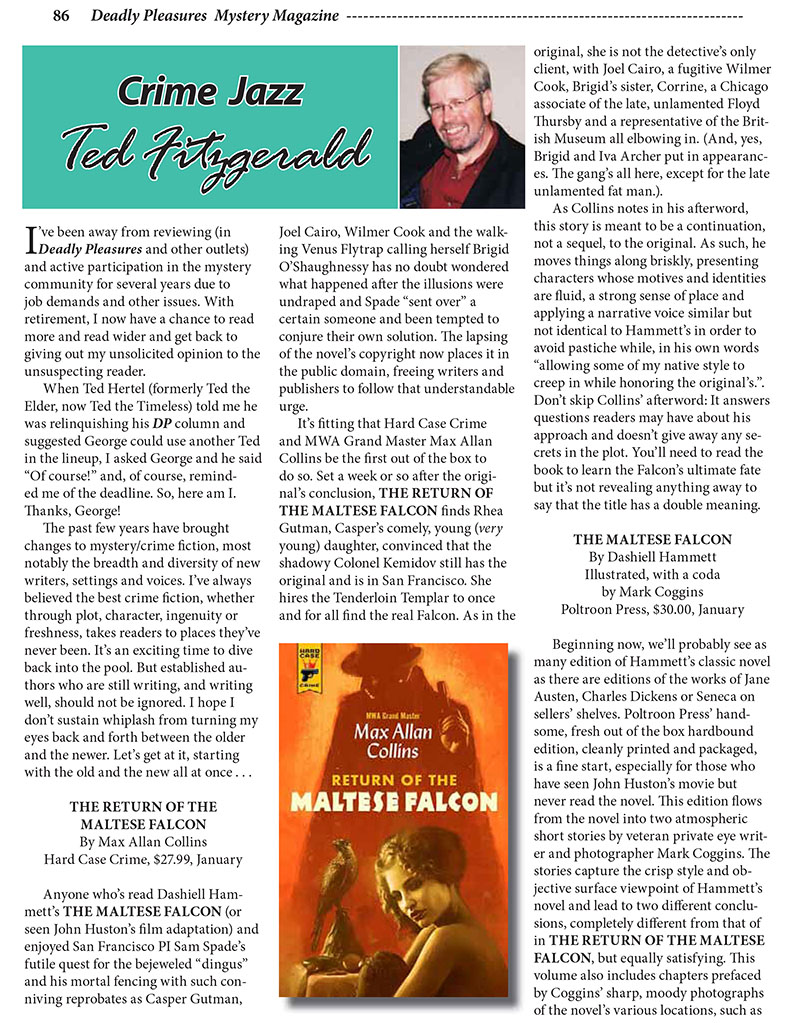
One of the best fanzines available by subscription is Deadly Pleasures from editor George Easter. It reports news about the genre and has an impressive stable of top reviewers – a fanzine at its best.

It is, thankfully, still around, although strictly in digital download form. The current issue includes three (count ‘em, three) reviews of Return of the Maltese Falcon.
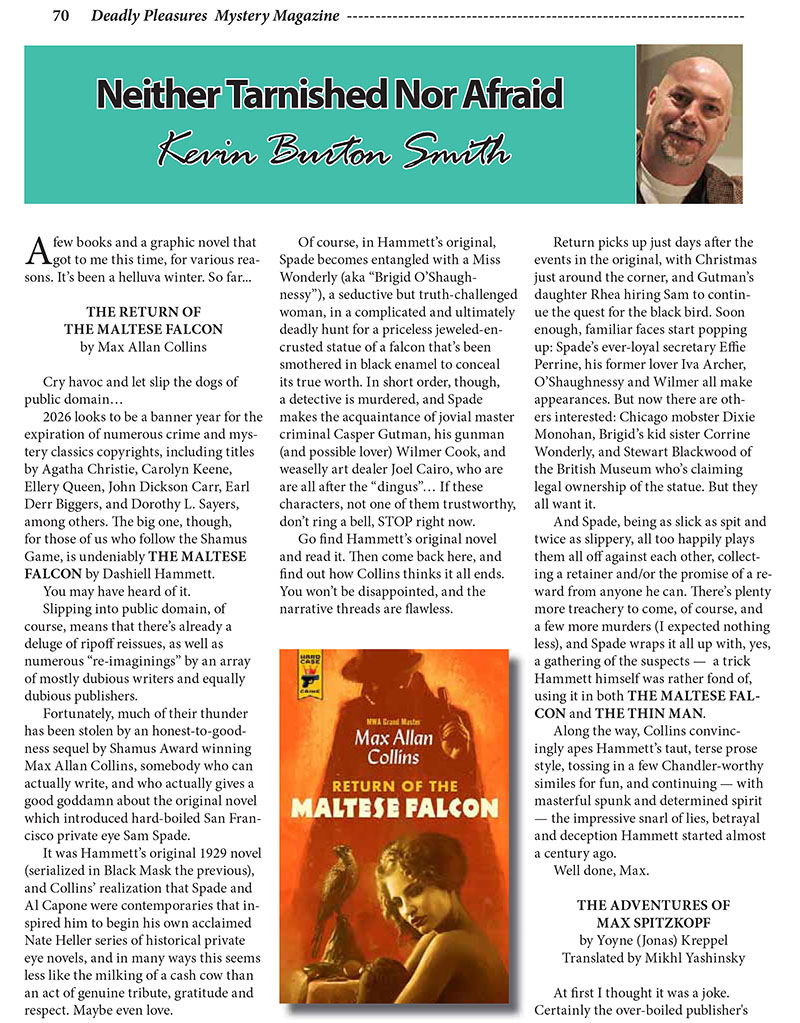
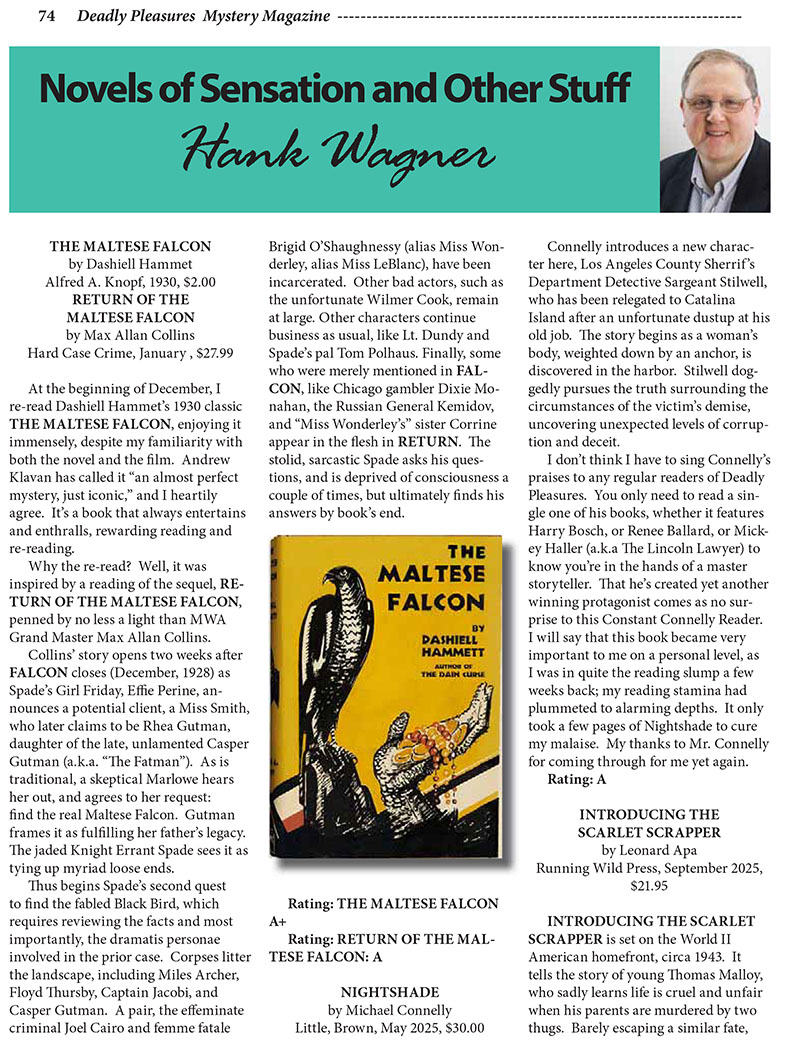
Finally, I know you’re wondering what you can give me for my birthday. If you like Return of the Maltese Falcon, let people know by way of Amazon comments, B & N and Goodreads. If you like Death by Fruitcake, on DVD, comment at Amazon; ditto at streaming services. Same goes for True Noir: The Assassination of Anton Cermak, wherever you bought it whether as a download or physical media. (Big True Noir event coming!)

As I reflect on my career, I am convinced that everything good that has happened has to do with loyal readers. So all I ask (and I know it’s a lot) is keep reading me…and favorably commenting. Smart word of mouth is everything.

Meanwhile, I’ll keep blowing out those candles.

M.A.C.
Book Giveaway! Blue Christmas and Bucket Lists…

Tuesday, January 17th, 2023
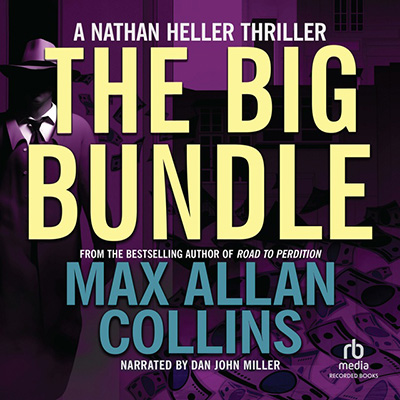
The Big Bundle audiobook
Hardcover:
E-Book: Kobo Google Play
Digital Audiobook:

We have a book giveaway this week – ten copies of the hardcover of The Big Bundle. You agree to write a review for Amazon and/or other on-line reviewing sites, like Barnes & Noble or even your own blog. This is for USA only – overseas is, I’m afraid, too expensive.

[All copies have been claimed. Thank you! –Nate]

The book will be out in about a week and a half, so time’s a wastin’. (I may not be writing Caleb anymore, but some things get in your blood.)

The audio may or may not already be available – I haven’t been able to determine that. But it will definitely be out when the book itself is released (it’s out there now on e-book). Barb and I listened to the first third of it on a jaunt to Cedar Rapids yesterday, and Dan John Miller is simply brilliant as Nate Heller and this extensive cast of characters. He’s always good but he’s outdone himself here.

* * *

We hope to include Mickey Spillane’s Encore for Murder on a Blu-ray/DVD release of the expanded Mike Hammer’s Mickey Spillane documentary, which Phil Dingeldein and I are working on right now. I think this makes more sense than releasing it on its own, because it is after all a local production, even with the commanding presence of Gary Sandy, who I think is really terrific as Mike.

But the experience of shooting the play (which we did live, as well as two dress rehearsals) and then editing the footage into a kind of movie got those juices flowing again. I honestly didn’t think, post-heart surgery, that doing a film project was possible. But this showed me, on a more limited scale, a project was possible.

We are going after grant money to get Blue Christmas off the ground. It will be, to say the least, a low budget production. Probably $75,000 plus that much again “in kind.” We initially were going to mount it as a play and shoot it that way, as we had with Encore for Murder, only with actual pre-production, as opposed to me just realizing we might have hold of something and oughta shoot it.

If the grants don’t come through, we would still do it, most likely, and would go the play route in the fall, with four cameras recording two dress rehearsals and two performances. We will be in a smaller theater – at Muscatine Community College, where years ago Barb and I fell in love and I later taught for a while – and if we do shoot it film-style, that black-box theater will be converted into a studio.

There is a part of me – the part of me that loves movies at least as much as I love books – that wishes I had gone the film route. There is a power to Chinatown, Vertigo and the Aldrich/Bezzerides Kiss Me Deadly that in my experience can rarely be touched in a book. (Feel free to disagree. I was shaped as a storyteller more by Hammett, Chandler, Spillane and Cain than by TV or movies. So I get that view.)

But I also like the collaborative aspect of making a film. It’s part of why I’ve stayed active with my band since 1974 (and from 1966 to 1971 before that). I am fine with working by myself, and as an only child am a loner. And the control that can be exercised in writing a novel or story is all-inclusive – nobody tells me what to do.

In collaborations, however, the human interaction is compelling and rewarding. Since I am a natural leader – I don’t know how to behave otherwise (I’m not proud of it) – I still tend to hold sway over the decision making. But that input from others makes the result far richer.

We are also in the “bucket list” area – not a term I love. But I am going to be 75 on March 3 (start shopping now!) and (like I said before) time’s a wastin’.

I began having a sense of the ticking clock well before my health issues kicked in. I started ticking off dream projects as early as Mommy, which was all about my obsessive desire to see Patty McCormack play a grown-up variation on The Bad Seed. USS Powderkeg (also published Red Sky in Morning) was about honoring my father and getting his WW2 story, with all its racial implications, told. Black Hats represented my desire to do a Wyatt Earp book.

Sometimes bucket list projects have foisted themselves on me. I thought Eliot Ness: An Untouchable Life was my last word on Ness. But Brad Schwartz convinced me we should write the definitive history of both Ness in Chicago and in Cleveland – though the instigator was Ken Burns. When he got Ness wrong in his Prohibition documentary series, by listening to uninformed, biased “experts,” those two massive books Brad and I did became necessary.

Blue Christmas is a story that has great meaning for me. As I’ve said here before, it was a story written on Christmas Eve 1992 – all fifty pages of the novella, in one fevered sitting – that got me back up on the pony to ride, after the bastards at the Tribune took Dick Tracy away from me.

I, of course, did not realize the Tribune had done me a favor, because I was about to fill the slack with Road to Perdition. I know I’ve mentioned this before, but I also think about what Dean Martin said: the two best things that ever happened to him were teaming up with Jerry Lewis…and breaking up with Jerry Lewis.

* * *

The great Ed Catto has written a lovely piece about Ms. Tree. Don’t miss this one. It’s right here.

J. Kingston Pierce was nice enough to say this at the Rap Sheet: “Among the non-fiction releases I look forward to seeing (is) Spillane: King of Pulp Fiction, Max Allan Collins and James L. Traylor’s ‘first ever’ biography of ‘the most popular and most influential pulp writer of all time.’” See that in context here.

Here’s a nice look at Jacques Futrelle, the detective mystery writer who starred in my The Titanic Murders. (I rate a mention!)

You may have already seen this interesting article on Quarry, but it’s worth at least one look.

M.A.C.

Powderkeg for Under a Buck and Zombies Rock the Planet

Tuesday, May 14th, 2019

E-Book links: Amazon iTunes Nook Google Play Kobo

Before I get to blathering, here’s a nice piece of news, particularly for those of who have not yet acquired the definitive edition of Red Sky In Morning, now under my original (and preferred) title, USS Powderkeg.

For 24 hours, on May 17 (this coming Friday), the novel will be available for 99 cents on every e-book platform – Amazon, Apple, Nook, Google Play, and Kobo. This is a Bookpub promotion.

Brash Books has supported me incredibly, bringing both “Patrick Culhane” bylined novels back out under my own name, and publishing all three books in the Road to Perdition prose trilogy, even getting permission to publish the complete version of the first one, previously available only in a short, butchered edition.

Thank you, Lee and Joel!

* * *

The time has come (you might say the time of the season has come) to discuss Zombies, not the Walking Dead variety but the Rocking Live variety.

After four nominations, the British band the Zombies has finally been inducted into the Rock ‘n’ Roll Hall of Fame. Here is the Hall of Fame bio, for those who came in late:

The first wave of the British Invasion carried a startling variety of sounds and styles from old world to new, but not all of the bands presented successfully emerged during that heady halcyon era. The Zombies, with their intricate arrangements and sophisticated atmospherics, stood apart from the raw, blues-drenched disciples of American blues and R&B. Their band’s sound filled space gorgeously and completely with jazz-inflected electric piano and choirboy vocals, endearing themselves overnight to a sea of fans.

The classic lineup of The Zombies fell back to school days at St. Alban’s: Keyboardist and singer Rod Argent met guitarist and vocalist Paul Atkinson and drummer Hugh Grundy as schoolmates. Bassist Chris White and lead singer Colin Blunstone joined shortly after.

Their second and final album Odessey And Oracle has earned its reputation (and its spot inside the Top 100 on Rolling Stone’s list of the “500 Greatest Albums Of All Time”) alongside such masterworks as the Beatles’ White Album and the Beach Boys’ Pet Sounds. Rod Argent’s eponymous band gave majesty and definition to the ’70s, but the Zombies, which he and Colin Blunstone have been helming on records and tours for the past decade, are truly a rock band for all seasons.

At the end of the day, it always comes back home to the triad of career defining hits by the band that beg the question: Where were you the first time you heard “She’s Not There” or “Tell Her No” or “Time Of the Season”? For many, those songs swept away fans, inspiring decades of allegiance or even the impulse to pick up an instrument and play.

HBO is showing a condensed version of the concert. While a good number of the acts I could not have cared less about, it was worth the wait to hear a lovely Susanna Hoffs of the Bangles introduce the Zombies.

“My love affair with the Zombies may have started in the ’60s, but the 60-year-old me loves them even more,” Hoffs said. “I listen to the Zombies every day…I need a dose of their particular sonic alchemy, it never fails to inspire me. It reminds me of what it is to be alive, to be human and the power of music to connect us all.”

Original members Rod Argent, Colin Blunstone and Hugh Grundy gave fine acceptance speeches, and were joined by members of their current touring line-up to perform four songs, “Time of the Season,” “This Will Be Our Year” (sadly omitted from the broadcast), “Tell Her No” and “She’s Not There.”

I was not surprised that they killed. Barb and I, a few years ago, saw the current band perform at a club in the Chicago area, and both Argent and Blunstone were spellbinding and almost otherworldly in their shared gifts. If I were one tenth the keyboard played that Argent is, I would still be ten times better than I am now. If I sang half as well, and with as much passion and abandon, as Blunstone, I wouldn’t have spent all these years writing mystery novels. Up to you whether that’s a good or bad thing.

I’ve mentioned here that, as a survivor of open heart surgery, I have occasional bouts of weepiness. That was pronounced during the first month or so of my recovery, and very, very occasional since. (This actually has a medical name, but I don’t recall it.) But seeing Argent and Blunstone, older even than I, performing in such an amazing, moving manner did bring me to tears, smiling though I was.

It swept me back to my high school days when playing rock ‘n’ roll in a “pop combo” became just as important to me as writing crime fiction. I didn’t replace the latter with rock – I was already caught up in music, specifically chorus and, earlier, band as well – but made room for it in my enthusiasm.

The British bands were my initial obsession. The Beatles, of course, but also the Animals, Herman’s Hermits, Them, and the Zombies. It took me a while to warm to the Rolling Stones, but of course I did, though to this day I prefer Eric Burden to Mick Jagger, and Them to the Stones. I knew Herman’s Hermits was fluff, but it was fun fluff and I was in high school, after all. And Peter Noone did some lovely work – his “Jezebel” is great. “No Milk Today,” too.

But I think I knew the Zombies were special. Their output was fairly small, though, so as some of the American bands began to join the Brits in my personal rock hall of fame, I shifted to American bands, like the Beach Boys (who I’d liked since junior high, after all) and Paul Revere and the Raiders and countless garage bands. I have an inexplicable love for Question Mark and the Mysterians, for example.

In the mid-‘70s, when some collections of Zombies material reached both vinyl and audio cassette, my love for their work expanded. I would now rate them number two, after the Beatles.

I got into playing rock ‘n’ roll – garage band rock – fairly late. The Beatles came along in ‘64, and a ton of garage bands turned up around then in small towns like my Muscatine, Iowa. My local heroes were the XL’s and the Rogues, but I was impressed by the Roustabouts and Coachmen as well. Really envied and wanted to be one of them. In the mid-sixties, we counted thirty-some combos in the Muscatine area…all vying for those sock hops and house parties and homecoming dances and prom gigs. My first band, in 1966, which lasted maybe three months, was the Barons – the spelling should have been Barrens, frankly.

My initial thought was to be a bass player. I’d had a few guitar lessons and it looked easier than having to play chords on a six-string. My uncle, Mahlon Collins, was a district sales manager for Chicago Musical Instruments. He had been a legendary high school band director in Iowa, just as my father (the real Max Collins) was a legendary high school chorus director. Both left their beloved professions, after ten years or so, to get better paying jobs.

Mahlon – a slender, handsome guy in glasses who I am pleased to say people used to say I resembled – was smart and tough and knew his shit. He would stay with us when he was calling on clients in our part of the world, and when I told him I was putting a rock band together, he asked me what instrument I was going to play. Whatever it was, he would get it for me at cost.

“Bass,” I said, and told him why.

I recall, for some reason, that we were sitting on the couch in our little family room, waiting for my mother to serve up supper. He looked at me with shrewd eyes. You see, Mahlon was a kind of a know-it-all, but you didn’t mind, because…well, because he knew it all.

“Didn’t you have piano lessons?” he asked me.

“A couple of years,” I said. “I never hated anything more.”

My father directed a male chorus, the Elks Chanters, who won national championships, and he’d insisted that I take my lessons from the chorus’s accompanist, an old gal named Stella Miser. Her name was right out of Dickens and so was she.

“But you did take piano,” Mahlon insisted.

“Yeah. That’s true. I was terrible, and never practiced, but I did take lessons.”

He got conspiratorial. “These combo organs are the latest thing. I can fix you up with a Farfisa.”

“But I hated piano.”

“Still, you did have lessons. You would be starting pretty much from scratch, with the bass. I can get you a bass, if you want. A nice one. But these combo organs? They’re the big thing.”

Thus did I become a keyboard player. And my band played its first gig two weeks from the day my Farfisa arrived. I went through several Farfisas – the double keyboard version was used on “Psychedelic Siren” – though I preferred Vox and, for the latter half of the existence of my band the Daybreakers, I played a Vox Continental. Double keyboard. Reverse keys – the white notes black, the black notes white. Beyond cool. Alan Price played one in the Animals. (Paul Revere used Farfisa.)

So, 53 years after my uncle talked me into buying a combo organ at cost, I am watching Rod Argent play the most fantastic, beautiful leads on his Hammond portable, and I am brought to tears. That, and Colin Blunstone reaching those high notes on the chorus of “Time of the Season,” full voice, not falsetto.

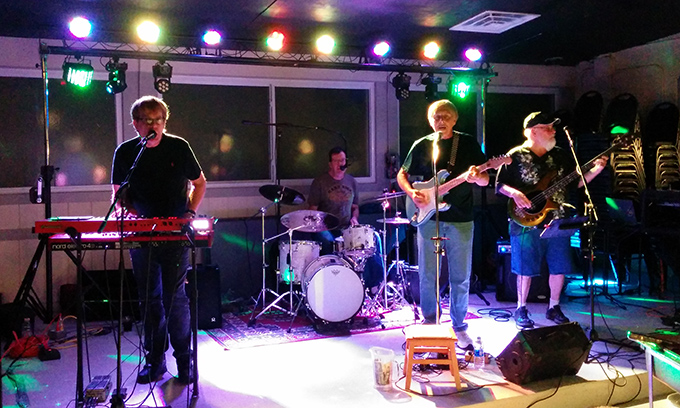
And right now my second band (the Barons don’t count – only the Daybreakers and Crusin’) is rehearsing for a season of around eight gigs this summer, and the intention of recording an album. We have been working on originals, which is of course an insane thing for an oldies band to do. The last thing an oldies audience wants is original material.

But I feel like we’ve earned the right. We’re in the Rock ‘n’ Roll Hall of Fame, too, after all. Twice. Okay, the Iowa one, but it counts.

To me it does.

* * *

This article at World Geekly News considers Road to Perdition the best comic book adaptation ever.

M.A.C.

Inspiration, Perspiration and Exasperation

Tuesday, January 29th, 2019

Paperback:
E-Book: Amazon Google Play Nook Kobo iTunes

USS Powderkeg will be available on February 1. You are unlikely to find it in a bookstore, so go to Amazon or Barnes & Noble or BAM! iTunes has it, too – read about that here.

Info about the book itself is available at Brash Books.

We have used the cover before, but this book – finally under my preferred title with my revised text – is important to me and will require some effort on your part to lay hands on it. This is the novel based on my late father’s experiences in World War II as one of a handful of white officers on an ammunition ship whose crew was otherwise African-American.

After shrugging off our disappointment at Scarface and the Untouchable not getting nominated for an Edgar – my “shrugging off” included expressing how pissed off I was, on Facebook – my co-author, A. Brad Schwartz and I are digging in to make some corrections and additions to the upcoming trade paperback edition (June 4).

This will include a new preface as well as bonus material (in the style of DVD extras) that will focus on the newly discovered case file of one of the Untouchables, which serves to underscore and further verify our conclusions about Ness and how he and his team have been underestimated and short-changed by history.

We are also prepping for a visit to the Mob Museum in Las Vegas over Valentine’s Day, about which more will appear here next week. Brad has also been out on the stump by himself somewhat, as I have been burrowed in, here in very cold Iowa, working on novels. Yesterday day I completed the new Quarry novel, Killing Quarry – although I will be re-reading it and tweaking it and such for a few days this week.

Anyway, among Brad’s adventures in promoting our book (did I mention the criminal overlooking of this major tome by the MWA true crime committee?) included this fine interview.

Speaking of the MWA committee’s neglect, someone I trust has suggested the intimidating length of the book probably put some or all of the committee members off. I suspect some truth might be found in that opinion. Having served on MWA committees, I know it’s a fact of life that the committee members are swamped with books to read in full. On the other hand, the advance notices (particularly the fine mini-review from Grand Master Sara Paretsky) should have encouraged them to do so, anyway.

What can you do to help make the pain go away? Well, if you attend Bouchercon this year, you can vote for Scarface and the Untouchable in the non-fiction Anthony Awards category.

I know I plan to.

Hey, I realize this is undignified and sour grapes and boo-hoo-hoo. I have a love/hate relationship with awards, anyway (love to be nominated, hate not to be, and also losing). But awards as respected as the Edgars bring new readers to the nominated works and especially those that win. They have importance only in that regard, because otherwise it’s just a bunch of subjective nonsense.

I feel much the same way about reviews. I want good reviews not because I need validation, but because more readers will come to the books. I would be lying if I said bad reviews don’t matter to me, because they do, and not just in the sense that they discourage readers (sometimes, oddly enough, such reviews don’t always work that way). But it hurts to have something you’ve put hard work into savaged and/or dismissed, particularly when a smart reviewer nails you for something you’re guilty of.

What hurts about Scarface and the Untouchable is the work, and the years of research, that went into it. I am less angry about this for myself and more for my co-author, whose research (building on my original research in Heller and Ness novels) has upended conventional wisdom about Capone and his tax woes, and Ness and the lack of respect and credit he gets, from those who resent how Hollywood portrayed him. Brad did a stellar, mind-boggling job.

He deserved better.

* * *

As I mention, I finished Killing Quarry yesterday, and will dig into minor revisions throughout the rest of the week. I have a particularly full plate this year, which is why I have written three novels in four months – Murder, My Love with Mike Hammer; the Caleb York novel, now entitled Hot Lead, Cold Justice (my original title, The Big Die-Off, deemed too obscure); and now Killing Quarry. Very shortly I will begin serious work on Girl Can’t Help It, the prequel to the forthcoming Girl Most Likely, a task for which I’ve allowed several months. This will be followed by my draft of Antiques Fire Sale (Barb’s working on her draft now), which I have allowed another month for.

This is, of course, insane. Why do I work so hard? Why is somebody who has five doctor’s appointments with specialists this month behaving like this? Should I slow down? Barb thinks I should.

But I like doing this. I really do. And – while I feel fine and all my reports so far (the dentist today) have been positive – when you are 70 and in a month or so will be 71, you sense that maybe you don’t have all the time left in the world to tell your stories.

And I came here to tell stories.

All of which is prelude to what I want to discuss today. Would you agree that everybody has bad days? Various kinds of bad days, of course – from the simple out-of-sorts day to the depressed-about-bad-news day (not getting an Edgar nomination for a ground-breaking book, to just pull an example out of the air) to the nothing-is-going-right day to…you get the idea.

Now I’m not talking about a sick day (in my business, cold and flu generally don’t count – open-heart surgery does) or a day when tragedy has struck a loved one or friend. Nothing like that. Your favorite aunt dies? Take the day off with my blessing!

No, just that typical terrible, horrible, no good, very bad day.

When you are writing on a six-day-a-week schedule, with a deadline bearing down, you write anyway. Writer’s block is not allowed, and I never have it, anyway. Recently I thought I had finally encountered this mysterious, possibly mythical beast – I could not get a single workable thing on paper. I always start with a rough draft, knowing that I’m creating the clay for me to shape into sculpture. But this time, I couldn’t get anything on paper worth building on.

Why?

Well, turned out I was effing exhausted! Just flat-out fried. So I took a two-hour nap, as elderly folk are wont (and permitted) to do. When I got up from my snooze, the words flowed. Maybe not like wine, but definitely Coca Cola.

During the writing of Killing Quarry, I had perhaps three bad days – one of them Edgar-related, which of course I won’t go into. Ironically, one of that sorry trio was the last day of the process – the day on which the crucial last chapter was written.

Knowing I was facing a key part of my story, I considered taking the day off – it was Sunday, after all – and just letting my batteries recharge. But I hadn’t run this race to goof off just shy of the finish line. Plus, all of the plot stuff was filling my brain and assembled into good order – I knew exactly what needed doing.

So I did it.

It was something of a slog. I usually do three drafts of every chapter, then give it to Barb, who gives me notes, and I make minor corrections and revisions (sometimes they’re major – Barb has great story sense), and I’m done till the final read-through. Yesterday I did three drafts, took an hour nap, then came back and did another draft. Barb did her read-through and I made a few revisions and corrections from her notes. If you’re keeping score, that’s an additional draft or pass on the chapter.

Now, here is the lede I’m burying (why is it spelled “lede” not “lead”?) (and why don’t I just Google that and not bother you about it?): how does inspiration figure into a working fiction writer’s process?

I would imagine all of us have bursts of inspiration, sometimes entire work session-long ones. Maybe some writers feel inspired for days or even weeks – trust me, they don’t feel like that all the way through a project. Everybody has bad days, remember?

There are two kinds of writers – the ones who can only write on their inspired days, and who navel-gaze on their (many) off days; and the writers who are thankful for the inspired days that God or luck or somebody or some thing grants them, and who on their bad days soldier on. March through the mud to victory, or at least the end of the work day.

Now here is the real dirty little secret about inspiration – the inspired work and the struggle-to-get-through-it work are always of the same quality. When you go back and read through your story or novel, and recall the passages that came easily as if by automatic writing, those passages won’t be any better or worse than the stuff that came hard.

Or anyway those passages shouldn’t be.

Inspiration is just the days the work is going well. If you are any good at all as a writer, you will develop standards that you will not allow yourself to fall below, before you press on. You stay at it till the work you had to work hard at reads just as well as the work that came easy.

* * *

This story about Black Panther’s Oscar nominations mentions a certain other comics-derived film that once-upon-a-time received five nominations (hint: Road to Perdition).

A cry goes out to reprint the Marshall Rogers Batman comic strip. Who was it wrote that again? (Hint: me.)

Finally, Scarface and the Untouchable made Otto Penzler’s Mysterious Bookshop best of the year list, as chosen by the staff – see “Mike’s Picks” on page three.

M.A.C.