Posts Tagged ‘New Releases’

Menace & Shrinking Island Giveaway…And Robert Morse

Tuesday, April 26th, 2022

The publication date of The Menace by Mickey Spillane and myself (from Wolfpack’s Rough Edges Press) is August 27 (Wednesday of this week, as I write). To jump-start some reviews of this and of The Shrinking Island (the collection of Mickey three YA adventure novels), I am announcing right now a book giveaway. Winners agree to write an Amazon review; other reviews are also encouraged.
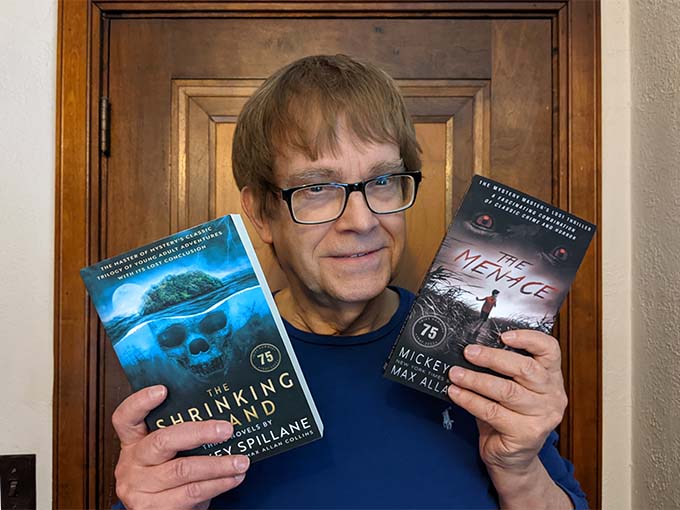
M.A.C. holding copies of The Menace and The Shrinking Island

I have five copies of The Menace and five copies of The Shrinking Island for the first ten who request a book by writing me at macphilms@hotmail.com. Tell me which book you prefer, but if your choice is gone, the other will be sent. You must include your snail mail address, even if you’re entered before. These will go fast.

As usual, USA only.

The Menace is a special book. It is unusual in several respects. The Mike Hammer novels under the Spillane/Collins byline reflect me finishing books of Mickey’s in progress or put aside at the time of his death in 2006, or novels developed from synopses he left behind. I’ve also done from partial Spillane manuscripts two non-Hammer novels – The Consummata (with Morgan the Raider from The Delta Factor) and a standalone (Dead Street), with a very Hammer-like protagonist.

The Menace was developed from an unproduced screenplay in the Spillane files. It was apparently written shortly before or around the time he and I became friends in 1981, and he spoke to me of it frequently. He seemed to have an independent production in mind; he was friendly with South Carolina indie producer, Earl Owensby, who had his own studio, and the two had explored doing projects together. Nothing came of it, but The Menace indicates something might have.

But the screenplay was short – around 40 pages – and seems either to be a condensed version designed to attract investors or a version that could have been a pilot for a one-hour anthology series, probably with Mickey hosting. (In the forthcoming Mysterious Press biography by Jim Traylor and me, Spillane: King of Pulp Fiction, we explore Mickey’s efforts to put a mystery/crime anthology on the air with himself as the on-camera Rod Serling or Alfred Hitchcock).

What is particularly interesting about The Menace is the genre – while one foot is in a crime/mystery story, the other is in horror. Elements of horror were a part of Spillane’s novels from the beginning – he brought the horrors of graphic violence to his post-war crime fiction – the endings of Kiss Me, Deadly and My Gun Is Quick come to mind – and flirted with horror themes in The Twisted Thing and his last Hammer-in-progress, The Goliath Bone.

But The Menace is specifically Mickey reacting to the success of Stephen King. I go into this in my intro to The Menace, and will only say here that it was a Spillane reaction to King’s enormous success as a writer who became a media star and who carved out his own new niche in popular fiction. It’s fair to say that King has been imitated in much the same way Mickey was in his heyday.

Spillane did not, however, like the supernatural aspect of King and that other huge success, The Exorcist (book and film). As a Jehovah’s Witness, he took demons and the devil very seriously and did not consider them appropriate subject matter for fiction. He didn’t cry out for censorship, and in fact called King “a great writer”; but that type of horror was not for him.

The novel I’ve fashioned from his compact screenplay is unusual in its crime/mystery aspect having no Mike Hammer substitute at its center, though a tough small-town police chief is one of the two protagonists. The story is about a family where the husband (a self-made-man doctor) and wife (an artist from a wealthy family) have been driven apart by their disagreement over how to raise their ten-year-old “special needs” son. During much of the action, the estranged couple and their boy are in a big old spooky house, the grounds behind walls, which becomes the setting for a siege of sorts involving an Aztec mummy who may or may not still be breathing and a creature who may or may not be human. And at its heart is the story of a family coming back together in adversity.

Not typical Spillane elements, but typically compelling Spillane storytelling. Like the adventure stories he wrote in his last decade – The Shrinking Island, Something’s Down There and The Last Stand – The Menace indicates an author trying to break away from Mike Hammer and flex other storytelling muscles.

I am very proud of the book and think it shows a whole other side to Mickey Spillane. It’s a relatively short novel – 40,000-words – but we have included as a bonus the original, previously unpublished version of the short story “The Duke Alexander” and a rare non-fiction crime story by Mickey, “The Too-Careful Killer,” unseen since 1952.

* * *

Yet another of my heroes has left the planet. As if losing Norm Macdonald and Gilbert Gottfried weren’t enough, a selfish God has taken Robert Morse away. Granted, Bobby Morse had a 90 year-run, and I admit when Barb and I screened How to Succeed in Business Without Really Trying in his honor over the weekend, we could not mourn. We could only get caught up again in the joy of experiencing the magical, shamelessly mugging musical comedy performance that is Robert Morse playing J. Pierpont Finch.

I started thinking about what I was going to say about How to Succeed and Morse, but thought I should check on what I’d said on the subject in this space before. And I discovered that in a post in 2017, I had already said the things that my mind was putting together for me to share now. So I’m going to do something I don’t believe I ever have here – I am going to rerun my response to seeing the Twilight Time Blu-ray edition of How to Success in Business Without Really Trying.

* * *
As you may have gathered, if you’ve stopped by here at all frequently, I am a collector of movies on Blu-ray and DVD. Many of my favorite films have made it onto Blu-ray, like Kiss Me Deadly and Gun Crazy (though I had to get that from Germany). And a fairly short list of my favorites remain on DVD only, like the Chinatown sequel, The Two Jakes, and the great film version of the Broadway musical, Li’l Abner.

One of my favorites, poorly represented with a terrible transfer on DVD, has finally made it to Blu-ray, in a limited edition of 3000, from Twilight Time, the boutique label that has brought us any number of terrific films, from The Big Heat to the Hammer Hound of the Baskervilles, from a Sinatra Tony Rome double feature to Pretty Poison.

But this time – and my birthday month yet – they have given me (and Barb and for that matter son Nate, who also loves it) a film I could watch once a week – How to Succeed in Business Without Really Trying.
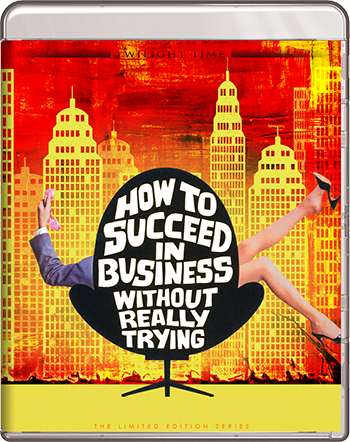
There are those who can find reasons not to like this movie, just as there are people who can find a reason not to like ice cream. They are to be pitied. How to Succeed features a brilliant, witty, acid but not hateful score by the brilliant Frank Loesser. A Pulitzer Prize-winning musical (yes, Pulizter Prize-winning musical) in 1961, the Broadway version skewered the shallowness of big business in an up-to-the-moment manner. Unfortunately, the timing of the film’s release – 1967 – made How to Succeed’s cutting-edge satire seem dated, a lot having happened since ‘61.

Fortunately, time has been kind to this early ‘60s musical, with its bright Batman TV colors and cartoon images come to life (cartoonist Virgil Partch – VIP – was a consultant) and Bob Fosse choreography that is as witty and biting as the original play itself. (Fosse is not the actual choreographer of the film, but he’s credited as the source.)

A number of players from the Broadway show are retained, including Michelle Lee (who was the second Rosemary Pilkington in the original cast), the very funny Rudy Vallee, Ruth Kobart, and Sammy Smith, with Charles Nelson Reilly’s Bud Frump M.I.A., though decently replaced by Anthony Teague. Maureen Arthur – a live-action Little Annie Fannie – was in the national company of the musical and joined the Broadway run later.

I saw the national company in Chicago when I was in high school and fell in love with the musical then. The cast included Dick Kallman as Finch (later star of Hank on TV), who was excellent, with the second Great Gildersleeve, Willard Watterman, in the Rudy Vallee role. And of course the eye-popping Maureen Arthur was Hedy LaRue (“O.K. Charlie!”).

Two things make this film one of the best transitions of a Broadway hit to the big screen. First, director/writer David Swift – with credits like Pollyanna and Under the Yum Yum Tree enough to make one doubtful – had the surprising sense to film faithfully a show that had won seven Tony Awards, the New York Drama Critics Circle award, and the 1962 Pulitzer Prize for Drama.

The other thing is Robert Morse.

His J. Pierrepont Finch is my favorite performance in any musical film. He shamelessly recreates the Broadway role with only the slightest concession to movie technique. He understands, as does the rest of the cast (though not on this level), that he’s appearing in a cartoon. His character, who climbs from window washer to the chairman of the board in a few days, following a self-help book that provides the film’s narration – should be unsympathetic. He’s manipulative and dissembling and is never seen really working (not really trying, remember?); but the boyishness of Morse himself smooths the edge off.

Morse brings a remarkable energy to his songs and his loose-limbed dancing brings James Cagney to mind. In the ensemble, “Brotherhood of Man,” in the midst of a sea of Bob Fosse choreography, brilliant scene-stealer Morse knows just how to draw the viewer’s eye, chiefly by lagging like a jazz player behind the melody just enough to seem improvisional among all the precise dancers. He alone seems spontaneous.
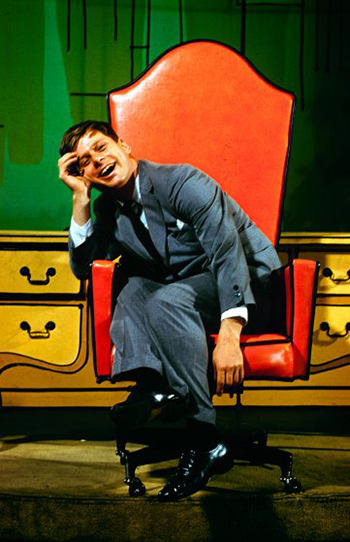
Does he mug? Almost constantly. His performance is basically Jerry Lewis Goes to Graduate School. Somehow, playing a ladder-climbing nogoodnik, he seems joyful – the perfect conveyer of Loesser’s lyrics, with their hidden dark side.

Famously, the big hit love song from How to Succeed is sung by Morse’s Finch…to himself in a mirror. Few scores rival this one, though like Sondheim, Loesser writes to the story. The songs that were left out (“Paris Original,” “Happy to Keep His Dinner Warm”) are the weakest in the show. The only loss, besides Charles Nelson Reilly, is the great “Coffee Break,” which was filmed but cut for time. Too bad it doesn’t seem to have survived to be a special feature.

Morse and Reilly, by the way, were so successful on Broadway that they made an album together, “A Jolly Theatrical Season,” in 1963.

If the name Robert Morse seems vaguely familiar to smart younger people, he played Bertram Cooper on Mad Men, a role he was cast in, in tribute to his star turn in How to Succeed. Toward the end of Mad Men’s run, Morse was given a lovely song-and-dance farewell.

Morse’s career on Broadway was a stellar one, particularly his roles in Sugar and his one-man play, Tru, in which he played Truman Capote, winning his second Tony. But his film legacy is, largely, How to Succeed. No other film caught his magic, and a few really did him no favors – Honeymoon Hotel; Quick, Before It Melts – though The Loved One and Guide for the Married Man are worthy credits. I used to feel sad that this great talent had only one film to do him justice.

But with How to Succeed finally on Blu-ray, and with Mad Men as a wonderful, Emmy-nominated coda, I can only smile.

Nice modern-day (separate) interviews with Morse and Michelle Lee are special features. No “Coffee Break,” alas.

Buy it here.

* * *

UPDATE: The Twilight Time Blu-ray is still available but is pricey from some sources, although Screen Archives still has it at $20.

Let me add a few thoughts. Morse, who I describe above as “Jerry Lewis Goes to Graduate School,” shared with Lewis an inability to move from boyishness into anything else. It took the heavy make-up of his Truman Capone one-man show to briefly change that – he won a second Tony for it, after all – but he remained a boyish persona.

His rise to success (and Succeed) came from a string of stand-out youthful Broadway roles that culminated in J. Pierpont Finch being designed as a star vehicle for him. Two Broadway revivals have not shown their popular stars able to make their performances anything but reminders of how good Morse was.

He worked. He had a career. For a while he remained hot on Broadway, with Sugar (the musical version of Some Like It Hot) in 1972 a particular highlight. But mostly it was episodic TV and TV movies (he played Grandpa Munster in one), Pringle commercials and lots of cartoon voiceovers (Teen Titans, toward the end) – not what his dazzling How to performance promised.

That he had Mad Men as a last act is wonderful. But he deserved more. And we deserved more Morse.

* * *

Richard Piers Rayner’s phenomenal work on Road to Perdition gets some nice notice here in a piece on movies that recreated panels from the comic books they were based on.

M.A.C.
Quarry Hits the Big Times

Tuesday, March 1st, 2022

It’s been ages since I’ve had a New York Times review of one of my novels. I’ve had some nice write-ups there – don’t recall a bad one – but this is the first ever Quarry novel the Times has reviewed. Here goes:

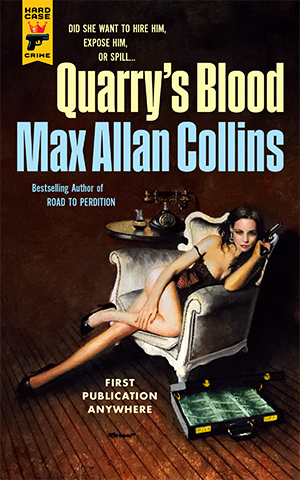
With QUARRY’S BLOOD (Hard Case Crime, 224 pp., paper, $12.95), Max Allan Collins finally bids goodbye to Quarry, his Marine sniper-turned-professional assassin, more than 10 years after The Last Quarry, by its title, promised to do so. This time feels like it’s for keeps, as the novel is set more or less in the present (there’s a reference to a character dying of Covid), and Quarry, pushing 70, is looking forward to retiring after all those decades of killing for hire.

Retirement, however, is put on ice when a true-crime writer, Susan Breedlove, shows up at Quarry’s door looking for some answers. Her arrival opens a portal into full-on metafiction, as the line between what Collins has published since the mid-1970s and what has spilled out into the actual world (like a television adaptation) grows so porous as to cease existing.

It goes without saying that the body count will pile up, and that Quarry, despite his aching body and slower reflexes, still operates at a more ruthless clip than almost anyone he encounters. This is a sure-footed ending to a series that marinated in the excesses of pure pulp.

That’s a swell review, but what’s interesting to me is to how the word “pulp” has become a compliment in recent years – possibly thanks to Quentin Tarantino’s Pulp Fiction – when for decades it was a pejorative. Now it denotes a certain style of fiction (often consciously retro) viewed with a positive, even affectionate spin.

Equally interesting to me is that this is the first I’ve had a paperback original reviewed in the Times, at least that I can remember.

So far the reader response, and reviewer reaction, has been very warm indeed to the new Quarry. It was a risky novel to write, as you readers of the book already know, because I ventured into “meta” territory, big-time. I don’t want to say more, but I will say that one of the things I dealt with is just what exactly Quarry has been writing in these first-person narratives all these years.

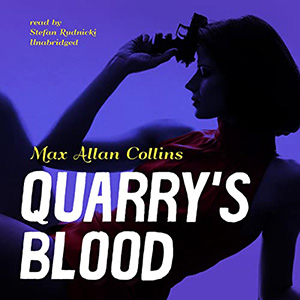
Quarry's Blood Audiobook cover
Digital Audiobook: Audible Purchase Link

Out right now is the audio book of Quarry’s Blood, read by the wonderful Stefan Rudnicki. The cover is pictured here. I have not listened to the audio yet, but will begin sometime this week, when we take a day off to celebrate my 74th birthday. (It’s March 3rd, not yet a national holiday.)

Stefan has become the voice of Quarry for me, just as Dan John Miller is Nate Heller.

Check out an excerpt here:

* * *

I am working on the new Heller novel now, ridiculously immersed in it, and for that reason this will be a short update. I would like to respond to Bill P’s follow-up comment on a discussion about writing, readers and reviewers that’s been going on for a few weeks here. I misunderstood Bill’s use of “archetype,” thinking he meant the characters I write about; but he was thinking of the archetypical reader I envision.

I accidentally answered that, by saying that I write to please myself, and my wife Barb, who is my first reader as I go along (meaning she reads the chapters as I complete them). I do, however, envision a reader. I don’t think specifically of a male or female, just someone who shares my interests and tastes, and the ideal reader is probably of my generation or the generation or two on either side of mine. A major part of my approach is my assumption that the reader is at least as smart as I am. He or she might be smarter, but not so much smarter that my work seems childish or beneath them. I never assume – never – that the reader isn’t as smart as I am. I endeavor never to write down.

The only slight exception – the only “sort of” exception – is when I write a first-person story in the voice of someone not as smart as me. I’ve only done this a few times, and it’s tricky (Shoot the Moon is one). This relates as well to writing in the point of view (when in third person) of someone who isn’t as smart as me. Who might be dumb, like Lyle in Spree. All I can say is that these characters never think of themselves as dumb, just as the antagonists of the protagonists never think of themselves as the villains.

I’ve made it clear here that I abhor writing that tries to impress – that spends too much time showing off. In this approach, the story almost always pays the price.

* * *
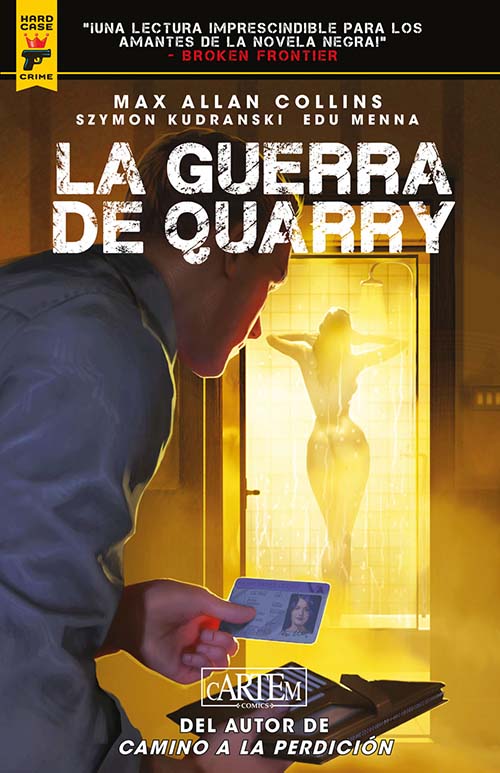
La Guerra De Quarry (Quarry's War, Spanish Edition) cover

I wanted to share with you this cover of the graphic novel Quarry’s War in Spanish.

I don’t remember Quarry appearing in Spain before. Road to Perdition did, which may be what led to this edition.

Here is a very smart review of Quarry’s Blood. This reviewer is always worth reading.

M.A.C.

Who I Try To Please

Tuesday, February 22nd, 2022

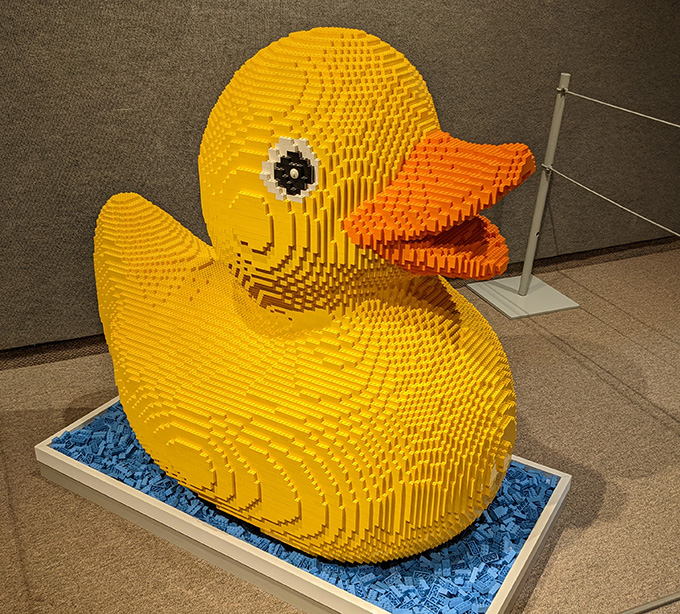
No book giveaway this week. To make up for it I am including a cute photo of our two grandchildren, Lucy and Sam, taken at the Muscatine Art Center’s lego display. You’re welcome.

Muscatine Art Center Lego Exhibit, Sam and Lucy
Muscatine Art Center Lego Exhibit, Rubber Duckie
* * *
Quarry's Blood
Paperback: Indiebound Purchase Link Bookshop Purchase Link Amazon Purchase Link Books-A-Million Purchase Link Barnes & Noble Purchase Link Target Purchase Link
E-Book: Google Play Kobo

Patience – another book giveaway will come. I just don’t want to detract from the release today (Feb. 22) of Quarry’s Blood. And winners in that book giveaway, will on that date be able to post reviews on Amazon.

* * *

And speaking of Quarry’s Blood, I want to share this great review from Ron Fortier at Pulp Fiction Reviews:

QUARRY’S BLOOD
By Max Allan Collins
Hard Case Crime

Max Allan Collins has been writing stories about his Vietnam veteran hitman since 1976. It was obvious from the start that the author and his creation were the same age making it easy enough for him to place the stories in time. Collins did a few Quarry books and then walked away from them. When Hard Case Crime came along, publisher Charles Ardai, a fan of the character, urged Collins to bring Quarry back. Collins, obviously older, as was his hero, realized he had a golden opportunity to write a finale.

What his crystal ball couldn’t predict was how successful “The Last Quarry” would become among his ever growing audience. And there was Ardai wanting more. Collins pulled a very neat hat-trick and went backwards with “The First Quarry.” Which of course meant dusting off his own memories of those long ago times and their social environs. All of which he did making it seem effortless.

Having thus given us the alpha and omega, it seemed we mystery/crime fans had seen the last of Quarry. Again we’ve been proven wrong in this new “Quarry’s Blood.” It’s pretty much a gripping fast paced epilogue and so much fun. We catch up with an aging Quarry, almost about to reach seventy and widowed for the second time. He’s content with living a quiet, if lonely life, until a very savvy female writer named Susan shows up on his doorstep. As it turns out she’s the author of a bestselling true crime novel that was clearly inspired by Quarry’s lethal career and she’s convinced he is the real hitman she researched in her book.

Unnerved by all this, he maintains his false innocence and sends her packing. The following day, while taking a pre-dawn swim at a nearby indoor pool, he’s nearly killed by two professional assassins. No way is it a coincidence and Quarry finds himself once again being pulled into his old world of hunter/prey, kill or be killed. But what’s the connection to Susan? And who, after so many long years, wants him dead and why?

This is one of the best Quarry books ever. Maybe we think that because we’re seventy-five, a Vietnam veteran and often times think about all our brothers who never made it home to their families and loved ones. Who never got to drink another cold beer or read a damn good book like this one. Thanks, Max, for all of them.

Thank you, Ron, for reading them. When a Vietnam vet reacts well to these books, I am especially pleased.

* * *
The Amazing Spider-Man

Okay, so sometimes I’m wrong.

Ten years ago, I thought The Amazing Spider-man with Andrew Garfield was lousy. But because I really liked the recent Spider-Man: No Way Home, in which all three big screen Spider-men were deftly woven into one narrative, I decided to pick up a 3-D Blu-ray of Amazing Spider-man (cheap) and Barb and I watched it tonight.

We loved it.

Part of this is our affection for Andrew Garfield in other films he’s been in that made us more open to his casting, and of course he’s very good in No Way Home. Part of it was how terrific the film was, really taking its time to explore the origin of the character in a way that was at once faithful to the original comic book and at the same time fleshed it out. Also, the attention by the filmmakers to mimicking artist Steve Ditko’s classic poses for Spider-man was thrilling to someone who had followed the character from Amazing Fantasy #15 and The Amazing Spider-man #1 to the end of the John Romita-drawn run.

Mostly our positive reaction, however, came from meeting the film on its own terms. This is true of novels and short stories, too. I’m a big believer in that, but I sometimes don’t take my own advice. In retrospect, I disliked the Garfield version of Spider-man, ten years ago, because I felt it was superfluous – that it was too soon to do a reboot (a term I don’t believe was in use yet). As a Sam Raimi fan – I saw Army of Darkness in a theater on its first release – I liked his version just fine, though the third one was not up to snuff. But Toby McGuire’s Peter Parker/Spider-man (should I have inserted a “SPOILER ALERT” there?) seemed definitive.

Now reboots are part of the plan, and No Way Home has rather brilliantly found a way to make all three versions of Spider-man at the movies exist in the Marvel Universe.

I mention this not just indicate any growth on my part, but as an adjunct to discussions here (on the update/blog itself and in the comments) about the value of reviews. I don’t recall if I reviewed Amazing Spider-man here ten years ago, but if I did, I probably panned it.

A review is just an opinion, and a snapshot of how the reviewer reacted to a film or novel at that time. Opinions can change, and they often should. I am always after my readers to post reviews at Amazon, and have made my preference for receiving good reviews no secret. But it really doesn’t have much with making me feel good (okay, a little), but mostly to help market the books. To draw attention to them and encourage new readers.

In the comment section last week, Bill P said the following:

So, if you as an author realize this is a collaboration with the reader, do you have an archetype in mind during writing for the intended audience? Does thinking of their acceptance/rejection of your choices guide you or limit you? And when you try to grow from that core audience from book to book, do you find some reject you extending those boundaries because they want the constancy of the world you have previously created?

I answered this last week, in the comments; but I think Bill raises topics worth discussing in a bit more depth.

I love my readers – money gets sent to my house because of them. But the truth is I write for only two people – Barb and myself. Primarily I write for me, because I am always trying to write a book that I would like to read. I am trying to satisfy my needs and express my ideas and to make something. Create something. Barb is secondary in this process, but incredibly important. I cannot imagine writing if she were not reading what I’ve written.

Now, that doesn’t mean she reads everything – she certainly skips introductions and essays and such that I occasionally write. But all of my fiction goes to her as my first reader (with novels, a chapter at a time). One reason for that is her abilities as a writer – even before she developed her skills along those lines, she had incredible story sense, and a remarkable bullshit detector. She knows when something isn’t working in a scene.

Also, and you’ll have to forgive the sentiment here, but I love her and want to please and impress her. To make her think I was worthy of her spending her life with me. I need to impress her because a lot of the time I am a buffoon.

Being my critic-in-chief isn’t an easy role for her. I hate criticism. I have a thin skin. (Not a desirable trait in a writer.) (Or anyone.) Sometimes I don’t react well. But generally she knows how to handle me (sad that she has to) and I know she is trying to protect me. Yes, from myself.

I don’t make any attempt to please readers by writing the same kind of thing every time out. For a long time, in the movie and TV tie-in days, I had to write all sorts of things to make a living. It was good for me, because I learned a lot writing in different genres – the movie novels, as I’ve mentioned here, included war, western, romance, science-fiction, sword and sorcery, horror and other themes forbidden to me in my narrowly defined role as a mystery writer.

But within mystery fiction, not everything I do pleases every reader of mine. When I do something like John Sand, occasional howls of displeasure have arisen. It’s probably no surprise that fans of Quarry might not be interested in the cozy comic Antiques novels. Quarry and Nolan fans sometimes find the longer length and historical approach of Nathan Heller off-putting, though Heller and Quarry and Nolan are cut from similar cloth.

I can’t help that. First, I need to make a living, and second, I need to stay fresh and interested. If I were doing one Quarry novel after another, in a row, I’d likely grow tired and to hate him. As it is now, it’s like spending time with an old, good friend (who kills people).

I do make concessions both to publishers/editors and to the type of book I’m doing. I have a sense of what’s appropriate for a given title. For John Sand, Matt Clemens and I decided to be very sparing with the “f” word – we hardly use it at all, whereas Quarry and Nolan and Heller readers know I am not fucking afraid to use it. In the Fancy Anders novellas and The Many Lives of Jimmy Leighton, that kind of effing profanity just didn’t seem appropriate. It wouldn’t be in the Antiques novels, either.

To me that’s just bringing to a given novel what is appropriate for that novel, and, yes, its audience. I don’t think that’s selling out – I think it’s being a conscientious professional.

I don’t know how to answer Bill’s archetype question. All of the first-person narrators are me – me in different circumstances, but me. In writing tough guys like Nolan, Quarry, Heller, even Mike Hammer, I strive to make their surfaces – and their inner lives – reflective of each being a real person. Not a type.

M.A.C.

John Sand, Jimmy Leighton, Mike Nesmith and Christmas Music

Tuesday, December 14th, 2021

My concern for your welfare knows no bounds. Hence, I am helping you with your Christmas shopping by pointing out a couple of possibilities for last-minute gift-giving (or post-Christmas use of Amazon gift cards). Later on this page I will talk about some Christmas CDs you might wish to consider. But first….

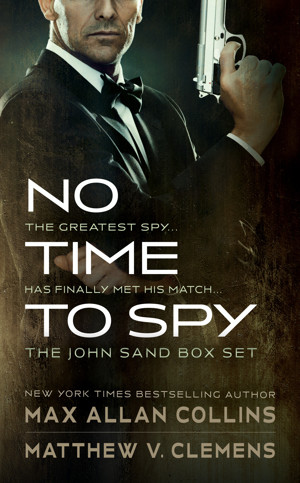
No Time to Spy: The John Sand Box Set cover
E-Book: Amazon
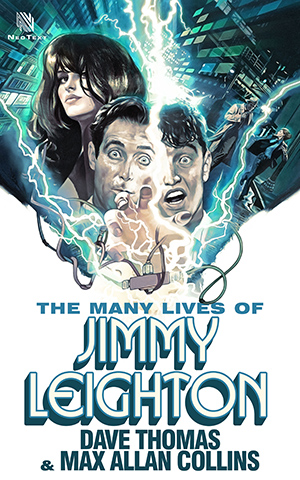
The Many Lives of Jimmy Leighton
E-Book: Amazon Purchase Link
Trade Paperback: Amazon Purchase Link

The three John Sand spy novels, collected in an omnibus titled No Time to Spy, will be out tomorrow (Dec. 15, 2121) on Kindle. It’s a mere $5.99. A print version will follow, probably before the end of the year.

Get it here.

The Many Lives of Jimmy Leighton is on sale on Kindle for a ridiculous $3.99. The trade paperback, with a cool Faye Dalton cover, is available now for $8.99, also a steal. You can order right here.

Dave and I did an interview about The Many Lives of Jimmy Leighton for The Dave Thomas Appreciation Page on Facebook. Emily Elizabeth conducted it. Here it is:

For those who do not know much about the book, can you give a brief summary to your followers here at Dave Thomas Appreciation?

MAX: It’s a contemporary hybrid of a science-fiction novel and a crime story. Jimmy Leighton is a smalltime thief who stumbles into a quantum experiment and gets thrust into one version of his life after another – various paths he might have taken but didn’t. Part of what sends him cycling through his many lives is getting shot, and throughout all of his trips he is in a coma in the hospital in the initial timeline. There two police detectives are trying to solve the mystery of who shot Jimmy Leighton – they are a mismatched pair, a veteran Black widower and a virtual rookie who is female and gay. How they come together as a team is a story in itself.

DAVE: Okay, Max has summed it up pretty well. Anything I would add to that would be redundant and boring.

There’s no denying that the concept of Jimmy Leighton is impressively unique, and that is quite the rarity these days in an endless cycle of regurgitated remakes and done-to-the-death storylines, so having a novel like this is beyond refreshing and is something we could all really benefit from, more frequently, as an audience. How did you initially develop the idea for the story?

MAX: I’ll defer to Dave on that, except to say that he had more than the basic idea – he had a story treatment and two or three chapters. That was our beginning and as both of us have experience in the world of crime fiction – me as a novelist primarily, and Dave working on Blacklist and Bones – we developed the secondary story about who-shot-Jimmy-Leighton.

DAVE: Okay, so here’s what happened. Initially, I came up with The Many Lives of Jimmy Leighton as an interdimensional television show – I’ve always been interested in time travel and other dimensions, and I’ve had more than one idea in this arena. However, when I researched the physics behind a theoretical move to another dimension, I came up with Princeton Physicist Hugh Everett III who introduced a concept in 1957 that became known as the Many Worlds Interpretation. What Everett said was that all the outcomes of every choice exist – even if they are not realized. For example, you come to an intersection and can turn right or left. If you turn right and get home safely, that’s your reality. But if you had turned left, you might’ve been in car accident and there would’ve been consequences to that. Everett believed that the right turn – the road not taken – created a universe where all the consequences of that righthand turn would tumble out, creating other choices and other consequences that ultimately created a different reality or universe. To me, the idea that there might be other universes where our lives are different, sometimes not dramatically different and other times very different, was intriguing. So, I worked this into a story about a little thief from South Boston who sticks his nose into a quantum physics experiment as a way in. Then I created some other characters and worked it up into a pitch for a television show. Well, it didn’t sell. So, I decided to write it as a book, something I’d never done but I’m always up for a new challenge. Well, I wrote three chapters. And then, in characteristic Dave Thomas style, I moved on to another better-paying project. I’m old-fashioned and I like to get paid for my work. So The Many Lives of Jimmy Leighton just kind of sat there for a year or two until I met Max. Now Max is an accomplished novelist and I was excited to hear what he had to say about this idea. Was it a novel or just a failed TV pitch? He read it, liked it, and said, in his opinion, it could be a novel. But then he went on to say he’d be willing to get me a book agent, a publisher or – what he’d rather do is write it with me. Well, that was all I needed to hear. I mean, the guy has written more than 100 novels and I had written…well, none! So, we started to talk and, very soon, Max helped me realize that what I’d come up with was not a novel at all but merely a layer for a novel. Working with Max made The Many Lives of Jimmy Leighton into a book. We added the two investigators, Neer and Farr, and the concept that Jimmy had been shot when he broke into the physicist’s lab – that became a mystery layer of the story that grounded the whole sci-fi concept. And what was a particular surprise to me, was that the idea of Jimmy getting shot also helped make the physics behind the book make more sense. Because, according to Everett, the only way to cross the barrier from one dimension to another was to commit “quantum suicide.” Well, we weren’t going to do that because we wanted Jimmy to be able to come back at the end of the book to the dimension where he started and resolve the story. But getting shot and hovering in a coma, halfway between life and death – now that gave Jimmy an entrance to other versions of his life that he couldn’t control. Okay, I know, I know, this is much more of the mechanics of our writing that anyone needs or wants to know. But this is an example of how the collaboration made this book greater than my original concept for it. The sum of the parts, right?

What would you say was your favorite thing about working with each other?

MAX: Dave challenges everything – makes me reach for something new or different, not just the path of least resistance. Also, we share a lot of interests, and it’s always fun when we realize we have something other enthusiasm in common.

DAVE: I think I answered that in the previous question. But maybe I could add that I learned a lot of technical stuff working with Max – things that a writer needs to know when he moves from one type of writing which, in my case was television, to another form – namely, the novel. Max knows novels and he was my teacher in this collaboration. There were just so many technical things about writing a novel that I needed to know that I didn’t know. It’s funny, I went all the way through university to the Masters Degree in English literature, taking apart the works of famous writers like Conrad, Vonnegut and Faulkner, writing essays on style and structure but that does not teach you how to write a novel. To do that you need someone like Max, someone who has spent years sitting in front of a typewriter, banging out thousands and thousands of words, learning all the tricks by doing. It’s the old saying – “there are those who write and those who teach about writing.” To me, the best way to learn anything is by working with someone who actually does it for a living.

If Jimmy Leighton were to ever be adapted into a film or television series, is there any role, either on or offscreen, that you would like to take in it?

MAX: I’d love to collaborate on a screenplay of it or TV series adaptation with Dave, who is a terrific screenwriter. I think he should play Dr. Goldman but he doesn’t agree…but he has to play some role.

DAVE: I have no interest in acting in an adaption of Jimmy Leighton or anything else for that matter. Acting is for young people who really want to do it and I am not young anymore. Personally, I think I look terrible on camera. I just plain don’t like looking at my face on the screen. On the other hand, I love telling stories. And I can do that without showing my old face. I would be happy to write a screenplay or teleplay with Max – especially since we would be on my home turf there and maybe I could be as valuable to him as he was to me in the world of novel writing.

Being an avid longtime fan of Dave’s work, I have noticed a slight similarity between this story and what is easily my favorite project of his, which is an amazing 1980s Showtime television film titled The Incredible Time Travels of Henry Osgood. The film centers around Dave’s character, a history professor displeased with modern life, who finds himself thrown firsthand into a number of various historical periods and events after being hit by a car. In what ways do you feel these two stories, and their respective titular characters, could be juxtaposed against each other?

MAX: My working relationship with Dave grew out of being an SCTV fan in general and a Dave Thomas fan in particular. I have a copy of Henry Osgood and knew there was a resonance between the two stories. As we got to know each other, it soon became obvious that we were both interested in a certain kind of fantasy story with a real-life aspect – Here Comes Mr. Jordan, A Christmas Carol, Groundhog Day. I’d always wanted to do that kind of story and Dave made it possible for me to realize that.

DAVE: When I first went to Disneyland, my favorite ride was not the most elaborate rides like Pirates of the Caribbean or the haunted House. It was the Peter Pan ride where you get in a rickety little cart and roll into Wendy’s bedroom and then the window opens and out you go, flying over the city of London and off to Never Never Land. That’s my favorite type of story – where the writer opens a window in the real world and beacons the reader to take a trip with him – out the window to some other reality where the rules are different and strange. I love stories like that. So, of course, whenever I get a chance to write them, those are the sorts of stories I love to tell.

Imagining for a second that the multiverse is, in fact, real, do you believe there are any versions of Dave Thomas and Max Collins out there who are living particularly interesting lives?

MAX: I often think about the paths not taken – both in terms of the right and wrong choices I’ve made, but also luck…even fate. Sometimes it seems like Dave and I were fated to do this project together. We have an incredible number of things in common.

DAVE: I absolutely believe there are better versions of me out there in the multiverse. And worse versions too – because I have dreamt about them. Ugggh! It’s pretty scary. So yes, I believe in alternate universes. And I believe in ideas. That’s one thing little kids don’t understand when they learn that Santa Claus isn’t real. No need to cry kids because no version of a real Santa will ever be as powerful as the idea of Santa. We all have a picture of him in our minds’ eyes, fat and jovial with a perfect beard, a real one, and a twinkle in his eye that says he knows who’s been naughty or nice. He’s perfect and will live forever.

Finally, with the holidays coming up: is there any chance of autographed copies becoming available? I can’t think of a better gift!

MAX: Because the book is only available through Amazon, we haven’t figured out a way to do that. We haven’t even met in person! It’s all been phone and Zoom calls…a lot of them. During the Covid lockdown, we spoke pretty much every day.

DAVE: Sorry… maybe ask Santa for it. But if it doesn’t come then don’t get all dramatic and sad. After all, it’s just a stupid signature. The real gift is the book. And it’s only $8.99 on Amazon ($3.99 for Kindle). Happy Holidays to all.

* * *

Here are some of my favorite Christmas albums available on CD, a physical media that is quickly approaching eight-track status. This is not a “best Christmas Albums of All Time” list – just what Barb and I enjoy.

I tend toward secular Christmas music, because the non-religious aspect of the holiday is my preference. My parents, who did so much positive in my life (as you may recall from previous posts), made me despise church and particularly recoil at most Christmas religious music. This has to do with my father being the minister of music at a Methodist church and throughout my childhood (aided and abetted by my mother) ruining a wonderful holiday of gift-giving and greed by (a) making me go to a midnight Christmas Eve service every year and (b) taking me away from my gifts for a week of travel (starting by car after that midnight Eve service) to both sets of grandparents to eat up my Christmas vacation.

So I lean toward Santa Claus and chestnuts roasting with a minimum of Jesus and Silent Night (although that’s a lovely song).

1. DEAN MARTIN – “Making Spirits Bright.” This is the ultimate cool, laid-back Christmas CD, and “Silent Night” is the only exception of the “Let It Snow” vibe (and it’s a very nice version at that). “Christmas with the Rat Pack” is pretty good, too, but take your Dean straight, if you can.

2. DIANA KRALL – “Christmas Songs.” This is fairly new and a softly jazzy wonderful compendium of all the usual suspects. She has a smoky voice and whimsical approach that reminds me of Julie London while being very much her own artist.

3. PHIL SPECTOR – “A Christmas Gift for You.” Sure, he was a murderer, but he rounded up the likes of Darlene Love, Ronnie & and the Ronnettes and the Crystals to wish you a merry Christmas. Just because he spent his last years behind walls doesn’t mean we can’t dig his wall of sound.

4. THE BEACH BOYS – “The Beach Boys’ Christmas Album.” One of Brian Wilson’s early masterpieces. My band used to do “Little Saint Nick” and let me tell you, doing Beach Boys material is hard. Sounds so simple and is so darn complex. Bask in those harmonies while sipping hot chocolate by the fire. Do it now!

5. BOBBY DARIN – “The 25th Day of December.” Darin’s presence on this list will come as no surprise, but except for “Christmas Auld Lang Syne” (a single release not on the original album) no Brill Building pop is on this at all, and no American songbook classics like Dino’s album is rife with either. It’s all religious stuff, but is one of Darin’s best albums, beautifully sung with a lot of rocking spirituals, in particular “Child of God.”

6. SOUTH PARK – “Mr. Hankey’s Christmas Classics.” If I included a murderer, why are you surprised by the presence of a talking poo? Or maybe you aren’t. We spend Christmas in Hell and along the way hear the best version of “Oh Holy Night” ever.

7. LET IT SNOW! – a cocktail lounge collection of Christmas tunes. There are a bunch of these anthologies out there and you probably only need one. This is as good as any.

8. THE BRIAN SETZER ORCHESTRA – “Christmas Rocks!” This is a “best of,” but really any one of Setzer’s CD’s will do. You probably don’t need more than one.

9. ELLA FITZGERALD – “Ella Wishes You a Swinging Christmas.” One of the best secular, swinging Christmas albums ever made. And no religion at all. Bliss!

AND FINALLY…

The Fab Four: Hark!

10. THE FAB FOUR – “Hark!” The best Beatles tribute band of all time collects its two Christmas albums (one of which had songs in an early Beatles style, the other in later, psychedelic Beatles mode) on one disc with two bonus cuts. This is a dead-on Beatles imitation, hilarious at times in its witty restructuring of Christmas classics into ghosts of Beatle songs past. For years I gave many copies of the original releases to friends and particularly bandmates over the years. This really is the great Beatles Christmas album the Beatles never made. Get it here.

There’s also a Monkees Christmas CD (“Christmas Party”), which I’ve only listened to a couple of times so far, but it’s very good. I’ll be spinning it more often now that the great Mike Nesmith has passed. Raise a glass of spiked egg nogg to the Wool Cap.

I really loved the Monkees TV show, and their albums, which I looked forward to almost as much as a new Beatles record. My first band, the Daybreakers, played many Monkees songs, and so over the years has Crusin’. Crusin’s was honored in 1992 to be asked to contribute to the Monkees tribute CD, Here No Evil. The CD was the brainchild of our great one-time guitar player, Rob Gal, and our track, “Little Bit Me, Little Bit You” – produced by the late Paul Thomas (miss you, buddy) – was singled out in the reviews. Nesmith was a wonderful songwriter, signer and comic actor, and he appears to have come to positive terms with his Monkees tenure and fame.

Here No Evil
* * *

This great review of Three for the Money, the Jack Kamen EC crime story collection, is complimentary about my introduction. The Christmas spirit has finally brought Fantagraphics and me together….

M.A.C.