
My Dozen Favorite Filmmakers

January 15th, 2019 by Max Allan Collins

Here’s just what no one’s been asking for – my list of favorite film directors and why!

First, let me say that some of my favorite films are by directors not on this list – Anatomy of a Murder, Groundhog Day, Army of Darkness, Here Comes Mr. Jordan, How to Succeed in Business Without Really Trying, Harvey, Chinatown and The Maltese Falcon, among others. Blake Edwards and Robert Aldrich gave us The Great Race and Kiss Me Deadly respectively, but also some (let’s face it) real turkeys. Budd Boetticher directed several of my favorite westerns, but his fairly small overall output also included some not terribly interesting films – he should be applauded, however, for doing the first several episodes of Maverick and defining the great James Garner-starring series.

But that’s TV. We’re talking film today.

These are directors who almost always interest me, whose work I collect on Blu-ray and/or DVD, and who have each given me a number of my favorite films. This is a list of a dozen, so don’t look for a lot of detail.

Also, you may be surprised to see me looking at film as if it’s the director who’s responsible, not the writer. Keep in mind a good number of these filmmakers also wrote or co-wrote the films in question. But having both written and directed films, I can tell you the thing writers don’t want you to know (and some of them don’t know themselves, because they have been limited to the writing side): it’s the director, if he or she is any good, who creates the film. A script is a hugely important part, but executing that script – particularly when the director is involved in editing, where the movie is really made – is what it’s all about.

1. ALFRED HITCHCOCK. When I made my little movie Mommy almost twenty-five years ago, and suddenly had the directing chore dropped in my lap, I felt overwhelmed, not having prepared for that job. I was just supposed to co-produce. We made a sequel a year or two later, during which time I watched every Hitchcock film available – all the sound ones, and a good number of the silents. Hitchcock is a school any maker of narrative films can go to and should. Vertigo is only one of half a dozen masterpieces, and plenty more are merely great.

2. JERRY LEWIS. Lewis was the great comedy director of the mid-20th Century. He was not the greatest director of comedies – that was probably Billy Wilder – but the greatest director of a star comedian…and he filled both roles. The Ladies’ Man and The Nutty Professor are both stellar works; so is The Bellboy, and The Patsy is also good. He made some truly terrible films as well – for example, Three on a Couch and Which Way to the Front? – but they were the terrible films of a real filmmaker and unique genius. Yup, the French were right.

3. JOSEPH H. LEWIS. This Lewis is the greatest B movie maker of all time, even better than Ulmer, who was damn good. While Gun Crazy and The Big Combo are the clear masterworks, many other Joe Lewis films – My Name Is Julia Ross and So Dark the Night come to mind – are also first-rate. Unlike Sam Fuller, Lewis tended not to do as well when given an A-film budget.

4. HENRI-GEORGES CLOUZOT. While his body of narrative film is relatively small, Clouzot’s list includes masterwork after masterwork – Le Corbeau, Manon, Wages of Fear and Les Diaboliques among them. Probably the only real competition Hitchcock ever had – both in terms of thrillers and sheer filmmaking skill – Clouzot was controversial because of movies he made during the Nazi occupation (subversive though they were to his masters). He also notoriously treated his actors harshly, to get the right feeling out of them on screen. He would on occasion slap an actress. When he tried this with Brigitte Bardot, she kicked him in the balls.

5. JACQUES TATI. Tati made an even smaller handful of films than Clouzot, but they are all wonderful, and Monsieur Hulot’s Holiday, Mon Oncle and Playtime are utter genius – comedies quietly satirical, sly and affectionate toward a France that’s slipping into the past and galloping into the future, making you have to pay attention to know how truly great, and funny, they are.

6. DON SIEGEL. Siegel is to the pure crime film as Hitchcock is to the thriller and Ford to the Western. His years as an editor made him the best in the business at putting together shoot-outs and other action sequences. He was another B-movie master, although he slid effortlessly into a later A-movie career, thanks to his Clint Eastwood relationship. Invasion of the Body Snatchers, Hell Is for Heroes (with Bobby Darin!), The Killers, Dirty Harry…those are the work of a great filmmaker.

7. BRIAN DEPALMA. DePalma has always had his detractors, and some of his films have been less than great, but even those are of interest. For me, it’s the period of Sisters, Phantom of the Paradise and Obsession that seal the deal. But much of what followed, starting with Carrie, demonstrated that you can study Hitchcock and still be joltingly original. I usually do not like camera work that calls attention to itself. But DePalma makes the technique intrinsic to the storytelling.

8. HOWARD HAWKS. Hawks was more concerned with good scenes than good stories, and that should bother me, but damn! Are you kidding? That overlapping dialogue, the strong man/woman relationships, the well-staged action scenes. We’re talking His Girl Friday, Bringing Up Baby, The Big Sleep, Red River, Rio Bravo…the guy justified his time on the planet, all right.

9. JOHN FORD. Do I need to say anything more than THE SEARCHERS? Okay, if you insist: Stagecoach, Young Mr. Lincoln, Grapes of Wrath, The Quiet Man, The Man Who Shot Liberty Valance…and on and on.

10. JEAN-PIERRE MELVILLE. Clouzot was the great French thriller director, but Melville was the great French crime film director. My favorites are Bob le Flambeur, Le Samourai, Le Cercle Rouge, and Un Flic. His is a world of cool professionals of crime – some crooks, some cops.

11. JOHN WOO. The great Hong Kong film director (and writer) has been little heard from lately, and none of his Hollywood output has compared to the HK masterpieces – A Better Tomorrow, A Better Tomorrow 2, The Killer, Hardboiled. But his distinctive stamp on action scenes, and his mingling of seemingly mismatched influences – Sam Peckinpah, Douglas Sirk, Jean-Pierre Melville (him again) – make a unique contribution to the world of narrative film.

12. SAM FULLER. Fuller was a lunatic, but what a lunatic. He could get so wrapped up in his tabloid approach that the B-movie attitudes of even his A productions could become over-the-top cartoons. And it’s true that even his best work for the major studios – Forty Guns, Pick Up on South Street, House of Bamboo – had over-the-top aspects, making them memorable and distinctly his. He didn’t call “action” on set, he fired off a gun. How can you not love that?

These, and a few other directors, are on my shelves the way writers like Spillane, Hammett, Chandler, Cain, Stout, Thompson and Christie are. They influenced my fiction writing just as much, too.

Please, in responding (and you are welcome and even encouraged to) keep in mind these are personal opinions, matters of taste, not a listing of what I feel you should like or think.

* * *

Here’s a lovely latterday review of the first Nathan Heller novel, True Detective.

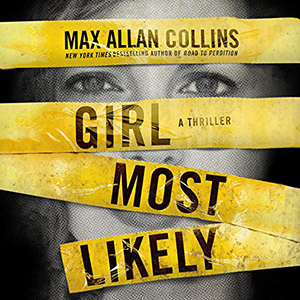
The opening paragraphs of Girl Most Likely are teased here.

Finally, Girl Most Likely is discussed as one of the most talked about forthcoming crime novels of 2019. You’ll have to scroll down some – a lot of crime novels are being talked about, apparently!

M.A.C.

Your New Year’s Resolution

January 8th, 2019 by Max Allan Collins

Here’s a sad story with which almost any professional writer can identify, as something like it has undoubtedly happened to every one of us.

At the last San Diego con, several personnel from Titan waved me over at breakfast to meet the man from Barnes & Noble who buys graphic novels for the chain. He was a big fan – clearly thrilled to meet me. I was the Beatles and he was Eddie Deezen in I Wanna Hold Your Hand. I sat and we chatted and I told him about the upcoming graphic novels from Titan, Quarry’s War and Mike Hammer: The Night I Died. He couldn’t wait!

Cut to recently when I looked at Barnes & Noble’s graphic novel sections in Davenport, Cedar Rapids and Des Moines, Iowa; and various Chicago B & N’s. Not a copy of either graphic novel was available at any of them.

Hey! I know! They had all sold out!

Or not.

A smaller sad story is the lousy one- and two-star Amazon reviews for both graphic novels from buyers who are angry that they accidentally bought a comic book. One of these reviewers hates graphic novels and considers them the downfall of literacy in America. Yes, these are idiotic cranks, but neither graphic novel has received enough reviews to weather such boneheaded ones (Quarry’s War does benefit from reviews some of you fine humans have contributed). The Mike Hammer has only one review – a two-star bummer from the aforementioned graphic novel hater.

So.

Here is your New Year’s Resolution. If you have already read either of these – whether in the four comic books collected in each graphic novel, or by way of the graphic novel itself – you will ASAP write a brief Amazon review, unless you have already done so. I do not specify that these reviews have to be raves. But I do request that you not post a review complaining that a graphic novel turned out to be (shudder! horrors!) a graphic novel.

Or…if you haven’t bought either book, and are not among those who despise the comics form, please acquire these gems (unbiased opinion). Maybe you’ll find them at a Barnes & Noble. But don’t count on it. B & N will have it on-line, as Amazon does. I have spotted Quarry’s War at a Books-a-Million, but not Mike Hammer yet. Maybe you have gift cards you haven’t used yet – what are you waiting for?

Okay, I’m whining again. Sorry. But judging by the stealth existence of these two graphic novels, the writer of Road to Perdition…which is on many “best graphic novels of all time” lists…won’t ever get to write a graphic novel again.


In the meantime, let me remind you what’s coming out in the first half of this year, with not a graphic novel in sight. I apologize there’s so much of mine to read, but (a) I can’t control dates of publication, and (b) if I don’t write, nobody sends money to my house.

Here is what is coming up.


Paperback:
E-Book: Amazon Google Play Nook Kobo iTunes

USS Powderkeg is a trade paperback (and e-book) from Brash Books on February 1st. This is the revised edition of the novel Red Sky in Morning, with the penname “Patrick Culhane” banished to the cornfield in favor of my actual byline (Max Allan Collins, remember?). I am very excited about this, and so very grateful to Brash to putting my preferred title on the book and, of course, my preferred byline. It’s a personal novel to me, based as it is (in part) on my late father’s experiences in the Navy in World War Two as one of a handful of white officers on an ammunition ship manned by black sailors.


Paperback:
E-Book: Amazon Google Play Nook Kobo iTunes

The Goliath Bone by Mickey Spillane and me will receive a mass market paperback, in the Titan format, in late February.


Hardcover:
E-Book: Amazon Google Play Nook Kobo
Audiobook: Kobo

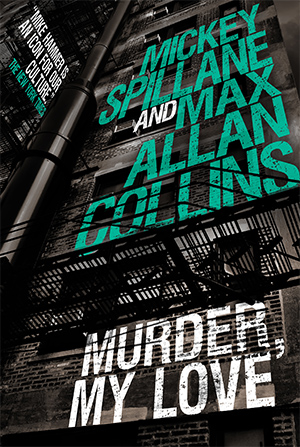
Murder, My Love by Mickey and me is the new Mike Hammer hardcover from Titan, out in mid-March. Published simultaneously on audio from Skyboat Media, available from Audible. This is the first Hammer written solely by me, but from a Spillane synopsis.


Paperback:
E-Book: Amazon
MP3 CD: Amazon Audio CD: Amazon

Girl Most Likely is a trade paperback and e-book from Thomas and Mercer, out on April 1, no fooling. This I’m particularly excited about because it’s a thriller that charts new territory for me – I would call it an American take on nordic noir. More about this closer to pub date.

Toward the end of May comes Last Stage to Hell Junction, the new Caleb York western from Kensington, a hardcover. It’s bylined Spillane/Collins, but it’s a Collins novel using characters and situations created by Spillane.

Toward the end of April comes Antiques Ravin’ by Barbara Allan, again from Kensington. Barb and her husband wrote it. Very funny and a darker mystery than you’ll encounter in most cozys. Of course, Jon Breen says we’re a subversive cozy series.

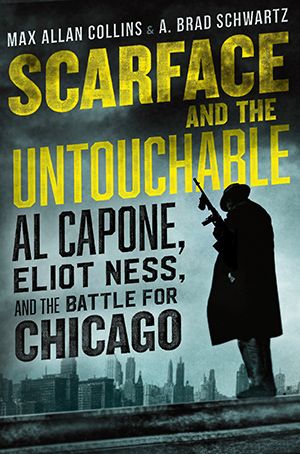
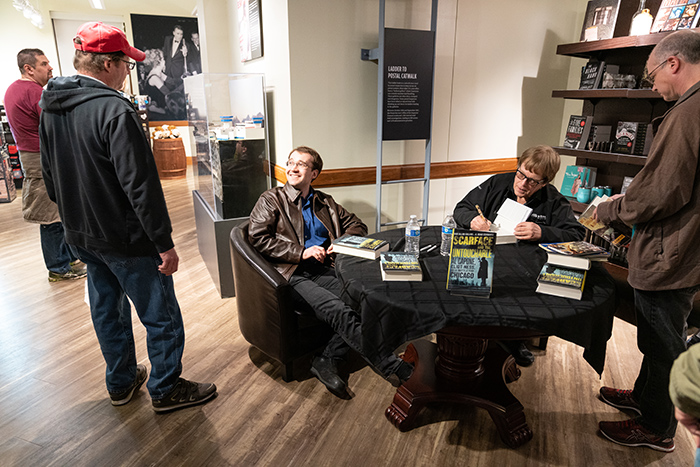
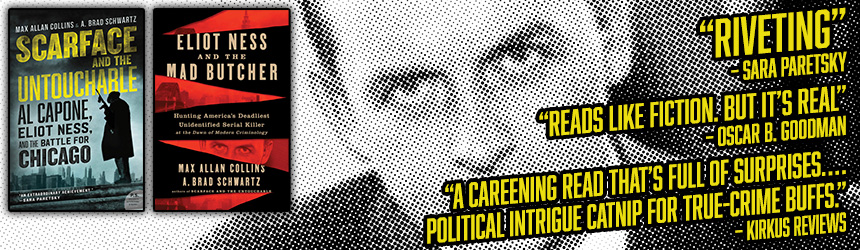
Then in early June comes the trade paperback of Scarface and the Untouchable: Al Capone, Eliot Ness, and the Battle for Chicago by A. Brad Schwartz and me. This is a major work (thanks to Brad) and I’m proud to be its co-author.

So, really, forget all these other writers you usually follow. You have priorities. You have work to do.

For those who need their pump primed – and you know how painful that can be – we’ll have a book giveaway before too long.

* * *

Oh, and Happy New Year, everybody!

We had a lovely holiday with son Nate, daughter-in-law Abby, and grandkids Sam (3 yrs) and Lucy (3 mths). Sam and his grandfather watched a lot of Pee-Wee’s Playhouse on Blu-ray. And for those wondering, yes, I did receive a Christmas card from Paul Reubens/Pee-Wee this year. That made it an official Christmas, particularly since both Scrooge with Sim and the original Miracle on 34th Street were watched as well.

* * *

Here’s the first review of Girl Most Likely.

And the Stiletto Gumshoe includes Murder, My Love among the books to read in the winter of 2019. Great site.

M.A.C.

Max Allan Ruins Everything

January 1st, 2019 by Max Allan Collins

I am about to recommend something you are probably already familiar with; but here goes….

Netflix recently added a sampling of the truTV series Adam Ruins Everything to its roster, and it looked interesting enough for me to try it…and now I am hooked. When I ran through the Netflix batch, I immediately bought the various seasons of the show on Amazon Prime and have watched all but a few episodes.

Adam Ruins Everything is the brainchild of stand-up comic Adam Conover, and (in the words of Wikipedia), “The series aims to debunk misconceptions that pervade U.S. society.” It spins off from Conover’s CollegeHumor web series, which I haven’t seen (yet). But it’s a lot more, being as much a comedy show as an educational one.

Adam Conover portrays himself as an overly helpful nerd, a smarty-pants who doesn’t understand why people don’t love him for correcting them. It’s a funny concept which Conover pulls off fearlessly, surrounding himself with some of the best comedic talent around, including veterans of Mr. Show and Reno 911. Recurring characters and story arcs are threaded through, as well.

Conover and his series skewer historical misconceptions, false beliefs fueled by corporate misinformation, urban legends and just plain stupidity. And, uniquely, sources are posted on-screen, and experts on the various subjects often appear in the context of the imaginative episodes. Though I discovered the well-made, entertaining show just a week ago, Conover and his research staff have already changed my behavior. I have sworn off vitamin supplements and Tylenol PM, for example.

He isn’t always right, and to his credit a later episode focuses on some of his mistakes. (When I say “he,” I refer not to the actual Conover but his television character.) For example, the episode about the real Wild West dismisses Wyatt Earp as a nobody con man who tried to peddle the untrue story of his life to Hollywood, implying he wasn’t a gunfighting heroic lawman at all.

Earp, of course, was a controversial figure, but he was famous during his day and well after, surviving several harrowing gunfights, including the O.K. Corral one (which happened in a vacant lot near the corral), which was even covered as news in the New York Times. The show is at its weakest when it accepts its experts at face value.

The Collins/Schwartz Scarface and the Untouchable, for example, debunks the debunkers who falsely represented Eliot Ness and his career. But I fear if Ness came up in a future episode, the research staff would accept the conventional (and wrong) wisdom about the Untouchables and the IRS investigators. Like the anti-Ness writers, many of the anti-Earp writers posthumously attacked the lawman-gambler-prospector because of the exaggerations of a book published after his death, leading to inflated TV fame.

For me, the the anti-conspiracy theory episode is unfortunate on a show that routinely exposes government and/or corporate conspiracies. It conflates the risible “moon landing was fake” theory with the Kennedy assassination. While my Nathan Heller novels have their fanciful aspects, the extensive research I’ve done (often with the help of George Hagenauer) has often shown the official versions of things are false…something Adam Ruins Everything often does.

Let’s not give conspiracy a bad name. Watergate and its cover-up was a conspiracy. The JFK assassination was almost certainly a conspiracy. Robert Mueller is not a guy in a tin-foil hat.

Also, sometimes conspiracies are not really conspiracies at all. Let me tell you about it! The railroading of Bruno Hauptmann for the Lindbergh baby kidnapping was nothing engineered, rather a bunch of cops backing each other up, plus some reporters manufacturing evidence, all filtered through a general hatred of Germans post-World War One. These folks didn’t get together in a room and conspire. They just had mutual views/assumptions of who did the crime.

For the record, when I write a Nathan Heller novel, I go in with an open mind. For JFK, the most outrageous thing I could have done was come to the conclusion that Oswald was the Lone Gunman. For Lindbergh, I’d have been swimming against the tide if I said Hauptmann was guilty; but if that’s where my research led, so be it. When I wrote the Roswell novel, Majic Man, I went in ready to report whatever I came away believing – including the existence of aliens. But my research indicated something else was going on.

With Do No Harm, the Sam Sheppard murder case novel that will be out in a year or so, I had no opinion about who did it…and did not decide till well into the work – not only the research period but the writing one.

So Adam Ruins Everything isn’t perfect. But it’s funny and informative, and – most important – it gets you thinking. It even got me thinking! Also, you need to stop using sleep aids and vitamin supplements.

* * *

I will admit to being disappointed on two fronts by various end-of-the-year “best of” lists.

Both The Last Stand and Killing Town, the final Spillane solo novel and the collaborative first Mike Hammer novel (begun in 1945 by Mickey and completed by me last year), have been pretty much roundly ignored…despite fairly stellar reviews.

One nice exception is this selection of Killing Town as the Best Retro Read of the Year, here.

More disappointing is how Scarface and the Untouchable by A. Brad Schwartz and myself has been overlooked, again despite stellar reviews. The book is a completely new approach to Eliot Ness and his contribution to the downfall of Capone, and the previously unnoticed collaboration between the government and Capone’s fellow mobsters to put the Big Fellow away. I fear the length of the book has scared away reviewers. And I am now officially nervous that we’ll be overlooked by the Edgars.

(But a nice exception is this gift guide from the Entertainment Report.)

If you haven’t tracked down the Titan graphic novel edition of Mike Hammer in The Night I Died, this good review might convince you.

By the way, I signed ten copies of The Night I Died for vj books, available here.

Here’s a nice advance look at Girl Most Likely from Col’s Criminal Library.

This is a mediocre review, but at least it’s a review, of the Quarry graphic novel, Quarry’s War. The reviewer complains about the alternating pages that intersperse the Vietnam war sequence with Quarry during his hitman years, considering what I’m proudest of about the work “annoying.” He complains that Quarry doesn’t open up enough about himself. Sigh.

On the other hand, both Quarry’s War and The Night I Died get nice mentions in this wrap-up of comics in 2018.

This is my first post of 2019, by the way, written in 2018. Happy New Year to all of you.

M.A.C.

Christmas Movie Festival – By Popular Demand!

December 25th, 2018 by Max Allan Collins

All right, I admit this is nothing anyone asked for – it’s just a rundown on our personal post-Thanksgiving Christmas movie fest. Barb and I almost always spend the evening watching a movie (sometimes a TV show or two), and this year we determined to watch nothing but Yuletide-themed movies till Christmas itself rolled around.

So you may want to run a copy of this off to guide you for your Yuletide watching next year (or, if you are sane, you may not).

Here, pretty much in the order we watched them, are our selections. We started with bad-taste Christmas comedies, then moved to TV Xmas episodes, followed by more traditional favorites. Nothing religious. We have no intention of debasing this secular holiday with religion.

The Thing – ****. The Howard Hawks-produced 1951 film. Admittedly not a Christmas movie, but the Blu-ray just came out, and the film is set at the North Pole. We were warming up for Christmas by vicariously experiencing all that cold in the company of a fire and hot chocolate.

Bad Santa – ****. Okay, I understand this is not by any rational accounting a four-star movie. But it accomplishes something very special. It surrounds its good heart with layers and layers of darkly funny coal. Billy Bob is a favorite of mine, and Willie T. Stokes is one of his finest creations.

Bad Santa 2 – ****. All right, I realize this is even less rational. Most reviewers hated this. Hated it! Apparently they didn’t notice how hilarious it is. Billy Bob’s commitment to his character is complete, and he has Kathy Bates as his cheerfully sociopathic mother to explain a lot about Willie’s development as a human being. The now adult Brett Edward Kelly as grown kid Thurman Merman damn near steals the picture, which is even nastier than the first one but with an even better heart.

A Christmas Horror Story – ***. This has become our favorite Christmas horror movie, dealing as it does with Krampus and featuring William Shatner as a hard-drinking, smiling radio personality, linking several interwoven stories, of which the most memorable features a wonderfully bad-ass Santa. Many of those working on this were part of the Orphan Black creative team.

Office Christmas Party – ***. Almost as dark as Bad Santa at times, this features Jason Bateman (nearly rivaling his Game Night performance), playing a funny straight man to an unending array of current comic talent. It, too, turns out to have a good heart but – like the Bad Santa films – not a sentimental one.

Murdoch MysteriesOnce Upon a Murdoch Christmas and A Merry Murdoch Christmas – **. We love this series. It’s uneven, but the recurring cast is winning and often the episodes are first-rate. These two Christmas episodes are among the worst outings, however, over-the-top and even embarrassing at times. A third, more recent Christmas Murdoch is better, but the bar isn’t set high.

Poirot – “The Theft of the Royal Ruby.” ****. One of two excellent Christmas episodes of the wonderful, long-running David Suchet series, this Christie adaptation – set in that great art-deco house that turns up in multiple episodes – is the best, amusing and even exciting.

A Nero Wolfe Mystery – “A Christmas Party.” ***. The repertory cast here is even hammier than usual – most Canadian-produced series, like Murdoch, do well with the central casting but reveal a shallow bench among the Canadian day players. Still, the byplay between Timothy Hutton’s Archie and the late, great Maury Chaykin’s Wolfe is a gift that keeps on giving.

Holiday Inn – ****. A masterpiece of music and well-motivated situation comedy with Bing Crosby and Fred Astaire playing off each other beautifully. Just fast-forward through the embarrassing blackface number, “Abraham.” By the way, I see blackface as a cultural thing that once was accepted – so, in that context, I can watch Eddie Cantor in his blackface scenes with little if any shame. Problem with this particular blackface number is…it’s an awful song. Irving Berlin wasn’t perfect. He didn’t think “White Christmas” was the hit in his new score (he figured “Be Careful, It’s My Heart” was the winner).

White Christmas – **. Pains me to say it, because I love Bing Crosby, Danny Kaye and my late pal Miguel Ferrer’s mom, Rosemary Clooney…but this film mostly stinks. Even Bing didn’t like it. “Count Your Blessings” with Bing and Rosie is lovely, though.

A Very Harold & Kumar Christmas – ***. Barb and I reverted to bad-taste comedy after White Christmas – to cleanse the palate. This is very funny, with some uncomfortable moments in the Neil Patrick Harris section (funny how quickly certain things have dated in the #metoo era). Even for non-dopers like Barb and me, this stoner comedy is funny and has a nice pace, getting gradually more absurd as it goes. And represents a rare, really good use of 3-D in a 21st Century film.

Scrooged – *. I love Bill Murray. Groundhog Day, which covers similar ground, is one of my favorite movies. And I love the Christmas Carol story. But this is a forced, shrill comedy with Bill Murray trying uncharacteristically too hard. The whole movie is hysterical, but in a humorless way, and seems filled to the brim with personalities of the moment who were soon to fade away.

National Lampoon’s Christmas Vacation – ***. I love this movie, and know it by heart, but there’s no denying it’s uneven. Still, it’s gradually become a favorite among many and has eclipsed the better first film in the series, because of course Christmas is at this third entry’s heart. Julie Louis Dreyfuss’s presence reflects smart (and lucky) casting. Where Scrooged doesn’t seem to really believe its positive message, Christmas Vacation manages to celebrate family even as it lampoons it.

Meet Me in St. Louis – ****. This should not be a four-star movie. It’s almost plotless. The co-star is Tom Drake, for Pete’s sake (or is that Pete Drake for Tom’s sake – I can’t remember). But it’s beautifully directed and perfectly paced, with Judy Garland at her loveliest and most appealing. And Margaret O’Brien is magically good as the little girl who, if you really listen to her, is apparently the first Goth Girl.

Silent Night, Deadly Night 2 – *** (for the Shout Factory Blu-ray). Okay, I watched this by myself – not Barb’s idea of a Christmas movie. It’s really not worthy of this rating. About a third of the movie is flashbacks from the first film. But the slasher anti-hero, Billy, played by Robert Brian Wilson, is fascinating – is that a terrible performance, or a great one? I’m just not sure! All I know is it’s “Garbage day!”). And the latterday “making of” documentary (longer than the movie!) is one of the best of its kind.

A Christmas Story – ****. Now we’re into the classics. One of my top four. No matter how hard the world tries to diminish this Jean Shepherd classic – with licensed toys, mini-leg lamps, t-shirts and other crap – this movie remains the best film about childhood in 20th Century America ever made. (There’s even an abysmal stage production – aired live, so you can “re-live” the experience, when I thought you relived it by watching the original again!) I love that Darren McGavin (TV’s first Mike Hammer and the great Carl Kolchak) has become an iconic figure, thanks to his perfect performance as Ralphie’s Old Man. Barb and I first saw this with my late, beloved aunt Beth on Christmas Day on the film’s first release. Loved it then. Love it now. It influenced Road to Perdition, by the way – the adult narrator recalling his childhood. Michael O’Sullivan Jr.’s childhood did vary some from Ralphie’s, admittedly.

Scrooge – ****. The Alastair Sim 1951 version. Accept no substitutes.

Miracle on 34th Street – ****. The Edmund Gwenn version. Again, accept no substitutes. This is Hollywood mid-20th Century studio filmmaking at its finest – perfect script and direction, with even the smallest part perfectly cast (Thelma Ritter!). No major stars – John Payne, wonderful, and Maureen O’Hara, also wonderful, were B+ talent, and Edmund Gwenn a little-known character actor whose only other real claim to fame is as a scientist in Them! And yet all of ‘em will live forever, thanks to this impeccably constructed film. Shot on location, by the way, at the real Macy’s in the real New York City.

It’s a Wonderful Life – ****. We haven’t watched this yet this year. We don’t watch it every Christmas season, because it’s a rough ride, in spots. But – like Groundhog Day – you have to forgive the protagonist his flaws in order to witness his redemption. You know what Wonderful Life and the two Bad Santa films have in common? Their protagonist tries to commit suicide, saved by Christmas in the form of Clarence the angel and Merman Thurman, the…God, I’m not sure what.

Merry Christmas, everybody. See you next year.

M.A.C.