
If you’re a fan of my Nathan Heller books – or just a dedicated reader of mine – and you have not yet ordered True Noir: The Assassination of Anton Cermak, well…you are missing out. Director Robert Meyer Burnett directs an amazingly stellar cast with full sound effects and a terrific score by Alexander Bornstein, all in service of a script by me from my novel True Detective. It’s just under five hours.
I think this is the best dramatic adaptation of my work, ever. You can get the download, the Audio CD (four CD’s) and an MP3 CD right here.
The portrayal of Nate Heller by Michael Rosenbaum is key to the enterprise. He totally “gets” Nate Heller. If you don’t recognize the name, here’s a pic he sent me the other day after I sent him the physical media version (the 4-CD set).
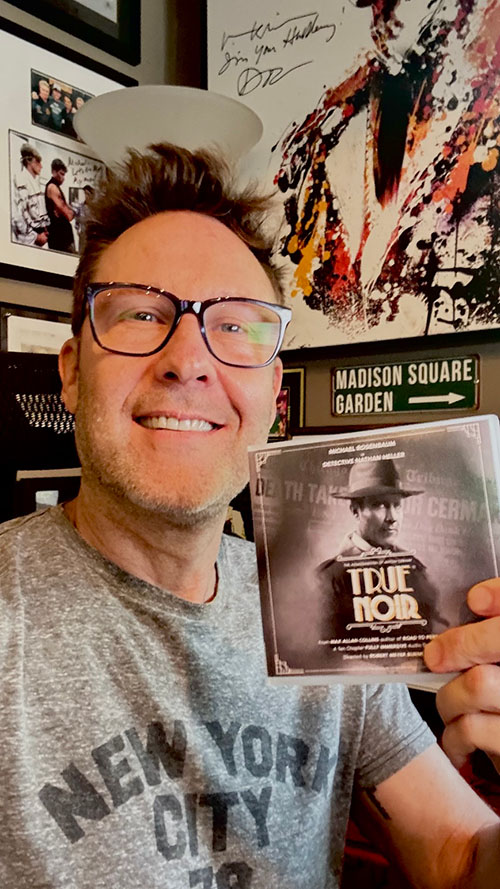
Michael is probably best-known for his iconic portrayal of Lex Luthor on the hit CW series Smallville, but also his and his voice work as The Flash in the DC Animated Universe. Beyond his numerous acting roles, as in Guardians of the Galaxy Vol. 2 and Vol. 3, Michael is also the host and creator of the celebrity interview show Inside of You – one of the most entertaining podcasts around with a star-studded array of guests. He also happens to be a genuinely nice guy.
Here’s some of the rest of the cast, by the way:
David Strathairn; Anthony LaPaglia; Jeffrey Combs; Thomas Howell; Adam Arkin; Katee Sackhoff; Vincent Pastore; William Sadler; Jesse Spencer; P.J. Byrne; Saverio Guerra; Louis Lombardi; Bill Smitrovich; Patton Oswalt; Curtis Armstrong; Barry Bostwick; Bill Mumy; Renée Taylor, Don McManus; Devon Conrad; and Richard Portnow. And that’s not everybody.
What are you waiting for?
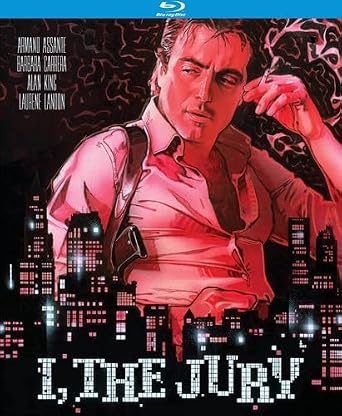
Last week I discussed, somewhat off the top of my head, my favorite portrayals of Mike Hammer on TV and in the movies. I made an egregious omission: Armand Assante in the 1982 version of I, the Jury. I am a big fan of Assante’s Mike Hammer and, in general, of the film itself, which is violent and sexy in a way no previous version had attempted (or any since, for that matter). Hammer’s relationship with Velda (Laurene Landon, whose blondeness we’ll forgive) is spot on, and the classic ending (and last line) is restored.
The movie got lost in the shuffle because the production company behind it went bankrupt. Terry Beatty and I drove from Muscatine, Iowa, to Chicago, Illinois to see it – driving in and back the same day/night. A six-hour round trip, not factoring in bathroom breaks and food. Later, to get the 1982 I, the Jury on physical media, I paid over a hundred bucks (a kajillion dollars in today’s money) for a Japanese laser disc (I owned the VHS, too, and of course the later blu-ray.) I wrote rather glowingly about it in Spillane on Film and Spillane: King of Pulp Fiction.
So why, other than feeble-minded old age, could I forget about it last week?
It was easy. I, the Jury (1982) was a (at the time) modern take on Mike Hammer and his debut novel. It holds a unique place in the Hammer filmography. The earlier TV and movie renditions were fifties and early sixties animals. When Hammer was done on TV in the ‘80s and ‘90s, he was done in a contemporary fashion but as a man out of time – as if Mike Hammer had jumped into a time machine around 1952 and emerged in that later era, where he was presented as a glorious dinosaur. (It’s not unlike what I did with Hammer’s protype Mike Danger, having him wake up in a politically correct future in the comic book Mickey and I developed for Big Entertainment.)
How to do Hammer on film – whether to make him a version of Mike in modern day (whatever modern day that happens to be) or to approach him in period, for example adapting one of the early novels with a ‘50s setting – is a conundrum Hollywood is still facing. Much discussion among movie folk has gone on about how to present Hammer today, including the notion of doing him in his original time frame. I see some real advantages to doing that, but usually the discussion comes around to the need (for all sorts of reasons) to do him modern-day. The Keach version managed to split the difference, in a way – but that was in the ‘80s; now the man-out-of-time approach would have a 1940s/1950s character operating over 70 years later.
A new Hammer movie is still percolating and the most recent script I saw worked pretty well, but the political mood of the country makes the character problematic. Even back in the day critics saw Hammer (wrongly) as a fascistic figure; today, if he mirrored (for example) Donald Trump’s world view, that would put him on the side of ICE agents. Yet Mickey’s Mike Hammer has friends of all sorts of ethnicities.
Hammer’s vigilante tendencies don’t transfer well to today. So it’s at best tricky, and at worst impossible, to do the urban avenger in any way that isn’t offensive to somebody. Ironically, Spillane was never really political with Hammer. Take One Lonely Night: the bad guys are “Commies,” but the top Commie turned out to be the Senator Joe McCarthy figure! Mickey always went for the surprise.
Yes, Mickey leaned into Ayn Rand territory in his Tiger Mann books; but political themes were rare in the Hammer novels.
I would vote for a period Hammer, but it will almost certainly not happen.
Anyway, Assante’s Hammer was a glorious success (artistically speaking) of bringing him effectively into the early 1980s. But, due in part to the meager release the movie got, that version didn’t get anywhere near the pop cultural purchase of Stacy Keach’s Mike Hammer.
Let’s talk, for a moment, about lists of favorites – whether it’s candy bars or movies. There is a difference between “best” and “favorite.” My favorite Hammer (not counting Mickey) is Darren McGavin. Why? Largely because he was my introduction to the character. Also, that TV show was set in – produced in! – the 1950s. Mike Hammer’s era.
Who was the best Hammer? Mickey wouldn’t agree, but Assante would be a contender on the big screen – he was the most authentic in terms of sexuality and violence and a genuinely conveyed thirst for vengeance.
An argument could be made for Biff Elliott because, again, he was operating in the 1950s and was a hot-headed roughneck right out of the original novels.
But the best Mike Hammer? Even Mickey came to think Ralph Meeker was the best movie Hammer, despite the film turning its source on its head. Meeker was a terrific actor in the Method mode whose best role was Hammer, and he inhabited the best Hammer movie, which is even fairly faithful to the novel. No movie, to date, has captured Spillane better, despite its agenda to criticize Mickey.
As far as TV goes, I would say “best” has to be shared by Keach and McGavin.
But my favorite? I told you last week.
My pal and sometime collaborator Matt Clemens interviewed me on his podcast recently about Return of the Maltese Falcon. Here it is.
And here Road to Perdition makes a list of the six “darkest comic book masterpieces.”
I lost a colleague last week. You meet all sorts of people in publishing, and many of them are worth knowing, but few have been as delightful to deal with as Titan’s publicist, Katharine Carroll.
Only the most financially successful writers – at least those of my generation and the one or two after it – could afford to hire publicists. So a writer is dependent on the publisher’s publicist, and this is very much a hit-and-miss affair. Frequently only the most successful writers get the kind of attention from a publisher’s publicist that proves fruitful.
Katharine was an exception. She was always open to considering my wildest suggestions. For example, she got us enormous attention for Mike Hammer’s 75th anniversary and Mickey Spillane’s 100th birthday. She would kick ideas around with me and then follow through. I had many wonderful, positive conversations with her. We were just starting work on Quarry’s 50th anniversary.
But that’s business. In the lonely writing game, the friendly voice on a telephone and the lighting-fast e-mails in reply to whatever screwy notion I might have, these are things that can’t be measured.
I’ll share a little about her below. But it’s not enough.

U.S. Publicist for Titan Publishing, Dies at 68
Jim Milliot/Jul 06, 2026
Katharine Trowbridge, who oversaw the U.K.-based Titan Publishing Group’s U.S. publicity effort for 18 years, died on June 28. She was 68.
Known professionally as Katharine T. Carroll, Trowbridge began her publicity career with Time Inc. in 1980, spending a decade working across campaigns with Time, Life, People, and Entertainment Weekly. In 1990, she launched her own publicity firm, KTCommunications, where she worked with a range of magazines, authors, and publishing companies.
She joined Titan in 2008 and is credited by the company owners with helping to grow the publisher in the U.S. She was particularly instrumental in helping to revive the respected Hard Case Crime imprint founded by Dorchester Publishing and acquired by Titan in 2011. A native New Yorker, Trowbridge was a regular at New York Comic Con, where she connected U.S. journalists and booksellers with Titan titles such as Dreadful by Caitlin Rozakis, Titan’s first-ever U.S. original fiction title to hit the New York Times bestseller list.
“We are devastated by the loss of Katharine,” said Titan Entertainment Group co-owners Nick Landau and Vivian Cheung in a statement. “She had the warmest of personalities and cared deeply for all her authors as well as her colleagues on both sides of the Atlantic. Her contribution to Titan enabled us to grow far faster in the U.S. than we ever thought possible. We will miss her dearly.”
Trowbridge is survived by her three children and her mother.
M.A.C.
Tags: Mickey Spillane, Mike Hammer, Nate Heller, Passings, Return of the Maltese Falcon, Road to Perdition, True Noir, True Noir: The Assassination of Anton Cermak, True Noir: The Nathan Heller Casebooks
Maybe from THE GIRL HUNTERS and the long ago Signet cover photo on THE BODY LOVERS, I tend to visualize Hammer in the image of Spillane.
I don’t picture Hammer — I am inside the character. Mickey himself said Mike Hammer is a state of mind.
I think Mike Hammer should definitely be set in the time period of 50’s maybe early 60’s. I’ve read a couple of your Nate Heller books which I’ve enjoyed and your book on Eliot Ness and Al Capone’s war for Chicago, I’ve always had an interest in prohibition and the gangs of Chicago. I’ve also got your book on Ness’s hunt for the mad butcher when he was director of public safety in Cleveland. I can’t wait to go back and read the other Nate Heller books and I’ve enjoyed the Mike Hammer books you finished for Mickey Spillane.