
The film version of Road to Perdition was released twenty-four years ago.
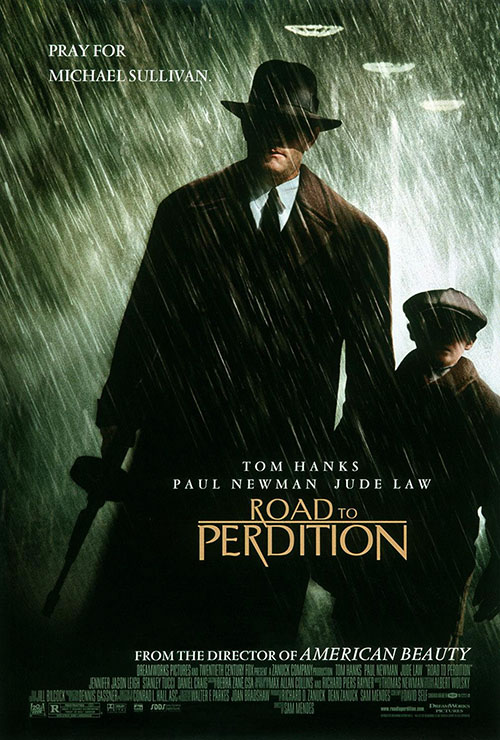
The 24th anniversary of anything is kind of an awkward one to be celebrating, and I note it primarily because it means next year marks twenty-five years since the film’s release, and that’s an anniversary people can wrap their heads around.
For me the release of that film signifies the moment when I had accomplished something in the popular culture that every author desires: a recognizable calling card. “By the author of Road to Perdition” (or words to that effect) would appear on the cover of almost any written work of mine that found publication.
Prior to that, the most I could muster was “from the writer of DICK TRACY,” and I was really only the second one of those. It’s important for a writer to be attached to some recognizable work, and now I had one.
In addition, the graphic novel I wrote, which was so beautifully drawn by Richard Piers Rayner, would allow me to write a novel version, two prose sequels (Road to Purgatory and Road to Paradise) and two more graphic novels (Road to Perdition 2: On the Road).
And have I mentioned here that I’m going to writing a prose sequel, Road to Hell, for Titan Books?
Speaking of anniversaries, 2026 will mark the thirtieth anniversary of the graphic novel’s publication (by DC Vertigo). You can bet we’ll be pounding the pavement about that anniversary.
From the beginning, editor Andrew Helfer and I had seen Road to Perdition as the start of a long saga, initially one that would have father and son Michael O’Sullivan and Michael Jr. on the road for hundreds of pages, perhaps as many as 900, robbing banks and being pursued by the Capone mob. Also posited was following Michael Jr. into an adulthood where he would seek vengeance against Frank Nitti and grow up, ironically, into a high-up mobster himself before eventually turning to the priesthood.
It was always ambitious, but initially the project got derailed when DC’s attempt to do a series of graphic novels fizzled and Road to Perdition barely got itself published (thanks to publisher Paul Kupperberg). But a few years later, movie moguls Dean Zanuck and his father Richard noticed the graphic novel and the rest is history – my history, anyway.
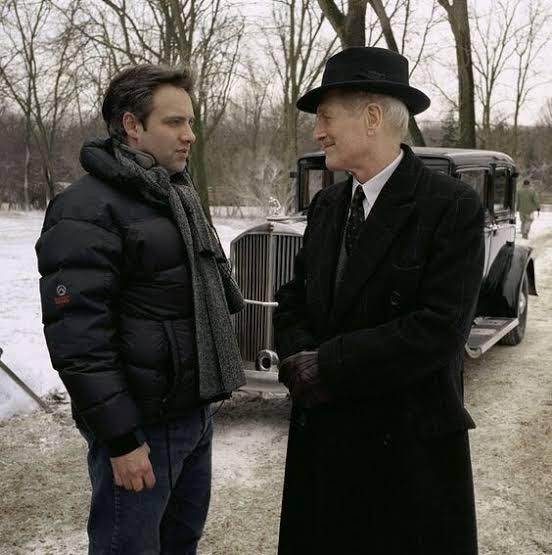
Director Sam Mendes and actor Paul Newman on set of Road to Perdition.
People on the Internet and on social media are noticing Perdition’s ride, and I’d like to share as article about that journey, which appeared today. It was posted on Facebook by SUPERMAN: A Who’s Who of the Man of Steel administrator Dennis Hays (not sure if he’s the author).
On this date, July 12, 2002, Road to Perdition was released in the US.
Road to Perdition is an American crime thriller film directed by Sam Mendes. The screenplay was adapted by David Self, from the graphic novel of the same name by Max Allan Collins. The film stars Tom Hanks, Paul Newman (in his final live-action film role), Jude Law, and Daniel Craig. The plot takes place in 1931, during the Great Depression, following a mob enforcer and his son as they seek vengeance against a mobster who murdered the rest of their family.
(NOTE FROM MAC: Road to Perdition was Newman’s last feature film role. He then went on to appear in 2005’s HBO miniseries, Empire Falls, winning an Emmy.)
The film was released on July 12, 2002, and eventually grossed over $180 million worldwide. The cinematography, setting, and the lead performances by Hanks and Newman were well received by critics. A home media release debuted on February 25, 2003.
When Max Allan Collins wrote the graphic novel Road to Perdition, his book agent saw potential in the story as a film adaptation and showed it to a film agent. By 1999, the novel had reached Dean Zanuck, who was the vice president of development at the company owned by his father, producer Richard D. Zanuck. The novel was sent to the elder Zanuck in Morocco, who was there producing Rules of Engagement (2000). The Zanucks agreed on the story’s prospect and sent it to director-producer Steven Spielberg. Shortly afterward, Spielberg set up the project at his studio DreamWorks, though he did not pursue direction of the film due to his full slate.
Mendes sought a new project after completing American Beauty (1999) and explored prospects including A Beautiful Mind, K-PAX, The Shipping News, and The Lookout. DreamWorks sent Mendes Road to Perdition as a prospect, and Mendes was attracted to the story, considering it “narratively very simple, but thematically very complex.” One theme that he saw in the story was of the parents’ world that is inaccessible to their children. Mendes considered the story’s theme to be about how children deal with violence, and whether exposure to violence would render children violent themselves. Mendes described the script as having “no moral absolutes,” a factor that appealed to the director.
(NOTE FROM MAC: Mendes had seen the graphic novel but not a “script,” as none yet existed.)
(NOTE FROM MAC: The alcoholism aspect reported here was not in the graphic novel or in any of the various versions of the script I saw. Nor did any of them scripts “distance themselves” from the graphic novel’s story.)
(NOTE FROM MAC: I don’t recall saying that, though I might have, as Lone Wolf and Cub was in the mix with: historical John and Connor Looney, the Rock Island, Illinois, gangsters; the heroic bloodshed of John Woo’s Hong Kong films; and my desire to combine the ‘30s urban gangsters with their rural outlaw counterparts. Basically, The Godfather Meets Bonnie and Clyde.)
(NOTE FROM MAC: Maguire was created because the graphic novel had originally been intended for serialization with a series of hitmen pursuing the father and son, and being defeated by them one by one. Also, “Looney” was changed by the filmmakers to “Rooney” to make the name sound less “comic booky.” As we say in the comics, “Sigh.”)
(NOTE FROM MAC: This reflects the desire of Mendes and DreamWorks wanting to distance themselves from the “comics” source. Understand, the status of the graphic novel form at the dawn of the 21st Century was quite unlike today – it was mostly superhero stuff and artier material like Maus. I had to object when DreamWorks left the word “graphic novel” off my credit in early materials, making it simply “novel.” And anyone who has read the graphic novel knows how leanly written it is.)
Collins opposed the profanity in the script, as the vulgar language did not fit his vision of the 1930s. He also contested the path of Sullivan’s son in the film. In the graphic novel, the son kills once, and in the film, he does not kill anyone. Collins also disagreed with the narration technique of the film. In the novel, the son narrates the story as an adult, becoming a priest, while in the film, he narrates while still a young boy.
(NOTE FROM MAC: Generally true, and I applaud the bigger emphasis on the dual fathers-and-sons. But I dislike the cop-out ending of the film, which has the father killing the hitman when the son can’t bring himself to do so. It’s understandable, though, since my true ending – where it’s revealed the tale has been told by the adult Michael Jr., who is now a priest – wasn’t used. By the way, at the New York premiere, Steven Spielberg took me aside and said, “I like your ending better.”)
Mendes collaborated with costume designer Albert Wolsky, production designer Dennis Gassner, and cinematographer Conrad Hall to design the film’s style. Wolsky designed costumes that were “very controlled, with soft outlines and very soft silhouettes.” Gassner built sets that could capture the cold look of the era. Mendes sought a muted palette for the film, having dark backgrounds and sets with dark, muted greens and grays. Mendes filmed Road to Perdition using the Super 35 format.
The director filmed exterior scenes in Illinois in the winter and the spring of 2001, using real weather conditions such as snow, rain, and mud for the scenes. Mendes considered the usage of bleak weather conditions and the intended coldness of Gassner’s exterior locations to define the characters’ emotional states. Pullman became a key location to reflect this theme, having several settings, including the town’s historic Florence Hotel, easily redressed by the crew for the film. Filming concluded in June 2001.
To establish the lighting of scenes in Road to Perdition, Mendes drew from the paintings of Edward Hopper as a source of inspiration, particularly Hopper’s New York Movie (1939). Mendes and cinematographer Conrad Hall sought to convey similar atmospheric lighting for the film’s scenes, applying a “less is more” mantra. Hall also shot wide open scenes that retained one point in the depth of field sharply focused. Hall considered the technique to provide an emotional dimension to the scenes. The cinematographer also used unconventional techniques and materials to create unique lighting effects. One of Hall’s methods was to use black silk in daylight exterior scenes to filter the light enough to create an in-shade look.
Hall purposely distanced the camera from Hanks’ character, Michael Sullivan, Sr., at the beginning of the film to establish the perspective of Sullivan’s son, who is unaware of his father’s true nature. Hanks’ character was filmed as partially obscured and seen through doorways, and his entrances and exits took place in shadows. A wide lens was used to maintain a distance from the character.
Shots in the film were drawn directly from panels in the graphic novel, illustrated by Richard Piers Rayner. An instance of the direct influence is the scene in which Michael, Jr. looks up at the Chicago skyline from the vehicle, with the skyline reflected in the vehicle’s glass. A seamless 40-second driving scene, in which Michael Sullivan and his son travel into Chicago from the countryside, was aided by visual effects. The live-action part of the scene was filmed at LaSalle Street, and due to the lack of scenery for part of the drive down LaSalle Street, the background of Balbo Drive was included with the use of visual effects.
(NOTE FROM MAC: The Richard Piers Rayner influence was far greater than the Edward Hopper one.)
Said Mendes, “[Sullivan] is in a battle for the soul of his son. Can a man who has led a bad life achieve redemption through his child?” Hanks described Sullivan as a man who achieved a comfortable status through violent means, whose likely repercussions he ignored. Sullivan is a good father and husband, but also has a job that requires him to be a violent killer. The film explores this paradoxical dichotomy. When Sullivan is faced with the consequences, Hanks says, “At the moment we’re dropped into the story, it is literally the last day of that false perspective.” To keep Sullivan from justifying his violent actions in the film, Mendes omitted scenes in the final cut that had Sullivan explaining his background to his son.
(NOTE FROM MAC: Is it too self-serving of me to remind everyone that I came up with title Road to Perdition, and the themes that goes with it? Particularly when there were attempts made to change the title to something more commercial? It seems the Zanucks fought for my title and won.)
The film also explores father-son relationships, not only between Michael Sullivan and his son, but between Sullivan and his boss, John Rooney, and between Rooney and Connor. Sullivan simultaneously idolizes and fears Rooney, and Sullivan’s son feels the same about his own father. Rooney’s son, Connor, has none of Sullivan’s redeeming qualities, and Rooney is conflicted about whom to protect: his biological son or his surrogate son. Connor is jealous of his father’s relationship with Sullivan, which fuels his actions, ultimately causing a domino effect that drives the film.
Because Sullivan shields his background from his son, his attempt to preserve the father-son relationship is actually harmful. Tragedy brings Sullivan and his son together. Sullivan escapes from the old world with his son, and the boy finds an opportunity to strengthen the relationship with his father.
Tyler Hoechlin, who portrayed Michael, Jr., explained, “His dad starts to realize that Michael is all he has now and how much he’s been missing. I think the journey is of a father and son getting to know each other, and also finding out who they themselves are.”
Water served as a motif in the film. It was developed after researching the wake scene at the beginning of the film informed the director that corpses were kept on ice in the 1920s to keep bodies from decomposing. The notion was interwoven into the film, which linked the presence of water with death. Mendes reflected on the theme, “The linking of water with death… speaks of the mutability of water and links it to the uncontrollability of fate. These are things that humans can’t control.”
When filming concluded in June 2001, the studio intended a United States release for the following Christmas. But by September 2001, Mendes requested more time. It was rescheduled for release on July 12, 2002, an unconventional move that placed the drama among the action-oriented summer films.
Road to Perdition opened in 1,798 theaters over its opening weekend, competing against several other new releases including Reign of Fire, Halloween: Resurrection, and The Crocodile Hunter: Collision Course, and grossed $22,079,481, placing second to Men in Black II, which was in its second week of release. It eventually grossed $104,454,762 in the United States and $76,546,716 in other territories for a worldwide total of $181,001,478.
The film received positive reviews and acclaim from critics, with the lead performances of Hanks and Newman being praised. Reviewer James Berardinelli, on his own ReelViews web site, praised Road to Perdition for its atmosphere and visuals, but he considered an emotional attachment to be lacking except for Sullivan’s son. Roger Ebert of the Chicago Sun-Times praised Hall’s cinematography and the thematic use of water. He, too, felt an emotional detachment from the characters, saying, “I knew I admired it, but I didn’t know if I liked it… It is cold and holds us outside.”
Eleanor Ringel Gillespie of The Atlanta Journal-Constitution enjoyed the film’s cinematography and Depression-era setting, as well as the performances of Hanks and Newman. Gillespie expressed the wish that the film lasted a little longer to explore its emotional core further. Eric Harrison of the Houston Chronicle considered Road to Perdition “the most brilliant work in this [gangster] genre” since the uncut Once Upon a Time in America (1984). Harrison considered Self’s script “so finely honed that the story can change directions in a heartbeat.”
Kirk Honeycutt of The Hollywood Reporter praised Hanks, Newman, and Craig but called Law’s performance “almost cartoonish”. Peter Travers of Rolling Stone also complimented Hanks and Newman: “[They] act together with the confidence of titans, their talents in the service of character, never star ego.” Travers cited Hall’s “breathtaking” cinematography and composer Thomas Newman’s “evocative” score.
Paul Clinton of CNN said: “While these deeply human issues are touched upon, they’re never fully explored, and that undermines the sense of greatness to which this movie obviously aspires. Clinton considered Craig’s character “one-dimensional to the extreme.” He found the cinematography too overpowering for the film’s storyline, which he considered “weak.” J. Hoberman of The Village Voice described the film as “grim yet soppy.” He added: “The action is stilted and the tabloid energy embalmed.” Stephen Hunter of The Washington Post thought that the script lost its path when Sullivan and his son fled their old life.
Review aggregation website Rotten Tomatoes gives the film a score of 81% based on reviews from 210 critics, with an average score of 7.5/10. Metacritic, which assigns a weighted average score out of 100 from reviews by mainstream critics, gave a film rating of 72/100 based on 36 reviews.
(NOTE FROM MAC: Despite a handful of misgivings, I like the film version of Perdition very much, and feel inordinately lucky to have it produced on such a high, expert level. Some of these reviews seem silly to me, and I can back that up by saying the film continues to be on countless “best of” lists whether it be “best gangster movie” or “best comics adaptation” or Tom Hanks’ best performance or…on and on.)
The film was also nominated for BAFTA Awards for Best Performance by an Actor in a Supporting Role (Newman), Best Cinematography, and Best Production Design, winning awards for the latter two. Hall also won an award from the American Society of Cinematographers for Outstanding Achievement in Cinematography in Theatrical Releases.[36] In April 2006, Empire recognized Road to Perdition as number six in its list of the top 20 comic book films.
Max Allan Collins, who authored the graphic novel, was hired to write the novelization for the film adaptation. Collins initially turned in a draft that contained 90,000 words, but the licensing at DreamWorks required the author to use only the dialogue from the film and no additional dialogue. Collins reluctantly edited the novelization down to 50,000 words and later said he regretted taking on the task.
(Of course the happy ending there is that I was finally able to publish my full novelization, in tandem with trade paperbacks of Road to Purgatory and Road to Paradise, thanks to Brash Books. A link is at the end of this Update.)
Road to Perdition was released on Blu-ray Disc on August 3, 2010, featuring a widescreen transfer, a DTS-HD Master Audio 5.1 soundtrack, and all of the features from the DVD release.
You can get my complete prose novel of Road to Perdition here – the full version.
And Road to Purgatory here.
And Road to Paradise here.
The graphic novel Road to Perdition 2: On the Road is available here.
And the final chapter, Return to Perdition, is here.
M.A.C.
Tags: Road to Perdition
As you know M.A.C., I collect original artwork and have a number of pages of Richard Piers Rayner’s artwork for the story. They are certainly noteworthy and a nice addition to my collection.
CORRECTION!
It was Paul Levitz (not Kupperberg) who saw to it that RTP was published. Thank you, Paul! Apologies, Paul! (And thanks to my buddy Mike White for catching me in an Old Man Moment.
Any chance we’ll see the original graphic novel back in print given the upcoming anniversary?
The deviation “to make the name sound less “comic booky” recalls the trend of removing alliterative names in adaptations which poster Count Karnstein mentioned, as well as the reluctance to deploy code names in adaptations.
This recalls a mild correction for an earlier post:
http://maxallancollins.com/blog/2023/06/13/dig-the-new
“The Michael Keaton Batman, decades ago, started the trend – reboots had to be dark and serious and grown-up, even when the subject matter was inherently juvenile”.
https://tvtropes.org/pmwiki/pmwiki.php/Main/ComicBookMoviesDontUseCodenames
Greystoke in 1984 (“Tarzan” only occurs in the title, anticipating the reticence on code names) and perhaps The Legend of the Lone Ranger in 1981 (the outfit color toned away from blue to gray, anticipating the departure from brightly colored outfits which often recurs, perhaps anticipating the Amazing Heroes#119 interview, though Bruce Jones seems to have anticipated this interview in #5 in a Ka-Zar article; the phrase “the Lone Ranger” only occurs in the title, narration, perhaps prop newspapers, and perhaps the credits) might challenge this claim.
For a further item, an article at an external link provided in an earlier blog post credited the Coen brothers with adapting Road to Perdition. They seemingly did not. The writer seems to have conflated with Miller’s Crossing.
HOO ! What an anniversary ! Gracias for printing the detailed essay, and I hope the author of it identifies himself. And a new sequel ? Anticipation Plus !
The deviation “to make the name sound less “comic booky” recalls the trend of removing alliterative names in adaptations which poster Count Karnstein mentioned, as well as the reluctance to deploy code names in adaptations. This recalls a mild correction for an earlier post:
http://maxallancollins.com/blog/2023/06/13/dig-the-new
“The Michael Keaton Batman, decades ago [released in 1989], started the trend – reboots had to be dark and serious and grown-up, even when the subject matter was inherently juvenile”. Greystoke in 1984 (“Tarzan” only occurs in the title, anticipating the reticence on code names) and perhaps The Legend of the Lone Ranger in 1981 (the outfit color toned away from blue to gray, anticipating the departure from brightly colored outfits which often recurs, perhaps anticipating the Amazing Heroes#119 interview, though Bruce Jones seems to have anticipated this interview in #5 in a Ka-Zar article; the phrase “the Lone Ranger” only occurs in the title, narration, perhaps prop newspapers, and perhaps the credits) might challenge this claim.
For a further item, an article at an external link provided in an earlier blog post credited the Coen brothers with adapting Road to Perdition. They seemingly did not. The writer seems to have conflated with Miller’s Crossing.
Justin, I am doing my best to get DC to pay attention to these two anniversaries with new, slightly larger editions of all three PERDITION graphic novels.