Posts Tagged ‘Spillane’

Swap Talk & Bobby Darin

Tuesday, April 22nd, 2014

Just hours ago, I shipped ANTIQUES SWAP off to our editor at Kensington. I say “shipped” out of habit – these days, there’s no rush to make it to a Fed-Ex drop to actually post packages. How many times did Barb and I work all day on final corrections, hoping to make it to the P.O., Fed Ex or UPS on time?

Hitting “send” is somehow not as satisfying as handing a clerk a package or shoving that package into the Fed Ex box. But I would never go back.

Barb and I spent a long day doing the final tweaks and corrections. Our standard operating procedure is that I read and revise a hard copy, using a red pen so that the corrections jump out, and she enters them. This is not just for “Barbara Allan” books, but everything of mine that’s book length.

I’m always afraid that, on the read-through, a novel isn’t going to hang together – as I go, I focus on one chapter at a time, as if I were doing a short story, and I rarely have a sense of how (or not) those chapters are coming together to make a book. Almost always I am pleasantly surprised, sometimes damn near thrilled, by how those chapters turn into something coherent and cohesive. That last read-through, for tweaks and typos, plays a key role, but it’s always nice to know that you’ve written a novel and not just a bunch of scenes.

ANTIQUES SWAP came out very well indeed. But you never know, and we both had our doubts along the way. The story starts at a swap meet and eventually deals with wife-swapping in small-town Serenity. This is delicate, even daring subject matter for a cozy, but I think we walked the tight rope successfully. There’s a scene Barb came up with where a concussed Vivian Borne thinks she’s on a USO Tour with Bob and Bing that is among our funniest.

Last week a number of you jumped on my offer of sending out signed copies of KING OF THE WEEDS for Amazon reviews. I offered 12 copies, but wound up digging into my personal stash for another five. Thanks to all of you who requested books, and my apologies to those who missed out this time. In a few weeks, there will be a similar giveaway with a dozen ARC’s of SUPREME JUSTICE. For those who haven’t noticed, these Updates go up every Tuesday at 9 a.m. Central Time.

In the next two months, we should be posting any number of interviews and reviews. This is one of those times when all my publishing worlds collide – ANTIQUES CON, KING OF THE WEEDS and SUPREME JUSTICE are all out at the same time. I’ve already done an interview for Jon Jordan at Crimespree (see below), and soon I’ll be offering a link to a very long, in-depth one for J. Kingston Pierce of the Rap Sheet and Kirkus on-line.

* * *

In the last year of his life, Bobby Darin did an NBC series called THE BOBBY DARIN SHOW. If you’ve been following my work for a while, chances are you know that I am the world’s biggest Bobby Darin fan. How can I make such a claim? Let’s start with: I own his Gold Record for “Mack the Knife.” Next!
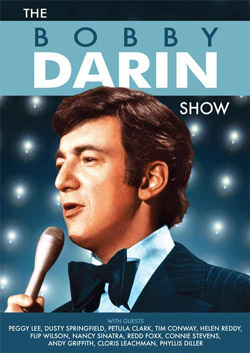
The Bobby Darin Show

Anyway, Darin’s series is in many respects a typical early ‘70s variety show, which is to say a weird hybrid of what was “happening,” baby, and wheezy traditions that dated to vaudeville. Darin is very good at doing sketches and production numbers, and is naturally funny, too. But those ‘70s variety shows, with the partial exception of Carol Burnett, were really pretty terrible. And the reason to celebrate the release of THE BOBBY DARIN SHOW on DVD is chiefly the moments, two or three times a show, when Darin stands on stage in a tux and sings standards and current pop hits in his sophisticated, hip nightclub manner.

Also, every episode (there are thirteen) finds Darin singing to (and with) that week’s female musical guest star. Usually the two perch on stools as he gazes at her with open admiration, in a kind of seduction ending with Darin kissing the female guest tenderly (in near silhouette). What’s most fascinating here is how Darin modulates his performances according to the talents of his partner. Connie Stevens is shockingly weak, and Darin carries her, singing softly and gently. Much the same is true with Nancy Sinatra – but she is much better with him, with his help, than in her embarrassing solo performance of a lame “Boots are Made For Walkin’” follow-up flop.

But when Darin sings with Dusty Springfield – the greatest blue-eyed female soul singer of her generation – they stand facing each other, going toe to toe, delighted by each other’s talent, holding nothing back, although Dusty may be just a little bit surprised that the “Splish Splash”/”Mack the Knife” guy has such incredible r & b chops.

It’s not overstating it to say Darin was dying when he made these shows. Sometimes he clearly feels pretty good, and other times not. He doesn’t betray that, but I can tell. He phrases differently – grabbing more air than usual – when he’s under the weather. At the end of each show, he sings “Mack the Knife” while the credits roll and then recedes into a big empty soundstage in silhouette, which now plays hauntingly. If he’s feeling good, he dances and prances; if he’s having a rough week, he does just enough footwork and body language to fool you into thinking he’s still Bobby Darin. It’s said that he took oxygen off-stage before and after these performances, and that he was like a puppet with its strings snipped till the camera came on and the orchestra kicked in, and he came – for a time – alive.

Bobby Darin was a character Walden Robert Cassoto played. The coolness of the cat, swinging his songs on these shows, is startling in contrast to the goofy humor bits he does, like when he’s in drag as “the Godmother,” or sitting on a brownstone stoop jawing with a neighborhood pal. His acting talent comes to the fore in some excellent low-key production numbers in which he enacts a scene drawn from a song he’s singing, as in “I’ll Be Your Baby Tonight,” where he’s a lower-class joe entertaining a prostitute in a cheap hotel room. Fairly startling, actually.

Darin could do anything. He was Oscar-nominated for a dramatic movie role and won a Golden Globe for a comedy. He was a genuine rocker. He was easily the greatest blue-eyed soul singer of his generation. He recorded some of the first country rock and folk rock, and was a songwriter of talent and versatility (he’s in the Songwriters Hall of Fame). At the start of his career, he opened for George Burns. In the last months of his life, he was the highest paid performer in Vegas.

If you buy this DVD set, know a couple of things. There are some things missing from these shows, apparently mostly guest-star performances that couldn’t be cleared. There are comedy bits you may wish to skip, and some dreadful musical performances by guest stars. I mean, it’s the early ‘70s. We’re talking the kind of era that makes people nostalgic for THE BRADY BUNCH.

But when Darin takes centerstage, with a big band behind him, a microphone in hand, and a rapt audience before him, prepare to get chills. There are performances here, by this dying young man, that are spellbinding and mesmerizing – “Cry Me a River,” “Some People,” “Once in a Lifetime.” A rare live performances of his great hit “Artificial Flowers” (one of his many songs about death) can be found here, and so can his thumbing-his-nose-at-the-reaper signature tune “Mack the Knife” – thirteen times, each different. The most astonishing performance is, perhaps surprisingly, his moving and electric rendition of Don McLean’s “Driedel.” Worth the price of admission.

The DVD set is widely available, on Amazon and at Barnes & Noble, and featured in mail-order catalogues like Critic’s Choice.

For those of you who have no idea what the fuss is, check out this 1962 performance:

* * *

Here’s that interview that Jon Jordan did with me about KING OF THE WEEDS and more.

Barb and I are thrilled that the Washington Post mystery review chose ANTIQUES CON for part of their round-up of new cozies.

And my old pal Ron Fortier (terrific writer his own self) had wonderful things to say about KING OF THE WEEDS.

JFK assassination expert Vince Palamara – one of my unwitting resources – has some very nice things to say about TARGET LANCER here. I can’t tell you how much it means when somebody like Vince approves of my exploration of the key crime of the 20th Century.

M.A.C.
Eight Million (and More) Stories

Tuesday, February 25th, 2014

I have begun the Spillane western, now entitled DEATH RIDES IN and labeled “a Caleb York Western.” I’m working from a screenplay Mickey wrote for John Wayne in the late ‘50s which, obviously, was never produced. There will be a background intro that will discuss Mickey and Wayne’s history together.

It feels okay so far – one chapter in – but with the exception of the MAVERICK novelization and the flashbacks in BLACK HATS, I’ve never tackled a western before. I called my long-tall-Texan pal Bill Crider for some help on a few points – he knows what he’s doing – and that helped me saddle up and ride. The script – not necessarily written for Wayne the actor, rather Wayne the producer – is very much a vehicle that you might have seen starring Audie Murphy or Randolph Scott circa ‘58. I love that, but as somebody who doesn’t read contemporary western novels, I can’t anticipate how modern readers will react. It’s very much a tough Spillane story transferred to the west, so that’s a plus.

My love for westerns comes not from novels – I’ve maybe read a dozen in my life, counting TRUE GRIT – but from movies and TV. Lately I’ve been watching a lot of old TV, sometimes with Barb, sometimes alone. We both greatly enjoyed revisiting MAVERICK, which was my favorite show of any kind in my distant youth – James Garner’s Bret Maverick influenced Nate Heller as much as any mystery-fiction PI – and Barb grew up on it, too. I’m also fond of Jack Kelly’s Bart Maverick, and the very best episodes often feature both brothers. I would argue that “Shady Deal at Sunny Acres” (maybe you saw the remake – THE STING?) is the greatest single episode of a TV series ever made.

Binge watching is something Barb and I (and Nate, when he was younger) practically invented. But it must be said that serialized series of today work better than runs of classic series of the ‘50s and early ‘60s. Those shows had such punishing schedules – PERRY MASON did as many as 39 hour-long episodes a year – that maintaining consistency much less high quality was damn near impossible. On the other hand, Barb and I have worked our way through PERRY MASON – inhaling each half-season DVD release in a couple of days – and it has a surprisingly small number of clinkers. Maybe half a dozen out of 271 (!). The best episodes, not surprisingly, are adapted from Erle Stanley Gardner novels. The first two seasons are mostly such adaptations, and are highly recommended.

MAVERICK doesn’t fare quite as well. The first two seasons are excellent, really as good as TV westerns of that (or really any) era get. But creator/producer Roy Huggins left at the end of season two, and James Garner was starting to have battles with some very stupid Warner Bros. executives who thought screwing their star out of money was a good plan. Season three begins well but flags at mid-point, and toward the end, even some Bret episodes are clinkers. Season four lacks Garner, and Roger Moore is brought in as a Maverick cousin, faring only so so. “The Maverick Line,” one last Garner held back from season three, does the impossible: it’s a lousy Bret/Bart episode. Jack Kelly was magical working off James Garner, but tended to do the straighter, more “serious” episodes, and when Garner left, he was shifted into Garner-style scripts. He was pretty good at comedy but wasn’t getting the level of material that Garner got in the Huggins years. So my advice would be: watch the first two seasons.

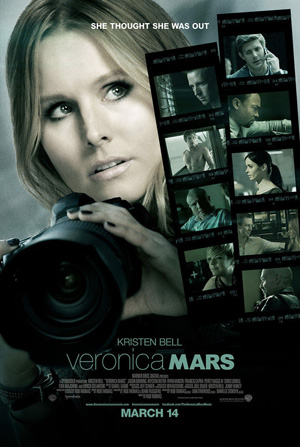
As for more contemporary fare, right now Barb and I are working our way through VERONICA MARS, and are almost done with the second season, which is very good if not up to the amazing first one. We’ll press on to the somewhat maligned third season, as we prepare for the imminent VERONICA MARS feature (I was a Kickstarter contributor). VERONICA MARS is one of the really great private eye series. The first season may be the best single season of any private eye show. Kristen Bell, as a teenage detective (the set-up is pure Nancy Drew – her father is a P.I. – but the feel is absolute FREAKS AND GEEKS) tosses off witty lines with a wry ease that Marlowe or Rockford might well envy.

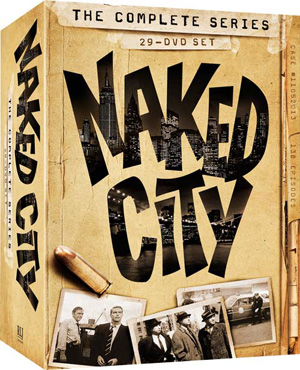
Barb did not join me on my long journey through the complete NAKED CITY – 138 episodes. This is a wonderful show, with much to recommend it. Initially John McIntire is Lt. Dan Muldoon, the fatherly mentor to James Franciscus’ younger detective. They have a nice chemistry, but McIntire leaves two-thirds of the way through the first season – his landmark demise in “The Bumper” remains shocking – and Franciscus grieves his way through the remainder of the year. Replacing McIntire is Horace McMahon with his overly gruff, even unpleasant Lt. Mike Parker. When the show returns in a new one-hour format (after a year hiatus), it’s almost a surprise McMahon has been asked back. Franciscus does not return – he was a busy movie and TV actor – and Paul Burke comes in as the similar Adam Flint, his liberal, sensitive cop warming McMahon’s Parker up. The only cast member who spans all four seasons is Harry Bellaver as lovable, not-brilliant Detective Frank Arcaro.

Of course, the location shooting, capturing late ‘50s/early ‘60s New York, is the real star – the Bowery, Greenwich Village, Times Square, we’re there. The talent pool is drawn from Broadway and the Actor’s Studio, including regular Nancy Malone, very winning and naturalistic as Burke’s girl friend, Libby. The series is justly famous for early appearances by Dustin Hoffman, Robert Duvall, James Caan, Bruce Dern, Sandy Dennis, Alan Alda, Jessica Walter, Martin Sheen, Peter Fonda, Gene Hackman, Christopher Walken and many more. Moonlighting Broadway stars like Robert Morse, Orson Bean, Maureen Stapleton, Jack Klugman and William Shatner turn up frequently as do such Hollywood legends as Mickey Rooney, Sylvia Sidney, Dennis Hopper, Roddy McDowell, Chester Morris, Steve Cochran, Claude Rains, and Burgess Meredith. Jack Warden, Carroll O’Connor, Lois Nettleton and Nehemiah Persoff make multiple appearances. Legendary acting coach Sandy Meisner has a rare on-screen role in one episode – he was Mike Cornelison’s teacher. Small world.

NAKED CITY is a child of early television – dramas like STUDIO ONE and PLAYHOUSE 90 – and is essentially an anthology series pretending to be a cop show. This can be a problem, because the cops are often shoehorned in, and sometimes the stories have little to do with crime. Some of the famous actors deliver terrible, scenery-chewing performances; many of the young actors – James Caan, Dustin Hoffman – are so in Brando’s thrall, you want to shake them until they agree to see a movie that isn’t ON THE WATERFRONT. The shadows of Tennessee Williams and William Inge loom large, turning some of the scriptwriters into pretentious windbags, burdening actors with impossible, archly poetic dialogue.

After a while, I began to see writers in the opening credits whose scripts I knew I’d abhor – in particular, Abram Ginnes, a blacklisted writer so over the top, his silly titles serve as a warning: “Stop the Parade, a Baby Is Crying,” “A Horse Has a Big Head, Let Him Worry,” “Robin Hood and Clarence Darrow, They Went Out with Bow and Arrow.” He’s responsible for at least a dozen episodes, and I would run screaming into the night before sitting through any of them. And almost every change-of-pace “comedy” episode is cringe-worthy.

There are several NAKED CITY “best of” collections, but unfortunately they choose episodes featuring famous cast members, with no thought to quality of writing. So why do I recommend the series?

Because when the show is good, it is really good – on that same list that includes “Shady Deal at Sunny Acres,” you’ll find “A Case Study of Two Savages,” in which hillbilly honeymooners Rip Torn and Tuesday Weld cut a bloody carefree swath of robbery and murder across Manhattan. Scripted by Frank Pierson – who wrote everything from DOG DAY AFTERNOON and COOL HAND LUKE and was working on MAD MEN when he died in 2012 – “Two Savages” clearly influenced Arthur Penn’s BONNIE AND CLYDE (the historical couple is directly referenced) and Weld’s later PRETTY POISON. Rip Torn’s performance is my favorite among all the NAKED CITY’s – funny, dangerous, charismatic. Actor’s Studio “Method” at is best.

And there are plenty of other terrific episodes – Duvall in “A Hole in the City,” Klugman in “The Tragic Success of Alfred Tiloff,” Rooney in “Ooftus Gooftus.” Writers include Howard Rodman, W.R. Burnett, and Gene Roddenberry. Directors include Arthur Hiller, Paul Wendkos, and Irvin Kershner. But you must commit to the complete series, and learn which writers and actors you want to avoid as you move through.

I should mention that the series creator, Stirling Silliphant (adapting the Jules Dassin film), writes all but a few of the first season half-an-hour episodes, which is my favorite season (not a view widely held, I admit). He only scripts a few of the hour-long episodes, as he’s off to create ROUTE 66. Silliphant is a fine screenwriter (IN THE HEAT OF THE NIGHT), though he’s somewhat purple in THE NAKED CITY (its first-season incarnation included “THE”), a sin committed to some degree by almost all of the writers involved. So you have to get in that groove.

But it’s worth it. The omniscient narration by Lawrence Dobkin (credited to producer Herbert Leonard in the first season, but sounding identical) is so very memorable, often giving the series a novelistic feel. Ed McBain was clearly influenced by the Dassin film, and must have watched this series, as well – the 87th Precinct vibe is strong. The music is memorable as well – Billy May at first, later Nelson Riddle.

How interesting is NAKED CITY, for all its flaws? In the first hour-long episode, an unbilled Peter Falk is killed before the opening credits. The episode also features Eli Wallach, George Maharis, Clifton James and Godfrey Cambridge.

* * *

The first SUPREME JUSTICE advance review is in (from Ron Fortier) and it’s a rave!

ASK NOT gets a lovely write-up here.

Still more WRONG QUARRY reviews are coming in. Here are two that are less than raves – the always interesting Alpha-60 and a new one to me, Bullet Reviews. Both complain about one of my favorite things in the novel, having to do with the build-up given to one of the hitmen Quarry goes after. Go figure.

M.A.C.

Notes From a Stuffed-Up Author

Tuesday, February 18th, 2014

I spent much of last week fighting a cold and researching/writing an introduction for a forthcoming Hermes Press collection of the pre-Disney ZORRO comic books from Dell. The centerpiece is a trio of issues drawn by Everett Raymond Kinstler, who would go on to be our nation’s premiere portrait artist, with subjects ranging from John Wayne to various Presidents. The other comic books (seven in all) are good as well, but I really had to dig in on the net and among Zorro fans to find out who the artists and writers were. Much guesswork involved. I am a big fan of Zorro as originally created by pulp writer Johnson McCulley, and my intro in part decries the paucity of McCulley Zorro stories in print.

Also, we received good reviews from agent and editor on ANTIQUES FRUITCAKE, so that one is largely put to bed (it’s an e-book novella). Barb is back to her draft of ANTIQUES SWAP, and I am headed into the Spillane western, THE LEGEND OF CALEB YORK. There will be a subtitle for the latter but I haven’t come up with it. I’ve been told to leave out the sex and hit the violence hard, even down to the title. So RAVAGING THE DANCE HALL GALS is out. I’m considering SHOOT-OUT AT SIROCCO.

I also worked on several more passes on a HELLER TV pitch. I’ve done seven so far. Hollywood is all about rewriting. I remember so vividly when I handed in draft umpteen on THE EXPERT to director Bill Lustig and he immediately said, “Thanks! Now, on the next draft I want to concentrate on – ” I interrupted to say that I wouldn’t take any more notes till he’d read the draft I just handed him.

Barb and I are listening to Dan John Miller’s audio rendering of THE WRONG QUARRY. This is Dan’s first Quarry novel, having done all of the Hellers. He has once again nailed it.

Speaking of THE WRONG QUARRY, here’s another nifty review.

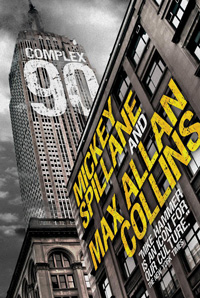
COMPLEX 90 made the top five best book covers of 2013 at the Rap Sheet.

Here’s a nice review of the Hammer short story (available from Mysterious Bookshop as a mini-book), “It’s in the Book.”

Finally, here’s a very smart review of the film of ROAD TO PERDITION. Nice to see this great film really making its mark over the years.

M.A.C.

The Write Quarry

Tuesday, February 4th, 2014

It’s very gratifying that THE WRONG QUARRY has generated so much attention, particularly on the Net. This is, after all, the tenth novel in a series begun in 1976. No other book of mine in recent years – including the Heller comeback novels that form the JFK Trilogy – has been so widely reviewed. As I noted a while back, out of what must be around forty write-ups by now, there’s been only one that wasn’t a near rave – and it was mixed.

It appears that a lot of the reviewers and bloggers who dig Quarry are only familiar with the recent five Hard Case Crime novels. I hope that gradually the Perfect Crime reprints, with the cool Terry Beatty covers, will find their way into the hands and minds of these new Quarry fans.

One interesting result of (I presume) younger readers discovering the series through Hard Case is that the premise of Quarry being a hitman who kills other hitmen has been hailed as innovative, and “new” for Quarry specifically and crime novels in general. Of course, many of you who follow these updates (both of you) know that the premise of Quarry using the Broker’s list began back in 1976, in the book now known as (not surprisingly) QUARRY’S LIST. Also, both QUARRY IN THE MIDDLE and QUARRY’S EX from Hard Case are “list” novels.

I’m not complaining. I always thought the “list” concept was innovative myself. I just thought that starting back in ‘76….

* * *
Complex 90

Here’s a nice essay utilizing interview answers from me. The emphasis, not surprisingly, is on Quarry and the current novel.

And, yes, wonderful WRONG QUARRY reviews are still appearing, like this one at Crime Fiction Lover.

Here’s a nice one from Fiction Addict.

On the Mike Hammer front, J. Kingston Pierce at the Rap Sheet has singled out his favorite covers of last year and COMPLEX 90 made the list. He’s giving you the opportunity to vote for your favorite among his. Remember, any vote for Mike Hammer is a vote for America.

Here’s an excellent review of THE GOLIATH BONE. There’s also an explanatory comment from me about who-wrote-what.

Finally, here’s an overview of Crime Fiction in Comics and Graphic Novels that includes a nice section on yours truly (I always want to add “Johnny Dollar” to that…).

M.A.C.