Posts Tagged ‘Spillane’

Leonard Nimoy And Me

Tuesday, March 3rd, 2015

The eccentric and self-aggrandizing mystery writer Michael Avallone liked to show people pictures of himself and Gene Kelly, standing together in a suburban front yard, with the great song-and-dance man’s arm slung around the pulp writer’s shoulder, both men grinning. Donald E. Westlake said to me about this photo, “The only way that could have happened is if Gene Kelly fell out of a plane.”

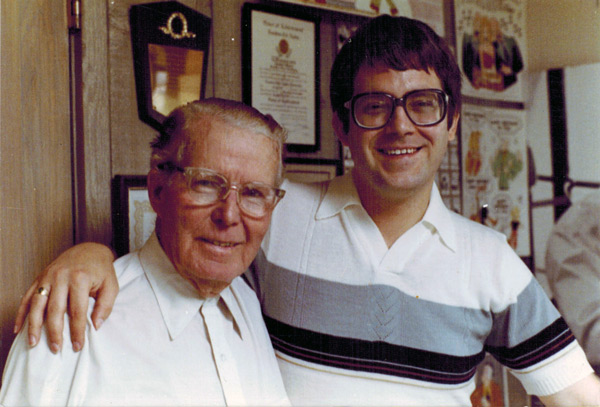
So the fact that I have a couple of photos of Leonard Nimoy, with me in them (that’s the back of my head in one), doesn’t mean we were pals. I doubt I made much of any impression on him. But he made an impression on me.

In the late ‘60s and early ‘70s, when I was commuting to the University of Iowa in Iowa City from Muscatine (where I still live), Barb and I were in the early days of our marriage. We lived in a little two-room apartment with kitchenette and bath, where I wrote BAIT MONEY while Barb worked at the bank (the one I had Nolan and Jon rob in that novel).

Our first big shared enthusiasm (okay, our second big shared enthusiasm) was STAR TREK, which we began watching during its third season (I was aware of the show but my band the Daybreakers had our regular rehearsal on the night it aired) (no VCRs yet). Shortly after that, STAR TREK reruns began to appear in the late afternoon. I usually got home in time to see an episode.

When my schedule didn’t allow that, I lingered in Iowa City at my pal Mike Lange’s apartment, which he shared with three or four other nerds. Mike and I had been in a vocal quartet that won State every year of high school. He was one of the original sweater-vest-and-briefcase geeks and was very funny, sometimes on purpose. Barb and I called him an “incompetent Spock.” The best way to understand who Mike was is best demonstrated by his asking a waitress, “What is the ETA of a tenderloin?” Years later, Mike would join us for the various STAR TREK movies, invariably on opening night, starting with STAR TREK: THE MOTION PICTURE, which we stood in the snow for several hours to see.

I suppose Barb and I were Trekkies, but the word wasn’t in wide use yet, at least not in Iowa. We went to one of the first ST conventions, in Detroit, where we met Gene Roddenberry, James Doohan, Majel Barrett (later to appear in my film MOMMY) and various writers from the show; I believe “The Menagerie” in black and white was shown. Around that time, I also somehow got in touch with Walter Koenig, who was a Big Little Book collector; we made some trades, and became friends, meeting up at several comic-book conventions. Very smart, nice guy, and an excellent writer. We’ve stayed in sporadic touch over the years.

We also went to see William Shatner, appearing in “The Seven Year Itch” at Pheasant Run dinner theater in Illinois; he was funny and energetic, as you might expect. This was in the early ‘70s. He signed autographs (including my copy of THE TRANSFORMED MAN) and was friendly but bewildered by the many STAR TREK fans who wanted to discuss a series that had been cancelled five or six years before. He said unequivocally that STAR TREK was dead (I asked him, “What about the rumors of rebirth for the series?” and he said, “More like afterbirth.”) I remain a big Shatner fan.

But of course the STAR TREK character and actor who had the Baby Boomers most in his thrall was Spock/Nimoy. The dignity, the humor, the humanity of that characterization spoke to so many things in my generation, not the least of which (pun intended) a shared alienation. Even more than Shatner, however, Nimoy felt captive to his ST role – the ears played a part in that – and it took him decades to understand the importance of his pop-cultural contribution, and to embrace it.

It needs to be said that the chemistry between Nimoy, Shatner and the great Deforest Kelley was the real engine of the show, thrusters be damned. That stroke-of-luck casting for three well-defined characters is the real reason why we are still looking at and talking about that 79-episode, late-‘60s science-fiction series.

In the ‘70s, Barb and I went to see Nimoy in a number of plays. One was THE FOURPOSTER, at another Illinois dinner theater, a matinee in a huge theater-in-the-round with maybe a dozen of us in attendance. Nimoy and his co-star, whose name I don’t recall, gave their all. I was very impressed. Later we saw Nimoy as a very strong Sherlock Holmes in a big, revamped version of the wheezy Gillette play; this was in a big Chicago theater and co-starred LAUGH-IN’s Alan Sues as Moriarty.

The most memorable Nimoy appearance for us was at a small political rally in the basement of the student union at NIU in DeKalb, Illinois, in October 1972. Nimoy was appearing to encourage young, first-time voters to get out and put anti-war candidate George McGovern in the White House. He gave a warm, smart speech, and we were in or near the first row. While we were McGovern supporters, Barb and I were there for Nimoy, of course. (This event, oddly enough, was just written up by me as a part of QUARRY IN THE BLACK.)
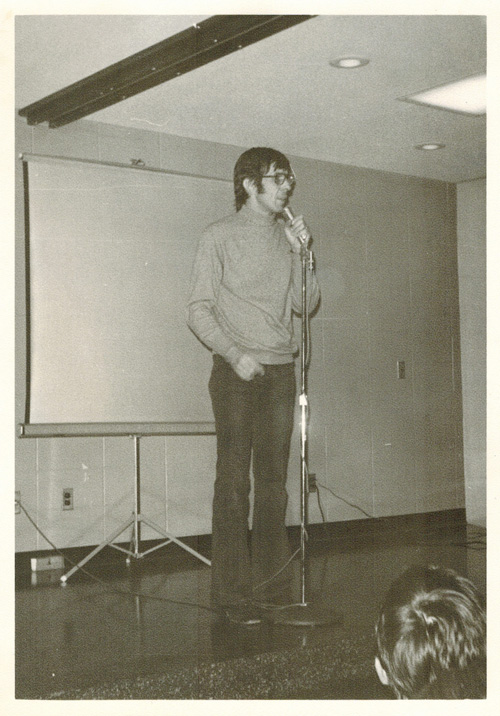
Leonard Nimoy at NIU
Leonard Nimoy speaking at NIU, 1972.

Barb and I were, in those years, very dedicated TREK fans. We still are, but as the fan phenomenon grew sillier and more shrill, we kind of reluctantly faded into adulthood. At the same time, as I said above, opening day for a STAR TREK film was our church (we also still worshiped at the temple of James Bond opening days) (still do). And Nimoy was an actor, and later director, who I continued to follow with admiration.

In the early ‘90s, when Tekno-Comics – by way of my late good friend Marty Greenberg – invited Mickey Spillane and me to create a comic book (MICKEY SPILLANE’S MIKE DANGER), the various celebrity creators of the various titles in that line were gathered at several events. Leonard Nimoy had created an s-f title, LEONARD NIMOY’S PRIMORDALS, which put me in the same room with him a number of times.
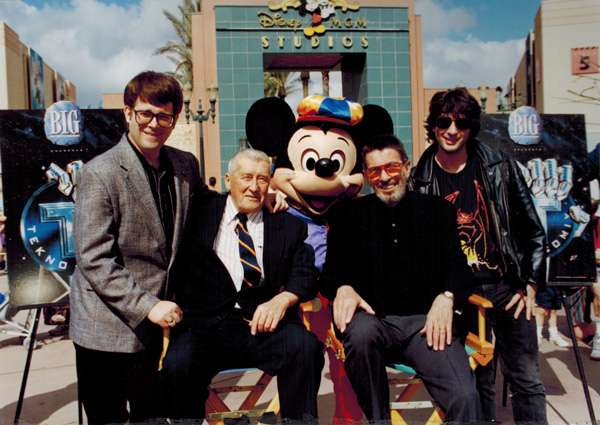
Max, Mickey, Mickey, Leonard, Neil
M.A.C., Mickey Spillane, Mickey Mouse, Leonard Nimoy, Neil Gaiman

At a Disneyworld event, specifically a luncheon, I mentioned that Barb and I had seen him in several plays, including SHERLOCK HOLMES. We spoke about Holmes for a while – Nimoy played him in a short film, as well – and he had a clear love for the character (according to Nicholas Meyer’s STAR TREK: THE UNDISCOVERED COUNTRY, Holmes is an ancestor of Spock – and Meyer should know). I found Nimoy reserved but friendly, very Spock-like actually.

Later that same year, at a Griffith Observatory event, he was coming down an aisle with his lovely wife and I was coming up the aisle with my lovely wife. Surprisingly, he remembered me, sticking out his hand for me to shake, and flashed that great smile that is always so shocking coming from Spock. We spoke for just a minute or so, but…well, it was a moment I won’t forget. Maybe I am a Trekkie.

He died at 83. As someone said, that sounds really old, unless you’re a man of 82. I am a man of 66, who will turn 67 on the day this update appears, and 83 sounds less old than it used to. But it’s tough to have a better life, at least in terms of art and career, than Leonard Nimoy. He turned Spock into a cultural icon as well as a character of enormous appeal and power, mostly by underplaying. He appeared in numerous other TV shows and movies, and directed some as well; he was a skillful writer, one of the few poets I ever bought books by, and was a respected fine-arts photographer. Yes, I am going to say it. He lived long and prospered.

Just not long enough.

* * *

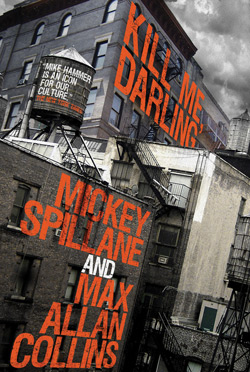
Here is an absolutely terrific, starred review of KILL ME, DARLING by Spillane/Collins.

March 15, 2015. KILL ME, DARLING. Spillane, Mickey (Author) and Collins, Max Allan (Author) Mar 2015. 246 p. Titan, hardcover, $22.95. (9781783291380).

It’s the mid-1950s. Four months ago, private eye Mike Hammer’s partner and girlfriend, Velda, left him without any sort of explanation. Mike leapt feet first into a bender, a four-month drunk; when this superb, old-school crime novel opens, he’s addicted to the booze and uninvolved in the world. His best friend, NYPD captain Pat Chambers, tells Mike he had better get his act together because Velda has turned up in Florida, hanging on the arm of a big-time gangster, and Velda’s boss from her undercover-cop days has turned up dead, the victim of a mugging that looks suspiciously like murder. So Mike heads off to the Sunshine State, determined to pull his head out of the bottle and find out why Velda left him—and, just maybe, to pull her out of whatever hole she’s put herself in and bring her back home. This latest collaboration between Hammer’s creator, the late Spillane, and noted crime writer (and frequent Spillane coauthor) Collins is based on an unfinished Spillane manuscript, but it reads seamlessly; in fact, it’s impossible to tell which parts were written by Spillane and which were written by Collins. Yes, it’s a new book, but it feels like something from 60-odd years ago, when Spillane’s prose was young and raw and full of energy. For Mike Hammer’s fans—yes, there are still plenty of them out there—it’s a sure bet. — David Pitt

Ron Fortier, fine writer in his right (righter in his own write?) is among the first to review KILL ME, DARLING.

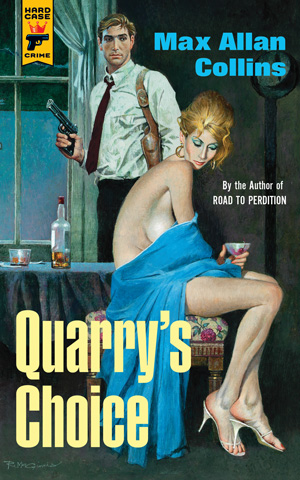
This review of QUARRY’S CHOICE is favorable but suggests you may need a shower after reading it. Why not? I’m all in favor of cleanliness.

Here’s an interesting if patronizing essay/article on Mickey Spillane.

Here’s a nice mention of QUARRY’S CHOICE from my old pal Chris Mills (he did the great Perfect Crime “Van Cleef” covers for the NOLAN reprints). Beautiful look at the McGinnis cover.

Finally, check out this excellent, darn near in-depth look at MS. TREE.

M.A.C.
Collaboration Again

Tuesday, February 17th, 2015

This week I begin serious work on the second Reeder & Rogers novel, STATE OF THE UNION. Prior to this, work on my end has been limited to creating a synopsis for both the original proposal and a work document, and ongoing story conferences with co-author Matt Clemens, who has for some months been working on a rough draft for me. I am meeting with Matt today – he’s coming down from Davenport to Muscatine – and he will turn over materials to me and we’ll talk about what I’ll be doing as well as the final chapters of the rough draft that he’s still working on. (We’ll also discuss doing a proposal for another, very different series.)

So I will be heading into the bunker again, but the process of collaboration is much easier on me than working on a Heller or even a Quarry, where I am starting with blank pages, with a lot of research left to do. Matt will have done most of the research – there’s always some research to do on the fly – and that makes my life easier.

People often ask about the collaborative process. My three collaborators – Barbara Collins, Matthew V. Clemens and the late Mickey Spillane – have only one thing in common: a lot of talent. In each case, I start with a short manuscript and expand and polish it to the desired length and the finished product. For an ANTIQUES book, Barb gives me 200 to 250 doubled-spaced pages, which is the basis of my draft, which comes in around 325 pages. With Matthew the length of the projects vary, but with Reed & Rogers, I probably get 50,000 to 60,000 words from Matt and take it up to around 80,000 or 90,000. For the first six Mike Hammer novels I completed (ditto THE CONSUMMATA), I had about 100 double-spaced pages of Mickey’s, which I turned into around 300. KILL ME, DARLING – coming out soon – is the first Hammer that starts with less of Mickey’s work (44 double-spaced pages) but I think stacks up well with the prior collaborations. My process turned those 44 pages into around 100, and of course Mickey had set the entire plot in motion in his opening chapters.

But I don’t think looking at these collaborations as numbers games tells the real story. The real reason to collaborate is not to save time – I could frankly do original works in about the same time that it takes me to do my drafts from Barb’s and Matt’s – rather the combination of talents, the merging of two voices into another unique voice that reflects both writers.

For the record, Matt co-wrote all of my CSI novels, both CRIMINAL MINDS, the trio of DARK ANGELS, the BONES novel, and doubtless other things that are slipping my mind (he contributed to RED SKY IN MORNING, for example). And of course we’ve written quite a few short stories together, and are in the early stages of putting together a rather massive collection of them. One of these days I’ll assemble a complete list of the books we’ve worked on together.

I am very lucky that both Barb and Matt never bitch about the changes I make. If anyone ran roughshod over me the way I do them, I would be homicidal. But understanding that the process means providing me with rough-draft material may be helpful to the egos of these two gifted writers, both of whom have shown their individualistic stuff in short stories. And Mickey seems to have done just fine without me….

* * *

Local papers often produce dreadful stories out of interviews with local celebrities. In my case this week, I got very lucky. Muscatine Journal writer Ky Cochran did an excellent article on the Quarry books and upcoming TV series. Check it out.

Chester Gould and Max Allan Collins
Chester Gould and M.A.C. in 1981 (photo credit: Matt Masterson)

There’s a Chester Gould documentary – which I haven’t seen yet, but I’m featured as one of the interviewees – that airs next Sunday on Chicago PBS. There’s a special INVITE ONLY event that same day at Woodstock, Illinois (filming site of the brilliant GROUNDHOG DAY). Barb and I are planning to attend, and I may be speaking, briefly. Read about it here, but I’ll report back next week.

M.A.C.

Note From The Bunker #2

Tuesday, February 3rd, 2015

[Nate’s note: Before we get to the regularly scheduled Update, we have some breaking news:

QUARRY ON CINEMAX

Cinemax today officially announced an eight-episode series order to drama pilot Quarry. Production will begin March 30 on location in New Orleans and Tennessee. Created and executive produced by Graham Gordy & Michael D. Fuller. Based on the novels of Max Allan Collins, the show will be directed and executive produced by Greg Yaitanes (Banshee), along with executive producer Steve Golin (True Detective).

Quarry tells the story of Mac Conway (Logan Marshall-Green), a Marine who returns home to Memphis from Vietnam in 1972 and finds himself shunned by those he loves and demonized by the public. As he struggles to cope with his experiences at war, Conway is drawn into a network of killing and corruption that spans the length of the Mississippi River. Jodi Balfour, Peter Mullan, Nikki Amuka-Bird and Damon Herriman co-star, along with Jamie Hector, Edoardo Ballerini and Skipp Sudduth. “This nuanced and dynamic show marks an exciting moment in the evolution of Cinemax programming,” said HBO’s Michael Lombardo.

An HBO Entertainment production in association with Anonymous Content, the series is also executive produced by Matt DeRoss, David Kanter, Max Allan Collins and Ken Levin. Additional writers on the series include Jennifer Schuur and Max Allan Collins.

Cinemax has been making strides in original programming with dramas Banshee and The Knick, the latter earning the sister HBO network its first awards nominations.

And now, back to the Update….]

* * *

Here’s the first major review for the upcoming Mike Hammer novel, KILL ME, DARLING – and it’s a great one from Publisher’s Weekly no less:

Kill Me, Darling

Set in 1954, Collins’s seventh posthumous collaboration with Mike Hammer creator Spillane (after 2014’s King of the Weeds) is one of his best, liberally dosed with the razor-edged prose and violence that marked the originals. The New York City PI has hit the bottle hard after his longtime assistant and love, Velda Sterling, abandoned him with a one-word note. Then Mike’s friend on the NYPD, Pat Chambers, tells him that Velda has surfaced in Miami, on the arm of Nolly Quinn, a notorious mob-connected pimp. Mike cleans himself up and heads south to rescue Velda from Quinn, only to find that she doesn’t want to be rescued. Collins faithfully follows Spillane’s successful formula, including frequent gunplay, menacing thugs, and betrayal. He even matches Spillane’s colorful turns of phrase (e.g., “My bullet shattered his smile on its way through him and out of the back of his head”). Agent: Dominick Abel, Dominick Abel Literary Agency. (Mar.)

* * *

I am still working on the new Quarry novel and might finish this week, if all goes well. But a writer never knows. I often say that I never get writer’s block, which is the kind of boast than can catch up with you. No writer’s block, that’s true in its way, but I do have bad days.

A typical bad writing day for me happens as follows. I have a very good writing day, turning out more pages than usual, and I am floating on a cloud of genius. Then, that night, going to bed around midnight, having gone blissfully and quickly asleep, I wake up at 1:30 a.m. Wide awake. I do my best to get right back to sleep, but no go. I go downstairs, read something until I get sleepy, which takes an hour to two hours. Then I sleep in my recliner for a while, wake up after a while and trudge back to the bedroom, where I get to sleep right away. But I wake up at the usual time, after a very disrupted night’s “rest.”

The writing day that follows is almost always a disaster. I do write. But I am not my usual nimble self. What’s normal for me is ten to fifteen pages of finished draft. Last week, after my rocky night, I spent all day on four pages.

Some of that has to do with the research that is now required of a Quarry novel, now that they have become historical books themselves, in their quirky way. I spend as much time chasing details on Google or in reference works as I do writing – not that different from the Heller process.

But the way I do a Quarry novel is much different than a Heller. Because of the historical crimes involved, a Heller novel is tightly plotted, with each chapter detailed in at least a paragraph in a document that can be anywhere from ten to thirty pages long. With Quarry, my chapter outline reverts (not surprisingly) to the approach of my early career, with each chapter indicated by a sentence or two. For QUARRY IN THE BLACK, my outline says for chapter one: “Quarry gets job from Broker.” Another says: “Quarry and Southern gal connect at club.” That’s it. The rest is done on the fly.

That really works for Quarry, but if I’m having an off day? He is just not himself. Like I am not. Sometimes I can power through it. Sometimes I can come back in the evening (which I did with the four pages mentioned above, which turned into seven) but not always. Being older doesn’t help.

And there’s that other thing that writers never talk about – that as writers we change from day to day. Make that second to second. Back in the ‘80s, before word-processing programs automatically saved every now and then, I lost an entire chapter of the Eliot Ness novel, THE DARK CITY. It was devastating. When I knew the chapter was gone, really really gone, I started over and did my best to remember it.

Of course, I couldn’t. The chapter, as it now exists, covers the same ground. But it’s not as good as the one I lost. If I were to lose this little essay and start over, it would be substantially different and none of the phrasing would be replicated. In the mid-‘80s, I lost a chapter of PRIMARY TARGET (aka QUARRY’S VOTE) and the same process happened: I tried to remember it and only came up with a shadow of what it had been.

If a writer starts working on a story or chapter in a novel on Monday morning, even working from a detailed outline, it will be substantially different that if he waited till Tuesday afternoon. We, like what we write, are works in progress. We hope it’s progress, anyway.

A number of people lately have asked me what order to read the Quarry novels in. Chronological would seem to make sense, like starting with THE FIRST QUARRY, moving to QUARRY’S CHOICE, then QUARRY aka THE BROKER, sliding the later-written books into continuity. But THE BROKER was written when I was in my early twenties; THE FIRST QUARRY and QUARRY’S CHOICE were written by a man in his sixties. Do you understand why my advice would be to read the books in the order I wrote them? Because the writer who did the first four Quarry novels was a very different one.

* * *

Here’s an okay review of SEDUCTION OF THE INNOCENT, but the reviewer doesn’t quite get it….

Here’s a fun review of DAMNED IN PARADISE.

And now, with the blessing of being snowed in, I will head back to the bunker. Only I’m already there.

M.A.C.

Choice Reviews!

Tuesday, January 6th, 2015
Quarry's Choice

QUARRY’S CHOICE comes out this week, and I’ve been a little worried because there hadn’t been a single advance review, despite Hard Case Crime sending out a bunch of ARC’s.

Just recently, though, two of my favorite writers – Ed Gorman and Bill Crider – have posted excellent reviews of the novel, one of which is getting some decent play at other blogs (more about that below). But QUARRY’S CHOICE could still use a boost, so if you’re a Quarry fan, and get and like the book, please consider posting an Amazon review.

Also, if you have a blog or some other place where you review books, contact me at and I’ll try to rustle up a review copy for you. (Please, no one tell Nero Wolfe I used “contact” as a verb.)

I thought THE WRONG QUARRY was about as good a Quarry as I could muster, but I have to admit CHOICE seems to me at least its equal. It’s set very early in Quarry’s career (still working as a hitman for the Broker), so if you haven’t read one, this wouldn’t be a bad place to start.

Meanwhile, I have completed the new Heller – BETTER DEAD – and I feel like I fell out a high window, which is not coincidentally one of the crimes covered in the novel. This one is about the McCarthy era and Bettie Page is in it. Do you suppose Heller gets frisky with her? No, I better not spoil it for you….

When I say I’ve completed the book, I should say “completed,” because I will spend the next couple of days giving it a last read-through, looking for typos and tweaking things, hoping to God it all hangs together. I always feel that I’ve got a solid chapter written before going onto the next, but I also always fear that the pile of chapters will not assemble coherently into a book. This has never happened, but I live in terror of the time it does.

* * *

I’m going to discuss something at the risk of sounding like a total prick. For some, that will mean only the added adjective. But here goes….

I have helped a lot of writers in my time. I taught for twenty-some years at a summer writer’s conference, for example, out of which a good ten published writers emerged from my classes. Matthew Clemens was a student of mine there, and he turned out not half-bad. I also taught a summer program at the University of Iowa a couple of times. The great Hugh Holton was one of my students.

So I am not against helping writers. I probably won’t teach again, but I’ve put in my time, and have nothing to apologize about.

But I keep running into a kind of writer locally – I mean right here in Muscatine, Iowa – who imposes on me in a way that drives me crazy. Or at least, I feel imposed upon – I might be wrong (that’s where the total prick thing comes in). Here are a couple of examples.

On three different occasions in the last few months, the same man – friendly, nice – approached me at various functions…two parties, once a dance my band was playing at (during a break where I needed to catch my breath)…and pumped me hard for writing advice. Well, not writing advice so much as publishing advice. This ranged from where he should send his stuff to how to approach the people he would send it to, etc. I don’t know this man, particularly – he was a friendly acquaintance of my father’s. But he buttonholed me three times and pumped and pumped.

What I suppose makes me feel like this is an imposition is this: not once did he mention anything I’d written, not even saying he’d seen the film of ROAD TO PERDITION. He was not a fan. I sensed he’d either not read me or had and wasn’t impressed. What impressed him was that I was a professional who lived in his hometown who he could utilize.

Not long ago Barb and I went to a fall cook-out down the street. A woman from our neighborhood who I did not recognize came over to the picnic table where I was sitting and handed me a five-page essay she’d written. She was taking some kind of college class and wanted to know why she hadn’t received a better grade. At this social function, with people around me roasting and eating hot dogs and S’mores, I sat and for at least half an hour dealing with her, reading the paper, giving her a critique, showing her the good, the bad. Here’s the ugly: when I was done, she wanted to know if she could e-mail me her future papers for my critiques, apparently to have me check them before she handed them in. I said no, I just didn’t have time. She was offended.

This next example isn’t a writer. It’s a nice guy down the street who comes out and talks to me when Barb and I are out for a walk, and who at neighborhood parties gravitates to me for a talk. Generally I find him pleasant and smart. But he continually talks to me about mystery and suspense writers he’s reading, telling me his opinions, which is mostly how good they are – I know more about Lee Child than most people who have actually read him. He never mentions my work. Never indicates he’s ever read me. Finally I gave him a couple of books of mine. He’s never said a word about either (one was TRUE DETECTIVE).

This strikes me as peculiar. He obviously thinks because I’m a mystery writer that I would like to hear his opinions on the genre. But if he doesn’t read me, or have any interest in my work, why should he care what I think? And why should I listen?

The phenomenon seems to be strictly hometown – I can’t think of a parallel with (let’s call them) real readers who I encounter at a convention or at a bookstore (sometimes an event, sometimes just somebody who recognizes me and stops to say something nice about my work).

Do I have a right to tell somebody looking for free help that I’m at a social event and don’t care to talk shop? Or something? Should I ask my neighbor why he wants to talk to me about mysteries when he doesn’t read or like mine?

Just wondering.

* * *

What a pleasure to read a great, insightful review from a writer you admire. Here are Ed Gorman and Bill Crider reviewing QUARRY’S CHOICE.

KING OF THE WEEDS has made another ten best list!

Check out this lovely review of BYE BYE, BABY.

Here’s a very solid New York Times article on movie and TV tie-ins, in which I am quoted.

Here’s a great look at the Disaster series.

I have written an introduction for a collection of pre-Disney ZORRO comic books for Hermes Press. It’s a lovely book and the stories are great fun. This reviewer isn’t much impressed, but it’s still worth checking his review out.

And finally here’s a very nice write-up about my work in general and Nate Heller in particular.

M.A.C.