Posts Tagged ‘Road to Perdition’

Spoiler-ville!

Tuesday, August 13th, 2019

Crusin’ played on Sunday, from six p.m till around a quarter till eight, at the Musser Public Library in Muscatine – part of the Second Sunday Concert series. We’ve been part of that concert series for about a decade, but previously we’d been on the patio, outside, at Pearl City Plaza. That space is now privately owned and being developed for a restaurant, so the series is now at the library.

We were supposed to appear outside, in the parking lot, with a Mississippi River view (as the patio had in the past provided), but the morning was rainy with the day bringing dark clouds, so we headed inside to a nice big air-conditioned room on the third floor.

Frankly, I thought this change in venue – two changes, actually, from Pearl City Plaza to the library and then from the parking lot to inside the building – would mean disaster. I’m happy to have been wrong – we had a capacity crowd, easily over one-hundred, with the overflow seated outside the room itself in the hallway.

It went well. In a way that’s frustrating, because I’ve been leaning toward making this my final summer playing regular gigs – even our schedule of six appearances has seemed too much. But we are planning to do an original material CD over the winter months, so maybe we’ll be back for a limited schedule to peddle our CD…three gigs, maybe.

We played five of our originals from that project and they were well-received. It’s tricky as hell for an oldies band to do original material, but we got away with it. That is encouraging.

For a long time I’ve wanted to do one last rock ‘n’ roll album, something that sounds like a really good record from 1967.

We’ll see.

* * *

Welcome to Spoiler-Ville, and continue on at your peril. Skip down quickly if you haven’t seen Once Upon a Time in Hollywood and the fourth season of Veronica Mars.

First, Veronica Mars.

The world of Marshmallows (the cringe-worthy name for hardcore Veronica Mars fans, who have been, shall we say, a-twitter over the death of Veronica’s longtime love, Logan Echolls, portrayed by slow-burn actor Jason Dohring. Marshmallows want the show (assuming it comes back for a fifth season) to find a way to bring Logan back. Creator Rob Thomas and star Kristen Bell are speaking in terms of the finality of the character’s demise.

This is in concert with Thomas (and to some degree Bell) talking about freeing Veronica from her high-school-heavy past in Neptune, California, and (literally in the final episode) sending her off to solve mysteries in what appears to be a hip variation on Murder, She Wrote.

Look, Bell is great, and so is the character that the actress continues to love playing – she knows it’s her signature role. Thomas is a gifted writer and TV guy, and they presumably know what they’re doing. I believe part of the notion of leaving Neptune flows from the two painfully mediocre tie-in novels that Thomas co-bylined but almost certainly had little to do with. The Neptune setting and extended cast, in those novels, are burdens and baggage.

Veronica can lose all of those characters, except one – and that character is not Logan Echolls, who has ceased to be useful in her story. The essential secondary player is Veronica’s father, Keith Mars (as portrayed by Enrico Colantoni). Their chemistry – their verbal interplay – is the heart of the show. If Veronica leaves Neptune behind, including Keith, the character becomes just another detective, if the cutest on the planet.

So if Rob Thomas doesn’t find a way to keep Keith solidly in the mix, that could sink the show, whereas all Logan’s presence does is drag it down.

On the other hand, Logan is probably not dead.

Huh? What?

Logan is a Naval Intelligence Officer, who is established in season four as someone who suddenly leaves from time to time, to do dangerous spy stuff. Also, right before he marries Veronica (I told you not to look, Nate!), she receives a text from him that says, “Sorry.” But then he shows up to marry her anyway, and shrugs off the “Sorry” as meaning he was sorry he was going to be a little late for the wedding (not a big church one, after all).

Okay. So how hard would it be to write Logan back in? Not at all. He’s off on secret spy stuff, so secret and dangerous that it might come back on Veronica if he’s found out. Naval Intelligence could easily fake his (off-camera) death. Then why would he marry her and put her through this? Part of the cover for his disappearing into undercover spy stuff would be to seem really dead…and marrying Veronica would at once (a) show her how he feels, and (b) get her all the perks of having a dead husband in the military.

So here’s what could happen. When Rob Thomas knows Veronica Mars is finally at its end (and it’s a hard show to kill, let’s face it), Logan can return. All kinds of melodrama can ensue, because Veronica will be furious with him, and so on.

This reading of the Logan Echolls demise may not be new – I do not keep up in any with Veronica Mars fandom, not being a Marshmallow, although I do like Krispie Treats.

On to Once Upon a Time in Hollywood.

First of all, I have seen it a second time and like it even more. It’s a masterpiece. I was able to convince Barb to go, even though the Manson aspect put her off; but she loves violent revenge (always a bit unsettling in a wife) and loved it as much as I do.

Tarantino fills the screen and the soundtrack with references that will fly over many heads. I thought I’d caught plenty of ‘em, but new ones hit me this time.

For example, when a bus glides by with a banner promoting the Combat TV series, the star pictured is Rick Jason (not the better-known Vic Morrow). Jason, whose name is obviously similar to DeCaprio’s character, Rick Dalton, died a suicide. And Rick Dalton is a fading TV series lead who has suicidal tendencies (he’s somewhat patterned on Pete Duel of the TV western, Alias Smith and Jones, as well, another real-life suicide).

And when Brad Pitt as Cliff Booth stops to possibly give a ride to Manson girlie Pussycat (Margaret Qualley), his POV shot of her is ironically accompanied by a “Heaven Sent” commercial on the car radio; her POV shot of him includes a billboard with a big slab of meat advertising a supermarket.

Tons of that kind of stuff. I look forward to spotting more next time around.

The looming question about Once Upon a Time in Hollywood is whether Cliff Booth killed his wife or not. But that question is not answered, although significantly the moment that seems to say he did has him pointing his speargun at his wife while seated before her on his boat deck – she looms above him, carping at him, and when we cut away from them, the thought that he might pull the trigger in the next instant is inescapable.

But…(and my son Nathan had already ascertained this) on second viewing, I could clearly see that the speargun is not loaded.

I continue to feel the purpose of the rumor about Cliff killing his wife is a commentary on Hollywood judging people by rumor and not fact, and is a sly critique of #Metoo gotten out of hand.

When I revealed here last week that I had not liked Tarantino’s early films, I was hit by a few folks who wondered how my taste could be so terrible. Surely everybody loves Reservoir Dogs, Pulp Fiction and the Kill Bills! Well, I didn’t, although I may revisit them. My problem at the time, mostly, was that I knew the references – and not the resonant kind in Once Upon a Time, but more I knew where he was stealing from.

I also found him to be an obnoxious interviewee, still the nightmare video store clerk who tells you what’s good and bad and ugly, and assumes you don’t know as much as he does. I still have that problem with Tarantino when I have to look at him and listen to him. It’s just, now I understand that behind that geek-made-good persona is a truly gifted storyteller and filmmaker.

I think he turned the corner, in a good way, with Inglorious Basterds. Barb pointed out something that shows how smart she is and how slow I am – she said, after viewing the slaughter of the Mansonites by Pitt, his well-trained dog, and DeCaprio, “Tarantino really likes to right wrongs, doesn’t he?”

That was it. The cult movie regurgitation of his early films was replaced by a real theme that generated compelling narratives, not just clever, dialogue-driven playlets not adding up to much (Jackie Brown, excepted…Elmore Leonard, after all). Now he’s giving Nazis what they deserve (Inglorious Basterds), and slave owners (Django Unchained).

And the Mansion family.

Also, Once Upon a Time is his best film because it addresses Hollywood in a different way than the fan boy/video clerk manner of his earliest, over-praised work.

You are now exiting Spoiler-ville.

* * *

This is a wonderful write-up in Booklist about the Mike Hammer novels that I’ve been completing.

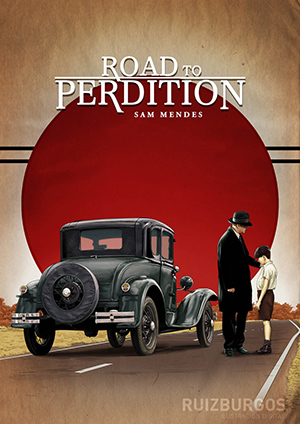
Here’s another of those write-ups where somebody notices that Road to Perdition the film began as Road to Perdition the graphic novel.

And another.

Finally, here’s a short but sweet RTP write-up, acknowledging the great Richard Piers Rayner.

M.A.C.
San Diego and More

Tuesday, July 30th, 2019

Last week’s update was strictly pics from San Diego Con, and this time – along with some news and reviews – I will report in prose.

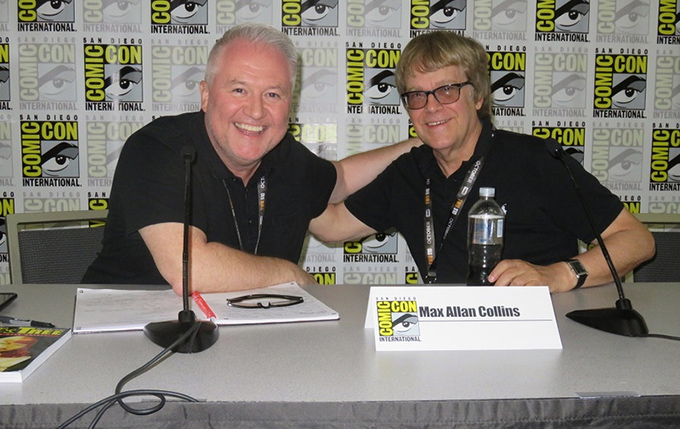
The highlight for me was the interview with my buddy Andrew Sumner, an exec at Titan; he and I did a Spillane two-man panel at SDCC last year and this time we focused on the upcoming release of the first of five Ms. Tree collections: One Mean Mother.


Andrew Sumner and M.A.C.

Jamie Coville posted the audio of our panel, a link to which you can find among the rest of his SDCC interviews – as of this writing, it’s the fourth entry down and you can download the audio by right-clicking the link once you navigate to this page.

A signing at the Titan booth – we had copies of Quarry’s War and the Mike Hammer graphic novel, plus free Ms. Tree art cards that I autographed – went very well. Got to talk to lots of smart fans – definition of “smart”: they like my work.

Jonathan Maberry did a great job, taking over for me as president of the International Association of Movie and Tie-in Writers, presenting the Scribe awards and helming a very good panel of mostly nominees. I did not win for Killing Town in the general fiction category, but did not expect to.

Otherwise, I have to admit that I find SDCC increasingly unpleasant and anything but user friendly. Part of this is my age, both in terms of physical tiredness and an absence of material of interest to me (Bud Plant, wherefore art thou?). Additionally, with this the 50th anniversary of the biggest con in pop culture, no particular fuss was in evidence. (The question I was most asked was, “Why isn’t Seduction of the Innocent playing?” And I have no answer.)

The aisles are hopelessly clogged, starting on preview night – in what I described to Barb as the world’s slowest moving stampede. Barb, doing an absent Nate’s bidding in search of inexplicably popular pins, had a series of increasingly harrowing, soul-destroying adventures in lines that were unfairly administered.

Here, in Barb’s words reporting back to Nate, are her experiences on Thursday, the official opening day of the con:

“We hit the Udon booth first thing for the other stuff you wanted, and there was no line…but they had sold out of the art book yesterday and won’t have any more. OMG, what a nightmare getting into the convention center at 9:30, a hundred thousand people – just crushing. And it didn’t let up once inside. I was plastered to a guy who worked at the Figpin booth, and he couldn’t get there. After hearing my tale of woe about trying to get a card, he pulled out the Ash pin from his pocket to shut me up.

I went to the Figpin line at 1:30 to mill around for the public 2 o’clock queue-up but there was already a line of a dozen, so I hopped on board. Then the staff tried to disperse us saying it was too early to be there, and when ignored, brought security over. We scattered like cockroaches, only to come back when they left. I was amazed at the camaraderie when we re-formed, “No, I was behind him, you were in front of her,” etc. We were locked in a war together!

After a while, the enemy gave up, and we settled in for the real battle. But then distressing news began filtering down from the front, “They’re out of Batman and the Joker!” Recon was sent out to confirm. “Yes, and Hercule, too!” And so it went. After an hour and a half, battle fatigue set in, some went AWOL, but the rest of the troop pressed forward into the breach! And when the dust settled, I got Thanos, and the last Gogeta.

One funny story – when I was exiting the booth, this girl was telling a Figpin employee HER tale of woe, which was that she had gotten inside before the others this morning, in a motorized wheelchair, and was zipping toward where Figpin was handing out the “golden ticket cards,” when, about three yards from her goal, the chair died, and she was stuck in the aisle, watching helplessly as the cards all disappeared. The thing is, she was saying this while STANDING, and stomped off in a huff when no comp card was given.”

All this culminated on Sunday with a near riot that had Barb shoved up against some garbage cans. Seemed a Figpin staffer just started tossing the precious cards (required to make a purchase) into the air like chum to sharks. Figpin, perhaps the prime offender, will be lucky not to be sued. A company called Bait also rates a “boo,” as Nate put it.

This seems to me to be no fun, no matter what your age. Yes, it’s entertaining to see the cosplay – my favorite was Jason from Friday the 13th dragging a body behind him – but belligerent guards, rude people and impossible-to-get-into panels featuring your favorite stars add up to a popular culture nightmare.

It’s unlikely I’ll be back…but that was what I said last year.

* * *

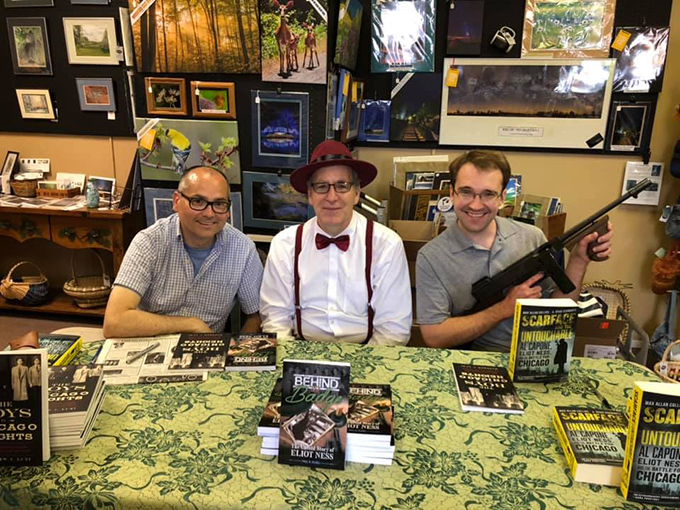
My partner in Eliot Ness crime, A. Brad Schwartz, attended a different convention of sorts in Coudersport, PA’s annual Eliot Ness fest. Read about it (and see him!) here.

I completed my pass of the second Ness non-fiction book, The Untouchable and the Butcher, and just recently yesterday the third pass, which is primarily tweaking and catching typos and so on. Barb enters these for me, in most cases. This was a big job – the manuscript runs around 550 manuscript pages, and does not include Brad’s bibliographic end notes. I still have to assemble the chapter files into one big file of the whole book.

We did this in the midst of a major event – the move to Muscatine from the St. Louis area of Nathan, his wife Abby and our two grandchildren, Sam, almost four, Lucy, ten months. They will be living up the street just seven houses away, and it will be wonderful. Right now it isn’t – we are all struggling to maintain controlled chaos. More about this later.

* * *

A few TV notes.

Much on the streaming services has yet to capture my attention. But three series already very much on my radar have delivered excellent seasons that are worth your time, whether you munch on them or binge.

The fifth season of Schitt’s Creek continues to astound with its unique combination of deepening characterization and off-the-wall humor. Netflix has it, and if you’ve not watched this offspring of SCTV starring Catherine O’Hara and Eugene Levy (the latter’s son Daniel is a co-star and co-creator with his dad, and a genius), you need to drop everything and start. And it only gets better and better. For me, a particular pleasure is watching Chris Elliott bump his gonzo comedy style up against the Second City-trained cast members, creating a comic tension that provides the laughs with a special subtext.

Stranger Things has a third season that is broader than the first two but similarly satisfying. The central location, an ‘80s mall, provides a nostalgic backdrop that provided me with unexpected pangs – who knew I actually missed Sam Goody and B. Dalton? The storytelling is first-rate as the cast members are divided into groups for excellent back-and-forth narrative with tiny cliffhangers to hold you from scene to scene, and of course larger ones to keep you bingeing. Millie Bobby Brown continues to be a remarkable young actress, exploring this dangerously powerful girl’s entry into the teen years with poignance and possibilities. The creators, the Duffer brothers, have also found a way to avoid (this time anyway) the pitfalls of a character who can easily swoop in to save the day.

Finally, Veronica Mars roars in with an unexpected fourth season. I have not hidden my admiration for Kristen Bell (not even from my wife) and she outdoes herself here, bringing layers to her characterization with every pause and glance. This twisty mystery is hard to discuss without spoiler warnings, so I’ll say only that the season seems to be dealing with the need to move on from Neptune, California, and Veronica’s teenage years (the character is pointedly described as being in her late thirties) into adulthood and the maturity of a classic detective. Creator Rob Thomas clearly wants Veronica to join the ranks of Marlowe, Hammer, Nero & Archie, and other noir-ish detectives. I would caution him only that to abandon Enrico Colantoni’s Keith Mars, and the hilarious yet warm verbal interplay between father and daughter, would be to lose the heart and soul of the show. My favorite moment in the season has Veronica telling her father how irritated she is that her longtime lover Logan Echolls (Jason Dohring) has asked her to marry him. Keith’s droll low-key reply: “What an asshole.”

* * *

Check out this fantastic Leonard Maltin review of Scarface and the Untouchable.

Jude Law’s role is number six on this list of his best screen performances.

M.A.C.

Powderkeg for Under a Buck and Zombies Rock the Planet

Tuesday, May 14th, 2019

E-Book links: Amazon iTunes Nook Google Play Kobo

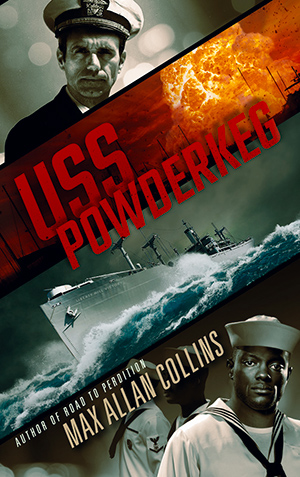
Before I get to blathering, here’s a nice piece of news, particularly for those of who have not yet acquired the definitive edition of Red Sky In Morning, now under my original (and preferred) title, USS Powderkeg.

For 24 hours, on May 17 (this coming Friday), the novel will be available for 99 cents on every e-book platform – Amazon, Apple, Nook, Google Play, and Kobo. This is a Bookpub promotion.

Brash Books has supported me incredibly, bringing both “Patrick Culhane” bylined novels back out under my own name, and publishing all three books in the Road to Perdition prose trilogy, even getting permission to publish the complete version of the first one, previously available only in a short, butchered edition.

Thank you, Lee and Joel!

* * *

The time has come (you might say the time of the season has come) to discuss Zombies, not the Walking Dead variety but the Rocking Live variety.

After four nominations, the British band the Zombies has finally been inducted into the Rock ‘n’ Roll Hall of Fame. Here is the Hall of Fame bio, for those who came in late:

The first wave of the British Invasion carried a startling variety of sounds and styles from old world to new, but not all of the bands presented successfully emerged during that heady halcyon era. The Zombies, with their intricate arrangements and sophisticated atmospherics, stood apart from the raw, blues-drenched disciples of American blues and R&B. Their band’s sound filled space gorgeously and completely with jazz-inflected electric piano and choirboy vocals, endearing themselves overnight to a sea of fans.

The classic lineup of The Zombies fell back to school days at St. Alban’s: Keyboardist and singer Rod Argent met guitarist and vocalist Paul Atkinson and drummer Hugh Grundy as schoolmates. Bassist Chris White and lead singer Colin Blunstone joined shortly after.

Their second and final album Odessey And Oracle has earned its reputation (and its spot inside the Top 100 on Rolling Stone’s list of the “500 Greatest Albums Of All Time”) alongside such masterworks as the Beatles’ White Album and the Beach Boys’ Pet Sounds. Rod Argent’s eponymous band gave majesty and definition to the ’70s, but the Zombies, which he and Colin Blunstone have been helming on records and tours for the past decade, are truly a rock band for all seasons.

At the end of the day, it always comes back home to the triad of career defining hits by the band that beg the question: Where were you the first time you heard “She’s Not There” or “Tell Her No” or “Time Of the Season”? For many, those songs swept away fans, inspiring decades of allegiance or even the impulse to pick up an instrument and play.

HBO is showing a condensed version of the concert. While a good number of the acts I could not have cared less about, it was worth the wait to hear a lovely Susanna Hoffs of the Bangles introduce the Zombies.

“My love affair with the Zombies may have started in the ’60s, but the 60-year-old me loves them even more,” Hoffs said. “I listen to the Zombies every day…I need a dose of their particular sonic alchemy, it never fails to inspire me. It reminds me of what it is to be alive, to be human and the power of music to connect us all.”

Original members Rod Argent, Colin Blunstone and Hugh Grundy gave fine acceptance speeches, and were joined by members of their current touring line-up to perform four songs, “Time of the Season,” “This Will Be Our Year” (sadly omitted from the broadcast), “Tell Her No” and “She’s Not There.”

I was not surprised that they killed. Barb and I, a few years ago, saw the current band perform at a club in the Chicago area, and both Argent and Blunstone were spellbinding and almost otherworldly in their shared gifts. If I were one tenth the keyboard played that Argent is, I would still be ten times better than I am now. If I sang half as well, and with as much passion and abandon, as Blunstone, I wouldn’t have spent all these years writing mystery novels. Up to you whether that’s a good or bad thing.

I’ve mentioned here that, as a survivor of open heart surgery, I have occasional bouts of weepiness. That was pronounced during the first month or so of my recovery, and very, very occasional since. (This actually has a medical name, but I don’t recall it.) But seeing Argent and Blunstone, older even than I, performing in such an amazing, moving manner did bring me to tears, smiling though I was.

It swept me back to my high school days when playing rock ‘n’ roll in a “pop combo” became just as important to me as writing crime fiction. I didn’t replace the latter with rock – I was already caught up in music, specifically chorus and, earlier, band as well – but made room for it in my enthusiasm.

The British bands were my initial obsession. The Beatles, of course, but also the Animals, Herman’s Hermits, Them, and the Zombies. It took me a while to warm to the Rolling Stones, but of course I did, though to this day I prefer Eric Burden to Mick Jagger, and Them to the Stones. I knew Herman’s Hermits was fluff, but it was fun fluff and I was in high school, after all. And Peter Noone did some lovely work – his “Jezebel” is great. “No Milk Today,” too.

But I think I knew the Zombies were special. Their output was fairly small, though, so as some of the American bands began to join the Brits in my personal rock hall of fame, I shifted to American bands, like the Beach Boys (who I’d liked since junior high, after all) and Paul Revere and the Raiders and countless garage bands. I have an inexplicable love for Question Mark and the Mysterians, for example.

In the mid-‘70s, when some collections of Zombies material reached both vinyl and audio cassette, my love for their work expanded. I would now rate them number two, after the Beatles.

I got into playing rock ‘n’ roll – garage band rock – fairly late. The Beatles came along in ‘64, and a ton of garage bands turned up around then in small towns like my Muscatine, Iowa. My local heroes were the XL’s and the Rogues, but I was impressed by the Roustabouts and Coachmen as well. Really envied and wanted to be one of them. In the mid-sixties, we counted thirty-some combos in the Muscatine area…all vying for those sock hops and house parties and homecoming dances and prom gigs. My first band, in 1966, which lasted maybe three months, was the Barons – the spelling should have been Barrens, frankly.

My initial thought was to be a bass player. I’d had a few guitar lessons and it looked easier than having to play chords on a six-string. My uncle, Mahlon Collins, was a district sales manager for Chicago Musical Instruments. He had been a legendary high school band director in Iowa, just as my father (the real Max Collins) was a legendary high school chorus director. Both left their beloved professions, after ten years or so, to get better paying jobs.

Mahlon – a slender, handsome guy in glasses who I am pleased to say people used to say I resembled – was smart and tough and knew his shit. He would stay with us when he was calling on clients in our part of the world, and when I told him I was putting a rock band together, he asked me what instrument I was going to play. Whatever it was, he would get it for me at cost.

“Bass,” I said, and told him why.

I recall, for some reason, that we were sitting on the couch in our little family room, waiting for my mother to serve up supper. He looked at me with shrewd eyes. You see, Mahlon was a kind of a know-it-all, but you didn’t mind, because…well, because he knew it all.

“Didn’t you have piano lessons?” he asked me.

“A couple of years,” I said. “I never hated anything more.”

My father directed a male chorus, the Elks Chanters, who won national championships, and he’d insisted that I take my lessons from the chorus’s accompanist, an old gal named Stella Miser. Her name was right out of Dickens and so was she.

“But you did take piano,” Mahlon insisted.

“Yeah. That’s true. I was terrible, and never practiced, but I did take lessons.”

He got conspiratorial. “These combo organs are the latest thing. I can fix you up with a Farfisa.”

“But I hated piano.”

“Still, you did have lessons. You would be starting pretty much from scratch, with the bass. I can get you a bass, if you want. A nice one. But these combo organs? They’re the big thing.”

Thus did I become a keyboard player. And my band played its first gig two weeks from the day my Farfisa arrived. I went through several Farfisas – the double keyboard version was used on “Psychedelic Siren” – though I preferred Vox and, for the latter half of the existence of my band the Daybreakers, I played a Vox Continental. Double keyboard. Reverse keys – the white notes black, the black notes white. Beyond cool. Alan Price played one in the Animals. (Paul Revere used Farfisa.)

So, 53 years after my uncle talked me into buying a combo organ at cost, I am watching Rod Argent play the most fantastic, beautiful leads on his Hammond portable, and I am brought to tears. That, and Colin Blunstone reaching those high notes on the chorus of “Time of the Season,” full voice, not falsetto.

And right now my second band (the Barons don’t count – only the Daybreakers and Crusin’) is rehearsing for a season of around eight gigs this summer, and the intention of recording an album. We have been working on originals, which is of course an insane thing for an oldies band to do. The last thing an oldies audience wants is original material.

But I feel like we’ve earned the right. We’re in the Rock ‘n’ Roll Hall of Fame, too, after all. Twice. Okay, the Iowa one, but it counts.

To me it does.

* * *

This article at World Geekly News considers Road to Perdition the best comic book adaptation ever.

M.A.C.

My Debt to Lone Wolf and Cub’s Genius Creator

Tuesday, April 23rd, 2019

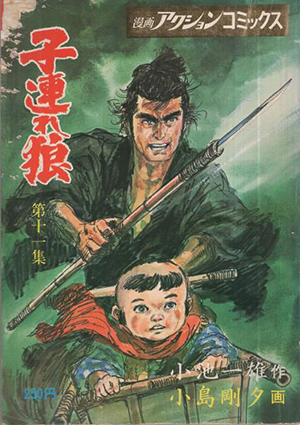
Kazuo Koike, the great creator of the manga classic, Lone Wolf and Cub, has died at age 82.

My name appears in many of his obits, along with Frank Miller and Quentin Tarantino, because of the influence he had on our individual work. Road to Perdition is often mentioned, of course, sometimes stating that it was an American version of Lone Wolf and Cub.

My interactions with this incredible writer were decidedly odd.

At one point, I received a very friendly e-mail from an associate of his saying Kazuo Koike would be in America soon and was an admirer of my work, and wanted to meet. This was perhaps a year after Road to Perdition, the film, came out. The meeting would have been in Los Angeles, if I recall, and I had to explain that I lived in Iowa, nowhere near L.A. I said I would have loved to meet with him, and that I was a great admirer of his work.

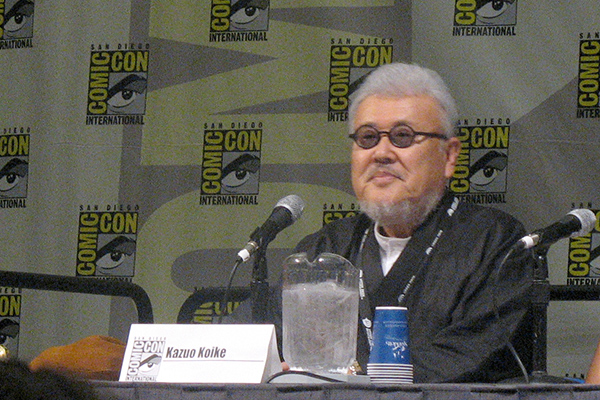
Then at the 2006 San Diego Comic Con, I attended a panel that was just Koike and a translator and someone from Dark Horse, his American publisher. During the question-and-answer session, Koike complained that his work had been plundered, and mentioned Road to Perdition as an example, complaining that these plunderers might at least have given him credit.

Afterward, I went up with my son Nate and caught Koike before he’d left the stage, and Nate startled the great man somewhat by introducing me in Japanese. (As many readers of these updates know, Nate is a translator of Japanese into English and has done novels, manga and video games.) Nate told him that I was a big fan and meant to pay homage to him, and would like to shake his hand. He shook my hand, and signed a book for Nate.


Kazuo Koike, SDCC 2006

A few years later, at another San Diego con, Koike was appearing again, and (Nate again with me) I approached the Dark Horse people about arranging a brief meeting between us. They checked with him. I was told he did not want to meet with me.

Lots of peculiarity here. First, why had I been approached for a friendly meeting earlier? Would it have been an ambush of some kind? Also, I have always gone out of my way to acknowledge Lone Wolf and Cub as one of the inspirations for Road to Perdition. Koike quotes serve as epigrams at the start of the graphic novel and the two prose sequels.

If anything, I have – and certainly others have – exaggerated Road’s debt to Lone Wolf. As I’ve mentioned in any of number of places, I was most of all drawing upon John Woo movies, including Heroes Shed No Tears (1986), a very overt (wholly uncredited) updating of Lone Wolf and Cub. In the ‘80s, I was watching a lot of Hong Kong crime movies, gray market VHS copies, when director/writer Woo was fairly unknown in America. I saw Heroes Shed No Tears before I saw any of the Lone Wolf movies.

Further, in Road, I was drawing upon the real-life Rock Island gangster, John Looney, and his homicidal son Connor, and the falling out that several formerly loyal lieutenants had with Looney. In a more basic way, I was combining the movies about ‘30s bank robbers (Bonnie and Clyde, Gun Crazy) with gangster films (St. Valentine’s Day Massacre, Godfather). The notion was to bring the worlds of the rural outlaws and urban gangsters of the ‘30s together. And I’d already been doing Nate Heller for some time (Looney and son are mentioned in True Detective, 1983).

No question that Lone Wolf was in the mix. I specifically thought that the shogun and his assassin had parallels in a mob godfather and his chief enforcer. And the father and son seeking vengeance while they were being chased was an element, too, although my anti-hero’s son was an adolescent, not a baby in a cart. Robbing banks where the mob cached their cash came from the terrific Don Siegel-directed film, Charley Varrick (1973), and striking back at the mob for vengeance through their bank books was from John Boorman’s Point Blank (1967). The latter was also the start of what became my Nolan series

A lot of what I do draws from popular culture I like, but with a twist. Quarry has some of its roots in another Siegel film, The Killers (1964). Mommy is The Bad Seed flipped. Nate Heller is Philip Marlowe/Mike Hammer thrust into real unsolved crimes of the Twentieth Century. Girl Most Likely, to some degree, transposes the Nordic noir to the USA.

Lone Wolf did inspire the saga-like structure I originally had in mind. The idea was to have Michael O’Sullivan and his son on the road for 900 pages (in 100-page increments). But Road to Perdition (1998) was published as a single graphic novel (and not three 100-page “issues”) when Paradox Press (DC’s noir graphic novel line) went bust. After the film came out, I was able to go back to do another 300 pages of the father and son on the run (Road to Perdition 2: On the Road). The rest of the story was told in two prose novels – available from Brash Books – Road to Purgatory and Road to Paradise, and another graphic novel from DC, Return to Perdition.

My debt to Kazuo Koike is undeniable, if perhaps not as great as he imagined. What is great is his body of work, and his masterpiece, Lone Wolf and Cub. He might wince to know I turn up so often in his obits, but I am nonetheless honored to be in his company.

* * *

Another of my favorite manga creators, Monkey Punch (Kazuhiko Kato), also died recently, at 81. His Lupin III is a classic, and inspired perhaps the greatest anime, Cowboy Bebop. If you’ve never seen Monkey Punch’s thief in action, seek out the feature length Lupin III: The Castle of Cagliostro (1997), directed by the genius animator, Hayao Miyazaki.

* * *

Check out this write-up about Kazuo Koike’s passing.

Here’s a top-notch review of Girl Most Likely from Criminal Element.

Here’s a short but sweet Girl Most Likely review.

Another decent Girl review can be seen here.

And this may be my favorite review of Girl Most Likely yet.

M.A.C.