Posts Tagged ‘Reviews’

A Typical Day in the Neighborhood

Tuesday, July 28th, 2020

In previous updates, I’ve mentioned that I am currently working with two publishers who are primarily e-book-oriented. One is Wolfpack, where I’ve just sent in my first original novel (co-written with my longtime collaborator Matt Clemens). I am not ready to reveal the title or the genre as yet, but I will say we’ve committed to at least three entries in this new series, and that I’m very pleased and excited with/by this first entry.

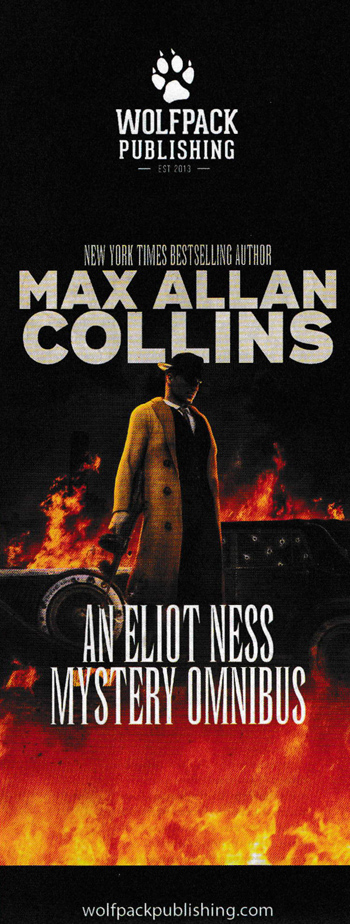
Wolfpack ad for Eliot Ness Omnibus

Wolfpack continues to be incredibly supportive. Take a gander at this ad that ran in Publisher’s Weekly for their first publication of my work – The Eliot Ness Mystery Omnibus, which collects the four Ness-in-Cleveland novels. For those of you with Kindles, you can get this omnibus – all four novels – for $2.99 (free for Prime Unlimited members).

Those of who you have already read these and own them in some other form are encouraged to write reviews of the omnibus, which as of now has only a single, lonely review. And Do No Harm, Girl Can’t Help It, Masquerade for Murder, Antiques Fire Sale and Hot Lead, Cold Justice have all kind of stalled out on the review front, so if you haven’t got around to posting yours, doing so would be appreciated.

The other e-book project I’m working on is for a new company that got a splashy welcome fromThe Hollywood Reporter (among others).

I am not ready to reveal what the Neotext project is, other than to say it’s a new detective series with a female lead and that I’m doing three novellas (30,000 words each) about the character. Okay, here’s a few more tidbits – it’s set during World War II, and it will be illustrated by a terrific Hard Case Crime artist, providing not just a cover but one painting per each chapter (ten per novella).

Initially these novellas will be published as e-books, one at a time, with an eye on later collecting them in physical book form. But so far Neotext itself is strictly an e-book publisher.

I am starting work this week on the second novella for Neotext. And Matt and I are meeting, via Zoom, to plot the second novel for Wolfpack. Both publishers have me creating new series, although Wolfpack is also publishing back list (including short story collections) and are up for me continuing existing series…in fact, have signed me to continue both Krista Larson and Reeder & Rogers.

This brings me to the non-promotional (at least not overtly so) portion of this update.

A question I am frequently asked is what my work schedule is – “What’s your typical day?”

In a way, I don’t have a typical day. Each morning does begin about the same, with the usual rising groggily, throwing down a handful of pills, scarfing down a mini-donut or two, guzzling some sparkling juice, and spending half an hour or so in my recliner watching Morning Joe (I’m a liberal – get over it).

Barb, in her neighboring recliner, always says, “Tell me about your day in the greatest of detail.” And I share my best-laid plans before the day proceeds to do whatever the hell it feels like.

When I am bunkered in writing a novel, which is most of the time, I attempt to write in the morning with lunch arriving no earlier than 11 a.m. and no later than noon. We used to go out for it, but now we rustle up our own (yes, I help in the kitchen, though my efforts are somewhat pathetic). When lunch happens depends on how my writing is going and, of course, how Barb’s writing is going. Barb has to get her writing done in the morning, as she is providing Day Care for our two grandkids a few houses up the street from one p.m. till shortly after five. I write all afternoon.

But fulltime freelance writing is a small business and both of us have to deal with business stuff as well as feed our muses – Barb in particular handles the financial side of things. But I have editors and agents and collaborators to deal with, and when galley proofs arrive I generally have to set my work schedule aside and deal with that aspect of things.

Between novels I do my best to attend to smaller projects, like short stories and the intros to the IDW Dick Tracy collections. I also always clean my office, which deteriorates to disaster-level proportions as a novel progresses – scattered research volumes, wadded-up paper on the floor, discarded drafts of pages and even chapters, and so on.

Also intruding on the actual writing are the requests for interviews, which I mostly try to handle via e-mail, but which sometimes require the phone or Skype or Zoom. These updates are written either Sunday evening, late, or first thing Monday. The longer ones sometime drain my energy to the point that no other significant writing gets done that day.

My pattern has changed radically over the years. As some of you may recall, for much of my professional life I was a night person who did most of his writing starting around midnight, going to bed at eight or nine a.m. and sleeping till noon. I had enormous energy as a younger person, needing little sleep; most nights I wrote a finished chapter, including long ones like those in a Nate Heller novel. But when we did the Mommy movies, and I had to rise at six a.m. or so – the director has to be first on the set and last to leave – my inner clock got changed. Ever since, I’ve rarely risen any later than eight a.m. or so. Now, as an old man (goddamnit!), I sometimes wake as early as six a.m.

And I hate it.

On such mornings, I start writing early, even before Barb gets up. So there are factors that come in, as you may have already noticed, that mean there is no really typical day.

On the other hand, sheltering in place for the corona virus has made one day seem much like another. Oddly, for Barb and me, time is passing more quickly, which seems like the opposite of what you’d expect.

* * *

The Quarry series was selected by Crime Reads as one of ten most binge-worthy series of the 1970s, which is a nice honor. In the comments, I corrected the assumption that the Memphis setting of the TV series is the same as the books.

Here is the opening sentence of a patronizing review of the Johnny Dynamite collection: “The opening introduction by writer Max Allan Collins is more a biographical essay about writer Frank Morrison Spillane (alias Micky Spillane) and writer/artist Pete Morisi. Not to mention it is excessively long. (Then again the title of this collection is also excessively long.) Though Collins’s introduction should please those wanting more knowledge about the subjects’ lives and/or the early comic book industry. While the introduction by artist Terry Beatty is of reasonable length it has one or two sentences that are a little clunky.”

I have a few thoughts to share. First, what other kind of introduction is there but an “opening” one? Second, if you’re going to be dismissive about Mickey Spillane’s role in this collection, at least spell his name right (not “Micky”). If you’re going to accuse my co-editor of writing a “clunky” sentence, perhaps you should learn to write in complete sentences yourself. Do you wonder why reviews like this irritate me?

On the other hand, here is Ed Catto’s terrific (and well-written) review of that same book, interspersed with quotes from an interview I gave Ed.

Here’s a brief, positive review of Eliot Ness and the Mad Butcher – the non-fiction follow-up to Scarface and the Untouchable by A. Brad Schwartz and myself that will be published…next week!

Finally, the “lost gem” that is my single Batman comic strip continuity (with the late great Marshal Rogers) is discussed here.

M.A.C.

Wolfpack Announces “Mommy” Duo

Tuesday, July 14th, 2020

I have had a very positive response to my announcement of signing a deal with Wolfpack Publishing. The readers who think enough of my work to check in here are happy to know that the door is open for me to revive and continue various series (or write sequels to standalones) that would otherwise be of no interest to my other publishers.

But let me assure all of you that, for now at least, I am still aligned with a number of mainstream publishers. Mike Hammer is still attached to Titan, who have been incredibly supportive of my efforts to complete (not continue) Mickey’s work. Under the Titan umbrella, but very much its own entity, Hard Case Crime – under the able leadership of Charles Ardai – continues to support Quarry and other work of mine. The Antiques series is no longer at Kensington, but is moving elsewhere (to be announced), though Caleb York will stay at that house as long they want him (and me).

These are early days at Wolfpack, but I can safely say that all of the original titles – including the novel I just delivered – will be published as physical books as well as e-books. This will include the new short story collections, and I hope the same will be true of the reprinted collections. (The Ness Omnibus is too large to be published as one book, but we are discussing the individual novels coming out in physical form.)

By the way, I do intend to continue my regular book giveaways with the original Wolfpack titles, to generate much-needed reviews. (Speaking of which, if you “owe” me reviews from past giveaways, better late than never.)

Coming soon – I don’t have a date to share just yet – will be a book collecting both Mommy novels. They will appear as a single e-book, but also as a “real” book, the first time both have been gathered together, which is something I always hoped for. Always intended.

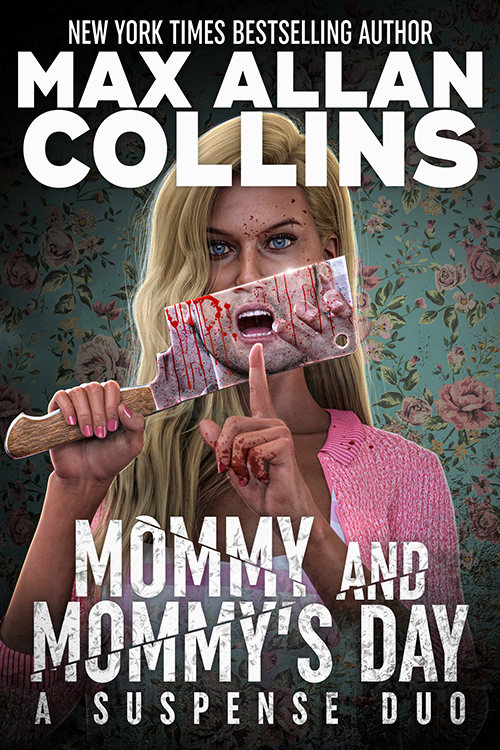
Mommy Mommy's Day: A Suspense Duo cover

I am sharing the cover with you this week, because I think it’s terrific. I find it very amusing because it plays off a line I came up with early on, in not only promoting Mommy as a home video release, but in putting together the investor proposal that raised the funds for the first feature’s production back in 1994. Specifically, I described the Mommy character as “June Cleaver with a cleaver,” and the art for this cover pictures her just that way (the reflection design is incredibly cool, in my opinion). Now, Mommy doesn’t actually wield a cleaver in either novel. Readers will have to accept that image as metaphorical, settling for the neck-breaking, electrocutions, shootings, and butcher-knife stabbings (among other things) that appear in the two novels.

Mommy and Mommy’s Day were originally published by Leisure Books in the late ‘90s. They were essentially tie-in’s to the DVD release of the movies (which came out on VHS in 1995 and 1997 respectively, and had a few theatrical screenings). The two books were novelizations of my screenplays, written during that period of my career when writing movie tie-in novels was a major part of how I supported myself as a freelance writer.

I had contracts for Nate Heller and other original work of mine with major mainstream publishers at the time, but those publishers – concerned about my selfishly prolific ways, crassly designed that I might make a living – did not want me to publish more than a couple of books a year, or better still just one. It wasn’t that I was being paid poorly, just that a paycheck for, say, $20,000, wasn’t something my family and I could live on for a year.

Because the Dick Tracy novelization (1990) – written strictly because I was then the scripter of the comic strip and had a proprietary attitude toward the property – was a success, I was able a few years later, post-Tracy, to offer myself as a writer of tie-ins. I loved doing the movie novels, because I was able to write all kinds of different genres and really flex my muscles, pursue interests beyond suspense, and learn new techniques. After all, I did Tom Clancy style techo-thrillers (Air Force One), war novels (Saving Private Ryan), westerns (Maverick), science fiction (Waterworld), sword and sorcery (Scorpion King), horror (The Mummy), espionage (I Spy), humor (The Pink Panther), and much more. Doing the novel for the second X-Files film was a real kick, as I was (and am) a big fan of the series. Eventually I was able to write original novels for such TV shows as NYPD Blue and (with Matt Clemens aiding and abetting) CSI, Dark Angel and Criminal Minds.

So it was natural for me to novelize my own two movies. I approached Leisure Books because one of their specialties was horror, and Mommy was psychological horror, often assumed to be an unofficial sequel to the classic The Bad Seed (I considered it more an homage).

Those two books are the most unusual novelizations I ever wrote, with the exception of Road to Perdition, where I was novelizing someone else’s version of my own work. What made the Mommy novels unusual was how different the process was from the usual novelization approach.

I have a feeling that many, if not most, readers assume that the novelizer of a film has seen – or perhaps has been provided a DVD (or back in the day, VHS) of the movie – for reference. That is never the case (almost never, as I will explain). Generally speaking, the film is being shot at the same time the book is written. The writer works from a script. I would make a novel out of the script from which the director was simultaneously making a movie. In surprisingly rare cases, the writer sees stills from the set, and even more rare a “sizzle” real designed for merchandising. A couple of times I saw the footage for films that fast food chains were viewing to decided whether to make a Happy Meal.

Which is an important aspect of explaining this: a novelization of a film is an ephemeral side product, like an action figure or lunch box. Novelizations happen less frequently now because one of their functions, maybe their main function, was to give fans of a movie an opportunity to re-experience it in those dimly remembered days prior to home video.

Often the script the novelizer works from is not the final shooting script – in fact, almost always it isn’t. In the case of I Spy, I was sent the script pages of a new ending that needed to be turned into prose just days before the book was to go into publication. Some studios didn’t care if the book wasn’t consistent with the finished film, which has made some novelizations highly collectible for the glimpses into what might have made it onto the screen, or for fans to experience scenes that had been cut.

Interestingly, many readers – wrongly assuming the novel came first – aren’t bothered by such inconsistencies at all.

The Mommy novels, because I had complete control over them, lacked the usual studio constraints. Both features were completed before novel rights were sold. Of the two, Mommy is probably the most satisfying, because I was able to start the story several months before the action of the film. So the first third or so is not in the movie version.
Mommy’s Day, a somewhat more complex story than its predecessor, filled out the desired number of pages without such extra material.

What made writing both novels unique in the novelization experience was my intimate familiarity with both movies. I was in the editing suite with director of photography/editor Phil Dingeldein every step of the way. While Phil is as expert an editor as I could imagine working with, he and I made each decision together, from which takes and camera angles to utilize to the length of holding shots. I loved the editing process, and eventually essentially edited my second documentary, Caveman: V.T. Hamlin & Alley Oop, at home, by use of freeze frame and time code, making a list for the assembly of edits. (Phil was not on that project.)

The director of a film sees it countless times. I know every frame of both Mommy films, every nuance, every line reading, every facial expression, every pause, every damn thing, so intimately that even today when I watch either film (or any of my films) I remember them in a way that is true of none of my novels or short stories.

So when I sat down to write the novels of the Mommy movies, I was recording them in a way unlike any other novelizations I’d written. At times it was a burden, because I was describing my indelible memories of the expressions on the faces of actors, and their line readings; of the sets, the locations, the lighting.

But it was also an opportunity to correct things I hadn’t been able to control in the editing suite. In editing, you have to deal with what you shot. If you never got exactly the line reading you wanted, but practicality made you move on, you’re stuck with what you settled for. Here I could tweak things further.

In a very real way, Mommy and Mommy’s Day are the only movie novelizations I ever wrote. Everything else was a novelization of a script.

My mantra, where writing movie novels was concerned, was always to make the novelization read like the book the movie was based on. I think I was very good at that. Oddly, making the novelizations of my own movies achieve that goal was trickier than usual. But I’m confident I succeeded.

I am thrilled to have these novels collected into one book – as I said, I always wanted that, always intended it. And, very soon, Wolfpack will make that happen.

* * *

Here’s what DICK TRACY 2 would have been. Gee, wonder if I would have gotten credit….

Finally, though you’ll have to scroll down a bit, here’s a great review of Hot Lead, Cold Justice.

A 99-Cent Sale, A Podcast, A Ness Book Review, and More

Tuesday, June 30th, 2020
Eliot Ness and the Mad Butcher cover
Hardcover: Indiebound Purchase Link Bookshop Purchase Link Amazon Purchase Link Books-A-Million Purchase Link Barnes & Noble Purchase Link
E-Book: Amazon Purchase Link Google Play Purchase Link Nook Purchase Link Kobo Purchase Link iTunes Purchase Link
Digital Audiobook: Amazon Purchase Link Kobo Purchase Link
Audio MP3 CD: Indiebound Purchase Link Bookshop Purchase Link Amazon Purchase Link Books-A-Million Purchase Link Barnes & Noble Purchase Link
Audio CD: Indiebound Purchase Link Bookshop Purchase Link Amazon Purchase Link Books-A-Million Purchase Link Barnes & Noble Purchase Link

The Thomas & Mercer has eight of my titles as part of its Mystery, Thriller & Suspense Kindle book deals starting 7/1/2020 and running through 7/31/2020. These e-books are only 99 cents USD during the promotion period:

The Lusitania Murders
The Pearl Harbor Murders
The Titanic Murders
The Hindenburg Murders
The London Blitz Murders
The War of the Worlds Murder
Midnight Haul
What Doesn’t Kill Her

My pal, writer Paul Bishop – a remarkable guy and the Renaissance man some people claim me to be – has a great podcast called Six-Gun Justice. As an adjunct, he interviews writers, and he did one with me. For the few of you who may not be sick of hearing my voice yet, here’s your chance to do so. Seriously, Paul did a great job with his questions and his editing. My interview and several others can be accessed here. [Note: The M.A.C. Interview podcast is dated 6/17/2020.]

Also, here is a great review of the soon-to-be-published Eliot Ness & the Mad Butcher by A. Brad Schwartz and me, from Library Journal:

Eliot Ness and the Mad Butcher: Hunting America’s Deadliest Unidentified Serial Killer at the Dawn of Modern Criminology

Collins and Schwartz (Scarface and the Untouchable) reunite to continue the story of law enforcement agent Eliot Ness, known for leading the Untouchables, the group famous for bringing down Al Capone. Ness moved on to serve as Cleveland’s public safety director during a tumultuous time in the city’s history following the Great Depression. He confronted various crime and political challenges, which are detailed within the book. The story is anchored by Ness’s efforts to identify the Mad Butcher, a serial killer who terrorized Cleveland and whose actions followed Ness until the end of his career. The book is thoroughly researched and well paced, a feat considering the breadth of Ness’s work.

VERDICT: A successful blend of history and suspense, this volume will appeal to readers interested in true crime and law enforcement.
Reviewed by Kate Bellody

Because I am wrapping up a novel that I haven’t told you about, because it is frankly under wraps until the publisher gives me the go-ahead to talk about it in public, the update this week is chiefly an article about me that ran a few days ago (as I write this).

I will be back sharing more of my thoughts than I should next week.

This is probably the most in-depth article ever written about me and my work. It was put together from various sources and interviews with me by Sean Leary, a successful (and terrific) writer of regional bestsellers in the Quad Cities. This appeared over the weekend at QuadCities.com as part of their regular Saturday in the Arts feature.

A few inaccuracies are included, due to my sloppiness being interviewed, and I am correcting those parenthetically in boldface. [From Nate: The article on QuadCities.com includes a nice selection of pictures, so I recommend checking out the article there as well.]

Scribe Award-Nominated Max Collins Still Having A Killer Time As A Best-Selling Author

Max Allan Collins’ success is no mystery.

The man in black has proven to be a maestro at making people’s lives full of stress, misery and murder — and people love him for it.

It helps that the people are fictional, characters in the canon of the Muscatine-based author, who, this month, was nominated for a Scribe Award for his 2019 novel, Murder, My Love. The awards winners will be announced July 15.

It’s only the latest honor for the longtime penman, who saw his novel Road To Perdition turned into an Oscar-nominated film, his novel series Quarry made into a series on Cinemax, his band Crusin enter the Iowa Rock And Roll Hall Of Fame in 2018, and who was given the 2017 Grand Master Award for lifetime achievement as a fictional murderer, a maestro of mystery novels, for over four decades.

MWA’s Grand Master Award represents the pinnacle of achievement in mystery writing and was established to acknowledge important contributions to this genre, as well as for a body of work that is both significant and of consistent high quality. Collins certainly fits both categories.

“The Mystery Writers of America is the primary professional group of mystery and suspense writers, and getting its lifetime achievement award, the Grand Master ‘Edgar,’ is about as good as it gets,” Collins said. “The list of Grand Masters includes many of my personal favorites, Mickey Spillane, Rex Stout, Agatha Christie, Alfred Hitchcock, and Erle Stanley Gardner, among many others. It’s a thrill to be in their presence. The award comes at a time when I’ve battled my way back from some nasty health issues, so it feels like really, really, good medicine. And, yes, it’s something I’ve dreamed of receiving, though didn’t know if I ever would.”

But how does it feel to be at that point in his career when he’s received a lifetime achievement award?

“It’s a mixed bag,” Collins said. “I’ve received several others, notably the Eye from the Private Eye Writers of America, and it’s nice to see your body of work recognized, but sobering knowing that nobody gets this kind of honor until their third act.”

His first two acts have been pretty impressive, and his debut was at a young age.

“I decided to be a writer in junior high and began submitting novels soon after,” Collins said. “I went to the University of Iowa Writers Workshop and sold two novels while I was there, Bait Money and Blood Money. (Blood Money came later – No Cure for Death was the other book I sold while at the Workshop.) I never looked back. I taught briefly, part-time, at Muscatine Community College, but I’ve never had a fulltime job except freelance writing. That was made possible in part because I landed the Dick Tracy strip, which gave me a nice income for fifteen years, by which time my novel-writing career was established. I stayed afloat by not being afraid to try different kinds of storytelling. I’ve done comic books, comic strips, novels, short stories, non-fiction books, trading cards, movie scripts, TV scripts, jigsaw puzzles and video games. I took on a lot of movie and TV novels, and put my name on them when others said I should hide behind a pseudonym. I felt using my own byline kept me honest, and it built an audience because many of my media projects were high-profile, movies like Saving Private Ryan and American Gangster, and TV properties like CSI and Criminal Minds—Matt (Clemens) worked on the latter two with me. I am proud to be a professional writer.”

Getting His Start With A Four-Color Fan Favorite

To many fans, Collins’ name is synonymous with a two-fisted, four-color counterpart — which is celebrating the 30th anniversary of its celluloid incarnation this year. Although his resume includes such hard-boiled characters as Mike Danger and Ms. Tree, to comics aficionados, he’s best known for his run as writer of the Dick Tracy newspaper strip from 1977 to 1993. Collins would go on to pen the novel for the film version of Tracy, and that novel would end up being the driving force for the screenplay for the Oscar-nominated film starring Warren Beatty in 1990. (The incredible story of that can be found on Collins’ blog.) The job was the realization of a childhood dream.

“It sounds corny, but it really did all begin for me with Dick Tracy, because I started reading that when I was a little kid — 7, 8 years old,” he says. “Most kids read Dick Tracyand wanted to be Dick Tracy when they grew up. But I read it, and I saw this signature on the strips, Chester Gould, and I was just fascinated by it, by the idea of someone writing it. I thought there was very little chance I could grow up and be Dick Tracy, but I could be Chester Gould. And by God, I was for about 15 years.

“The whole fascination with crime fiction really does go back to my childhood. Dick Tracy, The Untouchables TV show … those were things that I loved. That was partly because my father would tell me about stories in the paper about John Dillinger when he was a kid. He would talk about how he and his family would go out and see crime scenes afterwards. So at a very early age, I got this picture that behind this noir genre, there were real events and real characters, and that very much appealed to me.”

Sharing his work with friends was also a spur to his development.

“Just to get that encouragement, to have my friends say, `Oh, you wrote this? This is really cool,’ was a big deal for me and helped me to keep going,” Collins says. “The other thing that was important was having encouraging teachers. I had several good teachers throughout growing up that nurtured and encouraged me, and I was fortunate to have them helping me along.

“Talent is a relatively small part of it. It’s really enthusiasm and having those flames fanned by people in that educational support system. A good teacher can have such an impact on a young mind.”

After graduating from the University of Iowa with a degree in creative writing, Collins taught at Muscatine Community College and spent almost three years sending out manuscripts in hope of landing his first book deal. (This is a little wrong – I sent the novels out while I was at the Workshop starting in ‘68. I sold them right about the time I started teaching at MCC in 1972.)

“I was very discouraged,” he says. “I remember I had a manuscript come back around ’72, and it was really discouraging, and I thought, `Maybe this isn’t for me; maybe I’m not going to make it. And then, sometimes God decides to act like O. Henry. I got on Christmas Eve 1972 the letter saying that my first book, Bait Money, had been sold. And a year later it came out in time for Christmas the next year, and I’ve been going ever since.”

A Renaissance Man

In the ensuing four-plus decades, Collins has proven to be a Renaissance man of the genre. He’s tackled everything from comics to films to documentaries to novelizations of films and TV shows. He’s also been a regular on local music stages with his band Crusin, which was inaugurated into the Iowa Rock And Roll Hall Of Fame two years back.

All told, he’s placed over 100 novels on bookshelves — many featuring his most famous character, Nate Heller. His locally produced independent films, including the cable hits Mommy and Mommy’s Day were released as a DVD set called The Black Box. (And now are on Blu-ray.) To top that off, he also has several other writing projects on his plate and is busy knocking out novels with his wife, Barbara, and his other co-writer Matthew Clemens.

Asked about the constant movement, Collins chats breezily about his diverse interests and passions. His gesticulations and the rising timbre of his voice spark the image of him as a junior-high kid, bursting to share his action-jammed tales with his friends. However, his work ethic also seems driven by the memory of his early career struggles. Talking about them, his demeanor slumps.

“Even today, I think one of the hardest things about this profession is how long publishers sit on books,” he says. “It’s so crushing to go to that mailbox and wait to see that manuscript sticking out with that rejection letter.”

Collins hasn’t gotten many of those lately. (Actually, I have.)

Looking back on his career, of what is he most proud?

“Probably just having a career — being able to make a living at fiction writing without a day job, which I’ve been doing since 1977,” he said. “Career highs include landing the writing of the Dick Tracy strip back in ’77; winning the PWA Shamus Best Novel, True Detective, in 1984; directing and writing five independent features, with Mommy airing on Lifetime; and having my graphic novel, Road to Perdition made into an Academy Award-winning film with Tom Hanks. I’m also proud of what my wife (Barbara Collins) and I have achieved with our humorous ‘Antiques’ mystery series.”

The road to Road to Perdition

Undeniably, Collins’ most well-known achievement to the general public has been Road To Perdition, the graphic novel which led to an Oscar-winning film starring Tom Hanks, Paul Newman, Jude Law and various other heavy hitters.

“As I’ve gone down the suspense and mystery path, it has fascinated me to see how history feeds into the popular culture,” Collins says as he begins to talk about his most famous achievement. “The fact that there was a real Al Capone and an Eliot Ness and a John Looney, and that their traits ended up influencing these fictional characters like Dick Tracy or Vito Corleone, is very interesting to me.”

In 1998, Collins’ graphic novel Road to Perdition, based in part on Quad-Cities gangland history, smashed out of the gates to become a best seller. It almost immediately drew interest from Hollywood, and in 2002, it hit screens nationwide as a critically acclaimed — eventually Oscar-nominated — film starring Tom Hanks and Paul Newman.

The national notice also brought the Muscatine author a large dose of recognition on the local scene. One book-signing session at Borders in Davenport featured a line of fans snaking out the door and into the parking lot. “It was very rewarding,” Collins says, quietly.

Perdition generated a prequel, Road to Perdition 2, as well as two sequels, Road to Purgatory and Road to Paradise, the last of which was released in December 2005. (The three can be found as a trilogy for sale on Amazon Kindle now.)

Ironically, the origin of the story of hit man Michael Sullivan and his son, Michael Jr., lies in part in the bonding between Collins and his son, Nate, over their mutual love of the Japanese comics series Lone Wolf and Cub. The tale of a renegade samurai’s vengeance-stained travels with his infant boy provided the template for Perdition.

“I loved the image of this warrior with a baby carriage,” Collins says. “That combination of tender and tough has always fascinated me.”

Collins’ research for another novel, 1983’s True Detective, helped provide the characters and setting for the epic.

“I came across this guy, John Looney, who had been a gangster in the Quad-Cities in the ’30s. I couldn’t use him at the time, but I kept him on my shelf. So when it came time later that I wanted to pursue that idea of the Godfather-style executioner in the mode of Lone Wolf and Cub, I remembered that character of Looney. I thought it would be really cool to center the story around this local gangster. So I merged the two ideas, and that’s how Road to Perdition was born.”

(Looney operated in the teens and twenties – I couldn’t use the material in True Detective because it took place in the early thirties, although he is mentioned. When I did Road to Perdition as a graphic novel, I took the liberty of moving Looney up a decade or so, to take advantage of the Capone and Nitti era about which I wrote in the Heller novels – Looney had been aligned with the Chicago Outfit but under Johnny Torrio’s reign.)

Although at this point, the story has reached a satisfactory end, Collins hasn’t ruled out the possibility of revisiting the characters. “If you talk to most writers, they’re not inclined to sequels,” he says. “But I grew up reading serials, so I guess I always thought if I liked these characters and I think there’s something left to be said, I’ll want to write more about them.”

Following His Quarry, Continuing His Legacy

Speaking of series, Collins’ series Quarry, one of the first novel series to feature a hit man as its central character, was developed into a series by Cinemax that aired for one season in 2016, and continues to enjoy success as a literary endeavor. Collins has also continued his series of mystery novels with his wife, Barbara, his Nathan Heller series, the Reeder and Rogers suspense novel series he co-writes with Matthew Clemens, and more.

He’s also an active figure on the area writing festival scene, often giving classes and seminars for aspiring writers.

(I am semi-retired at this kind of thing – very rare now, once quite a major part of what I did.)

What kind of advice would he give to aspiring mystery writers?

“It’s a steady learning process,” he said. “There are writing schools, and I attended the best at the Writers Workshop in Iowa City. And there are seminars, and I’ve taught my share. But writing is chiefly self-taught. It comes from reading analytically, learning to edit your own work, and staying at it. I don’t think I’ve ever made any quantum leaps in my writing, but I’ve gotten incrementally better all along the way. I’m much better now than I was when I first published…but I wasn’t bad then.”

What has he most enjoyed about the process?

“Oddly, collaboration has been one of my biggest joys,” Collins said. “I say `oddly’ because writing is largely solitary. But I loved making films, most of them with my terrific collaborator Phil Dingeldein, and the whole collaborative experience, from movie set through editing, was the best. I also enjoy collaborating with my wife Barb on the ‘Antiques’ novels — that’s special, being able to co-author works with your spouse and stay happily married. Matt Clemens and I also have collaborated on a score of books, and I’m collaborating posthumously with Mickey Spillane, completing his unfinished manuscripts. Making new Mike Hammer novels happen is a delight to the thirteen year-old me, who travels with me everywhere.”

Collins is hardly resting on his laurels, lifetime achievement-wise or otherwise. He’s got a number of deadly projects on his bullseye for the coming years, and his latest Caleb York western novel, Hot Lead, Cold Justice, was released just a few weeks ago, on May 26.

As Collins said of the new novel on his blog, “Unlike the other Spillane co-bylined books in the Mike Hammer series (and other crime novels), these westerns are mostly by me, working with characters and situations from Mickey’s various drafts of his screenplay, The Saga of Calli York, written for John Wayne but never produced. I have endeavored in these novels – I just completed another – to bring either a strong mystery or crime novel element into the proceedings. Even if you don’t usually read westerns, I think you will have a good time – assuming you are reading my other work, in particular the Spillane material.”

No matter what your literary interests, you’re sure to have a killer time reading any of Collins’ books.

The author of this piece:
Sean Leary

Sean Leary is an author, director, artist, musician, producer and entrepreneur who has been writing professionally since debuting at age 11 in the pages of the Comics Buyers Guide. An honors graduate of the University of Southern California masters program, he has written over 50 books including the best-sellers The Arimathean, Every Number is Lucky to Someone and We Are All Characters.

I Confess About Perry Mason, Plus Quarry!

Tuesday, June 23rd, 2020

Photos: Everett Collection; Illustration: Dillen Phelps

Perry Mason is back!

What great news for mystery fans! Just think of it – the crackling courtroom scenes with their dramatic on-the-witness-stand confessions. The shrewd defense attorney willing to make the law jump through hoops to clear an innocent client. His tough P.I. associate who tracks down every lead and takes every risk. The loyal beautiful secretary who may, or may not, be having an offstage affair with her boss. The veteran police detective who this time has the goods on the lawyer’s client. The dogged D.A. who is convinced that, finally, he will definitely send Perry Mason’s client to the big house or perhaps even the chair.

And that TV cast – Raymond Burr, understated but smoldering; Barbara Hale, professional but so lovely; William Hopper, handsome and wry; Ray Collins, the Orson Welles player who made something lovable out of crusty Lt. Tragg; and William Talman, the bulldog D.A. who survived even his own marijuana conviction. Nine glorious years it ran (and 22 TV movies with Burr and Hale years later!), and it runs still, entertaining little noirs about love and business and justice.

The best ones were always based on the novels by Erle Stanley Gardner, that self-taught lawyer who cut his teeth in the pulps and went on to rule the slicks and the paperback racks, outsold only by Spillane and Christie, and – like them – under-valued by critics who didn’t know great storytelling when it bit them where they sat. But even those not based on Gardner novels were entertaining, and those scripted by mystery writer Jonathan Latimer were always terrific.

And now he’s back! Perry is back on HBO and he’s not your grandfather’s Perry Mason, boy, or your father’s or your mother’s or…anybody’s.

Look, I believe in taking film and TV adaptations of fiction on their own terms. You may be aware that I am a Spillane fan, yet Kiss Me Deadly (set in L.A., not New York, and designed to make a monkey out of Mickey) is my favorite Mike Hammer movie. I find Road to Perdition in some ways an improvement on my original. I didn’t mind the Quarry series on Cinemax moving my stories from the Midwest to Memphis, and even put up with the humor being drained out of my guy – it wasn’t my version. But they caught the spirit of what I was up to. (And sent checks.) Cool.

However.

This new Perry Mason is a private eye, not a lawyer (at least not yet). He is also a blackmailer and a drunk and a divorced father and generally a depressed sad sack in a studiously rumpled trench coat and shapeless fedora, as well as a tie that we’re reminded several times has an egg stain on it. He exists in a gloomy world where his activities include taking photos of an obese man performing cunnilingus on a starlet (pumpkin pie is involved), and doesn’t that seem right out of Erle Stanley Gardner!

It’s a series that is 50% art direction, 40% cinematography and 10% actors trying not to embarrass themselves. Oh, and there’s a score that consists of random piano chords and jazz-style dirge licks. The first episode establishes that Mason gets along okay with one police detective and exchanges insults with that detective’s partner – you know, like The Maltese Falcon, if The Maltese Falcon sucked.

And who needs Raymond Burr when you have Matthew Rhys to shuffle around feeling sorry for himself, exhibiting all the charisma of a wet sock. Remember how Perry lived on his dead folks’ rundown farm? You don’t? I guess I’m a little fuzzy on that myself. I can tell you the HBO show is set during the Depression, and, brother, does it put the depress in Depression. Of course, if you like dead babies with their eyes sewn shut, you’ve come to the right place.

But there’s diversity the old Perry Mason lacked. Paul Drake (not in the first episode) is an African-American uniformed cop. Mason’s girl friend is an Hispanic airplane pilot who doesn’t seem to like him much (can’t blame her). No, she’s not Della Street – that character is a different lawyer’s secretary. That lawyer is played by John Lithgow who seems to be a man who woke up in somebody else’s dream and is just trying to fit in.

Spare me the news that this is an origin story, and that Mason will evolve into the character we know and once loved. That much evolving even Darwin couldn’t sell.

It’s enough to make me long for Monte Markham.

Do I sound irritated? Well, I feel certain this series will be every bit as popular as the David Soul-starring Casablanca show. Current efforts by a lot of smart people to get Nathan Heller and Mike Hammer on TV will be crippled by this pathetic misfire. All HBO’s Perry Mason will accomplish is to convince TV execs that traditional tough detective shows, particularly, especially, set if in period, are home box-office poison.

Excuse me. I feel the urge to put on my studiously rumpled raincoat and shapeless fedora and go for a walk in the rain. Where did I put my egg-stained tie?

* * *

Now I’d like to share with you an essay by Kieran Fisher at Film School Rejects about the Quarry TV show.

There Was More Moral Ambiguity
to Explore For Cinemax’s ‘Quarry’

The Cinemax series brought Max Allan Collins’ iconic pulpy crime institution to the screen in 2016, but viewers didn’t pay attention to its brilliance at the time.

Most people live boring and mundane lives, meaning that they’ll never become willing participants in the criminal underworld. However, if pop culture’s fascination with crime stories reveals anything, it’s that people are drawn to the dark side when it comes to the entertainment they consume. The allure of this type of storytelling is multifaceted and complex, but sometimes it’s as simple as enjoying the thrills it provides.

Crime-centric entertainment often presents a more nuanced take on criminals as well. How many movies and shows have you watched where you root for protagonists who engage in some very questionable acts? That’s because these characters aren’t always evil to the core. They sometimes have justifiable or understandable reasons for their bad behavior. Such is the nature of Quarry.

Based on Max Allan Collins’ long-running pulp novels of the same name, and created for television by Graham Gordy and Michael D. Fuller, Quarry revolves around Mac (Logan Marshall-Green), a marine who returns to Memphis following the Vietnam War to find that he’s been shunned by society. His wife is having an affair, he can’t find gainful employment, and the press hates him due to his involvement in a village massacre while on duty. Mac then gets into debt with a man called The Broker (Peter Mullan), which leads to him becoming a contract killer.

Needless to say, Mac is a character who can’t catch a break. He just wants a fresh start and a regular life, but he’s forced into an unlawful situation that he doesn’t want to be a part of. Furthermore, he’s haunted by the guilt of his war crimes, having caused the deaths of several innocent women and children. He joined the army to become a hero and left a villain.

One of the most compelling elements of Quarry is Mac’s struggle to figure out who he is, morally and emotionally. He’s a flawed human being who wants to be a better person, but he makes some bad decisions along the way. But his propensity for killing comes naturally. Violence and killing make sense to Mac because he’s good at both, causing him to feel conflicted.

Marshall-Green brings the character to life with aplomb, straddling a fine line between sympathetic antihero and homicidal monster. He boasts the swagger to play a convincing tough guy, but he also displays the emotional range of someone who’s struggling to cope with repressed emotions. He’s also quite charming, which makes for a very layered and well-rounded performance. His charm also makes the character likable, even though you wouldn’t want to bump into this guy on the street.

Of course, another reason why Mac is easy to root for is that his enemies are worse than him. In one episode, a man called Suggs (Kurt Yaeger) — a murderer/potential rapist with a prosthetic leg — kidnaps Mac’s wife in an effort to lure the contract killer to him. Mac’s wife doesn’t deserve his drama, though there’s an argument to be made that her husband’s to blame for all the bad that comes their way. The Broker is also pretty rotten, as he’s essentially forcing Mac to murder people.

Quarry doesn’t hold back when it comes to the violence either. One standout scene sees some poor shmuck get crushed by a car. There are also some gruesome war flashbacks that depict pure horror and brutality. That’s unsurprising considering that the showrunners also wrote some episodes of Rectify, which contains its own fair share of violent moments. And like that show, Quarry is all about that Southern Gothic neo-noir style that’s absolutely intoxicating. The South’s landscapes make for a stunning backdrop to Quarry‘s world of death and mayhem.

The Quarry novels debuted in 1976 and continue to be published to this day. In recent years, Mac’s exploits have even branched off into comic books. There’s an abundance of interesting stories to bring to the screen, and Cinemax canceling this show after eight episodes is a hard pill to swallow. Despite being a constant presence in crime fiction, Quarry screen adaptations are severely lacking.

The books are all over the place and don’t adhere to any set chronological order. However, the general story is that he takes assignments for The Broker before breaking free of his duties. Then he becomes his own man, defending targets from other hitmen (for a small fee, of course). He eventually retires, but he can’t stay out of the game. If the audiences turned up for Quarry when it mattered, it could have lasted for multiple seasons without growing stale.

The series could have taken the chronological approach. The novels haven’t always been released that way, but you can read them in a certain order for a structured approach to the character’s life story. That makes sense for television, too. Still, I love the idea of a Quarry show where seasons bounce around all different timelines.

Fans of Breaking Bad, Banshee, True Detective, and shows of that ilk will enjoy Quarry. It’s pulpier than those shows, but it boasts enough similar sensibilities and stylistic similarities to hang out with them in its own way. It’s just a shame that it never received the opportunity to make a long-lasting impression on viewers.

* * *

The great magazine True West has reviewed the new Caleb York, Hot Lead, Cold Justice, right here.

This link is to the definitive interview with me on the subject of the Dick Tracy movie novelization.

Finally, the Mike Hammer mystery, Murder, My Love, has been nominated for the Best Original Novel “Scribe” award. Here is the complete list of nominees.

M.A.C.