Posts Tagged ‘Mommy 2’

Comeback for Physical Media?

Tuesday, May 12th, 2026

I am writing this on Mother’s Day and want to give you a belated chance to celebrate (since this appears on the Tuesday after).

In keeping with that holiday, You can watch my movies Mommy and Mommy 2: Mommy’s Day on Prime (and elsewhere) right here:

Mommy

Mommy 2: Mommy’s Day

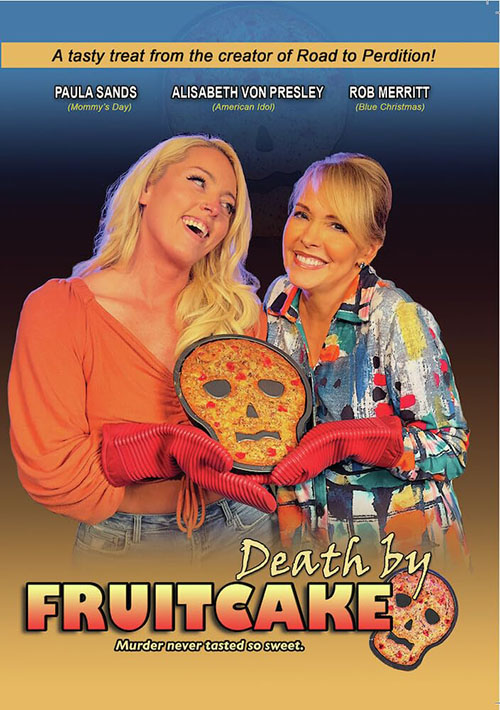
And you can visit mother-and-daughter sleuths, Vivian and Brandy Borne (from the Barbara Allan Antiques mystery novels by Barb and me) in our little movie Death By Fruitcake right here:

Death by Fruitcake

If you prefer to visit Mommy on physical media, try here (best price).

And Death by Fruitcake on DVD (no Blu-ray) is here – your support is MUCH appreciated!
* * *

Ted Turner died last week.

He created cable as we came to know it, and he created CNN and the 24-hour news cycle, and actually a lot more. I celebrate his dedication (through TCM) to making classic (and not so classic) films from the dawn of sound up.

He did not create streaming. I’m not sure anybody should have, at least not in the expensive, dishonest, frequently stupid way it has evolved. I don’t have to explain “expensive” – it’s the reason why following worthwhile shows on various streaming “services” is prohibitive for anyone but the wealthy.

I should explain “dishonest,” though – it’s the way we were sold a bill of goods that “everything” would be available to us at a click and we would no longer need physical media, like DVDs, Blu-rays and 4K discs. This has proven not only to be false but what is available (even after we’ve paid the monthly service charge) often includes a fee with no physical media attached. You can “buy” a movie this way, and “own” it, only to have it stripped away sooner or later without notice.

And I will explain “stupid” by way of the reality that streaming services are funding series and movies often well below the former standard of cable and even network TV. The drawback of network TV was always the limited channels; but the plus has been occasional shows of quality like classic Star Trek, Twilight Zone, Perry Mason and Seinfeld – which generated what used to be called “water cooler” talk.

Yes there are first-rate streaming series – as indicated, enough of them to make prohibitive signing onto a streaming service for its one or two good seriess. But quality shows happen only because talented people, not in need of guidance from a corporate daddy or mommy, can create a Sopranos or Breaking Bad or Curb Your Enthusiasm.

Give streaming accidental credit for that much.

And I say “accidental” because the streaming services show no signs of telling good from bad, mediocre from excellent. A series like Apple’s Palm Royale with the great Kristin Wiig and Carole Burnett can begin well and sputter into unexpected embarrassment. That same service’s Hijack can have an excellent first season and a become a travesty of itself in the second. And if you can’t give Idris Elba something worthwhile to wrap his acting chops around, give up.

The missus and I often sit down of an evening to peruse the streaming possibilities from Netflix to HBOMax, from Apple to Peacock, and we’ve been to Hulu, Disney and Paramount Plus (among others) on our travels and through the associated travails. And what we end up doing, three out of four times at least, is turning to my substantial collection of physical media – where we know something will be worth re-watching, with the unwatched tempting enough for me to have laid money down for its individual promise.

I am part of Robert Meyer Burnett and Dieter Bastien’s Let’s Get Physical Media show which is on most Sunday afternoons (1 p.m. Central). There I discuss noir and noir adjacent releases, and Rob and Dieter focus mostly on science fiction, fantasy, horror and fun schlock (Dieter proudly self-describes as the Trash Panda). I’ll include a window on a recent episode – I show up an hour or so in for an hour so appearance, recommending Blu-ray and 4K releases. Occasionally DVDs, too.

The decline of physical media for movies and TV has created a collector class for whom the Let’s Get Physical Media show is designed. These are collectors after boxed sets of single and multiple releases, fancy editions with slip covers and tons of bonus featrues and assorted bells and whistles including books – and it’s not unusual for one of these limited releases to cost fifty bucks or more.

But on every episode it’s noted that, of new discs, DVD sales still rule, with Blu-ray lagging behind and the superior format, 4K, a virtual afterthought. And yet in recent months physical media is making a vinyl-like comeback. Best Buy and Barnes & Noble are still strong in sales of all three forms (most other brick-and-mortar stores dropped out of physical media sales of video a couple of years ago).

What’s interesting about the comeback of physical media is that it’s driven by two groups: those special edition collectors I mentioned; but also Gen Z buyers – a younger generation that has rejected the streaming era and is turning to…DVD.

It’s a good trend – young people building libraries reflecting their personal tastes. One aspect of the trend has these Z’ers – with less disposable income than some previous gens of kids – going to Goodwill and other second-hand stores and buying DVDs for a few bucks (or even one buck). These buyers are less concerned having the high def aspect (if at all), possibly because they are used to the small screens on their phones, and video that’s just okay is okay by them.

I’m going to stop short of saying, “Physical media is back, baby!” But it’s definitely a shifting scene.

* * *

My buddy, editor/publisher Charles Ardai has an in-depth Crime Reads interview here about Hard Case Crime (and I rate a mention or two).

The movie version of Road to Perdition gets included in this list of great mob movies. (Exciting Perdition news forthcoming.)

M.A.C.
Bam! Pow! Zap!

Tuesday, July 20th, 2021

To Live and Spy in Berlin received a nice boost from BookBub. The new release price is $3.99 for the e-book; it’s $14.99 for the “real” book.

And on Wednesday the San Diego virtual Comic Con link with my panel with the great Andrew Sumner of Titan will be available. The discussion includes the upcoming Titan Ms. Tree third volume, the Nolan reprints from Hard Case Crime, and the Mike Hammer 75th anniversary publications from various publishers…and more.

The trade paperback edition of Eliot Ness and the Mad Butcher, the non-fiction work by A. Brad Schwartz and myself, is available now. It has a slightly different, tighter subtitle, at my urging: Hunting a Serial Killer at the Dawn of Modern Criminology. The info is here.

It looks like both Mommy and Mommy 2: Mommy’s Day are available for streaming on Roku.

Getting back to Live and Spy in Berlin, the indefatigable J. Kingston Pierce at the definitive mystery fiction web site The Rap Sheet said the following about John Sand:

I read and enjoyed both Come Spy With Me and Live Fast, Spy Hard, Max Allan Collins and Matthew V. Clemens’ initial two John Sand espionage novels, though I haven’t yet had a chance to write about them. And now the pressure to do so is even greater: Collins writes in his blog that the series’ third installment, To Live and Spy in Berlin, is due out on July 14, from Wolfpack. That makes three fast-paced, James Bond-ish adventures published in just nine months! No wonder I can’t keep up. “Will there be more John Sand books?” Collins asks. “That’s up to you. We have left something of an incredible effing cliffhanger [in book three] that needs resolving, so it’s on your conscience not ours if sales don’t justify that resolution.”
* * *

Barb and I took in Black Widow this weekend and I’m happy to report it’s a good film. It concentrates on espionage and action/adventure, and character interaction, particularly between Black Widow and her sister, well-portrayed by Scarlett Johansson and a scene-stealing Florence Pugh. There’s a surprising amount of humor and the Marvel-style, sometimes wearying action sequences don’t really get out of hand till the last half hour.

I could not help, in watching Black Widow, but flash onto a complaint a reviewer had recently about To Live and Spy in Berlin, specifically that John Sand was not a realistic character but rather a “cartoon.” While I would prefer the more exact “comic strip character,” I don’t argue with that designation.

Ever since I began also being a writer of comics, my novel writing has frequently been the target of reviewers who (rather lazily I think) remind potential book readers that I am a lowly comics writer. This has happened less post-Road to Perdition, which was a key component of the new attitude toward comics, i.e., graphic novels.

But I used to have reviewers who would look at, say, Nate Heller and write, “Bam! Pow! Zap!” in regard to my prose writing – sometimes in a kidding way, others in a more dismissive manner. The idea that anyone would look at Nate Heller and think “comics character” is absurd, but these reviewers knew I was writing the Dick Tracy strip and took a predictable cheap shot.

I think generally – and again, Road to Perdition played a role in changing attitudes in and about the field – readers mostly now understand that the comics form accommodates everything from over-the-top superhero to grimly realistic real life and everything that falls between. It’s a storytelling form with as many, actually more, capabilities than most others.

When the comics label on a writer is used, however, it’s almost always disparaging – meaning the writer is producing kid’s stuff or ridiculously over-melodramatic junk.

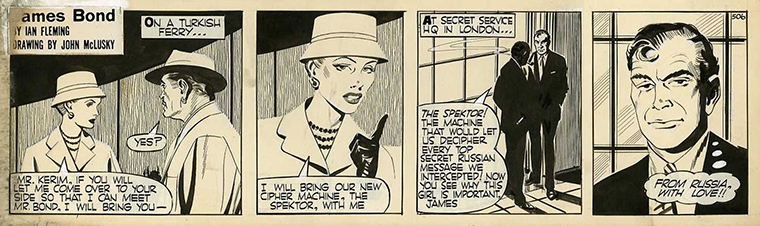
So is John Sand a comic strip character in the sense that his adventures are unrealistic and run to outrageous melodrama? I would say yes to that. And it’s intentional. But that does not mean (as a few detractors of the series say) the John Sand novels are spoofs. I’m getting a bit tired of having to say this, but Austin Powers, Derek Flynt and Dean Martin’s Matt Helm are spoofs. John Sand is an homage to Fleming’s Bond (and the early Bond films) and something of a pastiche with a dollop of my historical fiction approach. Bond, by the way, was in addition to novels a long-running comic strip signed by Fleming and pre-dating the films (Connery cast, in part, because he resembled the James Bond of the UK comic strip).

James Bond UK Comic Strip

The problem I run into – and those of you who drop by here frequently are aware of this – is the reader who likes one or two of the series (or one-shot novels) I write, and is confused, irritated or even angered by others. Of course, sometimes it’s easy to tell which Max Allan Collins is performing today – no one is likely to confuse Antiques Fire Sale with Killing Quarry or G.I. Joe with Nate Heller in Better Dead.

On the other hand, most – actually, much – of what I write is melodrama. Kitchen-sink realism interests me not a whit. My technique, which may or may not always be successful, is to layer a believable, even realistic surface on a story that is larger than life (“over the top,” in the view of detractors). That’s common to Antiques Fire Sale and Killing Quarry. No apologies.

I realize it can be confusing. Mike Hammer is more in the vein of John Sand (not surprisingly, since Bond was a British take on Hammer, largely) but would seem to be more along the lines of Quarry or Nate Heller. But my responsibility is to do the best job I can whichever road I go down on a given project.

And I am a professional writer. This is how I make my living, how I keep the lights on around this joint. This means I write for various markets and even multiple audiences. I admit it’s a frustration when a reader gets mad because, say, Girl Can’t Help It features people-next-door protagonists in a small-town setting. That’s actually a pretty good example – I do run into Antiques readers who love the Girl books, but would likely be appalled by Quarry.

Another aspect of course is the need for me to stay engaged. When I come to Quarry or Nate Heller after doing books that aren’t about them, I do so with renewed energy and interest. Robert B. Parker and I started out about the same time. You may have noticed he did just a bit better than I did in the world of publishing. But had one of my early series taken off – Nolan or Quarry specifically – I might have spent the bulk of my career writing chiefly about one of them…and going quietly nuts. Rich, but nuts.

I like that I have created a bunch of things, written over 100 books about a bunch of different protagonists in different settings and even eras.

Here’s an example of my approach, and it will demonstrate why some readers embrace my work and others don’t like it at all. The Caleb York books grow out of an unproduced screenplay Mickey Spillane wrote for John Wayne in the 1950s. When I was asked to write a series about York, I decided to approach it (and the first book, The Legend of Caleb York, a novelization of Mickey’s screenplay) as if I were doing a 1950s western movie that might have starred Randolph Scott or Audie Murphy.

In other words, the Hollywood Myth of the West, which had little to do with the actual Old West. I did this unashamedly and with a certain amount of delight. But at the same time, the world Caleb and his cast are plopped down in is a rather realistic one, with a lot of research brought to bear. York will shoot it out in the kind of Main Street gunfight that almost never really happened, but if he goes into a hardware store in the 1880s, by God it will be an 1880s hardware store. A bad guy right out of High Noon will have his roots in Quantrill’s Raiders. It’s a mix.

It’s trying to provide a recognizable realistic surface and undercarriage to a tale that is mythic, larger-than-life.

One of the things I try to do here is let you know what I’m up to with whatever my latest book is. I think I’ve made it clear than To Live and Spy in Berlin is neither Austin Powers nor John le Carré. Matt Clemens and I knew damn well we were over the top. But we did it with a twinkle in our eye but, while we were in the middle of the writing, a conviction in the reality of our fairy tale world.

* * *

The Wild Dog controversy raged on for a week but has cooled somewhat. I have nothing more to say about it, right now anyway.

However, one earnest soul reminded everyone that I had killed Moon Maid almost right out of the gate when I took over the writing of the Dick Tracy comic strip in 1977. This point was made, apparently, to show I had little respect for what had gone before. The Earnest Soul asked, “What did Chester Gould think?”

Well, here’s the thing. Chester Gould was still signing the strip with me and his assistant Rick Fletcher. Chet was consulting on a regular basis and knew, and understood, that the Tribune Syndicate wanted us to remove all remnants of the moon era from Dick Tracy. He had already dumped most of it himself.

So what did Chester Gould think? He may have been reluctant, but he went along. And, as I say, put his name on the strip…above mine.

* * *

Here’s a nice write-up about To Live and Spy in Berlin from our pal Sean Leary at quadcities.com.

M.A.C.