
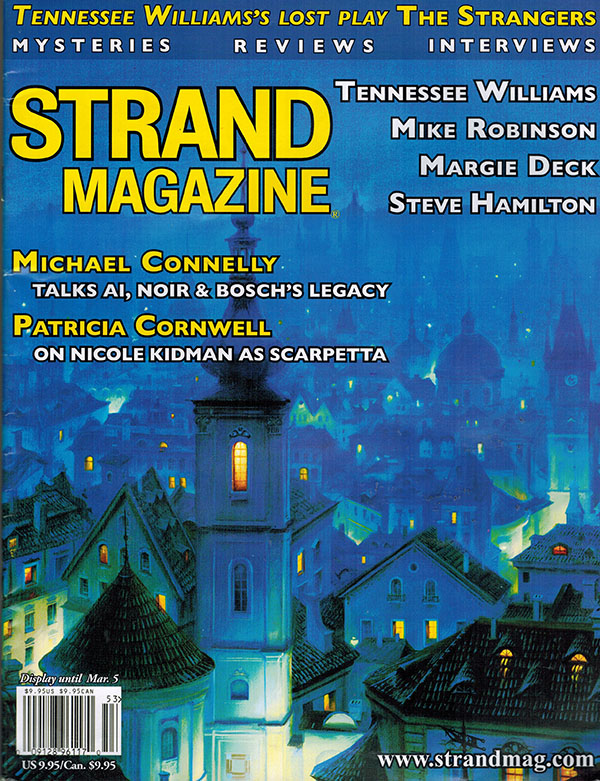
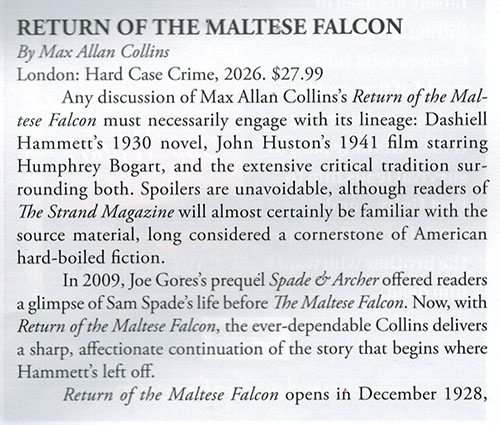
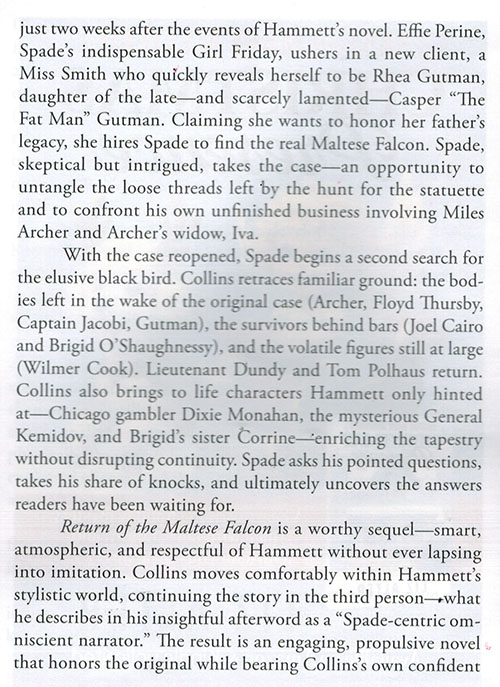
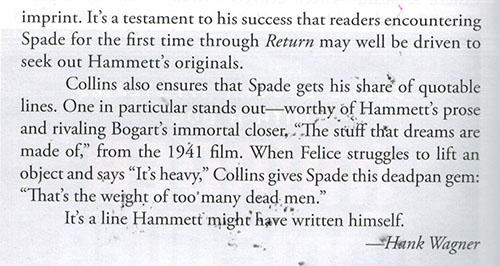
The Return of the Maltese Falcon continues to dominate around here. We continue to get lovely notices, and this one from The Strand is a doozy:
We encourage sending pics of Return from your phones spotted out in the wild of Return on display. Barnes & Noble has improved on the title, but reports still come in that the book is not anywhere in certain individual stores. If you are a brave, hearty soul, go to the Help Counter and ask if it’s in stock, and if it isn’t, whether more are on the way. (You don’t have to buy the book at B & N to do this.)
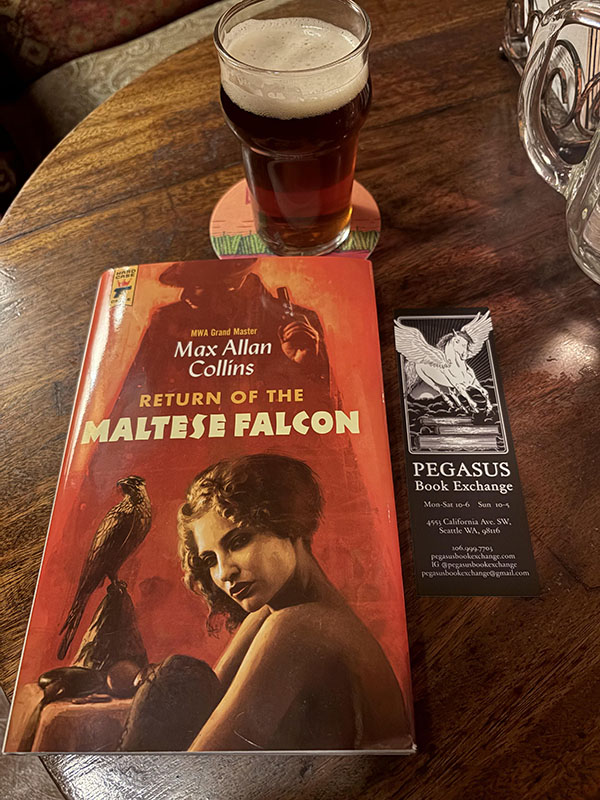
Also, reviews posted at Amazon are highly helpful, however short, though we’ve had some really smart, well-written long ones, as well. Worth doing at Barnes & Noble dot com, too – considerably fewer reviews have been posted there, but still a fair number.
John-Jr-Jackson, an Imagination Connoisseur, wrote Patton Oswalt an Instagram recommendation:
That’s very cool, as Patton is not only a friend (well, friendly acquaintance), but did me the favor of joining the all-star cast of True Noir: The Assassination of Anton Cermak.
By the way, a big, big, big date for me is coming up:
Why is that date important? It’s the official release date of two major projects of mine.
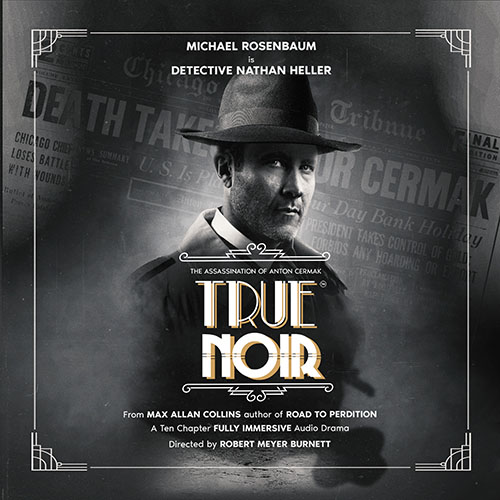
First – and more exciting news about this will follow in the next few Updates – True Noir: The Assassination of Anton Cermak, the 4 ½ full, full-cast adaptation written by me (from the first Nathan Heller novel, True Detective), will be officially released worldwide. You’ll find it downloadable at Audible and elsewhere, and will be able to order the Skyboat Media 4-CD set (yay physical media!).
February 17 is also the release date of the Antiques/Trash ‘n’ Treasures movie, Death by Fruitcake, based on the novels by Barbara Allan (wife Barb and me), adapted from a novella of ours and co-produced by Barb. The great cast is topped by Emmy winner Paula Sands, Midwest superstar Alisabeth Von Presley, and my Blue Christmas lead, Rob Merritt. Chad T. Bishop shot and edited our modestly budgeted film and I directed it.
Pre-order the DVD here (no blu-ray).

One of the best reviews and interviews, relating to Return of the Maltese Falcon, appears at J. Kingston Pierce’s indispensable Rap Sheet. I’m taking the liberty of reprinting the review portion this week.
Pinkerton detective-turned-author Dashiell Hammett realized he had something special on his hands when he submitted his revised, typewritten version of The Maltese Falcon to publisher Alfred A. Knopf in July 1929, asking that Knopf (who had previously handled his books Red Harvest and The Dain Curse) practice restraint in editing this latest manuscript. As Hammett scholar Richard Layman has explained: “He knew what he was doing, he said. Hammett wanted to get his third book right. It was a departure work for him, his attempt to break away from the formulas of pulp fiction to create a work with serious literary value.” Although the writer resisted changes by copy editors, he continued to tweak his own story—which had originally appeared (in slightly different form) in five monthly segments in Black Mask magazine—right up to when Knopf finally sent it away for printing. The completed novel was released on February 14, 1930.
Ninety-six years later, with the copyright on Hammett’s best-remembered (and most-filmed) tale having lapsed at the end of 2025, Iowa crime-fictionist Max Allan Collins seeks to add another “something special” to the Falcon legend. In Return of the Maltese Falcon, released this month by Hard Case Crime, he has boldly resuscitated the original book’s “hard and shifty” protagonist, San Francisco private investigator Samuel Spade, and sent him back out to locate the bejeweled bird of the title—which, you will likely recall, was never recovered in Hammett’s hard-boiled classic.
Penning a sequel to such a seminal genre work can only be characterized as intimidating. Indeed, Collins acknowledges that “avoiding strictly pure mimicry, and writing in my own style while honoring Hammett’s, was a tightrope to walk.” But the critical reception for Return of the Maltese Falcon has so far been generally favorable. Kirkus Reviews remarks that “Collins’ dialogue sounds pleasingly like Hammett’s; his plotting is even twistier; and if his descriptions mix Hammett’s terse, affectless minimalism with Raymond Chandler’s fondness for florid similes, that’s clearly, as he notes in an engaging coda, his intention. Fans convinced that nobody could possibly continue a tale that ends so definitely owe it to themselves to give Collins a try.” Reviewer Ray Palen of Bookreporter says Return is “a work of wonder, and I enjoyed every second of it. Collins has not just inhabited Hammett’s world but breathed new life into it and made it distinctly his own.” Finally, prolific author and blogger James Reasoner observes that, “stylistically, Collins’ fast-moving, straight-ahead prose isn’t quite as stripped down as Hammett’s, but it’s certainly in the same ballpark.” He adds: “The resolution of the mystery and the way the book wraps everything up are extremely satisfying.”
As Collins has stated in the past, he fell in love with The Maltese Falcon in 1961, when he was 13 years old and first watched the 1941 Humphrey Bogart movie adaptation on television. Not until much later did he consider recruiting Sam Spade into a new story—not necessarily a Falcon follow-up, but at least another novel starring the same principal. (Spade’s single other book-length appearance came in Joe Gores’ authorized 2009 Falcon prequel, Spade & Archer.)
Collins’ idea for a sequel dates back to 2024, when he included it in a future-projects sales pitch to Titan Books, the British owner of Hard Case Crime. Like numerous other readers, Collins was curious to know what happened after the events recounted in Hammett’s yarn—not just what became of the ever-elusive falcon statuette, but, as he told CrimeReads recently, how Sam Spade might “extricate himself from the ruins he’s made of his life and business.”
To help him answer those questions in Return of the Maltese Falcon, Collins brings back most of the original novel’s cast—some in secondary roles—while beefing up the involvement of several players to whom Hammett had assigned lesser parts. (Have no doubt: You should definitely have read the 1930 book before tackling Return.)
His action begins in December 1928, shortly after Spade failed to locate the gold, gem-encrusted (but now black enamel-covered) falcon at the center of the earlier story, and handed over his fetching but deceitful client, Brigid O’Shaughnessy, to the San Francisco cops for the murder of his detective partner, Miles Archer. Effie Perrine, Spade’s “lanky, tawny-haired” secretary (at 23, a decade Spade’s junior), has erected a Christmas tree where Archer’s desk once sat, and their office is looking “moderately successful” despite the “bad publicity” of late. Through the door comes Rhea Gutman, the “pale and petite,” 18-year-old blonde “daughter” of corpulent criminal Casper Gutman, who supposedly spent years chasing after the Maltese falcon, a treasure crafted for the King of Spain in the 1500s, only to have it stolen by a Russian general named Kemidov, and replaced with a fake. It seems that, like her late progenitor, Rhea is hungry to get her hands on the black bird, and she’ll split the rich proceeds with Spade if he can bring it to her.
Not surprisingly, the shamus accepts her offer. What he hadn’t expected was to then be approached by three more people wanting him to find the artifact (what he terms the “dingus”) on their behalf: Chicago gambler Dixie Monahan; a British Museum official, Steward Blackwood, who contends his institution holds true title to the falcon; and Brigid O’Shaughnessy’s younger sister, Corrine Wonderly. While raking in retainers from them all, he returns to his hunt for what has become the most famous “MacGuffin” in crime-fiction history. Spade’s investigation will eventually lead him to a violent clash with Casper Gutman’s erstwhile “gunsel,” Wilmer Cook; jail interviews with the aforementioned Miss O’Shaughnessy as well as dandyish Joel Cairo, familiar from the original tale and here claiming to know a private collector who’ll pay handsomely for the statuette; run-ins with police and the local district attorney; the discovery of an unidentified corpse in San Francisco Bay, in whose pocket is found Spade’s business card; a Golden Age-style gathering of suspects he hopes will flush out a killer; and late-in-the-game identity switches that I, for one, didn’t see coming.
When I first learned that Max Allan Collins would be revitalizing Sam Spade in a continuation novel—a sequel to one of American detective fiction’s founding yarns, no less—I felt a moment’s consternation. However, I reminded myself that Collins, who was named a Mystery Writers of America Grand Master in 2017, is a crackerjack tale-spinner who has given us two estimable series (a historical one starring Chicago gumshoe Nate Heller, and a second featuring the hit man known only as Quarry), and that he’s already succeeded in extending the life of another notable P.I., Mike Hammer, writing 13 new novels to add to the 13 Mickey Spillane had produced by the time he died in 2006. Furthermore, Collins put another iconic sleuth—Philip Marlowe—through his paces in “The Perfect Crime,” composed for the 1988 collection Raymond Chandler’s Philip Marlowe: A Centennial Celebration, edited by Byron Preiss. (He subsequently swapped Marlowe for Heller and added that story to his 2001 “casebook,” Kisses of Death.)
If anyone had the chops and chutzpah necessary to extend Spade’s otherwise brief career, it was definitely Collins.
With its text having now entered the public domain, this seems to be the season to celebrate Dashiell Hammett’s third novel. Publisher Poltroon Press has brought a new, photo-embellished hardcover version of The Maltese Falcon to market that also features a pair of Spade short stories inked by modern San Francisco-area author Mark Coggins. Blackstone has released its own “collectors edition,” complete with black-and-white illustrations and artistically sprayed page edges. Meanwhile, Steeger Books is selling hardback (or paperback) copies of the Falcon as it was serialized in Black Mask, with more than 2,000 textual variations from the final, 1930 book, and including the original pulp-style interior art by Arthur Rodman Bowker. Finally, notebook maker Field Notes has packaged that same magazine edit in imitation of the World War II-era Armed Service Editions.
Return of the Maltese Falcon is altogether something bigger, though. In this, his 53rd year as a published author (Bait Money, his debut novel, came out in 1973), Collins has given us not only an homage to Hammett’s most memorable composition; he’s drawn a direct line between himself and that august scribbler of yore, emphasizing the fact that he wouldn’t have the award-winning career he does without Hammett and other ink-slinging pioneers having laid the foundations of the popular field in which he toils. There will be Hammett purists who object vociferously to Max Allan Collins, or anybody else, employing Sam Spade in fresh adventures. Yet when the results are as delightful, dramatic, and downright satisfying as Return of the Maltese Falcon, it’s hard to argue that the effort should never have been made.
NEXT WEEK: I will post J. Kingston’s Pierce’s interview with me about Return of the Maltese Falcon. Jeff has done some of the very best interviews with me ever done.
Speaking of interviews, my pal Heath Holland (with whom I partner on blu-ray commentaries) spoke with me about Return of the Maltese Falcon here.
M.A.C.
Tags: Antiques Series, Death by Fruitcake, Interviews, Nate Heller, Nathan Heller, Return of the Maltese Falcon, Reviews, Trash 'n' Treasures, True Noir, True Noir: The Assassination of Anton Cermak, True Noir: The Nathan Heller Casebooks
Another great conversation you had with Heath Holland!
Heath is great.
The interview is screamingly good !