
Okay, this is getting ridiculous. The day this is posted I will be getting an out-patient procedure that will determine whether I will finally get my heart surgery, which if so, will likely (pause while I laugh hysterically) be next week. I never dreamed that I would be so eager to get an operation like this, but this has been going on since last June.
I will continue to keep you posted, and either Nate or I will provide updates here and on Facebook (our weekly ones will continue to be posted each Tuesday morning).
My apologies for this unintentional cliffhanger serial – I’m usually not quite this corny – but I continue to appreciate the support from my readers, friends and acquaintances. It’s been a great boost to the spirits.
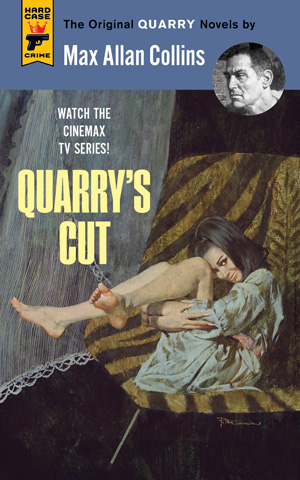
Perhaps in honor of my inevitable surgery, the Quarry reprint out this month is QUARRY’S CUT. Also coming out this month are mass-market paperbacks of ANTIQUES SWAP and KILL ME, DARLING.
A piece of good news for longtime readers of my stuff: my complete novel version of ROAD TO PERDITION the movie is due to be published along with reprints of ROAD TO PURGATORY and ROAD TO PARADISE. You may recall that my PERDITION novelization was reduced to a pale shadow of itself back in the day – a 40,000 word condensation of the 70,000-word novel is what was foisted upon the public (it even made the New York Times best-seller list). As a great man once said, “Pfui.” But we appear to be on the verge of vindication.
In addition, new editions of BLACK HATS and RED SKY IN MORNING are in the works, to be published under my own name for the first time (R.I.P. Patrick Culhane).
All five of these books will be published by Brash Books, which is in part the brainchild of my buddy Lee Goldberg.
I now have in hand all five Hard Case Crime reprints of the first five QUARRY novels, each with a stunning Robert McGinnis cover. Or I do, assuming this isn’t an hallucination, which is kind of what it feels like. This latest publication of QUARRY continues to stir up reviews of a novel that was first published in 1976 – that’s forty years ago – and written a few years before that.
For example, there’s a splashy QUARRY review, featuring the McGinnis cover, in the second issue of the amazingly slick and colorful (and expensive) UK magazine, CRIME SCENE. On your newsstands now. Nice write-up, but one that includes the now-usual complaint about Quarry’s non-PC gender attitudes – again, a forty-year old book is accused of being somewhat “dated.” No one seems to mind that he’s an assassin. I guess some things just never get old.
Check out this QUARRY review from Col’s Criminal Library.
And this one from the San Francisco Book Review.
QUARRY’S DEAL is given a fine review at Everything Noir.
Finally, here are a couple of splendid reviews from Bill Ott at Booklist that you may have missed:
Collins, Max Allan (Author)
Oct 2015. 271 p. Hard Case Crime, paperback, $9.95. (9781783298839).
Originally published in 1976 as The Broker, this first novel in Collins’ series starring the Vietnam-vet-turned-hit-man finds Quarry five years into his career as an assassin for hire, getting his assignments from a middleman called the Broker. Trained to kill in Vietnam, Quarry finds he quite likes the work and has no trouble distancing himself emotionally from what he does. But he doesn’t like complications, and when the Broker adds a wrinkle involving drugs to Quarry’s latest job, the hit man protests. So begins the severing of the Quarry-Broker connection, a relationship that we learn much more about in succeeding novels in the series.
Collins didn’t know Quarry would lead to a series when he was writing it, but he set the table perfectly, even so. Quarry was the first hit-man antihero in crime fiction, and, unlike most of his successors, he remains the most “pure,” in the sense that he isn’t somehow a good guy who only kills those who need killing (Dexter, et al.); no, Quarry kills for money and tells you so. Yes, he has his own sense of justice and will sometimes kill (pro bono) those he feels are on the wrong side of his very personal scales of right and wrong, but he’s still a killer more than a knight errant. And, yes, Collins makes us root for Quarry, or he draws us so completely into Quarry’s world that rooting for anybody becomes beside the point. That, after all, is the real trick to creating a compelling antihero.
Collins also pairs his antihero with a writing style that is perfect for the man and the premise: mainly straightforward, no-nonsense declarative sentences, more Hammett than Chandler, more Spillane than Hammett. Killers shouldn’t be fancy talkers, especially those who work the drab mean streets of places like the Quad Cities, spanning the Mississippi and connecting Illinois and Iowa, where the action in Quarry takes place. And, yet, just to keep us off balance, Collins will occasionally show some Chandlerian chops, as when he describes a cluster of trees “bent over green and graceful in the less than gentle afternoon breeze, like oversize, out-of-shape ballet dancers trying in vain to touch distant toes.” Even hit men can wax poetic now and again.
Although Collins originally saw Quarry as a stand-alone, he did leave his protagonist in a major pickle at the end of the book. The implication seemed to be that Quarry was doomed—a fitting end for a one-off noir—but when an editor asked the author to write more about the character, Collins was happy to find a way to get Quarry out of his pickle. When Hard Case finishes its reissuing of the first five Quarries, there will be a total of 11 pickle jars on the shelf (the original five plus the six Collins has written since he brought back the series in 2006)—and plenty of room for more.
QUARRY’S LIST
Collins, Max Allan (Author)
Oct 2015. 219 p. Hard Case Crime, paperback, $9.95. (9781783298853).
His relationship with the man known only as the Broker irretrievably broken in Quarry, the first in the series, Collins’ hit-man-for-hire hopes to develop a new business plan. Without the Broker to act as middleman, setting up clients for Quarry and others to kill, it could prove difficult to find marks, but Quarry has grown disenchanted with working through someone else and wants to go another way. But before that can happen, he must deal with the other hit men he knows will be coming for him, as various lethal entrepreneurs vie for the prize of taking over the Broker’s business. Quarry is ready when they come and dispatches a pair of killers with little trouble, but that’s only the beginning. Tracking back to find the man who wants him killed, he falls hard for a blonde in a swimming pool, only to discover that she’s the Broker’s wife and, further, that the man he is hunting is setting up a hit on Mrs. Broker. A plan is forming in Quarry’s mind: the killers in the Broker’s employ will all contract with other brokers eventually and go back to work. If Quarry can find the Broker’s list of killers, he can start his own business by tracking them to their next jobs and hiring himself out to their would-be victims: pay me, and I’ll kill the guy hired to kill you. It’s an ingenious scheme, but there’s lots of preparatory killing to do first.
Hats off to Collins: he needed a scheme to keep his series going, and he found a doozy. As Quarry puts it, “I’d still be killing people, but for the most part it would just be other hit men, like myself, and that seemed a step up somehow.” Originally published in 1976 as The Broker’s Wife, Quarry’s List is being reissued by Hard Case Crime along with the four other early Quarry novels (Collins took a 30-year hiatus from the series before bringing Quarry back in 2006). This one shows Collins developing the storytelling skills that eventually will define his long career as a genre writer. His plots are tricky but never overly so; like the late, great Ross Thomas, he knows how to build a maze but not lose his readers in it before showing them a way out. So it is here, as Quarry must juggle various pieces on a moving chessboard: the list, the widow, the killers, the plan. Fortunately for genre fans, Quarry (and Collins) are up to the challenge.
M.A.C.
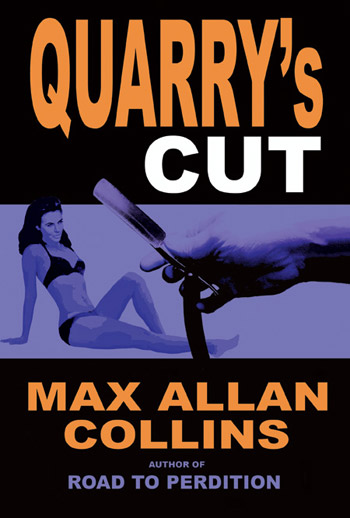 This week’s Quarry cover is QUARRY’S CUT, originally THE SLASHER – the final of the first four in the series, published in the mid-‘70s by Berkley Books. It’s the darkest of the first four, the most overtly a dark comedy of any of the novels, and is one of my periodic, probably ill-advised attempts to do an Agatha Christie-style closed environment mystery in the hardboiled style.