
Couldn’t They Make the Dog’s Pic Bigger?

November 4th, 2014 by Max Allan Collins

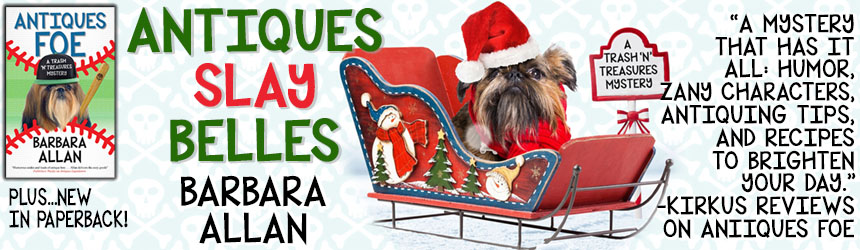
I thought I’d share with you the cover of the just-published large-print edition of ANTIQUES CON. Frequently large-print books have new, different covers and this is a good example of that. It also demonstrates how the “cute pet” aspect of cozy mysteries is viewed as uber-important by editors and publishers. Barb’s panel at the upcoming Boucher Con in Long Beach is devoted to the subject of pets in mysteries.

Antiques Con Large Print

I’m also posting my latest jack-o-lantern. Pumpkin carving is one of my few skills, so I thought I’d better share this one with you. We love Halloween around here, and decorate inside and out, plus view horror films in the evening all October. We ran through the HALLOWEEN flicks a year ago, so despite the lavish new Blu-ray boxed set that I picked up, we are saving a binge of that for next spook season. This time we concentrated on Hammer films (the Brit studio, not Mike), a number of which are now on Blu-ray, particularly in England. That’s where having an all-regions player comes in handy.

Jack-o-Lantern 2014

Barb is hard at work on her draft of the new ANTIQUES book and I have just wrapped up research on BETTER DEAD and will begin writing it today (Monday, as I write this). It’s a big subject and I’m intimidated. When I’m gearing up for a Heller, I have terrible stage fright – I have to tamp down the panic of wondering how I do this. I have a similar feeling before starting a Quarry, though not so intense. The enormity of a Heller project – the countless decisions that have to be made, the mountain of research that has to be culled and shaped – makes me uncharacteristically unsure of myself. Fortunately, Heller himself – like Quarry – seems always to be there, to assert himself and guide me.

A few brief movie recommendations.

JOHN WICK is a first-rate, stylish thriller with the underrated Keanu Reeves as a retired hitman brought back into action by tragedy, fate and maybe karma. It’s larger than life and particularly good at creating a fantasy world of hitmen and gangsters who operate with the benign neglect of the authorities (a point cleverly made by one quick scene). This was an odd experience for me, because the film is clearly influenced by my work – ROAD TO PERDITION, both the film and graphic novel; the Nolan series; and of course Quarry. But it’s also beholden to POINT BLANK, and that film (and the Richard Stark novels) had a huge impact on me and my career. The Parker novels were the last thing I read as a fan that influenced me, as both Nolan and Quarry demonstrate. Prior to that I was strictly a private eye guy, an inclination that came back around. Anyway, odd to see a film that is influenced by me and by the stuff that influenced me.

BOOK OF LIFE is a computer animated number drawing upon “Day of the Dead” Hispanic imagery. Very good, with a decent script that has some wit to it, BOOK is a feast for the eyes and a relief to me, since I was afraid BOX TROLLS had ruined such films for me.

ST. VINCENT is a comedy/drama that has nothing particularly new to say but says it well. What a relief to see Bill Murray at the center of what is clearly a Bill Murray movie, and not just a quirky supporting role in an indie. It’s almost an updating the relationship at the heart of MEATBALLS. Naomi Watts is very good as a pregnant Russian stripper, and Melissa McCarthy shines in a supporting role that shows her depth as an actress, though she does have a few very funny moments to remind us of her considerable comic skills. Most of all, ST. VINCENT understands the difference between sentiment and sentimentality.

* * *

Here’s a nice small review of that crime comics anthology I contributed to a while back.

Once again ROAD TO PERDITION makes a list of best graphic-novel movie adaptations. Weird poster, apparently from India.

Finally, Jeff Pierce at the Rap Sheet kindly picked up my mention of the private-eye soundtrack boxed set that just came out in the UK.

M.A.C.

Criminal Music

October 28th, 2014 by Max Allan Collins
Jazz on Film: Crime Jazz

An 8-CD set called JAZZ ON FILM – CRIME JAZZ! has just been released in the UK. The “film” part of the title somewhat misrepresents the set, which is dedicated almost entirely to the TV private eye and crime TV shows of the late ‘50s and early ‘60s. The liner notes are written by yours truly, an assignment I eagerly accepted although there was no money involved – which is the kind of career decision that keeps me semi-known, and in Iowa.

The best price is directly from Amazon UK right here (though you can order it through the USA Amazon, too).

My liner notes discuss each of the albums. Check out this astonishing line-up: “77 Sunset Strip,” “Hawaiian Eye,” “Checkmate,” “Shotgun Slade,” “The Naked City,” “Richard Diamond,” “Bourbon Street Beat,” “M-Squad,” “The Untouchables,” “Peter Gunn,” “Mr Lucky,” “Staccato” and “Mickey Spillane’s Mike Hammer” (both the TV series soundtrack and the music from the rare Stan Purdy “Mickey Spillane’s Mike Hammer Story” LP).

This is an incredible bargain, and features the likes of Henry Mancini, John Williams and Nelson Riddle.

Here is the opening of my liner notes (you’ll have to buy the set to read my CD by CD discussions).

CRIME JAZZ – AN INTRODUCTION

Full disclosure: I’m not a jazz buff. I was invited to the party because of crime-writing credentials, and a love for the late ‘50s/early ‘60s wave of TV private eye shows in America, an enthusiasm I’ve never been shy about sharing.

On the other hand, jazz is in the ears of the beholder. It’s a term that cuts a wide swath, and is defined in so many ways by so many fans that it nearly falls into the all-things-to-all-people category. I mean, we’re talking about a term that covers everything and everybody from Al Jolson to Miles Davis.

Similarly, “noir” is defined in many ways by many fans of crime fiction and films. Its roots are French, the term “noir” borrowed by film critics (several of whom went on to be noted filmmakers) from “Serie Noire,” a line of books from Gallimard that after the Second World War began translating and publishing such American crime writers as Dashiell Hammett, Raymond Chandler, Jim Thompson, Chester Himes and many more, including the author of this introduction.

But the term noir – chiefly designed to discuss American crime films of the war years that disguised a dearth of budget by a maximum of creative, moody lighting effects – has come to refer to all tough crime fiction, replacing the antiquated-sounding “hardboiled.” Arguments about what truly is noir occur constantly. Some critics, including the esteemed Otto Penzler, insist that private eye stories aren’t truly noir, because they aren’t bleak tales told from a criminal’s point of view. This will come as a surprise to anyone who’s read Mickey Spillane’s One Lonely Night (1951) or seen Jacques Tourneur’s Out of the Past (1947).

Spillane is a key figure here because his brutally tough, sexually active, war-haunted Mike Hammer created a boom in the private eye field at a point where radio had trivialized this mythic character into self-parody. Hammett’s prototypical tough P.I. Sam Spade became a figure of fun as a radio series, and Jack Webb’s various pre-Dragnet P.I.’s were all send-ups.

But Spillane revitalized the genre and – perhaps as a conscious follow-up to the craze for westerns on American television in the mid- to late fifties – a new wave of private eyes grabbed TV viewers like hoodlums they were roughing up. Generally considered to be first, and the gold standard, was Blake Edwards’ Peter Gunn and its cool jazz score by Henry Mancini, whose impact forever changed the way television series utilized music. (The interesting connection between Blake Edwards and Gunn and Spillane and Hammer will be discussed below.)

Mancini’s bestselling soundtrack created a whole new genre of vinyl entertainment for hi-fi enthusiasts, as well as an additional revenue stream for TV studios. In the late ‘50s and early ‘60s, such soundtracks – like comedy albums showcasing stand-up comics – were a craze unto themselves. Several P.I. series that pre-dated Peter Gunn (which first aired September 22, 1958) revamped their formats, often including an exciting movie-credits style opening inspired by Gunn’s, bringing a jazz-infused style to the scoring…as well as the opportunity for a soundtrack album.

This collection gathers many of the best of those albums, and while the Gunn influence can easily be discerned again and again, each has its own personality and merits, like the various TV series for which the scores were composed.

(Continued on the liner notes of JAZZ ON FILM – CRIME JAZZ.)

Though nobody at DC has notified me about it, apparently a collection of most of my controversial BATMAN work is coming next year:

Batman: The New Adventures
Max Allan Collins, Dave Cockrum
On Sale Date: July 21, 2015
$19.99 USD
272 pages
Trade Paperback
Comics & Graphic Novels / Superheroes9781401255183, 1401255183
Summary: After an encounter with Gotham City street criminals, Dick Grayson, a.k.a. Robin, is injured. When Batman goes into action on his own, he meets a young hoodlum called Jason Todd. Determined to guide Jason away from a life of crime, Batman takes him under his wing. These 1988 stories take Batman into police procedural territory, and set the stage for the bestselling BATMAN: A DEATH IN THE FAMILY. Written by acclaimed mystery novelist Max Allan Collins, best known for his graphic novel THE ROAD TO PERDITION, which was made into a Academy Award winning movie starring Tom Hanks, Paul Newman and Jude Law.
Collects BATMAN #402-403, 408-416 and BATMAN ANNUAL #11.

Speaking of my controversial BATMAN run (controversial in the sense a lot of fans think my work sucked and I don’t), here’s a fair-minded discussion of the Robin character as revamped by me and killed off by homicidal phone-call poll.

A very nice write-up about my Nathan Heller novella “Dying in the Post-War World” (available in TRIPLE PLAY) appears at the Gravetapping blog site. It was widely picked up in the mystery community.

Here’s a dandy review of the blu-ray of THE GIRL HUNTERS.

And here’s a solid discussion of the DICK TRACY strip, including my years on the feature.

Finally, I was pleased and honored that reviewer J. Kingston Pierce at The Rap Sheet chose BYE, BYE BABY as one of his ten favorite mystery novels of the past ten years.

M.A.C.

Mickey Spillane is Mike Hammer

October 21st, 2014 by Max Allan Collins
The Girl Hunters Blu-Ray

The day this update appears, the limited edition blu-ray disc of THE GIRL HUNTERS from Scorpion (1000 copies) will be released. Here’s where you can get it for a great price.

It’s also available on DVD, and here’s the Amazon link (and they of course have it on blu-ray, too).

For this Mike Hammer fan, having THE GIRL HUNTERS on blu-ray is a big deal. I don’t pretend that THE GIRL HUNTERS is a great movie, but it’s a very good P.I. movie by any standard and an almost hallucinatory treat for longtime Spillane/Hammer fans. I’ve stated many times that KISS ME DEADLY is the best Mike Hammer film, a statement with which few would take issue. I also feel that I, THE JURY with Biff Elliot is terrific representation of the feel and mood of the early novels, with a fine Franz Waxman score and great John Alton cinematography that seen in 3-D is something very special. And Elliot is a much better young hot-headed Hammer than he is generally given credit for.

It should be noted that in 1963, Mickey didn’t like any of the movies made from his novels (he was more charitable about the Darren McGavin TV series). He came to like KISS ME DEADLY, but that would take many years (and my efforts to sway him). The basic notion behind the film of THE GIRL HUNTERS was to do a Mike Hammer movie right for a change. And a good argument can be made that Spillane succeeded in his wish.

THE GIRL HUNTERS has a solid Hollywood director in Roy Rowland, whose interesting body of work includes everything from ROGUE COP to THE 5000 FINGERS OF DR. T. The melodic big band score, considered overbearing by some, is by Philip Martell, a composer more associated with that other Hammer, the one Christopher Lee and Peter Cushing worked for. That’s a clue to an oddity about the film (as is the presence of lovely co-star Shirley Eaton), which is that it’s a British/USA co-production, predominantly shot in the UK though with considerable B-unit location work in Manhattan. This two-country combo of shooting is skillfully done but limiting, and a funding source that fell through on the eve of production kept the film from being shot in color. The latter is fine with film noir fans of today, but in 1963, when the film was released, it hurt box-office potential considerably.

What is of course unique about THE GIRL HUNTERS is that Mickey Spillane portrayed Mike Hammer. Mickey had starred as himself in John Wayne’s RING OF FEAR (1954) and later would appear self-spoofingly in the wildly popular, long-running series of Miller Lite commercials, as well as in a couple of indie thrillers called MOMMY and MOMMY’S DAY. But in ‘63, Mickey had only RING OF FEAR and a few TV appearances for screen credits.

The risk of putting a non-actor in the lead role of a film, where he would appear in every scene and carry the picture on his shoulders, is staggering to contemplate. So is Mickey’s self-confidence and even audaciousness in accepting such a gig, the publicity value of which is topped only by its suicidal nature. But even more impressive is how good Mickey is – critics of the day loved him as Mike Hammer. Over the years, some viewers have been less impressed, but it’s hard to imagine anyone thinking Mickey was anything less than adequate.

And whether you think he’s great or merely passable, there remains the brain-frying fact that Mickey Spillane was playing his famous creation himself. We don’t have Conan Doyle on film as Holmes (or for that matter Watson) nor do we have Agatha Christie portraying Miss Marple, however ideal that casting might seem; and Ian Fleming seems to have been beaten out for the Bond role by somebody or other, and thank God we were spared Bob Kane as Batman. Yet the famous creator as his famous creation is exactly what happens in THE GIRL HUNTERS, as attest the film’s opening credits: MICKEY SPILLANE IS MIKE HAMMER.

THE GIRL HUNTERS puts on the screen, faithfully and well, the Hammer of the early and mid-‘60s, and it shows without doubt the manner in which Spillane viewed the character, which is to say with a steely-eyed mix of mercilessness and mirth. As tough as his Hammer is on screen, both actor and character (and writer) have a sense of fun. Of humor. (The prior screen Hammer closest to Mickey is McGavin.)

The film can seem a little slow to audiences today. Mickey himself said he wished he could cut himself, down to ninety minutes. (He also wanted to colorize it!) This may be the writer’s own fault, since it’s his screenplay; but it was the director’s responsibility to tighten it up. Still, for anyone even vaguely a Hammer fan, this is the one time a book in the series was translated almost word-for-word to the screen, with none of the sex or violence watered down. Only John Huston’s MALTESE FALCON rivals it in faithfulness. I have not received any copy of the blu-ray yet, so I can’t comment on the quality; but I am confident Scorpion did a good job. I played a role by doing a commentary, and also went to the original raw footage for my 1999 Spillane documentary and (with editor Phil Dingeldein’s help) put together lengthy interviews with Spillane and Shirley Eaton as bonus features for the disc. These interviews far surpass the “sound bites” that made it into my film (which you can see as an extra on Criterion’s KISS ME DEADLY release).

Truth be told, I have no idea whether my GIRL HUNTERS commentary is worth a damn – I haven’t heard it. It was strictly a down-and-dirty affair, with me at Phil’s dphilms studio in Rock Island going in and recording a non-stop, unedited commentary as I watched a DVD of the movie. I had done some prep, re-watching the film the night before and making some notes about what I might say. I’ll report back after I get a copy of the blu-ray.

But for now I am thrilled this even exists. We have the wonderful Criterion KISS ME DEADLY. We have the complete McGavin TV series on DVD. We even have a decent DVD of MY GUN IS QUICK, as well as a double-feature of the first two Keach TV movies. Now if we can only get blu-ray releases of both I, THE JURY movies, with the 1953 one in 3-D….

Here’s a very nice write-up at Detectives Beyond Borders about my intro to JACK CARTER’S LAW.

Here’s a Scotland paper’s review of DEATH SENTENCES, a collection of bibliophile mysteries edited by Otto Penzler that includes the Spillane/Collins “It’s in the Book.”

M.A.C.

Death Sentences

Novels Aren’t Movies

October 14th, 2014 by Max Allan Collins

GONE GIRL is doing well at the box office, and many critics like it, but that doesn’t make it a good movie. It reflects a new trend – so very much at odds with Hollywood’s traditional approach – of filmmakers being extremely faithful to their bestselling-novel source, apparently out of fear of alienating the book’s enthusiastic fan base. This started with the HARRY POTTER films, and goes on through the TWILIGHT series among others. Traditionally, Hollywood has played fast and loose with even the most popular source material (GONE WITH THE WIND a famous exception), including even Peter Jackson’s Tolkien films.

Frequently I get asked about the changes Hollywood made to ROAD TO PERDITION, usually with the asker’s expectation that I’ll do a rant about what the filmmakers “did” to my book. While I don’t agree with every change made – I would have retained the adult narration and my ending – I fully understood the need to rework the material for the screen. Some of what they did was an improvement – more was done in the film with the Looney father-and-son relationship, for example, and the Jude Law character was created to be a single tracker, combining my ongoing, oncoming fleet of such hitmen into one nemesis.

Novels are not movies, and novelists rarely make good screenwriters. One of the exceptions – Donald E. Westlake – refused to adapt his own work to the screen, basically on the “fool for a client” theory. Certainly novelists have trouble killing their darlings when adapting their own work. But it has more to do with basic differences between the forms, novels being an interior telling of a story and films an exterior one. There’s a reason why many classic films come from short stories, not novels – it’s easier to expand a 40 page tale into a 100-page screenplay than to reduce and compress a 300- to 800-page novel into one. GUN CRAZY, REAR WINDOW and STAGECOACH began as short stories, for instance.

I don’t know if Gillian Flynn is a good novelist – I haven’t read GONE GIRL, but it’s certainly popular – because (as regular readers here know) I don’t often read contemporary crime fiction, for reasons I’ve stated plenty of times. Still, a couple of things seem apparent. First, GONE GIRL the novel would appear to be one of those big popular mystery thrillers read by mainstream readers who don’t regularly read in the genre. I say this because the big surprises such readers go on and on about are (in the film at least) very obvious to seasoned mystery fans.

Second, GONE GIRL – adapted to the screen by Flynn – has a structure designed for a novel. Without getting into spoiler territory, major characters are off screen for long stretches of time. There is no focus, no one to root for (or against), despite the best efforts of a strong director (David Fincher). Flynn has in interviews spoken of how many characters and scenes she dropped, and the painful process of doing so, but she didn’t drop enough – the film runs a bladder-busting three hours. VERTIGO runs a little over two hours. LAURA is 88 minutes. Both were adapted from novels, the latter from a novel with a structure similar to GONE GIRL’s, but dropped in the otherwise faithful film.

GONE GIRL is a well-directed mess, and the faults largely come from the script. I don’t know whether putting this story on film reveals flaws in the novel, or whether Flynn couldn’t figure out how to deal with character and plot weaknesses on screen. The number of plot holes are staggering (the married couple has money troubles, except that also have endless supplies of money and live in a five-million dollar home), and the characters who don’t come alive are near legion (Neil Patrick Harris, generally a good actor, is defeated by a character so unbelievable as to be laughable). Three hours just weren’t enough for Flynn. Well, for me they were.

I was reminded of Brian DePalma’s THE FURY (1978), which I revisited on blu-ray recently. Some of you will recall that PHANTOM OF THE PARADISE is one of my favorite films, and that in the mid-‘70s I considered DePalma my favorite contemporary movie director (he’s still high on my list). SISTERS, OBSESSION, CARRIE – all blew me away. THE FURY, DePalma’s first big-budget film, was a stumble, filled with great set pieces but an unfocused narrative. The screenwriter was John Farris, who wrote the original, sprawling novel. Based on what’s on screen, he provided DePalma with a bewildering Cliff Notes version of his book, retaining a novelistic structure that put star Kirk Douglas on the bench for twenty or thirty minutes at a time.

The Judge

Ironically, one of the most novelistic recent films – in a good sense (rich characters, intertwining story elements, exploration of setting) – is the first-rate courtroom thriller, THE JUDGE. Chiefly the film is an acting showcase for Robert Downey Jr. and Robert Duvall, the former a big city amoral lawyer who returns to the small town he grew up in (and despises) to attend his mother’s funeral, and winds up defending his father, an idealistic judge with whom he’s been estranged for decades, on a murder charge. It’s a melodrama and a soap opera but a damn good one, and the supporting cast is rich with fine actors (Billy Bob Thornton, Vera Farminga, Vincent D’Onofrio) and interesting, fleshed-out characters. The focus is Downey. The film is leisurely at 148 minutes, but the characters and the narrative earn and use the time. The screenwriters are Nick Shenk (GRAN TORINO) and Bill Dubuque.

Of course, Rotten Tomatoes tells us that GONE GIRL is 87% fresh, and THE JUDGE only 46% fresh. Salon.com critic Andrew O’Hehir says of THE JUDGE: “It’s ‘what people want.’ Whereas I say the hell with people and what they want.” Well, guess what? I say to hell with jaded critics who have contempt for the moviegoers they are supposedly guiding. Oh, and O’Hehir loved GONE GIRL.

This is possibly another installment in my long-running AM I OUT OF TOUCH? series. But I don’t think so.

M.A.C.