Archive for the ‘Message from M.A.C.’ Category

You Say It’s Your Birthday

Tuesday, March 4th, 2014

Today (March 3rd, as I write this) is my 66th birthday. I am not looking for congratulatory e-mails or Facebook postings, but I do have a Paypal account for those wondering exactly how to help me celebrate.

Any birthday past forty inclines a person toward reflection, and I’m no exception. I am incredibly lucky. I haven’t had a real job since I taught college half-time in the early ‘70s, and my previous job had been sacking groceries. Yes, I’ve made money playing rock music, and obviously I bring in enough to keep the lights on around here by my writing. But both of those began as my hobbies, and having them turn into something more has been a blessing.

Career goals, many of them, have been reached or are nicely in progress. Nate Heller has worked the JFK case, the entire opus is back in print, and anything further is a lagniappe. I’ve written something that generated a major motion picture (ROAD TO PERDITION), which gives me a shot at being read after the writing has stopped. Nolan and Mallory and the Disaster series are completed. Quarry has made a rather remarkable comeback. There are other series that have decent shapes, should I never write another entry – four Eliot Ness in Cleveland, three Jack and Maggie Starr’s. I have completed the six substantial Mike Hammer novels from Mickey’s files, and two other non-Hammers. As with Heller, developing further Hammer and Spillane projects falls into the bonus area. I wrote my father’s wartime story (RED SKY IN MORNING) and a book about Wyatt Earp (BLACK HATS), and some thrillers, too, like the forthcoming SUPREME JUSTICE. I’ve written movies and directed a few – here I wish I’d done more and am still striving.

I have a respectable shelf of non-fiction works covering pin-ups, the history of mystery, men’s adventure mags and two (so far) Spillane critical/biographical titles. Goals remaining in that area include a full-length critical bio of Mickey (with my Spillane collaborator Jim Traylor) and of Eliot Ness (with writers/researchers Brad Schwartz and George Hagenauer) – those are already in early stages. A successful series continues with Barb on the ANTIQUES novels, which will number at least eleven, by current contract – very rewarding to do something in collaboration with Barb and that is so overtly funny.

I can look back on comics work that includes fifteen years on DICK TRACY, the longest run of a private eye comic book in comics history (MS. TREE – thanks, Terry!), and of course ROAD TO PERDITION (thanks, Richard!) and its prose and graphic-novel sequels. Thanks to movie and TV tie-ins, I got on the New York Times and USA Today’s bestseller lists, and was able to work in genres otherwise unavailable to me. I have won a number of awards and had quite a few nominations, though the Edgar remains elusive (up again this year, though), and that ugly little statue stays a career goal – Jon Breen has been nice enough to suggest in print that I should receive a career Edgar, which is more than a goal…more like a dream.

But I am in a position to look back and say I’ve earned my keep on the planet. I came here to write stories and play a little rock ‘n’ roll. So far it’s going very well.

And my personal goals achieved make my career accomplishments look like nothing at all. In my shallow way, I decided to marry a beautiful nineteen-year-old blonde. Now, all these years later, I remain married to her, and she is still stunningly beautiful, but along the way has proven to be funny, smarter than me, loving, talented and just about every other positive adjective you can think of. I have a son who is so smart and talented and such a great writer that I should be jealous…but he’s the one writer who I don’t mind being better than me. No grandkids yet, but a wonderful daughter-in-law. I had great, supportive parents who made all this possible.

Lots of friends, but it’s sad to think of how many are gone. A week doesn’t go by that I don’t think of actor Mike Cornelison and rockers Paul Thomas, Bruce Peters, Chuck Bunn and Terry Beckey. The only upside is realizing that such good friends as my writing partner Matt Clemens, researcher George Hagenauer, the guys in Crusin’, cartoonist Terry Beatty, writer pals like Ed Gorman and Bob Randisi, and filmmaking partner Phil Dingeldein, are all alive and well (and in some cases fat and happy).

For a guy who mostly lives in his converted-bedroom office in a little town in Iowa, I have so many friends! My agent Dominick Abel, Jane Spillane, Carl Amari, are just a few of my rich work-related relationships. Mickey Spillane was my son’s godfather! I am friendly with Stacy Keach, Patty McCormack, the Seduction of the Innocent guys, and on and on. Dangerous starting this list, but if you’re not on it, you are very much in my heart. Especially the editors out there buying my stuff.

Here’s a birthday card of sorts I received.

That’s it for now. I’m taking the rest of the day off.

M.A.C.

Eight Million (and More) Stories

Tuesday, February 25th, 2014

I have begun the Spillane western, now entitled DEATH RIDES IN and labeled “a Caleb York Western.” I’m working from a screenplay Mickey wrote for John Wayne in the late ‘50s which, obviously, was never produced. There will be a background intro that will discuss Mickey and Wayne’s history together.

It feels okay so far – one chapter in – but with the exception of the MAVERICK novelization and the flashbacks in BLACK HATS, I’ve never tackled a western before. I called my long-tall-Texan pal Bill Crider for some help on a few points – he knows what he’s doing – and that helped me saddle up and ride. The script – not necessarily written for Wayne the actor, rather Wayne the producer – is very much a vehicle that you might have seen starring Audie Murphy or Randolph Scott circa ‘58. I love that, but as somebody who doesn’t read contemporary western novels, I can’t anticipate how modern readers will react. It’s very much a tough Spillane story transferred to the west, so that’s a plus.

My love for westerns comes not from novels – I’ve maybe read a dozen in my life, counting TRUE GRIT – but from movies and TV. Lately I’ve been watching a lot of old TV, sometimes with Barb, sometimes alone. We both greatly enjoyed revisiting MAVERICK, which was my favorite show of any kind in my distant youth – James Garner’s Bret Maverick influenced Nate Heller as much as any mystery-fiction PI – and Barb grew up on it, too. I’m also fond of Jack Kelly’s Bart Maverick, and the very best episodes often feature both brothers. I would argue that “Shady Deal at Sunny Acres” (maybe you saw the remake – THE STING?) is the greatest single episode of a TV series ever made.

Binge watching is something Barb and I (and Nate, when he was younger) practically invented. But it must be said that serialized series of today work better than runs of classic series of the ‘50s and early ‘60s. Those shows had such punishing schedules – PERRY MASON did as many as 39 hour-long episodes a year – that maintaining consistency much less high quality was damn near impossible. On the other hand, Barb and I have worked our way through PERRY MASON – inhaling each half-season DVD release in a couple of days – and it has a surprisingly small number of clinkers. Maybe half a dozen out of 271 (!). The best episodes, not surprisingly, are adapted from Erle Stanley Gardner novels. The first two seasons are mostly such adaptations, and are highly recommended.

MAVERICK doesn’t fare quite as well. The first two seasons are excellent, really as good as TV westerns of that (or really any) era get. But creator/producer Roy Huggins left at the end of season two, and James Garner was starting to have battles with some very stupid Warner Bros. executives who thought screwing their star out of money was a good plan. Season three begins well but flags at mid-point, and toward the end, even some Bret episodes are clinkers. Season four lacks Garner, and Roger Moore is brought in as a Maverick cousin, faring only so so. “The Maverick Line,” one last Garner held back from season three, does the impossible: it’s a lousy Bret/Bart episode. Jack Kelly was magical working off James Garner, but tended to do the straighter, more “serious” episodes, and when Garner left, he was shifted into Garner-style scripts. He was pretty good at comedy but wasn’t getting the level of material that Garner got in the Huggins years. So my advice would be: watch the first two seasons.
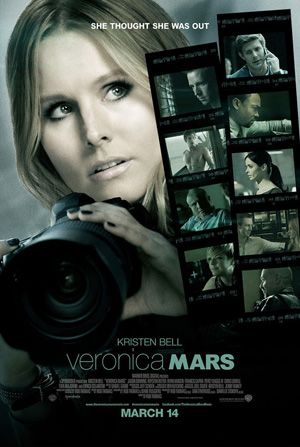
As for more contemporary fare, right now Barb and I are working our way through VERONICA MARS, and are almost done with the second season, which is very good if not up to the amazing first one. We’ll press on to the somewhat maligned third season, as we prepare for the imminent VERONICA MARS feature (I was a Kickstarter contributor). VERONICA MARS is one of the really great private eye series. The first season may be the best single season of any private eye show. Kristen Bell, as a teenage detective (the set-up is pure Nancy Drew – her father is a P.I. – but the feel is absolute FREAKS AND GEEKS) tosses off witty lines with a wry ease that Marlowe or Rockford might well envy.

Barb did not join me on my long journey through the complete NAKED CITY – 138 episodes. This is a wonderful show, with much to recommend it. Initially John McIntire is Lt. Dan Muldoon, the fatherly mentor to James Franciscus’ younger detective. They have a nice chemistry, but McIntire leaves two-thirds of the way through the first season – his landmark demise in “The Bumper” remains shocking – and Franciscus grieves his way through the remainder of the year. Replacing McIntire is Horace McMahon with his overly gruff, even unpleasant Lt. Mike Parker. When the show returns in a new one-hour format (after a year hiatus), it’s almost a surprise McMahon has been asked back. Franciscus does not return – he was a busy movie and TV actor – and Paul Burke comes in as the similar Adam Flint, his liberal, sensitive cop warming McMahon’s Parker up. The only cast member who spans all four seasons is Harry Bellaver as lovable, not-brilliant Detective Frank Arcaro.

Of course, the location shooting, capturing late ‘50s/early ‘60s New York, is the real star – the Bowery, Greenwich Village, Times Square, we’re there. The talent pool is drawn from Broadway and the Actor’s Studio, including regular Nancy Malone, very winning and naturalistic as Burke’s girl friend, Libby. The series is justly famous for early appearances by Dustin Hoffman, Robert Duvall, James Caan, Bruce Dern, Sandy Dennis, Alan Alda, Jessica Walter, Martin Sheen, Peter Fonda, Gene Hackman, Christopher Walken and many more. Moonlighting Broadway stars like Robert Morse, Orson Bean, Maureen Stapleton, Jack Klugman and William Shatner turn up frequently as do such Hollywood legends as Mickey Rooney, Sylvia Sidney, Dennis Hopper, Roddy McDowell, Chester Morris, Steve Cochran, Claude Rains, and Burgess Meredith. Jack Warden, Carroll O’Connor, Lois Nettleton and Nehemiah Persoff make multiple appearances. Legendary acting coach Sandy Meisner has a rare on-screen role in one episode – he was Mike Cornelison’s teacher. Small world.
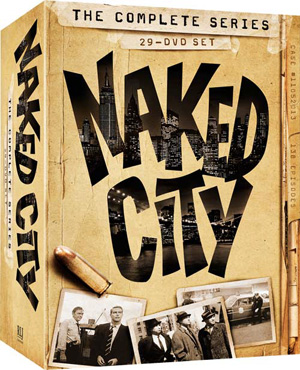
NAKED CITY is a child of early television – dramas like STUDIO ONE and PLAYHOUSE 90 – and is essentially an anthology series pretending to be a cop show. This can be a problem, because the cops are often shoehorned in, and sometimes the stories have little to do with crime. Some of the famous actors deliver terrible, scenery-chewing performances; many of the young actors – James Caan, Dustin Hoffman – are so in Brando’s thrall, you want to shake them until they agree to see a movie that isn’t ON THE WATERFRONT. The shadows of Tennessee Williams and William Inge loom large, turning some of the scriptwriters into pretentious windbags, burdening actors with impossible, archly poetic dialogue.

After a while, I began to see writers in the opening credits whose scripts I knew I’d abhor – in particular, Abram Ginnes, a blacklisted writer so over the top, his silly titles serve as a warning: “Stop the Parade, a Baby Is Crying,” “A Horse Has a Big Head, Let Him Worry,” “Robin Hood and Clarence Darrow, They Went Out with Bow and Arrow.” He’s responsible for at least a dozen episodes, and I would run screaming into the night before sitting through any of them. And almost every change-of-pace “comedy” episode is cringe-worthy.

There are several NAKED CITY “best of” collections, but unfortunately they choose episodes featuring famous cast members, with no thought to quality of writing. So why do I recommend the series?

Because when the show is good, it is really good – on that same list that includes “Shady Deal at Sunny Acres,” you’ll find “A Case Study of Two Savages,” in which hillbilly honeymooners Rip Torn and Tuesday Weld cut a bloody carefree swath of robbery and murder across Manhattan. Scripted by Frank Pierson – who wrote everything from DOG DAY AFTERNOON and COOL HAND LUKE and was working on MAD MEN when he died in 2012 – “Two Savages” clearly influenced Arthur Penn’s BONNIE AND CLYDE (the historical couple is directly referenced) and Weld’s later PRETTY POISON. Rip Torn’s performance is my favorite among all the NAKED CITY’s – funny, dangerous, charismatic. Actor’s Studio “Method” at is best.

And there are plenty of other terrific episodes – Duvall in “A Hole in the City,” Klugman in “The Tragic Success of Alfred Tiloff,” Rooney in “Ooftus Gooftus.” Writers include Howard Rodman, W.R. Burnett, and Gene Roddenberry. Directors include Arthur Hiller, Paul Wendkos, and Irvin Kershner. But you must commit to the complete series, and learn which writers and actors you want to avoid as you move through.

I should mention that the series creator, Stirling Silliphant (adapting the Jules Dassin film), writes all but a few of the first season half-an-hour episodes, which is my favorite season (not a view widely held, I admit). He only scripts a few of the hour-long episodes, as he’s off to create ROUTE 66. Silliphant is a fine screenwriter (IN THE HEAT OF THE NIGHT), though he’s somewhat purple in THE NAKED CITY (its first-season incarnation included “THE”), a sin committed to some degree by almost all of the writers involved. So you have to get in that groove.

But it’s worth it. The omniscient narration by Lawrence Dobkin (credited to producer Herbert Leonard in the first season, but sounding identical) is so very memorable, often giving the series a novelistic feel. Ed McBain was clearly influenced by the Dassin film, and must have watched this series, as well – the 87th Precinct vibe is strong. The music is memorable as well – Billy May at first, later Nelson Riddle.

How interesting is NAKED CITY, for all its flaws? In the first hour-long episode, an unbilled Peter Falk is killed before the opening credits. The episode also features Eli Wallach, George Maharis, Clifton James and Godfrey Cambridge.

* * *

The first SUPREME JUSTICE advance review is in (from Ron Fortier) and it’s a rave!

ASK NOT gets a lovely write-up here.

Still more WRONG QUARRY reviews are coming in. Here are two that are less than raves – the always interesting Alpha-60 and a new one to me, Bullet Reviews. Both complain about one of my favorite things in the novel, having to do with the build-up given to one of the hitmen Quarry goes after. Go figure.

M.A.C.

Notes From a Stuffed-Up Author

Tuesday, February 18th, 2014

I spent much of last week fighting a cold and researching/writing an introduction for a forthcoming Hermes Press collection of the pre-Disney ZORRO comic books from Dell. The centerpiece is a trio of issues drawn by Everett Raymond Kinstler, who would go on to be our nation’s premiere portrait artist, with subjects ranging from John Wayne to various Presidents. The other comic books (seven in all) are good as well, but I really had to dig in on the net and among Zorro fans to find out who the artists and writers were. Much guesswork involved. I am a big fan of Zorro as originally created by pulp writer Johnson McCulley, and my intro in part decries the paucity of McCulley Zorro stories in print.

Also, we received good reviews from agent and editor on ANTIQUES FRUITCAKE, so that one is largely put to bed (it’s an e-book novella). Barb is back to her draft of ANTIQUES SWAP, and I am headed into the Spillane western, THE LEGEND OF CALEB YORK. There will be a subtitle for the latter but I haven’t come up with it. I’ve been told to leave out the sex and hit the violence hard, even down to the title. So RAVAGING THE DANCE HALL GALS is out. I’m considering SHOOT-OUT AT SIROCCO.

I also worked on several more passes on a HELLER TV pitch. I’ve done seven so far. Hollywood is all about rewriting. I remember so vividly when I handed in draft umpteen on THE EXPERT to director Bill Lustig and he immediately said, “Thanks! Now, on the next draft I want to concentrate on – ” I interrupted to say that I wouldn’t take any more notes till he’d read the draft I just handed him.

Barb and I are listening to Dan John Miller’s audio rendering of THE WRONG QUARRY. This is Dan’s first Quarry novel, having done all of the Hellers. He has once again nailed it.

Speaking of THE WRONG QUARRY, here’s another nifty review.

COMPLEX 90 made the top five best book covers of 2013 at the Rap Sheet.

Here’s a nice review of the Hammer short story (available from Mysterious Bookshop as a mini-book), “It’s in the Book.”

Finally, here’s a very smart review of the film of ROAD TO PERDITION. Nice to see this great film really making its mark over the years.

M.A.C.

Target Japan

Tuesday, February 11th, 2014

I was surprised and delighted to see Mike Carlson, one of the UK’s best and most respected crime fiction reviewers, give TARGET LANCER a rave. Carlson was apparently sparked by the mass-market paperback edition. He seems to share my interest in, and take on, the JFK assassination. I’ve got to get ASK NOT into his hands.

I recommend the film THE MONUMENT MEN and urge you to ignore the mostly negative reviews it’s been getting. It’s a determinedly old-fashioned movie from its star cast (essentially playing themselves or at least their movie personas), a rousing and intentionally Old School score, a compelling episodic structure cutting between story threads, and a respect for history that makes it a DIRTY DOZEN for people who respect art. There’s not a lot of slam-bang action, but the extent of the evil of the Hitler regime comes across effectively in a unique fashion. No, it’s not INGLOURIOUS BASTERDS. And 12 YEARS A SLAVE isn’t DJANGO UNCHAINED, either.

This will be an extremely short update because (A) I seem to be coming down with a cold, and (B) I am prepping to start the Spillane western novel.

So I’m turning the rest of this post over to son Nate, who with his wife Abby recently went to Japan. I’ve asked him to share some photos of that trip.

M.A.C.

* * *

Hi everyone. Nate here. Let’s get right to the pictures!

Japan 2014

Our first day, we went to the Comic Market (aka Comiket) in Tokyo, which is sort of like Japan’s San Diego Comic-Con, only even more massive (around 540,000 attendees over three days to Comic-Con’s 130,000 over four days), and with a heavy focus on self-publishing groups (some 35,000 of them divided across the three days—each day has an entirely different lineup) in endless rows of small folding tables and minimal displays (only the industry publishers can swing enough space for booths here, and only in a separate hall with a separate entry line). Sadly, I did not take any pictures of the inside, as there was no room to do so.

Our AirBNB hosts shared us this video of the Comiket line management. San Diego Comic-Con organizers should take note!

Japan 2014

The first few days of the new year are the most important holiday in Japan, and one of the many New Year’s traditions is to visit a shrine or a temple. Due to the increased number of visitors, carnival-esque booths selling food and toys often spring up around the holy sites, and if you’re lucky, you might come across performances by traditional entertainers. Above is a ladder acrobatics demonstration stemming from firefighting techniques of the 19th-Century Edo period, when a portable ladder could often provide the fastest vantage point to find the source of a fire. The poles barely visible at the base of the photo are axes held by the other members of the troupe, who balance the ladder for the climber as they await their turn to show off. Would you like to know more?

Japan 2014

This is a statue in Kyoto’s Yasaka Koshin-do Temple of Binzuru-Sonja, one of Buddha’s disciples popular in Japan. He is said to help those who touch or rub his statue on the part of the body where they are suffering an affliction.

Japan 2014

“Unryuzu” by Kaiho Yusho, Kennin-ji Temple, Kyoto. 16th Century. (Reproduction)

Japan 2014

Kamo River, Kyoto.

Japan 2014

On one of our favorite days, our friend (and two of her helpers!) dressed us in these lovely traditional Japanese wedding kimono. Truly an honor!

Nate