Posts Tagged ‘Quarry’

The Column I Wrote Instead of Watching the Oscars

Tuesday, February 28th, 2017

As I take a breath from finishing up my novel Quarry’s Climax, here are a few capsule movie reviews. Prepare to be enlightened and enraged….

The usual four-star rating format:

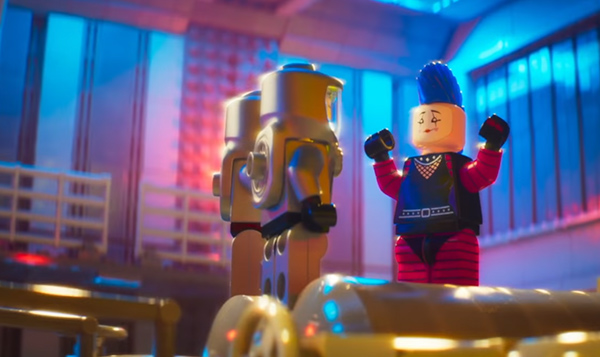
The Lego Batman Movie – ***. I wrote briefly about this earlier, and those who’ve been paying attention already know how heavily this film leans on my character the Mime. This is a terrific and often very funny film, superior to any Batman film in recent memory (including the so-dark Bale ones). Its only problems are a length that wears out its welcome for young kids and older folks particularly, and a tendency to so fill the screen with so much action as to be dizzying. The theme of family is also a bit heavy-handed, but this return to a non-dark Batman with fun villainy and self-deprecating humor is a welcome one…at least it is for this former Batman writer and fan of the comic book for a good decade before Adam West and Burt Ward came onto the Bat-channel. (For some of us, the shark repellant gags were the best in the film.)

The Great Wall – * 1/2. A lot wrong with this one. What’s right is its epic nature and the very sweep of the thing, so credit that much to director Zhang Yimou (of the overrated House of Flying Daggers). What’s wrong includes a terrible script (six screenwriters – not a good sign!), English-speaking actors given no direction by the Chinese director (Matt Damon spends the film in pursuit of an Irish accent), and a lot of pro-Communist propaganda laughable in its ham-handedness. Hilarious to see the Red Chinese preach against greed while plotting to take greenbacks out of red-white-and-blue pockets. The monsters are rather ugly in their CGI design, another rehash of the Raptors from Jurassic Park Parts Whatever. Back before mainland China took over Hong Kong, there was a vibrant Chinese film culture, including John Woo’s crime dramas, Jackie Chan’s adventure films and such wonderful fantasies as the Chinese Ghost Story films and David Chung’s I Love Maria. Now we get this empty spectacle.

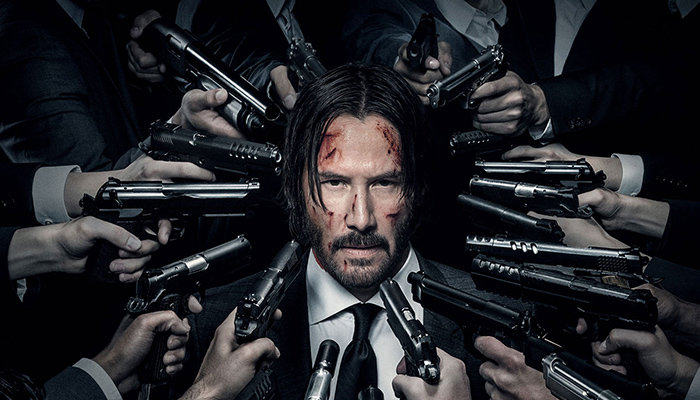
John Wick: Chapter 2 – **** The first Wick movie was the best action film of its year, and this year will find the sequel hard to top. Even if you’re already seen it, watching the first John Wick before taking this one in will be helpful – very nice resonances and returning characters. It’s over the top and people who hate guns will be in the wrong theater. Wick is a modern-day samurai who is driven by vengeance (again) in an almost science-fiction world where contract killers inhabit a secret society of their own. It’s as good as James Bond movies ought to be, and the action sequences – with the understated but very funny and yet scary Keanu Reeves doing almost all of his stunts – is depicted minus the missing frames and frantic editing that turn such sequences into utter incoherence in almost all other modern action films. You can follow what’s going on! What an innovation.

Resident Evil: The Final Chapter. *** I know I’m supposed to hate a movie like this. It does indeed have incomprehensible action scenes at times (well, more just at times). But the video-game-based film series anticipated the zombie craze and has specialized in making social comments through a genre film in a way that clearly eludes the Red Chinese. At the heart of the series and this (supposedly) final entry is charismatic Milla Jovovich, a strong female protagonist if there ever was one. In 3-D this played overly dark, and many of the secondary characters didn’t particularly register. But – unlike The Great Wall, with its evil puppy dog creatures swarming the barricades – the zombies here are a tangible, scary presence, and when they swarm, they really swarm. Also, the many threads of the five films that precede it are cleverly tied up and for once an X-Files-type “all will be revealed” promise is kept.

Manchester by the Sea – no rating. I’m not giving this a rating because I didn’t finish it. I gave it around forty minutes. I know of really smart people, many smarter than me most likely, who rave about this picture. And some of the acting, particularly the justifiably lauded Casey Affleck, is admirable. But the movie is a painfully slow soap opera. Slowing it down seems to be part of what fools people. What we have here is the story of a sad guy whose beloved brother dies, saddling him with a surrogate son in a nephew. Seems the sad guy got sad after he accidentally burned his little kids to death in a fire, which caused his wife to hate him. Scenes include driving in slow traffic to get to the hospital, and another visiting the brother’s dead body in the hospital morgue. I guess I’m not supposed to notice that the kid actors sitting around talking about Star Trek in the wake of their friend’s horrible news are a bunch of stilted amateurs. If you don’t have enough tragedy in your life, this is your film.

As for the Oscars, ever since Bob Hope stopped hosting, I only watch when a movie I had something to do with is nominated. So far that’s once.

* * *

Here’s a great review of Better Dead.

Here, in two parts (One, Two), is a nice look at the Mike Hammer movies and TV shows, with occasional mentions of yours truly.

Another great Quarry TV review, if a bit patronizing to his daddy.

Road to Perdition again gets love as one of the best comic-book movies.

Finally, here’s a nice article that understands that Mickey and Mike Hammer gave birth to James Bond.

M.A.C.

Batman Refuses to Lego of Me

Tuesday, February 21st, 2017

A week or so ago, people started telling me I’m mentioned in the end credits of The Lego Batman Movie. Well, that’s all it takes to get me to a movie!

I’d already been invited to the world premiere in Los Angeles, but somehow DC Comics neglected to send us plane tickets, so Barb and I passed.

This mention in the end credits of this fun, funny film came as a surprise, and a cool one. It comes fast right toward the very end, and you may miss it, because I’m one of a lot of Batman writers and artists thanked. A good number aren’t listed, like my pal Terry Beatty, who worked on more Batman stuff than me by a long shot (it was always a mildly bitter irony that the Collins/Beatty team’s two members each worked on BATMAN projects but never together…though we tried with several rejected projects, one of which prefigured the animated show’s approach).

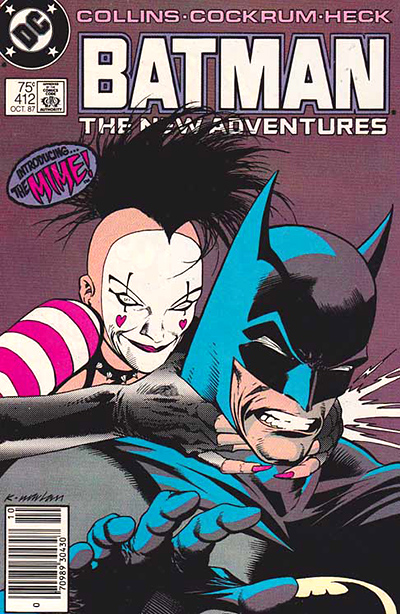
Terry was the one who figured out why I made an esteemed list that included such greats as Dick Sprang, Jerry Robinson and Neal Adams. I created two characters – one of the versions of Robin (the least popular of all time!) and the villain the Mime, who appears in the film. Check it out here.

Ironies abound. I quit the Batman comic book because the Mime premise (if not the character) was mishandled by the artist. I had written that in search of the Mime, the police had rounded up suspects – and I specifically said all of them would look identical, specifically stereotypical mimes. The artist decided to vary them, tall, short, fat, etc., ruining the gag.

I’d had it and, after a frustrating year or so, I quit…probably an instant before I’d have been fired, but I quit.

That issue’s Batman script was not the last I wrote, however, as the follow-up had the Mime meeting the Joker. It never went into production, however, and I wound up turning it into a short story for a Batman anthology, The Further Adventures of Batman (1989), “The Sound of One Hand Clapping.” The book, with my story singled out, is reviewed here.

Some oh-so-serious Batman fans hate the Mime character, although she clearly prefigures the popular Harley Quinn. These fans of the dark Dark Knight version of the character can’t abide that I brought humor to the mix, since Batman – the story of a guy who dresses up in a costume with bat ears and a cape and refuses to use a gun as he fights crime in the big city – is so obviously a deadly serious premise. Not at all something a couple of kids named Bob and Bill dreamed up for other kids back in the late ‘30s. Such “Bat fans” are seriously in need of therapy. I recommend Arkham Asylum.

And now my revenge: the Mime and I are in a Batman movie!

Briefly, and for no money at all, I grant you…but in it! And I’m ridiculously pleased.

* * *

Nice Quarry TV write-up here.

Here’s another good one, which includes all the special features, including an in-depth interview with me…no, wait, it doesn’t, because I wasn’t asked.

Here’s an interesting review of Mickey Spillane’s The Twisted Thing from top-notch writer, James Reasoner.

And for some context, my take on The Twisted Thing for the Rap Sheet back in 2008 is here.

M.A.C.

Long and Winding Road

Tuesday, February 14th, 2017

Paperback:

E-Book: Amazon Google Play Nook Kobo iTunes

Thanks to all of you who responded warmly to my update last week about the recently published “new and expanded” Road to Perdition prose novel. The sequel, Road to Purgatory, has just been reprinted by Brash Books in a uniform edition, and Road to Paradise will follow later this year or early next.

So, with your patience, I’ll talk a little about how Road to Purgatory came about, and the challenges involved.

The original graphic novel concept of Road to Perdition was developed for DC Comics editor Andy Helfer. Initially the plan was to do three 300-page graphic novels, each serialized in 100-page installments (the final book as published is in 100-page sections), for an epic 900 pages. I had been in part inspired by the great manga, Lone Wolf and Cub, and the epic nature of that work was something to aspire to.

Andy Helfer and I, however, had not come to terms with what the next two 300-page installments would be. I wanted to keep the father and son outlaws on the road for the full 900-pages, with various adventures not unlike the format of the classic TV series, The Fugitive. Andy had another idea – he thought I should do a generational saga, with Michael Jr. growing up in the middle section, and either aging him further in the final section or following another generation of O’Sullivans into a world of crime and vengeance and (maybe) redemption.

The more I mentally chewed on it, the more Andy’s notion made sense. I still liked my idea, and greedily thought about doing both – a long road saga with Michael O’Sullivan Sr. and son, and a generational saga that grew out of it.

This all became a moot point when DC’s Paradox Press line, designed to do noir graphic novels, sputtered to a premature death. Road to Perdition was the last graphic novel Paradox Press published, so any follow-ups seem unlikely.

Of course Richard and Dean Zanuck deciding to make a movie out of Road to Perdition was even more unlikely, and yet it happened.

With the movie in production, and having written the novelization (even if it was published in a truncated form…until just lately), I thought writing prose sequels, as opposed to graphic novel ones, made the most sense.

Why didn’t I write another graphic novel? Actually, I did – Road to Perdition 2: On the Road (from DC) played out my idea of showing the father and son on the road having adventures while fleeing the wrath of the Chicago mob.

But the generational saga, it seemed to me, would be better served by prose. Also, I was in the position of being primarily a prose writer of crime and mystery fiction, and suddenly the most famous thing I’d ever written was a comic book. I wanted to bring a wider audience to what I do most often: prose novels, where the readers have to provide the pictures in their heads.

Also, I knew I could get a prose sequel (Road to Purgatory) into the marketplace sooner – striking while the iron is hot – rather than go through the longer process of creating a graphic novel. My great collaborator, Richard Piers Rayner, had taken over four years to draw the 300 pages of Road to Perdition.

Another challenge was what to do about the differences between the film version of Perdition and the original graphic novel. I could only write a sequel to the latter – any changes Hollywood had made belonged to them, and anyway, I preferred my own version. The two major changes were the dramatic killing off of John Looney (Rooney in the film) and the inability of Michael Jr. to kill the man who had shot his father. In my world, John Looney didn’t die until many years later (since he was an historical figure and I like to stay true to history) and Michael Jr. indeed shot his father’s killer. His redemption came, not from his dying father doing the killing for him, but many years later.

I dance around this in the novel – I even do some dancing in my Perdition prose novel, which suggests that maybe Michael Jr. did shoot his father’s killer. In my novel Road to Purgatory I own up to that, but suggest that others have assumed the father did the killing. And I don’t mention the real circumstances of John Looney’s death.

That way someone who comes to the three prose novels will not experience jarring differences between the first and second book.

As some of you know, there is also a graphic novel called Return to Perdition, drawn by my longtime Ms. Tree partner, Terry Beatty. This indeed pays off editor Andy Helfer’s generational saga notion by following the story of Michael Jr.’s son in Vietnam and beyond. Some have suggested that I might write a prose version of that story – which I view as a kind of coda to the three prose novels – but it’s unlikely.

Why in doing the last chapter of the saga did I return to the original graphic novel form? Simple. I pitched it to the publisher of the two prose sequels and they weren’t interested. But DC Comics was. So it became a graphic novel.

It isn’t always about “what’s the ideal way to tell the story.” It’s often, who will pay me money to tell the story? That’s why I have gone out of my way to master, as best I can, not only the novel form but comics and movies and for that matter TV. More bites at the apple.

Working in the arts fulltime requires a grasp of reality. For example, I had proposals written for both Road to Purgatory and ROAD TO PARADISE, but did not submit them to a publisher until the movie had come out. In fact, I had to wait to see if the movie opened big before my agent would even contemplate approaching a publisher. When Road to Perdition had a hugely successful opening weekend, we submitted to multiple houses and had an auction with numerous offers. A week before we would have been lucky to get any offer. Reality.

One key thing I failed to mention last week about The New and Expanded Road to Perdition. It’s a simple fact about movie novelizations that seldom gets discussed: when a writer does a novelization of a film, he or she works from the screenplay and almost never has access to anything else. Sometimes some stills from the set are provided, but the writer never sees the movie before writing the novel.

I admit to being proud of myself when I re-read the complete novelization, in getting it prepared to finally be published by Brash Books. The novel really captures the film…and I hadn’t seen it! I “directed” from the screenplay something very similar to the film version that Sam Mendes directed. That alone makes the Perdition prose novel my proudest achievement in the movie tie-in field…particularly now that you can read it!

Road to Purgatory is available right now from Amazon, Barnes & Noble, BAM! and the usual suspects. Your favorite independent bookstore can also order it for you, if you would care to support them, which is a good idea.

* * *

The positive reviews on the Quarry Blu-ray keep coming in. Here’s one.

Here’s another.

And another.

And this one includes a shot at winning the DVD set. [Note from Nate: Contest is for UK residents only.]

Same opportunity here. [Note from Nate: For UK residents only. Also, might be Blu-Ray? Not sure.]

M.A.C.

Dinner With Perry and Della

Tuesday, January 31st, 2017

Barbara Hale is gone.

She was 94, so it’s not exactly a tragedy, but it still hurts. Few actresses have done more with so underwritten a part as Ms. Hale did with Della Street on Perry Mason. She brought humor and intelligence to the role, and her genuine connection with both Raymond Burr and William Hopper brought a sense of reality to a fairly ridiculous if enormously entertaining concept – the defense attorney who (almost) never loses a case.

I was lucky enough to meet Barbara Hale and spend some time with her. Here’s what happened.

Back in the late ‘80s, I got the chance to collaborate on a project with Raymond Burr. Now, coincidentally, I had for some time been collecting the old Mason shows on VHS, and reading the Erle Stanley Gardner novels as crime-fiction comfort food, even collecting Mason first editions. Barb was a fan of the TV show, too, so it was a mutual enthusiasm, which is always nice for husband and wife.

Getting the chance to meet Burr, and work with him, was a dream come true. I made three trips to Denver, where the Mason TV-movies were being shot, and spent a lot of time with Raymond (he preferred that to “Ray”). He was an interesting guy, warm and generous and puckishly funny. The high-end hotel where I was staying had a residential wing where Burr lived during production of the films. I went to his suite, knocked on the door, and he answered, wearing a railroad engineer’s cap and coveralls – he had an elaborate model railroad set-up that threaded through the various rooms of the apartment. And the trains were a rollin’!

He and I got along fine. The first trip we didn’t work – we just got to know each other, and he regaled me with tales of his long and fascinating, much-travelled life. I heard about the Ballets Russes, where his career had begun, and of such world figures as Madame Chiang Kai-shek, as well as his experiences touring with the USO in Vietnam. I told him we should just skip the idea of doing a thriller and put together his autobiography. But he was adamant that he would never write that book, after spending hours convincing me it would be important and fascinating. His bisexuality, which he fairly openly referred to in our conversations – his frankness was part of my acceptance as a friend – was something he never wished to discuss in public.

On the other two Denver trips, we worked – plotting an espionage thriller in the morning and over lunch, with me working several hours in the mid-afternoon in my hotel room to put our thoughts on paper, joining him again an hour or two before supper. Every meal I had on these trips was with Raymond.

One meal was particularly memorable. Barbara Hale was arriving to shoot the next Mason TV movie, which was about to begin production. Raymond asked me if I would like to meet her and go out with them for dinner at the best steakhouse in Denver. I would have gone to the worst diner in Paducah for a chance to do that. I called Barb and said, “Guess who I’m going out to dinner with tonight? Perry and Della!” She said she hated me, but sounded sweet saying so.

Barbara Hale would have been 66 at the time – two years younger than I am now – but I remember being almost startled by how lovely and young she seemed to me, and, frankly, sexy. She came across older on television in the Mason movies. There was a genuine chemistry between us, and the fact that I could make Della Street smile so easily was just about as good as it gets.

We definitely hit it off, and she was impressed that I knew about her career right down to her appearing in small roles in various RKO movies of the ‘40s, like The Great Gildersleeve entries. In the limo on the way to the steakhouse, sitting between her and Raymond like their overgrown child, I told Barbara how much I loved her in Jolson Sings Again. Raymond, with his ever-present twinkle, said, “Oh, I agree. She was wonderful getting down on her knees in blackface.” She giggled and batted his arm and he giggled back. These two loved each other. Was I really here?

At the steakhouse – where actor Tom Bosley (filming the Father Dowling mysteries in Denver) stopped by to pay his respects – we had a long dinner during which I questioned Raymond and Barbara incessantly about the original Mason show. I had brought along the hardcover first edition of a Mason novel that had Barbara and Raymond pictured together on the back cover – I got this signed by both of them. They had a great time reminiscing about the original show and I only wish I’d secretly recorded all of it.

The TV movie they were shooting, The Case of the Musical Murder, had Debbie Reynolds as a guest star, but she wasn’t around while I was. I did get to go on set several times and watch scenes being shot, and also had several nice conversations with William R. Moses, who had just begun playing Mason’s young assistant on the show. For the first nine movies, Barbara Hale’s son, William Katt, had played Paul Drake, Jr., and Moses was essentially replacing him. I didn’t know why and was tactful enough not to ask.

But I did, at our steakhouse dinner, tell Barbara in front of Raymond what a great job I thought her son had done in that role. She beamed at that. The next day, when Raymond and I picked her up at her suite for lunch, she took me aside and gave me a hug, and whispered, “Thank you for what you said about my son.” Katt, it turned out, had left the Mason movies for a (short-lived) series of his own, and apparently Raymond was not happy about it.

Still, the affection between the two performers was obvious. Raymond told me over lunch one day that he planned to end the series of movies with one in which Mason and Della finally got married. The films began to include genuine expressions of love between the characters, even a kiss or two (the original series had been much more coy about what was an obvious long ongoing relationship between boss and secretary).

Unfortunately the project with Raymond (and I do apologize for speaking of him so familiarly) did not go anywhere. The New York editor who had put us together wanted a mystery, and even suggested a courtroom-oriented one, with the world-hopping thriller we proposed not doing the trick. The editor clearly wanted something like Perry Mason or Ironside. Raymond Burr, with all his international interests and travels, wanted something wider-ranging and in the espionage field. I later learned that two other writers were put together with Raymond Burr and in each case the actor’s strong personality guided them to espionage, and each time the New York editor bridled.

Of course Perry and Della never got married. Raymond Burr’s death in 1993 pre-empted that.

While I regret I never shared the Burr byline on a book or even series of books, I still relish the memory of the collaboration.

After all, it’s not everybody who gets to spend an evening with Perry and Della.

* * *

Arrow is giving some info about Wild Dog’s origin. Still haven’t watched an episode.

Here’s a fun look at Mike Hammer in the movies and on TV (though the writer, who quotes me occasionally, does not seem to have read Mickey Spillane on Screen by Jim Traylor and me).

Here’s an article about the Quarry books and a discussion about what order to read them in, with several options.

Finally, here’s an essay that thinks Cinemax ought to give Quarry a second season. My bank account agrees!

M.A.C.