Posts Tagged ‘Mike Hammer’

The Name’s Sam Plus Hammer Suits Up

Tuesday, August 11th, 2015

I mentioned this in a reply to a comment last week, but for those of you who missed it: our grandson has a name – Samuel Allan Collins. Sam. Some of you may recall that Sam is Nate Heller’s son’s name, and of course there’s Samuel Dashiell Hammett and a man called Spade. So I like the resonance, although I didn’t come up with the moniker.

He’s a little guy – he was early – and he’s dealing with a few problems, but he’s a scrapper, and his parents are with him all the way.

* * *
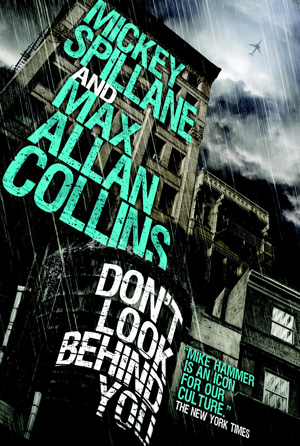
Don't Look Behind You

I am prepping for the next Mike Hammer, which I intend to start very soon (by the time you read this, it’ll be under way). You might be curious as to my process.

Of course it varies every time, because I am generally dealing with manuscripts from Mickey in various states and shape. This time I have about thirty pages of his to start with, but I also have plot and character notes, and the roughed-out ending.

One problem I deal with every time is dating the manuscript. My policy has been to maintain continuity with the existing Hammer books as they were written and published. The idea is to capture Mickey and Mike in the right creative context, as opposed to me just writing my idea of a general Mike Hammer book. Sometimes it’s a snap, as with LADY, GO DIE!, which was clearly designed to be the second novel.

This time I had to search out clues in the manuscript. It feels like an early work, a ‘50s piece, but evidence in the narrative finally led me to realize it was written around 1967. The evidence, specifically, is that Hammer mentions three major New York newspapers that have recently died. Researching them, I found all three folded in 1966.

Next step is to read some Mickey and get in the mood and the swing. What I like to do is read material that was written around the same time as the manuscript I’m completing. In this case (as someone once said), “It was easy.” Mickey published THE BODY LOVERS in 1967. So I am currently reading that novel, which I have grown to like and respect more and more as I’ve read and re-read it over the years. I mark the copy up with a highlighter, as if it were a text book for school.

In addition, Barb and I listened to the fine Stacy Keach abridgment of KISS ME, DEADLY on a recent day trip to Galena, Illinois. That book obviously wasn’t written in the ‘60s, but it always help to get some genuine Spillane vitamins into my system. An upcoming trip to St. Louis, to visit the grandson and his parents, will have me going all the way to the start, listening to the new Mike Dennis-read unabridged I, THE JURY.

These thirty pages will be expanded into around sixty, at least. The plot outline (there are several, somewhat contradictory) will need some serious thought. But I am itching to start and will probably deal with Mickey’s existing material before I plot the rest of the novel (from his notes).

The book will be called DON’T LOOK BEHIND YOU (a Mickey shout out to his favorite mystery writer, Fredric Brown) and the cover already exists, shared with you here.

* * *

Rich Whitney Turner has written a lovely tribute to, uh, well…me. Do please check this out.

M.A.C.

Mike Hammer Shoots .500

Tuesday, July 14th, 2015
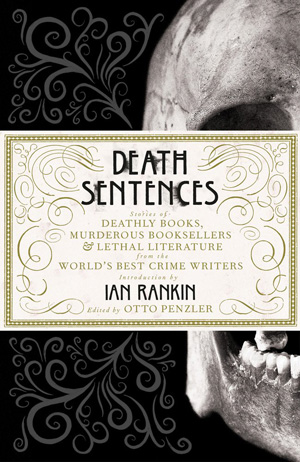
Death Sentences

Actually, Mike Hammer probably has shot five-hundred in his career, but I refer not to bad guys but the fact that at the International Association of Media and Tie-in Writers “Scribe” Awards, KING OF THE WEEDS did not win Best Novel, while the Hammer short story, “It’s in the Book,” did win Best Short Story.

No complaints. The Scribes have been great to the Spillane/Collins collaboration – we’ve won once for Best Novel (KISS HER GOODBYE, twice for Best Short Story (“Book” and “So Long Chief”) and once for Best Audio (“Encore for Murder”).

I am particularly pleased to see “It’s in the Book” honored, because it’s my favorite of the Hammer short stories (and it was overlooked by the Edgars and Shamuses, which had both singled out “So Long, Chief”). Right now I have one more Hammer fragment that would work as a short story, and I may save it for an eventual collection.

“It’s in the Book” is available as a small book and has been collected in a book club collection (see Mike Doran’s comment last time) and in the UK in a collection called DEATH SENTENCES.

Here are all the Scribe nominees with winners in bold face:
BEST ORIGINAL NOVEL – GENERAL
24: Deadline by James Swallow
Murder She Wrote: Death of a Blue Blood by Don Bain
Mike Hammer: King of the Weeds by Mickey Spillane and Max Allan Collins
Homeland: Saul’s Game by Andrew Kaplan
The Killing: Uncommon Denominator by Karen Dionne

BEST ORIGINAL NOVEL – SPECULATIVE
Sleepy Hollow: Children of the Revolution by Keith R. A.
DeCandido
Grimm: Chopping Block by John Passarella
Star Trek: Disavowed by David Mack
Star Trek: Foul Deeds Will Rise by Greg Cox
Grimm: The Killing Time by Tim Waggoner
Pathfinder: The Redemption Engine by James Sutter
Fringe: Sins of the Father by Christa Faust

ADAPTED NOVEL – GENERAL AND SPECULATIVE
Dawn of the Planet of the Apes by Alex Irvine
Noah by Mark Morris
War of the Worlds: Goliath by Adam Whitlach

YOUNG ADULT – ALL GENRES, ORIGINAL AND ADAPTED
Spirit Animals: Blood Ties by Garth Nix and Sean Williams
Battletech: The Nellus Academy Incident by Jennifer Brozak
Penguins of Madagascar by Tracey West

SHORT STORIES
Pathfinder: Hunter’s Folly by Josh Vogt
Mike Hammer: It’s in the Book by Max Collins and Mickey Spillane
Stargate: Perceptions by Diana Botsford
Pathfinder: Queen Sacrifice by Steven Savile
Tales of Valdemar: Written in the Wind by Jennifer Brozek

AUDIO
Dark Shadows: The Darkest Shadow by Nev Fountain
Dark Shadows: The Devil Cat by Mark Thomas Passmore
Blake’s 7: Fortuitis by George Mann
Doctor Who: Iterations of I by John Dorney
Pathfinder Legends: The Skinsaw Murders by Cavan Scott
GRANDMASTER (“the Faust Award”): TERRANCE DICKS

* * *

I note with sadness the passing of writer Tom Piccirilli, a very gifted man who reviewed many of my novels, and always favorably. When a writer as fine as Tom likes your work, you figure you’re doing something right.

Many tributes have appeared, but I’ll provide just this link to my friend Jeff Pierce’s write-up at the Rap Sheet.

* * *

Here’s a lovely review of THE LEGEND OF CALEB YORK from James Reasoner, who – like my pal Bill Crider – is a real western writer. When I pass muster with guys like James and Bill, I breathe a sigh of relief.

M.A.C.

San Diego Comic-Con & Hammer Interview

Tuesday, July 7th, 2015
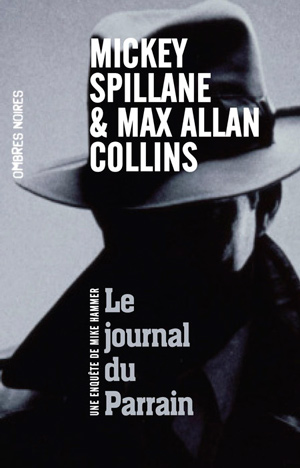
It's in the Book French Edition

As it happens, Barb and I won’t be able to go the Comic-Con this year. So the listings that have me hosting the Scribe awards, doing a signing, and having a Quarry panel are now all inaccurate. Likely I’ll be there next year, but this time, no. My pal Jonathan Maberry will be hosting the Scribes for me.

I have two nominations: Best Novel, KING OF THE WEEDS; and Best Short Story, “It’s in the Book.” Both are Spillane/Collins collaborations.

Coincidentally, a French publisher (Ombres Noires) is translating “It’s in the Book” for their own edition (it’s available in English only in a small book, as well, published by Otto Penzler). They asked me to do an interview, which they will include in the small book, in French of course.

I thought you might like to see it in English.

Interview with Max Allan Collins
It’s in the Book

You wrote the end of a story by Mickey Spillane, who passed away in 2006. You were friends, how did you two meet?

As a young teenager, I idolized Mickey and wrote him dozens of fan letters. He never responded until I published my first novel, BAIT MONEY, in 1973, and sent him a copy, He wrote me a warm, lengthy letter of welcome to the community of professional writers.

Over the years I have been a defender of Spillane, who remains controversial in the United States. Because of that, I was asked in 1981 to be the liaison between Mickey and the Bouchercon mystery convention in Milwaukee, where he was a guest of honor. We immediately hit it off and I began to visit him at his home in South Carolina once or twice a year.

How did you come to complete his manuscripts?

On my various visits to Mickey’s home, he would send partially completed manuscripts home with me. He said this was just because he thought I’d be interested, but on one occasion he said, “Maybe we can do something with these someday.” He was referring to two partial Hammer novels, THE BIG BANG and COMPLEX 90. We had begun to collaborate on projects – a number of noir anthologies of his work and the work of others, a science-fiction comic book called MIKE DANGER, and a biographical documentary I wrote and directed, “Mike Hammer’s Mickey Spillane.”

When Mickey became ill, with a particularly virulent strain of cancer, we stayed in close touch by phone. He was working desperately to finish what he described as the last Mike Hammer, THE GOLIATH BONE. Shortly before his death, he called and said he didn’t think he’d be able to finish it. And he asked me to do it for him, if that proved necessary. I of course said yes.

Around the same time, Mickey told his wife Jane to gather all his unfinished material and give it to me – “Max will know what to do.” No greater honor could be paid me. There were six major Hammer manuscripts, often with notes, and another half dozen shorter Hammer novels in progress. There were also short openings for novels, running from six to ten pages, that I thought would make good short stories. “It’s in the Book” is one of those.

You wrote several stories from his manuscripts. What did you like in this one in particular?

It had a beautifully written opening, with two cops coming to see Hammer in his office, to take him to see a U.S. Senator for some mysterious, important job. Mickey’s manuscript ended before that job was fully described by the client, and that enabled me to use the missing ledger that made the story a bibliographic mystery. You see, editor Otto Penzler had requested that specific kind of story.

What sort of shape did the manuscript have – was it just a few lines, a structure, several chapters?

It was basically that opening, right up to where Hammer meets with the senator. I thought it was a lovely, traditional opening for a private eye story.

It must be a very special experience, and a challenge, to finish a story more than 20 years later. Did you try in any way to modernize the style, the story, or anything – or did you try to remain faithful to Spillane’s style?

I’ve done seven Hammer novels now, and the unfinished Spillane manuscripts spanned his entire career – from 1947 to the month he died. I always try to determine when Mickey was writing the story, and then I immerse myself in material that he wrote around that same time, so I can catch the flavor and capture Hammer at that specific time. Hammer is a much changing character, and a story conceived by Mickey in the ‘50s is vastly different from one written in, says, the 1980s. I don’t try too overtly to mimic Mickey’s style — it’s collaboration, not pastiche. I concentrate on getting Mike Hammer right. It’s a matter of character.

I am a very traditional, Old School mystery writer, so this comes naturally to me.

Did he influence you in your writing, or help you in your own work?

Mickey was a huge influence on me. The key writers for me were Hammett, Chandler, Cain, Thompson and Westlake. These are very different writers in their approaches, and I think having such variant influences has worked well for me. Mickey never really gave me any writing advice – I was already a pro when our friendship developed. But he was supportive and provided blurbs for many of my book covers.

What is it that makes the character of Mike Hammer so special, compared to other popular characters?

Hammer had an enormous impact on popular culture worldwide, well beyond the private eye genre. James Bond is a version of Hammer, for example. Prior to Hammer, detectives did not display the emotions – love, hate, fear – that Spillane gave his hero. Hammer was the first avenger of modern fiction, a hero who used the methods of the villain to triumph over that villain. In addition, Hammer as a combat veteran brought a traumatic backstory to the detective, much imitated since. Finally, Hammer slept with women, unashamedly. While Sam Spade had sex with his femme fatale, just about no detective since had done so. Chandler said disparaging things about Mickey, but after the success of the Mike Hammer books, Marlowe began having an active sex life.

Say what you will about Mickey, but he was the most influential mystery writer of the 20th century…and the bestselling, with the possible exception of Christie.

How did you come up with the idea of this ending?

That idea jumped to mind at the outset. I knew it was a good one. Mickey loved surprise endings, and this was right up his alley.

Are you yourself interested in rare books and first editions?

I am. I have a good collection with many signed books – all the writers I mentioned above, and more. I have a very strong Rex Stout collection, for instance.

What do you enjoy most about writing short novels?

I’m not a short story writer by inclination. I’m very much a novelist. But I’ve grown to like the form. It’s nice to have a project that lasts a week and not several months. My wife, Barbara Collins, is an excellent short story writer.

Who are the authors that inspire you today? Why?

I read very little contemporary fiction. I don’t care to be influenced by trends, and anyway my reading time is taken up largely by research for my historical thrillers. I continue to read and re-read the greats – again, Hammett, Chandler, Cain, Spillane and so on.

Do you read French thrillers?

I’m very traditional on that front, as well – Boileau-Narcejac. Jean Pierre Melville is one of my favorite film directors.

* * *

Speaking of Spillane/Collins collaborations, here’s a look at THE CONSUMMATA at Detectives Without Borders.

The same site followed up quickly with a piece speculating about the Spillane/Collins collaboration process. You’ll see a lengthy comment from me explaining that process in some depth.

Here is a lovely, gracious review of SPREE by one of our great noir writers, Ed Gorman.

M.A.C.

I Did Something Right

Tuesday, June 2nd, 2015

Barbara Jane Mull and I were married on June 1, 1968. That means that the day before this update appears we will be celebrating our 47th anniversary.

I don’t want this to be a sickening exercise, because Barb would be the first to make a face (albeit a pretty one). But I did something right. I first fell for her in the fifth grade, decided that was a little early, and tried again in high school, failing miserably. Finally in 1966, at Muscatine Community College, I took advantage of the paucity of competition and landed a date. She says she fell in love with me when, in the midst of pontificating about something or other, I stuck my hand in my water glass (we were at a restaurant at the time).

It’s been my pleasure to go through life with this smart, funny, beautiful woman, and I hope to go through a bunch more of it. Another 47 years would do fine. What has been amazing to witness…well, the whole list of things she’s said and done that amaze me would take too long, but…has been her growth a writer.

To those of you who have longed to be a professional writer, who have dreamed and schemed and attempted deals with the devil to get that done, I will drive you insane by saying (truthfully) that Barb never wanted to be a writer, and often doesn’t particularly want to be one now. She’s a writer because she’s been married to me and she just…I swear…picked it up. If I’d been a brain surgeon, she’d be wielding a scalpel. If I was Van Cliburn, she’d be on stage at Carnegie Hall.

I’ve been a lucky man, in general, but marrying this pretty girl who became a beautiful woman was the jackpot. You may feel free to envy me about this part of my life. I wouldn’t blame you one little bit.

Did I mention she gave me a great son?

She did that, too.

The photo here, by the way, is circa 1971 (taken by the late Bill Mull, Barb’s father), right around when I was creating Quarry. That took longer to pay off than my marriage has.

Barbara and Max Allan Collins

* * *

Here’s a review from a Heller fan who doesn’t care for FLYING BLIND. Happens to be one of my favorite novels in the saga, but I get that when I wander too far afield from crime and politics, some readers get uneasy. They, for some reason, suspect that one guy might just not be able to have been involved in so many historical events….

Here’s a nice review of another of the Hellers, CHICAGO CONFIDENTIAL, coincidentally one of the books in the series that was received less than glowingly by some fans (this one likes it). Not long ago, I listened to Dan John Miller’s audio of the book and thought it was pretty good. But what do I know? Still, it was the last Heller for ten years.

Here’s a fun review of THE LAST QUARRY by a reader revisiting the novel.

Here’s a review by the same reader of Mickey’s THE GIRL HUNTERS. I find this particularly fun because he was inspired to read the book having enjoyed COMPLEX 90, the posthumous Spillane/Collins sequel.

Finally, check out this shortish but very sweet KILL ME, DARLING review in the San Francisco Book Review.

M.A.C.